
Specs are compiled from manufacturer listings and verified buyer reviews and can change over time — please confirm the key details on the product page before buying.
If your basement floor stays cold, damp, or ugly no matter how many times you mop it, the real problem is usually that the surface holds water instead of letting it go. The fix is a tile that either drains water underneath or seals it out on top, and this guide covers both. You will see drainage mats for wet stairwells and laundry corners, peel-and-stick vinyl for turning bare concrete into something that looks like a real floor, foam tiles for standing comfort, and rubber tiles built to take a car or a weight rack.
I’m Mohammad Maruf — the founder and writer behind KitchPrep. This guide is built by comparing the manufacturers’ published specifications and the patterns across verified customer reviews, so you get each pick’s real strengths and trade-offs instead of marketing spin.
Each pick below is grouped by what it does best, so you can match a tile to your damp stairwell, playroom, or workshop. Weigh drainage against looks against comfort before you commit to basement floor tiles.
Our Picks at a Glance


How To Choose The Best Basement Floor Tiles
Basements throw two problems at any floor at once: moisture that creeps up through concrete, and temperatures that stay lower than the rest of the house. A tile that ignores either one will peel, crack, or start to smell. The fix is simple once you know what you are shopping for: pick a tile whose material and structure match your moisture level.
Match the tile to your moisture level
If water pools or your stairwell floods, you want a drainage tile with holes in the surface, so liquid falls through and air moves underneath instead of sitting on top. If your floor is dry but cold and bare, a sealed peel-and-stick vinyl or foam tile is the better call. Rubber tiles handle damp concrete well because they are non-porous, meaning liquid stays on the surface where you can wipe it up.
Match the tile to how you use the room
A playroom or standing workbench wants cushioning, so choose foam. A home gym, a workshop, or a spot where you park a car wants density and load capacity, so choose rubber or a thick plastic tile that resists denting. A finished basement bedroom or bar area wants wood-look vinyl planks.
Get the coverage maths right before you order
Every box tells you how many square feet it covers, and running short mid-install is the single most common mistake. Measure your floor, then compare that figure to the box coverage. Order the same batch where possible, because peel-and-stick tiles from different batches can shade differently on the wall.
Quick Comparison
| Model | Best For | Coverage / Pack | Thickness | Tile Size | Amazon |
|---|---|---|---|---|---|
| EVANCENT 12” x 12” Drainage Interlocking Floor Mats (12 Pack)★ Best Overall | Wet stairwells and damp corners | 12 tiles | 12 mm | 12″ x 12″ | Amazon |
| FloorPops Black Rigel Peel & Stick Floor Tiles (FP3990)Top Performer | Bold laundry or bar area | 10 tiles | 0.06 inches | 12″ x 12″ | Amazon |
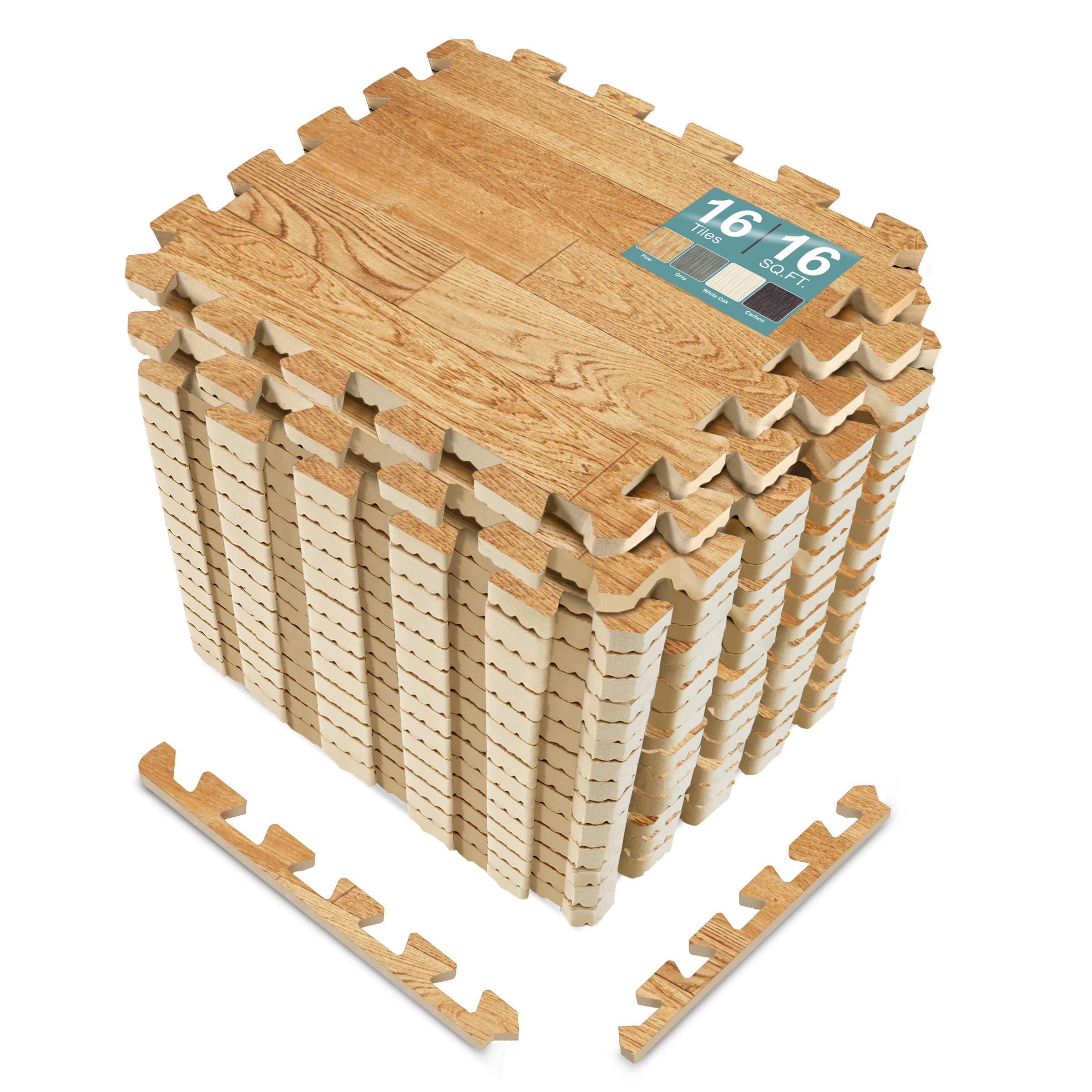
| Sorbus Wood Grain Foam Floor Tiles (16 Tiles, Pine)Best for Playrooms | Playroom and standing comfort | 16 tiles / 16 sq ft | 0.35 inches | 12″ x 12″ | Amazon |
| WESTICK Waterproof Peel and Stick Floor Tile (20 PCS) | Renter-friendly bathroom refresh | 20 tiles / 20 sq ft | 0.04 inches | 12″ x 12″ | Amazon |
| VEVOR Garage Floor Tiles (25 Pack, Graphite Gray) | Parking and workshop floors | 25 tiles | 0.53 inches | 12″ x 12″ | Amazon |
| INMOZATA 36 Pack Peel and Stick Floor Tile (Smoked Brown) | Large open finished space | 36 planks / 54 sq ft | 0.08 inches | 6″ x 36″ | Amazon |
| MULGREAT Peel and Stick Floor Tile (36 Planks) | Fast kitchen-style makeover | 36 planks / 54 sq ft | 1.5 mm | 6″ x 36″ | Amazon |
| Mohawk Home 24″ x 24″ Indoor/Outdoor Peel and Stick Carpet Tile (15 Tiles) | Warm finished basement rooms | 15 tiles / 60 sq ft | 0.25″ pile height | 24″ x 24″ | Amazon |
| VersaTex Garage Floor 18 x 18 inch Interlocking Tiles (24 Pack, Black) | Gym and utility rooms | 24 tiles / 54 sq ft | 4 mm | 18″ x 18″ | Amazon |
In‑Depth Reviews
1. EVANCENT 12” x 12” Drainage Interlocking Floor Mats, 12 Pack
Our pick — over 4.5★ from 250+ verified ratings; the strongest balance of quality and price.
The mat that lets your wet basement floor drain itself instead of holding a puddle.
This is the pick for a basement corner that gets genuinely wet — a stairwell that catches leaves, a laundry area that floods, a walk-out door that tracks in rain. Each tile has holes cut through the surface, so liquid drops through and air moves underneath rather than pooling where you stand. The tiles are 12″ x 12″ with a 0.47″ thickness, and they snap together with two male edges and two female edges, which just means you push them together like puzzle pieces, no glue and no tools. You can also trim them with a utility knife if a wall or a post gets in the way.
What wins people over here is how long the set lasts — durability is the quality that comes up most in owner feedback, followed closely by how easy the pieces click together. Real-world uses stretch well beyond the basement: a 12-piece set nearly covers a 3 ft x 4 ft stairwell floor at roughly 3/4-inch to 1-inch thick in neutral grey, and the underside teeth let water flow underneath, which is why one owner used the set to keep pine needles and leaves from clogging a basement stairwell drain. The material is commercial-grade 100% recycled PVC, and the non-slip surface is what keeps the finish safe underfoot when the floor is slick.
The honest part: the set carries a strong odour straight out of the packaging. Several owners describe an initial smell that fades after the tiles air out, and the practical move is to unbox and lay them outside or in a garage first if you are sensitive. The cushioning is also on the softer side, so a heavy appliance sitting on top can settle unevenly. That is a real limitation, not a deal-breaker — for floor cover in a damp utility space, it is the most useful tile on this list.
Where this mat pulls ahead
- Open drainage holes let water pass through and dry the floor from underneath, so puddles never sit.
- Snaps together with no glue, no special tools, and trims with a utility knife for edges.
- Made from commercial-grade 100% recycled PVC, which holds up to repeated wetting and cleaning.
- Non-slip surface adds grip where the floor is slippery.
What to expect on delivery
- Noticeable plastic smell out of the bag that fades once the tiles air out.
- Soft cushioning can let a heavy appliance settle if it sits directly on one spot.
- You will likely need more than one pack for a full room, since this box is 12 tiles.
Buy it for: the wet stairwell, the leaky laundry corner, the walk-out door that never quite dries.
Think twice if: the smell of new PVC bothers you, since a tight-packaged set needs a day outside before it settles in.
2. FloorPops Black Rigel Peel & Stick Floor Tiles, FP3990
Ten tiles that turn a gloomy concrete slab into something that looks like real flooring.
For a basement bar, laundry room, or utility corner that needs to look finished rather than raw, this is the design-led choice. Each tile measures 12 x 12 inches and sits just 0.06 inches deep, so it lays flat underfoot, and you stick it straight down — no grout, no underlay, no special tools. The black and white pattern is printed on virgin vinyl with a textured, low-lustre finish, which is what keeps it from looking like a flat sheet of plastic. One package holds 10 tiles.
Looks are what carry this one: appearance and build quality are the two things owners praise most about it, and the finish is convincing enough that people mistake it for genuine tile. The durability story is genuinely reassuring — six months after installation there was no fading, chipping, scratching, or adhesion trouble, and the floor held up fine with kids and wet, messy spills on top of it. A 12 x 12 inch square is also easy to trim around a toilet base or a door jamb as long as you measure before you cut.
Here is the catch, and it is worth reading twice: the tile is brittle once you start cutting it, so a careless pass with a knife can snap or tear the material outside the line you scored. The fix is simple — measure carefully, cut fully through in one clean pass, and order an extra pack so a mis-cut never stalls the job. Adhesion and seam alignment also vary a little from box to box, so take a minute to line up the pattern before you press each tile down.
Pattern payoff: the black-and-white look is the whole reason people choose this tile, and it delivers a real style upgrade over bare concrete at a budget-friendly tier.
Reach for this if: you want the biggest visual change for the least work and your basement floor is dry.
Look elsewhere if: your slab stays wet — a sealed peel-and-stick tile is not built to shed standing water the way a drainage mat is.
3. Sorbus Wood Grain Foam Floor Tiles, 16 Tiles, Pine
Soft underfoot, warm on bare feet, and convincing enough that guests assume it is wood.
Cold concrete is the reason a lot of basements go unused, and this set fixes that directly. Each tile is 12″ x 12″ and 0.35 inches thick, and the foam provides cushion that takes the sting out of standing on a hard slab for hours. The 16 tiles cover 16 square feet in Pine, a faux wood print that reads as real timber in photos. Pieces lock with a jigsaw-style connection, so you can add more sets as the room grows. No adhesive is needed at all.
The quality and the appearance are what owners highlight most, and the cushioning is the part you feel every day. One homeowner laid the set in a basement and described it as exactly what she wanted — cushiony and good-looking in the space. Standing fatigue drops noticeably too: a kitchen-floor user said the foam reduced the ache from long stretches cooking, doing dishes, and canning, and it wiped clean without staining from blackberries or elderberries. If you need to fit around a post or a wall, it cuts easily with a utility knife.
Two things to size up honestly. The picture on the listing can read like a tall stack of blocks, and more than one buyer expected far larger squares than the 1-square-foot tiles that arrive — measure your room first so the box count is right. Durability is the mixed note in owner feedback, and a few tiles have shown up worn or scuffed from the start, so inspect the set before laying it. For a dry playroom, home office, or workout corner, that is an easy trade for the comfort.
Comfort call: the foam gives you the cushioning a bare slab never will, without the cost or mess of carpet.
Suits: playrooms, basement gym corners, and any dry space where you want the room warm and forgiving underfoot.
Not for: a flooding or permanently damp corner, because foam absorbs where a drainage mat or rubber tile would shed.
4. WESTICK Waterproof Peel and Stick Floor Tile, 20 PCS
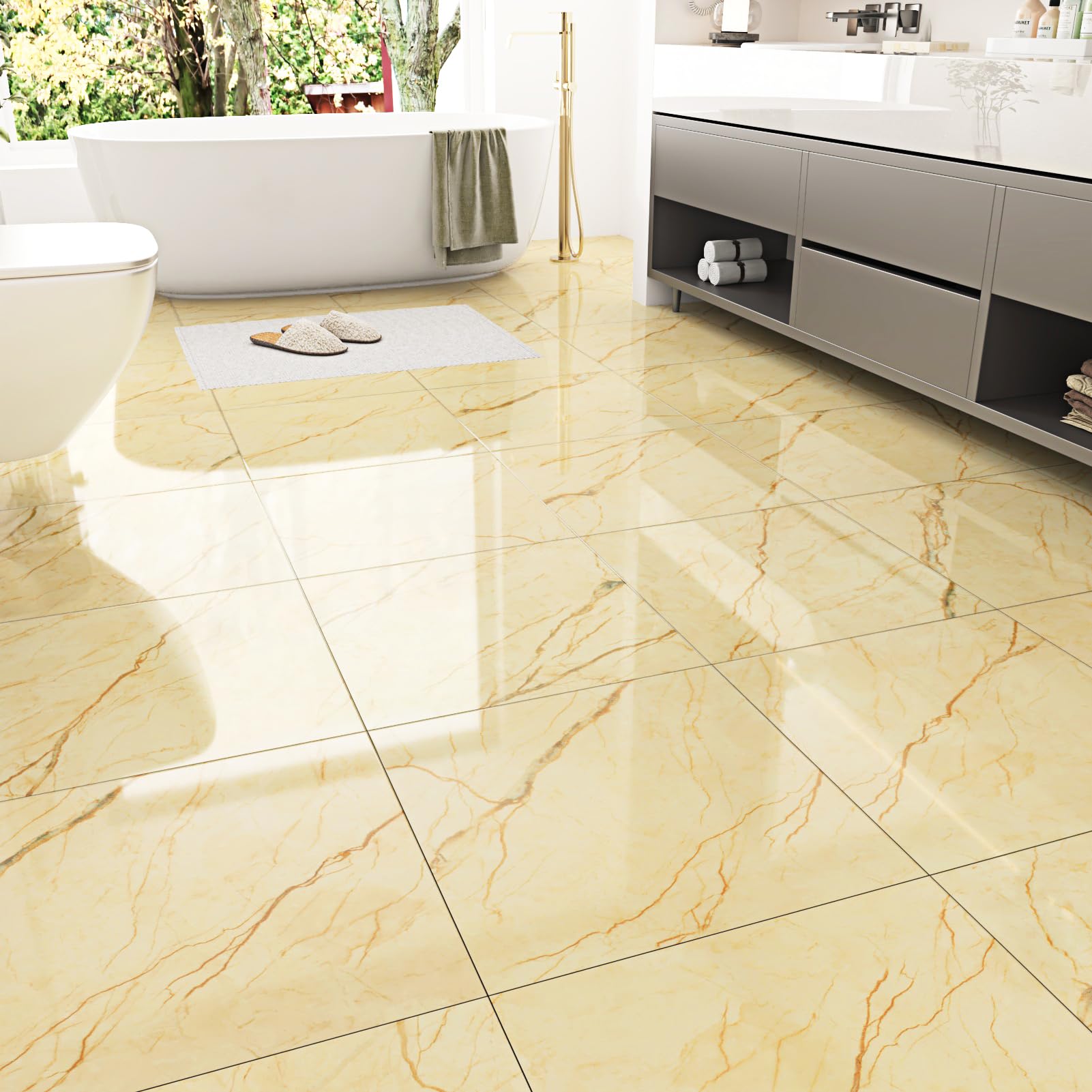
A marble-look tile that trims with scissors — just budget for extra glue.
The dark yellow marble pattern on this set is the draw, and 20 tiles at 12″ x 12″ x 1mm cover 20 square feet, which is enough to make a small room read as stone rather than vinyl. The 1mm vinyl is thin, and thin is why it cuts so easily — scissors or a razor handle curves around a toilet or a pedestal sink. It is self-adhesive with no grout required, and it is aimed squarely at renters and landlords who want a reversible change to a plain floor. The listing also notes a 30-day refund window if you are not satisfied.
The appearance earns the most positive feedback, and the flexibility is what makes it pleasant to work with. In a dark brown marble bathroom, one owner called the change transformational and got a clean brick-lay look by dry-fitting first, then leaving dime-sized gaps to hide small alignment flaws. Easy cutting is the second thing owners talk about most — a utility knife and a straightedge will handle nearly every edge you need.
Now the honest part, and it is significant: adhesion is the weakest spot here, and it shows up in low-traffic rooms too. Owners describe tiles lifting on a bathroom floor after cleaning and rolling, and several had to reach for extra tile glue or a spray adhesive to get the pieces to hold. It also is not built for vertical surfaces — one buyer tried wrapping a custom pedicure chair and found the backing too unreliable even with a primer and extra adhesive. Buy it for a dry, low-traffic floor where you can add your own glue on the edges, and it does the job.
Reasons this earns a spot
- Marble texture looks like stone and is the most-praised thing about the set.
- Cuts easily with scissors or a razor, so awkward shapes are manageable.
- Peel-and-stick installation needs no grout and removes without wrecking the slab.
- Tiles are stated to resist water and oil and to handle high temperatures.
Where it needs help
- The adhesive is the recurring weak point — extra tile glue is a smart add-on.
- Too thin to trust on walls or vertical furniture wraps.
- Skip it for high-traffic or damp floors, where a thicker vinyl or rubber tile holds better.
Good fit: a renter refreshing a dry bathroom or laundry floor on a light budget, with a tube of adhesive in the kit.
Not the one for: a busy basement that sees daily traffic or constant moisture, where a stronger backing matters more than a marble finish.
5. VEVOR Garage Floor Tiles, 12 x 12 x 0.53 inch, 25 Pack, Graphite Gray

Half an inch of rigid plastic rated to hold 5500 lbs without buckling.
When the basement doubles as a workshop or somewhere a car parks, thin peel-and-stick vinyl will not survive. This tile is 0.53 inches thick (13.4 mm) and rated to support up to 5500 lbs without damage, which is the difference between a floor you walk on and a floor you roll a truck onto. Six interlocking loops per edge replace the usual four, so the seams sit flatter with fewer protrusions, and the whole grid lays out in minutes with no glue, no tools, and no second pair of hands. The surface has a 3D diamond texture over a rhombic grid base, and mopping or vacuuming keeps it clean.
The load rating is the headline, and it is not marketing: the tile holds a 5500 lb SUV without damage, and the six-loop connection keeps the seams strong under that weight. A rigid core also means the tile will not compress under a jack stand the way a soft mat would.
The trade-off worth knowing before you order: this tile is hard plastic, not rubber, and hard plastic behaves differently in temperature swings. Buyers report tiles expanding and lifting in warm sunlight when they are weighted down, and shrinking, bowing, and cracking when the cold hits. It is also not the best choice for walking around in socks, and cutting it cleanly needs a saw rather than a knife — a handsaw or circular saw does the job, and a jigsaw or band saw makes the neatest edges. Leave expansion gaps at the walls and it behaves best in a temperature-stable space rather than an unheated one.
Load verdict: if you need a floor that can take a car, a truck, or a lifted SUV without denting, 5500 lbs of capacity is the number that matters, and this tile delivers it.
Choose this for: a workshop or garage-style basement where weight, wear, and clean-up matter more than softness.
skip it if: your basement swings from hot to freezing, since hard plastic reacts to those extremes.
6. INMOZATA 36 Pack Peel and Stick Floor Tile, Smoked Brown

Thirty-six planks of wood-look vinyl that can cover a whole basement room in one box.
This is the pick for somebody finishing a genuinely large space — a converted basement bedroom, a bar area, a rec room — without hunting down multiple packs. Each plank is 6″ x 36″ and 0.08 inches thick, and the box of 36 covers 54 square feet in Smoked Brown with a wood grain texture. The surface is rigid with a hard core, and it is stated as 100% waterproof, fireproof, and scratch-resistant, which is the combination that lets it ride out a below-grade room. It sticks straight down onto a clean, flat, dry slab — no underlay. The listing notes extra glue for walls, ceilings, or cabinets.
The easy install plus the look are what owners mention most, and the transformation is the part people lead with — the tiles completely change how the space reads, and they do not lift or peel when the surface stays dry and clean.
Two cautions worth knowing before you start. First, high-traffic zones are where this thin vinyl gives out — planks can lift where everyone walks, particularly over painted concrete, while normal traffic holds up fine. Second, and more important if you are bulk-ordering, defective boxes turn up occasionally. One owner had two boxes arrive with chipped corners, backing that would not peel, and a slippery grey adhesive that refused to hold the planks down, and they could not reach the seller for a fix. Inspect every box on arrival and check the planks stay put before you commit the whole room. That said, when the boxes are good, the coverage and the finish are hard to match in one pack.
Coverage maths: at 54 square feet from a single box, this beats most peel-and-stick sets hands down, and the figure matters most when you are ordering for a large floor.
The one for: a large dry basement where you want wood-look flooring down fast and do not want to chase multiple orders.
Look past it if: the room is damp or the slab is painted, since the planks lift where humidity or foot traffic fights the adhesive.
7. MULGREAT Peel and Stick Floor Tile, 36 Pieces, 54 Sq Ft
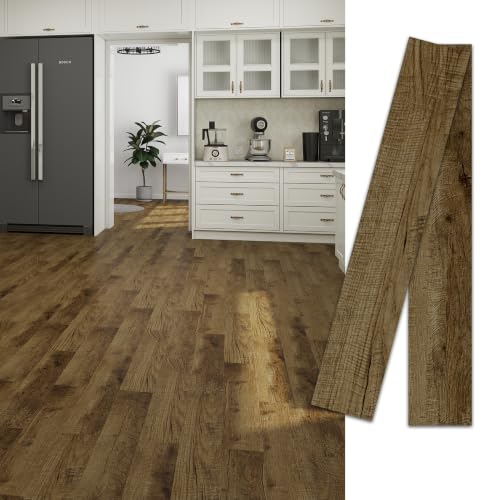
The thicker plank that actually feels like hardwood under your shoes.
Where the entry-tier vinyl planks run thin, this one steps up to 1.5 mm, and that extra body shows up the moment you walk on it. It is rated Commercial grade, which means it is built for spaces with more foot traffic than a finished room sees. Each plank measures 6″ x 36″ and the box of 36 covers 54 square feet in Dark Brown with a deep embossed surface. The wear layer on top is what protects against scratches and abrasion from daily walking, and the low-gloss printing film is why the pattern reads as real timber rather than plastic. Peel-and-stick, no underlay. Easy to clean and water resistant.
Quality is the quality that comes up most in owner feedback, with the look close behind. Reviewers describe a professional result from cutting and laying the planks themselves — a kitchen was transformed in a couple of hours — and six months on, the floor still sits flat without trouble. Pieces arrived whole with no chips or breaks, they went down, and they stayed down. The thicker plank also cuts cleanly with a toilet paper and a utility blade, so a trim around a vent or a doorway is not a fight.
One detail that the listing does not cover: a few owners note no acclimation guidance from the maker, and those who let the planks sit for a day or two at room temperature before sticking them down avoided any lifting. Adhesion is good on a dry, clean slab, but a humid basement corner or a very dusty floor can defeat any peel-and-stick product, this one included. Lay it over a dry, swept surface and it holds.
Realism read: the embossed wood grain and the thicker body together push this above the thinner plank options — the difference in feel underfoot is the reason to pay more.
Perfect pick for: a finished, dry basement floor where the wood look and the extra thickness matter more than the lowest price.
Reconsider if: the slab stays damp, since no peel-and-stick product beats a drainage mat in a genuinely wet space.
8. Mohawk Home 24″ x 24″ Indoor/Outdoor Peel and Stick Carpet Tile, 15 Tiles

Big 24-inch squares that turn a cold slab into something you actually want to walk on.
If the goal is simply making a basement feel warm underfoot, carpet squares solve it faster than any hard tile. Each one measures 24″ x 24″ with a 0.25-inch pile height, and 15 tiles cover 60 square feet. The fibre is 100% polyester, chosen for soil and stain protection, fade-resistant colour, and all-weather resilience, so these squares are comfortable outdoors on a patio or porch as well as inside. Installation is measure, peel, press, stick. You can also lift and swap a single tile if one gets trashed, which is exactly what a kids’ room or a pet corner needs. Matching is easy: rotate every other tile a quarter turn for a finished pattern.
Easy installation is what owners rave about most, and appearance is right behind it — this set has been used to transform dated spaces, including a bathroom stuck in the sixties. A partially finished basement with two large dogs is a good real-world test: the tiles went down over concrete, cut easily, stuck firmly, and never lifted, so the owner bought more to cover the whole room. The larger, lighter squares also beat the popular brand for value, and the backing keeps them from sliding on stairs. Cutting is simple with sharp scissors, though you may go through a pair on a big job.
The catch is adhesion, and it breaks both ways: some owners find it sticks very well, others find it hardly sticky at all. Prime the slab, roll the squares down firmly, and keep the floor dry before you lay them. Colour and value also draw mixed views, so order a box and lay a few squares before committing to the full room, and keep in mind that these are carpet squares — for a wet utility corner you still want the drainage mat at the top of this list.
Go with this for: a dry, finished basement room that needs to feel warm and quiet underfoot, especially with kids or pets.
Pick a different tile if: the floor stays wet — soft fibre absorbs where a drainage or rubber tile will not.
9. VersaTex Garage Floor 18 x 18 inch Interlocking Tiles, 24 Pack, Black

Dense rubber squares built to sit under a squat rack without denting.
For a home gym, a workshop, or a mudroom where something heavy is going to land, this is the tile that absorbs it. Each 18″ x 18″ square is made from recycled rubber-blend material, and 24 of them cover 54 square feet. The surface is non-porous and waterproof, so sweat and spills sit on top where you can wipe them away, and the tile is heat-resistant and puncture-proof — it will not tear, dent, shift, or compress the way EVA foam does under a weight machine. It sits safely over wood, laminate, tile, vinyl, and cement, and it needs no adhesive or tape. Since the tile is non-permanent, you can pick it up and re-lay it in a different pattern.
Snapping the pieces together is the part owners find easiest, and they hold together well once seated. A basement workshop is the classic use: this set replaced brittle flooring in one, and the tiles cut, clean, and re-lay easily when you want to change the layout. Because the rubber is UV resistant, it will not fade or crack, and it resists household chemicals, oils, brake fluids, and solvents — useful in a workshop where spills happen.
Two practical limits. First, the rubber is dense, and cutting it is a job and a half — it handles like a hockey puck under a utility knife, so a table saw or tin snips make far cleaner edges. Second, position matters: rubber tiles lift under heavy rolling items like a table saw on a mobile base, and in a garage where heat swings hard the tiles can expand and separate at the seams, especially if oil gets underneath. For a climate-stable basement gym or utility room, this set does its job with no drama.
Where it earns its keep: drop a dumbbell on foam and it leaves a crater; drop it here and the tile shrugs it off, because the material is dense rubber rather than soft foam.
Best match: a basement home gym, workshop, or utility room where you are loading real weight and want impact protection.
Pick a lighter tile if: you only need comfort underfoot — this one is heavy and firm, and it is overkill where nothing heavy ever lands.
Understanding the Specs
Coverage per pack
Every box states how many square feet it covers, and that number is the one that decides how many packs your room needs. Some sets list coverage as a tile count, like 10 tiles of a 12 x 12 inch backer, while others give an explicit square-foot figure such as 54 square feet. Multiply your floor’s length by its width to get your square footage, then divide by the coverage per box. Add a few extra tiles to cover damaged pieces and trimming around posts and doorways, especially with peel-and-stick products where you could cut a tile wrong. Order the same batch where possible, because tiles from different runs can shade slightly differently.
Thickness and material
Thickness on a basement tile is about two things: how it feels underfoot and what load it can carry. A 12 mm mat feels soft and forgiving, while a 0.53 inch rigid plastic tile feels hard and takes the weight of a car. Lighter vinyl tiles run well under a millimetre, which makes them easy to cut and quick to lay but not built for heavy loads, and foam tiles sit in the middle for cushioning without support. As for the material, drainage tiles are often made from recycled PVC, rubber tiles are non-porous and waterproof, and vinyl planks are built for a wood look on a dry, clean slab. Match the thickness and material to how the room is used, not how it looks in a photo.
FAQ
Will peel and stick tiles stick to a damp basement floor?
How many tiles do I need for a basement room?
Can I put floor tiles directly on concrete?
Do these tiles need glue or grout?
How do I cut floor tiles around a toilet or a post?
Are interlocking garage tiles strong enough to park a car on?
Do carpet tiles work in a basement with pets?
Will foam tiles stop my feet getting cold on a concrete floor?
Can I use the same tiles outdoors on a patio or in a garage?
How do I stop peel and stick tiles lifting at the edges?
Final Thoughts: The Verdict
For the majority of shoppers, the basement floor tiles winner is the EVANCENT Drainage Interlocking Floor Mats because it is the one tile on this list built to handle the moisture problem that got you searching in the first place — 12 tiles at 12″ x 12″ and 0.47″ thick, in recycled PVC, that let water drain through and the floor dry underneath, with a 4.6-star record across 298 ratings and a durability reputation owners keep coming back to. If you want a finished wood look in a dry basement, grab the MULGREAT Peel and Stick Floor Tile at 1.5 mm and 54 square feet per box.
How We Picked
We do not accept paid placement. Every pick is matched to a real buyer and a real use-case; we do not hands-on test units.
Sources & Methodology
Specifications: manufacturer listings and product documentation. Review insights: verified customer reviews, as of September 2026. Pricing: not shown on this page (it changes often); check the current price via the retailer link.
As an Amazon Associate, KitchPrep earns from qualifying purchases. This does not affect which products we feature.
Related Guides
