
Specs are compiled from manufacturer listings and verified buyer reviews and can change over time — please confirm the key details on the product page before buying.
Buying 12 gauge stranded wire is mostly a battle against two things: fake copper and stiff wire that fights you every time you pull it around a corner. If the listing says pure bare copper or oxygen-free tinned copper and the strand count is printed on the page, you are almost always getting real wire. If it says CCA, that is copper-clad aluminum, which is aluminum with a thin copper skin — it carries current, but not as well, and it is the single most common way this category cheats buyers. This guide sorts the real stranded copper from the pretenders and tells you which roll fits your actual job.
I’m Mohammad Maruf — the founder and writer behind KitchPrep. This guide is built by comparing the manufacturers’ published specifications and the patterns across verified customer reviews, so you get each pick’s real strengths and trade-offs instead of marketing spin.
You will see strand counts, temperature ratings, and burial approvals compared side by side, so you can pick without guessing. Everything below is sorted so you can choose the best 12 gauge stranded wire for the run you are actually wiring.
Our Picks at a Glance

How To Choose The Best 12 Gauge Stranded Wire
Twelve gauge is a workhorse size. It is the gauge people reach for when a circuit needs to move serious current over a short to medium distance — think a boat’s trolling motor, a light bar on a truck, or a landscape lighting run out to the far end of a yard. The trap is that every listing in this category looks the same at a glance: black or white jacket, two conductors, a number that says 12. The differences live in the details underneath the jacket.
Conductor material is the whole ballgame
Pure bare copper and oxygen-free tinned copper are the two you want. Bare copper is the honest workhorse for landscape and low-voltage lighting. Tinned copper adds a thin tin coating over each strand, which stops salt spray and moisture from eating the wire from the inside — that is why it dominates marine and boat use. Copper-clad aluminum, often shortened to CCA, is the one to watch. It weighs less and reads cheaper, but the aluminum core carries less current than copper of the same gauge, and it is easy to mistake for copper if you only glance at the photo.
Strand count controls how the wire behaves in your hands
Strand count is the number of tiny individual wires twisted together to make up one conductor. A higher strand count means the wire bends more easily and survives repeated flexing without cracking. One wire here is built from 680 strands, which is what makes it feel closer to rope than to metal. Lower counts — in the 45 to 72 range — are still far more flexible than a single solid core, and they strip and crimp cleanly. If your run bends around an engine mount or threads through a frame rail, strand count matters more than almost any other number on the page.
Match the ratings to where the wire lives
Indoor, dry, and nothing is at stake: almost any pure copper 12 AWG works. Buried in soil: you want a direct-burial rating and a UV-resistant jacket. On a boat or a trailer: you want tinned copper plus an insulation temperature rating that survives both wet and dry conditions. In an engine bay: heat is the enemy, so look for the highest temperature rating in the listing. Buying a wire rated for harsher conditions than you need is fine; buying one rated below your environment is how jackets crack.
Quick Comparison
| Model | Best For | Conductor | Strands | Length | Amazon |
|---|---|---|---|---|---|
| Lightkiwi 12/2 Landscape Wire★ Best Overall | Buried landscape lighting | Bare copper | 65 | 50 ft | Amazon |
| Fermerry 12 AWG Silicone WireMost Flexible | RC and hobby wiring | Tinned copper | 680 | 30 ft | Amazon |
| NAOEVO 12/2 Marine CableCompact Pick | Tight boat runs | Tinned copper | 45 | 15 ft | Amazon |
| YDDECW 12/2 Red Black Wire | Auto and audio runs | Oxygen-free copper | 72 | 25 ft | Amazon |
| NOVINO 12/2 Marine Wire | Speaker and marine | Tinned copper | Multi strand | 30 ft | Amazon |
| NAOEVO 12 Gauge Automotive Wire | All-round 12V work | Tinned copper | 65 | 30 ft | Amazon |
| GS Power 12 AWG Duplex Marine Wire | Coastal boat wiring | Tinned copper | 2 x 67 | 50 ft | Amazon |
| CONEPY 12 AWG 2 Conductor Wire | Automotive upgrades | Tinned copper | 65 | 30 ft | Amazon |
In‑Depth Reviews
1. Lightkiwi 12/2 Landscape Wire 50ft Pure Copper Direct Burial ETL Listed
Our pick — over 4.5★ from 950+ verified ratings; the strongest balance of quality and price.
The buried run that survives the second summer as well as the first
If you are running low-voltage landscape lighting and you want to dig the trench once, this is the roll that earns its place at the top. It is 50 feet of 12/2 stranded bare copper, and the jacket is ETL listed for direct burial, which means you can drop it straight into the ground without threading it through conduit first. The conductors themselves are bare copper, not aluminum-clad, and the listing states that bare copper delivers 40% better conductivity than copper-clad aluminum. For a fixture that sits far from the transformer, that difference is exactly the kind of thing that keeps your far-end lights from going dim.
Burying wire is a job that punishes bad choices, so the flexibility matters as much as the conductivity. The stranded design means it bends and routes around garden beds without kinking, and buyers report the wire is pliable enough for making turns and burying — the review pages sum it up: “Great value, ease of use”. Buyers praise the build quality first and the value for money second. The 50-foot length also covers far more ground than the 15-foot marine cable from NAOEVO on this list, a 50 ft vs 15 ft gap that matters the moment your run reaches the back fence.
The honest catch is thickness. A handful of buyers have called the jacket thinner than they expected, and heavier gauge wire is naturally stiffer to work with in long straight pulls. Neither is a deal-breaker for a buried lighting run, but if you are wiring something that needs maximum current capacity, this is not the pick for that job. The ETL listing, the direct-burial rating, and a lifetime satisfaction guarantee from Lightkiwi round out the package.
What earns it the top spot
- Bare copper with 40% better conductivity than copper-clad aluminum, per the listing
- ETL listed for direct burial — no conduit needed
- 50-foot length covers small to medium outdoor projects
- UV-resistant, waterproof jacket rated for aboveground, underground, and in-conduit use
- Lifetime satisfaction guarantee backs the roll
Where it takes some care
- Jacket thickness gets mixed feedback — a few find it thinner than expected
- Heavier gauge wire is naturally stiffer on long straight pulls
- Not the right pick if you need maximum amp capacity over a long run
Run this underground: Landscape lighting, pathway fixtures, and any low-voltage 12V or 24V job where the wire lives in soil.
Look elsewhere for: High-current circuits that need the fullest possible ampacity — step up in gauge for those.
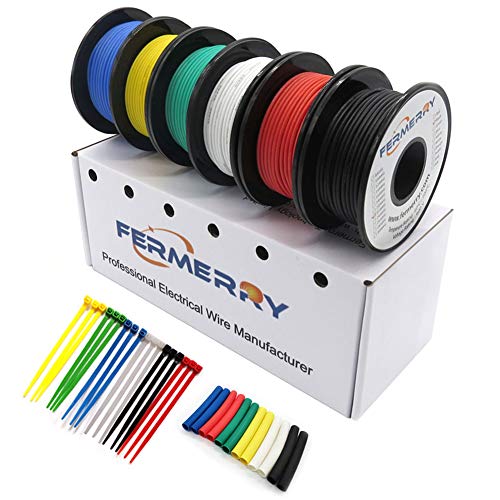
2. Fermerry 12 AWG Stranded Wire Spool 5ft Each 6 Colors
Six colors, a silicone jacket that flops like a shoelace, and 680 strands doing the work
Nowhere else in this lineup does the strand count climb this high. Each conductor here is built from 680 strands of 0.08mm tinned copper — that is 15.1 times the strand count of the NAOEVO marine cable on this list, which runs 45 strands — and the payoff is wire that behaves more like soft cord than metal. It is rated to withstand 51A and 600 volts, and the silicone insulation handles a temperature swing from -60 to 200 degrees. The kit gives you 5 feet of each of six colors — black, red, blue, white, green, and yellow, 30 feet total — plus 18 pieces of heat shrink tubing and 18 wire ties.
The silicone jacket is the real differentiator, because it strips cleanly and takes tight bends in confined spaces. One buyer who tested it against an automatic stripper found the strands survived without damage, while a standard stripper cut a few strands — a sign the strand count is genuinely as advertised. The review pages describe it as flexible enough to pull through closed loom with ease, which is exactly what you want when you are fishing wire behind a dashboard or through a model chassis. Buyers praise the build quality first, then the six-color assortment and included shrink tubing that drive reorders.
What you trade for that flexibility is length. Five feet per color is a kit for small jobs — RC motors, ESC connections, instrument panels, model harnesses — not for running power across a garage. Buyers who needed just a few feet for a repair loved it for exactly that reason; buyers expecting a full roll will come up short. The unmarked 14 AWG spool in this same line is a small annoyance for anyone relying on printed labels to sort colors.
Strand-count champ: 680 strands at 0.08mm each is the highest count in this entire lineup, and it is what makes the wire feel practically limp in your hand.
Reach for this if: You solder, crimp, or route wire into tight hobby spaces and want the six-color kit with heat shrink included.
Skip the kit route if: You need continuous length — five feet per color will not carry a long outdoor or automotive run.
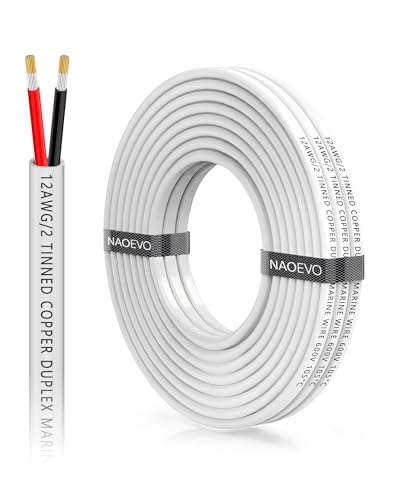
3. NAOEVO 12 Gauge Marine Wire Duplex, 12 AWG Wire, 12/2 Marine Cable, 15FT
Short spool, serious jacket — built to survive the bilge
This is the roll for the job you can measure in feet, not yards. Fifteen feet of 12/2 marine cable, each circuit built from 45 strands of 0.3mm tinned copper, wrapped in a white PVC jacket rated IP68 — the highest water-and-dust protection level in this category’s rating scale. It meets UL1426, SAE, and ABYC standards, carries a 600V rating, and the listing states it works down to -40°F and up to 221°F. It has passed a 10,000-bend test, the flexing a hull-mounted run sees over a season of chop.
What buyers actually notice is how it handles on the install day. It strips easily, crimps cleanly, and wraps around components without fighting back, which is exactly what you want when you are reaching into a cramped console. Owners mention running it through the side of a hull to rewire a bass boat and finding the white protective film kept the run clean and protected. Wiring a camper’s 12V lighting with it is another common job — customers note the flexibility and quality were exactly right for the price. Build quality is the most-praised trait here by a wide margin.
The short length is the obvious limit. At 15 feet, this spool is best for a single localized run — a fish finder, a navigation light, a speaker lead — not a full boat rewire. If your project runs long, you want the GS Power 50-footer on this list instead. For everything else, the IP68 rating and 10,000-bend test are more protection than most 12V jobs ever need.
Built for the short dirty job: IP68 waterproofing, a 600V rating, and the ability to keep working from -40°F to 221°F, in a length you can actually fish through a hull.
Perfect when your run is short: Boat, camper, or outdoor projects where 15 feet covers the whole job and the jacket needs to survive moisture.
Keep looking if: You are running long distances — the 15-foot length simply will not stretch to a full rewire.
4. 12 Gauge Wire 25 Feet, 12/2 AWG Pure Copper Wire, 12AWG 2 Conductors Red Black Oxygen Free Stranded Low Voltage Wire
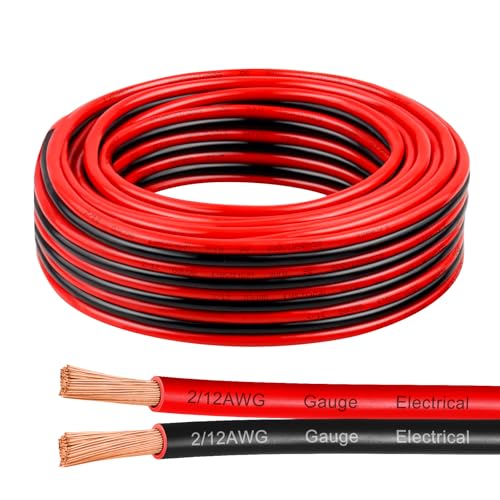
Red and black, 72 strands, and a jacket built to be split and stripped
For anyone wiring a car, a tractor, or an audio run, this is the everyday workhorse. It gives you 25 feet of 12 AWG oxygen-free copper in two conductors, one black and one red, each 25 feet long, split by a PVC jacket that is easy to separate and route. Inside, each conductor is made of 72 strands of 0.24mm pure copper — real copper, not the aluminum-clad stuff — and the listing rates it at 600 volts and 12A max current, with a working temperature range of -10 to 90 degrees. The PVC insulation is stated at 0.76±0.12mm thick over an overall diameter of 8.0±0.4mm.
One of the more unusual endorsements here comes from buyers using it well outside its stated lane — powering a subwoofer and reporting that true oxygen-free copper, not the silvery tinned material, made the difference at high power. Others stripped it and routed it through a tractor frame with relays and tight corners, finding the jacket pulled cleanly without snagging. What owners appreciate most is the quality of the copper itself, with the flexibility and the pure-copper construction both getting strong notice. It is one of the few rolls in this lineup where the strand count and the copper grade are openly printed on the listing.
The trade-off is that the outer sheathing makes this wire a bit stiff. One buyer described it as a little stiff but manageable — for a wire meant to hold a shape along a frame rail, stiffness is often a feature. The length is also on the shorter side at 25 feet, so plan your runs before you cut.
True OFC, no silicon core: 72 strands of 0.24mm oxygen-free copper in each conductor, with a red-and-black jacket that strips and splits cleanly for automotive work.
Best for automotive and audio: A 25-foot red-and-black roll for car wiring, battery runs, and speaker leads where true oxygen-free copper matters.
Consider the 50-foot roll if: Your run is long — 25 feet leaves little room for cutting errors on a full frame rewire.
5. 12 Gauge Marine Wire, 12 AWG Duplex Marine Grade Wire, 30ft 12/2 Gauge Cable

The white-jacketed marine roll boat owners keep reordering for their stereo
Thirty feet of 12/2 marine grade wire, tinned for corrosion resistance, in a white PVC jacket with red and black internal sheaths. The listing rates it to 600 volts, 105 degrees C dry and 75 degrees C wet, and states it meets UL 1426, SAE, and ABYC standards. The jacket is thickly built for heavy-duty marine and harsh external jobs, and the whole package is designed to survive corrosion, open flame, temperature swings, and abrasion. For a boat’s electrical system, that build spec is the whole point.
What owners keep coming back to is the sound. Reviewers point out using it as speaker wire in a marine stereo and calling it some of the best they have ever used, with the price standing out against the alternatives. The other common thread in the reviews is fish finder wiring — shoppers say it is flexible fine wire that is easy to route into tight console spaces. Quality is the leading praise, with value for money close behind. Thirty feet splits the difference between the 15-foot NAOEVO marine cable and the 50-foot GS Power roll on this list, which makes it the practical middle option for a stereo-and-lights upgrade.
The honest note is that the white jacket shows grime faster than a black one, and for a bilge-adjacent run the extra protection is welcome but the finish takes some cleaning to keep looking new. It is not a flaw so much as a fact of choosing white over black wire for a boat interior.
Marine-spec at 600 volts: Tinned copper with a thick white jacket rated to 105 degrees C dry and 75 degrees C wet, in a 30-foot roll sized for real console-to-stern runs.
Your pick for boat audio: Marine stereos, fish finders, and onboard 12V lighting where salt and moisture are the daily reality.
Choose black jacket if: You want the run to disappear visually — this white jacket is built to be seen during inspection.
6. NAOEVO 12 Gauge Wire 2 Conductor, 12 Gauge Automotive Wire 12V Cable, 30FT

Thirty feet of tinned copper that cuts down the extra parts list
For a general 12-volt install — light bar, solar panel feed, trailer lights, marine accessory — this is the roll that covers the most ground with the least fuss. Each circuit carries 65 strands of 0.24mm tinned copper with an outer diameter of 3.5mm, wrapped in PVC insulation that resists chemicals and oxidation. It carries an IP68 waterproof rating and a 600V rating, works from -22°F up to 221°F, and is flame-retardant to the VW-1 standard. Two things push it ahead for install day: the kit ships with 16 heat-shrink tubes and 4 cable ties, and the 30-foot length is generous for a single project.
Buyers repeatedly single out how easy it is to work with. The jacket is thin and soft enough to bend into tight spaces without strain, and the tinning earns its keep wherever moisture or vibration is a concern — buyers report using it on a hunt boat for a light bar and noting the tinned conductor handles corrosion well. Others report it working cleanly for a small solar project and calling it heavy duty. Buyers praise the overall quality first, with the wire’s functionality close behind. The included heat shrink and cable ties mean you are not ordering bagged accessories separately for a small job.
The trade-off is weight and wind. It is a lightweight wire by design, which is a plus for routing but does not give you the jacket mass of the GS Power marine roll higher up. If your environment is coastal salt spray, that heavier marine build is the safer call. For everything else, this roll earns its keep.
One-box 12V kit: A 30-foot roll of tinned copper with 16 heat-shrink tubes and 4 cable ties already in the package.
Go with this for mixed 12V jobs: Light bars, solar feeds, camper wiring, trailer lights — anything where flexibility and included accessories save you a second order.
Step up to marine-grade if: You are wiring a hull that lives in saltwater; the heavier marine jackets offer more protection.
7. GS Power 12 AWG Duplex Marine Wire – 50 Ft Tinned Copper Boat Wiring
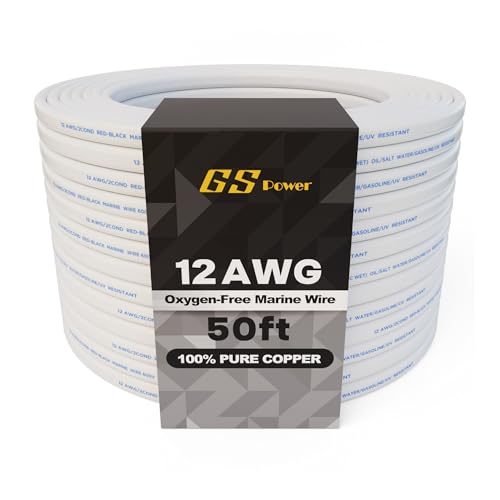
Fifty feet of Coast Guard-compliant tinned copper for the serious install
This is the longest environmental rating in the lineup and the most heavily documented spec. Each of the two conductors is built from 2 x 67 strands of 0.25mm oxygen-free tinned copper, rated to 600 volts, with the insulation tested to 105°C/220°F dry and 75°C/167°F wet. The listing states it meets ABYC E-11, SAE J1127/J1128, and US Coast Guard 33 CFR Part 183 requirements, and it is built to UL 1426 marine cable specs. Type III 26/0.0100 stranding keeps the wire supple enough for tight routing in engine compartments and bilge areas, and it stays flexible down to -40°F for cold-weather installs.
The details that make an install go smoothly are all here. The tin coating resists salt spray, moisture, and battery acid, and the red and black internal sheaths inside the white jacket make polarity obvious at a glance. Owners mention the outer sheath slides off easily once you cut the jacket to length — the listing describes it as powdered inside for exactly that — which saves real time on a full boat rewire. Owners praise the heavy-duty build quality first, with the tinned-copper conductors a close second. Fifty feet gives you enough to wire a trolling motor, a fish finder, trailer brake lights, and an RV solar circuit off a single roll.
The one caution is the jacket itself. It is thick and rigid by design, which protects the wire but makes it hard to slice open — one buyer warned to be careful with the razor blade. The tin coating also gives the wire a matte silver look rather than bare copper shine, which is normal for marine-grade tinning but surprises buyers expecting orange copper.
Why this is the premium choice
- 2 x 67 strands of 0.25mm tinned copper in each conductor
- Meets ABYC E-11, SAE J1127/J1128, and US Coast Guard 33 CFR Part 183 requirements
- Insulation tested to 105°C/220°F dry and 75°C/167°F wet
- Stays flexible down to -40°F for cold-weather installs
- Powdered outer sheath slides off cleanly in long pieces
What to know before you buy
- Thick rigid jacket is difficult to slit open — use care with a blade
- Tinned conductors look silver, not copper-orange
- Overkill for indoor or dry-land low-voltage runs
Buy this for coastal and off-shore work: Trolling motors, bilge runs, RV solar, trailer brakes — anywhere marine standards actually apply.
An indoor roll will do if: Your wiring lives in a dry shop or crawlspace and the Coast Guard spec is not required.
8. CONEPY 12 Gauge Wire, 12 AWG 2 Conductor Automotive Wire, 12/2 Cable, 30FT
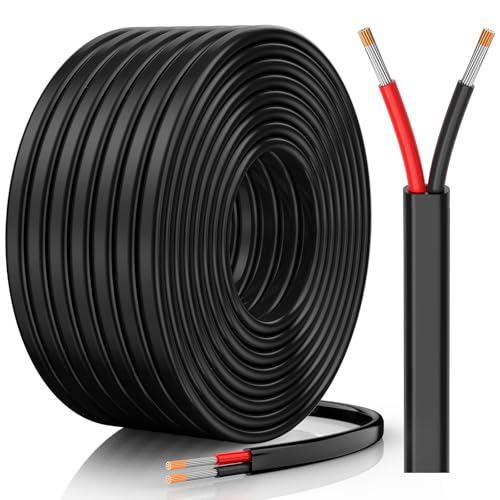
Sixty-five tinned strands per circuit, a jacket that refuses to split, and a parts kit in the bag
For anyone upgrading an older vehicle’s wiring, this is the roll worth reaching for. Thirty feet of 12 AWG duplex cable, each conductor made of 65 strands of 0.24mm oxygen-free tinned copper — the same strand spec as the NAOEVO automotive wire on this list, with a stated 5% more current capacity than aluminum. The PVC jacket resists splitting, oxidation, saltwater corrosion, UV rays, and extreme temperatures. It is rated IP68 for water, VW-1 for flame retardance, 600 volts, and works across an operating temperature of -30°F to 221°F. The kit ships with 16 heat-shrink tubes and 4 cable ties.
The application stories in the reviews are the giveaway of what this wire is for. One buyer used it to upgrade the headlight wiring on an old Ram Cummins with relays and reported full 12 volts delivered with no current limiting and easy tight bends. Another ran it through a truck frame for light installation, finding the jacketed cable eased through tough spots without damage. A third used it for DIY round cables and appreciated that the inner jackets are not bonded to the wire. The most-praised trait across the board is quality, with durability, ease of use, functionality, and materials all drawing their own shout-outs.
What is worth knowing is that the stranded conductor feels different from a silicone-jacketed hobby wire — this is a proper automotive cable with a rugged, semi-rigid jacket, not a limp cord. That is the right feel for a truck frame and the wrong feel for tight interior console work. Make sure your use case matches.
Built for old trucks: A 30-foot roll with 65 tinned strands per circuit, IP68 waterproofing, and a PVC jacket that resists split, UV, and saltwater.
Your pick for vehicle upgrades: Headlight relays, auxiliary lights, frame-mounted runs, and any automotive job where a rugged jacket matters.
Not for hobby wire work: If you are routing inside a dashboard or a model chassis, the stiffer automotive jacket is overkill.
Understanding the Specs
Strand count and why 65 beats 19 beats 7
Strand count is simply how many tiny wires are twisted together to make one conductor. A higher count means each strand is thinner, and thin strands bend without cracking, which is why the 680-strand silicone wire on this list behaves like soft cord and a lower-count wire still bends noticeably better than a solid rod. Buyers shopping for 12 gauge stranded wire should look at the number printed on the listing — if the strand count is missing, that is usually a sign the spec is nothing to brag about. For runs threaded through engine bays, boat consoles, or anywhere the wire flexes, a high strand count is worth paying a little more for.
Tinned copper versus bare copper versus CCA
Bare copper is the base-line best when the wire lives in dry or buried conditions — it conducts well and holds up. Tinned copper adds a whisper-thin coat of tin over every strand, and that coat is what stops salt spray and moisture from reaching the copper underneath, which is why marine wire is almost always tinned. Copper-clad aluminum, or CCA, is the impostor: aluminum with a thin copper skin. It weighs less and reads cheaper, but the aluminum core carries less current of the same gauge, and it is more prone to corrosion in a wet environment. If a listing says copper-clad or CCA, treat it as a different product with lower performance.
FAQ
Will 12 gauge stranded wire carry a 20 amp load on a 12V circuit?
Can I bury 12 gauge stranded wire directly in the ground?
Is stranded wire better than solid wire for a 12 gauge run?
What is the difference between bare copper and tinned copper 12 gauge wire?
Do I need 12 gauge or can I use 10 gauge for a long run?
How do I strip 12 gauge stranded wire without cutting strands?
Can I use marine12 gauge wire for an automotive job?
Do I need a different wire for solar panels versus lights?
What does IP68 mean on a wire rating?
Can I mix 12 gauge stranded wire with 14 or 10 gauge on the same circuit?
Final Thoughts: The Verdict
If you want one dependable pick, the 12 gauge stranded wire winner is the Lightkiwi 12/2 Landscape Wire because it pairs bare copper conductors with an ETL-listed direct-burial rating and enough length to cover a real outdoor run — rated 4.8 stars across 900+ ratings. The GS Power 50-foot tinned-copper marine roll is the step-up pick if your wire lives near salt or battery acid and needs Coast Guard-compliant construction. For hobby and RC work where flexibility is everything, the Fermerry 680-strand silicone kit will bend into places no other roll on this list will go. Match the wire to your environment first, then to the strand count your routing demands.
How We Picked
We do not accept paid placement. Every pick is matched to a real buyer and a real use-case; we do not hands-on test units.
Sources & Methodology
Specifications: manufacturer listings and product documentation. Review insights: verified customer reviews, as of September 2026. Pricing: not shown on this page (it changes often); check the current price via the retailer link.
As an Amazon Associate, KitchPrep earns from qualifying purchases. This does not affect which products we feature.
Related Guides
