
Specs are compiled from manufacturer listings and verified buyer reviews and can change over time — please confirm the key details on the product page before buying.
You want a cold room this summer without hiring an electrician. Every unit on this list plugs into a standard household outlet — the ordinary 120-volt socket your lamp already uses — so you can install it yourself and be cool the same afternoon. The trick is matching cooling power (measured in BTU, the unit of heat a machine can pull out of a room) to your actual square footage, then checking the watts it draws so you do not trip a breaker.
I’m Mohammad Maruf — the founder and writer behind KitchPrep. This guide is built by comparing the manufacturers’ published specifications and the patterns across verified customer reviews, so you get each pick’s real strengths and trade-offs instead of marketing spin.
Below you will find nine units sorted by what they are actually good at, from a 5,000 BTU bedroom cooler to a 12,000 BTU whole-floor workhorse. Cooling coverage matters more than almost anything else, so every pick here is rated for a real room size. If you want the short answer, the best 120 volt window air conditioner for most people is the BLACK+DECKER BD12WT6.
Our Picks at a Glance

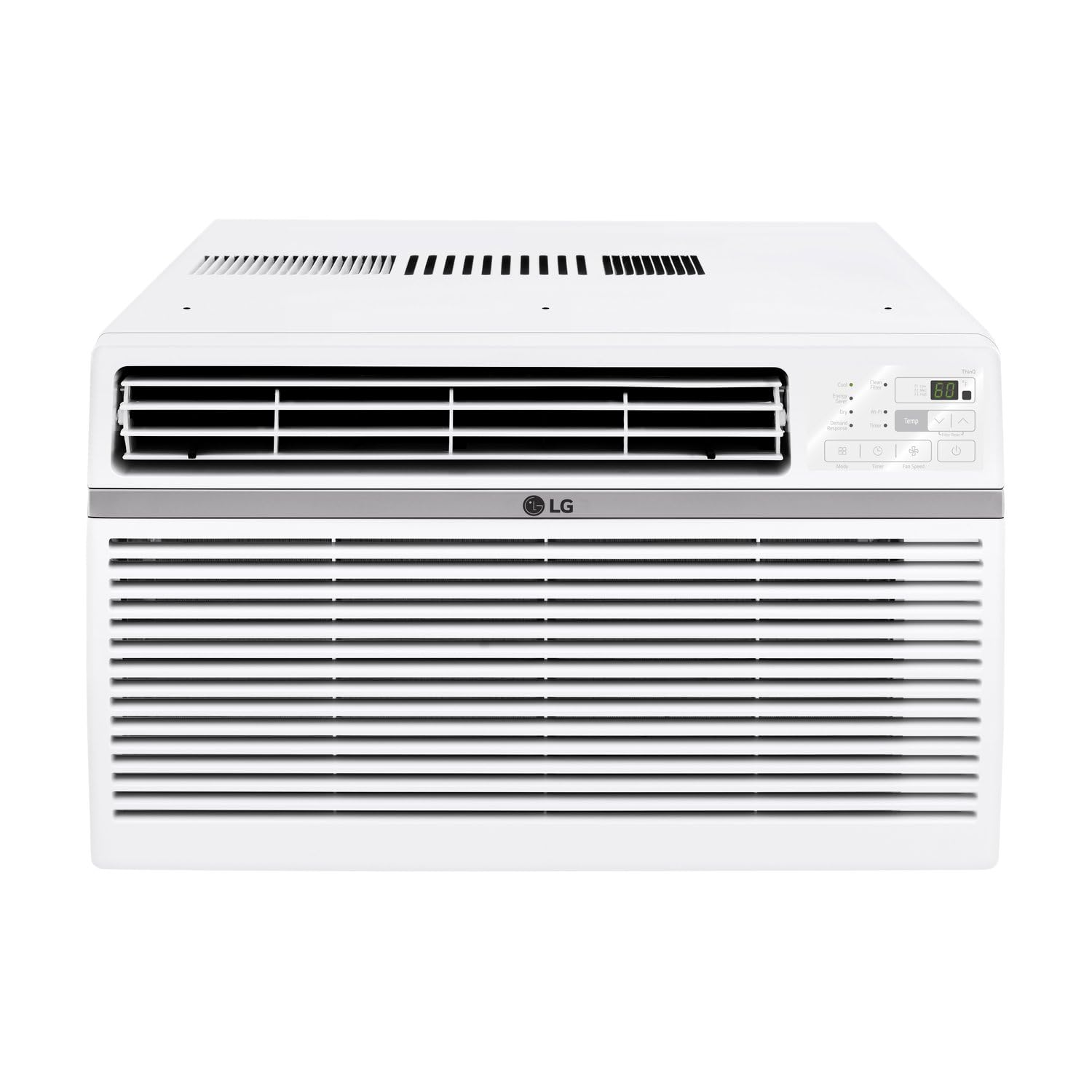
How To Choose The Best 120 Volt Window Air Conditioner
The single biggest mistake is buying by price tag instead of by room size. A 5,000 BTU unit in a large living room will run all day and never reach the temperature on the dial, while a 12,000 BTU unit in a tiny bedroom short-cycles — it blasts cold, shuts off, then restarts, which wastes power and wears the compressor. Start with the square footage of the room you actually want to cool, then work backward.
Match BTU to Square Footage First
A 5,000 BTU window unit comfortably handles a small bedroom or office up to roughly 150 square feet. Step up to 6,000 BTU for about 250 square feet, 8,000 BTU for up to 350 square feet, and 12,000 BTU for larger rooms up to 550 square feet. Those coverage numbers come straight from each manufacturer’s spec sheet, so they are the honest ceiling for each unit. If your room sits right on the boundary, size up and run a lower fan speed.
Check Watts So You Do Not Trip a Breaker
Every unit here runs on standard household 120-volt power, but the amps it pulls still matter. A lower-wattage unit leaves more room on the shared circuit for other appliances. The LG 5000 BTU LW5023 draws 450 watts, while the Midea 5,000 BTU draws 580 watts — a real difference if your outlet is already feeding a lamp, a charger, and a TV. On older wiring especially, check what else shares that circuit before you plug in.
Measure Your Window Before You Buy
Window air conditioners come in two basic body styles: fixed chassis, where the whole box slides in as one piece, and slide-out chassis, where the outer shell bolts down and the unit slides in separately. Fixed designs are the norm now and are easier to seal, but the window opening has to match. Most units list their exact width and height range in the specs — for example, the GE 6,000 BTU fits double-hung windows 27.125″ to 36″ wide and at least 13.375″ high. Measure your opening twice before ordering.
Quick Comparison
| Model | Best For | Cooling Power | Coverage | Watts | Amazon |
|---|---|---|---|---|---|
| BLACK+DECKER BD12WT6★ Best Overall | Master bedrooms and living rooms | 12,000 BTU | 550 sq ft | — | Amazon |
| LG LW8024RDTop Performer | Medium rooms, 14′ x 25′ | 8,000 BTU | 350 sq ft | 660W | Amazon |
| Midea U-Shaped InverterQuietest Pick | Quiet bedrooms and smart control | 8,000 BTU | 350 sq ft | 710W | Amazon |
| hykolity WiFi 12,000 BTU | App control over a large space | 12,000 BTU | 550 sq ft | — | Amazon |
| BLACK+DECKER BD08WT6 | Attic bedrooms and offices | 8,000 BTU | 350 sq ft | — | Amazon |
| Frigidaire 8000 BTU | Bedrooms needing quiet cooling | 8,000 BTU | 350 sq ft | — | Amazon |
| GE 6,000 BTU | Dorm rooms and small offices | 6,000 BTU | 250 sq ft | — | Amazon |
| LG LW5023 | Small rooms on a tight budget | 5,000 BTU | 150 sq ft | 450W | Amazon |
| Midea 5,000 BTU | Guest rooms and small bedrooms | 5,000 BTU | 150 sq ft | 580W | Amazon |
In‑Depth Reviews
1. BLACK+DECKER Window Air Conditioner 12000 BTU, BD12WT6, White
Our pick — over 4★ from 300+ verified ratings; the strongest balance of quality and price.
The brute of the bunch — enough cold output to chill a whole floor.
If your problem is a hot master bedroom or an open living space that never seems to catch up, this is the unit the whole list is measured against. It pushes 12,000 BTU of cooling — the heat-removal score — which the manufacturer rates for rooms up to 550 square feet. That is more than double the cooling power of the 5,000 BTU Midea at the budget end, and it is the reason this sits at the top. Buyers report exactly that kind of headroom, with one owner describing it as cooling a 12×12 room to 68°F on cool, low fan, and eco mode while it was over 90°F outside.
Day-to-day, the appeal is the flexibility. You get four fan levels (auto, low, medium, high) plus a full-function remote, so you can nudge the temperature from the couch instead of walking to the window. Sleep mode, an energy-saver setting, and a 24-hour timer round it out. The 783.88 kWh annual energy figure is the price of that cooling muscle, and a few owners with older home wiring have noted the amp draw as something to plan around. What wins people over is simply how much cool air it moves for the coverage it claims.
Installation is the accordion-panel style — the folding side flaps that bridge the gap between the unit and your window frame. It is designed to fit standard double-hung windows from 23″ to 36″ wide and as low as 15.5″ high. The catch worth knowing: those same side panels are the weak link for a few owners. One buyer had to build a makeshift insert because the unit did not fit their up-and-down window, and occasional units show a small dent on the side grille from the start. Neither stops it cooling. This is a serious-cooling machine, not a featherweight.
Where it wins: Coverage and raw cooling power at the top of its class — a floor, a large bedroom, or an open plan space all fall within its 550 sq ft rating, and reviewers consistently describe it catching up fast even in brutal heat.
Where it asks patience: It is heavier and hungrier than the small units, and the accordion side panels need a snug window to seal well.
The pick for large rooms: If you need one unit to genuinely cool a big space, this is the one that answers.
Check your windows first: If you have an up-and-down sash that is narrower than 23″ or shorter than 15.5″, plan on a custom insert.
2. LG 8,000 Window Air Conditioner, 115V, 350 Sq.Ft. (14′ x 25′ Room Size), Quiet Operation, Electronic Control with Remote, 3 Cooling & Fan Speeds, Auto Restart, 8000 BTU, White
A quiet 8,000 BTU workhorse built for rooms the size of a two-car garage.
This is the unit for the person who wants medium-room cooling that does not sound like a jet idling outside the glass. It runs as low as 53dB on low mode — decibels are just the loudness scale, and 53 is roughly the level of a quiet conversation. For a 350 square foot room — the maker pitches it for a 14′ x 25′ space — it delivers 8,000 BTU of cooling through three cooling and fan speeds plus an Auto Cool mode. The practical payoff is steady, adjustable comfort without the racket that plagues cheaper boxes.
The daily touches are sensible. Electronic controls and a remote mean no crouching at the window, and the Auto Restart feature is the standout — after a power outage, the unit powers itself back on and remembers your settings, so a flicker during a storm does not leave you reprogramming at midnight. There is a filter light reminder for the washable filter, so maintenance is at least prompted rather than forgotten. In real summers, owners have pushed these hard: owners mention running five units across rental properties in Georgia heat and keeping a 1,000 square foot mobile home in the mid-70s when it was 95-100°F outside.
The honest caveats: it is heavy, and owners say so. A couple have noted a bit of loudness despite the low-mode rating, and the paper filter reminder light triggering sooner than expected. The bigger fit note is that it runs at 660 watts, higher than the budget 5,000 BTU options — fine on its own circuit, but worth knowing if your outlet is already busy. It also arrives with minor dents for a few, cosmetic only. As a dependable mid-size unit, it earns its premium-tier spot on reliability alone.
Why it earns its price
- 53dB low-mode operation keeps a bedroom sleep-friendly.
- Auto Restart brings it back after outages without a reset.
- Three fan speeds plus Auto Cool suit a 14′ x 25′ room.
- Filter light reminder means you actually clean it.
What to weigh
- Heavy enough that two people help during setup.
- 660 watts draws more than the small budget units.
- Mixed reports on how quiet it really feels at speed.
Grab this if: You have a medium room, value reliability, and want outage-proof auto-restart.
Look elsewhere if: You need ultra-quiet at full blast — the U-shaped Midea is the better fit there.
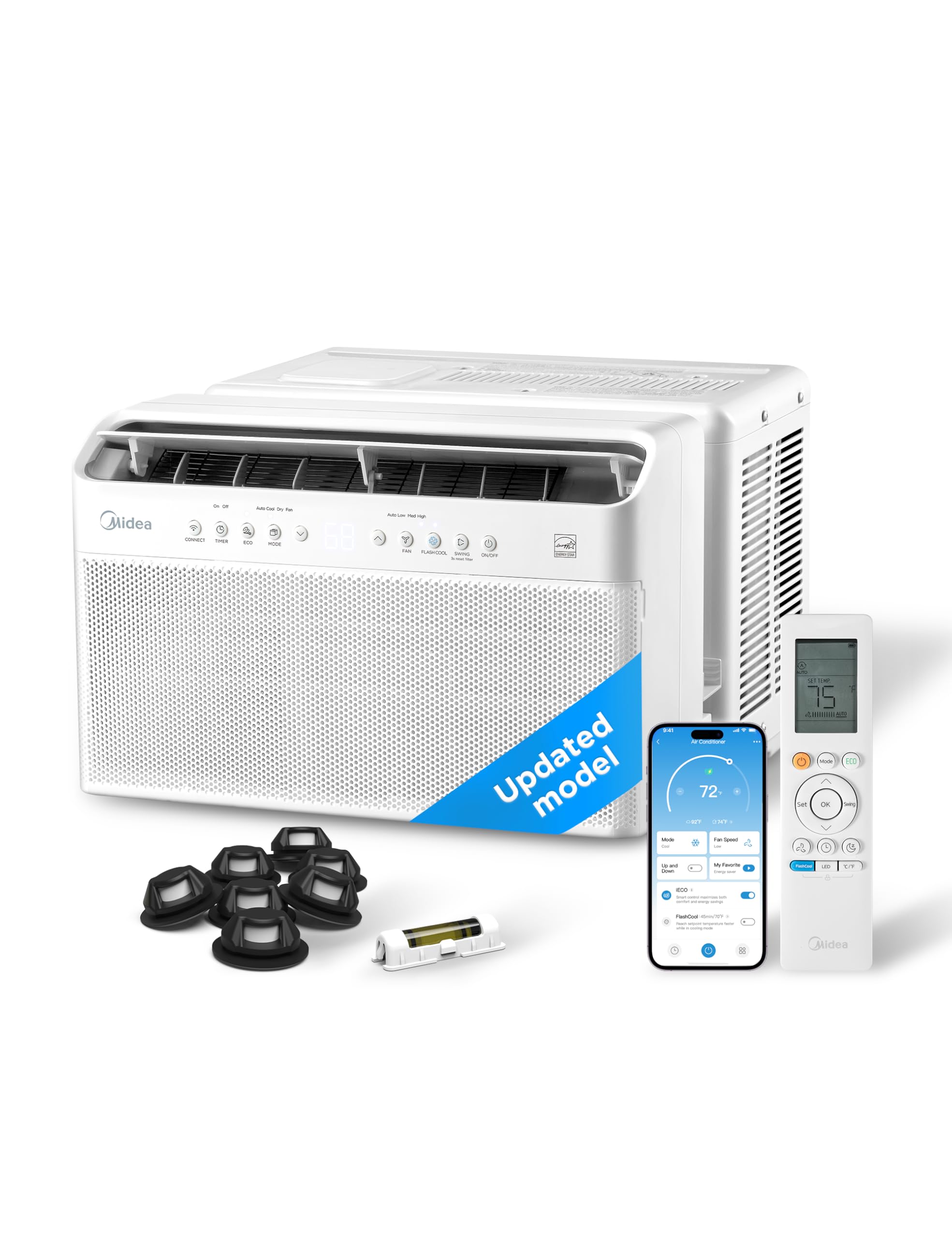
3. Midea 8,000 BTU U-Shaped Smart Inverter Window AC, Cools 350 Sq Ft, Ultra Quiet, Alexa/Google Compatible
The unit with the clever U-shape that lets you keep your window and your peace.
Here is the one spec that sells this unit before anything else: it runs as low as 32 dBA, which the manufacturer rates ten times quieter than a traditional window unit. The trick is the U-shaped body — it wraps around the window sash so the glass sits between the noisy compressor outside and you inside, while the inverter system (a motor that ramps smoothly instead of clicking on and off) keeps vibration low. For a light sleeper in a 350 square foot bedroom, that alone changes the calculus.
Because the unit saddles the sash, your window still opens — you can get fresh air and keep more of your view, and when it is closed the anti-theft mechanism locks the window. It is Wi-Fi enabled and works with Alexa and Google Assistant, so you can speak the temperature from bed. The maker claims more than 37% energy savings versus traditional units via DC inverter technology, and this is the first window AC to earn ENERGY STAR certification per Midea. The 8,000 BTU rating cools 350 square feet, and it draws 710 watts while doing it.
What owners rave about is the quiet and the speed of cooling, and there is real durability in the field — customers note units still running strong after several years, and one owner has kept theirs going since 2018. The honest follow-up question is installation clearance: it needs roughly the window opening spec and about 9″ of indoor clearance, and the support arms can be short for some sills. A couple of owners have also raised water management, with drain plugs that fit loosely. Weigh that against the silence and the window you get to keep.
The silence payoff: 32 dBA low-mode operation is the reason people pick this over a conventional box — you can leave it running through the night.
The setup reality: The bracket install is tidy once done, but plan for sill adjustments and check your window height and indoor clearance before ordering.
Reach for this if: Noise is your enemy and you want app and voice control over a 350 sq ft room.
skip it if: You have a shallow sill or storm-window gaps — the bracket wants extra room to fit right.
4. WiFi Enabled 12,000 BTU Window Air Conditioner, Smart Window AC Unit with Remote, Energy Saving, Easy Install Kit, Cools up to 550 Square Feet

Big cooling plus the ability to switch it on from your phone before you get home.
For anyone who wants a large room cooled and controlled from anywhere, this hybrid delivers both. It moves 12,000 BTU — the same cooling power as the top pick — across up to 550 square feet, and it adds an inverter compressor for smoother, more efficient operation. for the controls, this is the most connected unit on the list: alongside the remote, the SmartLife-SmartHome app on iOS or Android lets you run the AC from your phone, so the room is already cool when you walk in. Reviewers point out the room getting cool in about three minutes.
You can dial the temperature from 61°F to 88°F, and it offers three fan speeds with an automatic adjustment plus cooling, dry, fan, and auto modes. There is a washable, reusable filter, and a flexible timer you can set from 0.5 to 24 hours so it shuts off or kicks on around your schedule. Eco Mode and Sleep Mode handle the energy-saving side, and the unit carries a CEER of 11.0 — the efficiency score, where higher is better. The window fit is listed at 26″–36″ wide and at least 16″ high, with all mounting accessories included.
The fair warning is weight and temperament. At over 60 lbs, it is a two-person install — one owner noted exactly that. A few report the four fan settings feeling nearly identical, and the unit cycling on and off briefly every quarter hour after it hits temperature, which can be disruptive. Like any machine, an occasional defective unit occurs, and there is the usual small share of buyers who got a dud. On the whole, the combination of large-space cooling and app control is hard to find at this tier.
The connected advantage: Of everything here, this is the one that pairs 550 sq ft cooling with phone control you can use from the office.
Budget the brawn: Plan a second set of hands — over 60 lbs means it is not a solo lift.
The right match for: Big rooms and phone-first operators who want cool air waiting for them.
Think twice if: You want silent operation or a featherweight lift — this wants muscle and lets you hear it.
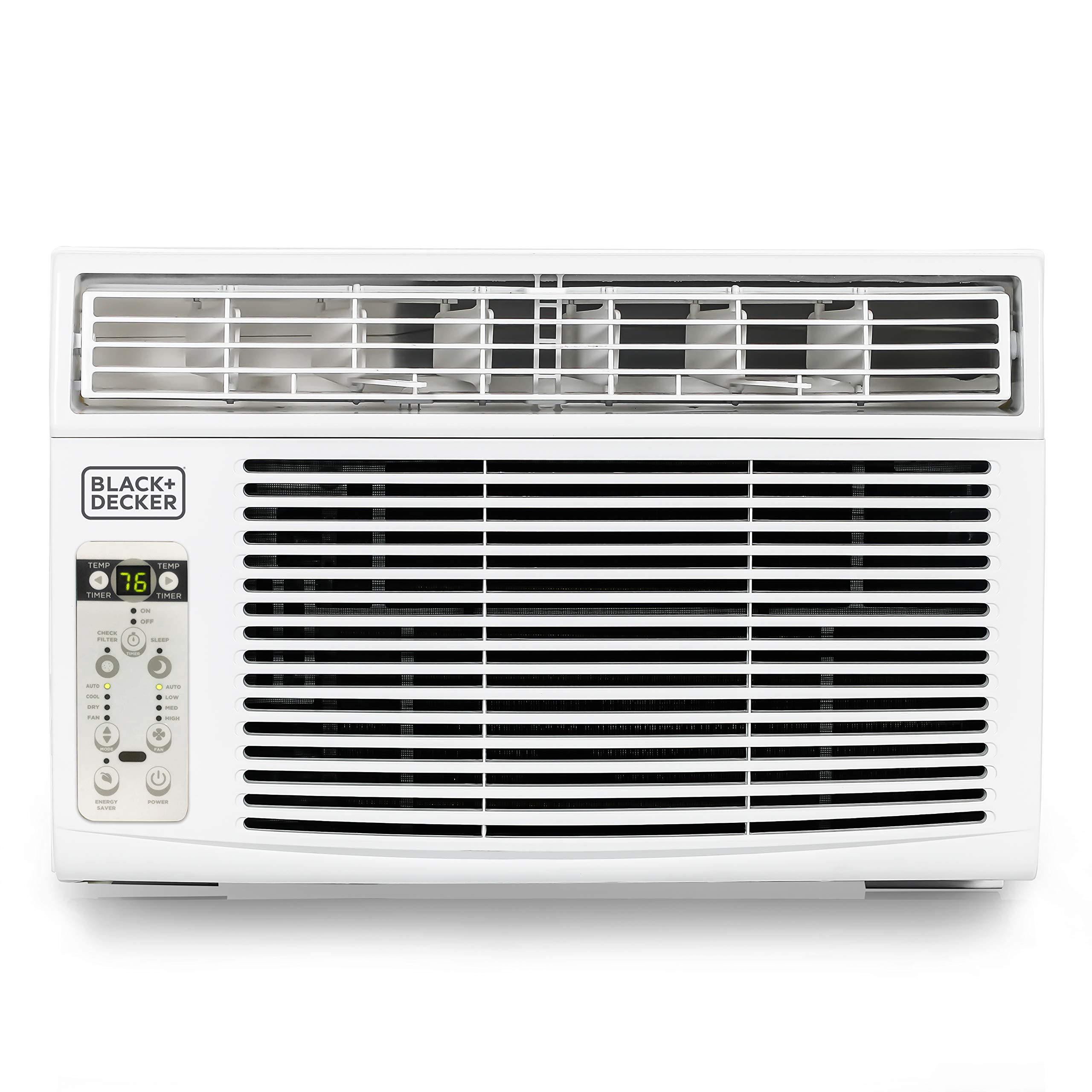
5. BLACK+DECKER Window Air Conditioner 8000 BTU, BD08WT6, White
A middleweight that owners keep coming back to summer after summer.
Where the 12,000 BTU version of this line is a bruiser, this 8,000 BTU sibling is the balance for a larger bedroom, office, or medium living space up to 350 square feet. It runs at the same four fan levels — auto, low, medium, and high — and carries the same full-function remote with sleep mode, energy-saver mode, and a 24-hour timer. In real terms, that means you set it once at bedtime and it quietly handles the night. Owners have used it through a full heat wave and reported it still going strong a year later, and it does not spit water like some competing brands.
The design details are consistent with the rest of the BLACK+DECKER line: accordion-style side panels for the window gap, and a fit rated for double-hung windows from 23″ to 36″ wide and as low as 15.5″ high. It uses R32 refrigerant, which the maker notes has zero impact on the ozone layer. The energy picture is modest for its size, with an annual energy consumption figure of 527.47 kWh — lower than the larger 12,000 BTU model, as you would expect from a smaller unit doing less work.
Its track record for reliability is what stands out: an owner reports it sailing through a heat wave without issue and getting it done quietly in an attic bedroom. The trade-off is that this line’s control panel is not always easy to read — a noted design gripe is light-gray labels on a white face — and a few owners say the energy-saver mode can override the cooling setting, cycling the unit off and on until you dial the temperature lower. Nothing here is a dealbreaker, but read the manual on that setting.
What keeps it in the running
- 350 sq ft coverage handles a spacious bedroom.
- Sleep mode and 24-hour timer suit overnight use.
- R32 refrigerant with zero ozone impact per the maker.
- Four fan levels give fine control over airflow.
Worth knowing before you buy
- Control-panel labels can be hard to read in bright light.
- Energy-saver mode may cycle off before you expect.
- Accordion side panels are the sealing weak point.
Best for the regular sleeper: A medium room where you want quiet, reliable nightly cooling.
Not the one if: You need app or voice control — this is remote-and-buttons only.
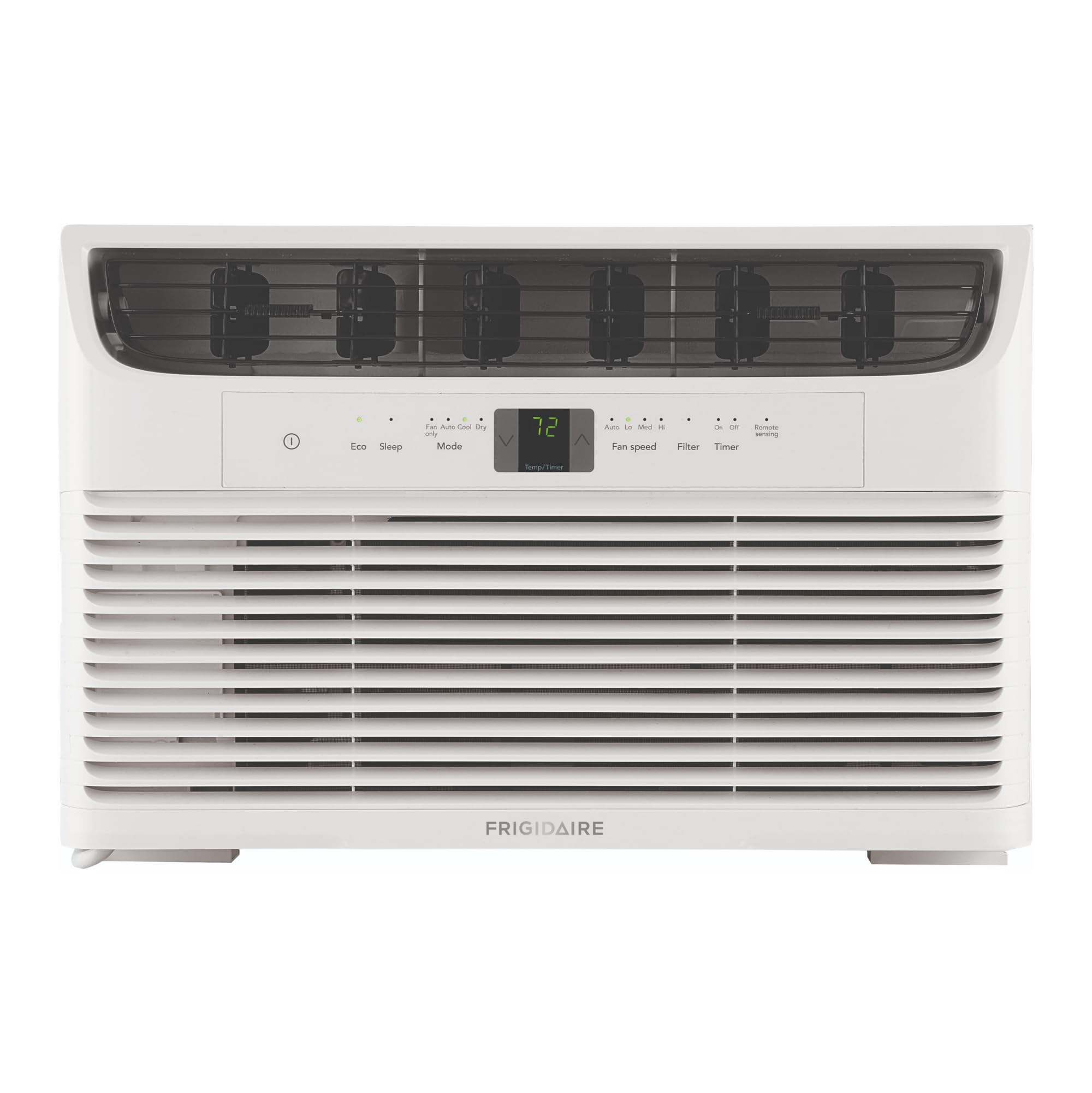
6. Frigidaire 8,000 BTU Window Air Conditioner with Remote Control, Cools Up to 350 Sq. Ft., Quiet Operation, Eco Mode, 3 Fan Speeds, Auto Restart
The airflow-aiming specialist that keeps a bedroom comfortable without blowing on your face.
If you have ever fought a window unit that only blows in one boring direction, this is the fix. It offers 6-way directional airflow plus three fan speeds and custom temperature settings — six, not two, ways to aim the cold where you actually want it. With 8,000 BTU, it is rated to cool rooms up to 350 square feet, and it runs at just 54 dBA, the loudness level, which the maker frames as quiet enough for bedrooms or small living rooms. That combination of aimable air and mild noise is what makes it a bedroom favorite.
Maintenance is where Frigidaire earns its keep. You get a Clean Filter alert that tells you when to wash the removable dust filter, so you are not guessing. There is Eco Mode for efficiency, Sleep Mode that gradually raises the temperature overnight so you do not wake up shivering, a 24-hour on/off timer, and a Dry Mode to pull extra moisture from humid air. Auto Restart keeps it running after an outage, and the whole thing uses an annual energy figure of 550 kWh. All the daily controls sit on an easy remote.
Owners have put it through real summers. Shoppers say running one in Arizona heat above 110°F and holding a 300 square foot tiny home in the 70s with a little fan help; another after their central air died in Florida found it the best of three window units they tried, with efficient dehumidifying that produced almost no water output. The honest note: a small number find it louder than they hoped for a unit sold as quiet, so if silence is your top priority, weigh it against the U-shaped Midea. For most rooms, though, it hits the mark.
The airflow win: 6-way directional control means you can point cold air away from your bed while still cooling the whole room.
The maintenance win: A filter alert removes the guesswork from keeping the unit running at peak efficiency.
The easy pick for: Bedrooms where you want to aim the air and get told when to clean the filter.
Skip unless you need quiet above all: For absolute silence, the U-shaped Midea leads this list.
7. GE 6,000 BTU Electronic Window Air Conditioner, Cools Rooms up to 250 sq ft, Digital Controls with Remote, Energy Saver Mode, 24Hr Timer

Digitally fussy-free cooling for a dorm room, office, or small apartment.
For the buyer who wants a precise temperature dial rather than a guessing-game knob, this is the value pick. It moves 6,000 BTU, rated for rooms up to 250 square feet — roughly a 10×25 foot space — and lets you set the exact temperature on a digital thermostat anywhere from 64°F to 86°F. The LED display makes the setting obvious, and the included full-function remote works across the room. Two-way air direction and multiple cooling modes let you shape the airflow, all while running at 52 dBA on low and 56 dBA on high.
The energy features are genuinely useful for a small space. An auto-cycling Eco Mode compressor holds your set temperature while cutting power draw compared to units that just run nonstop, and a 24-hour programmable timer handles overnight and away-time scheduling. Auto-restart remembers your settings after a power outage, so you do not reprogram it every time the grid hiccups. The washable, reusable filter even has a reminder indicator. Note that this unit is not Wi-Fi or smart-home compatible, so if app control matters, look to the hykolity or the Midea U.
Installation is the fixed-chassis style, which fits double-hung windows 27.125″ to 36″ wide and at least 13.375″ high, with an EZ Mount kit and expandable side panels included. The coverage claim holds up in practice — owners have cooled rooms a bit over 250 square feet just fine. The main gripes are typical of this size class: it can be louder than expected, which is why the low fan setting becomes your friend, and the expandable side curtains are a wear item you may replace down the road.
Points in its favor
- Set exact temperatures from 64°F to 86°F.
- Auto-cycling Eco Mode trims power use.
- Auto-restart survives outages without resetting.
- Filter reminder keeps maintenance simple.
The honest trade-offs
- No Wi-Fi or smart-home support.
- Louder than expected — use low fan.
- Side curtains wear and may need replacing.
The digital pick for: Small rooms where you want exact temperature control without smart-home extras.
Not ideal if: You want to run it from your phone — there is no app here.
8. LG 5000 BTU Window Air Conditioner, LW5023, Easy Mechanical Control, Washable Filter, 150 Sq.Ft.

Old-school knobs, gentle on the bill, perfect for one small room.
This is the unit to grab when you want simple, cheap-to-run cooling for a single small room up to 150 square feet. It turns at 5,000 BTU with two cooling modes and two fan speeds — no app, no digital display, just a knob and an on/off switch, which some people actually prefer. The number that quietly matters most here sits in the energy spec: it draws just 450 watts, the lowest among the units where that figure is published. Compared with the Midea 5,000 BTU at 580 watts, that is a leaner appetite on a shared household circuit.
The airflow design is a genuine perk. This model vents its cold air upward rather than straight out, which keeps the blast off your body while still cooling the room — good if you dislike air blowing directly at you. It fits narrow windows that larger units cannot, installs in as little as about five minutes for the main body, and uses a washable slide-out filter you can clean roughly every 30 days to keep it efficient. It runs on R32 refrigerant and includes an Energy Save function for lower bills.
The consistent theme among long-term owners is that it is a reliable little workhorse — buyers report cooling a bedroom noticeably within an hour on a mild setting in an old house without central air, with the power bill barely moving after weeks of nightly use. The mechanical version also tends to be quieter than the digital trim of the same line, and it fits snugly in small windows. The main thing to expect is the installation fiddliness around the side flaps, which a couple of buyers found fussy to screw down.
Why the budget crowd loves it
- 450W draw keeps it gentle on a shared circuit.
- Upward airflow avoids blowing directly on you.
- Mechanical knobs mean zero fiddling with apps.
- Washable filter keeps upkeep cheap.
What to expect honestly
- Mechanical controls — no remote or digital display.
- 150 sq ft covers one room only.
- Side-flap assembly can be finicky.
Right for the simple life: A small room, a low wattage, and a knob you never have to learn.
Choose the Midea instead if: You want a remote and a digital display at the budget end.
9. Midea 5,000 BTU Window Air Conditioner, Cools up to 150 Sq. Ft. with Easy-to-Use Reusable Filter, Remote, Electronic Control

A three-in-one small-room cooler that moonlights as a dehumidifier.
This is the budget pick for the buyer who wants more than just cold air. It is a 3-in-1 machine — it cools a space up to 150 square feet, circulates air on a three-speed fan, and can switch to dehumidifier mode to pull moisture out of the air. That last function is the reason it ends up in humid guest rooms and basements. It also runs as low as 52dB on low mode, so it will not keep your visitors up, and the intuitive LED display with an included remote lets you set time, temperature, and mode from across the room.
Midea has built its reputation on air treatment, and the details here support that. You get a removable, reusable air filter that captures dust and pet hair, all mounting accessories in the box, and custom settings like Eco mode and an EasyTimer for scheduling. There is a one-year parts and labor warranty backing it. Installation is designed to be quick in an existing window frame, though you will need your own screwdriver, and the maker suggests pilot holes for some frames. In practice, owners put this in a 127 square foot guest room despite already having central air, and reported an easy install and removal in about ten minutes.
The honest caveats, framed fairly: it costs a little more to run than the LG because it draws 580 watts versus the LG’s 450 watts, so on a shared circuit keep that in mind. A small number of owners find the side panels flimsy, and one buyer wished the airflow aimed upward as well as side to side. There is also the rare out-of-box frustration with a reconditioned unit. For its price, the dehumidify mode and remote make it a strong little performer for a single room.
Three jobs in one box: Cool, fan, or dehumidify — the mode switch is what makes it more useful than a plain 5,000 BTU unit.
The watts note: At 580 watts it draws more than the LG’s 450 watts, so check what else shares the outlet.
The best call for: Guest rooms and damp spaces where you want cool air plus moisture control.
Pick the LG instead if: You want the lowest possible wattage and mechanical controls.
Understanding the Specs
BTU and Room Coverage
BTU stands for British Thermal Unit — it is simply how much heat the machine can pull out of a room in an hour, so a higher number means more cooling power. The coverage figure each maker lists, like 150 or 550 square feet, is the room size that number is meant to handle. Buying too small means the unit runs forever and never cools; buying too large in a tiny room makes it cycle on and off. Note that a 12,000 BTU unit moves more than double the heat of a 5,000 BTU unit, which is why it costs more to run but cools a much bigger space.
120-Volt Power and Watts
Every unit on this list uses standard 120-volt household power — the ordinary wall outlet, not the 240-volt socket a central air system needs. Watts tell you how much electricity the unit actually consumes while running, and lower is easier on both your bill and your circuit. The LG 5000 BTU sips just 450 watts, while the Midea 5,000 BTU draws 580 watts. If you plan to run other appliances on the same outlet, lean toward the lower-wattage option. You do not need an electrician for any of these, but a dedicated circuit is always the safest setup.
FAQ
Will a 120 volt window air conditioner work in my regular wall outlet?
How many BTU do I need for my room size?
Will these units fit a sliding window or only double-hung windows?
What is the difference between a fixed-chassis and slide-out unit?
Why does noise level vary so much between units?
Do window air conditioners work as dehumidifiers?
Can I control a window AC from my phone?
How should I clean and maintain the filter?
Do these units need a special circuit or more amps?
What does 120 volts actually mean for a window AC?
Final Thoughts: The Verdict
For most people, the best 120 volt window air conditioner here is the BLACK+DECKER BD12WT6 because it simply out-cooled everything else, pushing 12,000 BTU across rooms up to 550 square feet — and it holds 4.4 stars across hundreds of owner ratings. If your priority is a silent bedroom, the Midea U-Shaped Inverter runs quieter than a whisper and lets you keep your window; for a medium room where reliability and outage-proof auto-restart matter most, the LG LW8024RD is the dependable pick. And if you just need one small room cooled for as little electricity as possible, the LG LW5023 at 450 watts is the frugal answer. Whichever fits your room size and noise tolerance, you are choosing from units that owners actually vouch for —
How We Picked
We do not accept paid placement. Every pick is matched to a real buyer and a real use-case; we do not hands-on test units.
Sources & Methodology
Specifications: manufacturer listings and product documentation. Review insights: verified customer reviews, as of September 2026. Pricing: not shown on this page (it changes often); check the current price via the retailer link.
As an Amazon Associate, KitchPrep earns from qualifying purchases. This does not affect which products we feature.
Related Guides
