
Specs are compiled from manufacturer listings and verified buyer reviews and can change over time — please confirm the key details on the product page before buying.
If you want a label maker that handles wide, one-inch tape without fuss, the Brother P-Touch PT-D610BTVP is the one to buy. It feeds tape cleanly, lets you type on the device itself, and connects to your phone or computer for fancier designs. The picks below cover every budget and every job, from pantry jars to frozen lab vials to warehouse shelving. One honesty note: this list uses flexible matching for one-inch (25mm) wide label tape, so a few picks are the nearest same-type size rather than the exact number you searched — each still serves the same job.
I’m Mohammad Maruf — the founder and writer behind KitchPrep. This guide is built by comparing the manufacturers’ published specifications and the patterns across verified customer reviews, so you get each pick’s real strengths and trade-offs instead of marketing spin.
This guide walks you through the tape-width and feed details that decide whether a 1-inch label maker actually earns its place on your desk.
Our Picks at a Glance


How To Choose The Best 1-Inch Label Maker
Three things actually decide whether you will love a label maker six months from now: the width of tape it takes, the way it prints, and how it feeds that tape with every press. Everything else — the icons, the fonts, the frame art — is decoration you will forget about by week two.
Start with the tape width, not the sticker count
One-inch tape (25mm) fits most homes and small businesses because it gives you room for two or three stacked lines — enough for a bin label or a file folder tab. A 1/4-inch strip is fine for a single word on a cable. If you want to do both, choose a machine that accepts a range of sizes, not just one.
Watch for this trap: some printers list a maximum tape width but quietly print across only part of it. The print head width is the real limit, so a machine that claims one-inch tape might still leave wide margins on each label.
Thermal direct versus thermal transfer
Cheap label makers burn an image straight into heat-sensitive paper — that is thermal direct printing, and it fades in sun and heat. Thermal transfer models use a resin ribbon that transfers onto the tape, so the print resists water, oil, scratches, and temperature swings. If your labels live in a freezer, a garage, or a lab fridge, transfer is worth the extra cost.
Keyboards, apps, and margin waste
If you mostly make ten labels at a time while standing at a shelf, a built-in QWERTY keyboard beats fumbling with a phone. If you design logos, barcodes, or QR codes, an app gives you far more control. Then look at the cut margin. Every print feeds a little blank tape before the blade cuts, and on some machines that margin is big enough to eat a meaningful slice of every roll.
Quick Comparison
| Model | Best For | Max Tape | Print Speed | Power | Amazon |
|---|---|---|---|---|---|
| Brother P-Touch PT-D610BTVP★ Best Overall | All-round office and warehouse labeling | ~1″ (24mm) | 20 ppm | 6 AA or AC adapter | Amazon |
| SUPVAN T50M ProBest Value | Fast app-first printing for home and shop | 2″ | 60 pages per minute | Rechargeable, USB-C | Amazon |
| SUPVAN E11 | Typing labels without a phone | Continuous and die-cut | 28 ppm | 1200 mAh rechargeable | Amazon |
| LABELWORKS Epson LW-K740PX | Industrial tape and heat shrink tube | Up to 1″ | 13 ppm | AC adapter | Amazon |
| NIIMBOT M2 | Freezer, lab, and vial marking | 20mm–50mm | 40 ppm | Rechargeable, USB | Amazon |
| DYMO LabelManager Executive 640 CB | Standalone typing with app backup | 1/4″ to 1″ (6mm to 24mm) | 10 ppm | Rechargeable lithium-ion | Amazon |
| Brother PTP750W | Shared network and NFC printing | Up to 24mm | 1 ppm | AC adapter or optional battery | Amazon |
In‑Depth Reviews
1. Brother P-Touch PT-D610BTVP Business Professional Connected Label Maker
Our pick — over 4.5★ from 350+ verified ratings; the strongest balance of quality and price.
A desktop label maker with its own keyboard, its own color screen, and a phone app for the fancy jobs.
Buy this if you label in batches — bins, pipes, wires, envelopes, binders, files — and you want to type right on the machine instead of typing on a phone. It takes Brother TZe tape up to roughly 1 inch wide, so you get room for multiple lines. You can run it on six AA batteries or plug it into the included adapter, which means it works on a shelf far from an outlet.
The screen is the part that sells it. You get a full-color LCD that shows 20 characters across two lines, so you can preview a label before you commit a single inch of tape. The built-in library is genuinely deep: 17 fonts, 17 font styles, 160 frames, 900 symbols, and 175 pre-loaded business templates, plus memory for up to 90 saved labels you can reprint whenever you need them. The VP version ships with a carry case.
Plan around tape waste: each print feeds a leading margin before the auto-cutter fires, and buyers report: “Printed 18 1.5″ labels: used 42″ tape for 27″ labels = 56% waste.” That adds up over months of heavy printing, so batch your runs instead of printing one-offs. On the upside, this machine starts printing within 30 seconds of a job, which is roughly 30 times slower off the mark than the SUPVAN T50M Pro — one of the few places a cheaper pick beats it.
What buyers keep bringing up
- Reviewers overwhelmingly describe it as a machine that simply works, job after job.
- Runs on six AA batteries or the included AC adapter, so no outlet tether.
- Reports of iPhone Bluetooth pairing in under five minutes.
- QWERTY keyboard with one-touch formatting keys means computer-free printing is genuinely fast.
Where it asks for patience
- The auto-cut margin eats tape on every print — run batches and it hurts far less.
- Windows setup can be fiddly; install the iPrint app and register before adding the driver.
- Registration demands the last nine digits of the serial number, which is easy to fumble.
Reach for this if: you want one machine that types labels standalone, connects to your phone or PC, and covers up to 1-inch tape for warehouse-scale jobs.
Look elsewhere if: you print a single label at a time, where the per-print tape margin will quietly cost you more than you expect.
2. SUPVAN T50M Pro Bluetooth Label Maker Machine with Tape, Black
The app-driven sprinter that spits labels out faster than anything else on this list.
If your labeling happens with a phone in one hand and a drawer full of jars in front of you, this is the pick. It prints a job within 1 second of you hitting go, and its rated print speed of 60 pages per minute is triple the Brother PT-D610BTVP’s 20 pages per minute. For anyone labeling a hundred containers in one sitting, that gap is the whole story.
It takes tape from 3/4″ up to 2″ wide, so it clears the 1-inch requirement comfortably. There is no ink or toner to buy — it is a thermal printer that burns the image into the label — and the companion app is free with no registration required. You get 30+ fonts, 50+ frames, and 660+ icons to play with, and you can add images straight from your phone, tablet, or PC. Auto label size recognition means it works out the tape dimensions for you.
Two honest catches. First, battery life is the weak spot. Owners mention a unit that “died overnight after first use; took 1hr+ to charge,” so treat the charge as something to top up rather than trust for a week. Second, very small text is a problem — bold three-to-five-word labels come out clean, but tiny 8-to-12 point lettering and fine logos tend to bind up and turn nearly illegible. It is a bold-labels machine, not a fine-detail one.
Where the money goes: this is a no-ink thermal printer (it uses heat instead of ink) with a free app and a very low entry point, which is why it is the pick for anyone labeling dozens of spice jars, food containers, or product boxes rather than one-off industrial tags.
Worth knowing: the app has a real ceiling on small fonts, so if your job depends on crisp tiny print, the higher-resolution NIIMBOT M2 is the better fit.
Best for: high-volume, bold, app-designed labels on jars, bins, and product packaging where speed matters more than fine detail.
Think twice if: your labels need tiny legible text or you need the printer to hold a charge reliably between sessions.
3. SUPVAN E11 Keyboard & Bluetooth Label Maker Machine with 4 Tapes
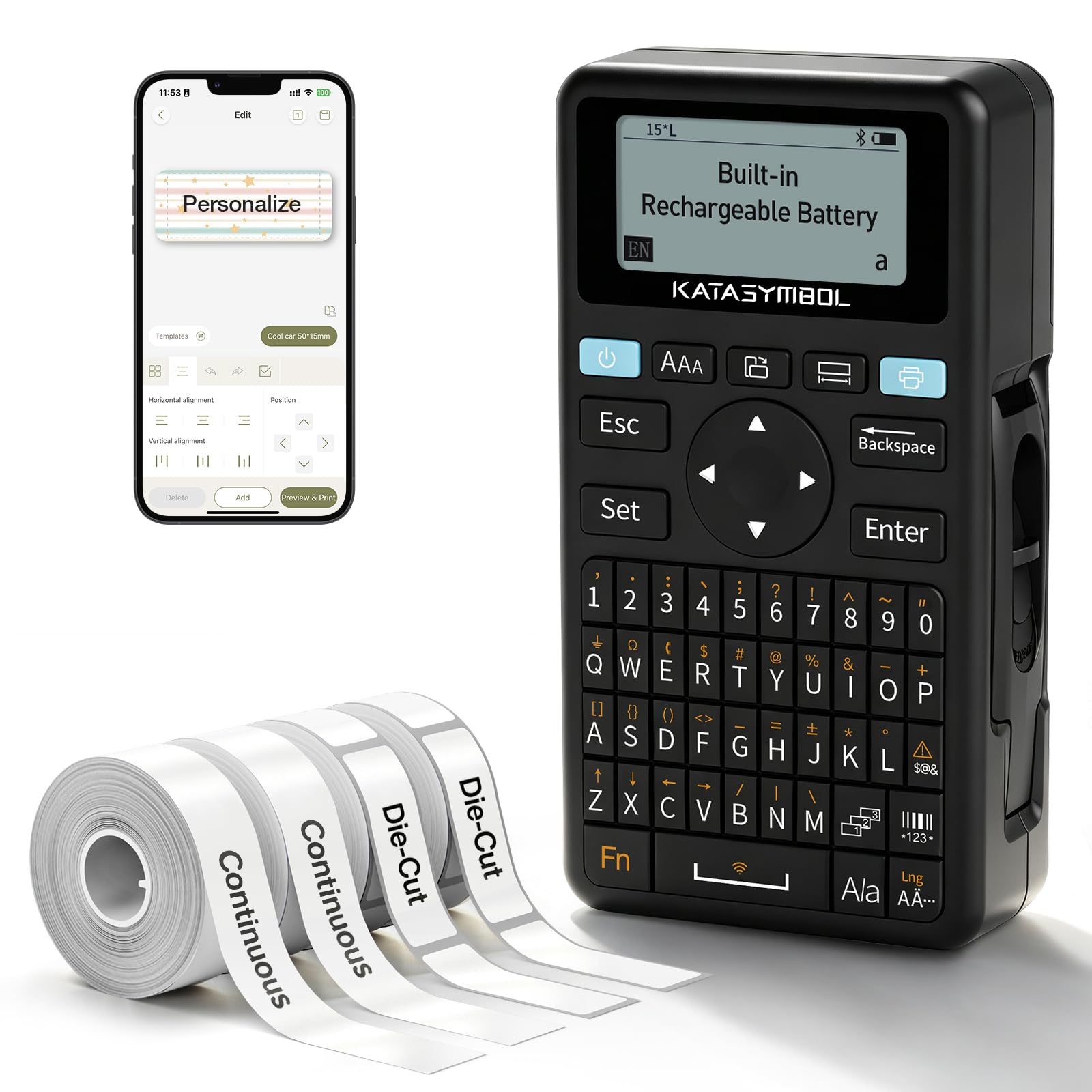
Type it on the keys or design it on your phone — and hardly any tape goes to waste either way.
What wins people over here is the margin. This printer leaves only a 0.2-inch gap before the cut, which is a fifth the size of what many label makers feed through on each print. Over a roll of tape that adds up, and for anyone who resents watching blank tape curl into the bin, this is the reason to choose it.
You get two ways to work. Type directly on the built-in keyboard for quick repetitive labeling — think wires, tools, breaker panels — or jump into the app over Bluetooth for customized designs with 30+ fonts, 50+ frames, and 660+ icons. The app supports 17 languages and lets you save your own templates locally. It runs on a 1200 mAh battery (a measure of battery capacity) that the maker says delivers up to a month of use per charge, and at 0.5 lb it is light enough to hold in one hand while you work down a shelf.
The trade-off is the screen. It is not backlit, so labeling in a dim garage or a cupboard corner takes some squinting. It also takes a little more work in the app than some rivals — you adjust text size manually rather than relying on auto-fit. And if cable labels are your main job, look elsewhere: this model cannot make them. Owners rave about print quality more than anything else, and the bundled 4 tapes get you started immediately.
The real selling point: keyboard typing for speed and an app for design, with a cut margin so small that tape lasts noticeably longer than on most machines.
The catch: no backlight on the screen, and no cable-label support — fine for jars and tools, wrong for a server rack.
Go with this if: you want both a physical keyboard and phone editing in one light, pocketable tool that wastes almost no tape.
Skip the cable jobs: this model cannot produce cable labels, so a rack-wiring project needs a different machine.
4. LABELWORKS Epson LW-K740PX Industrial Label Maker Kit – Portable Handheld
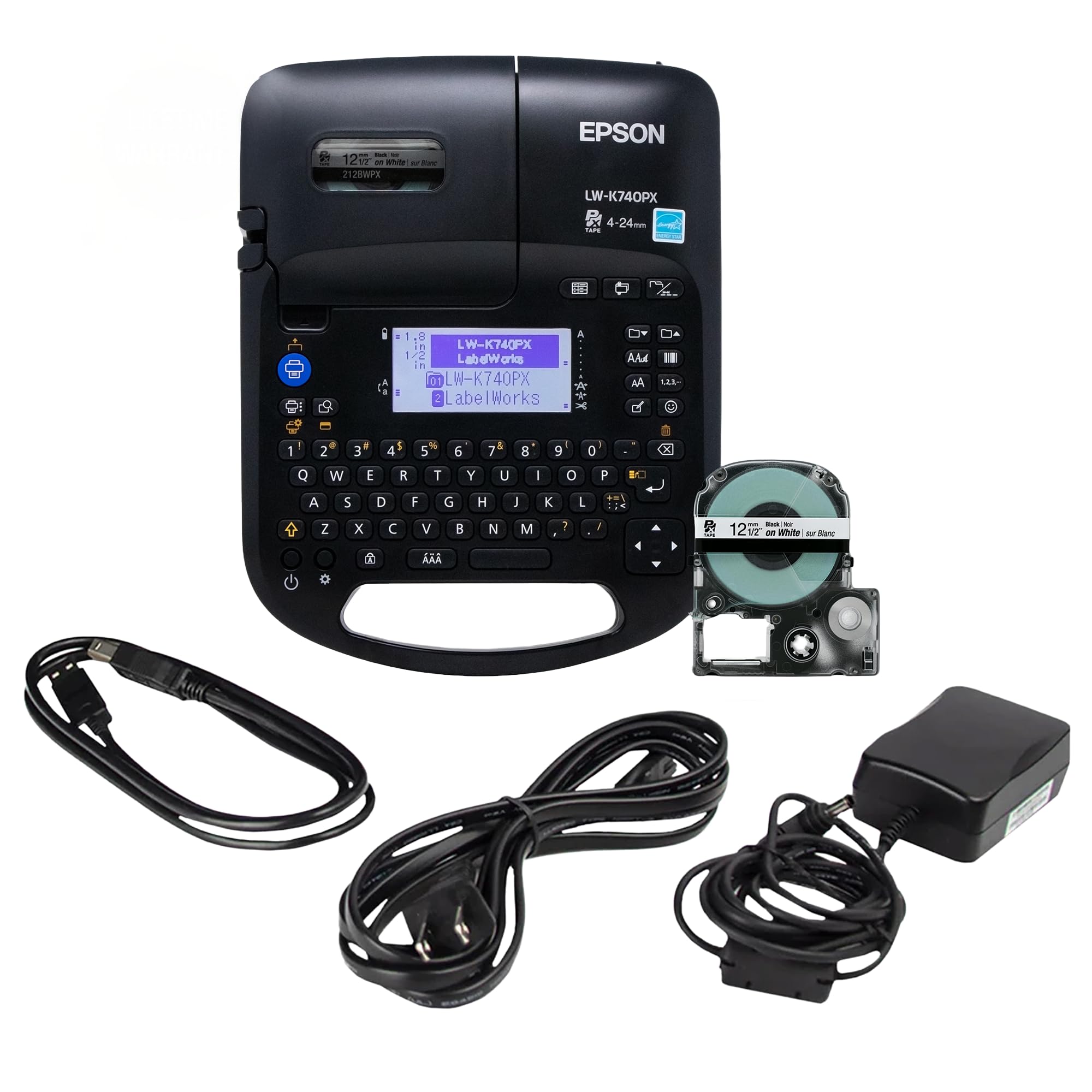
The kit built for heat shrink tube, vinyl, and the industrial tapes most home machines will never touch.
This is for the person labeling a generator panel, a boat’s wiring, or a rack of equipment — not a spice rack. It prints on more than 170 varieties of heat shrink tube, self-laminating wrap, vinyl, standard industrial tape, and specialty tapes, which is a far wider media range than any other pick here. It also includes features aimed at keeping margin waste low, which matters when industrial tape carries a premium.
The kit is complete from the start: the LW-K740PX printer, a cartridge of 1/2″ black-on-white standard industrial tape, an AC adapter, a USB cable, and the Label Editor software download. It takes LABELWORKS PX thermal tape cartridges instead of ink or toner, and the maker describes the resulting labels as durable and smudge-resistant. You get a large print preview screen so you can check a label before you burn tape, 14 preloaded fonts, and an auto-cutter.
Set your expectations on two fronts. It prints at 13 pages per minute, so it is slower than the SUPVAN E11’s 28 — speed is not what you are paying for here. And the Label Editor software draws mixed feelings. Customers are consistently happy with label quality, but ease of use splits: some find it simple, while others describe the Label Editor software as a little clunky even though it is feature-rich. Tape width is also limited, and the 1-inch ceiling is the practical top end of what it accepts.
Built for hard media: heat shrink tube, self-laminating wrap, and vinyl in one handheld kit, with a print preview screen so you do not waste pricey industrial tape on a typo.
Know before you buy: the desktop software is not the slickest, and 1-inch tape is the widest it takes — this is a specialist’s tool, not a household all-rounder.
The right tool for: electricians, marine repair, and equipment techs who need heat shrink and industrial tapes, not pantry labels.
Not for you if: you want fast casual labeling or dislike working through desktop software, where clunkier tools can slow you down.
5. NIIMBOT M2 Thermal Transfer Label Maker, Label No Fading for Office Lab Use
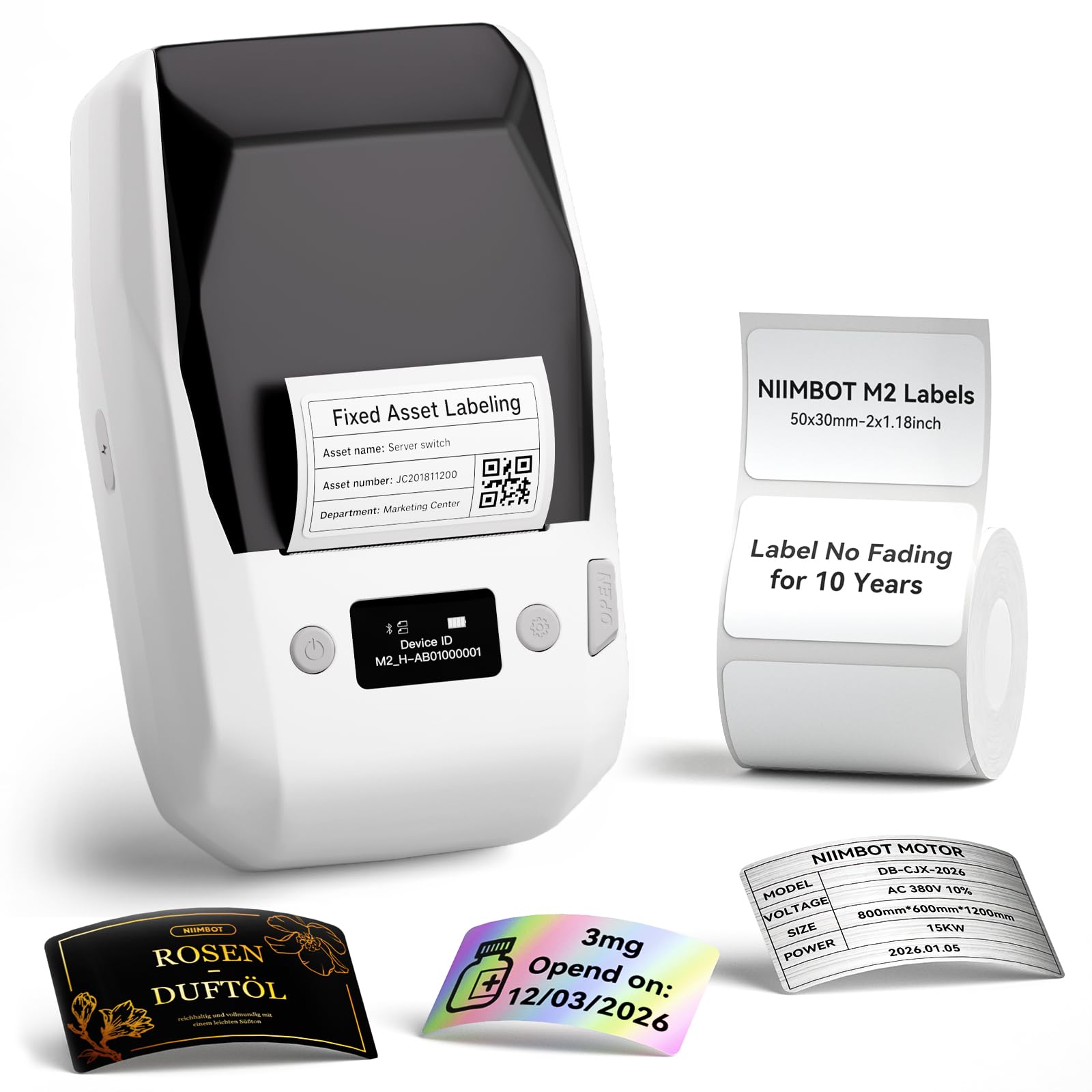
The pick for freezer bags, wet lab vials, and labels that get scratched.
Unlike the SUPVAN T50M Pro’s heat-sensitive paper, this machine uses thermal transfer with a resin ribbon the maker rates legible for 8-10 years. The maker rates the labels waterproof, oil-proof, scratch-resistant, and chemical resistant from -4°F to 248°F. If your labels live on freezer bags, lab vials, or outdoor equipment, that resistance is the entire reason to pick it.
Resolution is the other headline. At 300 dpi, it produces clearer text and images than lower-resolution machines, which is why it handles the tiny print that trips up cheaper units. The label width range is 20mm to 50mm, clearing the 1-inch mark, and the effective printable width is 48mm. It ships with one roll of 50x30mm tape at 230 pieces per roll.
Connectivity is flexible — iOS and Android phones, plus PC over USB — and it can hold ten mobile connections at once (three iOS and seven Android). The app brings templates, icons, tables, barcodes, QR codes, and more, and you get six months of app VIP service with the printer. The one thing to note is compatibility: it only takes M2 thermal transfer labels, not standard thermal labels, so buy the right refills. It also does not print in full color — this is a precise, durable monochrome machine, not a colorful one.
The small-print advantage
- 300 dpi resolution keeps tiny text crisp enough for vials and frozen labels.
- Thermal transfer labels resist water, oil, scratches, and temperature swings.
- Holds ten phone connections at once, so a whole office can share it.
- Compact enough to store and travel with, and it clears the 1-inch tape requirement.
Buy the right refills
- Only works with M2 thermal transfer labels — standard thermal labels will not print correctly.
- No full-color printing, so vivid multi-color designs are off the table.
- Some app templates sit behind a paid tier, even with the included VIP trial.
Made for: labs, pharmacies, freezers, and anyone whose labels must survive cold, damp, and chemical contact without fading.
Keep in mind: it needs the correct M2 thermal transfer refills and prints in precise monochrome only — not color.
6. DYMO LabelManager Executive 640 CB Portable Label Printer

A standalone typer with a big screen and a rechargeable battery — good for fast on-the-go labels, weaker in the app.
This is the pick if you would rather type on physical keys than hunt through a phone menu. It has a QWERTY keyboard, a large high-resolution screen you can customize with four colors, and a textured grip so it stays put in your hand. It takes D1 Standard and Durable labels from 1/4″ up to 1″, and it runs on a rechargeable lithium-ion battery, so no hunting for single-use AAs.
Connection is straightforward when it works. It pairs over Bluetooth Low Energy, which avoids the usual manual pairing dance, and USB-C covers the wired route. The software adds QR codes, signatures, backgrounds, and templates on top of the built-in fonts and clip art. A replaceable onboard battery keeps running costs down over time.
Be aware that this is the most polarizing machine on the list, and a lot of that depends on the app. The recurring gripes are the software and connectivity: no SVG support (a file format for vector images), no image rotation, occasionally finicky Bluetooth, and a printable width that falls short of the full 1-inch tape. Some units have arrived with a broken cartridge slot, and a few customers note battery charge holding issues. Standalone typing is where it shines; if you plan to do most of your work in an app, another pick will serve you better.
Standout strength: a generous color screen and a proper keyboard make quick standalone labels genuinely pleasant, with no cables or phone required.
Honest limit: the companion software is the weak link — limited image handling and inconsistent Bluetooth mean software-first users should look at the Brother PT-D610BTVP instead.
Suits you if: you want to type and print on one handheld device with a rechargeable battery and a big screen, minimal computer involvement.
Better to avoid if: your workflow lives in design software and you need dependable app connectivity, where this device struggles more than its rivals.
7. Brother Printer PTP750W Wireless Label Maker, 1.18, Black

A shared-office label printer that lives on your network and prints from any connected device.
Buy this if your labels are a team effort. It joins an 802.11bgn wireless network so several people can send jobs to it, connects over USB when you want a direct line, and supports NFC so you can touch certain mobile devices to pair. It uses Brother Genuine P-touch TZe tapes up to 24mm, which covers the 1-inch requirement, and it prints high-resolution labels with graphics, barcodes, and logos designed in P-touch software.
What this machine does well is print from wherever you are. Straightforward USB setup, automatic WiFi detection, and a solid iPhone app mean you can design a label on your phone and it comes out clean. It handles fonts, multi-line text, tables, graphs, even photos, across tape widths from 1/4″ up to 1″. The build quality is consistently described as excellent, and the laminated tapes are durable.
Two things deserve a heads-up. First, its rated print speed is 1 page per minute, by far the slowest here — this is a considered, low-volume printer, not a batch machine. Second, setup can frustrate. Wireless printing needs the AC adapter or the optional BA-E001 Li-ion battery (a rechargeable battery type) rather than AAs, and the connectivity side gets fiddly, particularly on Mac and iOS where the WiFi mode can cut your internet connection and the default password resists changing. Printing from Windows and Android is the smoothest path.
Why teams like it
- Prints from multiple devices over USB, two WiFi modes, and NFC.
- Handles graphics, barcodes, and logos alongside ordinary text.
- Excellent build quality and durable laminated labels.
- Prints clean labels from a phone without needing a keyboard at all.
Plan your setup
- The slowest printer on the list at 1 page per minute — fine for occasional jobs, not volume.
- Wireless printing needs the AC adapter or the optional BA-E001 battery, not AAs.
- Mac and iOS connectivity is the rough edge, with WiFi setup that can be difficult to configure.
The pick for: small offices and multi-device households that want to print labels from a phone or computer without any cables.
Look elsewhere if: you need to print a lot of labels quickly, or you work mainly on a Mac, where connection setup asks for patience.
Understanding the Specs
Tape Width and Print Head Width
Tape width is how wide the cassette is — 1 inch (25mm) is the standard for labels that carry several lines. But the tape is not the whole story. The print head has its own width, and some machines print across only part of the tape, leaving blank margins on each side. When a listing says it handles 1-inch tape, check whether the full width actually gets printed or whether wide margins eat into it. A machine that covers most of the tape gives you denser, more useful labels from the same roll.
Thermal Direct versus Thermal Transfer
Thermal direct printing is the budget route: the print head darkens heat-sensitive label paper, which means no ribbon to buy but a label that fades in sunlight or heat over time. Thermal transfer melts a resin ribbon onto the tape, and the maker rates those labels for water, oil, scratches, and -4°F to 248°F. For freezer bags, lab vials, and anything outdoors, transfer is worth the extra ribbon cost. For a folder tab indoors, direct is fine.
FAQ
Will a one-inch label maker work with narrower tape too?
Is a 1-inch label wide enough for a filing folder tab?
Do these label makers need ink or toner?
Which label maker prints labels that survive a freezer?
How much tape does a label maker waste on each print?
Can I type labels right on the machine without a phone?
What resolution do I need for small text on labels?
Can two people share one label printer?
Do I need special tape cartridges for each brand?
Is a battery-powered label maker better than a plug-in one?
Final Thoughts: The Verdict
The 1-inch label maker that covers the most ground for the most people is the Brother P-Touch PT-D610BTVP, because it types standalone, prints up to 1-inch tape, and runs on batteries or an outlet. If you want the fastest, cheapest app-first label maker for jars and bins, the SUPVAN T50M Pro is the one to grab. And if your labels have to survive a freezer or a lab vial, the NIIMBOT M2 is the pick to reach for. Whichever way you lean, decide on tape width, print method, and margin waste first — those three choices settle everything else.
How We Picked
We do not accept paid placement. Every pick is matched to a real buyer and a real use-case; we do not hands-on test units.
Sources & Methodology
Specifications: manufacturer listings and product documentation. Review insights: verified customer reviews, as of September 2026. Pricing: not shown on this page (it changes often); check the current price via the retailer link.
As an Amazon Associate, KitchPrep earns from qualifying purchases. This does not affect which products we feature.
Related Guides
