
Specs are compiled from manufacturer listings and verified buyer reviews and can change over time — please confirm the key details on the product page before buying.
If you want the short answer: the best bedroom cat door for most homes fits a standard interior door, uses a no-flap opening instead of a swinging plastic sheet, and lets you lock it shut when you need your room quiet. Everything else — the colours, the arch shape, the little doorknob — is decoration. The three things that actually change your life are how big the opening is for your cat, whether the door can be sealed against noise and air conditioning, and how confident you are with a jigsaw (a power saw for cutting curves), because every one of these doors requires cutting a real hole in your door.
I’m Mohammad Maruf — the founder and writer behind KitchPrep. This guide is built by comparing the manufacturers’ published specifications and the patterns across verified customer reviews, so you get each pick’s real strengths and trade-offs instead of marketing spin.
Some doors here mount in minutes on a hollow-core slab (a lightweight door with a hollow centre), some need a careful template trace and a steady hand, and one locks open so your cat never gets trapped on the wrong side. A quick-compare pass through this guide will tell you which is which.
Our Picks at a Glance

How To Choose The Best Bedroom Cat Door
Every product on this list mounts in an interior door — the lightweight slab between your bedroom and a hallway, not a wall and not an exterior door. That single fact decides most of your buying problem, because you are about to cut through a hollow or solid panel that you cannot easily replace.
Measure your door slab before anything else
Interior doors come in two builds: solid core, where the middle is filled with dense material, and hollow core, which is mostly empty with a thin skin on each side. The doors here are built to span a 1.25″ to 1.75″ thickness range, so grab a tape and check the edge of your slab. If your door falls outside that window, none of these fit cleanly. A thin hollow-core door also means you have very little material for screws to bite into, which is why several brands lean on a metal support block at the bottom edge.
Opening size beats the weight rating your cat “should” be
Listings quote a weight limit, but cats are not shaped like that. A long, lean cat and a barrel-chested cat of the same weight need very different openings. What actually matters is the pass-through height and width, plus how high off the floor the hole sits. Each door below lists its own frame and opening figures, and some buyers push past the advertised limit with no problem at all, so use the weight as a rough guide and the opening dimensions as the real test.
Match the closure style to what is annoying you
Flap doors swing on a hinge and can be pushed both ways, which lets air move and lets the flap snap back and forth. No-flap doors are simply an open hole with a panel you can drop in for privacy, so nothing bangs and nothing catches a paw. Hinged free-stop designs sit in between: the panel stays wherever you leave it. Ask yourself what you are fixing — noise, drafts, or a dog on the other side of the door — and pick the closure that addresses it.
Quick Comparison
| Model | Best For | Door Thickness Fits | Closure Style | Advertised Pet Weight | Amazon |
|---|---|---|---|---|---|
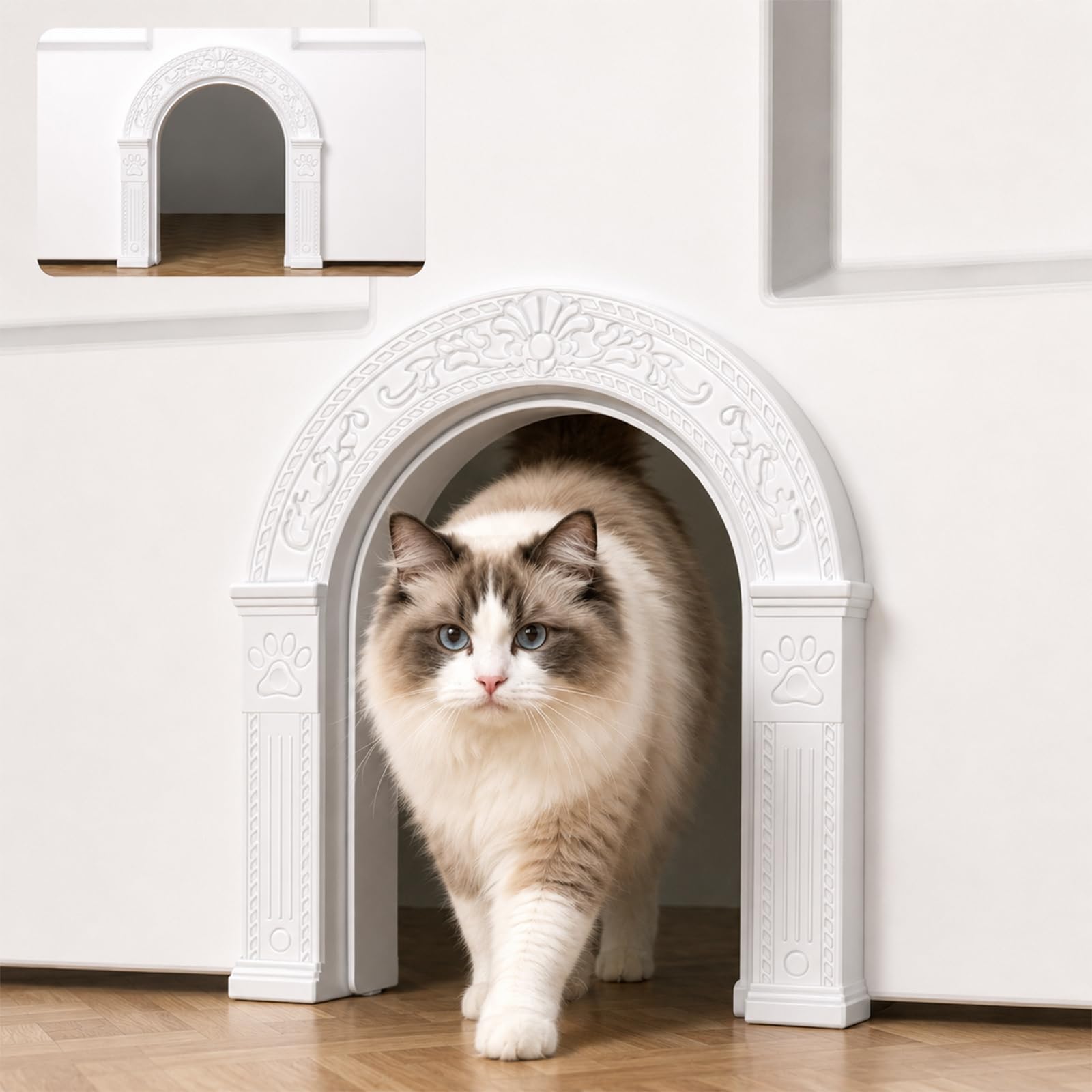
| Purrfect Portal Meow Manor★ Best Overall | Most bedrooms overall | 1.25″–1.75″ solid or hollow | No-flap, doorknob lock | Up to 20 lbs | Amazon |
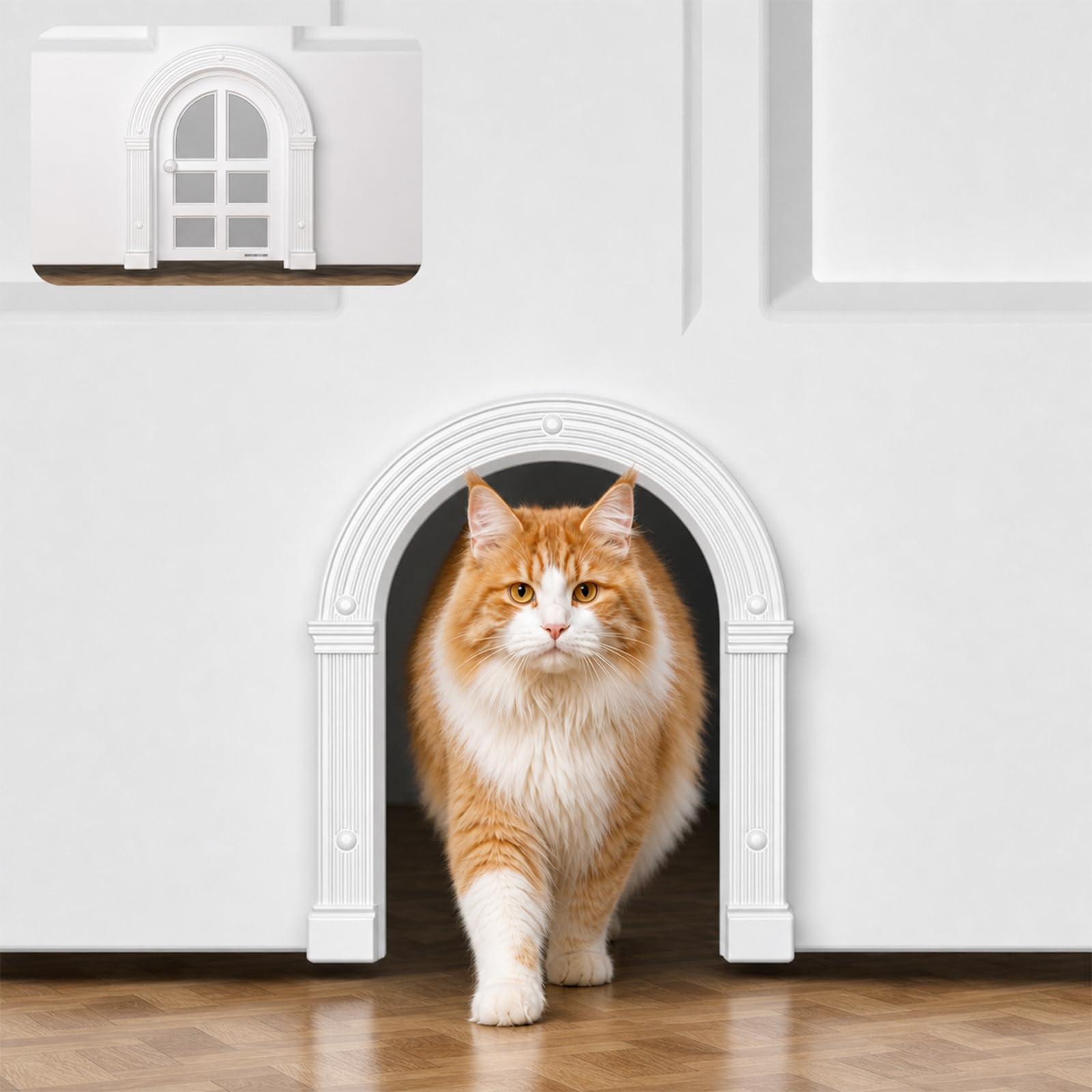
| XREY XL Cat Door (White)Roomiest Opening | Big cats, oversized opening | 1.25″–1.75″ hollow or solid | No-flap open design | — | Amazon |
| XREY XL Lockable Cat DoorBest Hinged Panel | Angle-adjustable hinged panel | 1.25″–1.75″ hollow or solid | Free-stop hinged, lockable | — | Amazon |
| The Kitty Pass Midnight Edition | Discreet black finish | 1.25″–1.75″ hollow or solid | Open pass-through hole | Up to 21 lbs | Amazon |
| Beacon Hill Interior Cat Door | Cats that need extra headroom | 1.25″–1.75″ hollow or solid | No-flap, lockable | Up to 20 lbs | Amazon |
| Gnome Door Interior Cat Door | Night-time litter-box duty | — | Lockable | Up to 20 lbs | Amazon |
| Purrfect Portal Meow Manor XL | Plus-size cats and small dogs | — | Lock | Up to 30 lbs | Amazon |
| Fairy Door Interior Pet Door | Keeping the bedroom door shut at night | — | No-flap, lockable | Up to 20 lbs | Amazon |
| Caremyworld Large Cat Door | Doors outside the standard thickness | 1″–2″ wood, PVC, metal | Magnetic flap, sliding lock | Up to 20 lbs | Amazon |
In‑Depth Reviews
1. Purrfect Portal Meow Manor® Cat Door Interior Door – No-Flap, Fits Cats Up to 20 lbs, Easy DIY Setup, No Training Needed
Our pick — over 4.5★ from 7,000+ verified ratings; the strongest balance of quality and price.
A no-flap interior cat door with a doorknob lock that seals the opening when you want the bedroom shut.
Here is the pick to start with if you want the least drama. The Meow Manor gives your cat a 9.4″ high by 9.2″ wide opening — roomy enough that a cat at the top of its 20-lb rating walks through without brushing its sides. That is roughly a hand-span-and-a-bit of clearance in both directions, so even a broad-shouldered cat takes it at speed. There is no flap at all. Your cat steps through an open hole, which is exactly why nothing bangs in the night and nothing can catch a paw or a tail on the way past.
What wins people over is how it looks once it is in. The peanut-brown frame with its little arched door reads like furniture rather than a pet gadget bolted to a slab, and the finish is the single thing owners rave about most. The lock is the clever part: a small doorknob turns to shut the opening, so the same hole that lets your cat into the bedroom can be sealed when you want the room to yourself. Practical touches hold up too — the frame fits both solid and hollow-core doors from 1.25″ to 1.75″ thick, and it arrives with real screws rather than the sticky tape a lot of pet doors rely on. Getting it in is a genuine DIY job: trace the template, cut with a jigsaw, screw the frame down. Buyers report finishing two doors in about 45 minutes.
The honest catch is the one every door here shares: once you cut, you have cut. There is no going back to a plain slab, and if you are not comfortable with a jigsaw, budget for someone who is. The second thing to know is that a couple of owners found the template sizing less forgiving than they expected, so measure twice before the blade goes in. Everything else about this door earns its place at the top — the crowd favourite sits at 4.8 stars across 7,400+ owners.
What actually sold owners
- Genuinely silent in use — no flap means no slap-back and no door noise at night
- Turns your bedroom door into a real door again: your cat comes and goes while the room stays sealed and cool
- Easy install with real screws and a template most owners finish in well under an hour
Where it asks a little patience
- The cut is permanent — every bedroom cat door here works the same way
- You may want to double-check the template against your own door before cutting
The pick for you: bedroom doors and litter-box rooms where you want quiet, no training period, and a lock you can actually reach.
Think again if: your cat is over 20 lbs — Purrfect Portal makes an XL version of this exact door for that.
2. XL Cat Door for Interior Doors Easy to Install in Minutes, No-Flap, White
An extra-large no-flap opening with a cutting template, sized for cats that outgrow standard doors.
The XREY XL exists because some cats simply do not fit the standard hole. It is an extra-large no-flap opening, and it comes with a cutting template so you can get the shape right on the first pass. It fits the usual 1.25″ to 1.75″ thickness range across both hollow and solid doors, which means it drops into almost any bedroom slab you already own. Because there is no flap, there is also no training period — the hole is open from the moment the screws go in.
This is the pick if your cat is wide as well as heavy. The most persuasive thing about it is how easily a genuinely big animal moves through: owners mention a 26-lb cat going in and out with no trouble at all, well past what most standard doors handle. A big cat that never hesitated is a big deal — you skip the whole “coaxing the cat through the hole with treats” phase.
The fair warning is the obvious one. Everything hinges on your cut, and the cutting is the hard part — the review pages sum it up best: “Cutting the door was the hardest part.” Lay something underneath if you are using a power tool, because a door resting on a hard surface will scratch the face you are not looking at. The frame is also the part most likely to need a second coat if you want a perfect colour match. Beyond that, this is a low-fuss door with a paint-ready finish and an opening that swallows large cats.
The real advantage: the extra-large opening handles cats far past the size a standard door comfortably clears, and the paintable frame lets you blend it into your own trim colour instead of accepting a factory white.
Worth knowing: the template makes the shape easy but your cutting accuracy still decides how clean it looks, and the XREY marketplaces ship this in a plain white finish that most owners end up customizing.
Reach for this if: your cat is genuinely oversized and you want the widest no-flap opening without jumping to a specialist build.
Look elsewhere if: you want the door to arrive finished in a colour you love — this one is designed to be painted by you.
3. XL Cat Door Interior Door, Lockable, Easy Installation in Minutes, No-Flap
The only door here with a free-stop hinged panel that holds at any angle you set.
Most cat doors give you two positions: open hole or blocked hole. This XREY does something different. The panel is hinged with a free-stop design, so it holds at whatever angle you set — fully open, half open, or shut. The outer frame measures 11″ high by 9.65″ wide, with an inner opening of 9.45″ high by 7.08″ wide, which the maker says suits everyone from a kitten to a large Maine Coon or Ragdoll. It fits the same 1.25″ to 1.75″ hollow or solid door thickness as the rest of the pack, and because there is no flap there is nothing for your cat to learn.
The free-stop hinge is the reason to buy it. A cat that wants to sit in the doorway at a half-open angle can; a cat that wants it clear can have that too, and you flip the panel shut on hot afternoons when the bedroom air conditioning matters. The frame itself is the modern arched shape, and the look lands well — the design reads clean and finished rather than gimmicky. Setting it up is a template-and-jigsaw job that most owners knock out in well under an hour on a standard slab, and the no-flap opening means a cat that has never seen a cat door before walks straight through.
The trade-off sits with the lock. A few owners have found the small plastic locking piece reluctant to rotate, which is a little frustrating if you specifically wanted to seal the room. The back face of the frame also shows less finish than the front, so if your cut line is jagged it will be visible from the hallway side — cut carefully or plan to cover the edge. Neither issue stops this being a genuinely useful door; it just means the locking feature is a convenience rather than a security guarantee. If you mostly want the adjustable angle, this delivers it in a way the plain no-flap doors cannot.
Why the hinge matters: a panel that holds at any angle gives you more control over airflow and noise than a simple open hole, and the frame’s arch shape looks deliberate on the door.
The honest gap: the locking piece can be stiff on some units, and the back side of the frame is less finished than the front, so your cut quality shows.
Suits you if: you want a door you can leave partially open for airflow and shut completely when your cat needs to be kept in or out.
Skip this one if: the lock is the main reason you are buying — grab a door with a doorknob-style latch instead.
4. The Kitty Pass Cat Door for Interior Door – Hidden Litter Box – Midnight Edition – Cats Up to 21 lbs – Jet Black
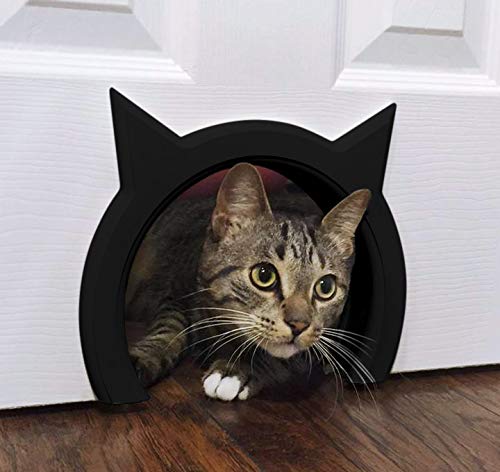
A pre-finished jet-black pass-through with no arch and no visible screws.
If your bedroom door is black or dark-stained, this is the one that gets out of the way. The Kitty Pass is a smooth, wide opening with no frame detail and no visible screw holes, which is the entire point: from across the room it reads as part of the slab rather than an add-on. The pass-through measures 7.5″ wide by 6.5″ high, it is rated for cats up to 20 lbs, and it fits hollow and solid interior doors from 1.25″ to 1.75″ thick. The jet-black composite PVC arrives fully finished, so there is no painting, no priming, and nothing to match.
The shape of the opening is doing quiet work here. It is wider than it is tall, which means a cat slips through low and flat rather than jumping up into a doorway, and there is nothing for a tail to snag on the way past. Owners describe their cats going through it with no hesitation at all, and for a door with no flap or hinge to investigate, that is exactly what you would expect. Installation runs under an hour for most people using the back piece as a template: trace the outline including the four screw channels, drill those channels, then cut the main shape with a jigsaw.
Two things to weigh honestly. First, the size splits opinion — some owners with larger cats find the opening generous, others find it snug, so measure your cat’s width across the shoulders before you commit. Second, this is the one door here that plenty of owners feel asks a lot for what is essentially a shaped hole; it does not offer a lockable panel or a hinge, so you are paying for the finish and the clean lines rather than features. If you want a black door with an invisible cat entrance, nothing on this list does it better.
What makes it stand out
- Comes pre-finished in jet black, so there is no painting and no extra cost to match your door
- Wide, smooth opening with no visible screws or logos keeps the look clean
- Template and instructions are accurate enough that most installs finish under an hour
Before you commit
- No lock and no hinged panel — it is an open pass-through only
- The opening dimensions feel snug to some larger cats, so check your cat’s shoulder width first
Go for it when: your door is dark-toned and you want the cat entrance to be the least visible thing in the room.
Not the one for: anyone who needs a closeable panel or wants the widest possible opening — pick a lockable or XL door instead.
5. Beacon Hill® Interior Cat Door – No Flaps, Stylish DIY Pet Door, Large Kitty Door for Cats Up to 20 lbs

A tall, lockable no-flap frame with clear printed instructions and a cutout pattern.
The Beacon Hill is the tall, generous one. It gives your cat real headroom and width instead of the minimum required, and the maker rates it for cats and dogs up to 20 lbs. It fits solid or hollow-core interior doors from 1.25″ to 1.75″ inches thick, and the panel is lockable, so you get privacy on demand without a swinging flap anywhere in the assembly. The whole design leans on being pretty as well as practical, from the arch shape down to the concealed litter-box role.
Where it earns its place is the installation experience. Owners who describe themselves as not confident with power tools report that this one went in easily, and the printed instructions and cutout pattern are clear enough to follow without second-guessing. The lockable panel is the second win: it can be held open so nothing rattles when you use the people door, which removes the annoying flapping that a standard cat flap produces every time you walk past. Cat owners who mounted it often describe their cat settling in immediately and seeming calmer for having its own way through rather than waiting at a shut door. A couple of owners have mounted theirs higher on the door than a typical cat door allows, which is useful if your cat likes to make an entrance.
Be clear-eyed about two limits. The latch is a hold-open or hold-shut mechanism, not a security bolt — it does not lock from both sides, so it is not a way to keep a determined dog out for good. And a few owners find that once your bedroom door starts closing behind the weight of the frame, the door can drag slightly on the threshold; sanding the bottom edge solves it. Neither is a deal-breaker. For a finished, attractive frame with a forgiving install, this is a strong middle-ground pick.
Where it wins: the extra height and width suit cats that dislike brushing their sides, and the lock-open panel stops the door rattling every time you use it.
The practical caveat: the latch holds the panel rather than securing the opening from both sides, and the added frame weight can make a door catch on its threshold.
Ideal choice for: households where the install must look neat, the cat dislikes squeezing, and a hold-open lock is all you need.
Better off with something else if: you need real two-way security or you want a modular lock you can operate from either side of the door.
6. Gnome® Door Cat Door for Interior Doors – No Flap, Lockable, Easy Installation, Fits Cats Up to 20 lbs
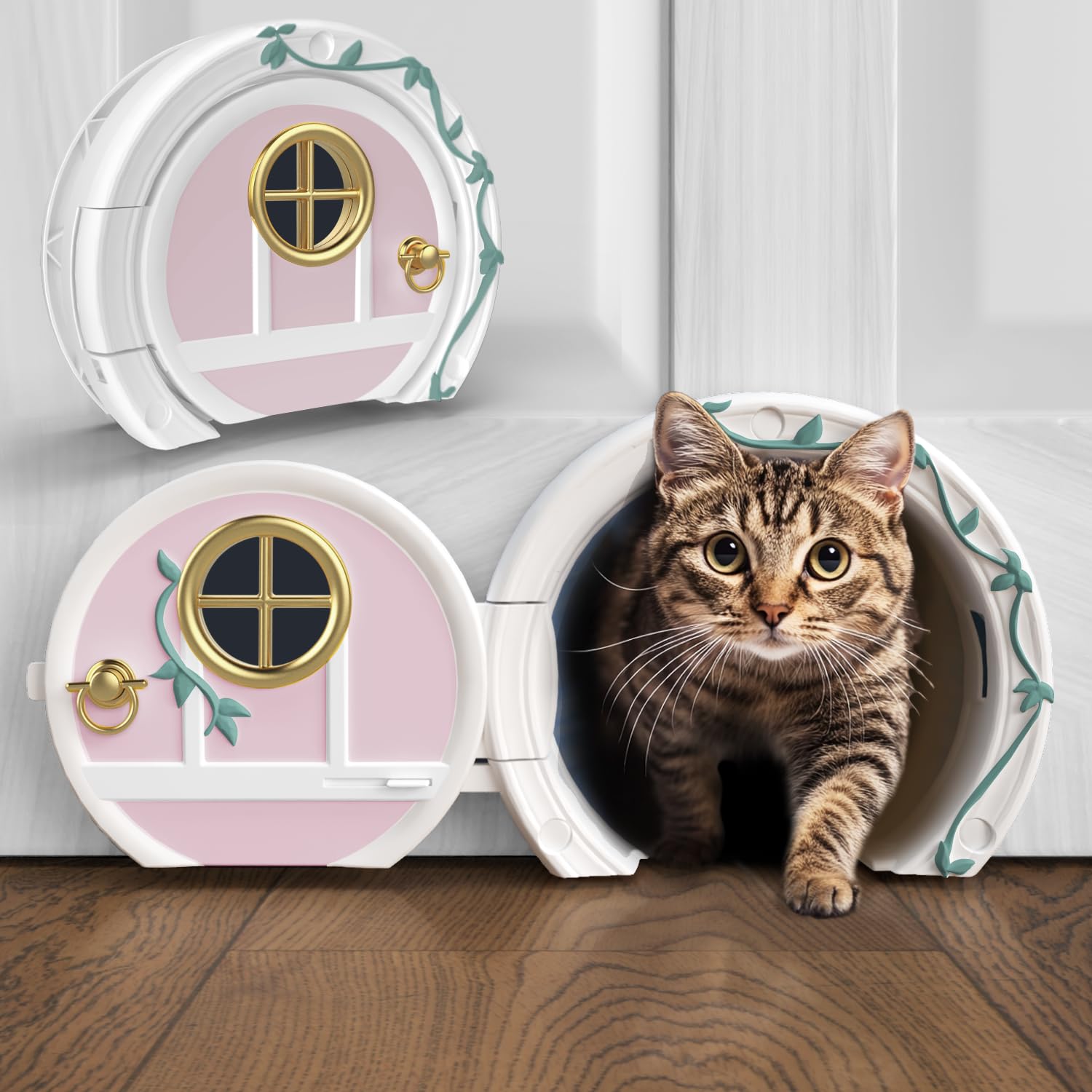
An arched, lockable no-flap door with a doorknob lock, built for night-time litter-box trips.
The Gnome Door earns its keep in the small hours. It measures 9.25″ by 10.83″ inches, it is built for cats up to 20 lbs, and the whole thing is designed around an arched door replica that looks like it belongs at the base of a tree. The charm is not the point though — the point is that customers note it working perfectly for night-time use, which is exactly the scenario bedroom cat doors are bought for. Your cat goes out for a drink or the litter box and comes back while you stay asleep and your door stays shut. There is no flap, so there is no clatter, and the design keeps the litter box out of sight behind a closed door.
Given how decorative it is, the honest note is that it is not for every room. If your bedroom is minimal and pale, a pink-and-gold gnome arch is a statement you have to actually want. And a small dog or large-cat household should check the opening against the animal’s real width, because the 20-lb rating describes a trim build rather than a big-boned one. Otherwise, this is a well-made, solid-feeling door that owners find pleasant to use and easy to install.
What wins people over: the lock and solid doorknob let you control access day and night without ever cutting a flap, and the build feels sturdier than the typical pet door.
The fit note: the whimsical pink-and-gold finish and the 20-lb ideal make this a style choice first and a size-sensitive choice second.
Match this to: a bedroom where character matters, the door is hidden behind a curtain of sleep, and the cat needs free passage at 3 a.m.
Choose another door if: you want a plain white finish or have a cat noticeably wider than the 20-lb ideal suggests.
7. Purrfect Portal Meow Manor® Extra Large Interior Cat Door – No-Flap, Fits Cats Up to 30 lbs, Black

The Meow Manor with a larger 10.25″ x 11″ frame, rated for cats up to 30 lbs.
Take the Meow Manor and make the hole bigger — that is the short version of this door. The frame measures 10.25″ by 11″ inches, comfortable for cats up to 30 lbs, which puts it in a different class from the standard models here. If your cat is the reason the last cat door failed, this is the one built for you. It keeps the no-flap design, the arched door look, and the front-mounted doorknob lock, and it installs the same way with a template, a jigsaw cut, and screws.
What wins people over here is the build quality. Owners consistently describe the hardware as solid and durable, with metal screws specifically called out instead of the flexible plastic fixings a lot of cat doors ship with. The little clear windows in the door give a cat the confidence to see what is on the other side before committing, which is a small detail that seems to help. Owners also note that once the frame is on, the doorknob catch will hold the door open on its own, so you are not propping anything. And the whole thing installs quickly — owners commonly report getting it done and the cat figuring out its new route in moments.
One installation note worth taking seriously: on a hollow-core door, only the top screw goes into facing, while the bottom screws need a real wood support to bite. Owners suggest pre-drilling your holes to avoid splitting the frame. Separately, once the frame is attached the door becomes slightly too deep to swing over the threshold, so you may need to lift it or sand the bottom edge. These are standard snags for any frame-heavy cat door, not defects. In return you get a door that feels substantial and holds up well.
Reasons owners recommend it
- The oversized 10.25″ x 11″ frame fits heavy built cats with room to spare
- Metal screws and solid construction get called out as noticeably sturdier than the competition
- Lock connects to a doorknob catch, so the door can be held open or shut without any flapping
Keep in mind
- Pre-drill your screw holes — a hollow-core door offers limited material to hold onto
- The added frame depth can make the door drag on the threshold until you sand or lift it
The best fit for: big cats, plus-sized cats, and households where the animal is a chunky maine coon mix.
Not quite right for: a flimsy hollow-core door you do not want to reinforce, or if you prefer a smaller, subtler opening.
8. Fairy® Door Interior Pet Door – Large Cat Door for Cats Up to 20 lbs, For Solid or Hollow Core, with Tight Lock

A lockable no-flap door with a 10.24″ x 10.63″ frame, so the bedroom door can stay shut at night.
This is the one built for a very specific, very common problem: you want the bedroom door closed at night, but you also want your cat to come in. The Fairy Door solves it with a 10.24″ by 10.63″ frame, a no-flap opening for cats up to 20 lbs, and a lock that holds the panel open or shut. No flap means no training and no banging at 2 a.m.
What people love about it, beyond solving the problem, is how it looks. Owners describe it giving off perfect fairy woodland vibes, and the tree-root-inspired arched frame sounds like the kind of detail your guests will comment on. The install gets consistently kind treatment too — owners single out the included paper cutout for making the cutting straightforward, which is the part of any cat door install most likely to go wrong. Practical points hold up: there is a real locking mechanism to keep the cat where you want it, the two-piece frame sits flush, and owners who bought a second one when they moved are extremely common. Cute, useful, and repeat-purchase popular.
The genuine caveat is measurement. This is a permanent cut, so you need to trace carefully and check your cat’s actual size against the opening before the saw comes out. A few owners have found it takes their cat a day or two to accept the new route rather than stepping straight through, so do not read hesitation as rejection. The size rating of 20 lbs also applies to the doorway, so a very large cat should consider the Meow Manor XL instead. For the bedroom-shut-at-night problem specifically, this is the pick that generates the fewest regrets.
The standout detail: a two-piece frame with a tight, lockable panel that closes cleanly enough to keep the room dark and quiet while the cat comes and goes.
Worth checking: the cut is permanent and the 20-lb rating means very large cats should size up to an XL model.
Best for: bedrooms where the door must stay shut at night for light and privacy but the cat must still be able to sleep on the bed.
Not for: a household with a cat well over 20 lbs — look at the Meow Manor XL instead.
9. Large Cat Door with Sliding Lock Panel and Magnetic Flap
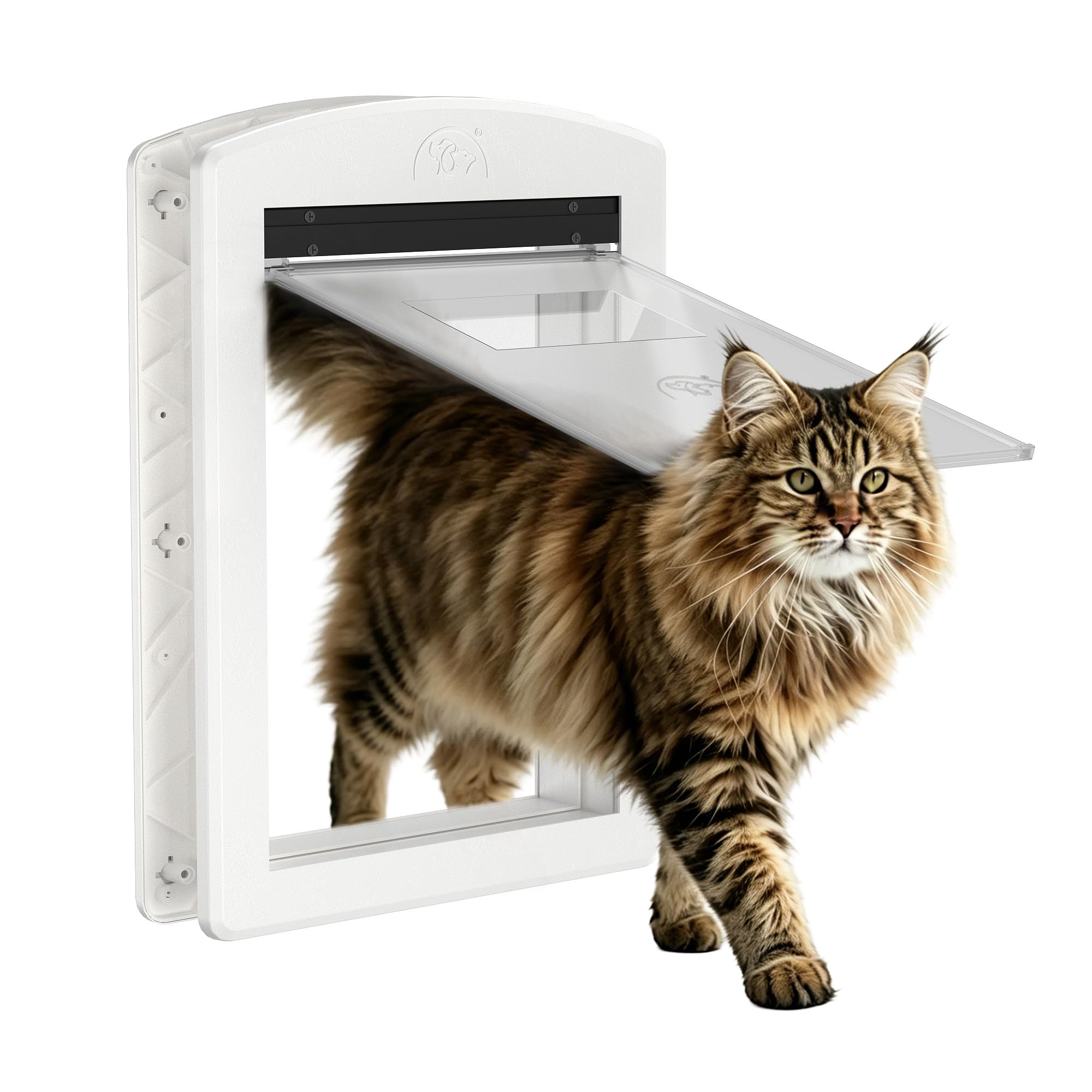
The only door here that handles thick doors, thin doors, and just about everything between.
Most doors on this list fit a 1.25″ to 1.75″ slab. This Caremyworld stretches wider — it works on paneled, wood, PVC, and metal doors from 1″ to 2″ thick, which makes it the answer if your bedroom slab falls outside the standard window. The frame is substantial at 11-5/8″ wide by 16-7/8″ high, with a flap opening of 8-3/4″ wide by 12-1/4″ high, and it is rated for pets up to 20 lbs. It ships with a cut-out template and step-by-step instructions, and Caremyworld offers free lifetime replacement of any missing or broken part caused by the maker.
Unlike everything else on this list, this one uses a magnetic flap with quiet brush strips, so it closes rather than sitting permanently open. Solid magnets hold the flap against the frame, which helps block airflow between the two rooms, and the brush strips cut down the noise when it swings. The sliding lock panel is the smarter detail, though: because it slides across as a single piece, it seals more positively than a snap-on cover. Owners doing exactly this job — moving a cat box out of a room and letting the cat travel between them — report it working cleanly and going in easily. One common use case is a garage or utility room, where the cat gets access without you propping a door open.
Two honest notes on this one. The frame plastic is thinner than the pricier doors here, so do not overtighten the screws or you will risk stripping the fixing; a couple of owners have flagged this and it is worth handling with care. And a magnetic flap is a magnetic flap — one buyer found theirs too stiff for their cat to push and had it fail, while others report years of use. If your cat is elderly or hesitant about flaps, a no-flap door is the easier route. For non-standard door thicknesses, this is your best option by a wide margin.
Why it works for the awkward jobs
- The 1″ to 2″ thickness range covers doors other cat doors here simply do not fit
- Sliding lock panel seals the opening better than a snap-on cover when you want the passage shut
- Magnetic flap with brush strips keeps draughts out and reduces noise versus an open hole
Where to be careful
- Thinner frame plastic means screws need a light touch — do not overtighten
- The swinging flap needs to be pushed both ways, so it may not suit a timid or elderly cat
Choose this when: your door is thinner or thicker than standard, or you want the opening about 12″ high for a tall cat.
Pass it over if: your cat has never used a flap — you will be back to teaching it, and the no-flap doors avoid that entirely.
Understanding the Specs
Door Thickness Fit (the measurement that decides everything)
Your interior door slab has a thickness, and every cat door is machined to span a range. The standard across most of this list is 1.25″ to 1.75″ inches, which covers a typical bedroom door. If your door measures outside that, the frames simply will not sit flush, and the mounting screws will either float or crush the frame. One door on this list handles a wider 1″ to 2″ range, which is note if your home has unusually thin slabs or heavier solid doors. Measure the edge of your door before you buy anything, and remember the product only fits hollow or solid core doors unless it says otherwise.
Opening Size vs. Weight Rating
Every listing quotes a maximum weight, but a cat is not a sphere. What actually decides whether your cat fits is the pass-through height and width, plus how low to the floor the opening sits. A 20-lb cat with a long, narrow frame may fit an opening far more easily than a 15-lb cat with a broad chest. Rather than trusting the weight figure alone, picture your cat stepping through at pace and check the listed dimensions against that reading. If the weight rating is close to your cat’s actual weight, size up to a wider opening — the gap between a comfortable entry and a tight squeeze is where most buyer frustration lives.
FAQ
Can I install a bedroom cat door on a hollow-core door?
Do these cat doors need to be cut into the door?
Will a bedroom cat door work if my cat is overweight?
Can a cat door keep my bedroom silent at night?
Are cat doors with flaps harder for cats to learn?
Can a cat door let dogs into the bedroom by mistake?
Will a cat door let air out of my air-conditioned bedroom?
What is the difference between a no-flap cat door and a flap cat door?
How long does a cat door last on an interior door?
Can I remove a cat door and make the door look normal again?
Final Thoughts: The Verdict
For most bedrooms, the best bedroom cat door is the Purrfect Portal Meow Manor, because it gets the essentials right — a silent no-flap opening sized for cats up to 20 lbs, a doorknob lock you can operate without bending, and a finished look that stops it feeling like a pet gadget bolted to a slab. Its 4.8 stars across 7,400+ owners is not a marketing number; it is what happens when a door quietly works. If your cat is bigger than the standard weight class, the Meow Manor XL gives you the same design with a 30-lb rating and a 10.25″ x 11″ frame. And for the specific job of keeping the bedroom door shut at night while your cat still sleeps on the bed, the Fairy Door is the one most owners end up recommending to friends.
Whichever you pick, measure your door thickness first, then the opening against your cat’s actual shoulders. Get those two numbers right and the rest is a jigsaw afternoon.
How We Picked
We do not accept paid placement. Every pick is matched to a real buyer and a real use-case; we do not hands-on test units.
Sources & Methodology
Specifications: manufacturer listings and product documentation. Review insights: verified customer reviews, as of September 2026. Pricing: not shown on this page (it changes often); check the current price via the retailer link.
As an Amazon Associate, KitchPrep earns from qualifying purchases. This does not affect which products we feature.
Related Guides
