
Specs are compiled from manufacturer listings and verified buyer reviews and can change over time — please confirm the key details on the product page before buying.
An automatic needle threader should end the hardest part of sewing — getting the thread through that tiny eye. That is exactly what you are paying for, and it is also the feature that fails most often on cheap machines. This guide separates the machines whose threading systems actually hold up from the ones that make you buy a manual threader anyway.
I’m Mohammad Maruf — the founder and writer behind KitchPrep. This guide is built by comparing the manufacturers’ published specifications and the patterns across verified customer reviews, so you get each pick’s real strengths and trade-offs instead of marketing spin.
If you want to stop squinting at the needle, the safest pick for most people is the Brother XM3700 with 37 stitches. It is the crowd favorite, holding 4.7 stars across 900+ owners. Every pick below has a genuine built-in needle threader, not just a listed “threading helper.” The rest of the list runs from a 5.5-pound travel machine to a 586-application workhorse, and this breakdown of the automatic needle threader sewing machine market covers which one earns its spot.
Our Picks at a Glance


How To Choose The Best Automatic Needle Threader Sewing Machine
The automatic needle threader is a small hook that swings down, grabs your thread, and pushes it through the needle eye for you. On a good machine it takes one pass. On a bad one it misses, bends, or jams, and you go back to threading by hand. So the threading system is the first thing to check, not the last.
Start With the Threading System, Not the Stitch Count
A machine with 100 stitches and a threader you cannot use is worse than a machine with 19 stitches and a threader that works every time. Look for wording like “one-step automatic needle threader” or “improved needle threader” — those phrases describe a dedicated mechanism. Machines that only say “easy threading” are describing a guide line, not a threader.
Match the Stitch Count to Your Actual Projects
Utility stitches cover hemming, seams, and mending, which is most of what a beginner does. Decorative and stretch stitches are a bonus. A 19-stitch machine with a four-step buttonhole covers ordinary clothes repair fine, while 150 to 586 stitch applications matter mainly if you quilt or do decorative work.
Weight and Table Size Decide Where the Machine Lives
A 5.5-pound machine can sit on a shelf and come out for a hem. A 16.6-pound machine stays on a table because moving it is a chore. If you quilt, an included wide table supports the fabric so it does not drag. If you sew cuffs and sleeves, a free arm matters more than table size.
Check What Is Actually in the Box
Presser feet, bobbins, and a hard cover are the accessories that cost real money later. A machine that ships with a walking foot, a zipper foot, and a buttonhole foot is ready for more work on day one. A machine with one foot means a follow-up order before your second project.
Quick Comparison
| Model | Best For | Stitch Count | Item Weight | Included Feet | Amazon |
|---|---|---|---|---|---|
| Brother XM3700★ Best Overall | First machine, all-round use | 37 | 12.5 pounds | 5 | Amazon |
| Brother CP100XBest for Quilting | Quilting and thick fabrics | 100 | 10.5 pounds | 10 | Amazon |
| PooLin EOC02Max Stitch Variety | Max stitch variety on a screen | 200 | 7.5 kg | 7 | Amazon |
| Janome MOD-19 | Quiet, sturdy everyday sewing | 19 | 11.7 pounds | 4 | Amazon |
| SINGER 6800C | Heavy fabrics and lettering | 586 applications | 16.6 pounds | 10 | Amazon |
| FEIYUE FYe390 | Slow, controlled stitching | 23 | 13.6 pounds | 5 | Amazon |
| FEIYUE FYe360 | Screen-guided beginners | 23 | 13.6 pounds | 5 | Amazon |
| MILLEPUNTI MKR45 | Light travel projects | 25 | 14.9 pounds | 4 | Amazon |
| All-in-One 728 | Tiny budget starter | 16 | 5.5 pounds | — | Amazon |
In‑Depth Reviews
1. Brother XM3700 Sewing Machine 37 Built-in Stitches
Our pick — over 4.5★ from 950+ verified ratings; the strongest balance of quality and price.
The 37-stitch Brother that hands you a threaded needle and a jam-resistant bobbin
The XM3700 is the machine to buy if you want one pick that will not strand you. It carries 37 unique built-in stitches, a one-step auto-size buttonhole, and a drop-in top bobbin that resists jamming. That bobbin design matters on a beginner machine — you drop the bobbin into a clear well instead of fishing it up from underneath, which is where most cheap machines start fighting you.
The threading system is the headline. Brother calls it a one-step automatic needle threader that pushes the thread through the needle eye for you, and the manual backs it up with clear directions. What wins people over is performance — a heavy camo hunting vest with a buckle, zipper, and game pouch got repaired on this machine, thick canvas and webbing included, by someone who does not sew. It also runs on felt, lifts with one hand, and one 40-year sewing veteran turned out 30,000 masks on it.
Compared with the Janome MOD-19 below, the XM3700 carries 37 stitches against 19, and versus the MILLEPUNTI MKR45 at 25 stitches it leads by 12. It weighs 12.5 pounds and ships with 5 sewing feet — zigzag, zipper, blind stitch, buttonhole, and button sewing — plus 4 bobbins, a twin needle, and a 3-piece needle set.
37 built-in stitches
- 37 stitches and a one-step auto-size buttonhole cover garment work and mending
- Drop-in top bobbin sits in a clear well and resists jamming
- 5 included feet plus bobbins and needles — usable on day one
- Free arm lets you sew cuffs, sleeves, and baby clothes without fighting the fabric
- 12.5 pounds is light enough to lift with one hand and store on a shelf
mechanical tension dial
- A few buyers report the self-threading hook can be fussy, so guide the thread slowly
- Built for US 120-volt outlets only — using it abroad voids the warranty
- The free arm and buttonhole foot both take a practice run before they feel natural
first machine: a first machine that has to handle hems, craft felt, and the occasional thick repair without a fight.
want digital: you plan to quilt large panels and need a wide table from the start.
2. Brother CP100X Computerized Sewing and Quilting Machine
A 100-stitch quilting machine with a fixed needle bar for straighter seams
If your projects are pillows, quilts, or anything with layers, this is the pick. The CP100X carries 100 built-in stitches with utility, decorative, and heirloom functions, plus 8 auto-size buttonholes. Its metal frame is built to take thick denim and heavy quilts without flexing, and the fixed needle bar holds the needle steady so your stitch lines stay even.
The threading is the part Brother improved here — a 1-step automatic needle threader described as easier to use, reliably pushing the thread through the needle. That fixed needle bar works with it, because the needle stays in one position while you thread. The included kit is generous: a wide table, 10 sewing feet plus a quilt guide, and a protective hard case.
Owners sew denim, cotton, and webbing with no tension issues and call it a workhorse. One 64-year-old beginner with back trouble runs it without the foot pedal at all, controlling everything from the buttons above the needle. Another replaced an older Brother with this one and rates it a favorite. The honest catch is the needle threader mechanism itself — it is described as bulky, and more than one owner simply has not figured out the angle yet, so budget a few minutes to learn it. Thread can also tangle on the bobbin post during winding, which is solved by guiding the thread by hand.
quilting extension table: 100 stitches and 8 buttonholes at 10.5 pounds, with a 12″D x 20″W x 17″H body that needs real table space.
quilting starter: you want one machine that goes from hemming to quilt assembly and comes with the hard case to protect it.
need speed control: you want a threader that takes zero learning — the mechanism here needs a couple of test runs first.
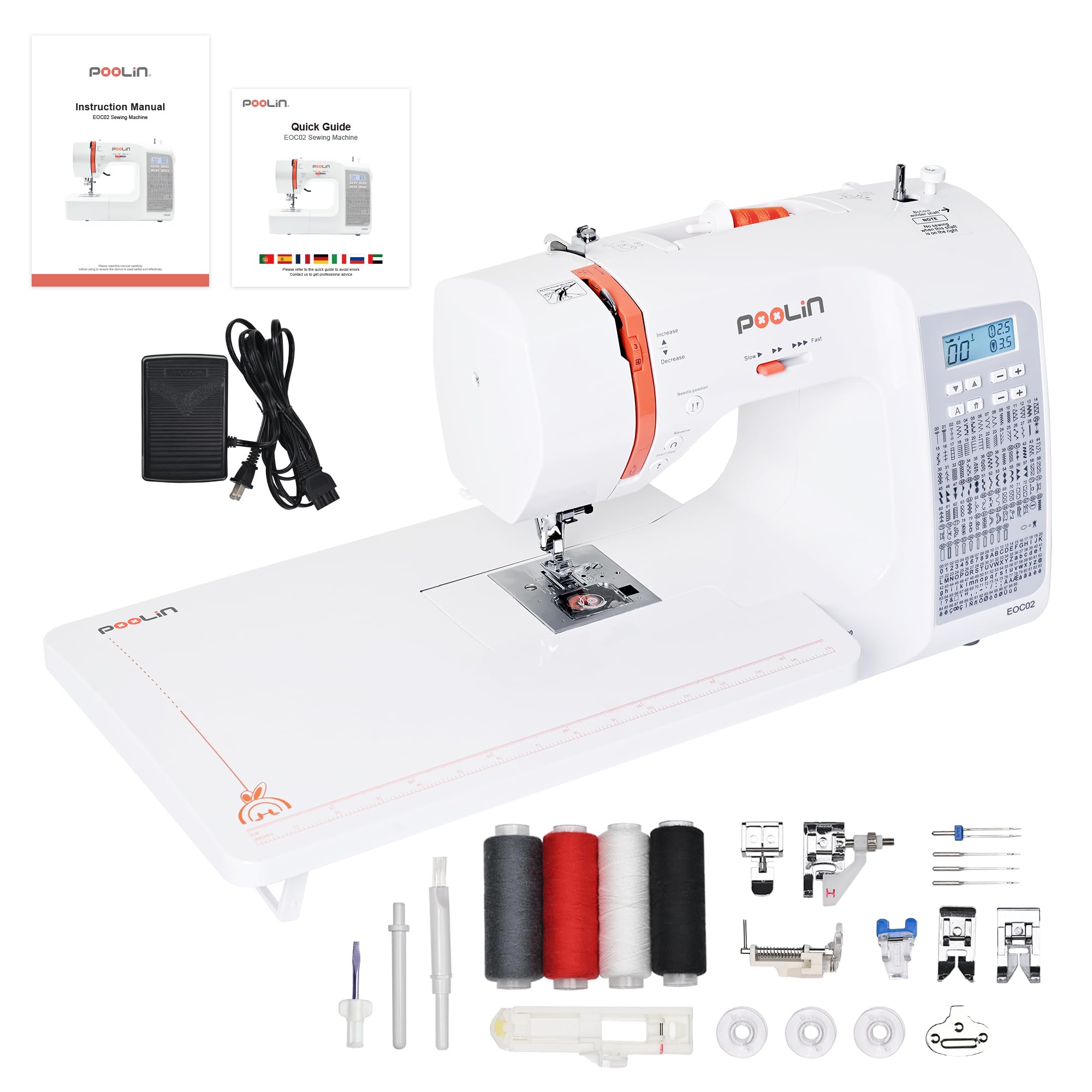
3. PooLin EOC02 Computerized Sewing Machine, 200 Stitches
200 stitches on a screen, with a wide table and seven presser feet in the box
The EOC02 is the machine for someone who wants choices. It holds 200 built-in stitches, including utility, decorative, and alphanumeric patterns, all shown on an LCD screen so you pick by number instead of guessing at a dial. Seven presser feet come included, and the extra-wide table gives quilts and bulky material somewhere to rest instead of dragging off the edge.
Beginners get along with this machine because the controls do the hard parts for you. A speed control slider lets you slow down for curves, a start/stop button lets you sew without the foot pedal, and a needle position button lifts the bobbin thread with one click. The screen shows different error prompts, so you know what went wrong instead of guessing. The fabric range covers satin, silk, jersey, cotton, denim, velvet, and layered work up to 6mm thick. One owner completed two quilted throws and reported even, beautiful stitches, while another finished a toddler vest with what they called professional results.
Be realistic about the ceiling. This machine is not a heavy-duty unit — three layers of fabric plus binding will make it struggle and stop, so it is the wrong tool for upholstery-weight work. The stitch count is also worth reading carefully: one long-time owner replaced a vintage Singer and Bernina with this machine and loves the consistent tension, while a disappointed buyer could not get it through a thick stack. Buy it for variety and control, not for thick layers.
pattern variety: best for anyone who wants the widest stitch menu and a large workspace for quilting and garments in light to medium fabrics.
brand loyalty: your projects are mostly denim hems and multi-layer bags — you need more punch than this delivers.
4. SINGER 6800C Heavy Duty Computerized Sewing Machine

The 16.6-pound workhorse that sews leather and letters its seams with a built-in cutter
This is the machine for thick material and heavy repetition. The 6800C pairs a metal frame with a high-performance motor the maker rates 60% stronger than standard, running up to 1,100 stitches per minute. The intended fabrics are denim, canvas, and leather. If your ideas involve bags, jackets, or anything with real weight, this is the frame that will not flex under it.
The feature list is the deepest here. You get a built-in needle threader, a top drop-in bobbin with a transparent cover, a built-in thread cutter, a tie-off button, and drop feed for free-motion sewing. Adjustments run to 6mm stitch length and 5mm width, and the LCD screen shows stitch images plus presser foot recommendations so you always know which foot belongs on. Ten presser feet ship in the box, including an Even Feed / Walking Foot and an Open Toe Foot, plus 4 Class 15 transparent bobbins and a soft cover.
Owners bring up durability: one new sewist made 30 quilts on it, it runs quiet, and it is a smooth upgrade from a beginner machine. The automatic threader works, but it has a rule — the needle has to sit at its highest position or the hook will not catch. Learn that one habit and it behaves. A few owners also find the button beep sounds annoying and want them switched off in settings.
heavy duty frame: 586 stitch applications across basic, stretch, and decorative patterns, plus 2 lettering fonts and 9 one-step buttonhole styles for personalized labels and monograms.
thick fabrics: denim, canvas, leather, and quilt volume — the 1,100 stitches per minute rate and the metal frame are built for it.
delicate fabrics: you want a machine to move between rooms — at 16.6 pounds it lives where you put it.
5. Janome MOD-19 Easy-to-Use Sewing Machine with 19 Stitches

Nineteen stitches, a quiet metal body, and a warranty that outlasts the trend
Most buyers never need more than nineteen stitches, and this machine bets on that. The MOD-19 carries 19 stitches including a four-step buttonhole, a built-in needle threader, and a top-loading bobbin under a clear cover so you can see the thread level without lifting anything. Stitch length and width are both adjustable. Four presser feet are included, and the free arm and drop feed cover the small cylindrical jobs.
Quality is the reason this one holds its position. Owners describe it as quiet, lightweight but sturdy, and easy to thread, and one used it to repair a comforter without trouble. A long-term owner reports no problems over extended use and clear instructions in the book. The metal body and 25-year limited warranty separate it from the plastic-bodied machines in this price range.
Two honest notes. The first is light: one owner deducted a star because the sewing area is dim and added strip lighting beyond the small built-in bulb. That split is real, and it depends on whether you value the metal build and warranty over a longer stitch menu.
simple sewing: if you want a machine that sews quietly for years and comes backed by a 25-year limited warranty, the low stitch count is not a problem.
advanced features: anyone who wants decorative stitch menus or a screen — 19 stitches is the whole menu.
6. FEIYUE FYe390 Sewing Machine, Energy Saving Servo Motor
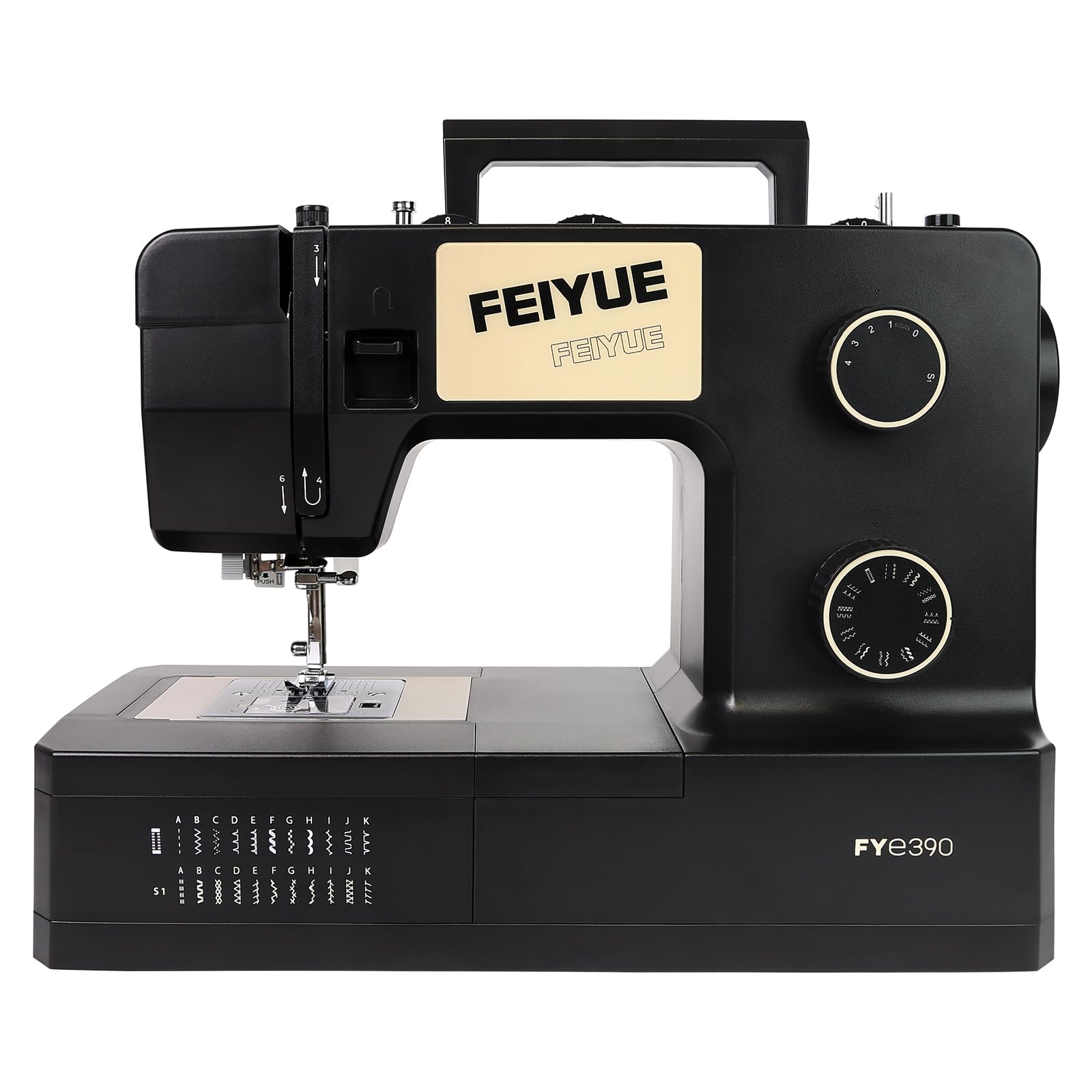
Slow-speed control for tricky fabrics, plus a light that blinks before you break something
The FYe390’s best trick is what happens when a seam goes wrong. If the thread tangles or the machine overloads, sewing stops on its own and the light blinks to tell you. You clear the jam and carry on, which saves both the motor and whatever you were stitching. That protection system is the reason to look here rather than at a plain mechanical machine.
Control is the other strength. It runs 23 built-in stitches across utility, decorative, and stretch patterns, with adjustable needle positions — left, center, and right — plus a needle up/down control. Seam placement for zippers and edge stitching gets noticeably easier with those options. The reinforced metal frame and high-torque motor hold a stable, very slow speed when you need it, which is exactly what delicate work and thick denim both call for. Threading is automatic, and the kit includes 6 bobbins, 3 needles, 5 presser feet, and a foot pedal.
Where it asks patience: the machine wants specific bobbins. Generic ones can cause thread tangles, so buy the correct type with the machine rather than raiding a drawer later. One owner also found the stitch length shortens as speed rises, meaning slow sewing and fast sewing do not produce identical stitches. Learn which speed suits your fabric and the results stay consistent.
energy saving servo: FEIYUE rates the servo motor at 10% higher efficiency and up to 35% more energy saved than traditional induction motors, and it holds smooth power at crawling speed without stalling.
quiet operation: sewers who want slow, deliberate control for zippers, delicate fabric, and thick layers, with a built-in warning when something jams.
stitch variety: you would rather thread a machine with any bobbin you have on hand.
7. FEIYUE FYe360 Sewing Machine, Adjustable Sewing Speed, LCD Display
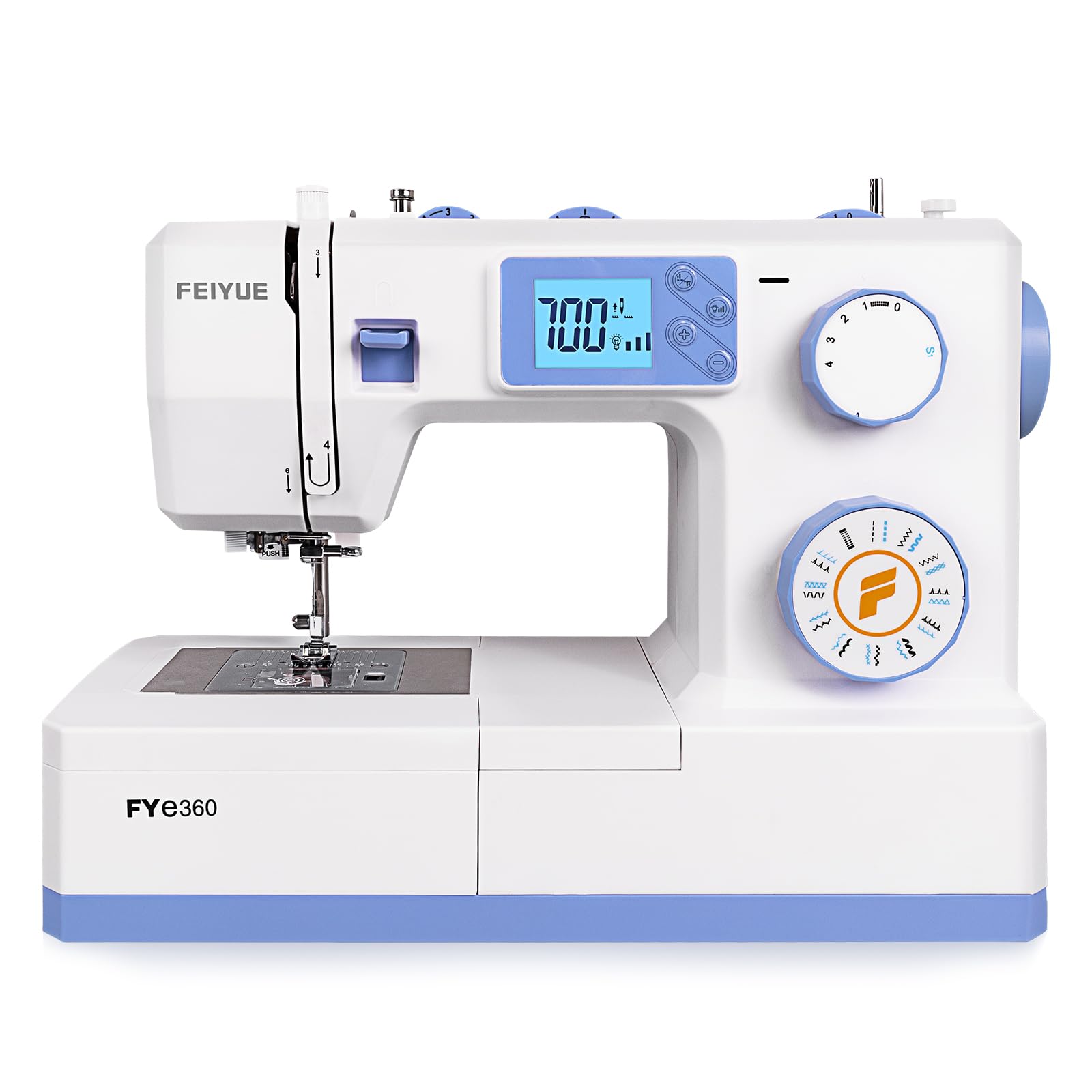
Buttons where dials usually sit, so needle position and speed are one press away
This is the sibling to the FYe390 above, and the split between them is the control panel. The FYe360 puts needle up/down position, adjustable sewing speed, light brightness, and start/stop settings on quick-access buttons, all shown on a digital display. If you like seeing a setting before you commit to it, this layout is friendlier than a row of manual dials.
The rest of the machine matches its stablemate: 23 built-in stitch patterns across utility, decorative, stretch, and buttonhole work, an automatic needle threader, and the same servo motor. The maker rates the same servo motor at 10% higher efficiency with up to 35% energy saved versus traditional single-phase induction motors. The same jam protection applies — tangle the thread or overload it and sewing stops while the light blinks. A metal frame and high-torque motor hold ultra-low speed for delicate fabric while still pushing through multiple layers of denim. The kit includes 6 bobbins, 3 needles, 5 sewing feet, and a foot pedal.
Read the feedback honestly before choosing this one. The positive notes center on the clear instruction video, easy setup, smooth stitching, and enough power to surprise a first-time owner. The negative notes are not minor — a couple of owners mention a seized motor and a machine that lasted months rather than years. That pattern is worth weighing against the lower price. Buy from a seller with a straightforward return path and keep the first few weeks of use as your test.
speed control: a beginner who wants a digital display, adjustable speed, and 23 stitch patterns without paying screen-machine prices.
metal parts: this is your only machine and you need years of dependable service — the reliability record here is thinner than the Brother alternatives.
8. MILLEPUNTI MKR45 25 Stitches Beginner Sewing Machine, Auto Needle Threader
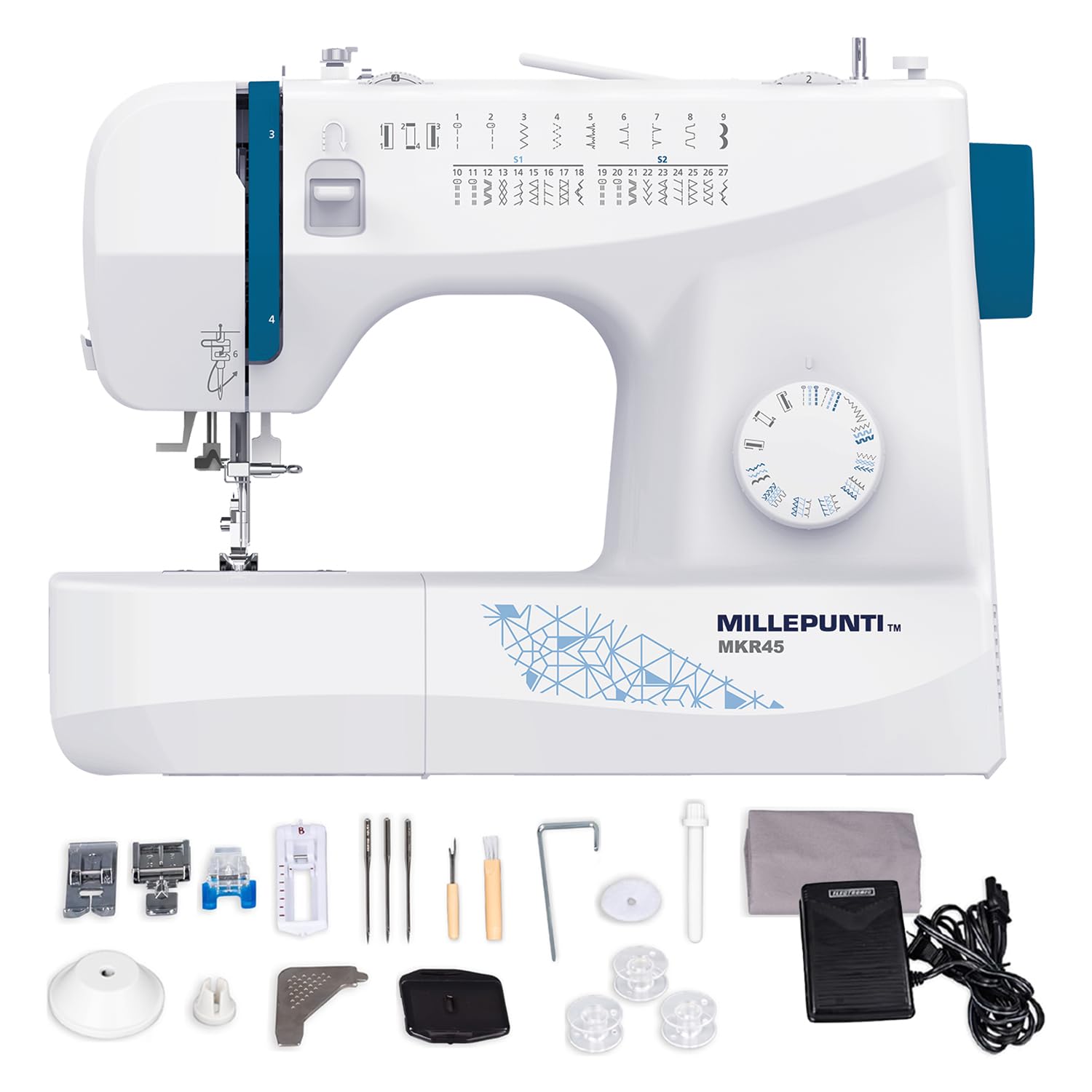
Twenty-five stitches, an auto threader, and a footprint that tucks into a closet
The MKR45 is the compact pick — 6.49″D x 13.77″W x 10.6″H, which is the smallest body on this list by a wide margin. That matters if the machine has to share a desk or come down off a shelf for each project. It carries 25 distinct built-in stitches, including decorative options, and it handles everything from delicate fabric to heavier material. The free arm surfaces for hemming pants, cuffs, and sleeves, and it works for doll clothes and pet accessories too.
Automation covers both ends of the setup: a built-in automatic needle threader and an automatic bobbin winder for uniformly wound bobbins. Owners call the setup easy and the machine quiet, and it handles all fabrics well for the price. One first-time user bought a second unit for a sister. You also get 4 sewing feet, 3 bobbins, a variety pack of needles, a seam ripper/brush combo, a quilting guide, and a non-woven fabric dust cover.
Here is the honest catch, and it is the one feature you would least expect: the automatic threader is the mixed part. Some owners find it a breeze, while others say it does not function properly and they went out and bought a manual easy threader instead. That is worth knowing before you buy, because the threader is the whole reason to pick this category. The rest of the machine earns its keep, but a specific one in three gets a threader that misbehaves.
learning basics: space is tight, the price is right, and 25 stitches covers your mending and craft work.
heavy use: the automatic threader is non-negotiable for you — reliability on that specific part is inconsistent here.
9. All-in-One Sewing Machine for Beginners, 16 Built-in Stitches
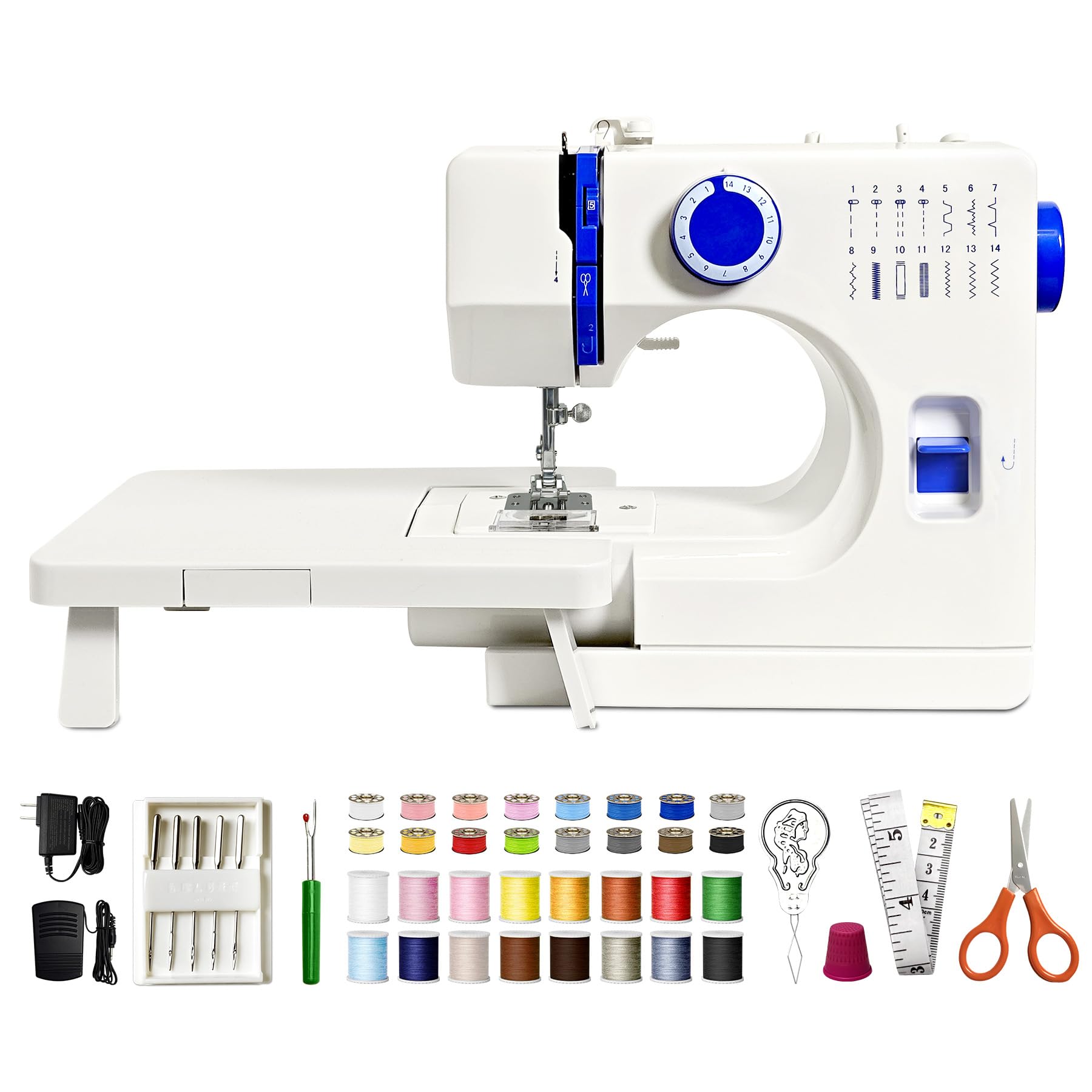
A five-and-a-half-pound starter with two speeds and a light over the needle
At 5.5 pounds this is the lightest machine on the list, and that is its whole case. It sits on a dorm shelf, goes in a bag, and comes out for a hem or a craft afternoon without being a commitment. You get 16 built-in stitches with essential stretch, decorative, and zigzag options, plus a one-step buttonhole. Both a foot pedal and a start/stop button are included, and you can choose between two speeds.
First-time users get a one-step automatic needle threader, a drop-in bobbin, and a bright built-in LED light that illuminates the needle area so you can see details on dark fabric or in the evening. It ships with thread spools, scissors, and a needle kit. That is a full starting kit rather than a bare machine, and the slower speed setting is what makes it usable for a child learning to sew.
Set expectations on power and consistency. A hemming job on ordinary trousers stalled for one owner, who could not get the needle to keep moving through a non-denim trouser leg. Another machine arrived switching off and on with bent needles. Those are real reports, and they fit a 3.6-star pattern rather than a fluke. Treat this as a light-project machine — crafts, mending, simple seams — and it delivers on the price.
entry level: a gift machine for a young beginner or a pickup-and-go crafts tool where light weight matters most.
experienced sewers: you need to hem trousers, sew through layers, or want the machine to stay reliable after the first month.
Understanding the Specs
Automatic Needle Threader
This is a small built-in hook that pulls your thread down and pushes it through the eye of the needle, so you are not squinting at a hole the width of a hair. It only works when the needle sits at its correct position, usually fully raised. On the SINGER 6800C and the CP100X, owners treat the threader as usable but picky about needle height. On the MILLEPUNTI MKR45, the threader is the most inconsistent feature. A working threader saves you from re-threading by hand every time a seam pulls out — which is the reason to pay for it at all.
Stitch Count vs. Fabric Weight
Stitch count measures variety, not strength. A 586-application machine and a 19-stitch machine both sew a straight seam; the difference is which decorative, stretch, and buttonhole patterns you can reach without changing the setup. What actually limits fabric is the motor and frame. A machine with a reinforced metal frame and a high-torque motor, like the FEIYUE FYe390 or the SINGER 6800C, handles denim and layered work that a lighter 5.5-pound machine will stall on. Match stitch count to your projects and motor strength to your fabric.
Drop-in Bobbin and Jam Resistance
A drop-in (or top-loading) bobbin drops into a clear well on top of the machine instead of being threaded from underneath. You can see the bobbin through the cover, which tells you how much thread is left without taking anything apart. Brother uses a jam-resistant drop-in design on the XM3700, CP100X, and CS7205. The cover version on the Janome MOD-19 works the same way. If tangle checks are a regular part of your sewing day, this one design choice cuts most of that time.
Free Arm and Wide Table
These two features solve opposite problems. A free arm removes the flat bed and leaves a narrow column so you can slide a pant cuff or sleeve around it. A wide table does the reverse — it extends the flat surface so a quilt does not drag and pull your stitches. Machines on this list give you one, the other, or both. The Janome MOD-19 and Brother XM3700 have free arms. The CP100X, PooLin EOC02, and CS7205 include wide tables. Buy the one that matches what you sew.
FAQ
How does an automatic needle threader actually work on a sewing machine?
Why does my automatic needle threader keep failing?
How many stitches do I actually need on a beginner machine?
Can these sewing machines sew denim or leather?
What is the difference between a drop-in bobbin and a front-loading bobbin?
Do I need a wide table if I only sew clothes?
How much does a sewing machine with an automatic needle threader weigh?
Is a computerized sewing machine better than a mechanical one for beginners?
What accessories should come in the box with a beginner sewing machine?
Can I use any bobbin in any sewing machine?
Final Thoughts: The Verdict
For most people, the winner is the Brother XM3700 because it pairs a genuine one-step automatic needle threader with a jam-resistant drop-in bobbin, 37 stitches, and a free arm that handles cuffs and sleeves. It will not strand you mid-project, and its price sits in the middle of this field rather than the top. If quilting is the goal, grab the Brother CS7205 for its 11 included feet, walking foot, and wide table. And if thick denim, canvas, or leather is your regular material, the SINGER 6800C is the one to reach for — its metal frame and 1,100-stitch-per-minute motor are built for the weight.
When you are ready to buy, start with the pick that has the deepest owner track record rather than the highest stitch count. The threader is the feature you touch every time you sit down to sew, so it is the one worth getting right.
How We Picked
We do not accept paid placement. Every pick is matched to a real buyer and a real use-case; we do not hands-on test units.
Sources & Methodology
Specifications: manufacturer listings and product documentation. Review insights: verified customer reviews, as of September 2026. Pricing: not shown on this page (it changes often); check the current price via the retailer link.
As an Amazon Associate, KitchPrep earns from qualifying purchases. This does not affect which products we feature.
Related Guides
