
Specs are compiled from manufacturer listings and verified buyer reviews and can change over time — please confirm the key details on the product page before buying.
Soggy dough, a sticky basket, and a floured-up counter — that is the usual sourdough story. A banneton bread proofing basket fixes the messy part by holding your shaped dough steady through its final rise. It also wicks surface moisture off the dough so the crust bakes up thin and crackly instead of pale and thick. The hard part is picking the size and material that actually matches how you bake.
I’m Mohammad Maruf — the founder and writer behind KitchPrep. This guide is built by comparing the manufacturers’ published specifications and the patterns across verified customer reviews, so you get each pick’s real strengths and trade-offs instead of marketing spin.
Nine picks below are split into mid-range and premium options, each matched to a specific loaf size and dough style. You will learn how rattan and wood-pulp baskets differ, why a liner changes how wet your dough can be, and which measurements to check before you order the right banneton bread proofing basket for your kitchen.
Our Picks at a Glance

How To Choose The Best Banneton Bread Proofing Basket
Start with the loaf you already bake, not the basket that looks prettiest online. The basket is just a mould that holds a shaped loaf through its final rise, so size and material decide whether it works for you.
Match the basket to your dough weight
A 9-inch round suits a standard medium loaf, while a 10-inch round or a long oval suits bigger batards. If your dough is pushing against the rim before the rise is done, you have the wrong basket. An oval shape gives you longer batards; a round gives you taller boules. Buy for the bread you actually make each week.
Rattan versus pressed wood pulp
Rattan cane is woven, so it breathes and leaves the classic spiral pattern on the crust. Pressed spruce, bamboo, or sugarcane pulp is solid and slightly absorbent, which wicks moisture off the dough surface for a crisper skin. Rattan needs flour dusting and gentle brushing; pulp baskets handle wetter doughs with less sticking.
Do you need the linen liner
A liner lets you proof very wet or no-knead dough without wrestling it out of the coils. It also means less flour on your counter and an easier cleanup. The trade-off is that a liner blocks the coil pattern, so if the spiral look matters to you, proof without it and dust generously instead.
Quick Comparison
| Model | Best For | Shape & Size | Material | Dough Capacity | Amazon |
|---|---|---|---|---|---|
| Bulka Sourdough Oval Groove 750g★ Best Overall | Large oval batards | 11.4″ oval | Pressed spruce wood pulp | 750 g | Amazon |
| Kook Banneton Baskets, Set of 2Best for Big Boules | Big round boules | 9″ round (2 baskets) | Handwoven rattan | Up to 2 lb | Amazon |
| ANPHSIN 13″ Oval BannetonBest Oval Pair | Long rectangular bakers | 13.2″ x 5.7″ oval | Rattan | — | Amazon |
| Brod & Taylor Batard 10″ (2-Pack) | Small kitchens | 10″ x 5.25″ oval (2 baskets) | Sugarcane pulp & bamboo | About 500 g flour | Amazon |
| Saint Germain 10″ Oval (2x count) | Cold-proofed sourdough | 10″ oval (2 baskets) | Handmade rattan | — | Amazon |
| Complete Set with 9″ & 10″ Baskets | Brand-new starters | 9″ round + 10″ oval | Natural rattan | — | Amazon |
| Saint Germain Round 9″ (Set of 2) | Medium round loaves | 9″ round (2 baskets) | Rattan | — | Amazon |
| Swice Round 9″ (Set of 2) | Dutch-oven bakes | 9″ round (2 baskets) | Rattan | 1.5 lb / 680 g | Amazon |
| Swice Oval 10×6″ (Set of 2) | Oval artisan loaves | 10″ x 6″ oval (2 baskets) | Rattan | 1.5 lb / 680 g | Amazon |
In‑Depth Reviews
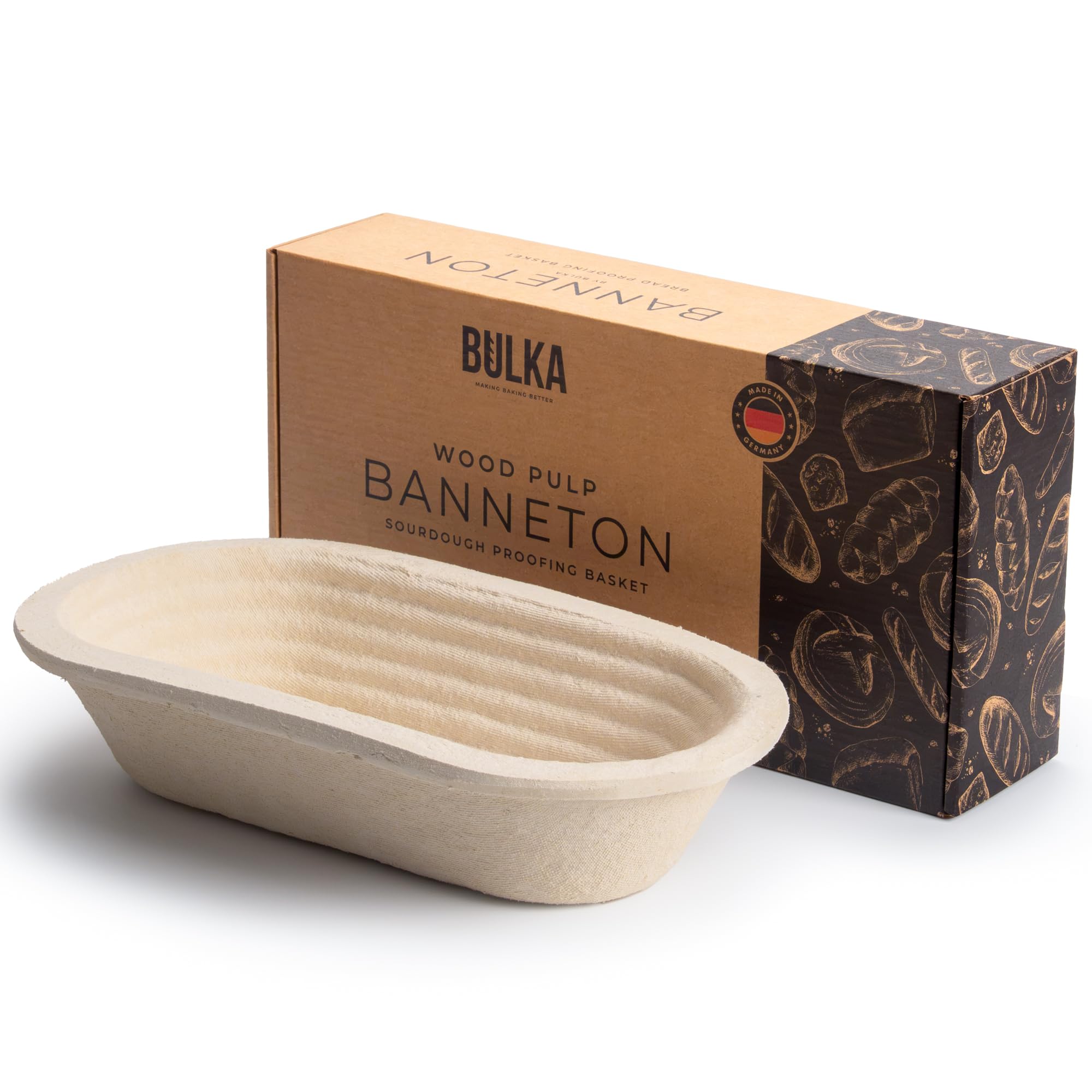
1. Bulka Sourdough Banneton Bread Proofing Basket 11.4″ Oval Groove 750g
Our pick — over 4.5★ from 950+ verified ratings; the strongest balance of quality and price.
The long oval that swallows a big batard and still lets it slide out clean.
Bulka’s take on the banneton skips the coils entirely. This one is 11.4 inches long and 5.3 inches wide, pressed from spruce wood pulp instead of woven cane, and it is built to hold a 750 g loaf — roughly the dough for a large batard, not a small round boule. The thick spruce walls insulate the dough so it proofs at an even temperature in a chilly kitchen. A slow, reliable rise is the whole point of the thing.
Spruce pulp is also absorbent, which is the reason owners describe it as a different animal from a lined rattan basket. It wicks surface moisture off the dough as it proofs, so the loaf skins over, scores without dragging, and bakes into a thin, crackly crust. It arrives bound by its own natural lignin, so no artificial binder holds it together. It is handmade in Germany from sustainably sourced spruce.
Size is the one thing to read twice before you commit. The basket handles up to 750 g of dough, and buyers report a 500 g flour / 350 ml water recipe nearly fills it after proofing, so push much past that and you will be scraping dough off the counter. Doughs with good gluten release with just a light dusting of flour, but a very wet or no-knead mix with olives or dried fruit needs a linen liner or kitchen towel. Whatever you do, do not wash it — dry it in residual oven heat at 210 to 250°F for 30 minutes, then brush the flour off.
Why bakers keep rebuying it
- The 750 g, 11.4-inch oval fits large batards that smaller rounds cannot take.
- Thick spruce walls hold proofing temperature steady for even fermentation.
- Owners mention it releases with a light flour dusting and needs no rice flour at all.
- Absorbent spruce pulp dries the dough surface so the crust bakes up thin and crackly.
The honest wrinkle
- At 13.12 oz it is a solid, substantial basket — nothing light about it on the shelf.
- Wet or no-knead dough will stick without a liner, so it is not the free-and-easy choice there.
- Push past its 750 g ceiling and the rise has nowhere to go.
Made for you if: you bake big oval sourdough batards and want a crust that scores cleanly with almost no sticking.
Second-guess it if: you mostly proof wet, no-knead dough — the spruce surface wants flour dusting, and skipping the liner will cost you a wrestle.
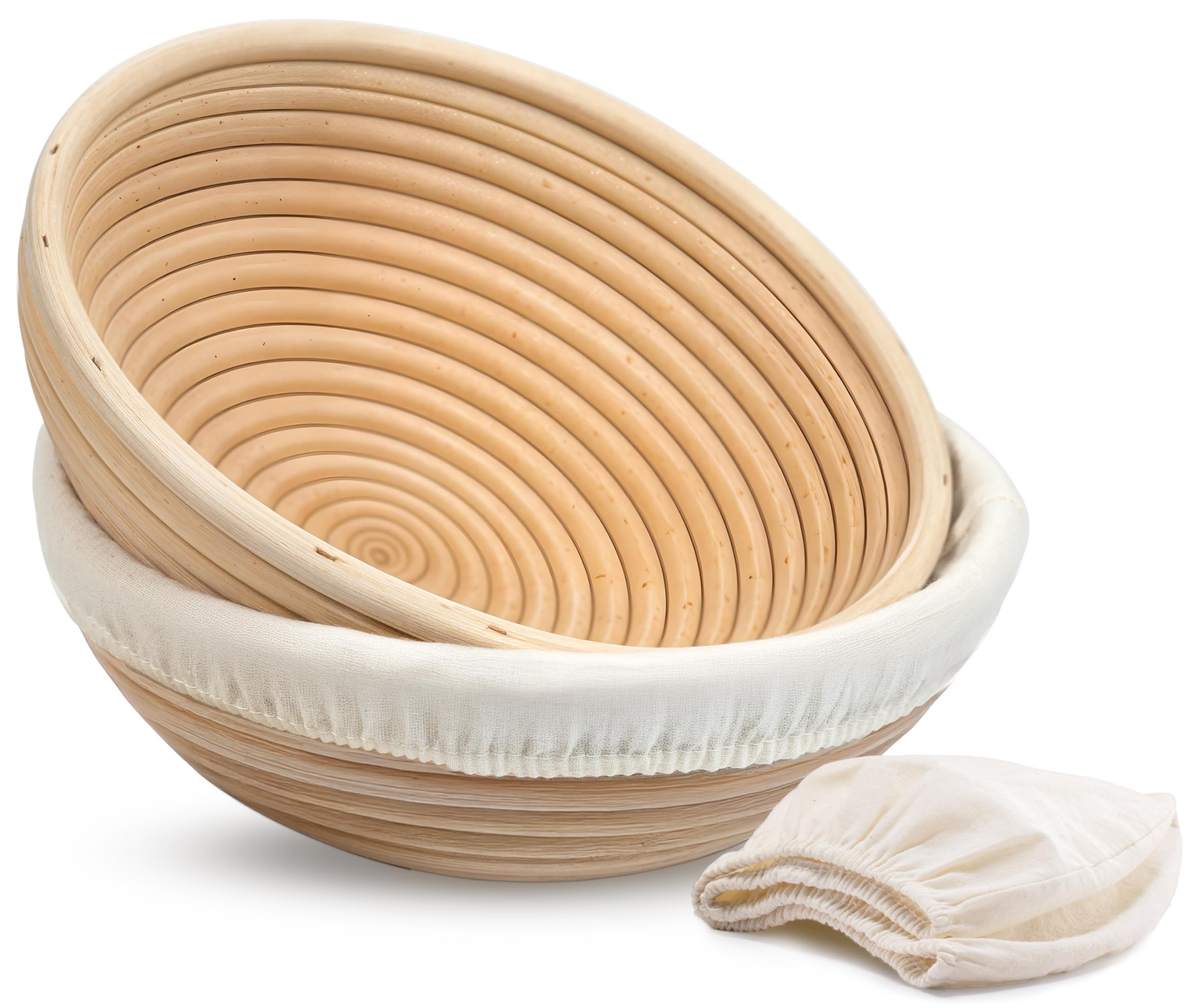
2. Kook Banneton Bread Proofing Baskets, 9 Inch Handwoven Rattan, Set of 2, Round
Two nine-inch rounds that hold the biggest boules a home oven can take.
The Kook set is a pair of 9-inch round rattan baskets, each rated to hold up to 2 lb of dough. That capacity is the number to fix your eyes on. Most 9-inch rounds top out well below that, so if your regular sourdough recipe is on the hefty side, this pair is one of the few that will take it without the dough spilling over the rim.
Rattan is the material doing the work here. The weave is breathable, so a slightly humid microclimate forms between dough and basket during proofing. As the dough dries against the rattan it forms a skin, which is what gives you the crisp crust and the clean ear after scoring. The coiled ring shape presses the classic spiral onto each loaf, so the bread comes out looking like it came from a bakery counter. Each basket is handmade from natural cane and arrives in custom polyfoam molds so it lands undented.
The set includes two washable linen liners plus a beginner’s guide, and cleaning is just a quick hand rinse and air dry. Where it beats the Bulka above is shape: that one is a single long oval built around a 750 g batard, while this pair covers two full round boules per batch. Where the Bulka pulls ahead is dough release on wet mixes — rattan weave needs more flour dusting than pressed pulp. The recurring note in reviews is a faint rattan smell when new, which fades.
What sold me: a 2 lb capacity in each basket, from a 9-inch round, is unusual — most rounds in this size class run smaller, and this is the one to pick when your dough is generous.
Reach for this if: you bake two big round boules at a time and want the coiling and spiral pattern that only woven rattan delivers.
Look elsewhere if: you mostly bake wet, high-hydration dough that sticks — the absorbent wood-pulp baskets handle that with less flouring.
3. ANPHSIN 13″ Banneton Bread Proofing Basket
The extra-long oval that finally fits the loaf your rectangular covered baker wants.
Thirteen inches is a lot of basket, and that is the entire point. At 13.2 inches long and 5.7 inches wide, the ANPHSIN oval gives a big sourdough batard the room a 10-inch oval simply does not have. The natural rattan is non-stick enough that the floured basket presses a nice pattern onto the crust and turns out a pretty cob loaf without much fuss. It comes with a removable linen liner, which is what makes a softer, higher-hydration dough manageable — you lift the liner out and the loaf moves with it.
Where this basket really found its people is with rectangular covered bakers. Owners describe it as the missing piece for a covered loaf baker, sized to drop straight in. A 13-inch oval also makes a genuinely sensible gift, since it is a real piece of kit rather than a duplicate of a round the baker already has.
One thing to know before you buy: the basket, the liner, and the scraper are not oven proof. This is a proofing tool, not a baking vessel, so it stays on the counter while the loaf goes in the oven. The linen liner is the part that makes Italian-style loaves and other wet doughs easy. Its rattan frame is solid and well-made, so expect it to serve for a long stretch of weekly bakes.
Where it wins: it is the longer of the two ovals in this guide — 13.2 inches against the 750 g Bulka’s 11.4 — and the extra room is exactly what a big batard needs.
Worth owning if: your dough is too long for a standard oval and you already own a rectangular covered baker it needs to fit.
Skip the upgrade if: your loaves are small — the basket will swallow them and the coil pattern will not meet the dough on every side.
4. Brod & Taylor Banneton Batard 10″ Proofing Bakket (2-Pack)
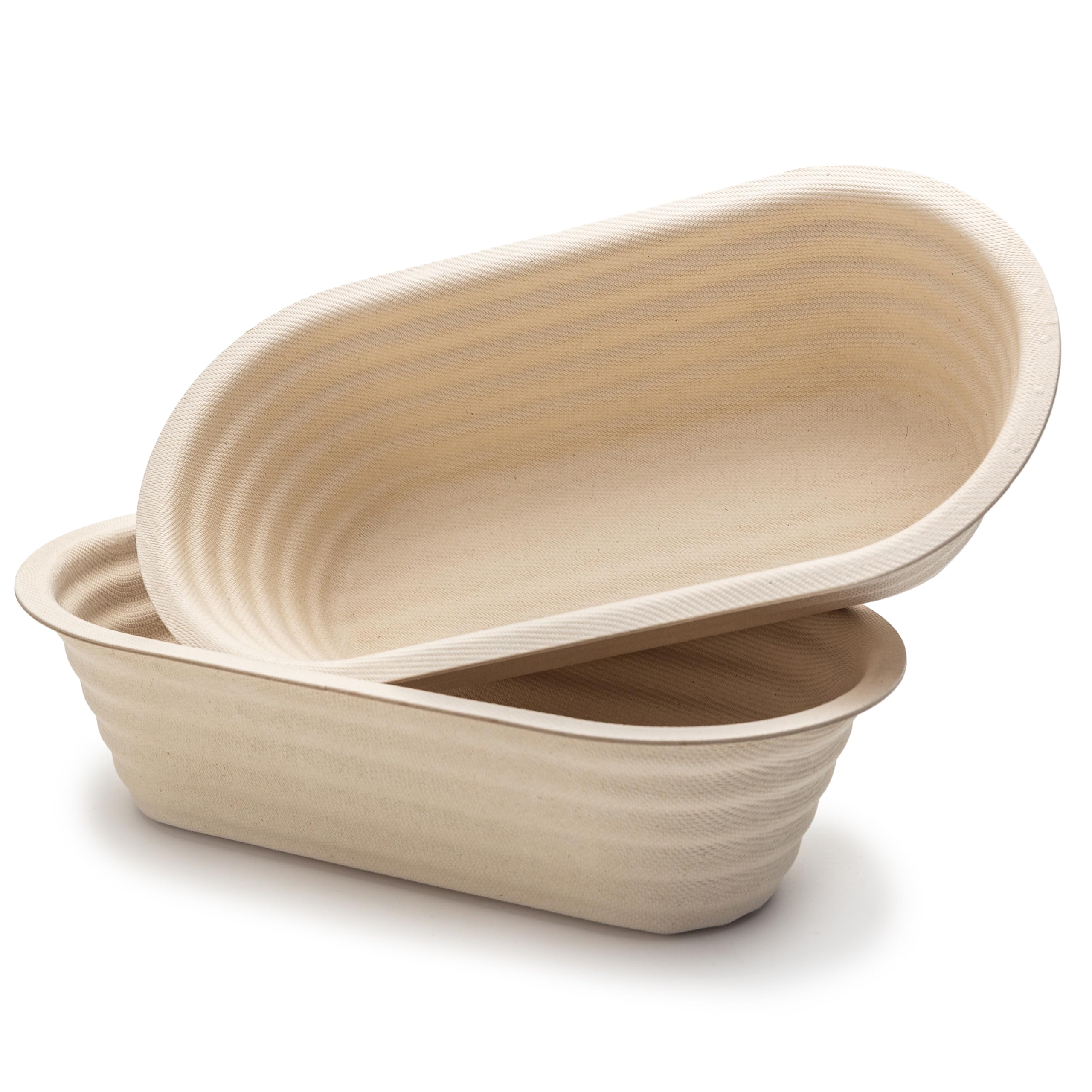
A batard that nests inside its twin, so two baskets take one basket’s shelf space.
Counter space is the quiet killer in a serious bread kitchen, and Brod & Taylor attacked it directly. This is a 2-pack of 10 x 5.25-inch oval bannetons, and the nesting design lets each one stack neatly inside the other. If you proof two loaves and then park both baskets until next weekend, they only take one basket’s worth of shelf. That is a real difference over the two-liner set it sits beside in this guide, which occupies two overlapping footprints when stored.
The material is the other half of the story. These are molded from upcycled sugarcane pulp and renewable bamboo, which is a lighter construction than the rattan sets here. The smooth, absorbent sugarcane-pulp interior releases dough straight onto the baking surface and wicks off surface moisture for a golden crust and a well-defined ear after scoring. Cleaning is a brush-off of the excess flour between bakes — no soaking, ever. Silicone and traditional cane both get shoved aside by owners who tried this format: the stackability and the lighter feel are the reasons.
The catch, and honestly it is a small one: this is a modest basket. Customers note it handles around 500 g of flour, which is a smaller loaf than the Bulka’s 750 g capacity. Some also describe it as not as thick as an imported basket they had used before. If your weekly loaf is a big one, size up; if it is a moderate round or oval, the stackable pair is the more practical buy.
Why the nesting design wins
- Nesting pair saves shelf space when two baskets are not both in use.
- Absorbent sugarcane-pulp interior dries the dough surface for a golden crust and a clean ear.
- Lighter than rattan and easy to brush clean between batches.
- Makes a genuinely useful gift for a baker with a small kitchen.
Where it asks you to compromise
- Around 500 g of flour — smaller than a 750 g basket, so big loaves do not fit.
- Thinner feel than an imported basket some bakers already own.
- Never wet it, so cleanup rules are stricter than a rinse-friendly rattan set.
Best fit for: a baker who proofing two moderate loaves per session and needs to store the baskets flat.
Keep looking if: you routinely bake a 750 g loaf — this one will not hold it.
5. Saint Germain Bakery Premium Round Bread Banneton Basket with Liner, 10″ Oval, 2-Count
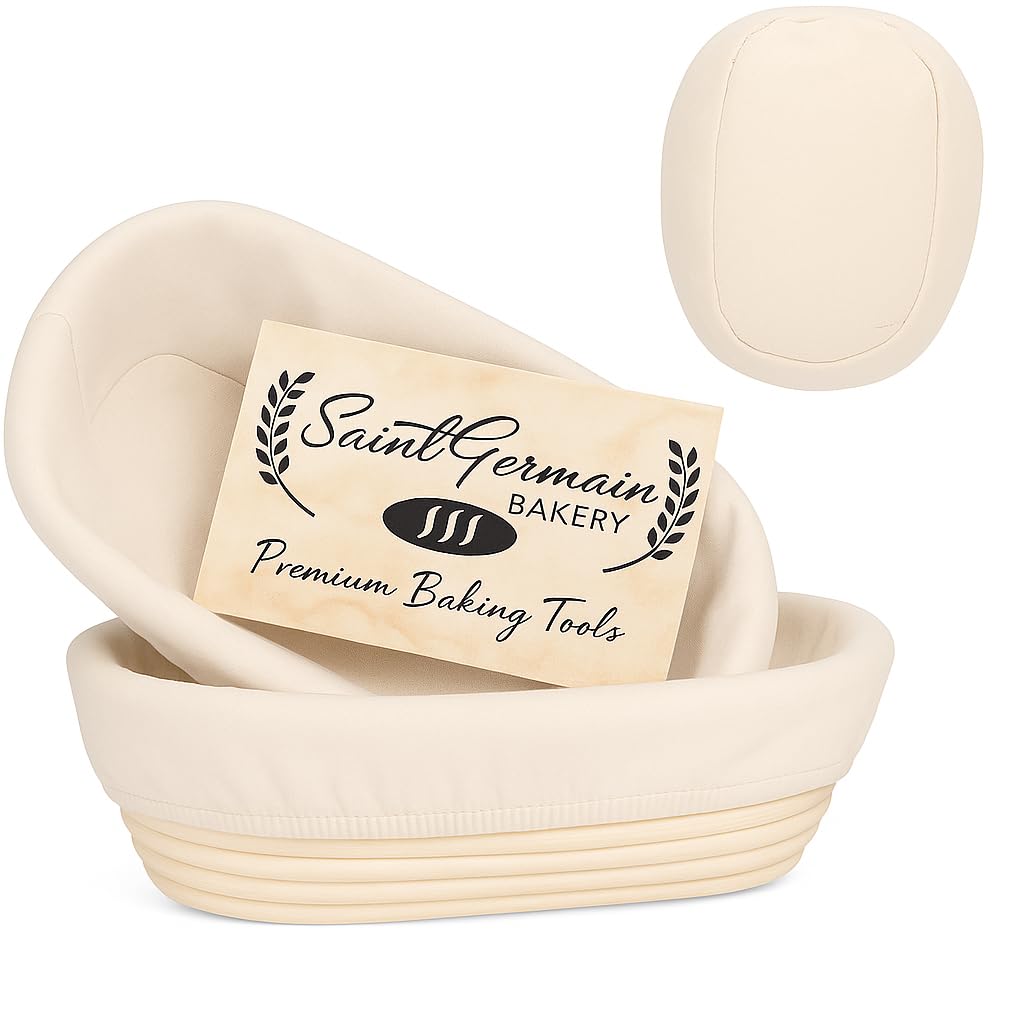
A pair of handmade ovals built for overnight fridge proofing, not just a quick rise.
These are rattan ovals, handmade by a small family business in Vietnam, and free from dye or chemical coating. The 10-inch size suits a medium-to-large oval loaf, which covers the bread most people actually bake in a home oven. They do the two things a cold-proofed loaf demands: hold shape for hours in the fridge and release cleanly when you turn the dough out onto the peel.
The linen liner is the reason this pair is particularly praised for overnight fermentation. High-hydration dough that sits in a fridge for 12 hours gets looser, not stiffer, and a liner gives it something to sit on so you do not end up scraping the loaf off bare cane. Where these fall short of the pressed wood pulp baskets is moisture management — a liner traps some of the surface wetness that a bare absorbent basket wicks away, so a crisp crust takes slightly more effort. The trade-off is an easy release on very wet dough, and that matters more than crust crisp for some bakers.
Two small honest notes. The rattan arrives with a fresh smell out of the bag, which fades quickly, and the hand-woven build means slight unevenness in the cane. Neither affects the bake. If you prefer a basket that skips the liner entirely and turns out a scoring-friendly surface, the Bulka above is the better fit — this one is tuned for dough that must sit and proof for hours.
My honest read: what wins people over is that the included liners make a messy overnight fridge proof feel handled, and the baskets are low-effort to keep clean between bakes.
Pick this when: you cold-proof sourdough in the fridge overnight and want a pair that holds two ovals at once with liners doing the hard work.
Consider another if: you proof at room temperature and want the crust crease that comes from flouring bare cane instead of lining it.
6. Complete Bread Proofing Baskets Set with 9 in and 10 in Banneton Basket

One box that hands a brand-new sourdough baker every tool they were about to buy separately.
If you have just fed your first starter and have no idea what comes next, this is the kit designed for exactly that moment. It ships with a 9-inch round and a 10-inch oval banneton, two cotton liners, a bread lame with five replacement blades, a dough whisk, two dough scrapers, and a cleaning brush. That is the round for your first boule, the oval for a batard, and the scoring tool you would have had to hunt down elsewhere.
The baskets are natural rattan, and the set is built for anyone still learning the rhythm of sourdough. Reviewers point out the rattan baskets hold the dough’s shape and produce a bakery-style crumb, and the completeness of the kit is the most repeated point — one reviewer called out that it includes all the necessary baking tools. A fifth-satisfaction gripe worth knowing is size: some find the 9-inch round a little small for a generous dough, which is fair, since this is a starter size rather than a large-loaf basket.
Where this beats the a la carte baskets in this guide is simply that you own everything at once. Where it is behind the Kook pair above is capacity — that set holds up to 2 lb per basket, while this is a starter-size round and a medium oval. Purchase this to get set up, then size up later once you know what your regular loaf weighs.
Everything in the box earns its place
- Round and oval baskets together — covers both boules and batards from day one.
- Lame with five blades, dough whisk, two scrapers, and brush included.
- Clear instructions and maintenance guidance for someone’s first sourdough bake.
Fair warning before you order
- The 9-inch round is starter-size, not large-loaf size, so big doughs will not fit.
- Lots of loose tools to keep track of if you are short on drawer space.
The smart first buy for: anyone starting sourdough this month who would rather order one box than five.
Not for: an experienced baker who already owns a lame and whisk and just wants one big basket.
7. Saint Germain Bakery Premium Round Bread Banneton Basket with Liner, 9″ Set of 2
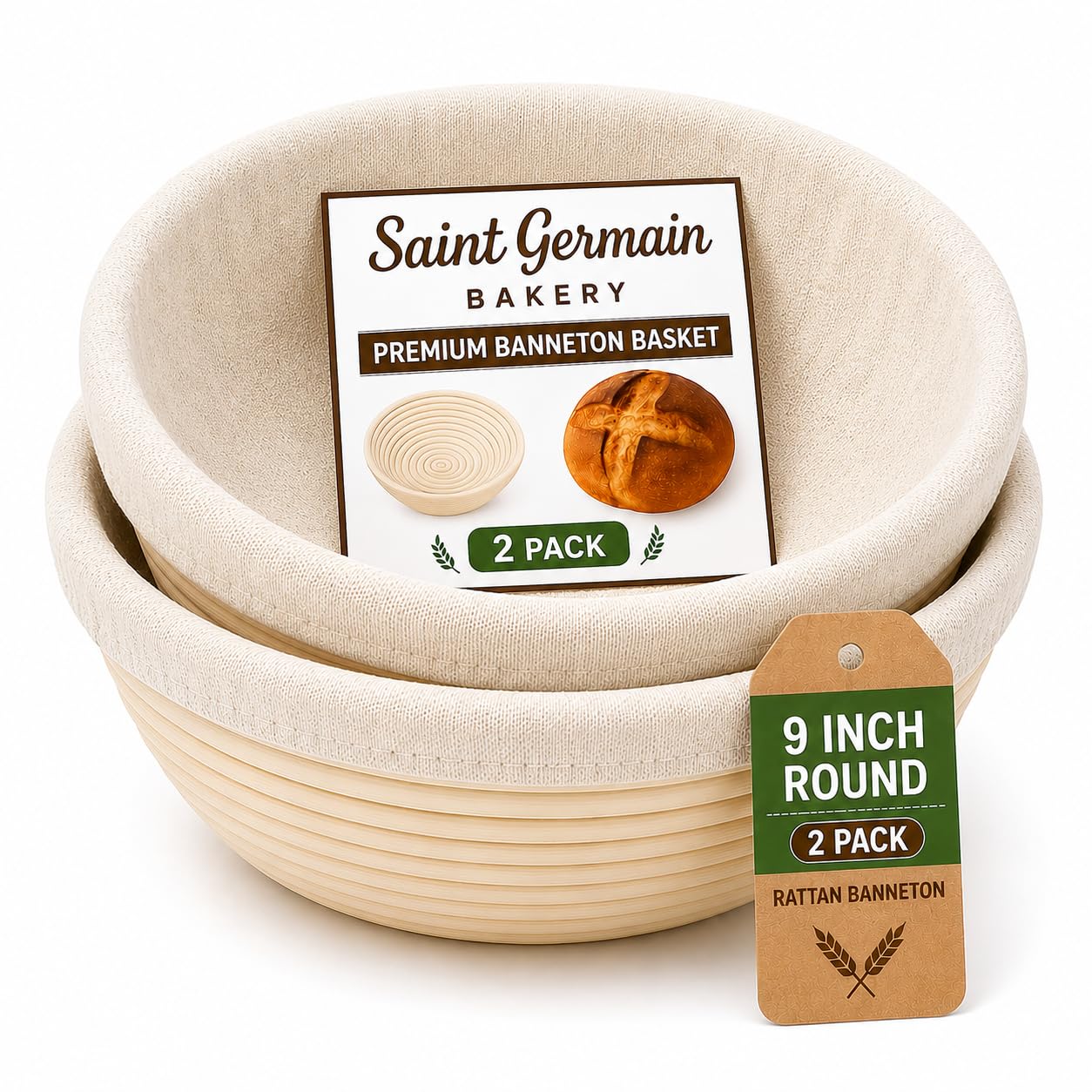
Two nine-inch rattan rounds with liners — the easy way into round sourdough baking.
Say you have been proofing in a towel-lined mixing bowl and want to stop scraping flour off the counter. This pair of 9-inch round rattan baskets comes with linen liners, so you can switch to a proper proof in one step. The dough holds its shape in the basket, the liner lifts the loaf out cleanly, and the floury-towel cleanup disappears from your routine entirely.
Nine inches is the size most round-loaf recipes call for, so this pair slides into a standard bread schedule without you reworking your formula. The finish is smooth, and the liners are what makes the first few bakes forgiving.
The one honest thing to flag is what the material is. Rattan is a natural woven wood, and a small number of these will arrive with a hairline crack in the cane. That is inherent to the material, not a sign of a bad basket — the strand still holds its structure and does its job, and the cloth liner was washed and air-dried before first use by the bakers who wanted to be safe. The woven coil gives round loaves the classic spiral pattern, and a few months in, it simply looks the way a working banneton should.
The buyer pitch: what makes the pair worth the jump is the liners washing up well and the baskets doing the round-shape job with nothing else to buy.
Suits you if: you proof round loaves with a liner and want a straightforward pair to rotate through the week.
Tread carefully if: you want a basket that never sees a hairline crack — pressed pulp holds a more uniform surface than natural cane.
8. Swice Banneton Bread Proofing Basket, Set of 2 Round 9 Inch Handmade Rattan

Hefty nails and a no-splinter surface, for bakers who have snapped a cheap basket before.
Rattan baskets live or die by how they are assembled, and Swice went heavier than most. These are put together with hefty nails rather than the small ones that let a basket shift and warp, and the surface is finished smooth with no splinters. If you have ever had a flimsy cane basket lose its shape after a dozen bakes, that construction detail is the whole reason to look at this pair.
Each 9-inch round basket holds around 1.5 lb — that is 680 g of dough — which covers a standard round sourdough loaf. The set arrives with a fitted linen liner and a step-by-step how-to-use-and-care guide for seasoning the baskets before their first use. The rattan is powder-free and carries no chemical coating, so the coil pattern presses cleanly onto the crust and leaves the classic round groove.
The size is the honest caveat. These are small rounds, and owners who pushed a big dough into them found they were smaller than expected and want more room. A cold-proofed loaf should be bagged at the fridge stage too, since cane absorbs moisture and dry air can pull the surface too dry. Weigh your dough before its final shape — anything past the 1.5 lb ceiling will spread beyond the rim rather than climb.
What the money buys
- Hefty-nail construction holds the shape and does not wobble or warp.
- Smooth, splinter-free surface is safe on sticky dough.
- Comes with a fitted liner and a clear care guide, so first use is simple.
Where the budget shows
- The 9-inch, 1.5 lb ceiling is real — doughs past 680 g spread rather than rise.
- Rattan absorbs moisture, so a cold-proofed dough needs a plastic bag over it in the fridge.
The turn-to pair for: a baker making one 680 g round loaf a week who is done with flimsy cane.
Not the one for: oversized family loaves — the 9-inch rounds will not take them.
9. Swice Bread Banneton Proofing Basket, Set of 2 Oval 10×6 Inch with Liner

The oval version of the hefty-nail basket, for loaf-shaped bread on a budget.
Same build philosophy as the round Swice pair, just stretched into an oval. Two 10 x 6-inch baskets, each holding around 680 g of dough, assembled with hefty nails and pressed out with a smooth, no-splinter natural rattan finish. If you bake rectangular-ish artisan loaves rather than tall boules, this is the budget pair to pick over the round set.
The liner is included and the how-to-care guide walks you through seasoning before first use. This pair suits cold proofing especially well: the dough settles into the oval, holds its shape overnight in the fridge, and turns out with grooves across the surface from the coil pattern. On arrival, check the rims for splinters or loose staples and give the liners a wash before the first bake — that is standard practice on any rattan basket, not a warning about this pair specifically.
What to know going in is that the packaging smell takes a day or two to clear, so air the baskets before their first use. The rims feel a touch smoother than raw cane, and a strip of owners describe the texture as less natural-feeling than they expected, which does not change how the dough behaves. The 680 g ceiling is real: for a bigger oval loaf, size up.
The practical read: what owners praise most is straightforward function — the oval shape, the included liner, and the fact that the basket does not need rice flour to release.
Buy this if: you bake oval artisan loaves and want two baskets at a careful price without skipping construction quality.
Step up if: you need a bigger oval — 680 g is the top, so a 750 g batard wants the longer Bulka instead.
Understanding the Specs
Dough Capacity
This is the weight of dough a basket comfortably holds, written in grams or pounds, and it is the number that decides whether your loaf fits. A 750 g basket (like the Bulka) covers a big oval batard. A 680 g basket (like the Swice pair) suits a standard round or oval loaf. Look at the weight of your shaped dough before the final rise, not the flour weight in the recipe — the water and starter add real weight, and a basket that looks roomy when empty can be full once the dough has proofed.
Material: Rattan versus Pressed Pulp
Woven rattan and pressed wood pulp behave differently on the bench. Rattan is cane woven into coils, so it breathes and leaves a spiral pattern while holding shape for hours. Pressed spruce, bamboo, or sugarcane pulp is solid and slightly absorbent, so it draws surface moisture off the dough for a crisper skin and a cleaner score. Rattan wants flour dusting and gentle brushing, and it can arrive with a slight smell that fades. Pulp baskets handle wet dough with less sticking, but they should never be soaked.
Shape: Round versus Oval
Round baskets give you tall boules with an even rise in all directions. Oval baskets give you longer batards with a more bread-loaf profile, which suits sandwich slicing and rectangular covered bakers better. The choice is cosmetic on some level, but not entirely: an oval is more forgiving of a long, soft dough that wants to spread, because its walls guide the loaf into a shape rather than letting it relax outward. Match the shape to the bread you actually cut, not the one that photographs better.
Liner or No Liner
A linen liner is essentially a fabric couche you can lift the dough out with. It makes high-hydration, no-knead, or loaded doughs — the ones with olives or dried fruit — far easier to move from basket to peel without tearing. It also cuts cleanup time. The compromise is the pattern: a liner blocks the coil marks the basket is built to leave. Use the liner for messy dough and skip it for a dry, well-shaped boule when you want the classic spiral crust.
FAQ
How do I know which banneton size fits my sourdough recipe?
Will a banneton fit inside a standard Dutch oven?
Is rattan better than wood pulp for proofing dough?
Do I need to use the linen liner every time?
How do I clean a banneton without ruining it?
My new rattan basket has a smell — is that normal?
Can I proof dough in the fridge in a banneton?
Should I flour the basket with regular flour or rice flour?
What is the difference between a banneton and a regular mixing bowl for proofing?
Do I need two baskets or just one?
Final Thoughts: The Verdict
For most bakers, the banneton bread proofing basket that ends the search is the Bulka Sourdough Oval, because its 750 g capacity, thick pressed-spruce walls, and dependable dough release cover everything from a small round to a large batard — and it stays in shape for years of weekly bakes. If you bake two big round boules at once, grab the Kook Banneton Baskets, whose 9-inch rattan rounds hold up to 2 lb each and press that classic spiral into the crust. And for bakers who cold-proof in the fridge, the Saint Germain Bakery 10″ Oval pair is the one to reach for, with its linen liners making an overnight proof feel handled instead of frantic.
How We Picked
We do not accept paid placement. Every pick is matched to a real buyer and a real use-case; we do not hands-on test units.
Sources & Methodology
Specifications: manufacturer listings and product documentation. Review insights: verified customer reviews, as of September 2026. Pricing: not shown on this page (it changes often); check the current price via the retailer link.
As an Amazon Associate, KitchPrep earns from qualifying purchases. This does not affect which products we feature.
Related Guides
