
Specs are compiled from manufacturer listings and verified buyer reviews and can change over time — please confirm the key details on the product page before buying.
You want one saw that cuts firewood, trims limbs, and frames a deck without a cord trailing behind you. A battery-powered saw now matches a corded one on most homeowner jobs. The real decision depends on three things: what you are cutting, how long you need to run on one charge, and whether you already own that brand’s batteries. Get those three right and you will not regret the purchase.
I’m Mohammad Maruf — the founder and writer behind KitchPrep. This guide is built by comparing the manufacturers’ published specifications and the patterns across verified customer reviews, so you get each pick’s real strengths and trade-offs instead of marketing spin.
Every saw here runs on a rechargeable pack, so the cord is gone for good — but the battery platform you already own quietly decides which of these is worth your money. That single fact reshapes the whole list of the best battery powered saw options.
Our Picks at a Glance

How To Choose The Best Battery Powered Saw
Start with the job, not the spec sheet. A saw that clears storm limbs in the yard is a different tool than one that cross-cuts framing lumber on a deck. Match the blade type and size to your most common task before you look at voltage or battery capacity, because the wrong blade shape makes even a powerful saw feel weak.
Match The Blade To The Job
A reciprocating saw (the type with a straight back-and-forth blade, often called a Sawzall) handles demolition, pruning, and cutting in tight spots. A circular saw spins a round blade for straight, clean cross-cuts and rip cuts. A chainsaw is for tree limbs and firewood, where a round cutting chain wraps around a bar. Pick the cutting action your work actually needs.
Why Battery Platform Beats Raw Voltage
The battery you already own often matters more than the number on the pack. A saw sold as “tool only” means it arrives without a battery or charger, so it only makes sense if you are already invested in that brand’s system. If you are starting fresh, factor the cost of a battery and charger into your plan, because a bare tool with no pack will not run at all.
Amp-Hours, Stroke Length, And Speed
Amp-hours (Ah) measure how much energy a battery stores — a 5Ah pack holds more than a 2Ah one, so it runs longer between charges. Stroke length on a reciprocating saw is how far the blade travels each pass; a 1-1/8-inch stroke clears material faster than a short one. Strokes per minute (spm) or revolutions per minute (rpm) tells you cutting speed. Higher numbers cut faster but drain the pack sooner.
Quick Comparison
| Model | Best For | Type | Power / Speed | Weight | Amazon |
|---|---|---|---|---|---|
| DEWALT 20V MAX Reciprocating Saw Kit (DCS387P1)★ Best Overall | All-round home and job site cutting | Reciprocating | 0–2,900 spm | 7 lb | Amazon |
| RYOBI ONE+ HP 18V One-Handed Recip SawBest for One-Handed Work | One-handed yard and tight-space cuts | Reciprocating | Up to 3,000 spm | 3.8 lb | Amazon |
| Milwaukee 2719-20 M18 FUEL HACKZALLTop Compact Performer | Compact power for pros and pruning | Reciprocating | Brushless, 24 TPI blade | — | Amazon |
| CRAFTSMAN V20 Circular Saw Kit (CMCS500M1) | Straight cross-cuts and rips | Circular | 4,000 rpm | 10.2 lb | Amazon |
| CRAFTSMAN V20 Reciprocating Saw Kit (CMCS300M1) | Budget home DIY and yard work | Reciprocating | Up to 3,000 rpm | 7.1 lb | Amazon |
| Greenworks 40V 12 in Cordless Chainsaw | Light pruning and storm cleanup | Chainsaw | 40V, 0.73 hp | 10.9 lb | Amazon |
| Makita XSH04ZB 18V Sub-Compact Circular Saw | Quick, light trim cuts | Circular | 5,000 rpm | 4 lb | Amazon |
| EGO POWER+ 16” Chain Saw (CS1613) | Heavy yard work and firewood | Chainsaw | 56V, 20 m/s chain speed | 20.9 lb | Amazon |
| DEWALT FLEXVOLT 60V MAX Worm Style Circular Saw (DCS577X1) | Heavy framing and crew work | Circular | 60V, 9.0Ah battery | 10.9 lb | Amazon |
In‑Depth Reviews
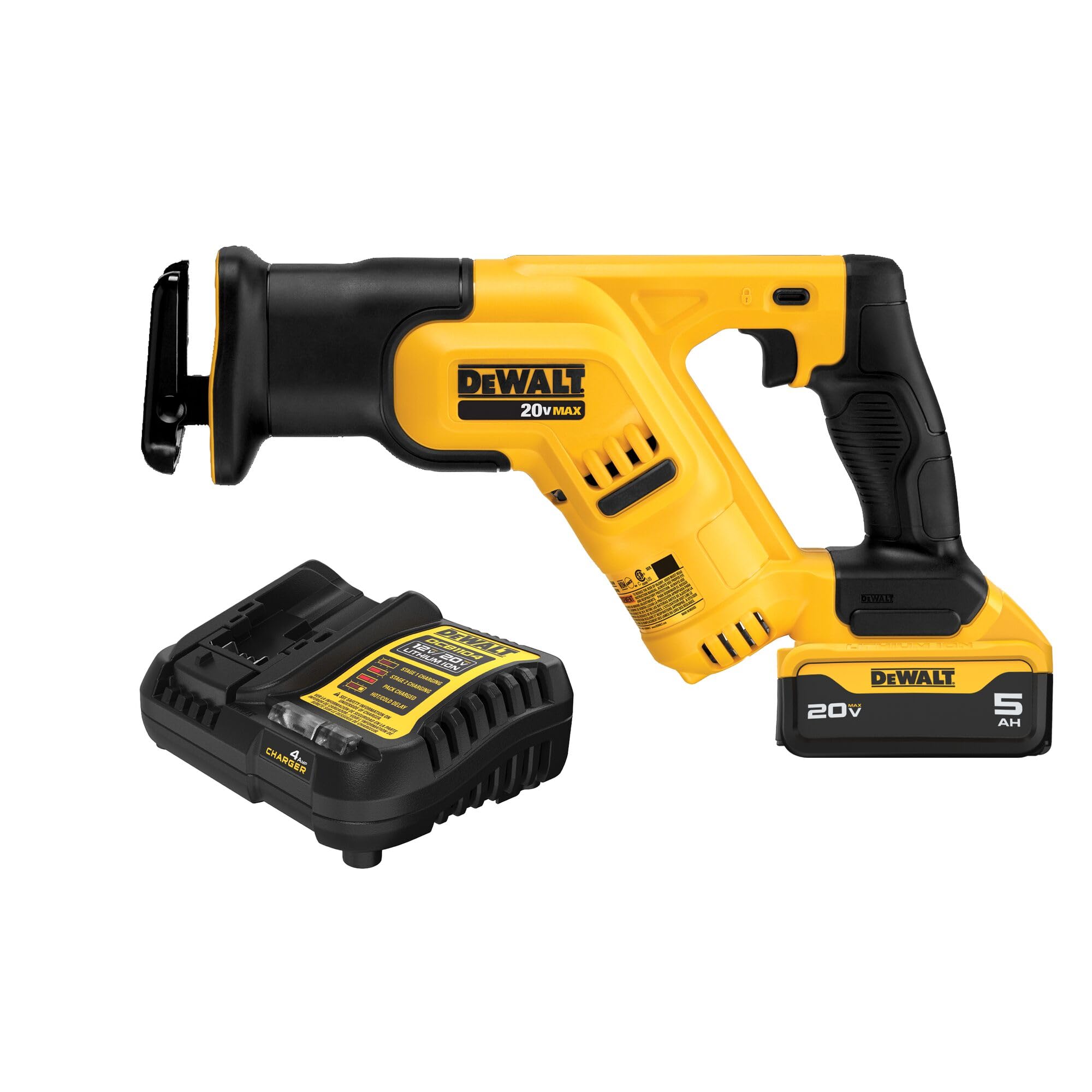
1. DEWALT 20V MAX* Cordless Reciprocating Saw Kit, 5 Amp-Hour Battery (DCS387P1)
Our pick — over 4.5★ from 800+ verified ratings; the strongest balance of quality and price.
The do-it-all cordless that cuts like it is still plugged in
This is the saw for the homeowner who owns one cutting tool and expects it to handle nearly everything. The DEWALT DCS387P1 runs a 1-1/8-inch stroke at 0 to 2,900 strokes per minute (spm — the number of back-and-forth blade passes each minute), which is a long, fast stroke that clears wood and metal without stalling. A 4-position blade clamp lets you turn the blade to four different angles for flush cuts and awkward reaches, and you can swap blades without tools.
The compact body measures 14.5 inches overall, so it slips between studs and into the space under a sink where a full-size saw will not reach. A pivoting shoe lets the saw pivot to stay flat against the cut as you work, and a bright LED light (a small lamp that lights the cut line) shines into dark crawlspaces and closets. It ships with the DCS387 saw, a DCB205 20V MAX XR 5.0Ah battery, and a charger, so you can cut the day it arrives. That 5.0Ah pack (amp-hours measure stored energy) is a big one, and the brand’s own 3-year limited warranty covers the tool.
Buyers report the saw feels like a corded tool in hand. One owner put it plainly: “Was a little skeptical because of experience with older battery saw. This Dewalt is light years ahead. It is very light, easy to handle and maneuver. Battery really lasts a long time. Cuts through most materials very easily and quickly.” That 5.0Ah battery is also why this saw spends less time on the charger than the RYOBI compact below, whose tool-only kit leaves you buying packs separately.
What earns the top spot
- 1-1/8-inch stroke at up to 2,900 spm cuts wood and metal fast
- 4-position tool-free blade clamp handles flush cuts and tight angles
- Includes a 5.0Ah battery and charger, plus a 3-year limited warranty
- Compact 14.5-inch body fits between studs and in confined spaces
The honest catches
- At 7 pounds it is heavier than the 3.8-pound RYOBI compact
- High vibration can tire your arm on long cuts with no damping
- Pistol grip sits awkwardly for some hand positions
Reach for this if: you want one cordless saw for framing, demolition, and pruning that also comes with its own battery and charger.
Think twice if: you need lightweight one-handed control overhead — the 3.8-pound RYOBI or the compact Milwaukee below will tire you out less.
2. RYOBI ONE+ HP 18V Brushless Compact One-Handed Reciprocating Saw (Tool Only) PSBRS01B
Light enough to wave at a branch with one hand overhead
If you are already in the RYOBI ONE+ 18V ecosystem (the brand’s shared battery system), this is the saw that replaces a heavy two-handed model for yard work. The brushless motor (a motor with no carbon brushes to wear out) spins up to 3,000 strokes per minute for quick cuts through wood, metal, and plastic. The real headline is the weight: at 3.8 pounds it is dramatically easier to lift than the 7-pound DEWALT above, which matters most when you are cutting overhead or at arm’s length.
The one-handed design is the whole point. A rapid blade-change system lets you swap blades without tools, and the saw is built to stand on its battery without tipping. Owners call the balance the standout trait and use it most for yard cleanup. The one recurring gripe is power: it handles branches, PVC pipe, outlet boxes, and pressure-treated lumber, but it is not meant for thick metal or long sessions in hard material.
This ships as a tool only, meaning no battery or charger is in the box. That is a smart buy if you already own ONE+ packs, because the ONE+ system shares batteries across more than 300 tools. If you are starting from scratch, price in a battery and charger before you commit. For light one-handed work, though, the trade of some raw power for control and comfort is exactly the right call.
Why the light weight wins: at 3.8 pounds it is the saw you can genuinely run one-handed for yard brush and tree limbs, and the ONE+ platform means the batteries you already own do the work.
The follow-up question: will it replace a full-size saw? For thick metal and long cuts, no — reach for the DEWALT above or the Milwaukee below and keep this one for branches and tight spaces.
Who it suits: existing RYOBI ONE+ owners who want a fast, one-handed saw for pruning, PVC, and light demolition without buying a battery they already have.
Who should look elsewhere: anyone with no ONE+ batteries in the house, since the tool-only box will not run without a separate battery and charger.
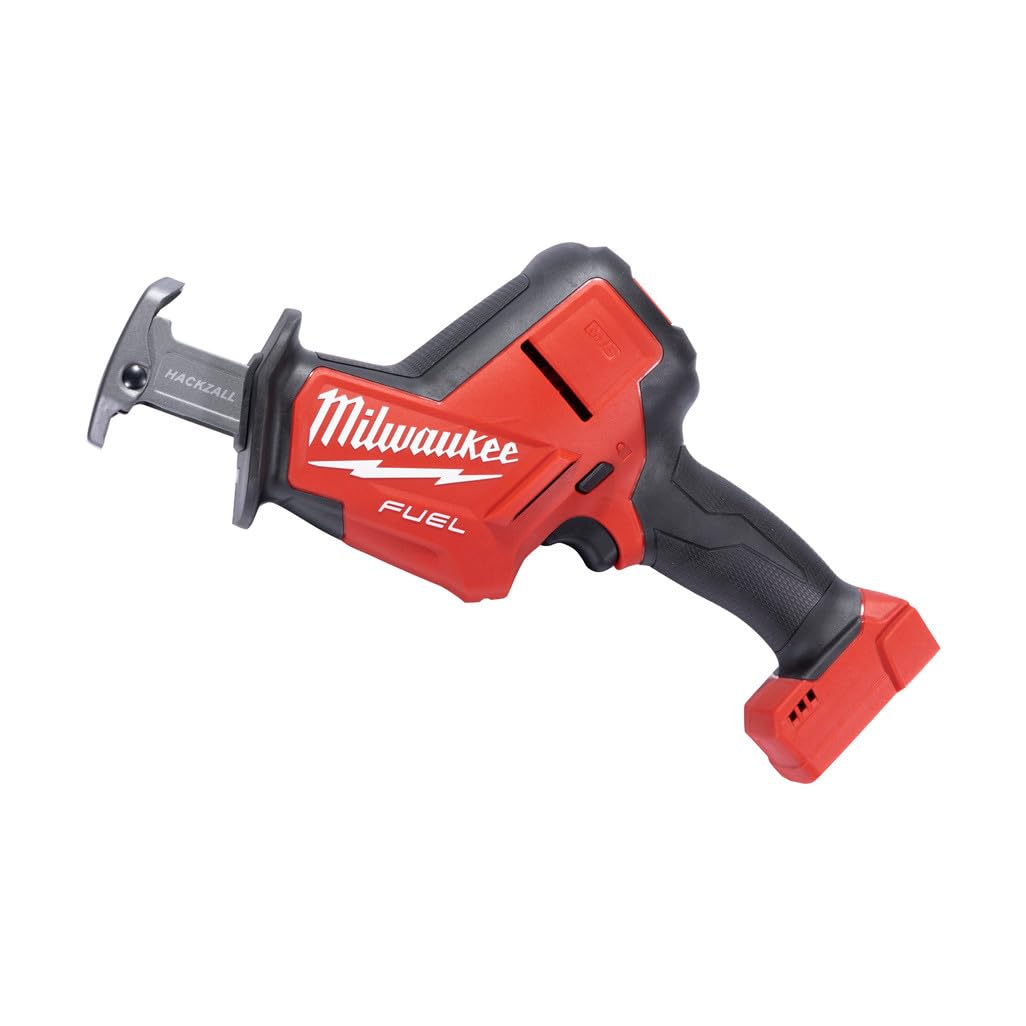
3. Milwaukee 2719-20 M18 FUEL HACKZALL (Bare Tool)
A full-size saw’s muscle packed into a compact body
Tradesmen already on the M18 battery platform get a lot from this little saw. The POWERSTATE brushless motor (brushless means no carbon brushes to wear out) delivers cutting speed that owners describe as on par with a full-size Sawzall, but in a body that fits where a full-size saw cannot. REDLINK Plus electronics (the brand’s tool-and-battery communication system) manage performance and add overload protection, so the saw and pack work together rather than the motor fighting the battery.
The pivoting shoe keeps constant contact with the workpiece, which cuts down on the bucking and vibration that tires your hands on longer jobs. Pruning blades make short work of tree roots and limbs, and the one-handed grip gets into the tight spots a two-handed saw skips. It runs a 24-tooth blade and takes High Speed Steel blades.
This is a bare tool, so no battery or charger is included — buy it only if you already own M18 packs. The clear trade-off is cost and commitment: it is the compact pick for people already invested in the platform, not a first saw. But for M18 owners, the combination of compact size and full-size power is hard to argue with.
The verdict: for M18 owners who cut roots, limbs, and framing in tight spaces and want the power of a large reciprocating saw in a compact body.
The caveat: as a bare tool it needs an M18 battery and charger you likely do not have if you are brand new — start with the DEWALT above if that is your situation.
4. CRAFTSMAN V20 Cordless Circular Saw Kit, 6-1/2 inch (CMCS500M1)

The corded circular saw replacement for weekend projects
Not every job calls for a back-and-forth blade — cutting plywood and framing lumber cleanly needs a round blade, and this CRAFTSMAN does it at 4,000 rpm. The kit includes the CMCS500 saw, an 18-tooth 6-1/2-inch blade, a battery, and a charger, so you can rip and cross-cut 2x material the day it arrives. The tool-free beveling shoe pivots up to 50 degrees for angled cuts, and the contoured over-molded handle keeps the saw comfortable on longer runs.
Owners describe it as a corded-saw replacement that cross-cuts like its plug-in counterpart, on a battery that also fits other CRAFTSMAN V20 tools. The compact size is designed to reduce fatigue, though it is not featherweight. The mixed notes center on power in the thickest stock: it rips 2x4s and 1/2-inch plywood easily, but slows a little on 2x6s and 3/4-inch plywood. For occasional home projects rather than daily framing, that is an acceptable trade.
Where it delivers
- 4,000 rpm cuts 2x4s and 1/2-inch plywood cleanly
- Tool-free beveling shoe pivots up to 50 degrees for angled cuts
- Includes battery and charger; runs on other CRAFTSMAN V20 tools
Where it slows down
- A little slower on 2x6s and 3/4-inch plywood than heavier saws
- At 10.2 pounds it can feel heavy on long cutting sessions
- Battery life draws mixed reports depending on what you cut
Best fit: the homeowner building shelves, decks, and fences who wants a corded-quality cross-cut without dragging an extension cord.
Pass on it if: you need nonstop cutting through thick stock for a full day — a corded worm-drive or the FLEXVOLT below is the better tool for that pace.
5. CRAFTSMAN V20 Cordless Reciprocating Saw Kit, 3,000 RPM, 14.5 inch (CMCS300M1)

A starter reciprocating saw that shares the battery across the house
This one earns its place as the entry-level pick for light home duty. The 1-inch stroke and variable-speed trigger up to 3,000 rpm let you start slow for precision and speed up for force, and the tool-free blade release swaps blades without hunting for a wrench. The compact 14.5-inch body also squeezes into the tight spots that a big saw cannot. It arrives as a kit with a battery and charger, so there is nothing extra to buy to get cutting.
The strongest draw is the shared V20 platform — the same battery runs your drill and leaf blower, so you can swap packs across tools and keep working. Owners mention the fast charge lets one pack handle most around-the-house jobs, and that it took down a 10-inch tree trunk. It does need quality blades to cut well, and it likes a little patience in tight spaces.
This is the saw to buy if your cutting is a few limbs a year and the odd stump. Occasional home use is where it shines, so if your cutting is a few limbs a year and the odd stump, it will serve you well.
What keeps the price honest: a 14.5-inch compact body with a battery and charger in the box, sharing the V20 pack across your drill and blower so you are not buying spare batteries for every tool.
What to watch: this saw is built for the occasional job, so if you are cutting hard every weekend, a heavier-duty reciprocating saw will outlast it.
Pick it if: you want a budget cordless saw that shares the CRAFTSMAN V20 battery you already own and handles light yard and home tasks.
skip it if: your work runs heavy all weekend — the DEWALT or Milwaukee above are built for that kind of regular abuse.
6. Greenworks 40V 12 in Cordless Electric Chainsaw, 2.0 Ah Battery

A quiet little chainsaw that starts with a trigger, not a pull cord
If your cutting is branches, storm debris, and camping firewood rather than tree felling, a compact chainsaw beats a reciprocating saw for the job. This Greenworks runs a 12-inch low-recoil chain on a 40V 2.0Ah battery and, per the maker, delivers up to 50 cuts through 4×4 treated wood on a single charge. At roughly 6 pounds it is light enough to carry through the yard and use at odd angles without tiring your arms — a real difference from gas saws that need a pull start.
Two features keep it beginner-friendly. A tool-free auto-tensioning system adjusts the chain without extra tools, and a dual safety start (a lock button plus the trigger) prevents accidental firing. An auto-oiler (a system that keeps the chain lubricated as it runs) extends chain life. The 40V battery also doubles as a portable power bank for charging phones and tablets, which is a nice bonus for camping.
Customers note it clears spruce limbs and storm debris on one charge, with battery left over after a long afternoon. The honest side: the low-recoil chain wants light, infrequent duty rather than daily hard use, and it cuts slower than a gas saw, especially in dry hard wood. A 3-year warranty covers both tool and battery.
Ideal for: the homeowner who wants a quiet, low-maintenance chainsaw for pruning, storm cleanup, and occasional firewood without fuel mixing or pull starts.
Not for: felling big trees or long sessions in dry hardwood — the 12-inch bar and battery runtime are tuned for lighter, intermittent yard work.
7. Makita XSH04ZB 18V LXT Sub-Compact Brushless Cordless 6-1/2” Circular Saw, Tool Only

A sub-compact circular saw light enough to grab instead of the big one
For quick trim cuts — pallet wood, tree limbs, small lumber — this Makita is the saw you reach for instead of hauling out a full-size model. The electronically controlled brushless motor spins the blade at 5,000 rpm, which is faster than the CRAFTSMAN circular above, and the tool weighs just 4 pounds with a 2.0Ah battery fitted (battery sold separately). It carries a 2-1/4-inch cutting capacity at 90 degrees and a bevel range from 0 to 50 degrees.
It is a bare tool, so it only pays off if you already own Makita 18V LXT batteries — but for anyone in that system, it becomes the grab-and-go saw for small jobs. Owners find it powerful for its 4-pound size and easy to handle, with depth and bevel adjustments that cover everyday trim work.
One genuine trade-off: the blade sits on the right, which suits left-handed users well but feels awkward for some right-handed operators. A couple of owners also note it can bog down slightly compared to a corded saw when pushed hard, so it is best treated as a quick-task tool, not a substitute for the FLEXVOLT below on heavy framing.
Choose it if: you are on Makita’s 18V LXT platform and want a featherlight circular saw for trim, pallets, and small boards without unpacking the big saw.
Leave it if: you are right-handed and want a familiar blade-right layout, or you need to power through thick stock all day — that is a job for the DEWALT FLEXVOLT.
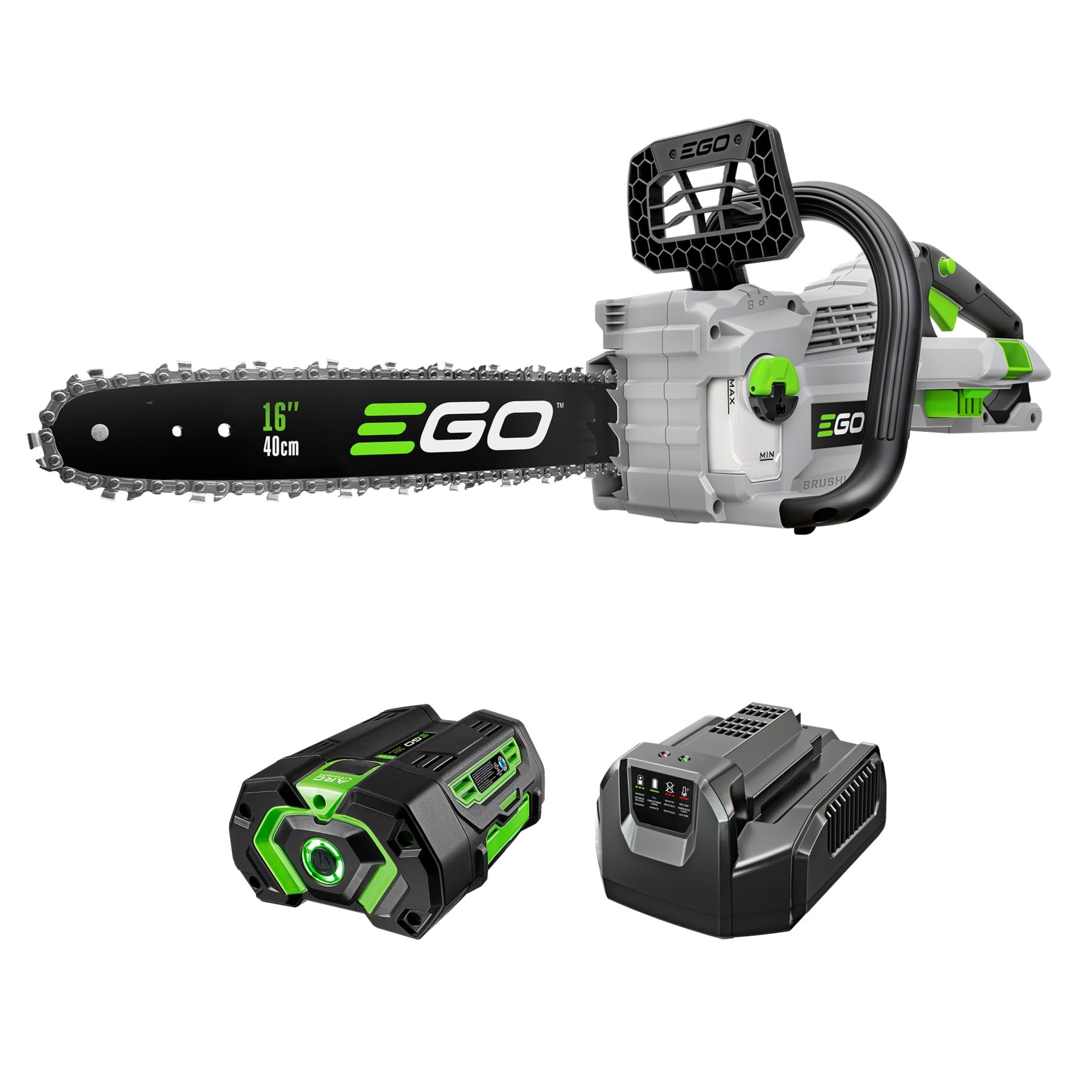
8. EGO POWER+ Chain Saw, 16” Battery Powered Chainsaw, 56V 4.0Ah Battery (CS1613)
Gas-saw power without the pull cord or the fumes
This is the chainsaw for the homeowner who already fells trees, not just prunes them. The high-efficiency brushless motor delivers chain speeds up to 20 meters per second, which the maker equates to a 40cc gas chainsaw, and it ships with a 56V 4.0Ah battery and charger. EGO rates it for up to 130 cuts on a 4×4 with that included battery. The 16-inch bar runs a 3/8-inch pitch, 0.043-inch gauge chain with 56 drive links — the bigger bar lets you take on thick trunks that the 12-inch Greenworks above simply cannot reach.
A tool-free chain tensioning dial tightens the chain with a twist, no tools or disassembly needed, and the IPX4 weather-resistance rating (protected against splashing water) means a little rain will not stop the job. The low-profile dial design also lets you cut flush to the ground for stumps.
Reviewers point out it fells 16-inch and 12-inch trees and even a roughly 2-foot trunk, with battery left after the cut. The trade-offs are honest ones: at 20.9 pounds the 4.0Ah battery adds noticeable weight that unbalances the saw to the left, and the chain can derail in tangled vines — easy to reinstall, but worth knowing. It is still far easier to live with than a gas saw that needs fuel and a hard start.
Why yard owners reach for it
- 56V brushless motor and 20 m/s chain speed equivalent to a 40cc gas saw
- Up to 130 cuts on a 4×4 with the included 4.0Ah battery
- 16-inch bar handles thick trunks the smaller chainsaws cannot
- Tool-free chain tensioning dial and IPX4 weather resistance
What to expect
- At 20.9 pounds the 4.0Ah battery makes it heavy and left-side heavy
- Chain can derail in tangled vines, though it reinstalls easily
- No pull start needed, but it is not a felling saw for the largest trees
The short version: the chainsaw to buy when you have real trees to drop, limbs to clear, and you would rather press a trigger than yank a starter rope.
Size check first: if you are only ever nipping branches, the lighter Greenworks above is easier to handle — this one is built for the bigger cuts.
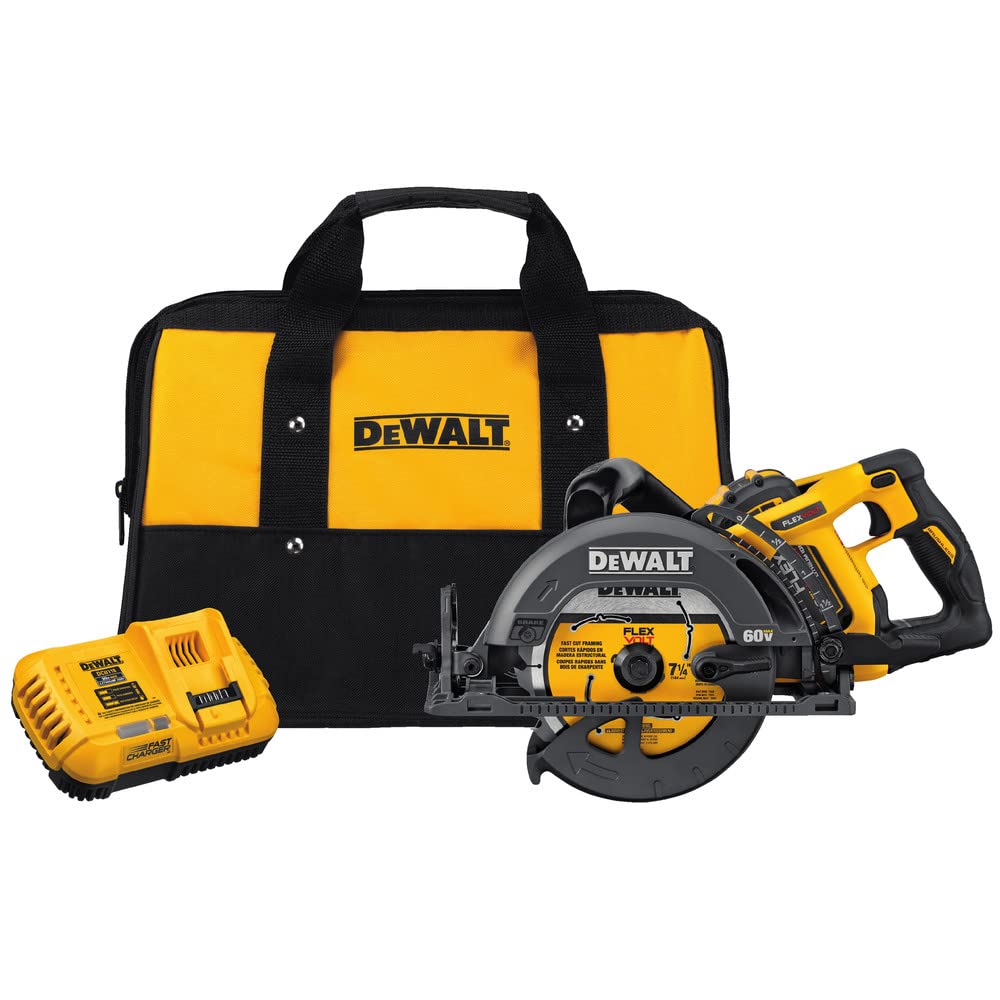
9. DEWALT FLEXVOLT 60V MAX* Circular Saw Kit, 7-1/4-Inch, Worm Style, 9.0Ah Battery (DCS577X1)
The cordless framing saw that makes contractors put their cords away
This is the saw for the framer and deck builder who cuts all day and cannot afford to slow down. The DCS577X1 puts the blade on the left and the handle at the rear for a clear line of sight, and it throws 60V of FLEXVOLT power through a worm-drive-style body. The blade reaches a 2-7/16-inch depth of cut at 90 degrees, with a bevel capacity of 53 degrees and stops at 45 and 22.5 degrees. The magnesium shoe keeps it rigid, and the brushless motor stretches runtime between charges.
It ships as a full kit — the saw, a DCB609 20V/60V MAX FLEXVOLT 9.0Ah battery, a carbide-tipped blade, a fan-cooled fast charger, a blade wrench, and a contractor bag. That 9.0Ah pack is the largest battery on this list, and it is the reason the saw can run long framing sessions where the smaller CRAFTSMAN circular saw would need a mid-job swap. An electronic brake stops the blade after you release the trigger, and onboard blade-wrench storage keeps blade changes quick. Rafter hook and integrated dust blower round out the job-site features — the blower clears your line of sight while you cut.
Owners who frame professionally call the cordless convenience the single best feature, with power to match a corded worm drive and battery that lasts hours of heavy cutting. The trade-offs are real: at 10.9 pounds it is heavy, the left-side blade throws sawdust toward the operator (a face shield is wise), and it is not built for rain. For anyone whose paycheck depends on clean, fast framing cuts, none of that outweighs the cord-free speed.
The number that justifies it: a 60V worm-style body with a 9.0Ah battery in the kit, cutting 2-7/16 inches deep at 90 degrees — that is the largest battery and deepest cut on this list, built for day-long framing.
The trade you accept: it is the heaviest circular saw here and the left-side blade flings chips toward you, so budget for a face shield and expect to build up to its weight.
Built for: the professional framer or serious DIYer who cuts to depth all day and wants corded worm-drive power and a massive 9.0Ah battery in the box.
Overkill for: occasional home cuts — the CRAFTSMAN circular and Makita above cost far less to own and cover weekend projects fine.
Understanding the Specs
Strokes Per Minute And Stroke Length
On a reciprocating saw, strokes per minute (spm) tells you raw cutting speed, and stroke length tells you how far the blade travels each pass. A longer stroke like the 1-1/8-inch on the DEWALT DCS387P1 clears material faster than a short one. Think of it as taking longer steps versus shorter ones — the longer steps cover the cut in fewer moves. Higher spm and stroke together mean quicker cuts, but they also drain the battery faster, so a variable-speed trigger that lets you slow down for precision saves power on fussy work.
Amp-Hours And Battery Platform
Amp-hours (Ah) measure how much energy a battery holds — the higher the number, the longer the saw runs between charges. The DEWALT 20V kit ships with a 5.0Ah battery, while the Greenworks chainsaw includes a 2.0Ah pack, and the FLEXVOLT framing saw tops the list with a 9.0Ah battery. But capacity only matters if the battery fits your tool. A saw sold as “tool only” carries no battery, so it only makes sense if you are already on that brand’s platform. Check the platform first, then the amp-hours.
FAQ
Will a battery powered saw really match my old corded saw?
What does tool only mean and will it run from the start?
Which battery platform should I invest in first?
How long will one battery charge actually last?
Do I need a different saw for pruning versus framing?
Are these saws heavy to use for long stretches?
What is the difference between a reciprocating saw and a circular saw?
Should I replace my gas chainsaw with a battery one?
Can I use tighter or different blades to cut metal?
How much saw do I really need for home projects?
Final Thoughts: The Verdict
For most home owners, the battery powered saw winner is the DEWALT 20V MAX Reciprocating Saw Kit because it cuts wood and metal like a corded saw, ships with its own 5.0Ah battery and charger, and fits into spaces a full-size saw cannot reach. If you mostly trim branches and want the lightest one-handed control, grab the RYOBI ONE+ HP Compact Reciprocating Saw. And for clearing real trees and firewood without fuel or a pull cord, the EGO POWER+ 16” Chain Saw is the one to reach for. Whichever you pick, match the saw to the job and to the batteries you already own — that is what keeps a good tool from collecting dust.
How We Picked
We do not accept paid placement. Every pick is matched to a real buyer and a real use-case; we do not hands-on test units.
Sources & Methodology
Specifications: manufacturer listings and product documentation. Review insights: verified customer reviews, as of September 2026. Pricing: not shown on this page (it changes often); check the current price via the retailer link.
As an Amazon Associate, KitchPrep earns from qualifying purchases. This does not affect which products we feature.
Related Guides
