
Specs are compiled from manufacturer listings and verified buyer reviews and can change over time — please confirm the key details on the product page before buying.
Water damage rarely announces itself. A supply line behind the washing machine drips all night, or a water heater tank lets go while you are at work — and by the time anyone notices, the repair bill has already been written. Automatic leak detection is the fix: a system that senses water where it should not be and closes the valve on your main water line before the puddle becomes a flood. This guide covers seven real kits and meters that each do exactly that, plus the specs that decide which one fits your plumbing.
I’m Mohammad Maruf — the founder and writer behind KitchPrep. This guide is built by comparing the manufacturers’ published specifications and the patterns across verified customer reviews, so you get each pick’s real strengths and trade-offs instead of marketing spin.
The categories are simple once you sort them: battery valve operators you clamp onto existing pipe, all-in-one valves your plumber splices in, and ultrasonic meters that watch flow down to the smallest drip. Below are the strongest options for automatic leak detection.
Our Picks at a Glance

How To Choose The Best Automatic Leak Detection
Your first decision is not which brand to buy — it is whether you are willing to cut into a pipe. A valve operator clamps onto the handle of the shutoff valve you already have, so you avoid any plumbing work. A motorized ball valve replaces a section of your line, which means hiring a plumber and making a splice. Your second decision is the sensor type: puck-style sensors sit on the floor where water pools, while flow meters watch the pipe itself and catch leaks the puck never touches.
Check the valve size before anything else
Your main line is almost always 3/4 inch or 1 inch. The kit has to match, or it will not thread on. Some kits include adapters for both sizes; others are fixed at one. Measure your pipe or read the label on your existing valve before ordering — a mismatched valve is the single most common reason an install stalls.
Decide whether offline protection matters to you
Some systems route every shutoff command through your Wi-Fi router. If the router dies during a storm outage, so does your protection. Others use D2D pairing, where a sensor talks directly to the valve, so the valve still closes with no internet and no power. If your main line feeds a finished basement or a second home you leave empty, water resistance in that offline scenario is worth paying attention to.
Quick Comparison
| Model | Best For | Valve Size | Sensors Included | Power | Amazon |
|---|---|---|---|---|---|
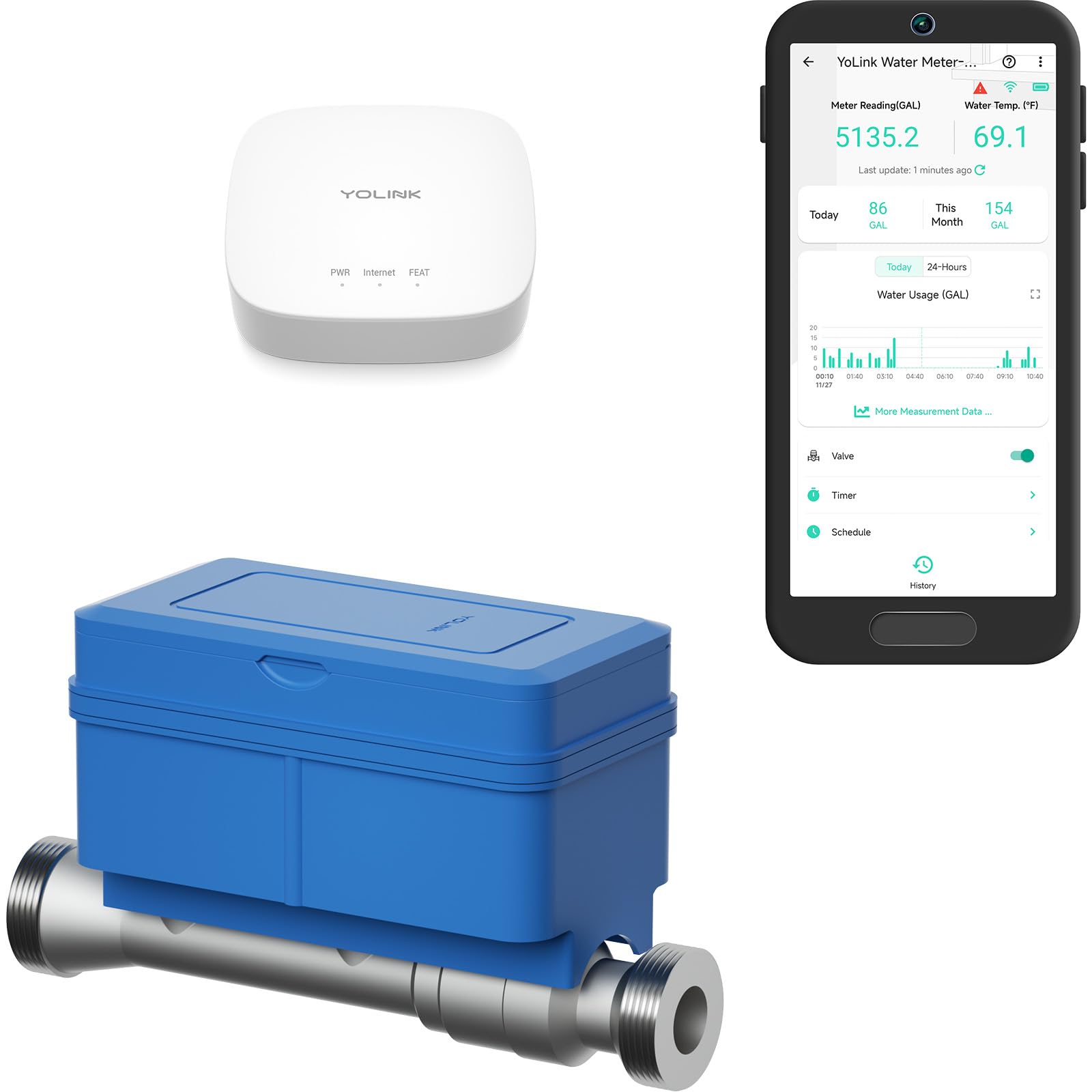
| YoLink EVO Starter Kit★ Best Overall | Whole-home protection with no plumbing | Existing valve (operator clamp) | 3 leak sensors | Battery (2 yr controller / 5 yr sensors) | Amazon |
| YoLink FlowSmart Meter YS5018Premium Pick | Reading every drop plus shutting it off | ¾” pipe (multiple sizes offered) | Ultrasonic meter, no puck sensors | Lithium (10+ yr) | Amazon |
| YoLink NSF Leak Protection Kit | Offline fail-safe shutoff on battery | 3/4″ motorized | 3 leak sensors | Lithium (10+ yr) | Amazon |
| Frizzlife LP365 | Catching tiny micro-leaks by flow | 3/4″ and 1″ | Ultrasonic flow meter | Plug-in, AAA batteries included | Amazon |
| iSpring LS43 | Simple whole-house coverage with room to expand | 3/4″ NPT | 2 sensors (expandable to 8) | Corded electric | Amazon |
| U.S. Solid 1″ 304SS | Potable-water lines needing a stainless valve | 1″ NSF certified 304SS | 3 sensors (20ft cables) | Corded electric | Amazon |
| U.S. Solid 3/4″ Brass | Stand-alone protection with no Wi-Fi needed | 3/4″ motorized brass | 3 sensors (20ft cables) | Corded electric | Amazon |
In‑Depth Reviews
1. YoLink DIY Automatic Water Leak Detection & Shut-Off Starter Kit, EVO Valve Operator
Our pick — over 4.5★ from 500+ verified ratings; the strongest balance of quality and price.
The kit that clamps onto the valve you already own and closes it in seconds
If you rent-adjacent worry about your plumbing but do not want a plumber in the house, this is the pick. You get three leak sensors, a valve controller, a hub, and the EVO valve operator, which mounts over your existing shutoff handle and turns it for you. No cutting, no soldering, no draining the line. Owners with a 1-inch copper line ahead of the meter describe mounting, wiring, and app pairing as straightforward — a DIY afternoon.
What really sells this kit is D2D — short for device-to-device, meaning the sensor talks straight to the valve instead of waiting on your router. Once you set up D2D control, a detected leak triggers the valve to close even during a power loss or a network outage. The controller carries two years of battery as backup, while the sensors run up to five years. That is the difference between protection and protection that quits in a storm.
Range is the second reason it tops this list. The system uses LoRa, a low-power radio that reaches as far as a quarter mile between devices and the hub, so sensors work in a basement, an attic, or a detached storage room where Wi-Fi gives up. When a leak does happen, alerts arrive by SMS, app, and email, and iOS owners also get Critical Alerts; each account includes five free SMS per month, and this kit starts you with thirty. The tracking here is the kind of boring reliability people stop noticing — which is the point.
Why this one leads
- Valve operator installs over your existing shutoff — no pipe cutting required
- D2D shutoff keeps working through power and internet outages
- LoRa radio reaches up to a quarter mile, so basement and attic sensors stay connected
- Three sensors, hub, and controller in one box
- Works with Alexa, Google Assistant, IFTTT, and Home Assistant
What to weigh first
- You still need a working shutoff handle for the operator to grab
- Programming sensors takes some patience according to the longer review writeups
- This is a kit, so the budget route is a different product
Reach for this if: you want whole-house protection without touching a pipe, and you want the valve to close itself when the power is out.
Look elsewhere if: your budget is tighter and you can live with a corded valve that needs a plumber to splice in.
2. NSF Certified YoLink FlowSmart All-in-One Smart Water Meter & Auto Shutoff for ¾″ Pipes
One device that measures every gallon and slams the valve shut when the flow looks wrong
This is the upgrade pick for someone who wants to know what their water is doing, not just whether it is leaking. Instead of a puck sensor sitting on the floor, the FlowSmart uses ultrasonic measurement inside the pipe to read flow in real time, then closes its built-in motorized valve automatically when it spots a leak or abnormal use. It ships with a hub and fits ¾-inch pipe, with ½-inch, 1-inch, 1¼-inch, 1½-inch, and 2-inch versions also offered. The assembly is NSF certified for potable water, which matters because it sits directly in your drinking supply.
The everyday value shows up in the reporting. Owners describe hourly, daily, weekly, and monthly usage logs in the app, and the leak detection caught a sprinkler drip that would have run for weeks unnoticed. What wins people over, though, is the notification speed — a leak triggers an alert and a valve action rather than a shrug. Outdoors it is fine with a plastic film cover for long-term protection, and one owner running 32 YoLink devices calls the setup flexible and the alerts reliable across phone, text, email, and Alexa.
The honest catch is the valve itself. This is a spliced-in unit, so you will need a plumber or the confidence to DIY. One long-time user reported two 1-inch PVC couplings that leaked and needed retightening, and warns to hand-tighten the stud connectors and never overtighten PVC. Another pointed out there is no live real-time water pulse display, just the logs. Installation is the trade-off you accept for the continuous flow picture.
Where the money goes: the ultrasonic tube and motorized valve are one integrated body, so you get measurement and shutoff from a single fitting instead of two devices plus wiring.
Be honest about the install: this is not a clamp-on kit like the YoLink EVO operator above — the line has to be opened, and one owner’s two leaking PVC couplings are a fair reminder to thread carefully.
Worth it if: you want usage data and leak protection from one NSF-certified fitting and you are comfortable calling a plumber.
Think twice if: you want a no-plumbing install or want to see live flow on the screen rather than in the logs.
3. Frizzlife LP365 Smart Water Monitor and Automatic Shutoff Valve
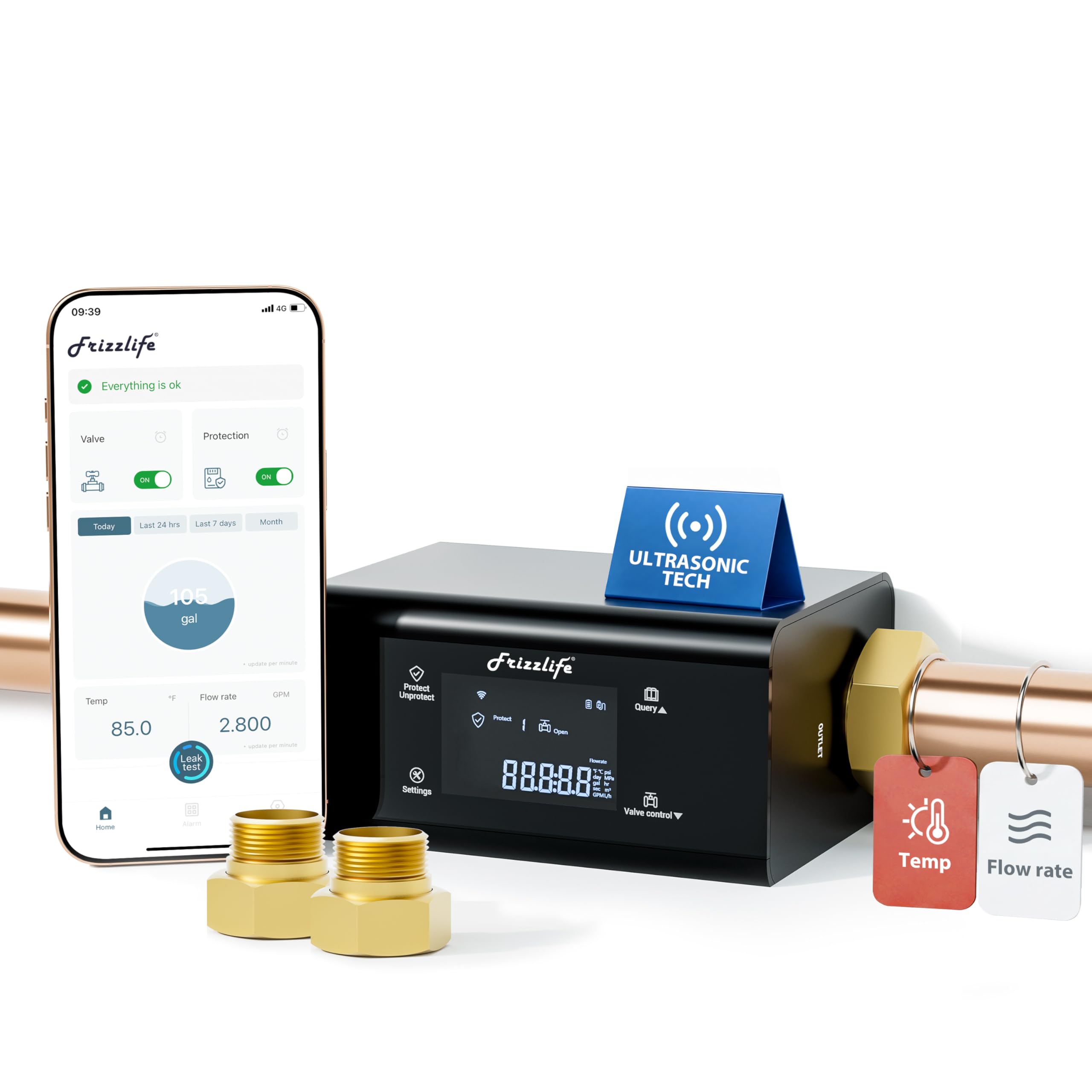
A flow meter sharp enough to notice a drip nobody would ever see
Some leaks never pool. They seep through a joint at a rate too slow to puddle, and a floor sensor never fires — the utility bill just climbs. The LP365 attacks that problem differently: ultrasonic sensors watch the water moving through the pipe and pick up changes as small as 0.01 GPM (gallons per minute, a trickle barely visible to the eye). It fits both 3/4-inch and 1-inch pipe, comes NSF/ANSI 61 and 372 certified for potable water, and includes the adapters you need in the box.
What owners value is how much the app shows you: flow rate, temperature, and pressure alongside 24/7 usage reports, all through the Smart Life app. You get remote shutoff from your phone whether you are at work or on a trip. A home-automation owner replacing a 15-year-old shutoff valve calls the build solid and the Tuya app genuinely useful. The default auto-shutoff settings work without fiddling, and you can customize thresholds around your family’s habits to avoid false alarms.
The trade-offs are real but reasonable. This is a plug-in unit — Frizzlife is clear the device needs to be powered to stay networked, so a dead outlet means no protection. The valve takes about 20 seconds to close, though owners note it seals fully with zero leaks afterward. And it needs proper plumbing: supporters report that adapters or soldering call for a plumber, and one installation gripe is that the brass adapters lack flats, making them harder to grip with a wrench.
The case for the LP365
- Catches micro-leaks down to 0.01 GPM that floor sensors miss entirely
- Fits both 3/4-inch and 1-inch pipe with adapters included
- Real-time flow, temperature, and pressure in one app view
- 24/7 usage reports and remote shutoff from anywhere
- NSF/ANSI 61 and 372 certified for drinking water
Where it asks more of you
- Needs a live outlet — no battery backup for the valve itself
- Valve closes in roughly 20 seconds, not instantly
- Plumber recommended for the adapter work; one gripe is brass adapters with no wrench flats
The smart buy for: chasing slow, invisible leaks and wanting a full picture of household water use.
Pass if: you need protection that survives a power cut or you refuse to call a plumber.
4. YoLink Leak Protection Kit, 3/4″ Battery-Powered Shutoff Valve with Controller

A battery valve that keeps guarding your main line when the grid goes dark
Most people shopping this category eventually ask the same question: what happens when the power fails and the leak is still running? This kit answers it. The 3/4-inch motorized shutoff valve is battery-powered with an integrated controller, and D2D direct pairing lets the leak sensors trigger the valve to close without internet or AC power. It is NSF certified for potable water, comes with three leak sensors and a hub, and is rated for a decade-plus of battery life on an ultra-low-power radio design with no wiring required.
The range is the quiet hero here. LoRa wireless reaches up to a quarter mile in open air, so you can drop sensors in a basement, a meter pit, or a mechanical room where Wi-Fi has no chance. Functionality is clearly what owners care about most, and the pattern in the reviews backs it: the valve responds the moment a sensor gets wet. Setup runs about an hour for most, with one owner wiring it to a 1-inch main and placing detectors under the washer, dishwasher, heater, and softener, then adding more as they went. It expands past 80 devices with no subscription fees.
Two practical notes before you buy. First, the valve has to be spliced into the line, so plan on a plumber — one owner who fitted two homes in cold climates paid for a valve splice and also found the sensor programming a bit complicated at first. Second, the notifications are genuinely useful: text, email, and app alerts, plus the option to create conditions like an alert when a monitored space gets too warm. Owners have used that for pet safety and for freezer and fridge monitoring.
The defining number: 10+ year battery life on the valve and sensors means you are not mentally adding “check the batteries” to your spring cleaning list — the radio wakes only when it needs to.
Best fit for: a second home, a cold-climate property, or any main line where you want the valve working through outages.
Skip if: you are set on a clamp-on install that avoids cutting pipe, or you are working to a strict budget.
5. iSpring LS43 Water Leak Detector Alarm System with Automatic Shut-Off Valve

Straightforward whole-house coverage that starts with two sensors and grows from there
If this is your first leak-detection system, the appeal here is simplicity. A 3/4-inch NPT automatic shut-off ball valve goes on your whole-house line, the controller runs the show, and two water detection sensors come in the box. When water is detected, the valve closes and cuts the supply. Installation is described as easy to follow, and the controller can expand to as many as eight sensors. That means you can add coverage to the dishwasher, washer, basement, and bathroom as you go — the sensor count climbs with your budget instead of all at once.
The mixed wired-and-wireless sensor setup is the real selling point for odd layouts. You get a wired main-line sensor plus a standalone wireless sensor, so you can put one directly on the pipe and drop the other next to a garage water heater without running cable across the house. When a leak triggers, real-time phone alerts fire alongside a high-decibel indoor alarm that is loud enough to carry from a basement. No false-alarm headaches, either — it triggers on standing water, not on humidity or rain.
The one thing to know before you order: this controller is corded, so it needs an outlet nearby and it will not keep protecting if the power goes out. If your priority is a system that still shuts off during an outage, a battery-backed kit like the YoLink above is the better match. For everyone else, this is a clean, dependable entry point that does its one job well.
Why people pick it
- Two sensors to start, expandable to eight as needed
- Mixed wired and wireless sensor placement for awkward layouts
- High-decibel alarm loud enough to hear from the basement
- Shuts off the main supply in seconds on leak detection
Where it stays simple
- Corded electric means no protection during a power outage
- No battery backup option for the controller
- Requires an outlet near the install point
Smart pick for: first-timers who want reliable whole-house coverage and room to add sensors without a big upfront commitment.
Not the one if: you need the valve to close itself during a blackout — you will want a battery-powered system instead.
6. U.S. Solid Water Leak Detector with Auto Shut-Off Valve, 1″ NSF Certified 304SS Motorized Ball Valve
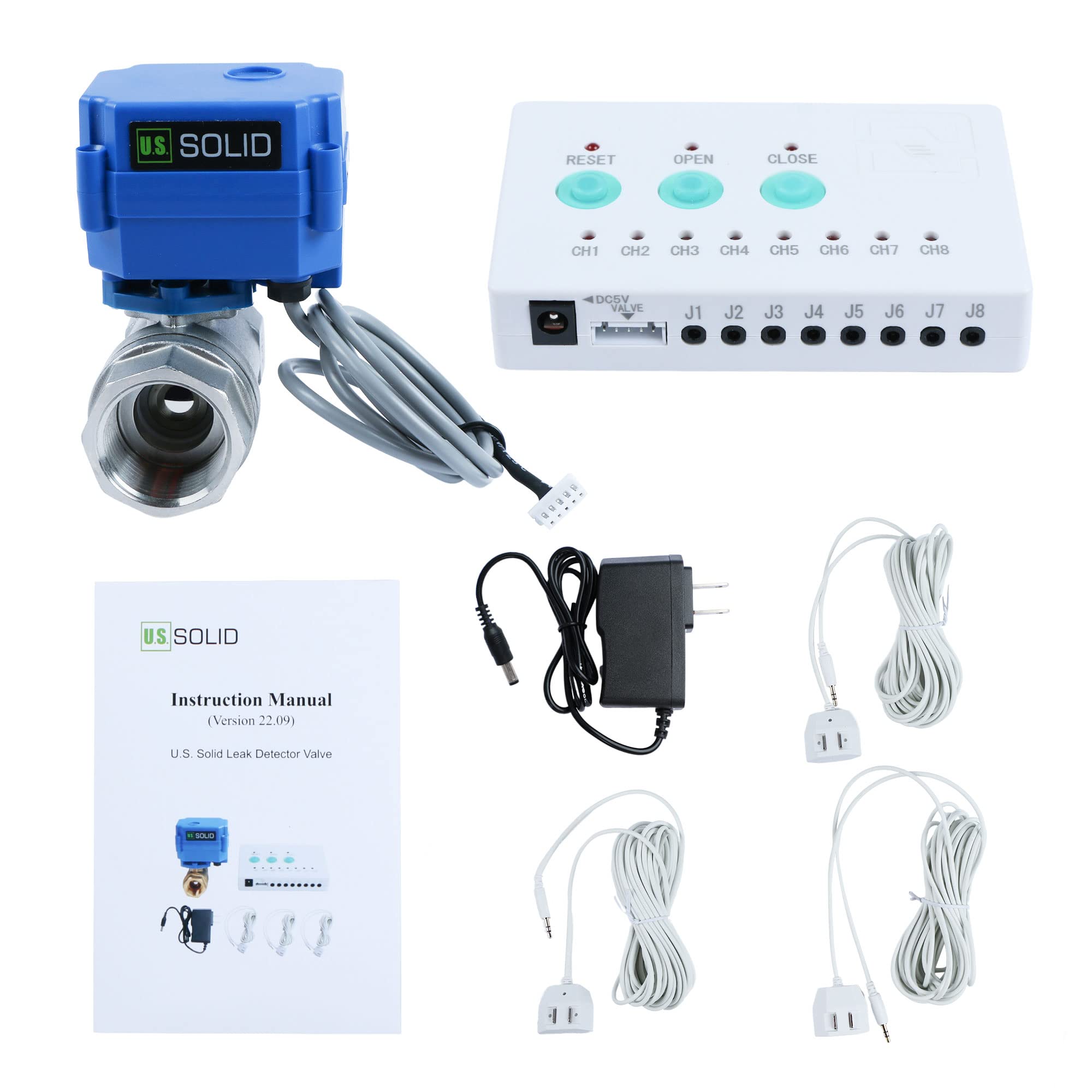
Stainless steel in the water path, three far-reaching sensors, and a loud alarm that will not shut up until you fix the leak
If you want the wetted parts to be stainless rather than brass, this is your pick. The 1-inch ball valve is NSF certified 304 stainless steel — lead-free, rust-resistant, and approved for potable water — with an IP65 waterproof rating (that means it shrugs off splashes and dust) and a 50,000-hour service rating. Three high-sensitivity sensors come aboard on extra-long 20-foot cables, so a single controller can watch a laundry room, a water heater, and a run of exposed pipe without extra hardware. It is a corded, wall-mounted controller, and it pairs with your phone for app control.
Buyers often had a specific trigger: a new water softener with plastic fittings, a water heater on a lower floor, or a brewing setup at risk of a runaway fill. One user testing it deliberately found the system isolates the line within 4-5 seconds. The buy-in value theme runs through the reviews too: three sensors instead of two, and the install handled by the household rather than a crew.
The fair caveats: it needs mains power, which is different from the battery-backed kits above, and the alarm will keep beeping until the leak is cleared and you reset it. That is the point, but worth knowing if you are away. A few buyers have mentioned the manual arriving in German and wishing for a wireless version, so if those matter to you, look at the battery models. For a fixed installation on a 1-inch potable line, the stainless valve is the standout reason to choose this one.
Why stainless matters here: 304 stainless in an NSF-certified valve means no lead and no rust in the water path, which is exactly what you want on a line feeding your taps and appliances.
Choose this if: you have a 1-inch line and want a stainless, NSF-certified valve with three sensors and a hard-wired install.
Consider another route if: you want battery backup or a wireless valve you can place without a nearby outlet.
7. U.S. Solid Water Leak Detector with Auto Shutoff Valve, Sound Alarm, 3/4″ Motorized Brass Ball Valve & 3 Sensors

The one that keeps working perfectly well without ever touching your router
Not everyone wants another app. This U.S. Solid kit is built to run on its own: a 3/4-inch motorized brass ball valve with an IP65 waterproof rating and a 50,000-hour lifespan, a professional controller, and three high-sensitivity sensors on extra-long 20-foot cables. Detection and shutoff happen at the controller — no cloud, no phone required. One buyer deliberately chose it for exactly that reason, wanting a unit that worked stand-alone rather than Wi-Fi dependent. If your phone is not your comfort zone, this is the one for you.
The brass valve is heavy-duty and lead-free, and the three sensors give you a wide monitoring area — a laundry room, a water heater closet, and a stretch of exposed pipe from one box. Owners who have run it for a year report it preventing basement flooding, and several bought a second unit for another shutoff point. The audible alarm is loud and persistent, continuing to beep until the leak is cleared and the system is reset. Set it up once and it watches quietly.
Two honest notes. First, the same stand-alone design means no remote alerts — you will hear the alarm, but you will not get a phone notification while you are at work. It is best paired with the understanding that someone will be home or within earshot. Second, it is wall-mounted and corded, so you will need an outlet at the install point. If wireless alerts matter more than independence, a connected kit like the YoLink FlowSmart is a better match.
Where it earns its keep
- Runs fully stand-alone — no Wi-Fi, no app, no cloud account needed
- Three sensors on 20-foot cables cover a wide, spread-out area
- Heavy-duty brass ball valve with IP65 waterproof protection
- Owner reports of a full year in service preventing basement flooding
Set your expectations
- No phone alerts — the alarm is your notification
- Corded, wall-mounted install, so an outlet is required
- Buyers report some units ship with a German-language manual
The pick for: a homeowner who wants dependable protection with zero smart-home setup and no router involvement.
Not for you if: you need remote alerts on your phone while away or want wireless placement without a power cord.
Understanding the Specs
Valve Size: The First Thing You Must Match
Your main water line runs at a specific diameter — usually 3/4 inch or 1 inch — and the shutoff valve has to match it. Buy the wrong size and it will not thread onto your pipe. Clamp-on operators that grab an existing handle sidestep this because you keep your own valve. If you are buying a spliced-in valve, measure the pipe first or check the label on your current valve. Then confirm the kit includes the fittings you need, like the 3/4-inch and 1-inch options Frizzlife includes in the box.
Power Source: Battery, Cord, or Both
How a system gets its electricity decides what happens during a blackout, and that is when leaks are most likely to go unwatched. Corded controllers simply stop protecting when the outlet loses power, so they suit homes where someone is almost always around. Battery-powered valves like the YoLink kits keep working through an outage, and D2D pairing lets the sensor talk to the valve over the air without a router in the middle. LoRa radio range stretches farther than Wi-Fi — up to a quarter mile for the YoLink kits — which is why they can watch a remote basement or attic the router never reaches.
FAQ
Will an automatic leak detection system work with my existing plumbing?
What happens to my protection during a power outage?
How many leak sensors do I actually need?
What is D2D and why does it matter for water leaks?
Can a flow meter detect leaks that a floor sensor misses?
How fast will the valve close once a leak is detected?
Do I need Wi-Fi for any of these systems?
Does the valve work with potable water?
How long do the batteries last in these leak systems?
Will this lower my home insurance premium?
Final Thoughts: The Verdict
The winner is the YoLink EVO Starter Kit, and the reason is simple: it closes your valve without any plumbing work and keeps doing it when the power and internet drop. If your priority is reading every drop instead of just stopping a puddle, the YoLink FlowSmart Meter is the one to reach for. And for a no-fuss install on a 1-inch potable line, the U.S. Solid 1-inch stainless valve kit earns its place with three far-reaching sensors and an NSF-certified valve. Whatever you pick, match the valve size to your pipe before you order — that one measurement decides whether the install is a quick afternoon or a call to a plumber.
How We Picked
We do not accept paid placement. Every pick is matched to a real buyer and a real use-case; we do not hands-on test units.
Sources & Methodology
Specifications: manufacturer listings and product documentation. Review insights: verified customer reviews, as of September 2026. Pricing: not shown on this page (it changes often); check the current price via the retailer link.
As an Amazon Associate, KitchPrep earns from qualifying purchases. This does not affect which products we feature.
Related Guides
