
Specs are compiled from manufacturer listings and verified buyer reviews and can change over time — please confirm the key details on the product page before buying.
If you want water that is safe to drink when the tap, the well, or the lake is questionable, the fix is simple: pick a filter with a pore size small enough to trap bacteria. That usually means an absolute 0.2-micron membrane, a ceramic element, or a UV purifier that scrambles the DNA of anything living in the water. Get that one detail right and almost everything else on the box is secondary.
I’m Mohammad Maruf — the founder and writer behind KitchPrep. This guide is built by comparing the manufacturers’ published specifications and the patterns across verified customer reviews, so you get each pick’s real strengths and trade-offs instead of marketing spin.
Our Picks at a Glance


How To Choose The Best Water Filter for Bacteria
Every filter on this list will remove bacteria — that part is settled. What separates them is how they do it, what kind of water they expect, and whether they need batteries, gravity, or a hose connection. Match the mechanism to your source: straw for a stream, gravity bag for a group, UV pen for clear water and a battery, in-line cartridge for a tap.
The micron number is the whole ballgame
A micron is one-millionth of a meter, and bacteria like E. coli and Salmonella typically run around 1 micron or larger. A filter with an absolute 0.2-micron rating has every pore at 0.2 microns or smaller, so those bacteria physically cannot pass through. Hollow-fiber and carbon-block cartridges are rated the same way, so check for the word “absolute” before you buy. A 0.01-micron ultrafiltration membrane goes even finer.
UV kills, but it needs clear water
A UV purifier does not strain anything out — it shines ultraviolet light through the water to damage the DNA of bacteria, viruses, and protozoa so they cannot reproduce. The catch is that light cannot pass through murky water, so UV usually gets paired with a pre-filter for sediment. It also needs a battery or a charge, which matters if you are far from an outlet.
Ceramic and gravity options trade speed for independence
A ceramic element is cleanable and reusable — you scrub it and keep going — while a gravity bag drips by weight with no pumping and no power. Both are slower than a straw, but neither depends on a battery. Think about how much water you need per day and how much patience you have at camp.
Quick Comparison
| Model | Best For | Type | Capacity / Life | Bacteria Removal | Amazon |
|---|---|---|---|---|---|
| LifeStraw Personal 4-Pack★ Best Overall | Backpacks and go-bags | Straw | 4,000 liters | 99.999999% | Amazon |
| Waterdrop RF17W-UF ReplacementBest Under-Sink Fix | Under-sink upgrades | In-line cartridge | 3 years / 24,000 gallons | 0.01 μm membrane | Amazon |
| LifeStraw Peak Gravity 3LBest for Group Camping | Group camping | Gravity bag | 3 liters | 99.999999% | Amazon |
| SteriPen Adventurer Opti | Global travel | UV pen | 8,000 liters lamp life | UV light | Amazon |
| SteriPen Ultra | Rechargeable UV | UV pen | 8,000 treatments | UV light | Amazon |
| Katadyn Pocket Ceramic | Long-term durability | Hand pump | 13,000 gallons | Microfilter | Amazon |
| Lifesaver Jerrycan | Overlanding and prep | Pump canister | 18.5 liters stored | 99.9% | Amazon |
| Clearsource Premier | RV campground water | Two-stage in-line | 2,000 gallons | Absolute 0.2 μm | Amazon |
| Clearsource Ultra | Full-time RV living | Three-stage in-line | 4.5 gallons | 0.2 μm + VirusGuard | Amazon |
In‑Depth Reviews
1. LifeStraw Personal Water Filter for Hiking, Travel and Emergency, Navy, 4 PK
Our pick — over 4.5★ from 125,500+ verified ratings; the strongest balance of quality and price.
The straw that turns a questionable stream into a sip you don’t have to think twice about.
Here’s the number that actually matters: the microfiltration membrane inside this straw removes 99.999999% of waterborne bacteria — that includes E. coli and Salmonella — along with 99.999% of parasites such as Giardia and Cryptosporidium. In other words, you dunk the straw, sip, and the microscopic troublemakers stay behind. It also knocks out the smallest microplastics found in the environment, down to 1 micron, and pulls cloudiness down to 0.2 microns so the water not only reads as safe but looks it.
Where it shines is portability. At 1.6 ounces per straw, each one disappears into a side pocket, and a four-pack of that exact build is what the crowd favorite reputation is built on — 4.8 stars from over 125,000 ratings. Four straws means one for your pack, one for the car, and two for a real emergency stash, because this is the kind of device people forget about until the day the tap stops running. Labs verify the bacteria and parasite claims using US EPA, NSF, and ASTM testing protocols, so the numbers on the box are not decorative.
The build is BPA-free plastic with a lifespan of 4,000 liters — about 1,000 gallons — per straw with proper use and maintenance. Compare that to the LifeStraw Peak Gravity’s 3-liter bag and the Personal’s 4,000-liter rating is a completely different scale of endurance. One honest note from the review pages: this is a bacteria and parasite filter, not a virus filter, so it is the wrong tool for sketchy municipal water where viruses could be present. Buyers who trek in the backcountry and preppers building a kit both land here for the same reason — it works with zero setup and zero power.
What earns the top spot
- Removes 99.999999% of bacteria and 99.999% of parasites like Giardia and Cryptosporidium
- 1.6 ounces per straw — invisible in a pack until you need it
- 4,000-liter filter life per straw across the four-pack
- Claims verified against US EPA, NSF, and ASTM lab protocols
Where it comes up short
- No virus removal, so it is not built for contaminated city water
- One straw serves one person at a time — no shared pour
Grab it if: you hike, travel, or want a dead-simple backup filter that works the second it leaves the wrapper.
Skip the straw route if: your water source could carry viruses — you want UV or a multi-stage system instead.
2. Waterdrop RF17W-UF Water Filter Replacement for Waterdrop 17UBW-UF
Faucet water that tastes clean without hauling anything to camp.
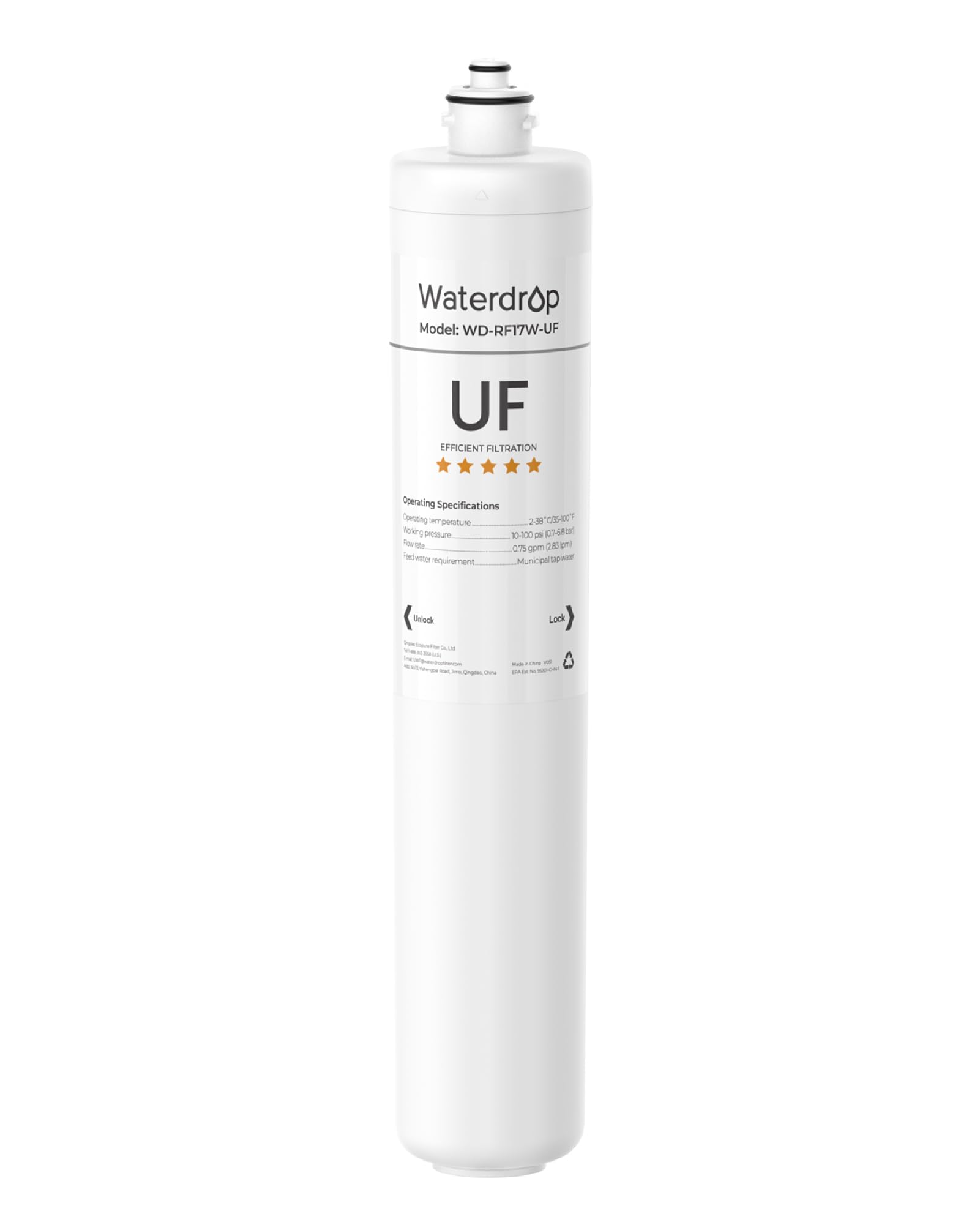
This cartridge cleans your tap water so you can drink without worrying about E. coli. Its filtration accuracy is 0.01 microns (a micron is one millionth of a meter), fine enough that the ultrafiltration membrane catches most bacteria larger than 0.01 μm — E. coli included. Unlike the LifeStraw Personal’s straw format, this fits a Waterdrop under-sink system (WD-UA, WD-UB, WD-UC series) under your counter and cleans the water at your original faucet, a dedicated faucet, or your refrigerator. You confirm the fit by model number before ordering, since it is a replacement cartridge and not a freestanding unit.
You get up to 3 years or 24,000 gallons on municipal water, according to the brand. Reality depends on your supply. Buyers who ran it on city water through a dedicated drinking faucet report a first filter lasting five months and a second lasting nine — real numbers that fall short of the advertised ceiling but still come with water they call fantastic. Quality accounts for the biggest share of what owners write about, and the twist-and-lock design lets you swap it in 3 seconds without tools.
It is certified by WQA against NSF/ANSI 372 for lead-free materials, tested against NSF/ANSI 42 for chlorine, taste, and odor, and it also reduces VOC (chloroform), benzene, chlorobenzene, chloropicrin, and styrene. The activated carbon comes from natural coconut shells, which is why Waterdrop itself asks that you confirm whether you are allergic to it. Compare it to the Clearsource Premier’s absolute 0.2-micron rating and this cartridge goes finer, though it still stops at bacteria and does not claim virus protection.
The value math: if you already run a Waterdrop under-sink system, this is the cheapest way to upgrade your everyday drinking water to bacteria-grade filtration.
One caveat to plan around: the real-world filter life can land well under the advertised three years, so budget for a spare cartridge earlier than the box suggests.
Reach for this if: you own a Waterdrop under-sink system and want finer filtration without buying a new unit.
Look elsewhere if: you don’t have that system or you need a standalone filter you can carry.
3. LifeStraw Peak Compact Gravity Water Filter, 3 L, Dark Mountain Gray
Fill it up and walk away — gravity does the work so one bag serves the whole camp.
This one is built for streams that run fresh and clean, and the numbers back it up: the membrane protects against 99.999999% of bacteria, including E. coli and Salmonella, and 99.999% of parasites such as Giardia and Cryptosporidium. It also catches silt, sand, cloudiness, and 99.999% of microplastics. The re-engineered membrane plus a custom backwash accessory keeps flow strong against sand and silt over time, which is the part that usually kills gravity filters. Set it up as a gravity system, a large squeeze bottle, or as a straw, and you have one filter covering most camp situations. At 228 grams it disappears in a pack, and the standout for a group is the 3-liter capacity against the Personal straw’s single-sip design.
The mixed feedback here is worth knowing. Filtration and filter quality win the most praise, and reviewers who use it in the backcountry call it lightweight, durable, and efficient. The taste side is split — some say the water is excellent and others describe a vinyl flavor, so if you are sensitive to plastic notes, plan to run the first few liters through. A related complaint involves cross-contamination: if the drink piece ends up in the dirty-water bag, or a wet filter gets stuffed in a pocket, the cleanliness you paid for is compromised. Keep the clean and dirty sides separate and you avoid the whole problem.
This earns its spot against the LifeStraw Personal because of its format, not its pore size — same bacteria protection, but the Peak serves 3 liters at a pour or a camp-wide refill, whereas the Personal is a one-person sip. One frequent traveler even reports using sink water through it with no hassle, which fits the portable, on-the-go use case. Between the 3L Peak and the 4,000-liter Personal, the deciding question is simple: do you need one bag for a group, or a pocket straw for yourself?
The group advantage: 3 liters on tap without pumping, and the backwash accessory keeps the flow alive longer than most gravity filters of this size.
The catch to manage: keep the drink side out of the dirty bag and away from pockets, or cross-contamination eats into the clean-water promise.
Best suited to: campers and hikers who want one filter to cover several people at once with no batteries involved.
Think twice if: you want a clean taste on the very first sip — plastic notes come up, and you should flush it first.
4. SteriPen Adventurer Opti UV Personal Water Purifier for Camping, Backpacking, Emergency Preparedness and Travel Black/Green Small
A pen that kills with light instead of straining with pores.
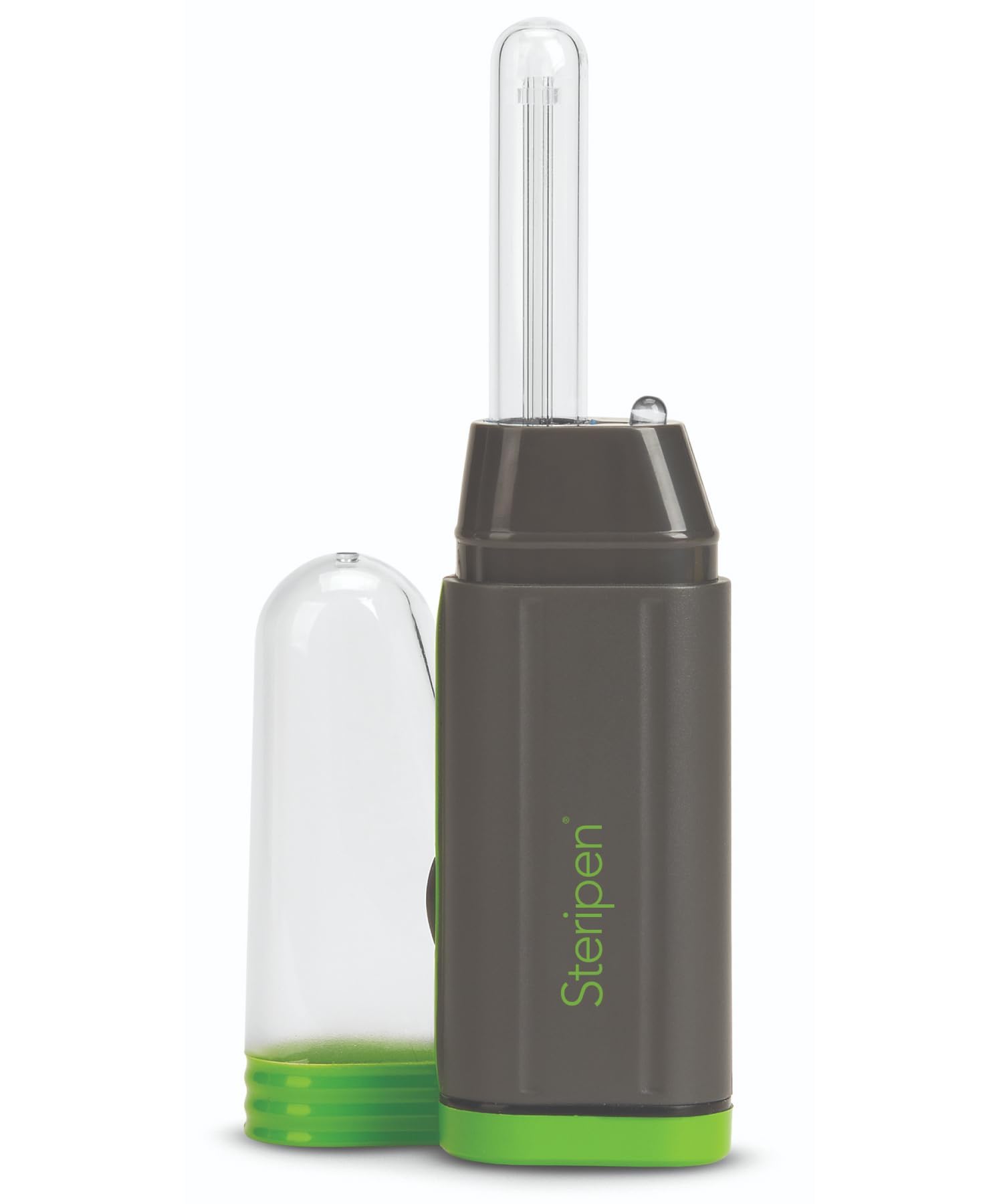
The mechanism here is completely different from the straws and cartridges above. This UV purifier does not filter — it shines ultraviolet light through the water to neutralize bacteria, viruses, and protozoa. That matters because the category’s honest limitation is virus removal, and UV sidesteps it entirely, unlike the bacteria-only microfilters like the LifeStraw Personal. The pen treats clear water in a 6-inch handheld body at 3.6 ounces. Insert the lamp into a wide-mouth bottle, press the button, and stir for 90 seconds.
The Adventurer Opti runs on 2 CR123 lithium batteries (included) — the kind sold in camera shops and outdoor retailers worldwide, so you are never hunting for a USB cable in a foreign town. One set delivers 60 treatments. The optical water sensor is one of its smartest touches: it detects when the lamp is submerged and only activates in water, which saves battery and keeps it from firing mid-air. Built-in LED doubles as an emergency flashlight. It holds an 8,000-liter lamp-life rating, so one unit covers years of ordinary travel.
Owners say this pen works well with pre-filters in wide-mouth bottles, and functionality and quality dominate the conversation. A trek to Everest Base Camp is one scene that keeps coming up — the pen was used daily with no bottled water needed, killed everything in 90 seconds instead of the four hours iodine or chlorine tablets require, and never touched the taste of the water. The one firm limitation owners point to is volume: 1 liter at a time, roughly 50 liters per battery set, and no treating containers larger than 1 liter or ice. Pair it with a sediment pre-filter for cloudy water and it is among the most versatile tools in this list.
Why owners keep it
- CR123 batteries beat USB dependence for travel far from outlets
- Optical sensor only activates under water — a genuinely thoughtful design
- 8,000-liter lamp life means years of trips per unit
Where the trade-offs sit
- Treats only 1 liter at a time, about 50 liters per battery set
- Needs clear water — pair it with a pre-filter for cloudy sources
Ideal for: global travelers and backpackers who need virus protection in a region where microfilters won’t cover them.
Not the pick for: filtering at the gallon scale — the 1-liter batch size will slow you down.
5. SteriPen Ultra UV Water Purifier, USB Rechargeable
The UV purifier for travelers who would rather charge a cable than swap batteries.
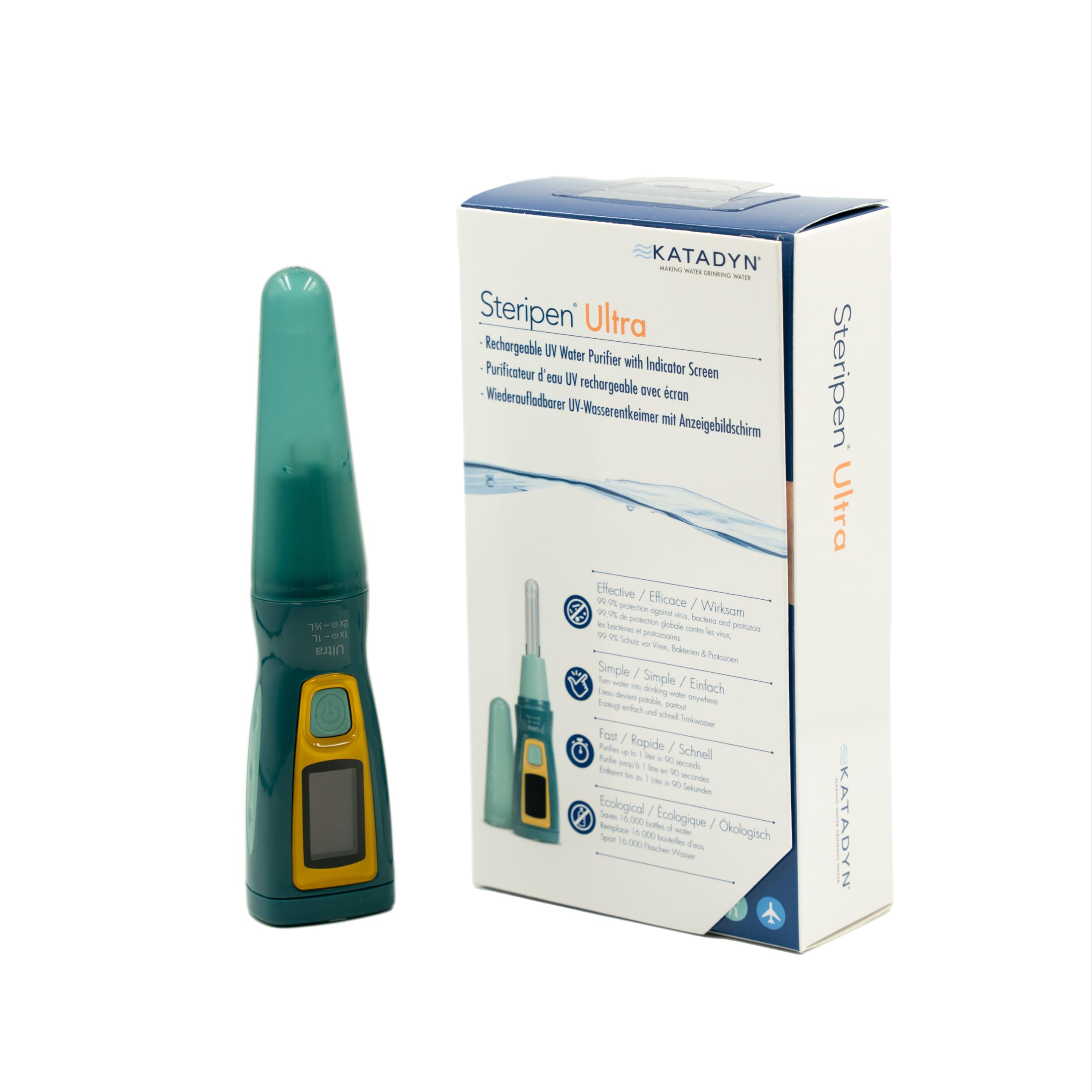
You can charge this pen over USB instead of hunting for specialty batteries like the Adventurer Opti needs. The Ultra upgrades the SteriPen formula with an internal lithium-ion battery that charges over USB instead of consuming CR123 cells — the exact difference that matters if you are spending months abroad. The internal battery holds a full charge for up to 50 liters: that is 50 1-liter treatments or 100 half-liter treatments on one charge. With slim 7.3″ x 1.3″ x 1.6″ dimensions and the ability to fit bottles down to a 20mm (0.8-inch) minimum diameter, it slots into everything from single-serve bottles to camping mugs.
Two numbers make the value case over the long haul: an 8,000-treatment lamp life and a 2-liter-per-minute maximum flow rate, so the light cycles don’t bottleneck you. A high-contrast OLED display tells you the treatment status at a glance, which is the kind of on-screen feedback that people who treat water repeatedly come to depend on. A tapered end fits the brand’s FitsAll or Pre-Filter accessories if you want to pre-clean sediment before the UV light does its work.
The reviews here are genuinely mixed, and the pattern is worth understanding before you buy. Owners who have used it since 2021 for backpacking, kayaking, and bikepacking describe it as zapping bacteria, viruses, and protozoa and preferred it over clogging, cracking, or leaking alternatives. On the other side, battery life and durability draw criticism, with some units quitting and a few reporting a defective first unit that had to be replaced. The recurring operational tip is to keep only the light edge in the water — dunk the whole head and you get an error reading. Handled with that care, it holds up as the rechargeable option in this list.
The rechargeable edge: 50 liters per charge and an 8,000-treatment lamp life cover years of regular trips without a single battery purchase.
The honest risk: battery and durability feedback is more divided than on its battery-powered sibling — some units fail early, and the OLED model isn’t field-repairable.
Pick this one if: you travel often enough to charge on the road and want a chemical-free, rechargeable option with a status screen.
Pass if: you want the certainty of swappable batteries — the Adventurer Opti is the safer field choice on that front.
6. Katadyn Pocket Ceramic Hand Pump Water Filter for Emergency & Survival
The pump you buy once, clean forever, and hand down to someone else.
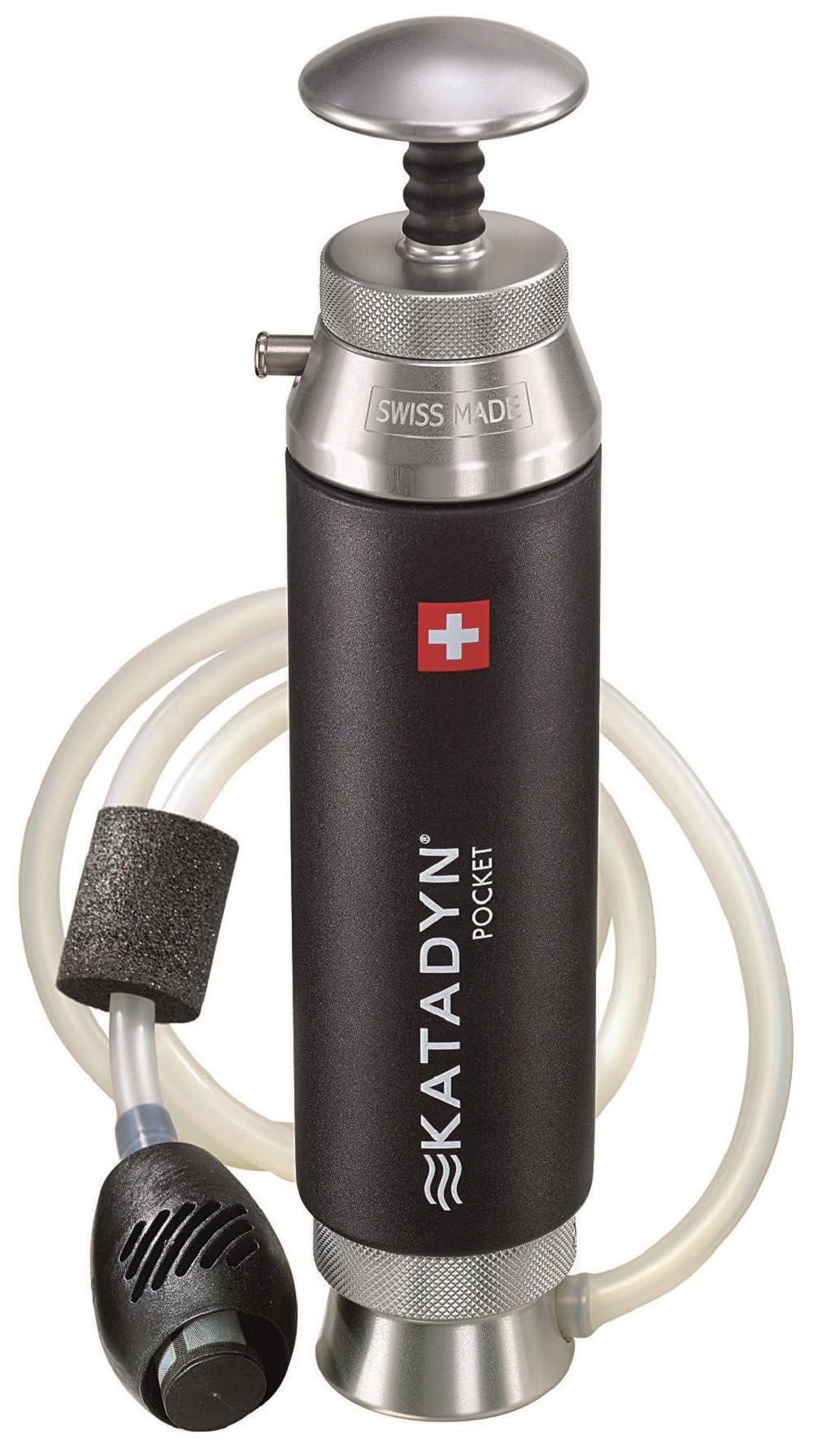
Two numbers define this unit: a 13,000-gallon filter life and a 20-year guarantee backed by 20 years of spare-part availability. That is the entire case. You are not buying it for light weight — it comes with 7.36 ounces of weight but delivers water at a modest 1 liter per minute through a 10″ x 2.4″ x 2.4″ ceramic-element body. You are buying it because the ceramic membrane can be cleaned and reused rather than replaced. Owners describe it as overbuilt, with no plastic barbs or critical plastic parts to snap in the field, and “built like a tank” forms the consensus.
Under the conditions owners actually run it — Iraq, wadis, rainwater runoff, backcountry Camelbak refills — reports describe it turning murky water into clean, drinkable output without a single failure. It is one of the few units in this list that is genuinely field-serviceable: you disassemble it easily, and a filter-life gauge tells you when the ceramic element needs attention. Because the element is cleanable, a busy trip or a silty source just means more scrubbing, not a dead filter. That durability curve, against the single-use hollow-fiber straw format, is the whole reason to step up.
Two honest limits to plan around. First, no virus removal — this is a bacteria and protozoa microfilter, so tricky municipal water still wants a chemical or boil backup. Second, freezing risk: any trapped moisture can freeze, expand, and crack a ceramic element, which ruins it. Keep it above freezing in winter, and it’s a spring-through-fall workhorse. It is not the lightest or the smallest on this list, and it takes a bit of a learning curve to avoid cross-contamination, but for someone who wants one filter to outlast a decade of trips, nothing else here plays in that league.
The lifetime argument
- 13,000-gallon filter life, by far the longest in this list
- Ceramic element is cleanable and reusable — no disposable cartridges
- 20-year guarantee with 20 years of spare-part availability
- Field-serviceable with an easy teardown and a filter-life gauge
The honest limits
- Freezing can crack the ceramic element — keep it above freezing in winter
- No virus removal, and it weighs more than a straw or pen
This is for you if: you want one filter to run for a decade of trips without replacing the element.
Pass it by if: you camp below freezing or want virus protection from a single device.
7. Lifesaver Jerrycan Water Purifier – Military Spec, Heavy Duty Water Purifier for Overlanding, Camping, Hiking, Emergency Preparedness and Survival Kit

A jerrycan that holds the day’s water and purifies it on demand with a built-in pump.
The proposition is a big one: store up to 18.5 liters of water from any source, then filter when you need it with the built-in pump and filtered spout. It exceeds NSF P248 military-grade standards for water purification, reducing viruses, bacteria, cysts, and parasites by 99.9% or greater — even from the dirtiest water. The 20,000-liter filter capacity is the number serious preppers lock onto: that is a staggering amount of water from a single unit. Fill, pump, drink. The activated carbon filter removes chlorine, taste, and odor so the water tastes like water, not like a chemical treatment tablet.
The system includes one activated carbon filter, a plastic flush cap, a pump, and a tap, sized at 13.75″ x 6.7″ x 14″ and 9.4 pounds — it isn’t pocket gear, it’s basecamp gear. It blends with military kit in its finish, and it works as a replacement for the old military water can format. Long-haul buyers report using it exclusively for all their water needs on a 10,000-mile overlanding trip — 2 to 3 gallons a day — with zero adverse effects. Hardware like the pump and spigot held up. The main complaint owners have is speed: the low flow rate requires pumping, on the order of 15 gallons in 45 minutes. That’s the fair trade for never carting in bottled water.
Store it sideways with the spigot down for better flow. Keep the filter submerged — there is no water-level indicator — to keep mold out, and because the reservoir must stay perpetually wet after first use, this is not a set-and-forget container between seasons. Refilling requires removing the pump, which opens a window for contamination, so work clean. Replacement carbon filters can be hard to source. Manage those habits and it is among the most self-sufficient systems in this list.
Why preppers love it: 18.5 liters stored, 20,000-liter filter life, and military-grade standard on viruses, bacteria, and cysts all in one turnkey can.
What to know upfront: it is slow to fill (roughly 15 gallons in 45 minutes by pump), and it must stay wet and clean between uses or the filter grows mold.
Built for: overlanders, long-term campers, and households that want a serious bug-in water plan.
Not for: anyone who wants to stash it dry for months and pull it out in an emergency — it wants attention.
8. Clearsource Premier RV Water Filter System – Protects Against Contaminants & Bacteria
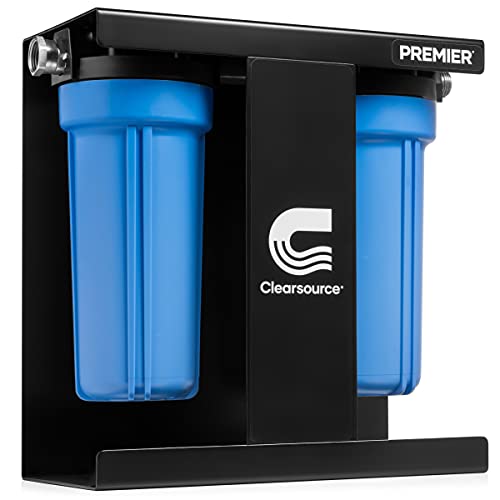
The filter that turns campground well water into something you actually want to drink.
The word to understand here is “absolute.” This two-stage system carries a 0.2-micron absolute rating, which means every single pore is 0.2 microns or smaller — not just some of them. Many competitors only rate 0.5 microns nominally, where a portion of the pores exceed the advertised size and let contaminants slip through. That distinction is what lets the Premier remove or reduce bacteria like Legionella and E. coli plus cysts like giardia. The first stage is a coconut-shell carbon-block filter that improves taste and smell and reduces sediment, chlorine, chloramines, and volatile organic compounds, so your coffee stops tasting like the campground’s plumbing.
You get strong showers and fast faucets even when hooked up, because flow is 6.5 gallons per minute through oversize canisters. At 17 pounds it earns the “built like a tank” reputation — powder-coated chassis, stainless-steel fittings, heavy and stable enough that it won’t tip in transit. Full-time RVers report that after a full hookup, this system tested clean with no bacterial growth, while an older single-stage setup maxed out its growth chart and a mid-tier competitor landed somewhere in the middle. The system holds a 2,000-gallon capacity rating, so how often you swap filters depends on your water.
Two genuine caveats surface in owner feedback. The interconnect lines between the filter housings have been reported to leak by some owners — often fixed with 1-2 extra gaskets at the hose connections, but it is a known quirk to watch. Full-timers also advise checking your water source and replacing those carbon filters on roughly a quarterly schedule if you are on hookups year-round. The metal-body construction and filter quality win the most praise from buyers, and the same people consistently say they stopped buying bottled water after installing it. Check your RV bay dimensions before you commit — it’s a substantial unit.
Why it’s worth the space
- Absolute 0.2-micron rating means every pore is at size — no bypass
- 6.5 gpm flow rate keeps all your water pressure intact
- 2,000-gallon capacity covers plenty of hookups before a filter change
- Powder-coated chassis and stainless-steel fittings built for the road
Things to watch
- Interconnect lines between housings have reported leaks — carry spare gaskets
- Heavy at 17 pounds, so plan for the space in your RV bay
The right call for: full-time RVers and serious campers who want bacteria-grade filtration on their incoming water line.
Think about it twice if: you want plug-and-forget — you’ll need to monitor gaskets and change filters roughly quarterly on hookups.
9. Clearsource Ultra RV Water Filter System with VirusGuard – Ultra Protection Against Viruses, Bacteria & Cysts
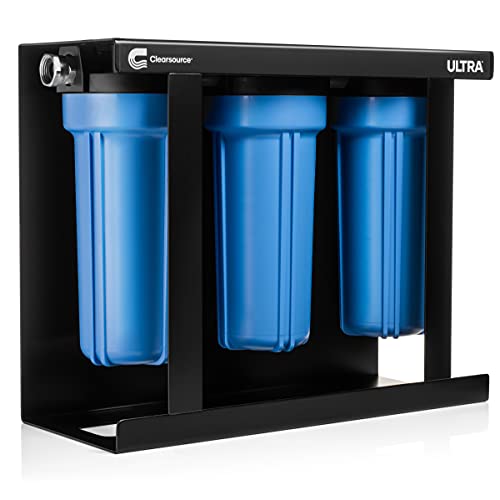
The RV system that goes after viruses as well as bacteria — a step no ordinary 0.2-micron filter takes.
Most bacterial filters stop at bacteria and cysts. The Ultra’s exclusive VirusGuard filter uses an electrically charged coating (developed with NASA technology, per the maker) to trap even the smallest viruses, while 0.2-micron filters only catch rare, larger viruses and let the rest pass. The three-stage design runs your water through a 5-micron filter for rust and sediment, then a 0.5-micron coconut-shell carbon block for taste plus chlorine and VOC reduction, and finally the VirusGuard stage for bacteria like E. coli, cysts like Giardia, and — uniquely here — viruses of all types. On a 4.5-gallon rated capacity and a 4.5 gpm flow rate, it keeps pressure up even feeding your whole camper. It is also the heaviest system in this list at 32.3 pounds.
You get a powder-coated metal chassis and stainless-steel fittings that don’t flex or rust the way thin plastic housings can. Owners who reached for this model during a Texas boil-water notice ran it through their shower via hoses and fittings and described the output as the purest they had experienced — no residue, no chemical smell, no need for anything else. Others have kept it in the shower since. Feedback runs heavily positive on the taste, odor removal, and build quality, and full-time seasonal users report the filter set lasting a whole season before replacing it.
Two honest limits. First, backpressure: owners who run continuous cold water through the system report filters clogging in under a month when the water is unusually dirty, though the customer service response to that situation has been described as excellent — free replacement filters and clear guidance. Second, this is not a small unit: check your RV bay dimensions before committing, because it is a substantial footprint. For a full-timer who wants virus-level protection in one installed system, it delivers the most complete coverage in this list.
The standout feature: VirusGuard’s charged coating catches viruses that standard 0.2-micron pores cannot, making it the only three-stage system here to cover viruses, bacteria, and cysts together.
The practical catch: filters can foul in under a month on unusually dirty water and the unit is bulky — verify your RV bay dimensions before ordering.
Reserve it for: full-time RVers who want the most complete water protection available from a single installed system.
skip it if: you have a tight water bay or only need bacteria-grade filtration — the Premier handles that for less bulk and weight.
Understanding the Specs
Micron Ratings: Absolute vs. Nominal
A micron is one-millionth of a meter, and it is the unit that decides whether a filter stops bacteria. The critical split is between “absolute” and “nominal” ratings. An absolute 0.2-micron rating — like the Clearsource Premier’s — means every pore is the stated size or smaller. A nominal rating means some pores hit the number while others are larger, leaving gaps a bacterium can slip through. If you want a real bacteria guarantee, look for the word “absolute” or a similarly fine rating like the Waterdrop’s 0.01-micron membrane.
UV, Ceramic, and How They Compare
A UV purifier — like the SteriPen models — uses light to damage the DNA of bacteria and viruses rather than straining them out, so there are no pores to clog, but it only works on clear water and needs power. A ceramic filter — like the Katadyn Pocket — physically strains water and can be scrubbed clean and reused, which is why it lasts for years. The difference in practice: UV treats bottles one at a time, ceramic filters pump liter by liter, and 0.2-micron cartridges handle whole-house or whole-RV flow. Match the mechanism to your volume: UV treats one bottle at a time, ceramic pumps liter by liter, and 0.2-micron cartridges handle whole-RV flow.
FAQ
What micron rating actually removes bacteria from water?
Does a LifeStraw remove viruses as well as bacteria?
Is UV purification or pore-size filtration better for travel?
How long does a bacteria water filter usually last?
Can I use a LifeStraw on tap water from a sink?
What is the difference between nominal and absolute micron ratings?
Will a ceramic filter crack if it freezes?
How often should I change an RV water filter cartridge?
Can I drink from a gravity bag right after I fill it?
Final Thoughts: The Verdict
For most people, the water filter for bacteria winner is the LifeStraw Personal 4-Pack because it delivers 99.999999% bacteria removal in a 1.6-ounce straw that needs nothing to work — no pump, no battery, no setup. If you already run a Waterdrop under-sink system and want everyday drinking water cleaned at the tap, grab the Waterdrop RF17W-UF Replacement. And if your plans involve viruses or a whole RV hookup, the Clearsource Ultra with VirusGuard is the one to reach for. The honest nudge: the 4.8-star rating on the top pick comes with more than 125,000 happy owners behind it, which is why it’s worth buying first before you build out a bigger system.
How We Picked
We do not accept paid placement. Every pick is matched to a real buyer and a real use-case; we do not hands-on test units.
Sources & Methodology
Specifications: manufacturer listings and product documentation. Review insights: verified customer reviews, as of September 2026. Pricing: not shown on this page (it changes often); check the current price via the retailer link.
As an Amazon Associate, KitchPrep earns from qualifying purchases. This does not affect which products we feature.
Related Guides
