
Specs are compiled from manufacturer listings and verified buyer reviews and can change over time — please confirm the key details on the product page before buying.
You want a solar setup that keeps a camera, a pump, or a shed light running without you babysitting it — and the honest answer is that a 12V panel paired with its own battery only works as well as the controller and the battery chemistry behind it. This guide walks through eight kits that genuinely include a battery, so you can match one to your job instead of guessing from a spec sheet.
I’m Mohammad Maruf — the founder and writer behind KitchPrep. This guide is built by comparing the manufacturers’ published specifications and the patterns across verified customer reviews, so you get each pick’s real strengths and trade-offs instead of marketing spin.
A kit that fits your load beats a bigger one that fights it, and the picks below are sorted by exactly that logic so you can choose the right 12v solar panel with battery for how you actually plan to use it.
Our Picks at a Glance

How To Choose The Best 12V Solar Panel with Battery
Most disappointment in this category traces back to one mistake: buying a panel that produces plenty of watts for a battery that cannot store them, or a battery with a chemistry that gives up in the cold. Before you compare wattage, work out what you are actually powering and how long it needs to run without sun.
Start With The Load, Not The Wattage
A 100W panel and a 10W panel are built for completely different jobs. If you are topping off a trail camera that only wakes up to take a photo, a 10W to 20W panel with a small internal battery handles it. If you are running a submersible pump, a shed light, or a small refrigerator, you want 100W or more feeding a 20Ah-and-up battery. Match the panel to the load first, then confirm the battery is large enough to carry the load through a cloudy stretch.
Battery Chemistry Decides Cold-Weather Behavior
LiFePO4 (lithium iron phosphate — a lithium chemistry that tolerates deep discharge better than lead-acid) holds up over thousands of charge cycles and stays steady in the cold when it is charged properly. Gel deep-cycle batteries are heavier and cheaper to replace but behave differently in freezing temperatures. Lead-acid and gel units also need the controller set to the right charging profile, or they never reach a full charge.
The Charge Controller Is The Quiet Decision-Maker
A PWM controller (pulse width modulation — a simple, affordable way to taper the charge as the battery fills) is what most kits at this level include. What matters is whether the controller auto-detects 12V versus 24V and whether it has a charging algorithm matched to your battery chemistry. A controller with a digital display also lets you read state of charge without pulling out a multimeter.
Quick Comparison
| Model | Best For | Panel Output | Battery | Output Voltage | Amazon |
|---|---|---|---|---|---|
| ECI Power 100W 12V Solar Power Kit★ Best Overall | Shed and off-grid power | 100 watts | 20Ah LiFePO4 | 24 volts max | Amazon |
| VUEBEE 10W Solar Panel with 10400mAh BatteryBudget Champion | Trail and security cameras | 10 watts | 10400mAh built-in | 5V / 12V | Amazon |
| Wildgame Innovations Sol-PakBest for Trail Cams | WGI cellular trail cameras | 12V solar panel | 3000mAh Li-ion | 12 volts DC | Amazon |
| VUEBEE 20W Solar Panel Kit with 24000mAh Battery | Doorbells and outdoor cams | 20 watts | 24000mAh built-in | 5V DC | Amazon |
| LIFEMOI 15W Solar Panel Kit | Multi-voltage device power | 15 watts | 16000mAh built-in | 5V / 6V / 9V / 12V | Amazon |
| Stealth Cam FieldMax 10″ Solar Panel | Remote hunting locations | 10-inch panel | 10000mAh lithium | 12 volts DC | Amazon |
| ExpertPower 100W 12V Solar Power Kit | Permanent shed installs | 100 watts | 21Ah gel | 12 volts DC | Amazon |
| ECO-WORTHY 200W 12V Complete Kit | RV and camper van builds | 200 watts | 50Ah LiFePO4 | 12 volts DC | Amazon |
In-Depth Reviews
1. ECI Power 100W 12V Solar Power Kit with 20Ah LiFePO4 Battery
Our pick — over 4.5★ from 60+ verified ratings; the strongest balance of quality and price.
The complete kit that turns a bare shed wall into a working power source
Everything in this box already talks to each other — a 100W monocrystalline panel, a 20Ah LiFePO4 battery (lithium iron phosphate — a lithium chemistry built for deep discharge cycles), a 10A PWM controller, 10ft MC4 solar cables, 6ft battery cables, and mounting brackets. That is six items, and it means no hunting for a mating connector on the day the kit lands. Owners repeatedly describe the wiring itself as heavy-duty with solid connections, which is exactly what you want on a permanent outdoor install.
The 20Ah LiFePO4 battery is the headline spec, and the maker states it is lab-tested to at least 2000 cycles at 80% depth of discharge, with a maximum of 5000 cycles at 50% DOD. Depth of discharge is simply how far you drain the battery before recharging — the shallower you run it, the longer it lives. In practice that translates to powering a garden fountain around the clock, which is precisely what one buyer uses it for, or running four added lights inside a shed as another setup did. The 10A controller auto-detects whether it is on a 12V or 24V system, so first-time setup is short.
Set expectations on size: 100W is a starter-scale array. The honest ceiling here is lights, a fountain, a fan, or a small pump — one owner notes it does not produce enough for anything big, and that is accurate rather than a knock. If you want to run a refrigerator or power tools, the ECO-WORTHY 200W kit further down carries double the panel wattage for that job. The other recurring note is the battery out in a temperature-swinging shed, where one buyer did not expect the battery to survive the seasonal flips. Keep the battery in a more stable spot if you can.
Where This Kit Earns Its Keep
- Complete six-piece set — panel, battery, controller, and both cable pairs arrive together
- Auto-detecting 10A PWM controller handles 12V or 24V without a settings change
- 20Ah LiFePO4 battery rated to a minimum of 2000 cycles at 80% DOD
- Weather-tolerant panel backed by a corrosion-resistant frame per the maker
What To Plan Around
- 100W tops out at lights, fountains, and small pumps — not refrigerators
- Shipping many loose components means checking the box thoroughly on arrival
- Exposed seasonal temperature swings shorten battery life in an unheated shed
Reach for this if: you want a shed, garden, or small camper running on its own without shopping for individual parts.
Look elsewhere if: your load includes a fridge or power tools — you need the higher panel output of the ECO-WORTHY kit.
2. VUEBEE 10W Solar Panel with 10400mAh Battery for Security Cameras
A pocket-sized 10W trickle charger that keeps camera batteries off your to-do list
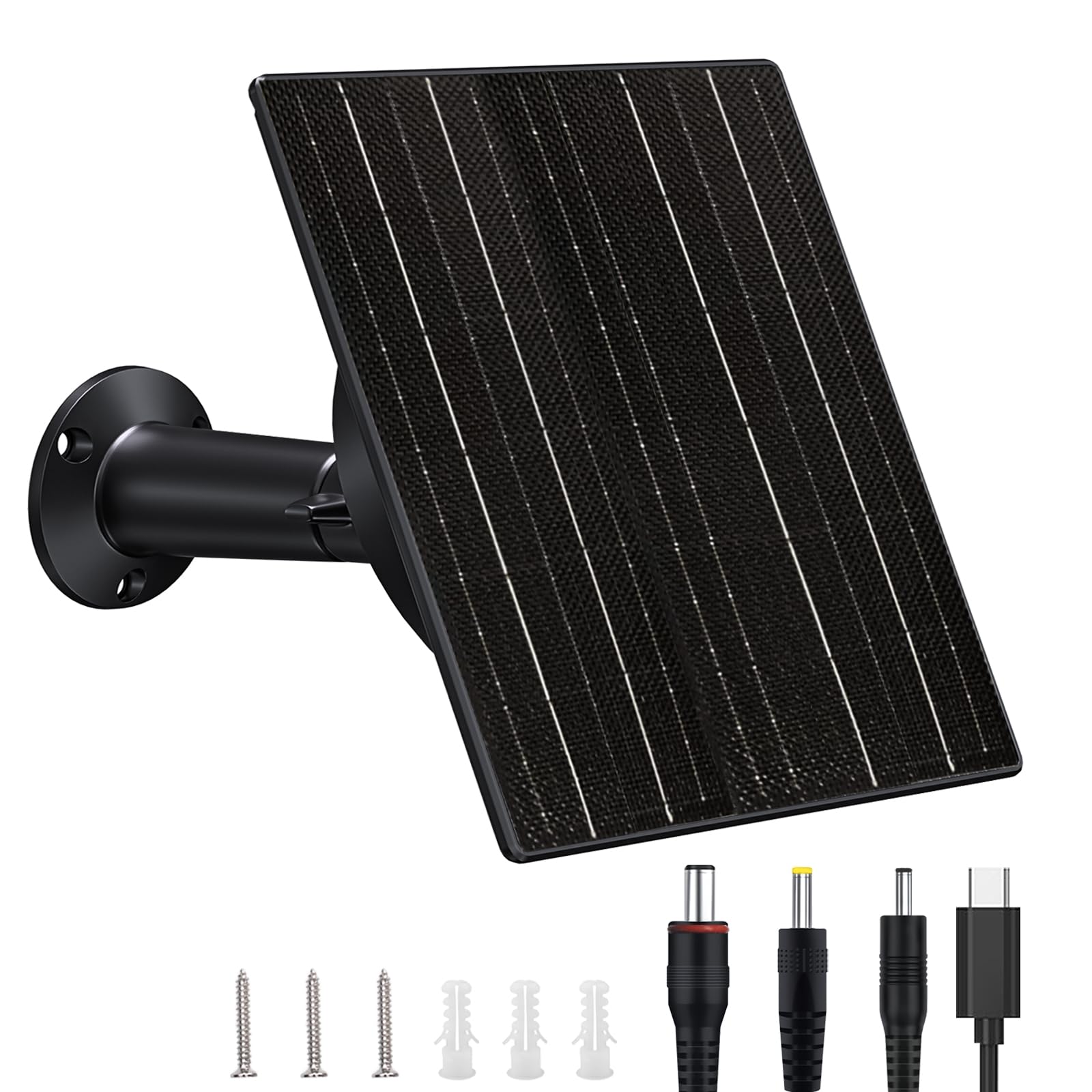
Here is the setup most buyers of this category actually have: a battery-powered camera on a tree or a wall, and a nagging calendar reminder to swap AAs. This VUEBEE panel is built for exactly that. It is a 10W monocrystalline panel with a 10400mAh battery folded into one unit, and a slide switch that lets you pick 5V or 12V output. Only one output port works at a time, so decide which camera you are feeding before you mount it. The included USB-C cable and the 5.5×2.1mm, 4.0×1.7mm, and 3.5×1.35mm DC plugs cover most camera port shapes you will run into.
Note the output gap honestly: this is a 10W panel against the 100W ECI Power kit, which is a 10.0x difference in panel wattage, and 2 amps against that kit’s 10 amps. That is fine for a camera that draws almost nothing, and completely wrong for a pump. Winter performance is where buyers sound happiest — a pair of hunters reported a camera climbing from 20% to 99% overnight on a GardePro unit, without pre-charging the panel first, and one who runs a solar-powered Meshtastic node has had it working well for months. The stated IP66 rating (a waterproof grade that tolerates rain and spray but not full submersion) and the −20°C to 70°C operating range back up the year-round promise.
The weak spot is the phone-style mounting. The 360-degree adjustable bracket gets you pointed at the sun, but the tree-mounting joint has drawn complaints that it will not hold a 45-degree angle and drifts face-down, and the battery inside has a documented failure mode where a fully charged pack went stone cold dead inside a week on a Tactacam. The recurring theme across lower scores is the mount — not the charging.
The camera-camper math: at 9.37 inches long and just over a pound, this panel disappears onto a post or a fence rail. Pick the 12V setting for a cellular trail camera, the 5V setting for a doorbell or USB-charged cam, and it silently tops the battery back up while you forget it exists.
Buy the bracket, not the mount: several buyers ended up reinforcing or replacing the tree connection. A wall bracket at a fixed angle is the more reliable path here.
This is your pick if: you are feeding a single battery-powered trail or security camera and want the smallest possible footprint for the money.
Skip the tree mount and go wall-mounted if: you need the panel aimed and staying aimed on a 45-degree angle.
3. Wildgame Innovations Durable Sol-Pak Solar Battery Pack
A trail-camera companion that lives on the tree and stops the battery-changing circuit
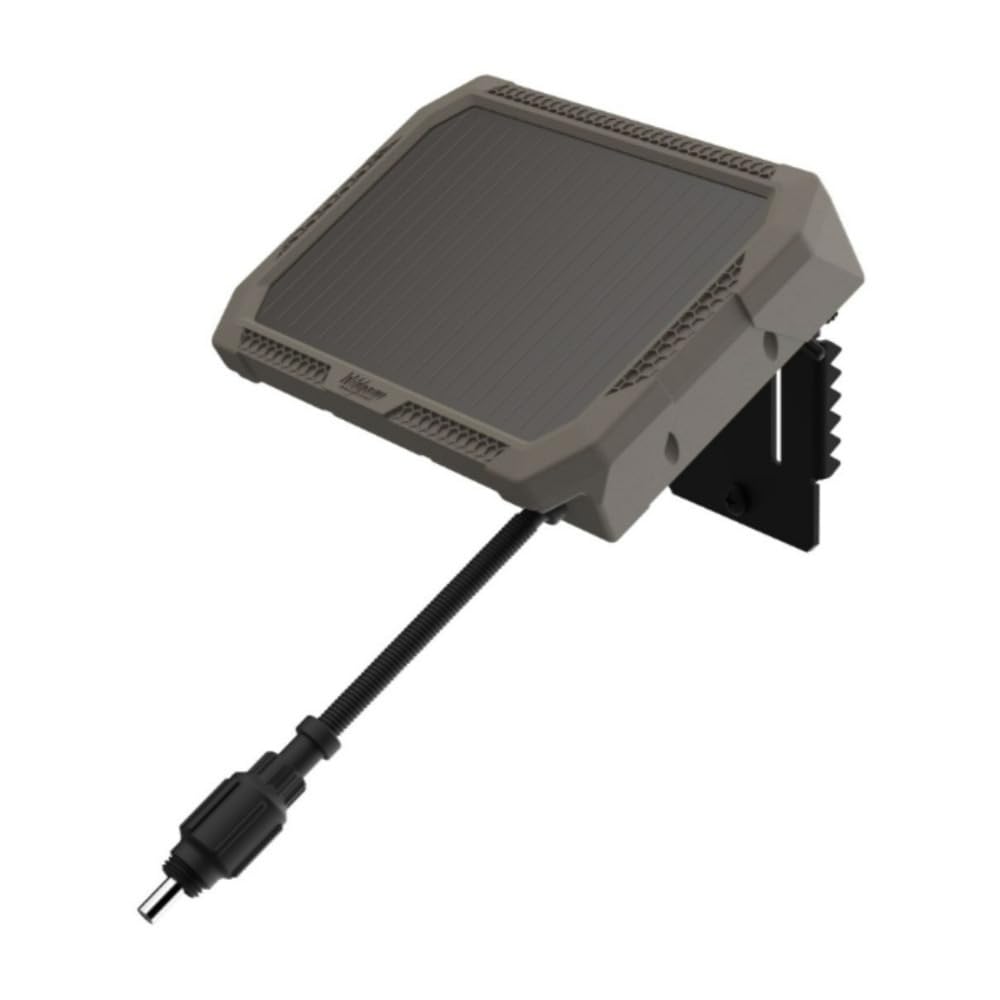
If your fall ritual involves driving to a property and swapping AAs on six cameras, this is the panel that breaks that cycle. The Sol-Pak pairs a 12V solar panel with a 3000mAh Li-ion battery in a weather-resistant housing, plus a 3ft insulated cable and a 12-volt DC jack that plugs into any compatible WGI wireless or cellular trail camera with an external power port. The point is not raw wattage — it is eliminating the trip.
Owners describe the cycle change in plain terms: one went from six or seven battery swaps a year down to a couple, and another simply stopped changing batteries every other week. Several have now put them on every game camera on their property, which says more about the mounting and cable setup than any spec sheet could. An LED indicator gives you a quick look at remaining charge, and a USB-C port (cable not included) lets you top up the internal battery yourself before the season starts.
The catch is brand compatibility. This panel is made for WGI cameras with an external 12-volt DC jack, and buyers who tried to use it on a Tactacam found the barrel plug was too big for the port and still too large even with the provided adapter. If your camera is not a WGI unit, check the port size before you buy. The other practical gap buyers raise is security — there is no built-in way to secure the panel with a cable lock, so on public land it is an easy thing to walk off with.
What It Saves You
- Ends the multi-trip battery swap pattern on cellular game cameras
- 3ft insulated cable and included mounting hardware make setup simple
- USB-C charging port on the unit lets you pre-charge before install
- Weather-resistant housing built for wind, rain, and harsh conditions
The Fine Print
- 12-volt DC jack is sized for WGI cameras — other brands may not fit
- No built-in locking point, so public-land use carries theft risk
- Cord length is short enough that buyers sometimes want more reach
Buy this if: you run Wildgame Innovations cellular cameras on a hunting property and want to stop hauling AAs out there.
Hold off if: your camera is a Tactacam or another brand without the matching DC port size.
4. VUEBEE 20W Solar Panel Kit with 24000mAh Battery
Double the panel and more than double the battery of its 10W sibling, for doorbells that eat power
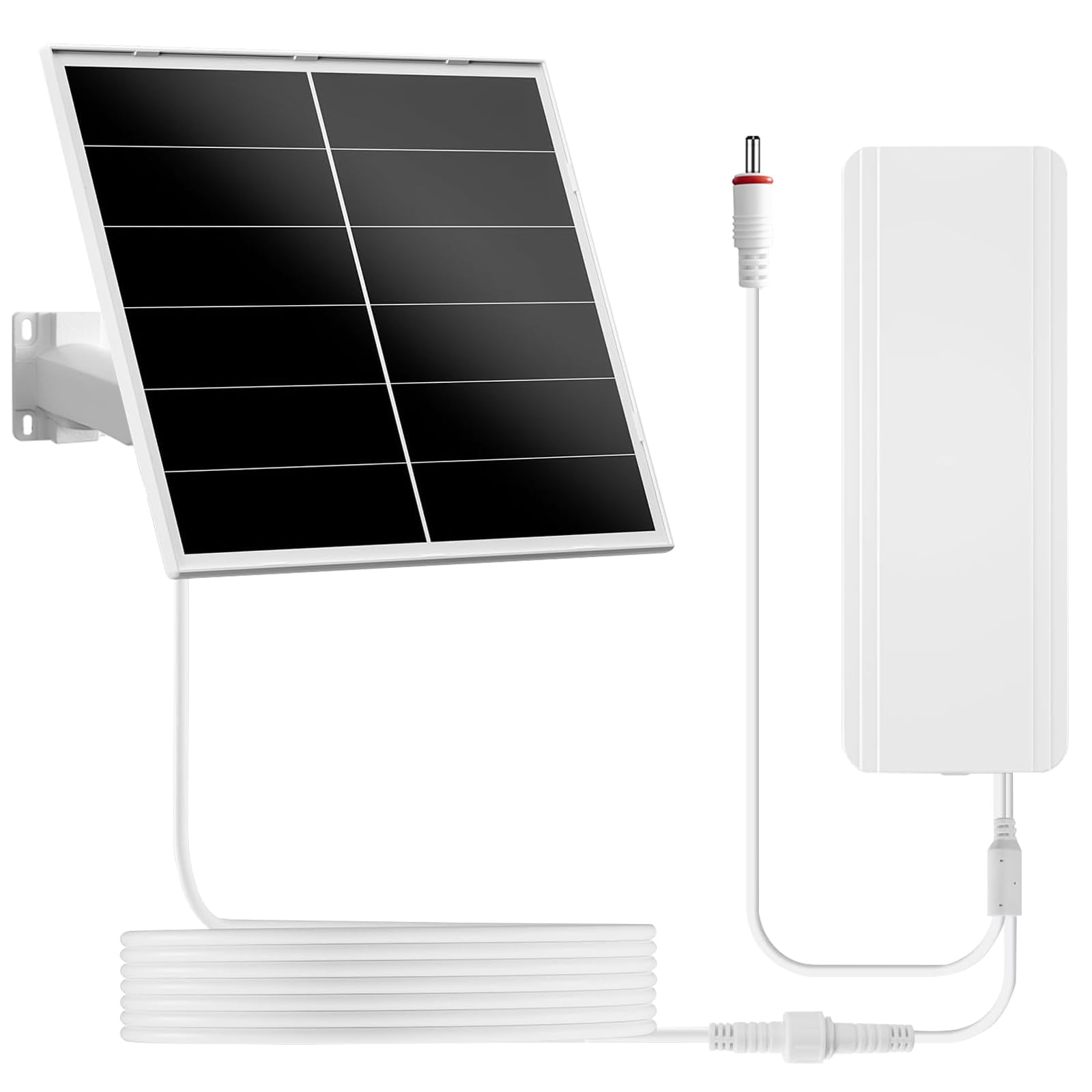
Take the 10W VUEBEE concept and push it up in every direction — this version steps the panel to 20W and the internal battery to 24000mAh, then keeps the same 5V/12V slide switch, the same USB-C plus three DC plug sizes, and the same 360-degree adjustable mount. If you are powering a video doorbell whose cam runs constantly, or an outdoor camera set to capture-all motion, the larger panel means the battery recovers faster after a heavy night. It handles the 5V and 12V split the same way, and again only one output port works at a time.
Owners compare it favorably against the small solar chargers bundled with popular doorbells — several swapped out a 2-3W accessory panel and report the camera holding at 100% even on dark days with settings maxed. That is the largest single jump buyers notice after upgrading. Note the mounting difference from the 10W version: this one ships with a wall bracket and post brackets with adjustable rings, straps, and screws, so you get more ways to anchor it. The stated IP66 rating and 0°C to 45°C operating range make it a three-season outdoor unit.
The reality check on this model is longevity. A cluster of buyers report units that started fine and then stopped holding charge within seven months, and a smaller group describes intermittent water-running noises during operation and battery indicator lights that stopped working. That pattern is worth knowing before you commit — if you want the most bulletproof long-term storage, a LiFePO4 kit like the ECI Power unit is the more durable chemistry. Most buyers still rate the value positively, and it does the doorbell job well while it is running.
Where it fits: constant-draw doorbells, outdoor cameras, and any device where you want a real reserve of stored power behind a modest panel.
The honest call: the internal battery is doing most of the heavy lifting here, and it is the part with the mixed track record. Buy it for a camera you can easily reach, not a remote install you can only visit twice a year.
Good match if: you power a video doorbell or an outdoor camera with a steady draw and want a large internal battery reserve.
Not your best fit if: the install is somewhere genuinely hard to reach — the battery’s long-term reliability is the question mark.
5. LIFEMOI 15W Solar Panel Kit with Built-In 16000mAh Battery
Four selectable voltages and five ports, so it can feed almost anything you already own
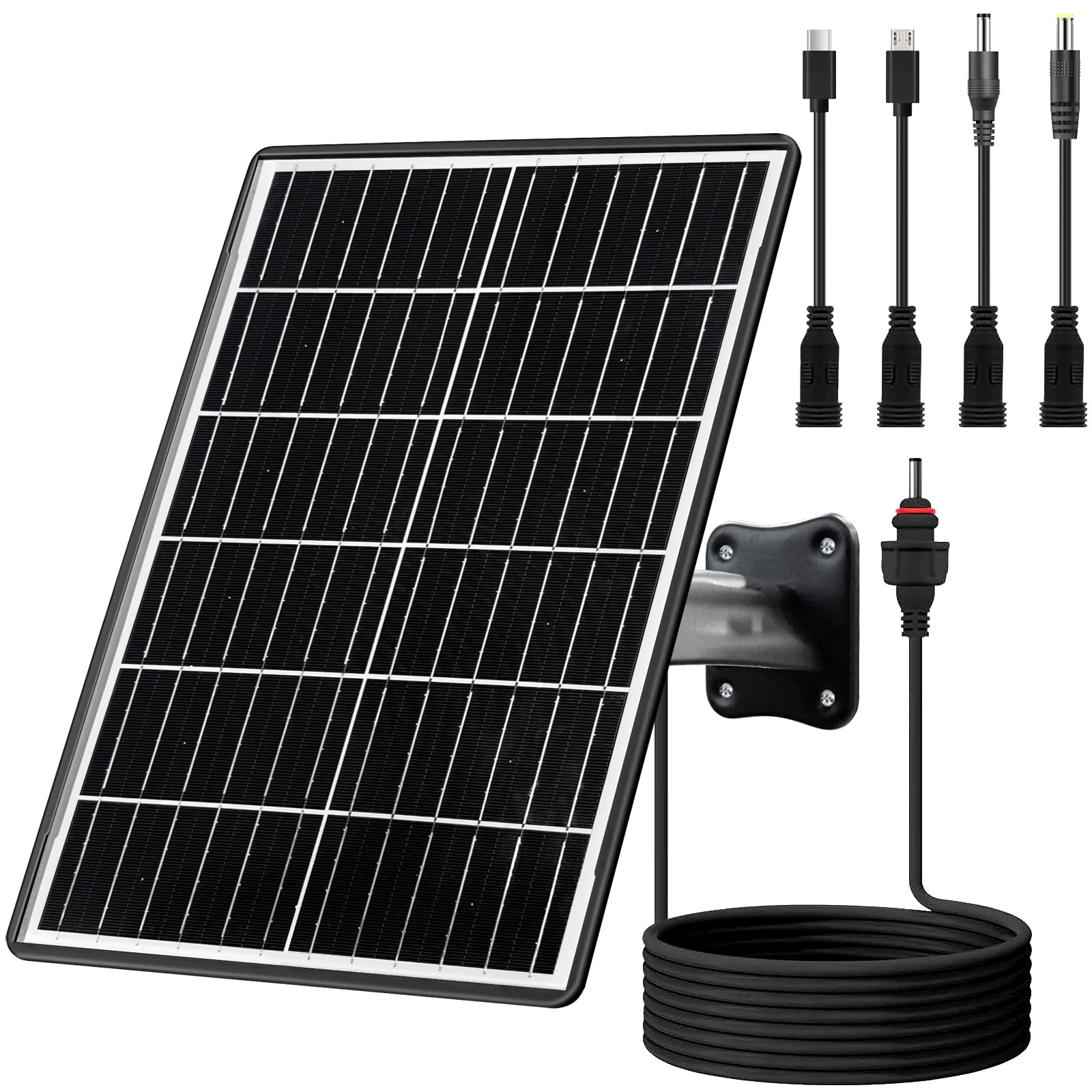
Where the VUEBEE units give you two voltage choices, this LIFEMOI kit gives you four — 5V, 6V, 9V, and 12V, each at 1.5A output — across five separate interfaces: USB-C, Micro-USB, and three DC plug sizes (5.5×2.1mm, 4.0×1.7mm, 3.5×1.35mm). If you have a drawer full of devices with mismatched connectors, that list is the reason to pick this one over a two-voltage alternative. The built-in battery is 16000mAh, and the panel itself is 15W monocrystalline silicon with a stated 23% conversion efficiency.
The practical heart of this unit is the LED digital display, which shows remaining battery power and the currently selected output voltage. That matters because the voltage selection is not instant — after powering on you have to press and hold the button for three seconds to enter voltage-selection mode, then hold one second to cycle through options. Miss the window and the panel defaults to 5V output after ten seconds, which is fine for USB devices but wrong for a 12V camera. Owners who read the included instructions get along with it; owners who wing it sometimes end up with an underpowered camera. The internal smart protection circuit covers overvoltage, overcurrent, overcharge, over-discharge, short circuit, and reverse polarity, and the housing carries an IP65 waterproof rating.
At 2.7 pounds with a foldable glass-surface panel, it is portable enough to move between a trail camera, a camping kit, and an emergency power backup. The trade-off owners mention is charging time rather than output — the 16000mAh cell takes several hours to refill from solar alone. Also note it uses Li-ion cells rather than LiFePO4, so cycle life is shorter than the lithium-iron-phosphate kits further up this list.
Why the extra ports matter: a locator, a camping light, a tracker, a deer feeder, a bird-feeder camera, and a phone can all draw from the same panel across the course of a season — no adapter shopping required.
The learning curve: the button-hold voltage selection is the one thing to master before you mount it, or a 12V device ends up on a 5V feed.
Worth it for: anyone juggling devices across 5V, 6V, 9V, and 12V who wants one panel and one battery to cover the lot.
Think twice if: you want a set-and-forget install — the multi-step voltage selection asks for attention at setup.
6. Stealth Cam FieldMax External 10″ Solar Panel
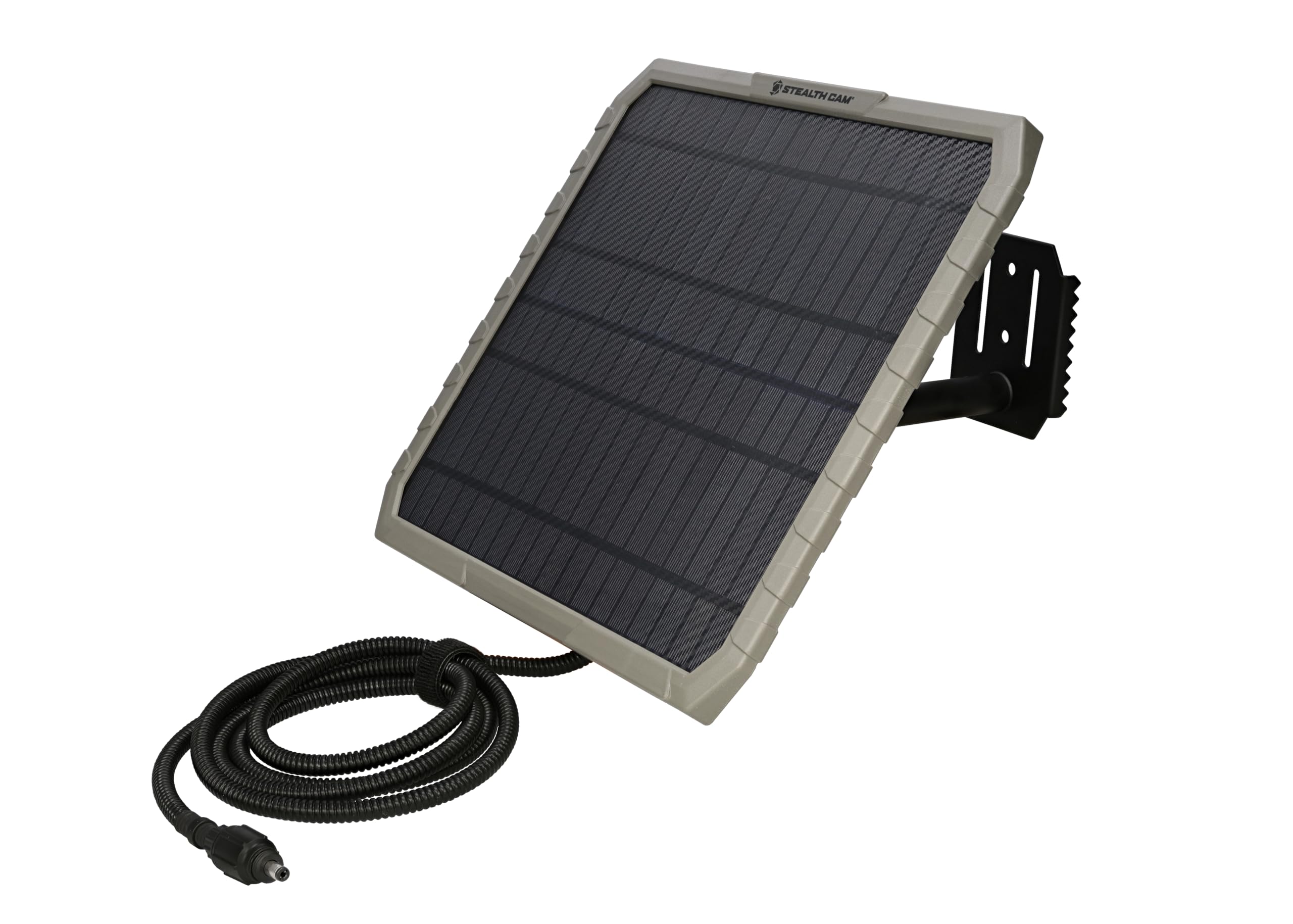
The trail-camera panel owners trust for a whole Michigan winter
Cold weather is where trail-camera power setups go to die, and this is the panel buyers specifically credit for surviving it. The FieldMax pairs an adjustable 10-inch solar panel with a 10000mAh lithium battery, feeding 12 volts DC into any trail camera that has a 12V external power jack. Owners describe running a camera through a Michigan winter from November to April — clouds, snow, and freezing rain — by mounting the panel near-vertical so snow slides off rather than piling up. That mounting trick is the whole game for cold-climate use.
The build uses aluminum and glass rather than plastic, and the panel repositioning is what buyers cite as the daily-use advantage: as the sun moves across the sky through the seasons, you can swing the 10-inch panel to chase it. Setup is short — the unit ships with the power cable and mounting hardware, and owners consistently describe going from box to installed without fuss.
One thing the panel does not do: tell you it is working. There is no charging indicator, so if you want to confirm it is actually topping the camera up, you have to check the camera’s own battery readout. A buyer using a Revolver camera also found you cannot run this solar panel and the lithium battery pack that camera ships with at the same time — one or the other. Check your camera’s manual for that overlap before wiring this in.
What Buyers Keep Coming Back For
- Adjustable 10-inch panel lets you chase the sun through the seasons
- 10000mAh lithium battery carries the camera through cloudy stretches
- Fresh units arrive fully charged and ready to mount from the start
- Aluminum and glass construction instead of basic plastic housing
Small Details Worth Knowing
- No charging indicator light, so you verify power from the camera side
- Some cameras cannot run this panel and their own lithium pack together
- 12V DC jack means it needs a camera with that specific external port
Pick this one if: you hunt in a cold-weather state and want a panel that keeps working when the temperature drops.
Choose a different pick if: you need a visible charging indicator on the panel itself, or your camera lacks an external 12V jack.
7. ExpertPower 100W 12V Solar Power Kit with 21Ah Gel Battery

A gel-battery kit built to sit on a roof for years, not a season
Same 100W panel scale as the ECI Power kit, different battery philosophy: where that kit uses a 20Ah LiFePO4 cell, this one ships with a 21Ah gel deep-cycle battery (a lead-acid variant that resists spillage better than a flooded battery). The panel itself is monocrystalline silicon behind tempered glass in a corrosion-resistant aluminum frame, and the maker states it is rated to withstand 2400Pa wind load and 5400Pa snow load — the snow-piling and gale-force numbers that matter for a permanent roof mount. Owners who installed it on a shed describe it doing exactly that job.
The 10A PWM controller here is more flexible than most. It works with 12V and 24V systems and supports FLD, GEL, LiFePO4, and AGM battery types — AGM and FLD being other lead-acid variants — so if you later swap the gel battery for lithium or AGM, the controller can follow you. That upgrade path is why this kit appeals to buyers planning a permanent install rather than a portable one, and one reviewer describes powering a small submersible pump by placing the controller and battery in a weatherproof container.
The most common complaint is not the kit itself but logistics — one buyer received the order without the battery in the packaging, which is a shipping problem rather than a design flaw, and worth confirming on arrival given how dependent the whole kit is on that single component.
The controller is the real selling point: FLD, GEL, LiFePO4, and AGM compatibility means this kit does not lock you into one battery chemistry for the life of the install.
Where it does not shine: gel batteries want to be kept charged and out of deep swings, so plan to size the load conservatively — this is not the kit for a high-draw appliance running all night.
Right choice for: roof-mounted, unpack-once installations on a shed, small cabin, or outbuilding where the system stays put.
Less ideal if: you need something you can carry between locations — the gel battery adds heft.
8. ECO-WORTHY 200 Watt 12V Complete Solar Panel Starter Kit for RV Off Grid
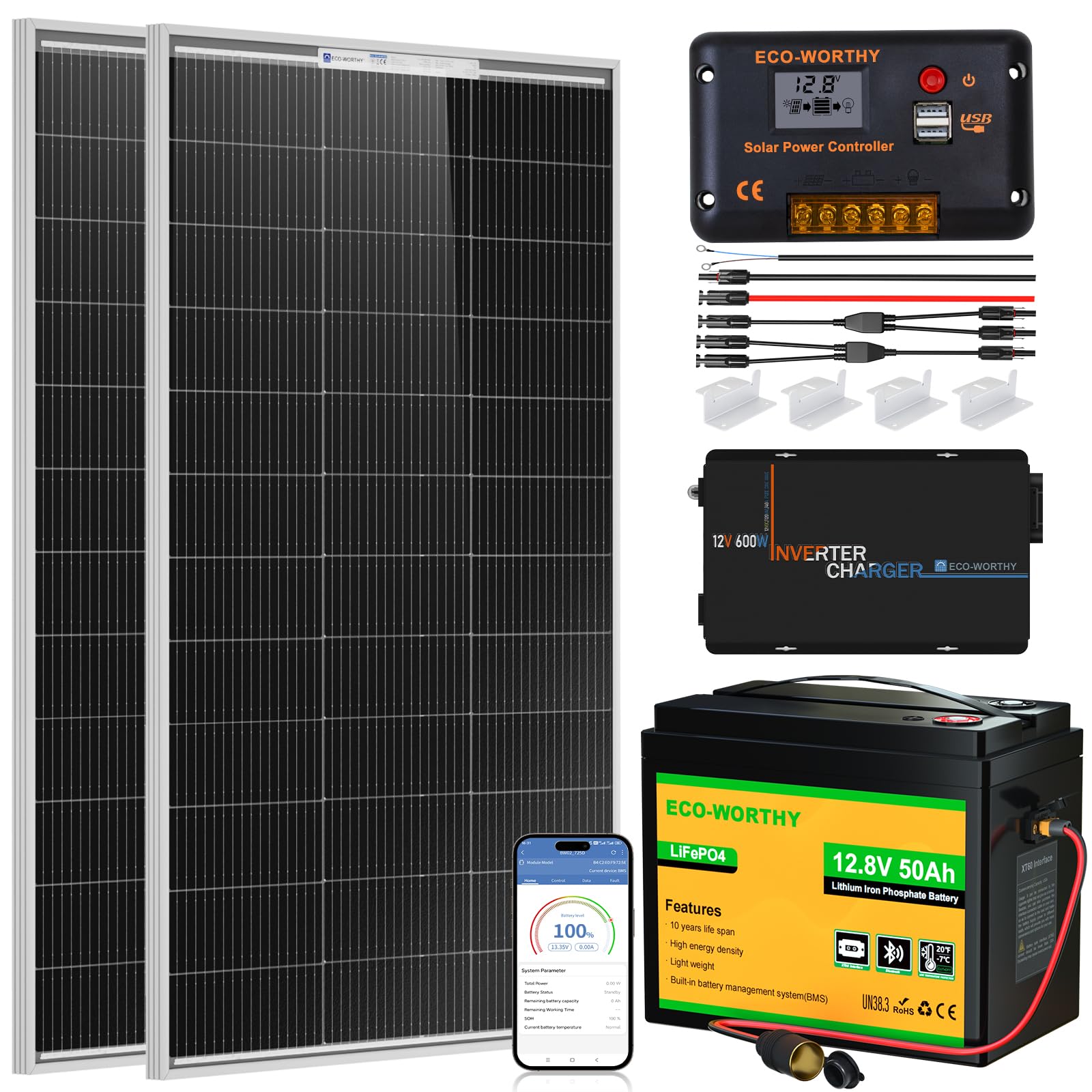
The full RV system — panels, lithium battery, charger, and an inverter that flips DC into household AC
This is the kit for a van build or a camper, not a shed light. It ships with 200 watts of N-Type monocrystalline solar panels, a 50Ah LiFePO4 battery, a 30A charge controller, and a 600W pure sine wave inverter — that last component being the device that converts the 12V DC power your battery stores into the 120V AC power your laptop charger and coffee maker expect. The inverter also includes a 20ms UPS auto-switch (uninterruptible power supply — the wall-socket-style backup behavior that kicks in fast when grid power drops) and 5A-40A adjustable current via an app or a physical button.
The battery side is where the chemistry argument lands hardest. ECO-WORTHY’s 50Ah LiFePO4 is rated for 4000 to 15000 deep cycles, which the maker frames as more than 10 times the 300 to 400 cycles of a lead-acid battery. That spec is the reason to pay more up front on a system you plan to leave in place. The panels use N-Type cells with a stated 25% efficiency and a dual-sided design the maker claims captures reflected light for up to 15% extra output — light bouncing off a white RV roof counts toward your charging. Buyers describe the kit making it easy to run LED lights, phone chargers, a roof vent, and a mini fridge from a van setup in the Pacific Northwest.
The realistic limit is winter. The same customers note that in cloudy months the system needs a full charge before the fridge can run, and it holds a weekend rather than full-time van life — unless you move somewhere genuinely sunny. So does a shorter runtime than the numbers suggest for anyone expecting a full-time off-grid life out of a 50Ah battery. It is also worth knowing that two units in the review set arrived with controller problems, so test the controller the moment the shipment lands rather than after install.
Why It Belongs On An RV List
- 600W pure sine wave inverter powers AC devices straight from the battery
- 50Ah LiFePO4 battery rated for 4000 to 15000 deep cycles per the maker
- N-Type panels with dual-sided light capture and 25% stated efficiency
- 30A charger with adjustable current and app or button control
Where To Set Expectations
- Cloudy-season output drops enough to require pre-charging before heavy loads
- Controller reliability is inconsistent across individual units
- Instructions are minimal — download the better-translated manual before you start
The kit for you if: you are building out a camper van or small RV and want the panels, lithium battery, charger, and inverter in one purchase.
Not the right scale if: you only need a camera or a shed light powered — the two 100W kits higher up this list cover that for a fraction of the footprint.
Understanding the Specs
Panel Wattage And What It Actually Powers
The wattage number on the panel tells you how fast the battery refills, not how much power you get out the other end. A 10W panel is enough to trickle-charge a security or trail camera battery that draws almost nothing. A 100W panel is the floor for anything that runs continuously, like a shed light or a small pump. A 200W array is what you need before you start running appliances like a refrigerator. Match wattage to the load’s daily draw, not to a bigger-is-better instinct.
Battery Chemistry And Amp-Hours
Amp-hours (the shorthand for amp-hour capacity) tell you how long the battery can deliver a given current before it is empty — a 20Ah battery can run a 1-amp load for roughly twenty hours in theory, though depth-of-discharge limits keep you from draining it flat every cycle. Chemistry decides how many times you can do that. LiFePO4 is rated in the thousands of cycles, lead-acid and gel in the hundreds. Lithium also loses less capacity in cold weather, which matters if the panel is mounted on a shed or a tree.
FAQ
What size 12V solar panel do I need to charge a 20Ah battery?
Will a 12V solar panel work with a trail camera that uses AA batteries?
How long does a 16000mAh solar battery take to recharge from the panel?
Do I need a charge controller with a 12V solar panel and battery kit?
How do I set the output voltage to 12V instead of 5V on these panels?
Is LiFePO4 better than a gel battery for a solar panel setup?
Can I run a fridge or power tools from a 100W solar panel and battery?
What does IP66 waterproof mean for an outdoor solar panel?
Can a solar panel keep a 12V battery charged through the winter?
Do these kits come with everything I need to connect the panel to the battery?
Final Thoughts: The Verdict
For most people shopping this category, the winner is the ECI Power 100W 12V Solar Power Kit — 100W of monocrystalline panel feeding a 20Ah LiFePO4 battery through an auto-detecting 10A controller, with all six components in one box so there is nothing left to source. If you are powering a camera rather than a shed, the VUEBEE 10W Solar Panel with 10400mAh Battery handles the trickle-charge job at the smallest footprint, and the Stealth Cam FieldMax is the one to reach for if you hunt somewhere that freezes. If you are outfitting a van or an RV and need household-AC power from the battery, the ECO-WORTHY 200W Complete Kit with its 600W inverter and 50Ah LiFePO4 battery is the correct starting line — just plan for the cloudy months and test the controller the day it arrives.
How We Picked
We do not accept paid placement. Every pick is matched to a real buyer and a real use-case; we do not hands-on test units.
Sources & Methodology
Specifications: manufacturer listings and product documentation. Review insights: verified customer reviews, as of September 2026. Pricing: not shown on this page (it changes often); check the current price via the retailer link.
As an Amazon Associate, KitchPrep earns from qualifying purchases. This does not affect which products we feature.
Related Guides
