
Specs are compiled from manufacturer listings and verified buyer reviews and can change over time — please confirm the key details on the product page before buying.
If your bathroom fan sounds like a small aircraft and your mirror fogs over anyway, the fix is a fan rated in sones and CFM: a replacement fan rated in sones (a unit of loudness where lower is quieter) and CFM (cubic feet per minute, the volume of air it moves). Match the airflow to your room size, pick a sound rating you can live with, and the steam, the odor, and the noise all go away together. This guide breaks down nine replacement fans that actually fit real ceilings and real joist spacing, with the specs that decide whether the job takes an afternoon or a weekend.
I’m Mohammad Maruf — the founder and writer behind KitchPrep. This guide is built by comparing the manufacturers’ published specifications and the patterns across verified customer reviews, so you get each pick’s real strengths and trade-offs instead of marketing spin.
Replacing an old fan is mostly about three numbers — CFM, sones, and the duct size you already have in the ceiling. Get those right and even a first-timer can swap a rattling unit for a quiet one without opening up the attic. The picks below cover every ceiling layout and duct setup, which is why this list of the bathroom exhaust fan replacement options covers quiet, retrofit-friendly picks for every ceiling.
Our Picks at a Glance

How To Choose The Best Bathroom Exhaust Fan Replacement
The reason most replacement jobs go sideways is simple: buyers shop by brand and looks, then discover the new housing is a half-inch too deep for the joist or the duct collar faces the wrong way. Shop by fit first, sound second, and features third — and the install stays boring, which keeps the install to an afternoon.
Start with CFM, because it decides whether the steam actually leaves
CFM is the volume of air the fan moves per minute. A rough rule of thumb most manufacturers publish: match CFM to your room’s square footage — a fan moving 80 CFM suits a bathroom up to roughly 80 square feet. Go bigger for tall ceilings, long duct runs, or a room with a jetted tub, since more airflow clears a fogged mirror faster after a shower.
Then pick your sones — 1.0 is the quiet benchmark
Sones measure loudness on a scale where higher numbers are louder, and 1.0 sone is the number to look for if you want a fan you can run while someone is sleeping nearby. Older fans often ran loud enough that people skipped them entirely, which is how moisture damage starts. A 1.0-sone fan you actually run clears more moisture than a loud one you avoid.
Confirm the duct and the ceiling cutout before you buy anything
Measure your existing duct collar — most bathroom exhaust fans use a 4-inch round duct, and reusing your current pipe avoids extra trips to the hardware store. Then measure your ceiling opening and the depth above it. A shallow housing clears tight joists; a deeper one may need drywall cutting and patching. Several picks here are built specifically for retrofits where you have no attic access above the ceiling.
Quick Comparison
| Model | Best For | Airflow (CFM) | Sound (Sones) | Duct Size | Amazon |
|---|---|---|---|---|---|
| Panasonic FV-0511VFL1 WhisperFit★ Best Overall | Best all-around retrofit with dimmable LED | 50 / 80 / 110 CFM | Selectable via Pick-A-Flow | 4″ or 6″ | Amazon |
| JOEAONZ 110 CFM Metal Housing FanBudget Champion | Budget pick with the most air movement | 110 CFM | 1.0 Sones | 4″ polymeric | Amazon |
| Amico 80 CFM No Attic AccessCompact Pick | Tight 2×6 framing, shallow joists | 80 CFM | 1.0 Sones | 4″ | Amazon |
| Broan-NuTone 744 Recessed Light Vent | Replacing an old recessed can light in a shower | 70 CFM | 1.5 Sones | 4″ round | Amazon |
| Homewerks 50 CFM with LED | Powder rooms and small half baths | 50 CFM | 0.7 Sones | 4″ round | Amazon |
| Akicon 80 CFM Matte Black | Black-fixture bathrooms that need a design match | 80 CFM | 2.0 Sones | Ceiling mount | Amazon |
| Broan-NuTone Retrofit 110 CFM CCT | No-attic retrofits with selectable light color | 110 CFM | 1.0 Sones | 4″ | Amazon |
| Panasonic FV-0510VSL1 WhisperValue | Ultra-shallow ceilings and wall or tub mounts | 50 / 80 / 100 CFM | Quiet start-up | 4″ oval | Amazon |
| OREiN 3-in-1 with Humidity Sensor | Big bathrooms and hands-free humidity sensing | 160 CFM | 1.0 Sone | Cutout 11.81″ x 11.02″ | Amazon |
In‑Depth Reviews
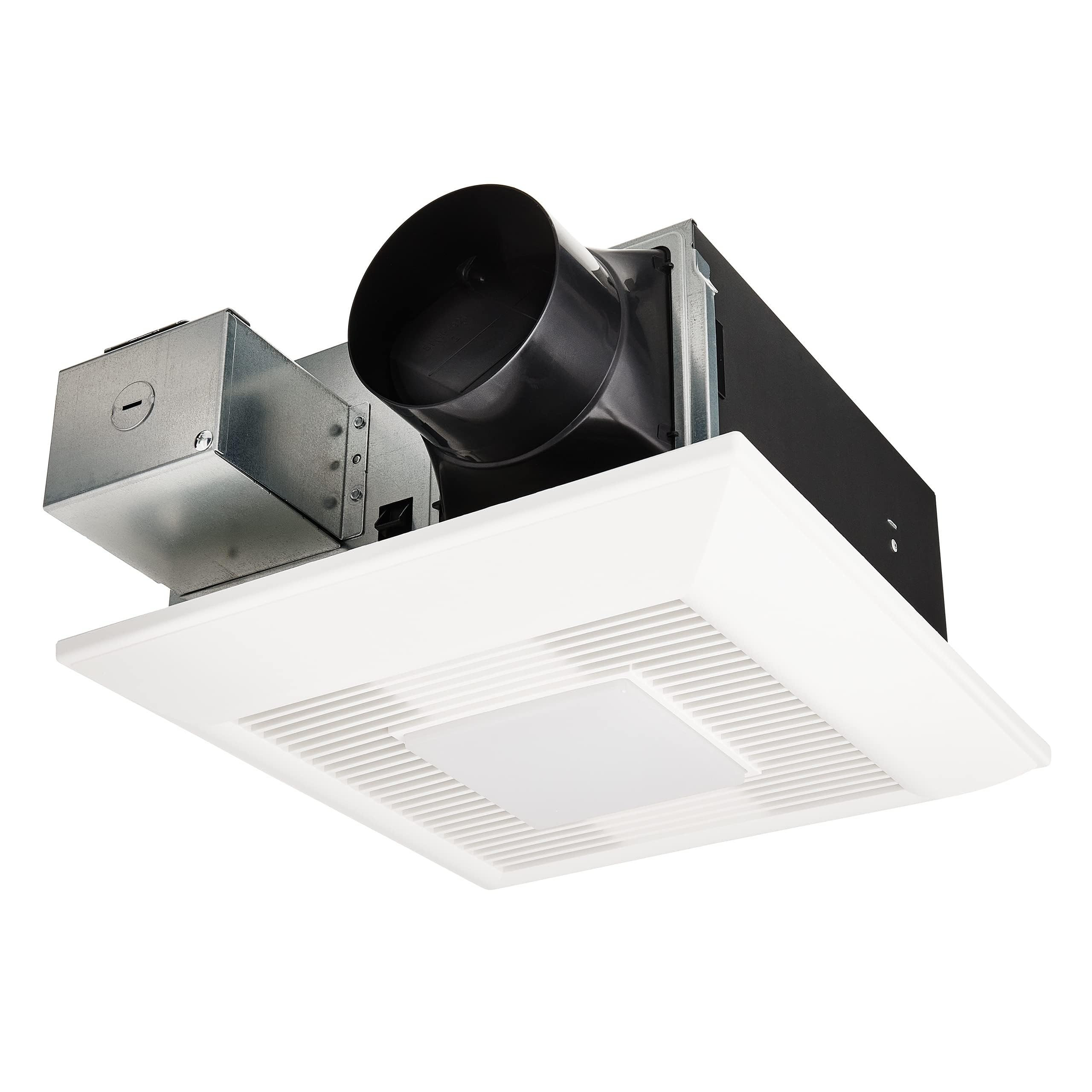
1. Panasonic FV-0511VFL1 WhisperFit Bath Fan + Light, 50-80-110 CFM
Our pick — over 4.5★ from 900+ verified ratings; the strongest balance of quality and price.
Dial in your exact airflow on a switch, then forget the fan is even running.
Here is the one number that earns this fan the top slot: the Pick-A-Flow selector lets you choose 50, 80, or 110 CFM with the flip of a switch, so you buy once and match whatever room you install it in today or down the road. A small powder room gets the quiet 50 CFM setting; a large steamy bath gets all 110 CFM.
The install is where it separates from the pack. The single-hinged Flex-Z Fast bracket means you position the housing yourself instead of wrestling a heavy unit into a joist bay, and it works with either 4-inch or 6-inch ducting. The 10W dimmable LED and the sub-1W night light mean you’re swapping your light fixture and your fan in one job instead of two — no separate recessed can to wire back in.
What wins people over is the build quality; it’s the most-praised trait among the fan’s owners by a wide margin, followed by how manageable the installation actually is. Buyers report it does the job quietly and clears steam fast, and the adjustable airflow gets steady thumbs-up across room sizes. Reviewers flag that you get plenty of CFM range without the noise floor climbing — a rarity in this category.
Two honest caveats from the field: a few owners find the speed regulation a little fussy when they first dial in a setting, and the IRC M1504.2 code limits a 4-inch duct to roughly 10 equivalent feet at 100 CFM — so if you’re running a long duct, plan on stepping up to 6-inch pipe. Also, the housing has a deeper footprint than some budget units, which can mean minor drywall repair if your old cutout is smaller. As the crowd favorite at 4.7 stars across 900+ ratings, those are the small print, not the story.
This fan is the fit for anyone who wants to choose by results rather than by roughness of the install. The included adaptors and mounting hardware mean you’re not hunting for extra parts mid-job, and Energy Star certification means you’re not paying to run it like a small appliance.
Where this pick shines
- Pick-A-Flow selector covers 50, 80, or 110 CFM — one fan, any room
- Dimmable 10W LED plus a sub-1W night light replaces two fixtures in one cutout
- Flex-Z Fast bracket delivers a one-person install without attic access
- Handles either 4-inch or 6-inch ducting, so long runs get the pipe they need
What to know before you buy
- Speed regulation takes a little fiddling to dial in at first
- IRC M1504.2 limits 4-inch duct to roughly 10 equivalent feet at 100 CFM — go 6-inch for long runs
- Deeper housing can mean minor drywall work on a tight existing cutout
Reach for this if: you want one fan flexible enough to suit a small bathroom today and a larger one later, with the light already built in.
Think twice if: your ceiling opening is unusually shallow — the fix here is real, but you’ll be patching drywall, not swapping a grille.
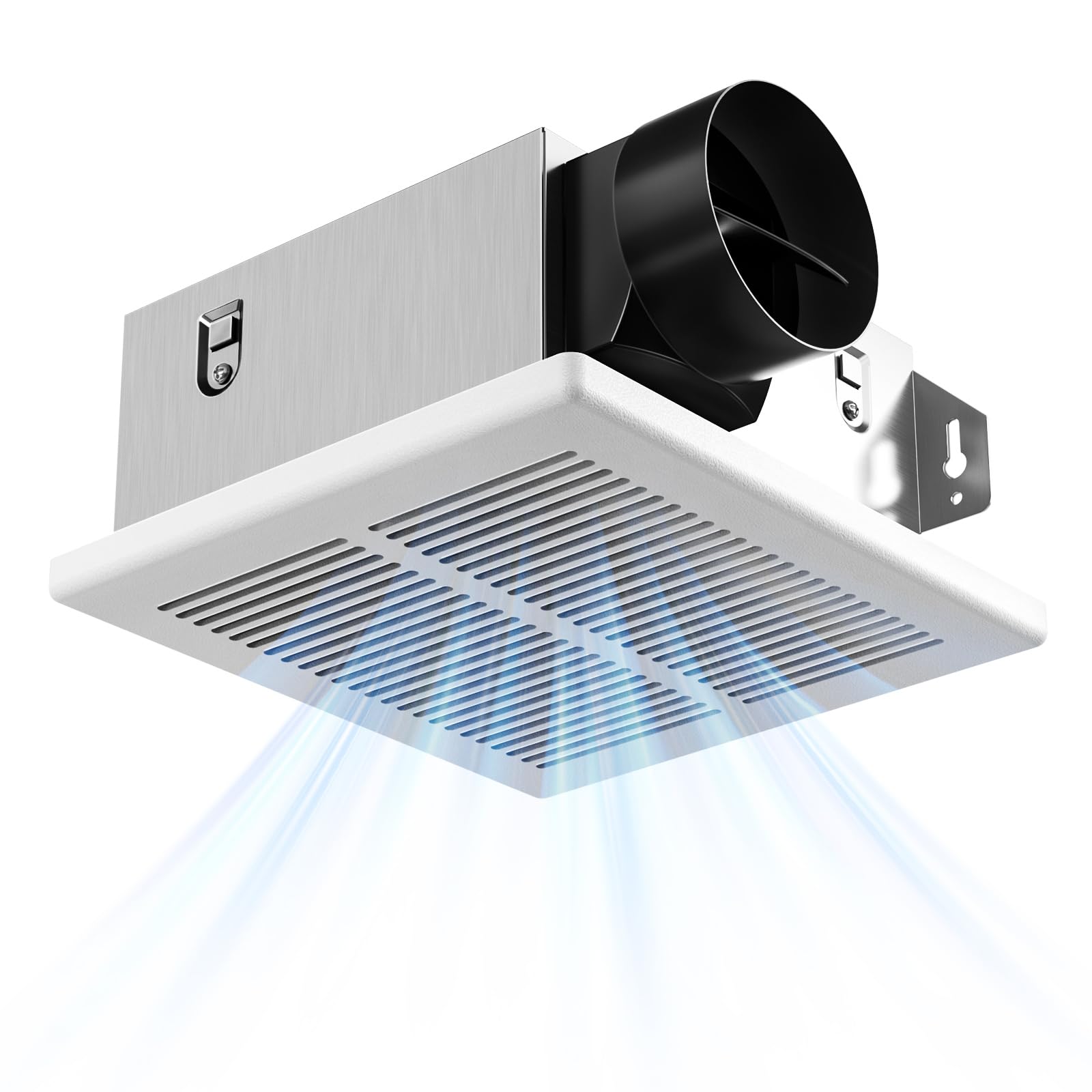
2. JOEAONZ Bathroom Exhaust Fan 110 CFM 1.0 Sones Ultra-Quiet with Metal Housing
The metal-bodied workhorse that moves more air than its price has any right to.
If you’re replacing an old 4-inch duct fan and want more pull without a remodel, this is the shortcut. It moves 110 CFM at a 1.0-sone rating, which is the same airflow as the Panasonic top pick but in a housing that fits the common 7.75 W x 7.5 L x 5.7 H inch opening most old fans leave behind. The 110 CFM is enough for enclosed rooms up to 107 square feet, and that measured reach is the reason it hangs with the premium picks on paper.
The install story is simple by design: a detachable 4-inch polymeric duct connector using the most common duct size means you can usually slide this onto your existing pipe without extra materials. The motor is removable via two screws, which matters years down the road when a bearing wears — you replace the motor, not the whole fixture. Quick-connect electrical and duct adapters plus drywall mounting tabs keep the job friendly for a first-timer.
What lands in the owner reviews is the noise drop. Going from a decades-old rattler to a 1.0-sone unit is the standout moment for most buyers — as owners put it, “Wow I can’t believe how quiet it is.” A basement-bathroom owner with a serious condensation problem reports switching over and immediately ending the dripping-ceiling complaint, which confirms the 110 CFM rating is real and not marketing.
The trade-off is the one the spec sheet whispers: air movement draws mixed reactions. Some owners say it moves far more air than expected; a few find the 110 CFM less punchy than the number suggests, especially on longer duct runs. It’s the least-praised attribute in the review set by raw count, and it’s a fair flag if your run is long or your ceiling is high. Treat it as a fit note for larger rooms, not a defect — this is the value pick that punches above its tier.
Bottom-line read: where this replacement fan delivers in spades is the noise drop and the metal housing at the entry price point. The metal construction resists the sag and flex you see on all-plastic budget units, and the detachable duct connector makes the swap painless when your old pipe is still good.
Who it beats for: the buyer replacing an old loud fan on a standard 4-inch duct who wants extra pull and a metal body without stepping up to premium pricing.
Where it falls short: if your duct run is long or your bathroom has a tall ceiling, that 110 CFM may feel modest — step up to the Panasonic’s adjustable 110 CFM setting for those rooms.
3. Amico Bathroom Exhaust Fan, 1.0 Sones, 80 CFM, No Attic Access Needed
The shallow-joist specialist: 80 CFM that slips into tight 2×6 ceiling framing without modifying anything.
Modern homes often use shallower ceiling joists than older builds, and this is one of the few 80 CFM fans that steps into that space without a fight. The housing measures a compact 7.5″D x 7.2″W x 4″H — a 37% smaller footprint in the depth dimension than the Panasonic WhisperFit, which is the difference between a one-hour swap and a drywall patch job on a tight ceiling. You mount it between ceiling joists with the included brackets, or screw it straight to a joist.
For the airflow, 80 CFM is the workhorse size — enough to clear steam from a bathroom up to 80 square feet. The 4-inch duct diameter matches the standard pipe size most homes already have, and the install only needs a 7.6 x 7.3 inch ceiling cutout. There’s no bulky fan body to route around the romex or a duct collar, and the screwless wiring points mean you’re not wrestling pigtails into a cramped junction.
The reviews point to two clear strengths: noise level is the thing everyone raves about, followed by the fan’s overall function. At 1.0 sones it’s quiet enough that a powder-room owner would notice the difference next to a laundry-room unit. A working electrician’s review stands out — it fits 2×6 framing (5.5″ depth) without modification, the metal housing is solid, and the install is straightforward. For a contractor or a confident DIYer doing a tight retrofit, that’s the whole pitch in one review.
The one honest limit: this is an 80 CFM fan, so it’s sized for a small to medium bathroom, not a big master bath. If your room is over 80 square feet or you have a tall ceiling, you’ll want the extra pull of a larger unit. And lighter airflow on smaller settings naturally draws a few mixed notes, which is normal for a fan of this size. For a hall bath or half bath, the balance of quiet and price is hard to argue with.
Who it’s built for: anyone with 2×6 ceiling framing or a tight cavity where other 80 CFM fans simply don’t fit. The shallow 4-inch body depth is the reason this makes the shortlist, not an afterthought.
What to know: UL listing confirms the electrical safety piece, and the metal and polycarbonate build matches the housing depth that makes the tight install possible.
Reach for this if: your bathroom tops out around 80 square feet and your ceiling cavity is shallow enough that other fans won’t clear the joists.
Look elsewhere if: you’re ventilating a large bathroom or one with a long duct run — that’s a case for the higher-capacity picks below.
4. Broan-NuTone 744 Recessed Light Ventilation Fan, 70 CFM, 1.5 Sones

It looks like the recessed light it replaces, so the ceiling stays clean and the shower stops fogging.
This isn’t a new fan dressed up as a replacement — it’s the classic Broan-NuTone answer for the exact scenario of swapping an old recessed can light in a shower ceiling. The trim is matched to the designs of major recessed light manufacturers, so once it’s installed, the grille reads as a light fixture, not an appliance bolted to the drywall. The 6.87-inch-high housing fits into standard 2×8 ceiling joists, which is the depth that lets you keep the existing cutout in many shower installs.
The fan moves 70 CFM at 1.5 sones through a 4-inch round duct connector. That sound rating sits between the whisper-tier fans and the budget rattlers — audible, but a deep hum rather than a whine. It uses a 75-watt R30 or BR30 bulb, and the wiring allows you to run the fan and light on independent switches or tie them to one. If you’ve got a mirrored bathroom where the fog slides in fast, this places the light and the vent in the same footprint over the tub.
Noise level earns the strongest praise from owners, followed closely by the fact that it’s a direct drop-in for existing openings — the “fit existing hole in ceiling perfectly” scenario comes up repeatedly. It clears steam before it hits the walls and mirror without being the loudest thing in the house. The recessed-light look is a real draw for owners who don’t want a bulky grille in the middle of the ceiling, and it handles shower ceiling installs (when wired to a wet-rated bulb) as well as laundry rooms.
The known friction points are honest and fixable. The metal housing has sharp edges and burrs in spots, so a deburring pass saves your knuckles during the install. The exhaust outlet faces a set direction, and on some joist layouts that’s the wrong side with no conversion option, so measure before you commit. Finally, 70 CFM is modest — check the bathroom square footage against the airflow before buying, especially in larger rooms. Mention any of those is fair; none of them keep it out of the shortlist.
The design logic: this is the one pick on the list built to replace a recessed can light specifically, which is why it shoots to the top for shower-ceiling jobs where the existing opening is a light hole, not a fan hole. Optional wall controls let you run it without fishing for a replacement switch plate.
Best suited to: anyone replacing a recessed can light in a shower, laundry room, or bath where you specifically want the light and the fan in one ceiling cutout.
Not the one for: larger bathrooms where 70 CFM won’t move enough air, or ceilings where the exhaust outlet needs to face the opposite direction from where this one points.
5. Homewerks 50 CFM 0.7 Sones Bathroom Exhaust Fan with LED Light

A 0.7-sone whisper for powder rooms and half baths where quietness matters more than raw CFM.
At 0.7 sones, this is the quietest fan in the entire list — the sound rating number beats every other pick on the page. That matters in a powder room right off a living space, or a hall bath next to a bedroom. The 50 CFM airflow is sized for rooms up to 50 square feet, so it’s not the fan for a big steamy master bath. But for a half bath or a small full bath, “whisper quiet” is a literal description here, not a marketing line.
It’s a light-and-fan combo, so you’re covering two jobs with one ceiling mount. The LED runs at 4000K, a cool-white color temperature that reads bright and modern rather than yellow. The housing is galvanized steel for corrosion resistance, and the install uses a no-cut design with a 7-1/2 by 7-1/4 by 5-3/4 inch ceiling opening. A 13-inch round grille covers the visible footprint, which is more generous than the smaller square grilles on some competitors. The 4-inch round duct connector matches the most common pipe size.
The owner reviews land hard on two positives: the noise level and the fan’s overall performance. People who replaced an old rattler with this one describe it as “very quiet,” and the bright LED light comes up time and again as a bonus that turned the whole room brighter. The slim profile is a small but constant theme — a chunk of buyers swap a bulky old fan for this and instantly note how much less ceiling space it eats.
Set your expectations honestly on the light and the install. The lighting and air movement each draw mixed reactions — a few owners have reported half the LED failing over time, and the install is trickier than advertised on some retrofits because there’s no room for wire termination inside the housing, so you may need to add a junction box beside it. The 50 CFM airflow likewise draws mixed feedback — it’s a booster for small rooms, not a heavy-duty extractor. Sized for what it does, it’s a great fit; pulled into a bigger job, it won’t be enough.
Where this pick earns its place
- 0.7 sones is the quietest rating in the entire comparison set
- 4000K cool-white LED covers the light fixture job in the same install
- No-cut design keeps the ceiling opening simple — just 7-1/2 x 7-1/4 x 5-3/4 inches
- 13-inch round grille looks clean and covers more ceiling than small square options
Where the small print lives
- 50 CFM caps out at rooms around 50 square feet
- Some installs need an added junction box since there’s no room for wire termination in the housing
- Light and airflow each draw mixed long-term feedback in the reviews
The right buyer: someone with a powder room, half bath, or small full bath who wants the quietest possible operation and a modern LED light upgrade in one swap.
Skip it for: master baths, jetted tubs, or rooms over 50 square feet — you’ll want a bigger fan for that airflow load.
6. Akicon Ultra Quiet Bathroom Exhaust Fan with LED Light 80CFM 2.0 Sones

The fan that reads as lighting design first — matte black, frosted glass, three color temperatures.
If your bathroom has black fixtures, this is the unit that stops looking like an exhaust fan. The matte black finish and frosted glass cover let it match black pot lights and matte-black faucets, which is a real problem to solve in an all-black bathroom. It moves 80 CFM at 2.0 sones through a φ13-inch round light cover, so it’s a proper ventilation fan that happens to be a centerpiece.
The color flexibility is what sets this one apart: the LED can be set to 3000K (warm), 4000K (neutral), or 5000K (daylight) by sliding a switch on the back of the lampshade. That means you can match the warmth of the rest of your bathroom lighting instead of installing a mismatched cool-white fixture. The 80 CFM airflow is sized for rooms up to 80 square feet, and the housing measures 8-1/2 x 8-1/2 x 5-3/4 inches. It’s a DIY-friendly install with no attic access required on compatible retrofits.
What owners talk about most is the combination of quietness and looks. At 2.0 sones it’s not the quietest fan by the number, but in practice owners routinely call it ultra-quiet after swapping out their old unit. The modern black-and-glass design and the three-temperature LED flexibility both draw strong owner praise, and the build is rated cUL and HVI listed. A few owners bought it in multiples for a full renovation and switched the LEDs to amber for a warmer look — the color-matched aesthetic is exactly the point.
The complication to know is that the airflow itself is air-movement good, not air-movement spectacular — 80 CFM is right for its room-size recommendation, not a heavy-duty extractor for a jetted-tub master bath. The design also means the frosted glass cover is the part owners have to handle carefully: the typical issue is breakage in shipping or during install, and the manufacturer’s customer service step-in is the anecdote that keeps coming back up. Handle the glass with care and this lands beautifully; it’s the best answer on the list for a designed bathroom that still needs real ventilation.
The design case: pairing matte black with frosted glass makes this the pick to reach for when the bathroom has a strong aesthetic identity — it stops looking like a utility appliance and starts acting like a fixture.
Worth knowing: the 3 CCT switch inside the lampshade is the practical reason to choose this over other black fans, since you’re not locked into one color temperature.
Fit for: a designed bathroom with black or dark accents where the fan needs to match the pot lights and faucets, not fight them.
Instead consider: a glossy-white multi-flow unit like the Panasonic above if you want adjustable CFM too — this one picks one airflow and sticks with it.
7. Broan-NuTone Bathroom Exhaust Fan – Retrofit Design, 1.0 Sones, 110 CFM

110 CFM, four light temperatures, and a room-side install that skips the attic entirely.
This is the fan for the person whose ceiling cavity is sealed up tight — no attic access, no crawlspace, no desire to go up there. Broan-NuTone designed it to install from the room side, which fits 2×6 joists and lets you drop it in from below. The 12-1/4 x 12-1/4 inch cover provides a clean finished footprint, and the housing measures 9-1/4 x 10 x 5-3/4 inches, so it slides into the common retrofit opening. For a lot of older homes with no overhead access, this is the whole reason to buy it.
Airflow is a serious 110 CFM at 1.0 sones, sized for spaces up to 105 square feet. That’s meaningfully more pull than the 80 CFM budget pick and it uses the same 4-inch duct that’s almost certainly already there. The CleanCover grille design has a full-perimeter air intake to reduce dust buildup on the visible face, which is a nice detail on a fan that lives on the ceiling. The four selectable CCT settings (3000K, 3500K, 4000K, 5000K) let you match the light to the rest of the room and it remembers your last setting, so you’re not resetting it every time.
Owner feedback zeroes in on the quiet and the light. The 1.0-sone rating comes through in reviews as genuinely whisper-quiet after swapping out an old rattler — several compare it directly to a much older, louder 3.5-sone fan and say the difference is dramatic. The adjustable light temperature gets frequent praise because you can tune it warm for a relaxing bath or cool for a bright morning routine. And the room-side install works exactly as promised for people without attic access.
What’s honest to flag is the installation fussiness. Reviews are split between those who found it straightforward and those who hit a couple of snags — the exhaust hose placement can be awkward on some rafter layouts, and the retention hardware for the cover takes some fiddling to seat correctly. Neither is a defect, but if you’re already unsure about DIY work, this is the job to call a handyman for. For an experienced installer, the upgrade from a 3.5-sone old fan is worth the extra steps.
What makes it the top performer
- 110 CFM at 1.0 sones — the best power-to-quiet ratio in the retrofit category
- Room-side install means no attic access needed, ever
- Four selectable CCT settings with memory, so the light matches the room
- Full-perimeter intake grille stays cleaner on the visible face
Real-world notes
- Exhaust hose placement and rafter access can trip up the install
- Cover retention hardware takes patience to seat correctly
- Not the easiest fan for a first-timer if attic access is tight
Who it wins for: any retrofit where you can’t get into the attic and want serious 110 CFM airflow alongside a light you can tune to the room.
Where it loses: install patience — the same room-side access that makes it possible also makes the inner work fiddly, so budget extra time for the cover hardware.
8. Panasonic FV-0510VSL1 WhisperValue Bath Fan + Light, 50-100 CFM
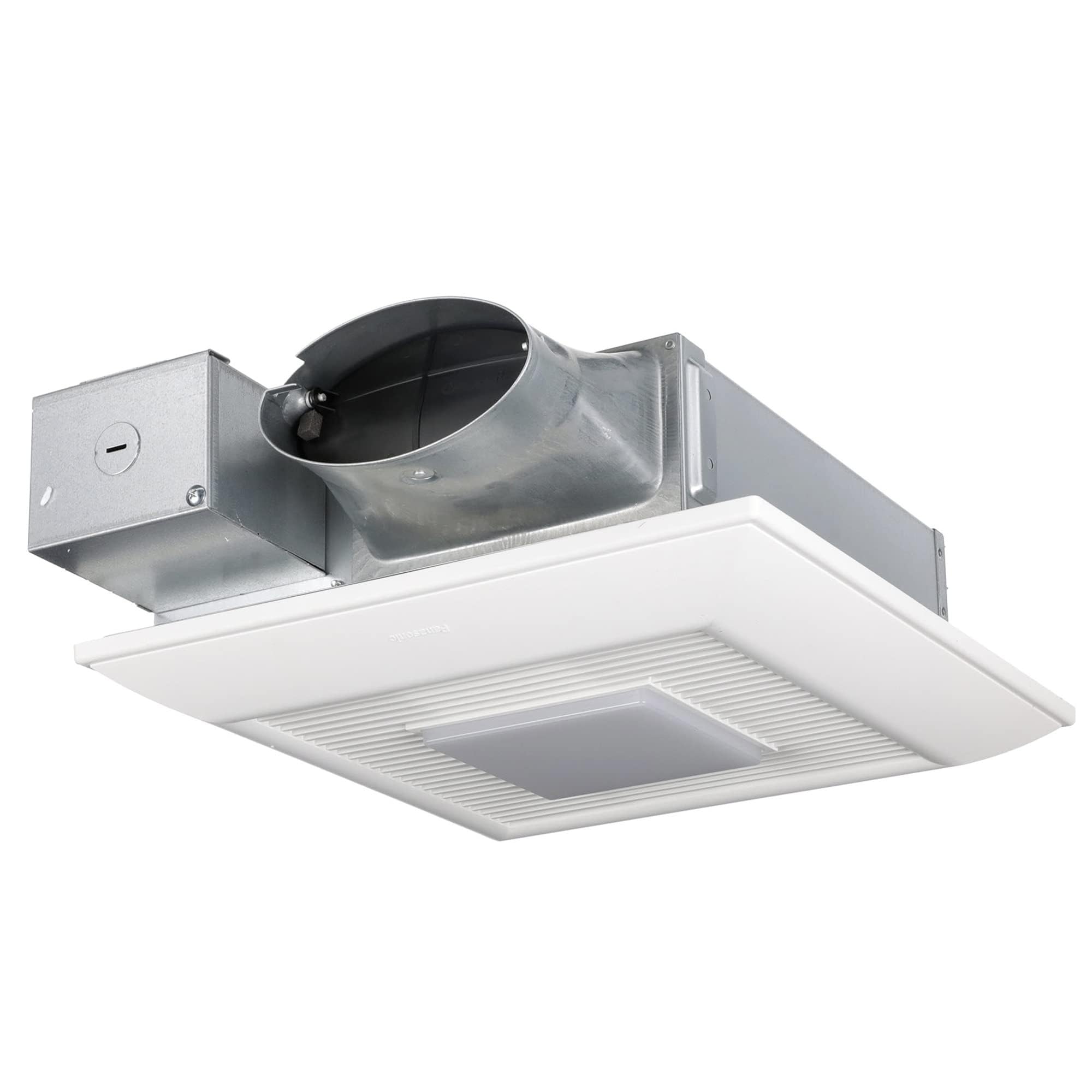
A 3-3/8-inch body that slips into ceilings where most fans don’t fit.
The single spec that sells this fan to a ceiling-space-starved buyer: a housing just 3-3/8 inches deep. That’s the thinnest body on the list and the reason it can step into ultra-tight ceilings where deeper fans run out of room. It’s the WhisperValue family, which means the DC/ECM motor and SmartFlow technology drive a 50, 80, or 100 CFM adjustable airflow via the same Pick-A-Flow selector you see on the WhisperFit.
Flexibility is the theme: UL listed for ceiling, wall, and tub/shower enclosure mounts when GFCI protected, so it’s the pick for installations where the fan physically can’t go in the ceiling. A unique L-shaped bracket simplifies install and provides firm support, and the 4-inch oval duct keeps the connector compact. The energy-efficient DC motor runs on a dimmable 3000K LED with a low-power night light, and the flexi-fast bracket and self-drilling screws are all in the box. It’s a serious, well-equipped fan with the same Energy Star certification as the bigger Panasonic picks.
Owner reviews highlight the quiet operation above all. People replacing old fans say this one runs at about half the noise of what they had, and that “very quiet yet powerful at full blast” sums it up. The LED is described as surprisingly bright without being overpowering, and owners mention it eliminates bathroom steam with no visible buildup. One owner specifically called out that the lowest 50 CFM setting is still effective at clearing moisture and odor, which is the correct answer for a small or medium bathroom that only needs constant background ventilation.
The honesty note here is the fit consideration: this is not a one-to-one drop-in on some retrofits. Several customers note the housing is larger than their old fan, meaning they had to cut and patch drywall, and the oval vent outlet may need an adapter for a round duct. If you’re replacing into a cutout that happens to match its footprint, fantastic — that’s the lucky scenario. If not, budget for a little ceiling work. Also, the dimmable LED does need the separate night light circuit if you want the night light to work independently, so read the wiring diagram before you buy.
The core case: the 3-3/8-inch depth is the entire argument for this fan — it goes where a standard 5- or 6-inch housing physically cannot. The 50/80/100 CFM Pick-A-Flow selector makes it a one-buy decision regardless of room size.
Worth knowing: 4-inch oval duct is the standard these fans use, so if your existing duct is round, you’ll want a matching adapter on hand before you start.
Reach for this if: you’re dealing with a shallow ceiling cavity or need a wall or tub-enclosure mount, and you want the airflow adjustable.
Consider alternatives if: you need a true drop-in fit into a small existing cutout with no patching — a shallower-footprint fan will be a friendlier swap.
9. OREiN 3-in-1 Bathroom Exhaust Fan with Light & Humidity Sensor, 160 CFM, 1.0 Sone

The most powerful fan on the list — 160 CFM that turns itself on when the room hits 60% humidity.
Every other fan on this list waits for you to flip a switch. This one doesn’t. The built-in humidity sensor watches the air and turns the vent on automatically when humidity rises above 60%, which means the fan clears the room after a shower even if you forget about it. A green LED indicator shows when sensing mode is active. Combined with the 160 CFM airflow — the highest on this list and enough for bathrooms up to 160 square feet — this is the pick for a large bathroom, a bathroom with a jetted tub, or a busy household where nobody remembers to hit the fan switch.
The lighting is just as serious: 1500 lumens of LED output with three switchable color temperatures (3000K, 4000K, 5000K) plus a soft 2200K night light for middle-of-the-night trips. That’s brighter than every other pick on this list, which matters in a room where you also want to see yourself clearly. It’s certified Energy Star, HVI, ETL, and FCC, and it comes with a 5-year limited warranty — the longest warranty on the page. A wall switch controls the fan, and the included cutout template, mounting bracket, and screws make the install a proper kit rather than a bare housing.
Reviewers keep returning to the same two facts: the fan works, and it’s quiet for how much air it moves. Reviewers point out it clears mirror fog and steam fast, and owners single out the auto-on humidity sensor as the feature they didn’t know they needed. The night light gets a genuine mention as a kid-friendly feature on late bathroom trips. At 1.0 sone, the noise is low enough that people run the fan continuously as background ventilation without it being intrusive — which is the point of a fan designed to turn itself on.
The honest caveats are: this is a heavier unit, so it must be properly anchored on both sides or it can tear through drywall during install (installer missteps have caused this in the past, and the fix is simply following the manual). It’s also not compatible with dimmer switches or timer switches, so it’s designed to run on its own controls, not on the wall gear you might already have. Get past those two design constraints and the auto-humidity sensor plus the 160 CFM airflow make this the smartest replacement for a large, high-traffic bathroom.
Why it earns the versatility tag
- 160 CFM handles bathrooms up to 160 square feet, the largest reach here
- Auto-on at 60% humidity means it clears the room even if you forget
- 1500LM LED with three color temperatures plus a 2200K night light
- Energy Star, HVI, ETL, and FCC certified with a 5-year limited warranty
Where the trade-offs sit
- Heavier housing means the install must be anchored on both sides to be secure
- Not compatible with dimmers or timer switches
- Larger cutout (11.81 x 11.02 inches) means a fresh cut if replacing a smaller fan
Choose this if: you have a large or high-traffic bathroom and want the fan to handle humidity on its own, with the brightest light and the longest warranty in the set.
Step back from it if: you want to reuse an existing dimmer or timer wall switch, or you’re not prepared for a fresh, larger ceiling cutout.
Understanding the Specs
CFM (Cubic Feet per Minute): The Airflow Number
CFM is the volume of air the fan moves out of the room every minute. Bigger CFM means faster steam and odor removal, but it needs to match your room size to be useful — 80 CFM handles about 80 square feet, 110 CFM handles about 105 to 110, and 160 CFM covers a large master bath up to 160 square feet. If your fan is undersized for the room, the ceiling and mirror fog up no matter how long you run it, which is the most common reason a “working” old fan still leaves moisture behind.
Sones: How Loud It Actually Sounds
Sones measure loudness on a scale where higher isnoisier — 1.0 sone is a whisper, and 2.0 sones is still quiet but audible. Anything above 3.0 sones starts to feel like running a small appliance, and it’s why so many old fans never get used. A fan you can hear but barely notice at 0.7 to 1.5 sones is the target for most homes. Also check the housing depth (a shallower body fits tight ceiling joist bays) and the duct diameter: 4-inch round is the common size to reuse existing pipe, and moving up to 6-inch duct eases long runs and higher CFM settings.
FAQ
What CFM do I need for my bathroom exhaust fan replacement?
Can I replace my bathroom exhaust fan without attic access?
How do I know what duct size my new fan uses?
Is a 1.0-sone fan quiet enough to run at night?
Can I reuse my old 4-inch duct when replacing the fan?
What bathroom size does an 80 CFM fan actually handle?
Do bathroom exhaust fans with LED lights need a separate switch?
Is a higher CFM fan always better for a bathroom?
How long should a replacement bathroom exhaust fan last?
Will a new exhaust fan fit my old ceiling cutout?
Final Thoughts: The Verdict
For most bathrooms, the bathroom exhaust fan replacement winner is the Panasonic FV-0511VFL1 WhisperFit because its Pick-A-Flow selector covers 50, 80, and 110 CFM in one unit, the dimmable LED and night light replace the old fixture, and the Flex-Z Fast bracket installs without attic access. Want maximum airflow with hands-free humidity sensing? Grab the OREiN 3-in-1 with its 160 CFM and 5-year warranty. And if the budget matters more than features, the JOEAONZ 110 CFM delivers metal-housing airflow at the entry price — It’s the rare budget pick that keeps the 1.0-sone quiet operation.
How We Picked
We do not accept paid placement. Every pick is matched to a real buyer and a real use-case; we do not hands-on test units.
Sources & Methodology
Specifications: manufacturer listings and product documentation. Review insights: verified customer reviews, as of September 2026. Pricing: not shown on this page (it changes often); check the current price via the retailer link.
As an Amazon Associate, KitchPrep earns from qualifying purchases. This does not affect which products we feature.
Related Guides
