
Specs are compiled from manufacturer listings and verified buyer reviews and can change over time — please confirm the key details on the product page before buying.
If you want the short answer: for most home shops the RYOBI BD4601G is the one worth buying, because it pairs a wide 4-inch belt with a side disc and enough torque to shape wood all afternoon. The catch is weight and a fiddly table clamp. If your bench is short on room and your real job is putting an edge on knives and chisels, the low-speed BUCKTOOL is the smarter machine. And if you just want the cheapest way to touch up a blade, the Central Machinery 1″ x 30″ gets it done.
I’m Mohammad Maruf — the founder and writer behind KitchPrep. This guide is built by comparing the manufacturers’ published specifications and the patterns across verified customer reviews, so you get each pick’s real strengths and trade-offs instead of marketing spin.
A benchtop belt sander is a stationary machine that bolts to a bench or stand, so it stays put while you push material into the belt instead of lugging a handheld tool. The three picks below cover wide-belt woodworking, slow-speed metal sharpening, and budget blade touch-ups, which is why this best benchtop belt sander shortlist splits by job rather than by brand name alone.
Our Picks at a Glance

How To Choose The Best Benchtop Belt Sander
First-time buyers tend to shop by motor size alone, which tells you almost nothing about how a sander handles a given job. A 3-amp motor on a 1-inch belt and a 2.3-amp motor on a 1-inch belt cut differently, and neither does the work of a wide belt on a 36-inch bed. Pick belt width first — 4″ x 36″ for flattening boards, 1″ x 30″ for edges and blades — then choose speed for the material.
Start With Belt Width, Not Horsepower
Belt width decides what the machine can physically do. A 4-inch wide belt covers a lot of surface in one pass, which is what you want for flattening a glued-up panel or rounding a table edge. A 1-inch belt is a detail and edge tool — it can sharpen, deburr, and shape small stock, but it will not flatten a board.
The RYOBI BD4601G runs a 4-inch wide belt on a 36-inch long bed, which is the widest and most surface-hungry setup in this group. A 1″ x 30″ machine is the opposite end: tiny contact patch, edge-focused work.
Belt Speed: The Number That Decides Wood Vs Metal
Belt speed is how fast the abrasive moves past your workpiece. Wood wants speed — it removes stock quickly and the heat is not a problem. Steel wants the opposite. Fast abrasives grind carbon steel hot enough to draw the temper out of a knife edge, which ruins the hardness you sharpened for.
That is the whole reason low-speed machines exist for knives. The BUCKTOOL spins at 1790 rpm specifically for controlled metal removal, while the Central Machinery 1″ x 30″ runs at 3400 rpm for faster cutting on wood and quick blade touch-ups.
Motor Type, Vibration, and Bench Weight
An induction motor, which is a motor with no brushes that spins smoothly under load, tends to run with less vibration than a universal motor of similar size. Less vibration means a cleaner finish and steadier tracking. The BUCKTOOL uses an induction motor rated at 2.3 amps.
Bench weight is a trade-off: stability under load against portability. The RYOBI stays planted when you push hard, but its own buyers report it is heavy enough that you will not want to move it. The RYOBI is a substantial bench unit, and its own buyers describe it as heavy enough that it is not one to lug around.
Extras Worth Paying For
A tilting table lets you sand angled stock — the Central Machinery table tilts from 0 to 45 degrees for beveled work. A tracking adjustment keeps the belt centered instead of wandering off the wheels. A safety key, like the removable one on the BUCKTOOL, stops the machine from starting by accident while you have your hands near the belt. Dust collection readiness matters if you are sanding wood indoors.
Quick Comparison
| Model | Best For | Belt Speed | Amperage | Belt/Size | Amazon |
|---|---|---|---|---|---|
| RYOBI BD4601G Bench Sander Green★ Best Overall | Wood shops wanting a wide belt plus side disc | — | — | 4″W x 36″L bed | Amazon |
| Belt Sander 1” x 30” | Cheap blade touch-ups and small detail work | 3400 rpm | 3 A | 1″ x 30″ belt | Amazon |
| BUCKTOOL 1×30″ Low Speed Belt Sander | Knife makers and metalworking on low speed | 1790 rpm | 2.3 A | 1″ x 30″ belt | Amazon |
In‑Depth Reviews
1. RYOBI BD4601G Bench Sander Green
Our pick — over 4★ from 90+ verified ratings; the strongest balance of quality and price.
A 4-inch belt on a 36-inch bed plus a side disc sander, so you can round a table edge and clean up an inside curve without swapping machines.
This is the machine for the home woodworker who shapes cabinet parts, rounds over table edges, and wants a second abrasive on the same bench. Its 36″L x 4″W x 14″H footprint is by far the biggest here — the Central Machinery 1″ x 30″ measures 11.13″L x 9″W x 13.5″H, so the RYOBI needs real bench territory. What that bulk buys you is a 4-inch wide belt backed by a side disc sander, and that combination covers both long flat faces and tight inside curves without swapping tools.
Real owners reach for the belt like a shaping tool, not a finishing tool, and they treat it that way. It excels at rounding edges — clamp two pieces at once and you get consistent shapes across both. The one habit owners warn each other about is leaning into the machine: push too hard and you lose power, so it works best when you let the tool do the work and feed slowly. In the same vein, experienced buyers treat it as a hobbyist and non-expert-DIY machine rather than a production shop unit, and they say it runs smoothly and sands cabinet rollouts well.
You get two sanders in one: a belt plus a disc sander (a spinning round pad on the side) for curved edges. Owners keep praising that combo on their own, and the review pages sum it up as “Lots of power. Easy to adjust. Large sanding area.” Plan to buy extras, though. The unit ships as a bare bench sander with no base or stand, so you source those separately. It also arrives with 80-grit medium abrasive (a coarse sanding belt) and no hook-and-loop disc (a disc that sticks on and peels off).
What It Does Better Than The Rest
- A 4-inch wide belt across a 36-inch bed — far more surface area per pass than the 1-inch machines below.
- Belt on one side, disc sander on the other, so curves and flat faces share one footprint.
- Grit number 80, medium grit type included and ready to cut right from the start.
- Corded 110V power means it runs on a standard household outlet.
Where It Asks For Patience
- It is a heavy machine — owners flat-out say it is not for weaker users, so plan a fixed bench spot.
- The belt table clamp is a hex-bolt design that buyers knock, and the plastic disc table trim is a known weak point.
- No base or stand included, and no hook-and-loop disc in the box.
- Feed it too aggressively and it bogs rather than powering through.
Buy this one if: you shape wood at a fixed bench and want one machine that rounds edges on a wide belt and cleans up inside curves on a disc.
Think twice if: your real job is putting an edge on knives — the speed here is built for wood, not for keeping steel cool.
2. BUCKTOOL 1×30″ Low Speed Belt Sander for Knife Sharpening, 2.3A, 1790RPM
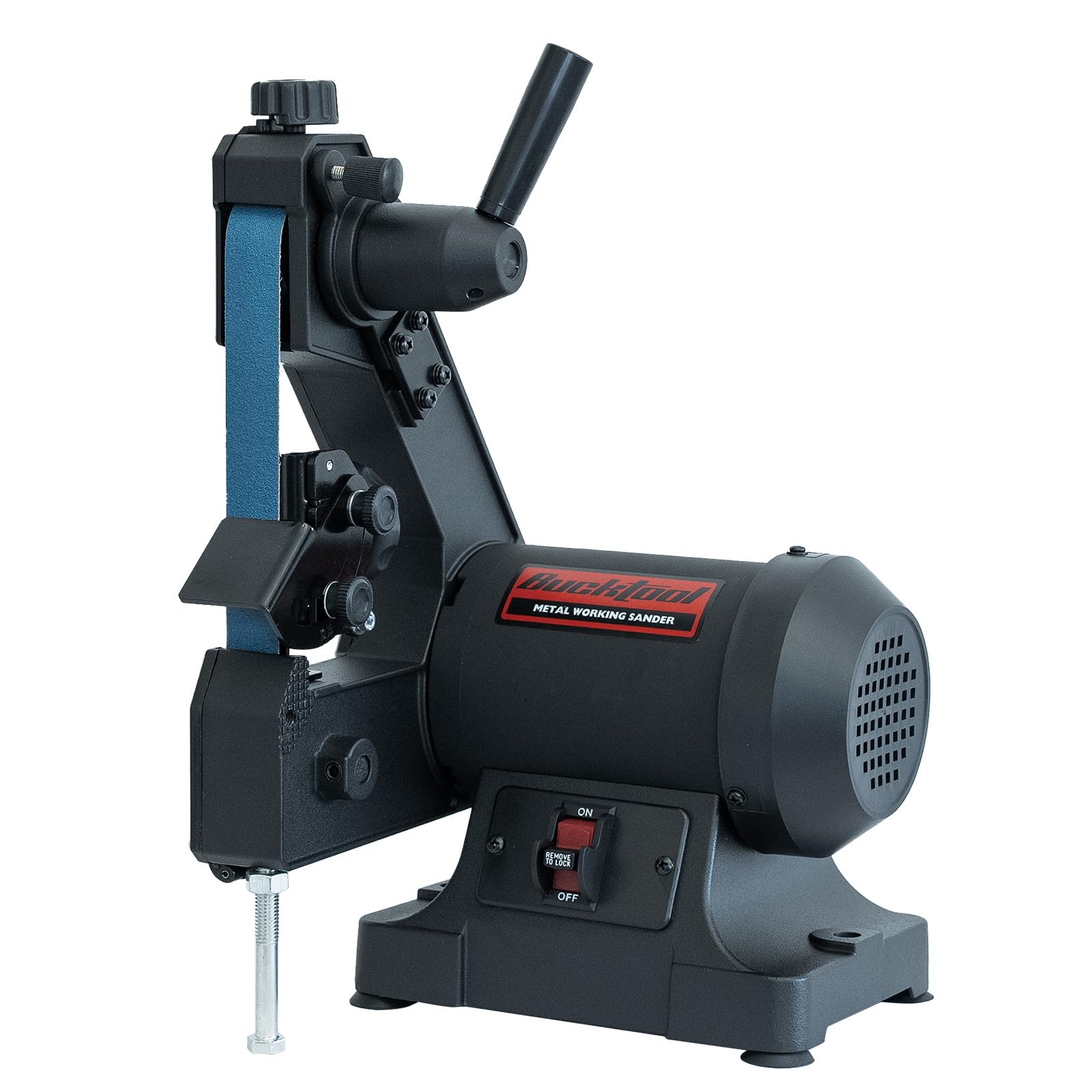
1790 rpm — roughly half the 3400 rpm of the budget machine — so the belt cuts steel without drawing the temper out of a bevel.
If you make knives or restore chisels, plane irons, or hand tools, what you need most is control where the abrasive meets the metal. This machine spins at 1790 rpm (revolutions per minute, how fast the belt turns) versus the 3400 rpm of the Central Machinery 1″ x 30″ in this list — roughly half the speed. Owners who moved down from a 3450 rpm sander call it an upgrade, not a downgrade. A slower belt cuts metal with noticeably less heat, so you can hold a bevel (the angled cutting edge) against the belt without cooking the temper out of the steel.
The angle guide is the second reason to pick this over a bare sander. It adjusts from 10 degrees to 45 degrees, so you can set a repeatable sharpening angle for knives, blades, and chisels instead of freehanding every pass. It is a hefty guide, and buyers with larger bevels do modify it to fit their blades. Belt changes are quick too — a one-button belt cover comes off and the tension releases, which matters when you are swapping grits through a sharpening progression.
Two details round out the daily experience. The 2.3A induction motor, which is a brushless motor that spins smoothly under load, keeps vibration down for controlled material removal. The removable safety key prevents the machine from starting by accident while your hands are near the belt, and the whole thing is backed by a 2-year limited warranty. The honest note is not about the machine’s design but about support — an occasional buyer has come away frustrated with how a problem unit was handled. Treat that as a reason to read the warranty terms before you buy, not a reason to skip the tool.
Why it wins the metal bench: a 1790 rpm belt, a 2.3A induction motor, and a 10°–45° guide together give you repeatable bevels with less heat than a fast sander — the exact combo knife makers ask for.
The practical caveat: it is a 1-inch belt, so it sharpens and details beautifully but will not flatten a wide board the way the RYOBI above can.
Reach for this if: your bench exists to produce sharp edges on knives, blades, and chisels and you value control over speed.
Look elsewhere if: you need to surface flat wood panels — that calls for the wider belt up top.
3. Belt Sander 1” x 30”
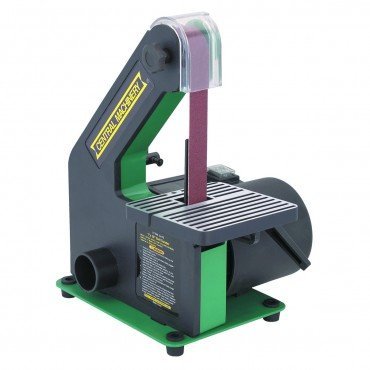
The lowest-priced machine here: a 1/3 HP motor, a 5 in. x 5 in. die cast aluminum table, and 3400 rpm that cuts fast but heats steel fast too.
For a starter knife maker or a home shop that just needs an edge touched up now and then, this Central Machinery unit gets you sanding for the least money in this group. It pairs a machined 5 in. x 5 in. die cast aluminum table with a 1/3 HP motor pushing 3260 FPM — feet per minute, the actual travel speed of the abrasive. Its 3400 rpm drive speed and 3 amp draw make it the fastest and most power-hungry of the three, roughly ninety percent more rpm than the BUCKTOOL and thirty percent more draw.
Speed cuts both ways here. It removes material quickly, which is great for rough shaping and fast blade touch-ups, but it also builds heat fast against steel — the exact reason many knife makers eventually step down to a slower machine for bevel work. The tilting table is a real value add: it swings from 0 to 45 degrees so you can sand angled stock, and a tracking adjustment keeps the belt running true (straight, without drifting off the wheels). It is also dust collection ready, which helps for indoor work.
Reviews here are the most mixed in this list, and they point at setup rather than the idea. Owners mention it is tough to top for a quick touch up, and that it is great for starter knife makers — one buyer put it plainly: it was bought over a year ago expecting it to make a few knives and cap out, yet it was still running strong with no complaints. The recurring gripe is the drive wheel (the wheel that turns the belt). A few buyers have trued a wheel that sat out of round (shaved it so it spins evenly), and the fit and finish on the base and adjustment hardware is where corners were clearly saved. Instructions are vague, and one toothed washer is commonly missing from the box.
The value case: the least expensive entry into benchtop sanding, with a die cast aluminum table, a table that tilts 0–45°, and belt tracking adjustment — real features at an entry-level price.
What to expect going in: 3400 rpm is fast for steel, the base and hardware need patience during assembly, and tracking the belt true is part of the break-in routine.
Worth it for: a first benchtop sander, a starter knife bench, or quick sharpening duty where the lowest spend matters most.
Pass on it if: you plan to grind bevels all day in steel and want controlled, low-heat cutting from day one.
Understanding the Specs
Belt Speed in RPM and FPM
RPM counts how many times the drive wheel turns in a minute — the BUCKTOOL runs 1790 rpm and the Central Machinery runs 3400 rpm. FPM, or feet per minute, measures how fast the abrasive surface actually travels past your workpiece; the Central Machinery moves its belt at 3260 FPM. For wood, higher travel speed means faster stock removal. For hardened steel, lower travel speed means less heat pumped into the edge, which is why slow-speed machines exist for knife and tool work.
Belt Size and Table Geometry
Belt size is written width by length, so a 1″ x 30″ machine carries a one-inch wide belt on a thirty-inch loop. Narrow belts are for edges, curves, and small parts; wide belts cover flat ground fast. The table under the belt sets your work support — the Central Machinery uses a machined 5 in. x 5 in. die cast aluminum table that tilts from 0 to 45 degrees for angled stock, while the RYOBI spreads a 36-inch long bed under its belt for long parts.
FAQ
Will a low-speed belt sander like the BUCKTOOL sharpen a knife better than a fast one?
Can the RYOBI BD4601G run on a normal household outlet?
What belt size does the Central Machinery 1″ x 30″ take?
Do I need a stand or base for these sanders?
How do I stop the belt from wandering off the wheels?
Is a 1-inch belt sander or a 4-inch belt sander better for woodworking?
Can I sand metal on a wood-focused belt sander?
What grit belt should I start with on a benchtop sander?
Is a benchtop belt sander heavy enough to move around the shop?
Do these sanders include a dust port for shop vacuum hookup?
Final Thoughts: The Verdict
For most home shops, the benchtop belt sander winner is the RYOBI BD4601G Bench Sander Green, because a 4-inch belt across a 36-inch bed plus a side disc sander covers both flat stock and inside curves on one machine. If your bench is built around sharpening knives and chisels, grab the BUCKTOOL 1×30″ Low Speed Belt Sander for its 1790 rpm belt and 10°–45° angle guide. And for the smallest spend on a first machine or quick blade touch-ups, the Belt Sander 1” x 30” is the one to reach for.
How We Picked
We do not accept paid placement. Every pick is matched to a real buyer and a real use-case; we do not hands-on test units.
Sources & Methodology
Specifications: manufacturer listings and product documentation. Review insights: verified customer reviews, as of September 2026. Pricing: not shown on this page (it changes often); check the current price via the retailer link.
As an Amazon Associate, KitchPrep earns from qualifying purchases. This does not affect which products we feature.
Related Guides
