
Specs are compiled from manufacturer listings and verified buyer reviews and can change over time — please confirm the key details on the product page before buying.
You want a grinder that keeps a belt tracking straight under your thumb, spins a platen slow enough for a fine bevel, and does not bog down when you lean into a hardened blank. That is the short answer: a 2×72-inch machine with a real variable-frequency drive, a stiff frame, and a platen you can flatten an edge against. Everything below sorts five real machines by what each actually does at the bench, so you can pick the one that matches your shop, your power outlet, and the blades you build.
I’m Mohammad Maruf — the founder and writer behind KitchPrep. This guide is built by comparing the manufacturers’ published specifications and the patterns across verified customer reviews, so you get each pick’s real strengths and trade-offs instead of marketing spin.
Knife-making grinders are unforgiving tools — a belt that wanders, a platen that dishes out, or a drive that stalls mid-bevel all show up in the finished blade. The picks below cover the machines that hold up, which is exactly what a serious belt grinder for knife making has to do.
Our Picks at a Glance

How To Choose The Best Belt Grinder for Knife Making
Buying a grinder for blades is not the same as buying a general shop sander. A knife-maker leans hard into the belt at a shallow angle, holds the contact point for seconds at a time, and cares about how flat the tool rest keeps the plunge. Two things decide whether a machine suits that work: the belt size and format, and how fast you can change belt speed to match the blank in front of you.
Belt size and format come first
The 2×72-inch belt format (a belt two inches wide and seventy-two inches around) is the one most knife-makers build around, because it carries a wide spread of grits and accepts different contact wheels and platens. A machine that also takes a slightly longer belt range gives you more options without changing the frame. Belt changes should take seconds, since you will swap grits from profiling to sharpening in one sitting.
VFD speed control, and what your outlet can give it
A VFD is a variable-frequency drive — the box that lets you dial motor speed from a slow crawl up to full tilt. That matters at the bench: run slow for a fine finish or for the tip of a blade, run fast to hog off steel when profiling a blank. Several of these machines ship with a transformer that steps 110 volts up to 220 volts, so check your outlet before you mount anything to a bench. Some units want a dedicated high-amperage circuit, and running on an undersized circuit or a power strip is asking for trouble.
Frame stiffness, platen, and tool rest
A grinder that flexes while you press a blank against it will not hold a clean bevel line. Look for welded steel construction and a thickened base, because both cut vibration and keep the belt on its path under load. The platen (the flat backer plate you grind against) and the tool rest do most of the precision work, so a solid adjustable rest and a platen that stays flat are worth more than any cosmetic feature.
Quick Comparison
| Model | Best For | Belt Size | Motor / Speed | Amperage | Amazon |
|---|---|---|---|---|---|
| VEVOR Belt Grinder Sander with VFD★ Best Overall | All-around knife bench | 2 x 72 inch | 1500W / 2900 rpm | 5 A | Amazon |
| Jinlida 2×72 Belt Grinder Sander with VFDTop Value | Knife-making on a budget | 2 x 72 inch | 1500W / 3000 rpm | 10 A | Amazon |
| JLD Professional 2×72 Belt Grinder | Bevel polishing precision | 2 x 72 inch | 1500W / 3000 rpm | 10 A | Amazon |
| JLD 2×72-82 Belt Grinder Sander | Heavy metal removal | 2 x 72-82 inch | 1500W / 3000 rpm | 10 A | Amazon |
| Shop Fox Knife Belt Sander/Buffer W1843 | Sharpening and buffing duty | 2 x 72-76 inch | 1 HP / 1725 rpm | 14 A | Amazon |
In‑Depth Reviews
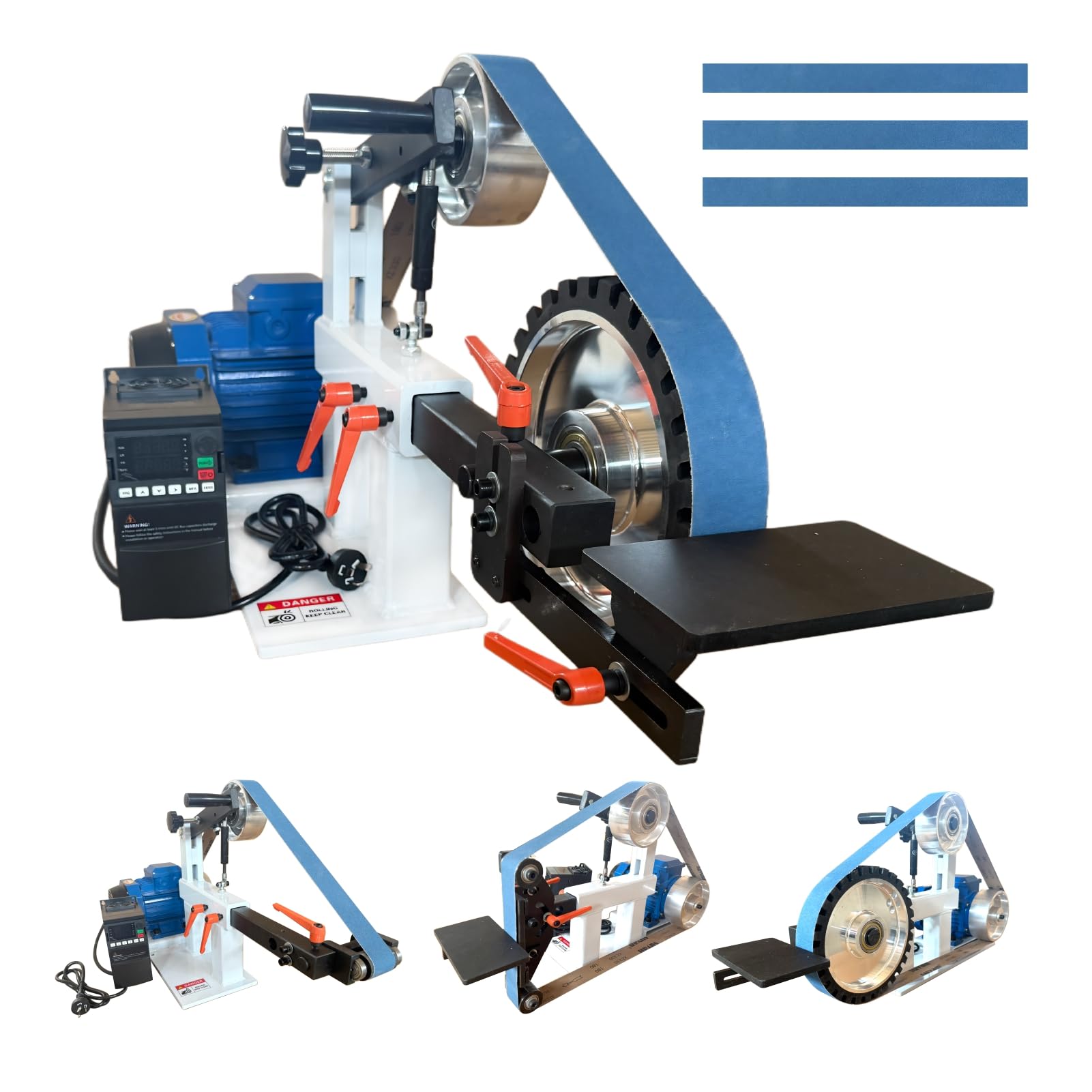
1. VEVOR Belt Grinder Sander, 72 x 2-Inch Variable Speed Belt Polisher with VFD, 1500W 2HP Polishing Grinding Machine with 3 Grinding Moulds & 3PCS Sanding Belts for Metalworking, Knife Making
Our pick — over 4★ from 350+ verified ratings; the strongest balance of quality and price.
A 110-pound steel-framed workhorse that runs three grinding modes on one motor.
The VEVOR runs a 1500W pure copper motor at 2900 rpm — a motor built from copper windings, which is the material that holds up better under heat than the cheaper alternatives, so long grinding sessions do not cook the machine. Its 2×72-inch belt is the size most knife-makers build around. What wins people over is the build itself: the welded steel frame and thickened base keep it stable while you press a blade into the platen, and it earns the strongest quality praise of anything in this lineup. Its 4.3-star average across a large owner base reflects consistent quality, not a fluke.
Speed control here is stepless through the VFD, which means you dial in anything from a slow crawl for a finishing pass to full tilt for profiling a blank. It ships with a 100-grit belt for hogging material, a 180, and a 240 for refinement, so you have a full coarse-to-fine run in the box. Three grinding modes — circular for curved work, flat for plates and profiles, and arc for irregular shapes — let you move between tasks without reaching for a second machine. Owners say it “does exactly what it is built for and is worth the money.”
Assembly is the one split decision on this machine — easy for some, frustrating for others, so budget an afternoon if you are not handy with a wrench. Belt tracking also draws mixed notes and a few owners have reamed or adjusted rollers to settle it, so plan on dialing in the tracking before your first blade. For one grinder to cover profiling, bevels, and cleanup, this is the machine to beat.
What earns it the top spot
- 1500W pure copper motor at 2900 rpm holds speed under load
- Stepless VFD lets you drop to a crawl for finish passes or run flat out for profiling
- 100/180/240-grit belts included, covering coarse through fine in one box
- Welded steel frame and thickened base cut vibration while you work
Where it asks more of you
- Belt tracking benefits from adjustment before first use — owners have reamed rollers to settle it
- Assembly instructions split opinion, so set aside real time to build it out
Grab this one: if you want a single 2×72 machine that covers profiling, bevels, and cleanup without adding a second tool to the shop.
Look elsewhere: if you would rather not spend an afternoon on assembly and tracking setup — this one rewards a little patience.
2. Belt Grinder Sander with VFD,2×72-inch 1500W 2HP Variable Speed Control Belt Sander with 3 Sets Grinding Tools and 3 Zirconia corundum Sanding Belts for Metalworking, Knife Making
A 3000-rpm blank-eating grinder that asks for its own dedicated outlet.
Start with the belt speed, because it is the fastest here. This machine runs 3000 rpm against the VEVOR’s 2900 rpm and the Shop Fox’s 1725 rpm, and it carries a 10 A draw where the VEVOR sits at 5 A. The 1500W pure copper motor and VFD deliver stepless speed control, and the MFK button on the drive adds a reverse function so you can run the belt backward for polishing. Functionality is what people single out most, and the verdict is that it flat-out eats steel.
It ships with a 110-to-220-volt transformer, and that detail matters at the bench — the motor is rated at AC 220V, so on a 110V supply the transformer has to boost it to 220V before you run anything. The 2×72-inch belt rides a frame with the same welded steel construction as the bigger machines. Grinding tools come in three sets covering circular, flat, and arc work, so you are not buying attachments a week later.
The catch is planning for power. A 10 A machine of this class is best served by a dedicated circuit, and owners strongly advise against running it from a power strip. Setup is quick, but the VFD connections ride a short cord and some owners have had to fabricate a mount so the control box sits where they want it. That control box is not sealed either, so dust is a long-term thing to watch. Buy it for the fastest belt speed and reverse control on a knife-specific frame, if you have a dedicated outlet.
Speed you can feel: at 3000 rpm it spins faster than the VEVOR’s 2900 rpm and far past the Shop Fox, so profiling a hardened blank goes quicker.
Feed it properly: you need a dedicated 30-amp plug, so map your shop power before it arrives.
Built for: the blade-maker who wants top belt speed and reverse control on a dedicated knife frame.
Skip it for: a shared outlet or a bench fed by a power strip — this one wants its own circuit.
3. JLD Professional Belt Grinder Sander, 2×72 Inch Belt, 1500W Electric Motor with 2.2KW VFD, 2 sets of grinding kits with 3 grinding methods, Vertical and Horizontal operation includes 3 sanding belts.
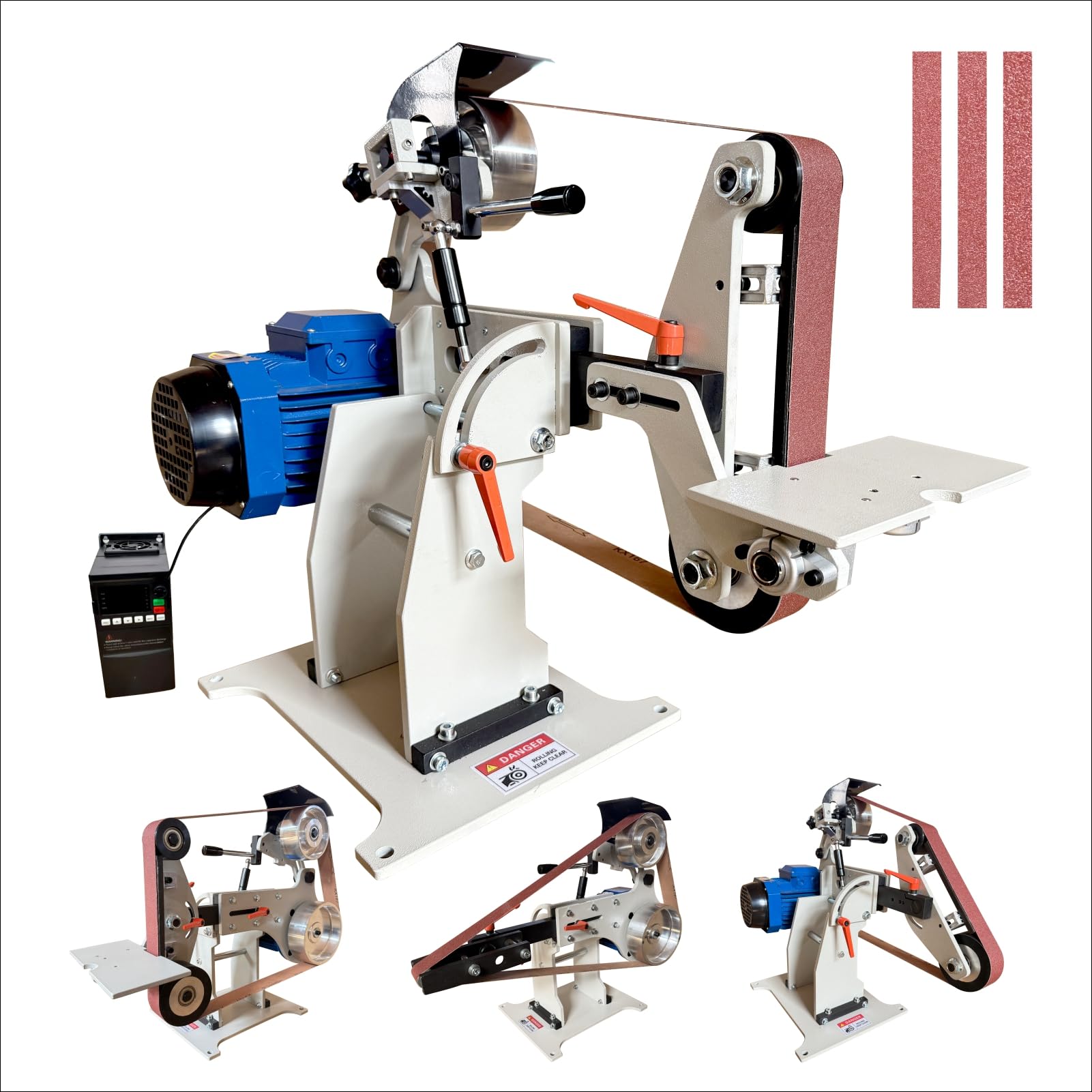
Stepless 0-2800 rpm control for the fine end of bevel and finish work.
The standout here is the drive, not the motor. A 2.2kW VFD (variable-frequency drive) gives you stepless speed adjustment from 0 up to 2800 rpm, which means no jerky jumps between settings — you can creep the belt down for a delicate tip or a fine polish, then dial it up to shape a bevel. The 1500W pure copper motor still maxes at 3000 rpm, and the maker claims the transmission boosts grinding efficiency 30% over standard models. What owners value most is the performance on the whole.
It grinds circular, flat, and arc work through two professional grinding kits, so one machine covers curve shaping, plate and profile work, and irregular structures. Belts arrive in 60, 100, and 180 grit for a full rough-to-fine run. The frame is one-piece molded steel with a powder-coated anti-rust finish, which cuts vibration during long sessions and keeps the precision consistent.
Here is the honest trade-off: several owners dislike the separate transformer that sits ahead of the VFD, calling it an extra switch to manage, and a dedicated 220V outlet — while recommended — is the smoother path if you have it. A few also plan to add a guard at the top idler for sparks, so that is a worthwhile add-on. Its 4.7-star average comes from a small, recent owner pool, but the early signal points to the best fine-control pick here.
Why the control wins
- Stepless 0-2800 rpm range lets you fine-tune for bevels and sharpening
- 2.2kW VFD spreads speed broadly across steel and softer material alike
- Two grinding kits cover circular, flat, and arc work in one machine
The fine print
- Separate transformer ahead of the VFD adds an extra switch to manage
- Dedicated 220V outlet is the cleaner setup, though not strictly required
Reach for this: if fine speed control for bevels and finishing is worth more to you than raw convenience.
Think twice: if you would rather not deal with a separate transformer and an extra switch on the bench.
4. JLD 2 * 72-82Belt Grinder Sander, equipped with 2.2KW VFD, three sets of grinding heads, and 3 zirconia corundum sand belts (60 100 180) compatible with 2 * 72 sand belts
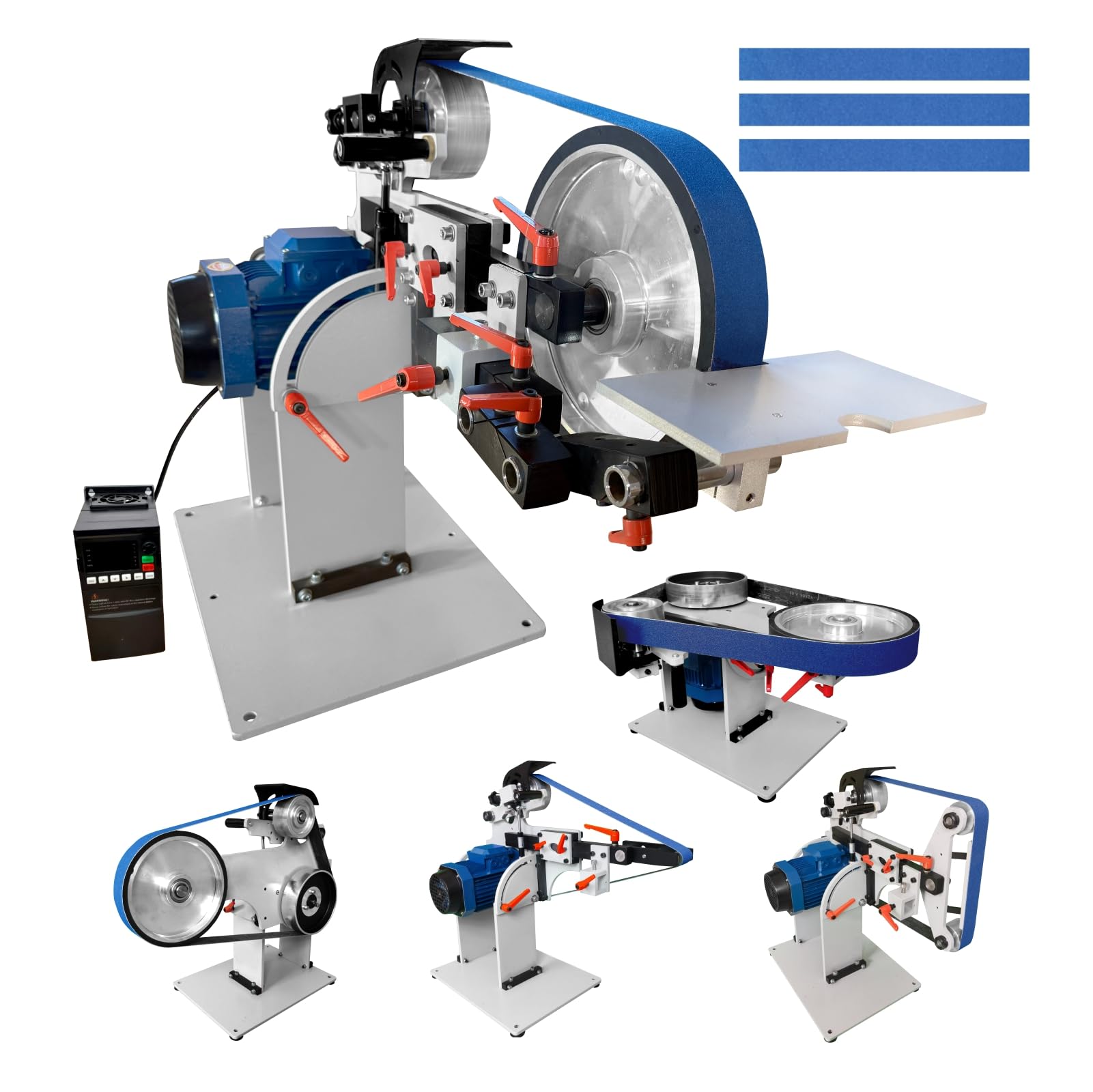
The heaviest frame of the bunch — built to shrug off thick steel all day.
At 187 pounds this is the heaviest grinder on the list, and the weight is the point: thick plate steel, welded construction, and a stiffened frame that holds steady while you lean into a blank. The 1500W pure copper motor spins at 2900 rpm, and it takes belts from 2×72 all the way up to 2×82 inch, so you are not locked to a single belt length. Owners call it a beast that chews through steel without hesitation — exactly what heavy metal removal demands.
The 2.2kW VFD adds stepless speed control and can switch fast and slow for polishing, and it carries a programmable side that owners appreciate — smooth belt adjustment and tracking come up again and again. You get three grinding heads covering circular, flat, and arc work, plus a zirconia corundum belt set in 60, 100, and 180 grit for the full rough-to-fine run. It runs vertical or horizontal on a strengthened steel frame with a detachable workbench, so you can switch modes and angles quickly.
The honest friction is the manual and the drive setup. Instructions are thin, the speed knob can take a lot of turns to move through its range, and the VFD runs on 220V single-hot-plus-neutral, which is not the same as US 240V — so the included 110v-to-220v transformer earns its place. A couple of owners swapped in a different VFD to sidestep the quirks. Owners say it performs like machines costing many times more, making it a serious pick for mass and power.
Mass that works for you: at 187 pounds it outweighs the 110-pound VEVOR and the 105-pound Shop Fox, which is what keeps it quiet and planted under a hard cut.
Know your manual: the documentation is the weak spot — the VFD is programmable but the instructions do not walk you through it, so budget time to learn the drive.
Best matched to: the shop that wants maximum mass and a wide 2×72-82 belt range for heavy steel removal.
Less ideal if: you want a drive that programs itself from the start — this one expects you to learn it.
5. Shop Fox Knife Belt Sander/Buffer W1843

A fixed-speed, all-ball-bearing sharpener and buffer that runs fast and smooth.
This one is a different animal, and that is the point. It runs a 1 HP motor at 1725 rpm and drives the belt at 4500 FPM (feet per minute — how fast the belt surface actually travels), which is a brisk, powerful clip for sharpening and buffing. Belt size spans 2″ x 72″-76″ so it accepts the standard 2×72-length consumables, and it is built all-ball-bearing throughout — the smooth-running construction that owners feel immediately. Quality is what people cite most, with performance close behind.
Setup takes about an hour, and belt changes are quick — owners note they take just seconds, with a tracking adjustment that is simple but holds well once set. The all-bearing build keeps it running quietly and powerfully through long sharpening sessions. It runs on a 14A draw at 110V single-phase, so give it a real circuit. For general shop work and buffing it earns its keep, and owners say it beats wrestling a bench grinder for knife duty.
Two things to know before you buy. It is a fixed-speed machine — there is no VFD, so if you want to drop the belt slow for a fine bevel you will not get it here. And the tool rest is small and the tracking is fussy to dial in, though stable once you find it. What it does offer is a heavy-duty, ball-bearing frame that sharpens and buffs cleanly, at a friendlier price than the variable-speed crowd. The one failure that shows up in the reviews is the plastic power switch, which can give out over time — a cheap part, but worth knowing.
Where it shines
- 4500 FPM belt speed sharpens and buffs fast and smooth
- All-ball-bearing construction runs quiet and steady
- Easy assembly with seconds-long belt changes and reliable tracking once set
What you give up
- Fixed speed — no VFD to slow down for finishing work
- Tool rest is small and tracking is fussy to set the first time
The right call for: sharpening, buffing, and general shop duty where a fast, smooth fixed-speed machine is all you need.
Not the one if: variable speed is non-negotiable for your finishing passes — this machine runs at one pace.
Understanding the Specs
VFD speed control
A VFD (variable-frequency drive) is the control box that changes how fast the motor spins, letting you dial belt speed up or down instead of running one fixed pace. Stepless control means you can stop anywhere in the range, so you can run slow for a fine bevel or a blade tip and fast to hog off material. The trade-off is setup: some machines ship with a separate transformer ahead of the drive, and a few have programmable drives with thin manuals, so plan on learning the control before your first blade.
Amperage and your shop circuit
Amperage tells you how much current the grinder pulls, and it decides what circuit you can safely run it on. The machines here range from a 5 A draw up to a 14 A draw, and the higher-draw grinders generally want a dedicated outlet rather than sharing a branch with other tools. Running a heavy grinder from a power strip is a common mistake — the machine may spin up fine, but the strip is not built for that load. Match the outlet to the amperage before you mount the machine, and use the included transformer where the motor is rated for 220V.
FAQ
Will a 2×72 belt grinder work for knife making specifically?
Do I need a dedicated 30-amp plug for these grinders?
What does the VFD actually do on a knife grinder?
Do these grinders come with the transformer I need for 220V?
Is variable speed really necessary compared with a fixed-speed grinder?
How heavy are these grinders and will my bench hold them?
Do I need reverse on a belt grinder for knife making?
What tools do I need to assemble these grinders from the start?
How do I keep the belt tracking straight on a new grinder?
Final Thoughts: The Verdict
The best belt grinder for knife making in this lineup is the VEVOR 2×72 with VFD — a 1500W pure copper motor, three grinding modes, and a welded steel frame that holds tracking while you press a bevel. Its draw is the lowest of the bunch at 5 A, and it comes with 100/180/240 belts ready to run. If you want more top-end belt speed plus a reverse function and you have a dedicated outlet to feed it, grab the Jinlida 2×72. And for a fast, smooth, fixed-speed machine that sharpens and buffs, the all-ball-bearing Shop Fox W1843 is the one to reach for.
The honest nudge: if part of your decision hinges on the lowest-draw machine that also carries the strongest quality reputation here, the VEVOR is the one whose 5 A draw and 4.3-star standing make it the gut-check pick for a first serious knife grinder.
How We Picked
We do not accept paid placement. Every pick is matched to a real buyer and a real use-case; we do not hands-on test units.
Sources & Methodology
Specifications: manufacturer listings and product documentation. Review insights: verified customer reviews, as of September 2026. Pricing: not shown on this page (it changes often); check the current price via the retailer link.
As an Amazon Associate, KitchPrep earns from qualifying purchases. This does not affect which products we feature.
Related Guides
