
Specs are compiled from manufacturer listings and verified buyer reviews and can change over time — please confirm the key details on the product page before buying.
Buying a check valve is a five-minute job that turns into a weekend of regret when the wrong one shows up. The single decision that matters most is the size — these are all 1-1/2 inch valves, and a 1-1/2 inch valve will not seal against a 2-inch pipe no matter how much tape you wrap around the threads. The second decision is orientation. A swing valve (a flap that opens and closes with the flow) usually has to sit flat, while a spring-loaded valve can point up or sideways. Get those two right and a cheap valve can outlast an expensive one. Get them wrong and you are cutting glued PVC out of a wall.
I’m Mohammad Maruf — the founder and writer behind KitchPrep. This guide is built by comparing the manufacturers’ published specifications and the patterns across verified customer reviews, so you get each pick’s real strengths and trade-offs instead of marketing spin.
Some valves here are built for pools, some for sump pits, and one is aimed squarely at potable water lines. Match yours to the job and the rest is straightforward. The trick with any 1 1/2 inch check valve is matching thread type, orientation, and pressure rating to the pipe you already own.
Our Picks at a Glance


How To Choose The Best 1 1/2 Inch Check Valve
Four things decide whether a check valve works in your system or sits in a drawer: the connection type, the closing mechanism, the pressure rating, and the body material. None of them are complicated once someone explains what each one does on a real line.
Connection Type Comes First
Threaded connections screw onto pipe ends. Slip and socket connections glue onto plain pipe with solvent cement. Compression fittings tighten down with a nut, which is why sump-pump owners like them — you can unscrew the valve later without cutting anything.
Thread standards matter too. NPT stands for National Pipe Tapered, meaning the threads get slightly wider toward the base so they wedge tighter as you turn. IPS (Iron Pipe Size) is the older name for the same nominal sizing family. A threaded valve rated for 1-1/2 inch NPT will match a 1-1/2 inch threaded pipe; a slip valve will not, because it has no threads at all.
Swing, Spring, or Ball
A swing valve hangs a disc on a hinge and lets the flow push it open, then lets gravity and back-pressure close it. Because gravity does part of the work, most swing valves need to sit horizontal — laying flat, with the flow running sideways through them. Mount one pointing straight up and the disc may never seat.
A spring-loaded valve adds a spring behind the disc, so it can close regardless of which way gravity points. That is why spring valves are the usual pick for vertical runs. The trade-off is a little extra resistance in the line.
A ball check valve uses a free ball that rolls back into a seat to seal. There is no spring and no hinge, so it is simple and clog-resistant, but it also means the valve only seats reliably when mounted the correct way up.
Pressure Rating and Water Hammer
The PSI number on the body is the maximum working pressure the valve is rated to hold, not the pressure your system runs at. Sump and pool discharge lines typically run far lower than the valve’s ceiling, so a 50 PSI rated valve is common on sump duty while 200 PSI rated models show up on well and boiler lines.
Water hammer is the bang you hear when a pump shuts off and the moving water slams into a closed valve. A spring that closes the disc quickly, before the water reverses, is what stops that bang. This is the single biggest reason people replace a plain swing valve with a spring-loaded one.
Material: Brass, Stainless, or PVC
Brass resists corrosion and handles hot water. Stainless steel 316 is the choice for aggressive fluids, salt, and well water heavy with minerals. PVC is the standard for pools and sumps because it glues straight into existing plastic pipe and shrugs off chlorinated water. If the line carries drinking water, look for a lead-free rating.
Quick Comparison
| Model | Best For | Connection | Max Pressure | Material | Amazon |
|---|---|---|---|---|---|
| Jandy 7235 Check Valve★ Best Overall | Pool and spa overflow lines | 1.5 in threaded | — | CPVC | Amazon |
| Megairon SS316 Swing Check ValveBest for Well Water | Aggressive fluids and well water | 1.5 in NPT threaded | 200 psi | Stainless Steel 316 | Amazon |
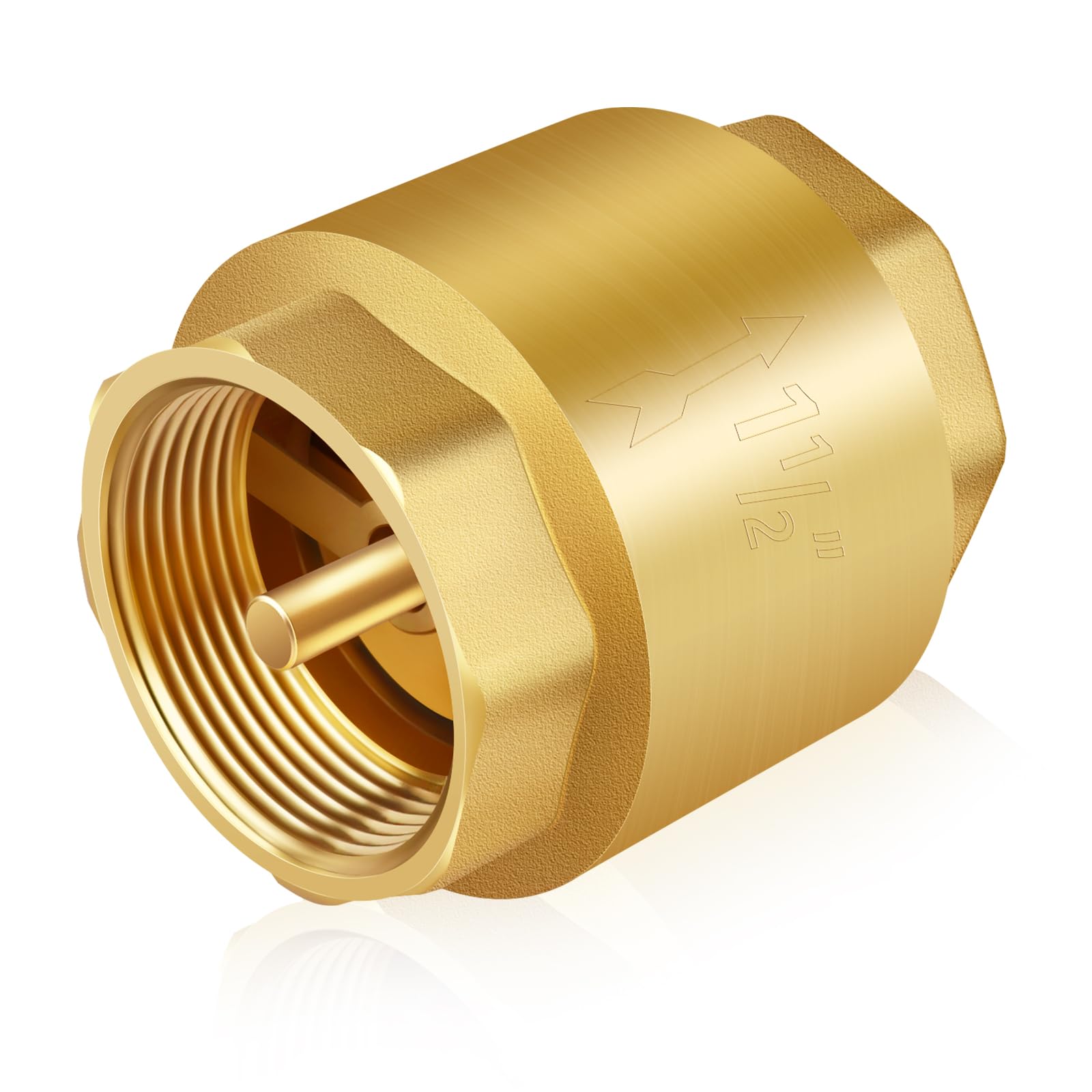
| Boltigen Solid Brass Spring Check ValveBest Budget Brass | Wells and water heaters | 1.5 in NPT threaded | 200 psi | Brass | Amazon |
| Zoeller 30-0041 Check Valve | Sump pump discharge | 1.5 in compression | 50 psi | PVC | Amazon |
| Zoeller 30-0040 Quiet Check Valve | Noise-free sump installs | 1.5 in slip | 50 PSI | PVC | Amazon |
| Valterra 200-CU15 Check Valve | Seeing inside the line | 1.5 in slip union | 150 psi | PVC (Sch 40) | Amazon |
| Boltigen PVC True Union Check Valve | Vertical-only cleanable lines | 1.5 in slip union | 150 psi | PVC (Sch 80) | Amazon |
| Eastman 20429LF Brass Swing Check Valve | Potable water and boilers | 1.5 in IPS threaded | 200 psi | Lead-free brass | Amazon |
| SYWUWV Vertical Spring Check Valve | Vertical upflow piping | 1.5 in NPT threaded | 1.6 MPa (232 psi) | Brass | Amazon |
In-Depth Reviews
1. Jandy Genuine Parts 180 Degree, 1 1/2″ – 2″ Check Valve, 7235
Our pick — over 4.5★ from 750+ verified ratings; the strongest balance of quality and price.
A pool-spa valve with a window in the lid, so you never guess whether it is clogged.
If you have ever drained a raised spa twice in one week because the overflow kept losing water overnight, this is the valve built for that exact line. It carries a 1.5 inch inlet connection and is made from durable CPVC, a chlorinated plastic that stands up to treated pool water far better than ordinary PVC glue joints. The body measures 1.2 pounds, which is enough mass that it sits stable on a pad without extra bracing.
The feature that sells it is the clear lid with a red seal. Instead of cutting the valve out to check whether debris has jammed the mechanism, you look through the top and see it. Owners say they replaced an older fully enclosed valve precisely because they could not tell if it was clogged. It also uses a unique swing and spring design that lets it handle both return and intake water, and it disassembles for debris cleaning without replacing the whole assembly.
What holds up across owner experience is simple: the thing works. The valve handles what it is asked to do, installs without drama, and the sight glass earns its keep over a season. The honest caveat is durability — the spring mechanism has been reported to rust and eventually fail over time, and the fit is threaded rather than glued, so it is not a drop-in for a slip-socket line. Jandy backs it against manufacturer defects for one year from purchase.
What Owners Keep Praising
- Functionality is the runaway leader in owner feedback — the valve does the one job it was bought for
- Clear lid with red seal lets you inspect for debris without cutting pipe
- Swing and spring design covers both return and intake flow in one part
- Handles a raised spa overflow that was losing water nightly
Where It Falls Short
- Spring mechanism has been reported to rust and fail over the long haul
- Threaded connection only — not a fit for slip-socket pipe
- Costs noticeably more than a plain PVC swing valve
Reach For This If: you are working on a pool, spa, or water feature where you want to see the valve working and the connection is threaded.
Pass It Over If: your discharge line is slip-socket PVC, because this needs threads to seat and you will be gluing an adapter on.
2. 1-1/2″ Stainless Steel SS316 Swing Check Valve, NPT Female x Female Thread, WOG 200 PSI PN16 CF8M
Rust-proof stainless innards for well water that eats ordinary fittings alive.
Well water loaded with minerals is what kills brass and plain steel valves, and that is the problem this one solves. The body, disc, and screwed cap are all stainless steel 316, and the seals are PTFE, so the wetted parts shrug off the corrosion that turns a cheap valve into a seized lump. It uses two 1-1/2 inch NPT female threaded ports and carries a 200 WOG rating, meaning it is rated for water, oil, and gas service.
You get full flow with almost no resistance because this valve uses a swing design (a disc that swings open with the flow and swings shut when flow reverses). That brings one hard rule: mount it on a horizontal run only. Put it on a vertical run and gravity interferes with the swing, so the disc may not seat. Owners who run grout or heavy water through their lines pick it because the swing style passes full flow compared with a spring-loaded valve, and one buyer reports it as a “Perfect fit for my AquaHot 375 LP.”
The temperature range is unusually wide at -60 to 450 degrees Fahrenheit, and the manufacturer lists compatibility with water, oil, air, gas, light acids and alkalis, biodiesel, fuels, and alcohols. That breadth comes from the stainless and PTFE combination, not from any special coating. The trade-off is orientation: if your run goes up rather than sideways, you need a spring-loaded valve, not this one.
Build Quality First: the thing that wins people over is simply how solid the body feels, followed by how reliably it moves fluid once installed. Buyers putting it on a well setup and a hot-water system both report it doing its job without fuss.
The Catch: horizontal only. That is not marketing caution, it is how a hinged disc works, so plan the run before you buy.
Winner For: hard well water, grout lines, or any fluid that would corrode brass — as long as the pipe runs sideways.
Not The Pick For: a vertical upflow line, since the disc needs gravity working with it, not against it.
3. Boltigen Solid Brass Spring Check Valve, 1-1/2 Inch NPT Female Thread
Heavy brass that installs either way up, which is the freedom most brass valves do not give you.
Most spring check valves force a decision about orientation. This one does not — the stainless steel spring lets you mount it vertically or horizontally without worrying about gravity, and that flexibility is the reason it belongs on a short list for well, pump, and water-system work. The body is heavy-duty brass, chosen for corrosion resistance, and it connects through two 1-1/2 inch NPT female threads.
The numbers are straightforward. Maximum pressure is 14 bar, which is 200 psi, and the working temperature range runs from -10 degrees Celsius to +120 degrees Celsius, which is 14 to 248 degrees Fahrenheit. The valve opens at 45 PSI and requires zero minimum back pressure to close reliably, so it does not need a strong pressure differential to seal. The tap is a taper thread — that means it widens slightly toward the base so it wedges tight as you turn, giving a better seal than a straight thread.
Buyers report the valve holding months after installation, one noting: “I installed this about 6 months ago and it’s still holding.” A few describe minor weeping at the joint, though the same buyers tend to blame their own installation. Several cite the price compared with local valve shops as the deciding factor, and the maker says every unit is individually tested before shipping.
What You Are Paying For: brass construction, a 200 psi ceiling, and the rare freedom to mount the valve in either orientation without a mounting restriction.
Worth Knowing: the 45 PSI opening pressure means very-low-pressure gravity-fed systems may not trip it reliably — check that your line can push past that figure before ordering.
Right Answer When: you want brass durability, either mounting orientation, and a 200 psi rating without moving into premium pricing.
Look Elsewhere When: your system runs on gravity alone, because 45 PSI of opening pressure is more than a low-head line can generate.
4. 1-1/2″ NPT Vertical Spring Check Valve, Brass Heavy-Duty Female Thread DN40

A vertical-lift spring valve that shuts fast enough to keep the pipes from banging.
Vertical upflow lines are where swing valves fail, and this one is built for exactly that run. It uses a vertical lift spring mechanism (a disc that rises and drops in a straight line rather than on a hinge), so water pushing upward opens it and the spring snaps it shut the instant flow reverses. That fast closing is the point — it keeps water hammer (the loud bang when a pump stops) from slamming the piping.
The body is heavy-duty brass with uniform wall thickness, and the inner wall is polished to reduce scaling and clogging. That polishing is not cosmetic. A smoother bore collects less mineral buildup, which means the valve keeps sealing properly over more service cycles. Pressure ceiling is 1.6 MPa, listed as 232 psi, and the temperature range spans -20 degrees Celsius to 150 degrees Celsius, which is -4 to 302 degrees Fahrenheit. Media compatibility covers water, oil, and non-corrosive gases.
Owners say the sealing is the strong suit. One reviewer noted holding for 24 hours with no leakage from 20 to 70 psi (pounds per square inch, a measure of water pressure). Another noted that unlike a previous check valve, this one “seals well all the time.” Since it fits 1-1/2 inch NPT female threads (a standard tapered pipe thread), it drops onto threaded pipe without adapters, which is a real convenience on sump backups and vertical pump lines.
Why It Earns A Slot: the combination of a vertical lift design, a 232 psi rating, and a polished inner bore covers three problems at once — orientation limits, pressure headroom, and buildup over time.
The Honest Limit: it is built for vertical upward flow by design, so horizontal runs should go to a swing or spring valve instead.
Built For: vertical upflow sump and pump lines that need fast shutoff and a wide pressure ceiling.
Better Left Alone If: your line runs sideways, since the lift design wants flow moving against it from below.
5. Zoeller 30-0040 Quiet Check Valve 1-1/2″ PVC
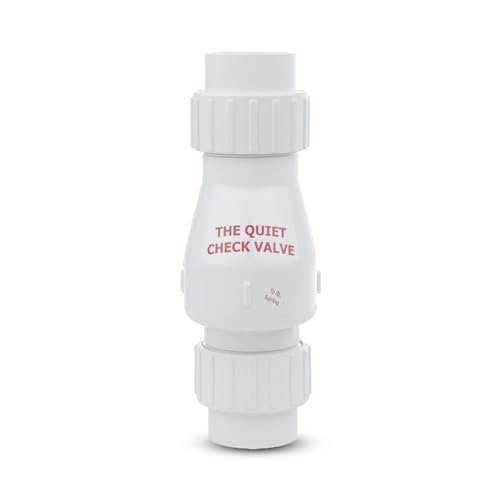
The one that deletes the clunk — a 1/2 lb spring flapper that shuts before the water reverses.
Sump pump clatter is the complaint that drives most people to replace a check valve, and this one is designed around that single problem. The flapper is spring-loaded with a 1/2 lb spring, which closes rapidly enough to eliminate water hammer and take the pump noise out of the equation. It is rated to 50 PSI, which is a 115 ft head ceiling, so it comfortably covers typical basement and crawl space discharge lines.
The build is slip-x-slip 1-1/2 inch PVC with unions on both ends, and the unions are the practical win. They let you splice the valve into an existing PVC discharge line without threading pipe or cutting more than you need, and they make removal a screw-on, screw-off job later. The full-flow non-clog design passes water with minimal resistance, so it does not throttle the sump pump’s output. Total weight is 8.8 ounces.
What has held up over the years is the silence. Owners mention the valve “removed the clunking sound completely,” and one replaced a unit that lasted 8 years. The install does require PVC glue and a cutter or saw, and one buyer mentioned the whole job taking about 15 minutes with the tank drained low for clearance. Vertical or horizontal mounting is both fine.
Where It Shines
- 1/2 lb spring-loaded flapper closes fast enough to kill water hammer noise
- Slip-x-slip unions let you splice into existing PVC without threading pipe
- Full-flow non-clog bore keeps sump pump efficiency intact
- 50 PSI rating covers a 115 ft head, plenty for residential sump lines
Before You Buy
- Requires PVC glue, a cutter, and about 15 minutes of actual work
- Slip socket connections only — not a match for threaded pipe
- Dimmable sump clunk is gone, but so is the audio cue that the pump ran
Take This One If: your sump pit currently announces every pump cycle and you want the noise gone.
skip it if: your discharge line uses threaded steel pipe, because the unions here are designed for glued PVC.
6. Eastman Brass Swing Check Valve, 1-1/2 Inch IPS, Brass Plumbing Fitting, 20429LF

Lead-free brass for drinking-water lines, where a plain PVC valve will not do.
Potable water is where material choice stops being a preference and starts being a requirement. This valve is lead-free brass, which is what makes it suitable for drinking-water supply installations in the first place, and it uses a swing mechanism rather than a spring. The swing disc falls shut on its own weight and the back-flow pressure pushes it tight, which is why swing valves hold reliably on supply and return lines. It weighs 13.6 ounces — heavier than the PVC options — because it is solid brass, and that mass is what gives it the stability of a permanent fixture.
The connection is 1-1/2 inch IPS threaded, and the working pressure spans 125 PSI to 200 WOG. It is designed specifically as a backflow preventer for water systems, protecting supply lines from contamination and damage. Another describes the valve doing exactly what a check valve should, letting water flow one direction only.
Owner experience is a clean sweep, which is unusual for plumbing parts at this price point. The trade-off is the price of brass and the fact that the swing design needs the pipe to run horizontal — same rule as any swing valve. If you have never worked with threaded brass into cast iron or copper, plan for a wrench and pipe tape rather than glue.
Why Brass Earns Its Place: a lead-free body makes this the correct call for any line carrying drinking water, and the swing mechanism delivers the same reliable backflow protection as PVC without the material restrictions.
What To Plan For: threaded brass means wrenches and tape rather than solvent cement. And the swing type needs horizontal pipe, so a vertical run should use a spring valve instead.
Go Brass If: the line carries drinking water or feeds a boiler, where lead-free brass is a real requirement.
Stick With PVC If: the line is sump or pool discharge and you want the cheapest reliable answer — plastic does that job fine.
7. Valterra 200-CU15 PVC Swing/Spring Combination Check Valve, Clear, 1-1/2″ Union

You can watch this valve open and close through the housing, which settles most arguments.
A clear housing is worth more than most buyers realize until the first day something goes wrong. This Valterra gives you a direct view of the disc working inside the pipe, so you can confirm at a glance that it is sealing, stuck open, or caught on debris. The body is Schedule 40 PVC, which is built for strength and resistance to corrosion and mild chemicals, and the seal is EPDM rubber for resistance to water and oils. The connections are 1-1/2 inch slip unions on both ends.
The mechanism is a swing and spring combination with a 1/2 lb spring, so it closes with both gravity and spring tension helping. Maximum pressure rating is 150 psi, which covers most pool, irrigation, and light industrial duty. Owners putting it on variable-speed pool pump supply lines report it fixing back-pressure issues and working horizontally — which matters, because most swing valves cannot be mounted that way. Another buyer noted it does not clog with pine needles or leaves the way an earlier valve did.
The fit is the honest rough spot. It is designed for 1-1/2 inch PVC pipe with slip connections, and even though the union is sized to that standard, some customers note fit issues when their existing pipe is not quite to spec. One owner reported minor back-flow after 18 months in a laundry application — swing seats soften with wear. Most reviewers point out clean, leak-free operation for years.
Standout Perks
- Clear body lets you visually confirm the valve is working or stuck
- Swing and spring combination works in horizontal orientation, which most swing valves cannot
- Schedule 40 PVC with EPDM seals resists chlorinated water and mild chemicals
- 1/2 lb spring closes the disc before backflow builds
Trade-Offs To Know
- 150 psi ceiling is lower than the 200 psi brass options
- Slip-union fit can be tight or loose depending on your existing pipe tolerance
- Swing seats soften over years — plan on eventual replacement in demanding lines
The Sensible Choice When: you want to see the valve working, you need it to run horizontally, and you are on Schedule 40 PVC already.
Think Twice If: your line runs above 150 psi or your pipe is threaded — this needs slip sockets and a moderate pressure ceiling.
8. PVC True Union Check Valve, 1-1/2″ Slip Swing Full Port Utility Check Valve, Sch80 Socket Pool Ball Check Valve
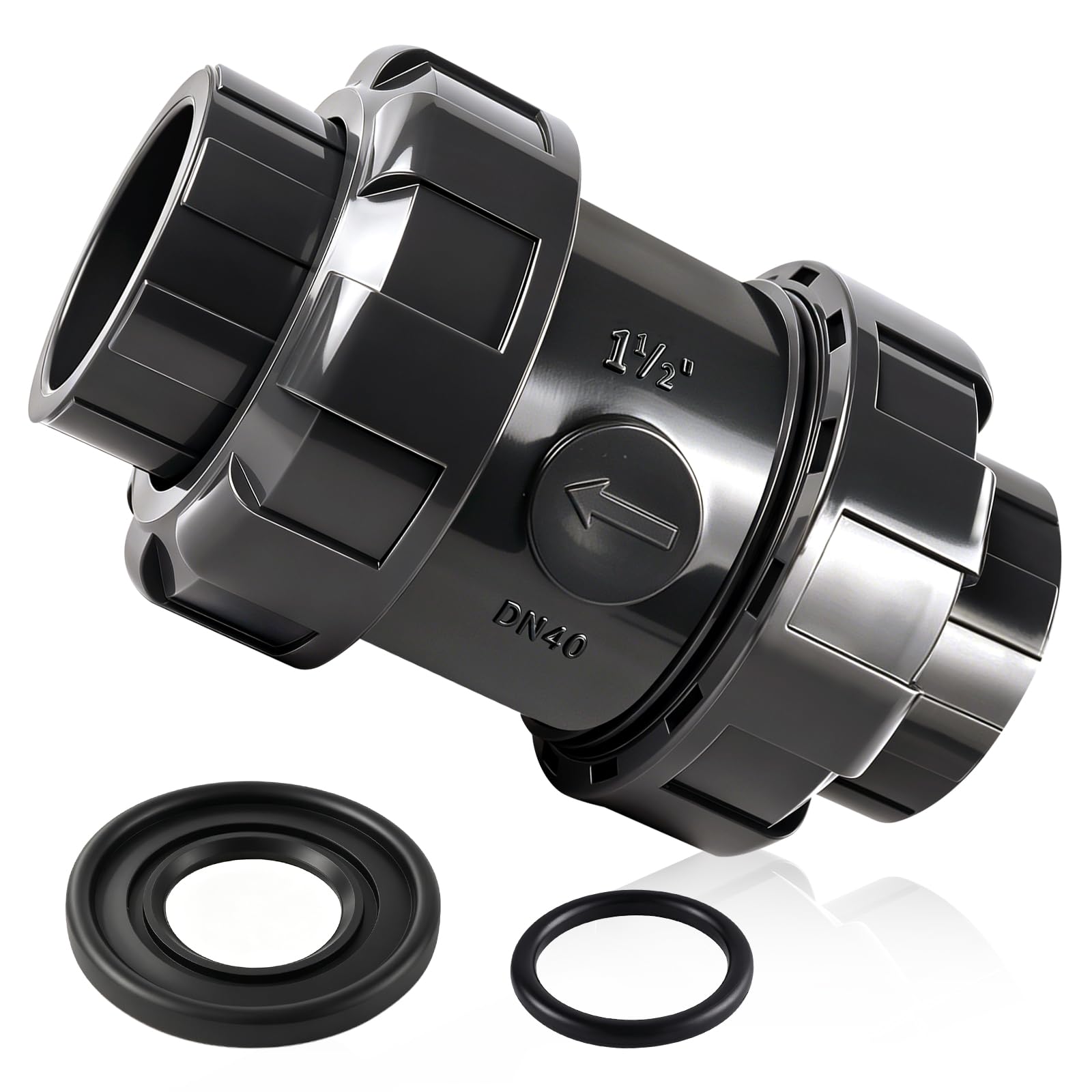
A heavy-duty Schedule 80 ball valve that comes apart for cleaning without cutting pipe.
Schedule 80 PVC is thicker walled than the Schedule 40 you find at most hardware stores, which is why this valve is a sturdier piece of hardware than its siblings. Inside the body is a free ball that rolls back into its seat to seal, so there is no hinge, no spring, and no flapper to jam — the simplest possible backflow mechanism. The O-ring is EPDM, and the plastic is rated for low temperature, impact, ultraviolet light, and rust resistance. Maximum pressure is 150 psi.
The union design is the real selling point for anyone with hard-to-reach plumbing. Because the valve is a true union, you can take it apart for cleaning or rebuild without breaking down the piping connection — threaded end caps unscrew, the internals come out, and the pipes never move. It fits Schedule 80 1-1/2 inch pipe by slip socket, so it glues in like any other PVC fitting. Applications listed include commercial plumbing, aquariums, irrigation, swimming pools, water parks, and OEM work.
The important caveat is orientation. This one is built for vertical installation only — it must be mounted in an upflow position with the flow arrow pointing the direction the water travels. The manufacturer explicitly warns not to install it upside down, because with no spring to close it, gravity is what seats the ball. Buyers who try to force it horizontal report poor performance, and that is a design constraint rather than a defect.
Where It Wins: the true union body is genuinely useful — you can service or replace the internals without touching the pipe, and Schedule 80 walls handle more abuse than thin-wall PVC.
The Real Catch: vertical-upflow only. With no spring in the design, this valve relies on gravity to seat the ball, so mounting it sideways or upside down will cause it to leak or fail to seal.
Ideal For: vertical upflow lines where you want a serviceable valve and thick Schedule 80 walls, especially in irrigation or pool piping that sees debris.
Wrong Tool For: horizontal runs — with no spring to close the ball, sideways mounting defeats the design entirely.
9. Zoeller 30-0041 50 psi PVC 2-Port Check Valve, 1-1/2″
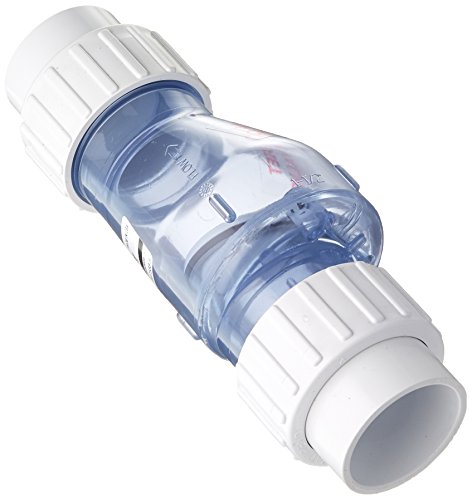
Compression fittings and a clear body, which is the pair that makes a sump valve serviceable.
Sump pump owners know the pain of a check valve that has to be cut out. This one solves it with compression end fittings on a durable PVC body, so installation and removal do not require cutting pipe or wrestling with hose clamps. The valve is rated to 50 psi and is designed for both horizontal and vertical installs, giving you flexibility in a tight pit. The clear housing lets you see whether the valve is actually working.
You get quiet operation because this valve closes fast enough to prevent water hammer (the loud thud when water slams into a closed disc) rather than letting the water crash. Shoppers say no more loud thuds when the sump stops pumping. One owner who switched from a traditional flapper noted it is noticeably quieter and appreciates the threaded couplers because they are faster to disassemble than hose clamps. Another reported it still running strong after 5 years.
The clear body is more useful than it sounds. It lets you see backflow in real time — one owner used a dye test to confirm operation — and it also shows when calcium buildup starts coating the seat and interfering with the seal. That visibility is what converts a mystery “why is my basement wet” into a two-minute inspection. The trade-off is that the housing is plastic and needs a careful hand at the connections; over-tightening compression fittings will crack them.
Why It Edges Ahead: five years of service life in real sump pits, and quiet operation that beats the clunky flapper valves it replaces.
Watch For: plastic compression fittings crack if you overtighten them. Hand-tight plus a quarter turn is the right approach, and the fit is a bit tight in narrow pits.
Buy This If: your sump pit needs a quiet valve you can service without cutting pipe, and you are tired of the loud thud every cycle.
Not Quite Right If: your discharge line is threaded steel or the pit is so tight you cannot get a wrench on the fittings.
Understanding the Specs
Thread Type: NPT vs IPS vs Slip
NPT stands for National Pipe Tapered — the threads get slightly wider toward the base so the joint wedges tighter as it is turned. IPS, or Iron Pipe Size, is the nominal sizing family and typically means the same thread standard for most valves you will find. Slip connections have no threads at all — they are sockets you glue onto plain pipe with solvent cement. Compression fittings are a third style altogether: they squeeze a nut down onto a ferrule to grip the pipe.
What matters for buying is not the acronym but what your existing pipe already has. Threaded pipe mates with NPT and IPS valves. Bare pipe mates with slip valves — and there is no adapter-free conversion between the two, so the connection is usually the deal-breaker on the wrong valve.
Pressure Rating and Head
The PSI number on the valve body is the maximum pressure the valve is rated to hold, not the running pressure of your system. Sump discharge lines frequently run well below the valve ceiling — a 50 psi valve covers a 115 ft head, more head than any residential sump pit will ever produce. Well and boiler systems see higher pressures, which is why those applications push toward the 200 psi valves here.
The rating also sets the safety margin against water hammer. Closing a valve against moving water produces a momentary pressure spike, and a valve with headroom above your operating pressure has more tolerance for that spike. Ridged-on-the-ceiling ratings are a sign the valve will eventually fail under hammer shock.
Closing Mechanism and Orientation
Swing valves use gravity to close the disc, so they need a horizontal run — gravity has to pull the disc back into the seat. Spring-loaded valves add a spring behind the disc, which lets them close regardless of orientation, so they work on vertical upflow lines. Ball valves use a free ball that rolls back into a seat, and they too rely on gravity, which is why most ball check valves specify vertical-only installation.
The wrong mechanism in the wrong orientation is the most common reason a check valve fails to seal after installation. It rarely shows up as a defect — it shows up as a drip that only appears when the pump cycles off.
Why a Clear Housing Matters
A clear body lets you see the disc, ball, or flapper working in real time, which is useful in two settings. On the diagnostic side, it lets you confirm the valve is sealing after installation without cutting anything out. Over the long run, it lets you catch calcium buildup, debris, or foliage material collecting on the seat before the seal fails completely.
The lifetime of any check valve in a mineral-heavy or debris-heavy line depends on how quickly that seat degrades. Being able to see the degradation is what converts a surprise leak into a scheduled replacement.
FAQ
Will a 1-1/2 inch check valve fit my 1-1/2 inch pipe?
Can I install a swing check valve vertically?
What does the PSI number on a check valve actually mean?
How do I stop the loud clunk when my sump pump shuts off?
Why does my check valve leak a little water when the pump stops?
Is brass or stainless steel better for a check valve?
What is the difference between Schedule 40 and Schedule 80 PVC check valves?
Can I use a check valve on a pool or spa plumbing line?
Do I need a lead-free check valve for drinking water?
How long does a 1-1/2 inch check valve typically last?
Final Thoughts: The Verdict
For most buyers, the 1 1/2 inch check valve that earns the top spot is the Jandy 7235, because the clear lid lets you inspect the disc without cutting pipe and it is built from durable CPVC (a type of plastic pipe) that shrugs off chlorinated water — a real advantage on the 4.7-star rating tier. If your line carries drinking water or feeds a boiler, reach for the Eastman 20429LF — lead-free brass is not optional on potable lines. And for the basement sump pit that thuds every cycle, the Zoeller 30-0040 is the one to grab, with a 1/2 lb spring flapper that silences the noise at the source.
One nudge before you click: whoever buys first, confirm the connection type on your existing pipe before checkout. Threaded, slip, union, and compression fittings do not interchange without adapters, and that mismatch is the number one frustration on every 1-1/2 inch check valve order.
How We Picked
We do not accept paid placement. Every pick is matched to a real buyer and a real use-case; we do not hands-on test units.
Sources & Methodology
Specifications: manufacturer listings and product documentation. Review insights: verified customer reviews, as of September 2026. Pricing: not shown on this page (it changes often); check the current price via the retailer link.
As an Amazon Associate, KitchPrep earns from qualifying purchases. This does not affect which products we feature.
Related Guides
