
Specs are compiled from manufacturer listings and verified buyer reviews and can change over time — please confirm the key details on the product page before buying.
If your room sounds hollow, your callers hear it, and your recordings sound distant, the fix is usually acoustic treatment — not soundproofing. Those are two different jobs. Soundproofing stops sound leaving or entering a room, and it means rebuilding walls. Acoustic treatment tames the echo and reverb bouncing around inside the room you already have, and it is what most people actually need. Every pick below is a real treatment product with a real published thickness, density, or coverage number you can compare.
I’m Mohammad Maruf — the founder and writer behind KitchPrep. This guide is built by comparing the manufacturers’ published specifications and the patterns across verified customer reviews, so you get each pick’s real strengths and trade-offs instead of marketing spin.
Thickness, density, and coverage decide whether a panel actually kills echo or just decorates your wall, so those are the three numbers worth checking before you buy. The panels below range from thin peel-and-stick hexagons to 2-inch fiberglass baffles, and the right one depends on whether you are chasing a quiet podcast booth or a wall that simply looks good. For acoustic isolation, match panel thickness to the room: 0.4 inch for voice harshness, 2 inches for mid-range echo.
Our Picks at a Glance


How To Choose The Best Acoustic Isolation Panels
The fastest way to waste money here is to buy a big cheap pack of thin foam and expect a silent room. Treatment panels absorb the echo that bounces off hard surfaces, so the room stops sounding like a bathroom. They do not stop noise from passing through a wall. Once you accept that, choosing gets simple: match the panel’s thickness and density to the specific noise problem you have, and match the mounting hardware to the surface you are sticking it to.
Thickness and density decide what a panel can absorb
Thin foam in the 0.4-inch range is best at soaking up the high frequencies that make voices sound harsh and bright in a small room. Step up to a 2-inch panel and you get more material depth, which means more of the mid-range gets caught too. Density is the second half of that story. A panel rated at 9.4 lb/ft³ is packed tighter than a generic foam tile, so it holds its shape and absorbs more consistently. For a podcast booth or a mixing desk, the thicker and denser the panel, the more useful it is.
How much wall you actually need to cover
A single small pack of tiles rarely changes a room on its own. Coverage is measured two ways in this category: total square feet of wall the pack treats, and the physical size of each panel. A 12-pack of 12 by 10 inch tiles covers about 7.5 square feet, which is roughly the size of a doorway. A 36-pack of 12 by 12 inch panels covers about 36 square feet and starts to wrap a real reflection point. Decide where the first reflections hit your ears — usually the wall behind your desk and the side walls — and cover those spots first rather than spreading tiles evenly across the room.
Stick-on or screw-in mounting
Peel-and-stick backing is the fastest route and works fine on clean painted drywall and doors. The trade-off is removal: a strong adhesive can lift paint when you take the panel down. Panels sold with a template and mounting brackets cost more but hang sturdier and come off cleanly. Foam wedge panels with no adhesive at all give you the freedom to choose spray adhesive, double-sided tape, or hook-and-loop strips for your specific wall.
Quick Comparison
| Model | Best For | Panel Thickness | Pack Size | Coverage | Amazon |
|---|---|---|---|---|---|
| Art3d 6-Pack Wood Slat Wall Panels★ Best Overall | Living room and bedroom accent walls | — | 6 panels | 31.5 sq.ft | Amazon |
| Amantech 12 Pack Hexagon PanelsBest for Small Rooms | Renters and small home offices | 0.4 inch | 12 panels | — | Amazon |
| Dailycooper 12 Pack Hexagonal PanelsBest Looking | Futuristic gaming and studio walls | 0.4 inch | 12 panels | 7.5 square feet | Amazon |
| AUSLET 36 Pack Pyramid Panels | Full wall echo treatment | 2 inches | 36 panels | 36 square feet | Amazon |
| 70 Pack Wedge Foam Panels | Podcast and vocal booths | 1 inch | 70 panels | — | Amazon |
| 4 Pack 48 x 24 x 2″ Foam Panels | Bass-heavy rooms and larger spaces | 2 inches | 4 panels | — | Amazon |
| TONOR Dual-Layer Wall Panels | Apartment and laundry room walls | 0.72 inch | 4 panels | Approximately 4400 square inches | Amazon |
| UMIACOUSTICS Fiberglass Panels | Home studio mixing and mastering | 2 inches | 4 panels | 432 square feet | Amazon |
| NeatiEase Wood Slat Wall Panels | Floor-to-ceiling feature walls | — | 4 panels | 33 sq.ft | Amazon |
In‑Depth Reviews
1. Art3d 6-Pack Soundproof Wood Slat Wall Panels, 94.5 x 7.9 Inch, Walnut
Our pick — over 4.5★ from 800+ verified ratings; the strongest balance of quality and price.
The slat wall that doubles as the nicest thing in your living room
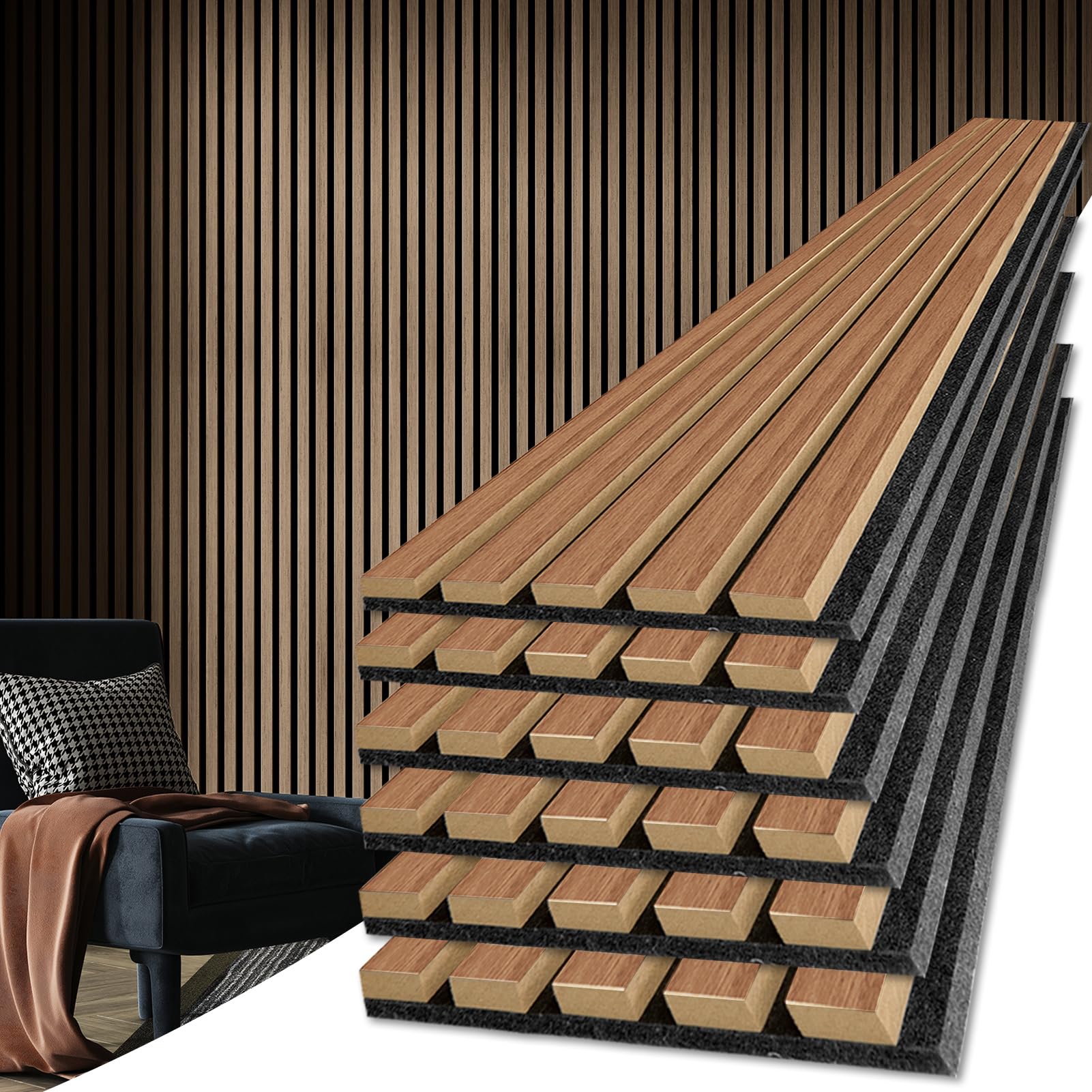
This is the pick for the person who wants an acoustic upgrade they would be proud to show guests. Each fluted panel runs 94.5 inches long and 7.9 inches wide, and six panels to a box cover about 31.5 square feet — enough for a floor-to-ceiling statement wall behind a sofa or bed. The walnut wood-laminate face is the whole point here. A plain black foam tile absorbs echo but looks like a studio rental; this panel absorbs echo and reads as interior design.
The build is quieter than it looks. Under the wood face sits high-density polyester fiber, made from quality MDF with no harmful chemical emissions and low TVOC levels, so it is not off-gassing in your bedroom while it works. Installation rewards patience over skill. The trick that comes up again and again is a little glue plus a few screws per board, not adhesive alone, because the panels are long enough that a single mounting method lets them sag. One owner put it plainly: “Love our slat wall! We’re not DIY people but were able to install it ourselves after our contractor cut them to size for us, used a nail gun and caulk on the back to keep it all from moving or sagging.”
The honest catch is the edges. Cut one of these and the exposed end is sharp enough to need a quick sanding before it goes anywhere near a doorway or a kid’s reach. Worth knowing before you plan a complicated layout with lots of cuts.
What earns it the crown
- 94.5 by 7.9 inch fluted panels give you a real floor-to-ceiling run with no mid-line seam
- 31.5 square feet per six-panel box covers a standard accent wall without a second order
- Walnut wood-laminate finish makes it wall decor first and a treatment panel second
- High-density polyester backing with low TVOC levels keeps the room air clean
The honest trade-offs
- Cut edges are sharp and need sanding before handling
- Long panels sag when you rely on adhesive alone — plan on screws too
Buy this if: you want the wall itself to look finished and you are willing to spend an afternoon with a drill.
Think twice if: your project needs lots of precise cuts, because that sharp cut edge shows up every time.
2. Amantech 12 Pack Square Acoustic Panels Self Adhesive Sound Proof Foam (Snow White)
Twelve white hexagons that tame echo in an afternoon, no tools
Call this the entry ticket. Twelve square panels at 12 by 0.4 by 12 inches arrive with glue already on the back, so the entire install is peel, press, done. For a renter in a small home office who just wants the room to stop ringing during video calls, that is the whole job. The boards are made from 100% polyester fiber and are listed as odorless, non-toxic, and formaldehyde-free, which matters when you are sticking them a few feet from your face all day.
They also do not overpromise. Buyers are candid that these absorb echo rather than block sound from traveling through a wall — which is exactly what a treatment panel is for. A band practice wall, a fridge hum you want softened, a home theater corner: all fair game. At 3.59 pounds for the set they are light enough to mount on a ceiling or a door without a bracket, and they cut easily with a knife if you want a custom shape.
The thing to plan around is quantity, not quality. One set of twelve covers a small zone, so a larger room needs more panels than a single pack provides. The other recurring note is the adhesive’s staying power — it holds well enough that pulling a panel off later can take paint with it, so think before you commit a position.
Where it wins: light, affordable, and genuinely tool-free — the easiest first purchase in this whole category.
Where to be careful: a single pack is a starter kit, so budget for a second pack if your room is bigger than a closet office.
Reach for this if: you rent, you want zero drilling, and you need an easy white finish that blends with the walls.
Look elsewhere if: you need real low-frequency absorption, because 0.4 inch of foam is not built for bass.
3. Dailycooper 12 Pack Self-Adhesive Acoustic Panels 12″ X 10″ X 0.4″ (Black)
Dense hexagons that read more like wall art than acoustic gear
Here is the number that separates this pack from the cheap foam tiles: a density of 9.4 lb/ft³. Density is how tightly the foam is packed, and a tighter panel holds its shape and absorbs more consistently than a soft, airy one. The panels are 0.4 inch thick and measure 12 by 10 inches each, cut with beveled edges that throw a shadow line across the wall. Twelve of them cover about 7.5 square feet, so think of this as a starter set for one reflection point rather than a whole room.
The hexagonal shape is the reason people buy it. Arranged in a honeycomb cluster, these panels look like a design decision instead of an acoustic one — which is the entire appeal for a gaming room or a home studio where the wall is on camera. Buyers describe them as lightweight and easy to rearrange, and one owner found the finish playful enough that the panels “glow under black light” in a gaming setup. Cutting them to fit a layout is straightforward with a knife.
Where honesty wins: this is a lighter-weight panel than the 2-inch picks further down, so it will not pull much low-end rumble out of a room, and buyers who expect full soundproofing report it does not deliver that. It treats echo and adds visual character. Nothing more, nothing less.
Reasons it caught our eye
- 9.4 lb/ft³ density is denser than typical cheap foam tiles in this class
- Beveled hexagonal edges give a 3D look so it functions as wall decor
- Flame-retardant, odor-free 100% polyester fiber construction
- 12 panels cut easily with a knife to build a custom layout
Worth knowing first
- About 7.5 square feet of coverage means one pack is a starter amount
- 0.4 inch is thin, so it does not help much with deep bass
The match for: someone building a visual centerpiece — a gaming corner or streaming backdrop — who also wants real echo reduction.
Not the one for: a room where the goal is killing low-frequency noise, which needs a thicker panel.
4. AUSLET 36 Pack Pyramid Acoustic Foam Panels, 12″ x 12″ x 2″, Black

Thirty-six thick pyramid tiles that turn a bare wall into a treated one
When the problem is an entire room and not just one corner, this pack does the heavy lifting. Each panel is 12 by 12 inches and 2 inches thick, and the box holds 36 of them — about 36 square feet of coverage if you install them edge to edge. The 2-inch profile gives you real material depth, and the 30 kg/m³ density helps the panels hold a firm shape instead of collapsing against the wall. The pyramid surface isn’t just decoration either: the 3D shape increases the surface area facing the room, which is what catches reflections, echo, and reverb before they bounce back at your ears.
Owners lean on these in home theaters, podcast setups, and any room where an industrial hum or a kitchen bleeding through the floor was the actual enemy. One buyer’s kitchen below a theater room got quiet enough that they could not tell when it was occupied, and the bass was the only thing that survived. That is the pattern with thick pyramid foam: it takes the sharp, reflected edge off a room, and a proper set of these does the work of several thin tile packs.
The one thing to confirm before ordering: there is no adhesive on the back, so you supply your own tape, spray glue, or hook-and-loop strips. Buyers also flag that panel quality varies panel to panel, with an occasional thin or misshapen tile in a box — usable, but not something to count on as perfectly uniform.
In short: this is the value leader on coverage — 36 square feet of 2-inch material is the kind of volume that actually deadens a room, not just decorates it.
Made for: anyone treating a full home theater or studio wall who wants maximum panel count and depth for the money.
Plan around: buying your own adhesive, since nothing on the back holds these to the wall from the start.
5. 70 Pack Acoustic Foam Panels, 1″ x 12″ x 12″ Wedge Panels, Black

The panel-count king for covering a whole booth wall without a second order
Seventy panels in one box is the headline. Each one is a 1 inch thick, 12 by 12 inch wedge, so the pack gives you enough pieces to run edge to edge across a full vocal booth or podcast corner rather than treating a single spot. The wedge profile is the classic studio look — angled ridges that face the room and break up reflections — and it gets used in podcast rooms, YouTube backdrops, and gaming setups where the wall is visible on camera.
It is also lighter, at 6.16 pounds for the full set, and the foam cuts cleanly without tearing, which makes custom-fitting around corners and outlets easy. Most owners describe it as a straightforward, no-drama install once the panels have expanded.
Two honest notes. First, no adhesive is included — you supply construction adhesive or double-sided tape yourself, and buyers find the little sticky dots that come with tape tricky to peel. Second, this is real acoustic treatment, not a soundproofing solution; it softens reflections and voice harshness but will not seal a thin apartment wall. Treat it as echo control and it does that job well.
The value read: per-panel, nothing else here gets close to this price-to-coverage ratio — 70 wedges means a whole wall, not a patch.
Best suited to: anyone outfitting a podcast booth, streaming corner, or study room where plenty of square panels beat a few expensive ones.
Skip if: you want a press-and-stick install, since there is no adhesive in the box.
6. 4 Pack Acoustic Foam Panels, 48 x 24 x 2″ Sound Proof Foam Panels

Four large 2-inch panels for the wall that needs a lot of help, fast
Only four panels in the box — but each one is 48 by 24 by 2 inches, which is closer to a small door than a tile. If you would rather hang a few big pieces than arrange dozens of small ones, this is the shortcut. The 2-inch thickness gives the foam genuine depth, and the wedge shape across the face is aimed squarely at reverb, flutter echo, and reflected sound in a room that rings.
The spec that reads best for DIY projects is recovery time. These panels are listed to regain their shape within about 5 seconds of opening the package, versus the 24 to 48 hours many foam packs need to decompress from shipping. That means you can unbox and hang the same afternoon. They also cut to size without affecting performance, so trimming around a window or outlet is not a problem, and the material is fire retardant.
The design story is worth mentioning plainly: panels this large are heavy — 6.07 pounds for the set — and the wedge shape is real sound-treatment geometry, not window dressing. Buyers using them for bass management in a home-theater corner describe the low-end containment as the standout benefit, with the foam absorbing the thump that used to travel through the floor. The caveat is that in transit, some units arrive compressed and do not fully fluff back up, so inspect them from the start and allow the full recovery window before you decide.
Why large format wins
- Four 48 by 24 by 2 inch panels cover a lot of wall with minimal seams
- Rapid 5-second shape recovery avoids the usual decompression wait
- Fire-retardant wedge foam built for echo and reverb control
- Easy to trim to size without hurting performance
Before you commit
- Only four panels per pack means limited coverage from a single order
- A small number arrive still compressed, so inspect on arrival
Pick it for: a home theater or large room where you want a handful of big, deep panels over a wall of tiny ones.
Know before buying: a four-pack covers one wall zone — a full room means several packs.
7. TONOR Dual-Layer Thickened Acoustic Wall Panels, 4 Pack 47.2″ x 23.6″ x 0.72″

Big peel-and-stick panels built for the thin wall between you and the neighbors
Each panel runs 47.2 by 23.6 inches and 0.72 inch thick — that is a substantial piece of wall coverage, and with four to a pack you can line a door or a shared wall quickly. The “dual layer” in the name refers to a double-layer thickened absorption material, which is what gives this panel more density than a basic foam tile at the same thickness. It is 100% high-density polyester fiber, the classic studio-safe material, and it comes covered in a felt-like finish so it reads as a fabric wall treatment rather than bare foam. Buyers describe the look simply, in their own words: “the wall looks like felt.”
The install is where this one really separates itself. The backing is self-adhesive and strong enough that you just peel and stick — no tape gun, no spray adhesive, no drilling on a wall you do not own. For a renter trying to sleep through a neighbor’s television, that simplicity is the entire value proposition. The panels also cut easily with a box cutter to fit around doorframes and outlets.
Real talk: this is a fabric-wrapped panel, not a soundproofing wall, so it excels at absorbing echo and mid-range voice noise and does much less against structural vibration. Several owners hoped for dramatic reduction against banging and thudding through the floor and found the effect modest there. If your problem is airborne noise — talking, music, TV — this is a strong fit. If it is someone stomping on the ceiling, no panel here will solve it.
The honest verdict: the best balance of coverage and easy install for apartment dwellers — four large peel-and-stick panels that go up in an afternoon without touching a drill.
Right for: renters dealing with neighbor noise and needing large, adhesive-backed coverage without permanent fixtures.
Wrong job for: low-frequency vibration, where the felt structure offers only modest help.
8. UMIACOUSTICS 4 Pack Acoustic Panels 23.6″ x 23.6″, 2″ Thick Fiberglass
The one that installs like framed art and performs like studio gear
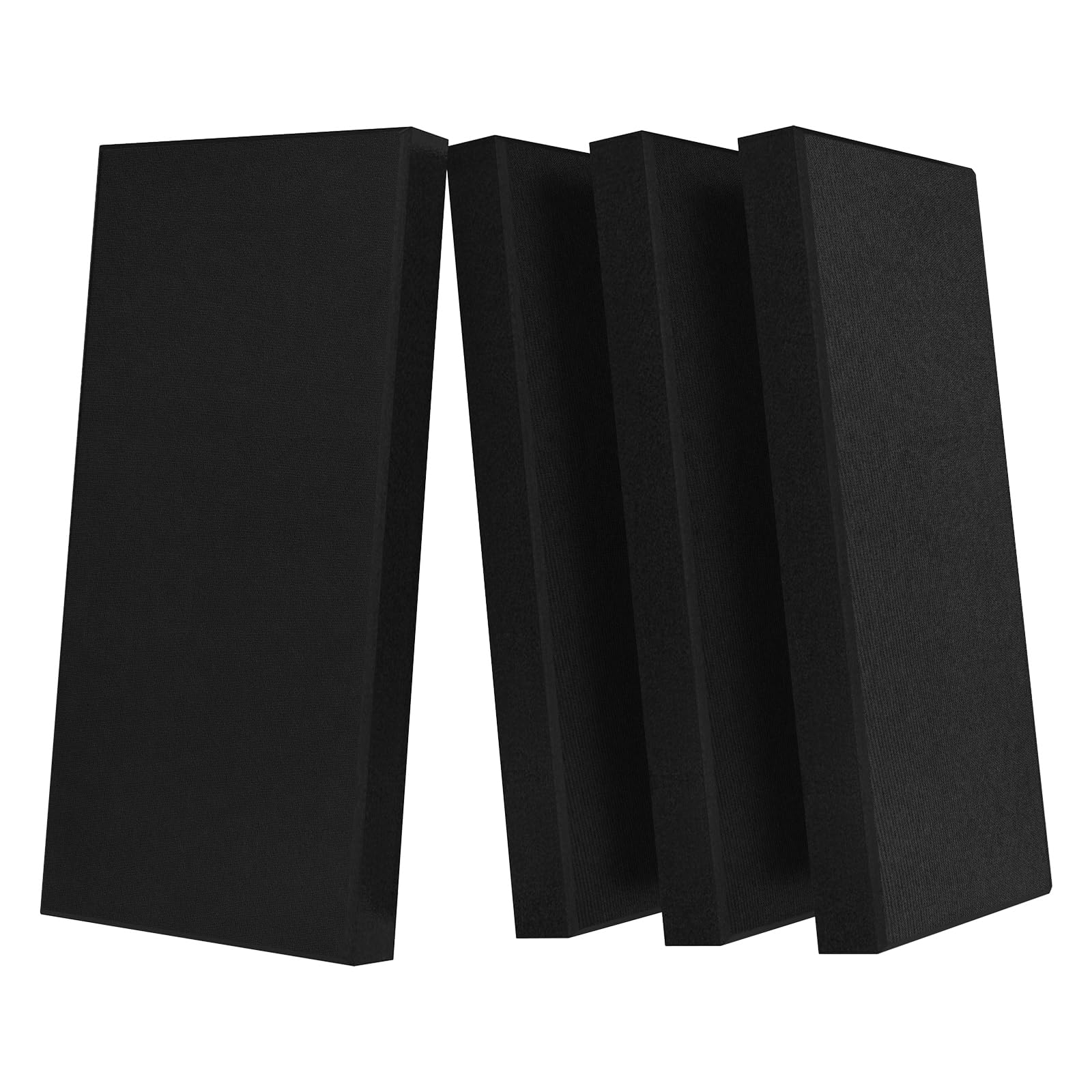
Fiberglass is the material serious studios pay for, because a compressed fiber core absorbs more across a wider range than plain foam. Here the core is 2 inches thick, wrapped in 100% polyester high-density fabric, with a white fiberglass inner layer carrying an E0 environmental rating. Fabrics and corners are crisp, and the panel is 23.6 inches square — a tidy framed-print size that looks at home on a home-office wall as much as in a booth. Four to a pack, and each one hangs on an included metal bracket rather than any adhesive.
What makes this the most “finished” pick is the mounting system. A paper template plus metal brackets mean you can level and space the panels cleanly, and one owner’s description of the install was that they “click into place” rather than sagging or peeling. Buyers who use these for mixing and mastering describe the absorption as consistent with competing 2-inch panels — high praise — and note how much reflection drops when you hang a full set around the workspace.
The trade-off is the hardware. The included screws and wall anchors are the weak link — several buyers swapped in their own, and the nub-and-bracket design is easier for wall mounting than ceiling mounting without a bit of DIY ingenuity. Budget a trip to the hardware store and you get a panel that looks purpose-built rather than improvised.
The studio-grade case
- 2-inch fiberglass core absorbs more than thin foam panels at the same size
- Metal bracket and template system means a clean, level, removable install
- Fabric-wrapped finish looks like professionally framed acoustic art
- E0-rated inner fiberglass with a white color that resists typical fiber shedding
The fine print
- Bundled screws and anchors are flimsy; plan to buy better ones
- Ceiling mounting needs a little improvisation since only wall hardware ships
For the perfectionist: a home-studio owner who wants panels that perform and look mounted on purpose — not taped to a wall.
The catch to accept: you may need to supply your own mounting hardware to get them level.
9. NeatiEase Wood Panels for Wall, 4-Piece 96″ x 12.6″ Soundproof Wood Slat Panel (Teak)

Nearly eight feet of slat wall that hides seams and swallows echo
Four panels, each 96 by 12.6 inches, covering about 33 square feet — that is a full floor-to-ceiling feature wall from one box, with no mid-wall splice to hide. The teak finish sits on a wood face over a high-density polyester felt backing, made from MDF and high-density fiber with low TVOC levels, and the material is listed as sourced from certified sustainable sources. It can be run horizontally or vertically and cut to any shape, which is the flexibility that makes slat walls popular for accent walls you want to look designed rather than purchased.
The slat format is also genuinely useful as acoustic treatment — the gaps between slats and the felt behind them break up sound reflections, which is why buyers notice the change in echoey rooms almost immediately. The panels go up with screws or superglue on either walls or ceilings, and the felt backing cuts cleanly without chipping, so trimming around light switches and outlets is manageable with a circular saw.
Two things worth knowing before you order. These are dense and weighty to work with, so this is a two-person, drill-in-hand job, not a solo afternoon — and the panels do carry their own material scent when new, which several owners noticed and expect to fade over time. Neither is a dealbreaker, but both shape how you plan the install.
The design payoff: real acoustic dampening wrapped in a wood finish nobody would guess is functional — a floor-to-ceiling wall in a single box.
Go for it if: you want a feature wall that both looks intentional and quietens an echoey living room or kitchen.
Weigh the logistics first: heavy panels and a fresh material smell mean an install to schedule, not rush.
Understanding the Specs
Panel thickness and what it absorbs
Thickness is the single number that tells you what a panel can realistically do. A 0.4-inch foam tile is thin and best at trimming the bright, high-frequency harshness that makes small voices sound brittle. Step up to a 2-inch panel and you are adding material depth that reaches more of the mid-range, which is the range a lot of echo and reverb lives in. If you have played with acoustic treatment before, the natural next question is always “what about bass?” — that is where even a 2-inch panel starts to struggle, and the honest answer is that no foam panel handles deep low-frequency sound the way a purpose-built bass trap does. Buy by the frequency range you need to control, not by the price of the pack.
Density, coverage, and adhesive
Density, measured in lb/ft³ or kg/m³, is how tightly the foam is packed: a denser panel holds its shape and absorbs more consistently than a soft, airy one. Cover is the other half of the story: one small pack of tiles treats a corner, while a 36-pack or 70-pack wraps a whole wall. Peel-and-stick backing is convenient but removable with effort — strong adhesive can lift paint, so a screw-in or bracket mount is better where you intend to rearrange. Also, most foam ships vacuum-compressed; budget a day or two to let it puff back to full size before you decide it looks thin.
FAQ
Do acoustic foam panels actually soundproof a room?
What thickness of panel do I need for a podcast or vocal booth?
How many square feet of panels do I need for a whole room?
Do I need adhesive or will the panel stick on its own?
Can acoustic panels help with loud neighbors in an apartment?
Are these panels safe to have in a bedroom or kids room?
Do I need to let foam panels expand before installing them?
Should I choose foam, fiberglass, or wood slat panels?
Can I cut these panels to fit around outlets and windows?
Will wall panels help my microphone recordings sound better?
Final Thoughts: The Verdict
For most rooms, the acoustic isolation winner is the Art3d 6-Pack Wood Slat Wall Panels because it does the two jobs that matter at once — it absorbs echo with a high-density polyester backing and covers about 31.5 square feet in a finish you would hang on purpose. If you want a wall that looks like felt and goes up with peel-and-stick simplicity, the TONOR Dual-Layer Panels are the apartment-friendly pick. And for a studio where the panels need to perform like equipment, the UMIACOUSTICS Fiberglass Panels with their 2-inch core and bracket mounting are the ones to reach for. Whichever you choose, match the thickness to the room: 0.4 inch for a subtle cleanup, 2 inches for a real transformation.
How We Picked
We do not accept paid placement. Every pick is matched to a real buyer and a real use-case; we do not hands-on test units.
Sources & Methodology
Specifications: manufacturer listings and product documentation. Review insights: verified customer reviews, as of September 2026. Pricing: not shown on this page (it changes often); check the current price via the retailer link.
As an Amazon Associate, KitchPrep earns from qualifying purchases. This does not affect which products we feature.
Related Guides
