
Specs are compiled from manufacturer listings and verified buyer reviews and can change over time — please confirm the key details on the product page before buying.
If you want the short answer: the Victorinox Fibrox Pro 8 Inch Chef’s Knife is the one to buy, because it stays sharp, keeps its grip when your hands are wet, and has the deepest well of happy owners in this whole group. Everything below is about matching a knife to your hands and your cooking, not chasing the fanciest-looking blade on the shelf.
I’m Mohammad Maruf — the founder and writer behind KitchPrep. This guide is built by comparing the manufacturers’ published specifications and the patterns across verified customer reviews, so you get each pick’s real strengths and trade-offs instead of marketing spin.
Each pick below gets judged on how it feels during a long prep session, how well it holds an edge, and how you are supposed to clean it. That is the whole job of this awesome chef knives shortlist, and every entry here earns its place on those terms alone.
Our Picks at a Glance

How To Choose The Best Awesome Chef Knives
A chef’s knife is the one blade you pick up more than any other, so getting this single purchase right changes how every meal you cook feels. The good news is that you do not need to spend a lot to get a knife that stays sharp and feels secure in your hand. You only need to know which three or four numbers actually matter and which ones are decoration.
Hardness, the number that decides how long the edge lasts
Blade hardness is measured on the Rockwell C scale, usually written as HRC, and it is the single best predictor of how long a knife holds its edge. A higher HRC means the steel resists rolling over and going dull, so you sharpen less often. The trade-off is that very hard steel is also more brittle, which is why the German blades here sit around 57 to 58 HRC and the Japanese-style blades push higher. Soft steel straightens easily on a honing rod; hard steel holds its bite but needs a lighter touch.
The edge angle, and why thinner cuts cleaner
Edge angle is how steeply the two sides of the blade meet to form the cutting edge, measured in degrees per side. A shallower angle, like the 8 to 12 degrees on the Japanese-style knives here, glides through onions and tomatoes with almost no pressure. A wider angle, like the 15 degrees per side on the German knives, is sturdier and survives more abuse. Neither is better on its own; the shallow edge feels sharper while it lasts, and the wider edge forgives more mistakes.
Stamped or forged, and what it means for your wrist
A stamped blade is cut from a sheet of steel, which keeps weight down and cost low, while a forged blade is shaped from a single heated block, which adds heft and a fuller bolster. Lighter knives cause less hand fatigue over a long prep session, but heavier ones feel steadier when you push through something dense. If you cook for an hour at a time, weight matters more than you think.
Handle material and grip when your hands are wet
Your handle decides whether the knife feels safe. A textured synthetic grip holds tight even when your hands are greasy or soapy, while smooth resin or polished wood can turn slick the moment they get wet. Look at how the handle meets the blade too, because a smooth, snag-free transition means less food catching in the crevice and easier cleaning.
Cleaning rules you should not ignore
Most high-carbon blades here are built to be washed by hand and dried right away. Heat and prolonged moisture from a dishwasher can dull the edge and stain the steel, so a knife that says it is dishwasher safe is the exception rather than the rule. A quick hand wash with warm water and mild soap, followed by a full dry, keeps any of these blades in shape.
Quick Comparison
| Model | Best For | Blade | Construction | Handle | Amazon |
|---|---|---|---|---|---|
| Victorinox Fibrox Pro 8 Inch Chef’s Knife★ Best Overall | All-round daily cooking | 8 in stainless steel | Stamped | TPE non-slip | Amazon |
| ZWILLING Professional S 8-inch Chef’s KnifePro Pick | Serious home cooks | 8 in carbon steel | Forged | Polymer, three rivet | Amazon |
| Dalstrong Valhalla Series 8 inch Chef KnifeShowpiece Pick | Showpiece and gifting | 8 in high carbon steel | Forged | Resin and stabilized wood | Amazon |
| Miyabi Kaizen 8-Inch Chef’s Knife | Precision produce work | 8 in VG10 steel | Forged | Micarta | Amazon |
| Wüsthof Classic Ikon 8″ Chef’s Knife | Everyday heavy prep | 8 in high carbon stainless | Forged | Resilient synthetic | Amazon |
| KYOKU Shogun Series Japanese Chef Knife | Japanese edge on a budget | 8 in VG10 Damascus | Forged | G10 fiberglass | Amazon |
| KEEMAKE 8″ Chef Knife | Long prep sessions | 8 in high carbon stainless | Forged | Pakkawood | Amazon |
| HENCKELS Forged Accent 8-inch Chef’s Knife | Forged steel on a modest budget | 8 in German stainless | Forged | Stainless steel | Amazon |
| Mercer Culinary Millennia Colors Chef’s Knife | Beginner and backup blade | 8 in high carbon steel | Stamped | Santoprene | Amazon |
In‑Depth Reviews
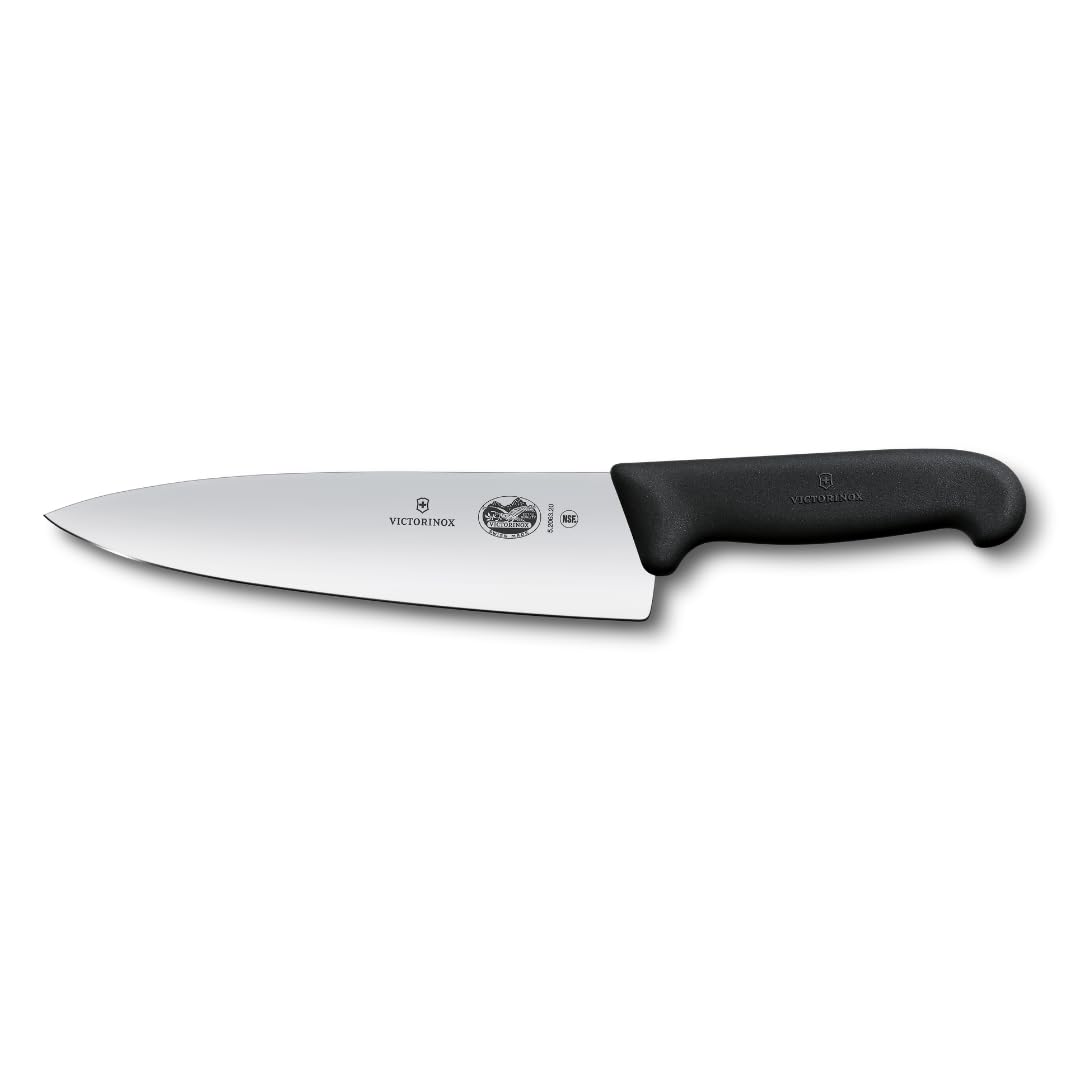
1. Victorinox Fibrox Pro 8 Inch Chef’s Knife, Dishwasher Safe, Black
Our pick — over 4.5★ from 14,500+ verified ratings; the strongest balance of quality and price.
A stamped stainless blade that stays sharp and grippy for the price of a week of groceries
The Fibrox Pro is the pick for anyone who cooks most nights and wants one knife that disappears into the work. Its 8-inch blade is stamped from stainless steel rather than forged, which is exactly why it weighs just 22.68 g and why your wrist is still fresh after an hour of onions. That light build is the whole point: a knife you barely notice is a knife you reach for without thinking.
What wins people over here is the sheer weight of approval behind it — this is the crowd favorite by a wide margin, and the reason is boring in the best way. It simply does what a chef’s knife should, cut after cut, year after year, and it keeps doing it for a price that feels almost too low for Swiss steel. Buyers report the same story over and over: razor-sharp straight from the start with no hand fatigue, and a handle that feels natural the moment you pick it up.
The handle is where this knife quietly earns its keep. It is made from a rubbery thermoplastic elastomer, a synthetic grip material that stays tacky in your hand even when it is wet or greasy, so a slippery chicken breast is not a hazard. The 8-inch blade slices through overripe tomatoes and raw meat alike without squashing them, and the taper means you can switch from dicing to chiffonade without changing your grip. It is also dishwasher safe, which almost none of the harder, fancier blades on this list are.
Where this knife shines
- Stays grippy when your hands are wet or oily, thanks to the textured TPE handle
- Light at 22.68 g, so long prep sessions do not leave your hand aching
- Genuinely dishwasher safe, unlike the high-carbon steel blades further down this list
What to keep in mind
- A stamped blade, so it lacks the heavier heft some cooks prefer when powering through squash
- The utilitarian black look is not a showpiece for a knife rack or a gift box
Buy this if: you cook daily and want one reliable knife that asks nothing of you.
Look elsewhere if: you want a forged blade with visible heft and a handle that turns heads.
2. ZWILLING Professional S 8-inch Razor-Sharp German Chef’s Knife
Forged German steel with the kind of heft that makes dense vegetables give up quietly
This is the knife for the cook who has outgrown a starter blade and wants the real thing. The Professional S is forged from a single piece of solid steel rather than stamped from a sheet, so it carries real weight in the hand and a full bolster between your fingers and the edge. That construction is why it feels planted on the board when you are breaking down a chicken or pushing through a butternut squash.
Your money goes into the engineering. The blade is ice-hardened and rated at 57 Rockwell hardness (a measure of how well steel resists dulling), so it holds its edge through a long stretch of cooking before it needs attention. Zwillings hones the edge to 15 degrees per side, a wider angle than the Japanese-style knives later on this list, and that trade is deliberate — a stouter edge shrugs off contact with a cutting board where a thinner one might chip. It is also dishwasher safe, an unusual luxury for a forged blade in this group.
The knife is also built to be used, not admired. Its weight sits at 277 g, which is substantial without being clumsy once you find the pinch grip, and the three-rivet polymer handle is bonded to the full tang so it stays tight over years of washing. Compare the construction to the KEEMAKE forged blade further down, which runs a harder 58 HRC edge for a sharper bite but asks for hand washing to stay in condition. The Zwilling asks for less fuss and rewards you with consistency.
It does come with a caveat worth knowing before you commit. The Professional S carries a heavier, more old-world feel than the featherweight stamped blades up top, so if light and nimble is what you love about a knife, this one will feel like a different sport.
The forged advantage: a single piece of ice-hardened steel at 57 Rockwell hardness means this blade carries its weight where it counts and holds an edge through long sessions.
An honest trade: it is the heaviest and most expensive knife in the mid-range group here, so it rewards cooks who value substance over speed.
Made for: the home cook who wants a single forged German knife to keep for years.
Think twice if: you want something light and forgettable in the hand.
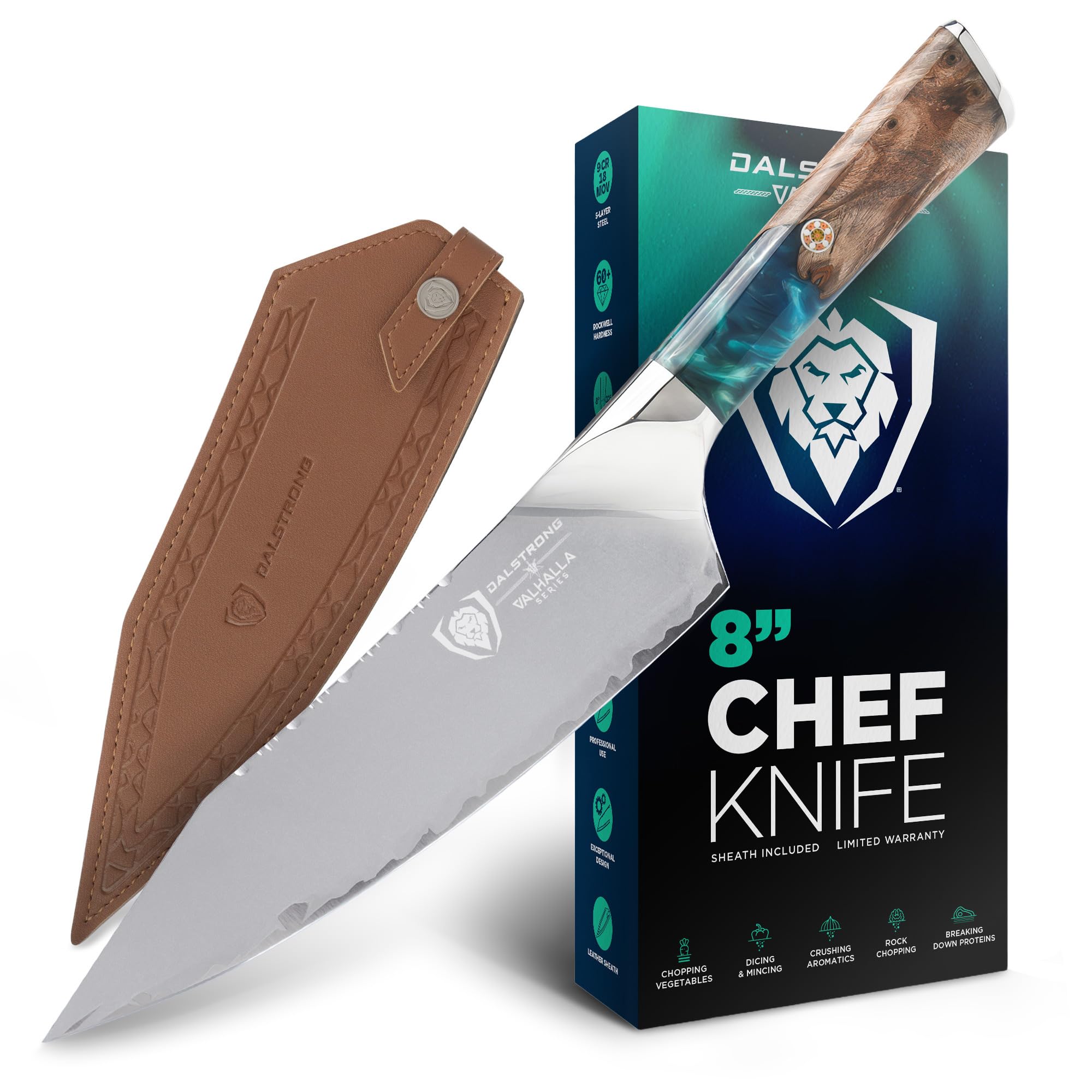
3. Dalstrong Chef Knife – 8 inch – Valhalla Series
A 60+ HRC forged blade with a resin-and-wood handle that looks as sharp as it cuts
The Valhalla Series is what you buy when the knife is part tool, part centerpiece. Forged from a single piece of high carbon steel and tempered past 60 Rockwell hardness (a measure of how well steel resists dulling), it holds an edge impressively well, and the hand-sharpened 8 to 12 degree bevel means it bites into a tomato without a whisper of pressure. It comes with a leather sheath and gift-ready packaging, so it doubles as a present for someone who loves to cook.
Then there is the handle, and honestly it is the reason half the people click buy. The celestial resin is reinforced with stabilized wood and capped by a stainless steel bolster, giving it a swirling, layered look that photographs beautifully and feels solid in hand. The one thing owners rave about most is the way the knife looks sitting on the board — it is a genuine conversation piece. The profile is also a good fit for large hands, with the generous knuckle clearance that big-handed cooks tend to need.
The trade-off is weight and the handle material. At 1.8 pounds the Valhalla is heavy in the hand, and a couple of cooks find the balance sits toward the handle rather than the blade tip. Resin-and-wood handles also need more care than a plain synthetic grip; they do not love being left wet in a sink, so dry the knife properly after every wash. It is not the knife to leave lying in a puddle overnight.
Why it stands out
- Hardened past 60 Rockwell, so the edge holds through heavy use
- Hand-sharpened 8 to 12 degree bevel cuts with barely any pressure
- Comes with a leather sheath and gift-ready packaging
The trade-offs
- Heavy at 1.8 pounds, and heavier toward the handle than some cooks prefer
- The resin and wood handle needs drying after each wash, not a soak-and-forget
Pick it for: looks, heft, and giving a cook something they will actually show off.
skip it if: you want a light, low-maintenance knife you can leave wet in the sink.
4. Miyabi Kaizen 8-Inch Chef’s Knife

A 9.5 to 12 degree VG10 edge that drops through tomatoes without crushing the skin
The Kaizen is the knife for the cook who cares about the cut itself. Its VG10 steel core is ice-hardened to Rockwell 60 (a measure of how well steel resists dulling), a notably hard blade that keeps its biting edge for a long time, and it is wrapped in 65 layers of a flower Damascus pattern that is real layered steel, not an etched picture. The blade is hand-honed using the traditional three-step Honbazuke process to a 9.5 to 12 degree edge, which is a shallower angle than the German knives here and the reason it glides instead of pushes.
That thin, hard edge is what makes it feel different on the board. It drops through a banana with no pressure, slices a tomato skin without crushing it, and cuts raw beets without demanding brute force. The Micarta handle, a layered linen composite with a D-shaped profile and a mosaic pin, grips well even when your hands are wet, and it balances across the blade rather than the handle. If clean, precise cuts are the reason you cook, this is the pick that delivers them.
The one thing to understand is that a blade this hard and this thin is delicate in the way a fine tool is delicate. The trade-off of high Rockwell steel is brittleness, and this edge will chip if you twist it in a hard food or leave it knocking against the sink. It is not dishwasher safe, and it wants to be dried fully after washing, not left to air-dry. Treat it like the precision instrument it is and it stays razor-sharp for a very long time; treat it like a beater and it will complain.
Its length also stands out against its stablemates here. At 14.75 inches overall the Kaizen runs longer than the KYOKU Shogun at 13.2 inches, so if you work on a big cutting board the extra reach is genuinely useful.
The precision case: a Rockwell 60 VG10 core wrapped in real layered Damascus, honed to a 9.5 to 12 degree edge for a glide-through cut.
The honest caveat: that hardness and thinness demand hand washing and careful handling, because the edge is not built to shrug off twists or dishwashers.
Best matched to: a cook who treasures clean cuts and will treat a blade with respect.
Not the one for: anyone who wants a toss-it-in-the-dishwasher knife they can abuse.
5. Wüsthof Classic Ikon 8″ Chef’s Knife
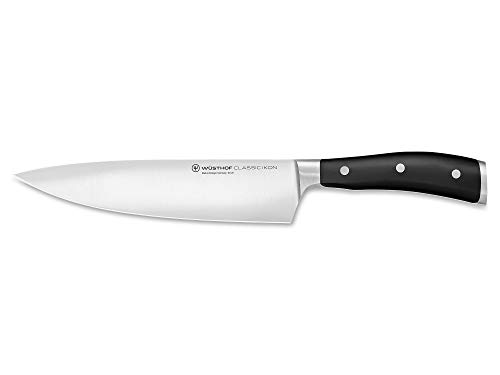
A 58 HRC forged German blade with a double bolster that stays planted through heavy prep
The Classic Ikon is for the cook who wants a knife that will outlast nearly everything else in the drawer. Forged from a single block of high carbon stainless steel and tempered to 58 Rockwell hardness, it has a sturdy, planted feel in the hand that the light stamped blades up top simply cannot match. Wüsthof applies its Precision Edge Technology, which the brand describes as producing a blade that is 20% sharper with twice the edge retention than its previous models.
The distinctive double bolster is the signature detail, adding weight and a protective shoulder at both ends of the handle. Around the family dinner table this knife minces garlic in one pass, chops a watermelon without straining, and breaks down a whole chicken cleanly. Cooks appreciate the partial bolster specifically because it eases sharpening later, since a full bolster tends to grind against a whetstone. That is the kind of detail that only matters to someone who plans to own a knife for a decade.
The classic trade-off here is weight and price. At 9.6 ounces it is heavier than the Miyabi and the Valhalla, so it rewards a confident pinch grip and punishes a delicate touch. It is also the kind of purchase you make once and then keep forever, which is either reassuring or a big enough step up in cost that it gives some cooks pause. If you want a lighter everyday driver, the KEEMAKE further down runs 8.48 ounces and costs a fraction of the price.
Why cooks keep it: forged to 58 Rockwell with a partial bolster that makes later sharpening easier and less damaging.
The honest trade: 9.6 ounces is real weight, so this is a knife for cooks who like heft rather than a featherlight feel.
A fit for: cooks who plan to own one chef’s knife for many years and like a substantial handle.
Not for: anyone who wants something light, cheap, and disposable.
6. KYOKU Chef Knife – 8″ Shogun Series Japanese Style VG10 Steel

A 67-layer Damascus VG10 blade at roughly half the price of the Miyabi
If you want the look and bite of Japanese steel without the premium ticket, the Shogun Series is the compromise that actually works. Its VG10 steel core is made in Japan and rated 58 to 60 HRC, and it is wrapped in 67 layers of Damascus for that rippling, wave-like pattern you notice the moment you unbox it. The core is cryogenically treated, a cooling process that helps the steel hold its structure, and the blade is sharpened to an 8 to 12 degree edge using the traditional three-step Honbazuke method.
The feel matches the look. The fiberglass handle is balanced so the knife sits evenly in your hand and works through long chopping without cramping, and the included sheath and case let you store it safely between uses. It comes in sturdy, gift-ready packaging, which is why it keeps showing up as a present. Against the flagship Miyabi, which also runs a VG10 core at a higher level of finish, this gets you into similar territory for much less.
There is one honest catch worth knowing. The handle is slick when wet, so if you are the kind of cook who washes vegetables and immediately keeps chopping, keep a towel nearby. Some cooks also find the overall weight too heavy if they tend to reach for a lighter blade. For the price, though, the layered steel and the honed edge are a genuinely remarkable amount of knife.
What you are getting
- 67-layer Damascus over a Japanese VG10 core rated 58 to 60 HRC
- Hand-honed to an 8 to 12 degree edge with the traditional Honbazuke method
- Fiberglass handle with mosaic pin, plus a sheath and case included
Worth knowing first
- The handle turns slick when your hands are wet, so keep a towel close at hand
- On the heavy side for cooks who prefer a lighter blade for quick work
Grab one if: you want a layered Japanese blade that looks and cuts well without a premium price.
Leave it if: you need a knife that stays grippy when your hands are completely soaked.
7. KEEMAKE 8″ Chef Knife, Ultra Sharp Kitchen Knife with Ergonomic Handle
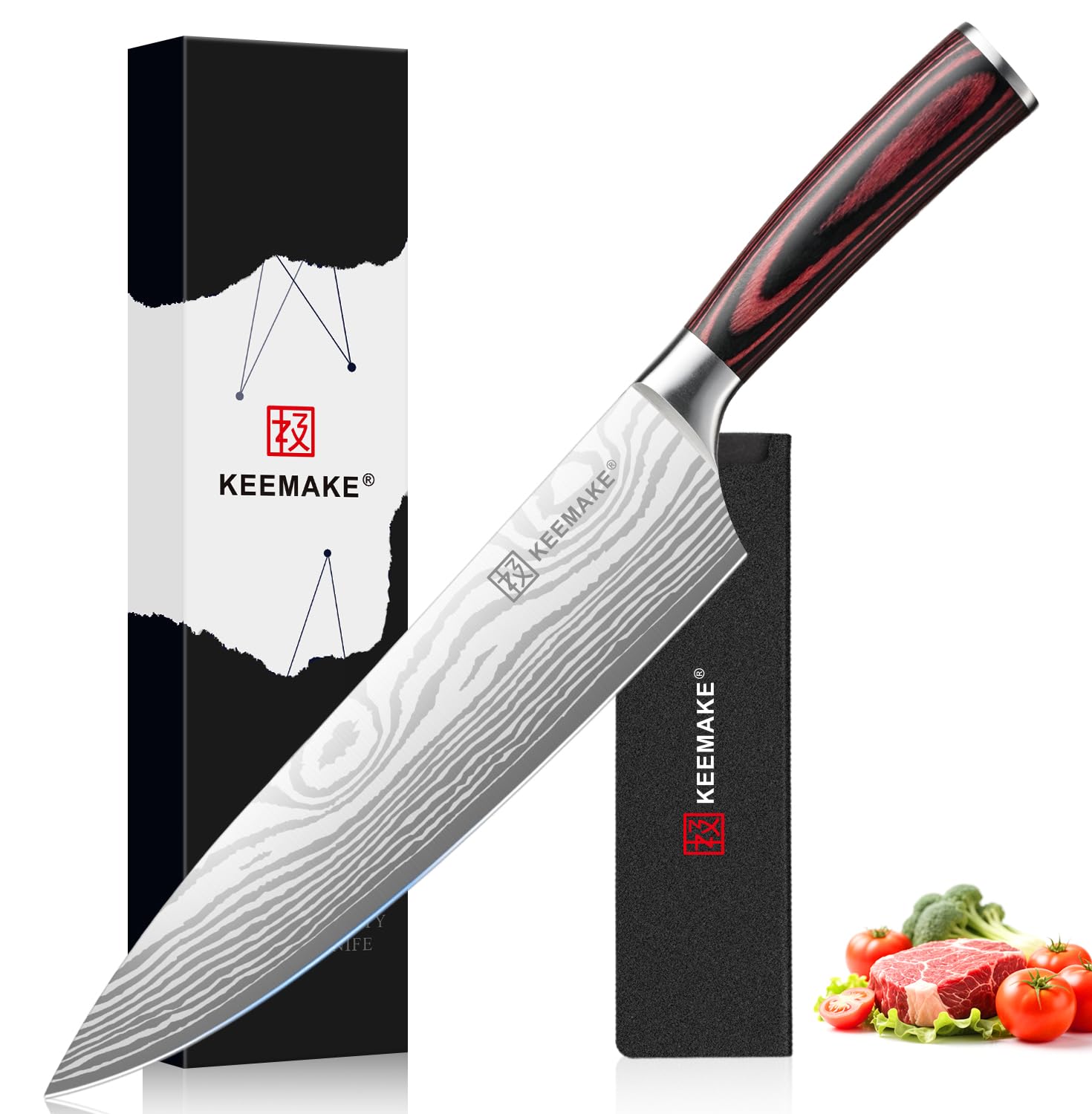
A 58 HRC forged blade at 8.48 ounces with a curved Pakkawood handle for long prep sessions
The KEEMAKE is aimed squarely at long prep sessions, and it takes that job seriously. Its blade is forged from 1.4116 high carbon stainless steel hardened to 58±2 HRC (a measure of how well steel resists dulling), which holds a sharp edge well, and it is hand-sharpened to an 8 to 12 degree bevel on each side so it slips through ripe tomatoes, cooked brisket, and even partially frozen meat without forcing. At 8.48 ounces it sits noticeably lighter than the Wüsthof at 9.6 ounces, which matters when you are chopping for an hour.
The handle is the real story. A curved Pakkawood grip with a sloped bolster lets you settle into a pinch grip that keeps your wrist relaxed, and the whole design is meant to cut down on fatigue during holiday cooking or a big Sunday meal-prep run. Owners keep coming back to the same theme: the knife feels reassuringly balanced, and the secure hold means you are not white-knuckling the handle. For a forged blade, it is also priced to make you feel smart — one buyer even reported picking it up after finding a nearly identical knife at a much higher figure elsewhere.
Its one catch is care. The high-carbon steel rewards a quick hand wash and a thorough dry rather than a dishwasher cycle, and if you want a knife you can just toss in the top rack, the Victorinox up top is the better answer. Treat it well and this is a forgiving, capable everyday blade at a price that is hard to argue with.
The fatigue-free build: a forged 58±2 HRC blade at 8.48 ounces with a curved Pakkawood handle designed around a relaxed pinch grip.
The one catch: high-carbon steel means hand wash and dry, not a dishwasher, if you want it to last.
A smart buy for: big prep days and cooks who want a forged blade without a big outlay.
Think again if: you refuse to hand wash your knives.
8. HENCKELS Forged Accent Razor-Sharp 8-inch Chef’s Knife, Black

A forged German stainless blade with a full bolster and triple-riveted handle at a budget price
The Forged Accent is what you buy when you want the substance of a forged knife without moving all the way up to the premium tier. The blade is fabricated from German stainless steel and honed for long-lasting sharpness, and the forged bolster creates a smooth transition from blade to handle with solid balance. That full-bolster construction, plus the triple-riveted handle with a stainless-steel endcap, gives it a sturdier feel than its mid-level position might suggest.
In the hand it reads exactly as a good everyday knife should. It is well balanced and comfortable to hold, and it slices cleanly through vegetables and proteins without fuss. It is dishwasher safe, though the maker recommends hand washing, which is the sensible middle ground: forgiving if you are in a rush, better if you are not. For a German-engineered blade it is a straightforward, honest piece of kitchen equipment that does not ask you to baby it.
This is not a knife without quirks. A few owners note that the blade is not perfectly straight from the start, though the same reports confirm it still holds an edge and the grip alone is worth keeping. If you are chasing mirror-perfect Japanese fit and finish, this is not that knife. If you want a solid, forged, dishwasher-safe blade that just works, it delivers.
Reach for this if: you want a forged German steel knife with a comfortable grip at a friendly price.
Look past it if: you demand flawless cosmetic finishing straight from the start.
9. Mercer Culinary Millennia Colors Chef’s Knife, 8-Inch, Green

A 6.8-ounce stamped blade with a textured Santoprene grip that stays put when wet
If you are just learning to cook and do not want to spend much on your first real chef’s knife, the Millennia is the obvious place to start. Its blade is crafted from a single piece of high-carbon Japanese steel, which keeps the edge easy to maintain, and it is stamped rather than forged, so it stays light at 6.8 ounces. Beginners and seasoned cooks alike find it sharp and easy to handle, and the textured finger points on the Santoprene handle give you a non-slip grip that feels safe even when everything on the counter is wet.
What makes it a genuinely smart buy is how much knife you get for the price. The green handle is colour-coded for produce, which is a small but handy way to keep it straight in a busy kitchen, and the edge holds up well with regular upkeep — one long-time cook reported it holding its edge excellently after four months on a 1k and 5k stone. It cuts a potato like butter and resharpens easily when it needs to. For someone building confidence at the board, that is exactly what you want.
The honest limits are about care and durability. This is a stamped blade with a thinner tip, and a few owners note it can bend if it is dropped or knocked around, though the same cooks say it takes a new edge without much trouble. It is also hand wash only, and the maker warns against leaving it submerged for long periods. Treat it as the dependable workhorse it is meant to be and it delivers far above its price.
Why beginners love it
- Light at 6.8 ounces with a textured Santoprene grip that stays put when wet
- Sharp from the start and resharpens easily, so it is forgiving to maintain
- Colour-coded green handle makes it easy to keep straight among other tools
Where it asks for care
- The thinner tip can bend if the knife gets dropped or knocked around
- Hand wash only, and the maker warns against long soaking
Ideal for: first-knife buyers and anyone who wants a light, affordable daily blade.
Not the one for: cooks who expect a forged, heavy handle and a lifetime of abuse.
Understanding the Specs
Rockwell hardness (HRC)
Rockwell hardness is a score for how hard a blade’s steel is, and it is the best clue to how long an edge will last before you have to sharpen it. Higher numbers, like the 60 on the Miyabi and the 60+ on the Dalstrong Valhalla, mean the steel resists dulling for longer. The catch is that harder steel is also more brittle, which is why those blades want hand washing and careful handling. Lower numbers, like the 57 on the Zwilling, trade a little edge-holding for steel that rolls with a knock instead of chipping.
Edge angle (degrees per side)
Edge angle is how steeply the two faces of the blade taper to the cutting edge, measured in degrees per side. A shallower angle, like the 8 to 12 degrees on the KEEMAKE, KYOKU, and Dalstrong, slips through onions and tomatoes with almost no pressure because there is less material to push aside. A wider angle, like the 15 degrees per side on the Zwilling, leaves a thicker edge that stands up better to rough contact with a board. Neither wins outright; shallow feels sharper, wider lasts longer against careless use.
Stamped vs forged construction
A stamped blade is cut from a flat sheet of steel and then ground into shape, which keeps it light and inexpensive, exactly like the Victorinox and the Mercer at 22.68 g and 6.8 ounces. A forged blade is shaped from a single heated block, giving it more weight, a full bolster, and a sturdier feel, as with the Zwilling, Wüsthof, and Keemake. For a long prep session, the lighter stamped blade is easier on your wrist, while a forged blade feels steadier when you push through something dense.
Handle material and grip
Handle material decides how safe a knife feels once your hands are greasy or wet. Textured synthetic grips, like the thermoplastic elastomer on the Victorinox and the Santoprene on the Mercer, stay tacky and secure. Pakkawood and Micarta, used on the KEEMAKE and Miyabi, offer a firm hold with a warmer look but want drying after washing. Smooth resin and wood, like on the Dalstrong, look best but turn slickest when wet, so they demand the most care.
FAQ
Is an 8-inch chef’s knife the right size for a home kitchen?
Which is better for vegetables, a Japanese or a German style blade?
Can I put a high-carbon chef’s knife in the dishwasher?
How long should a chef’s knife stay sharp before I need to sharpen it?
What does the Rockwell hardness number actually mean for my cooking?
Does a forged knife really cut better than a stamped one?
Is Damascus steel on a chef’s knife just decoration or does it matter?
How do I keep a wooden or resin handle looking good over time?
What should I look for in a first chef’s knife?
Will a heavier chef’s knife help me cut through tough foods?
Final Thoughts: The Verdict
For most people, the right awesome chef knives choice is the Victorinox Fibrox Pro 8 Inch Chef’s Knife, because it pairs a non-slip TPE grip and a light stamped blade with the kind of owner satisfaction that keeps it at the top of this list. If you want a forged German blade with real heft for serious everyday prep, grab the ZWILLING Professional S 8-inch Chef’s Knife. And if a razor-thin Japanese edge for precision produce work is what you are after, the Miyabi Kaizen 8-Inch Chef’s Knife is the one to reach for — just treat it like the precision tool it is and hand wash it every time.
How We Picked
We do not accept paid placement. Every pick is matched to a real buyer and a real use-case; we do not hands-on test units.
Sources & Methodology
Specifications: manufacturer listings and product documentation. Review insights: verified customer reviews, as of September 2026. Pricing: not shown on this page (it changes often); check the current price via the retailer link.
As an Amazon Associate, KitchPrep earns from qualifying purchases. This does not affect which products we feature.
Related Guides
