
Specs are compiled from manufacturer listings and verified buyer reviews and can change over time — please confirm the key details on the product page before buying.
If your goal is to keep the fridge cold and the Wi-Fi alive during an outage without hauling gasoline or listening to a pull-cord engine, a battery-based generator is the answer. These units store electricity in a battery and push it back out through normal wall-style outlets. The catch most buyers learn too late is that capacity in watt-hours sets how long everything runs, while rated watts set what you can actually plug in at once. Mismatch watt-hours to your runtime and watts to your appliance’s startup draw, and the fridge goes warm on night one.
I’m Mohammad Maruf — the founder and writer behind KitchPrep. This guide is built by comparing the manufacturers’ published specifications and the patterns across verified customer reviews, so you get each pick’s real strengths and trade-offs instead of marketing spin.
You do not need to be an electrician to get this right. The two numbers that matter most are capacity and output, and the table below lines them up side by side so you can spot the trade-offs in seconds. That is exactly how to shop for the best battery-based generator without wasting money on the wrong size.
Our Picks at a Glance

How To Choose The Best Battery-Based Generator
Buying one of these is really two decisions: how much energy you need to store, and how much power you need to push out at once. The energy figure is measured in watt-hours (Wh) — think of it as the size of the fuel tank. The power figure is measured in watts (W) — think of it as how wide the pipe is when you open the tap. A 3,000Wh station with a 1,000W inverter still cannot start a window air conditioner.
Capacity in watt-hours sets your runtime
To keep your fridge running, match watt-hours (a measure of stored energy) to what you need. Judge any unit by its stated fridge runtime in hours, not by a vague claim. A fridge cycles on and off, so it draws far less than its rating most of the time. A longer stated fridge runtime means fewer recharges during an outage.
Rated watts and surge watts set what you can plug in
Rated watts is the steady power the unit can deliver — the number your microwave, coffee maker, or space heater has to fit under. Surge watts covers the brief spike when a motor or compressor first kicks on, which is why appliances like fridges and A/C units need headroom above their label rating. If a unit lists both a rated and a surge figure, the gap between them is your safety margin for startup.
Battery chemistry decides how long it lasts
Almost everything worth buying here now uses LiFePO4 (lithium iron phosphate) cells, which are the longer-lived, more heat-tolerant lithium chemistry. Instead of raw years, look for cycle life — each cycle is one full charge and discharge. A unit rated for thousands of cycles at a stated retained capacity is the honest durability signal, so a higher cycle count matters more than a marketing sentence about lifespan.
Recharge speed and solar input decide where you can use it
Recharge speed matters most during a storm you can see coming; a unit that refills fast from a wall outlet gives you less waiting and less planning. Solar input matters if you will be off-grid for days, and here the maximum solar wattage the unit accepts is the number to watch — a low ceiling means even large panels fill it slowly.
Quick Comparison
| Model | Best For | Capacity (Wh) | Rated Output (W) | Weight | Amazon |
|---|---|---|---|---|---|
| Anker SOLIX C2000 Gen 2★ Best Overall | Fridge backup that recharges in under an hour | 2,048Wh (expandable to 4kWh) | 2,400W (4,000W peak) | 41.7 lb | Amazon |
| EF ECOFLOW DELTA 3 MaxTop Performer | Running 99% of home appliances on X-Boost | 2048Wh LFP | 2400W (3400W X-Boost) | — | Amazon |
| BLUETTI Elite 200 V2Longest Lifespan | Long cycle life with big appliance headroom | 2073.6Wh | 2600W (3900W lifting) | 53.4 lb | Amazon |
| BLUETTI Elite 100 V2 | One-handed carry and quick top-ups | 1024Wh | 1800W (2700W lifting) | 25 lb | Amazon |
| ABOK Ark3600 | Wheeled home backup, expandable to 11520Wh | 3840Wh (expandable to 11520Wh) | 3600W (4500W peak) | 92 lb | Amazon |
| Jackery Explorer 2000 v2 | Light 2kWh unit for camping and outages | 2042Wh | 2200W | 39.5 lb | Amazon |
| Jackery HomePower 3000 | Whole-home essentials with a TT-30 RV port | 3072Wh | 3600W (7200W surge) | 59.5 lb | Amazon |
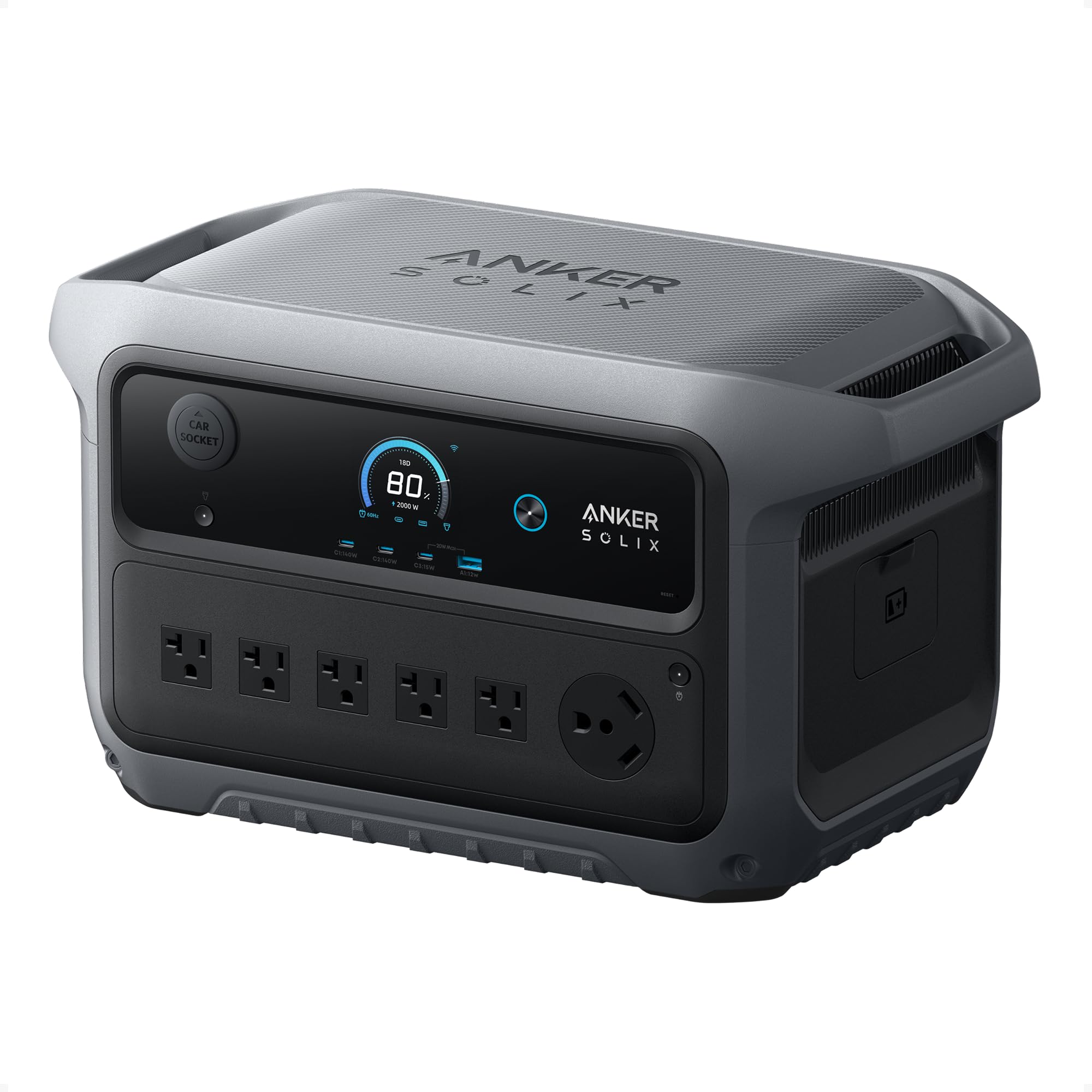
| Anker SOLIX F3000 | 240V pairing and generator pass-through power | 3,072Wh (expandable to 24kWh) | 3,600W pass-through | 91.5 lb | Amazon |
| PECRON F3000LFP | Cascading batteries for multi-day home backup | 3072Wh (expandable to 10752Wh) | 3600W | 63.3 lb | Amazon |
| AFERIY P210 | 16-device capacity at a budget-friendly tier | 2048Wh | 2400W (4800W surge) | 54 lb | Amazon |
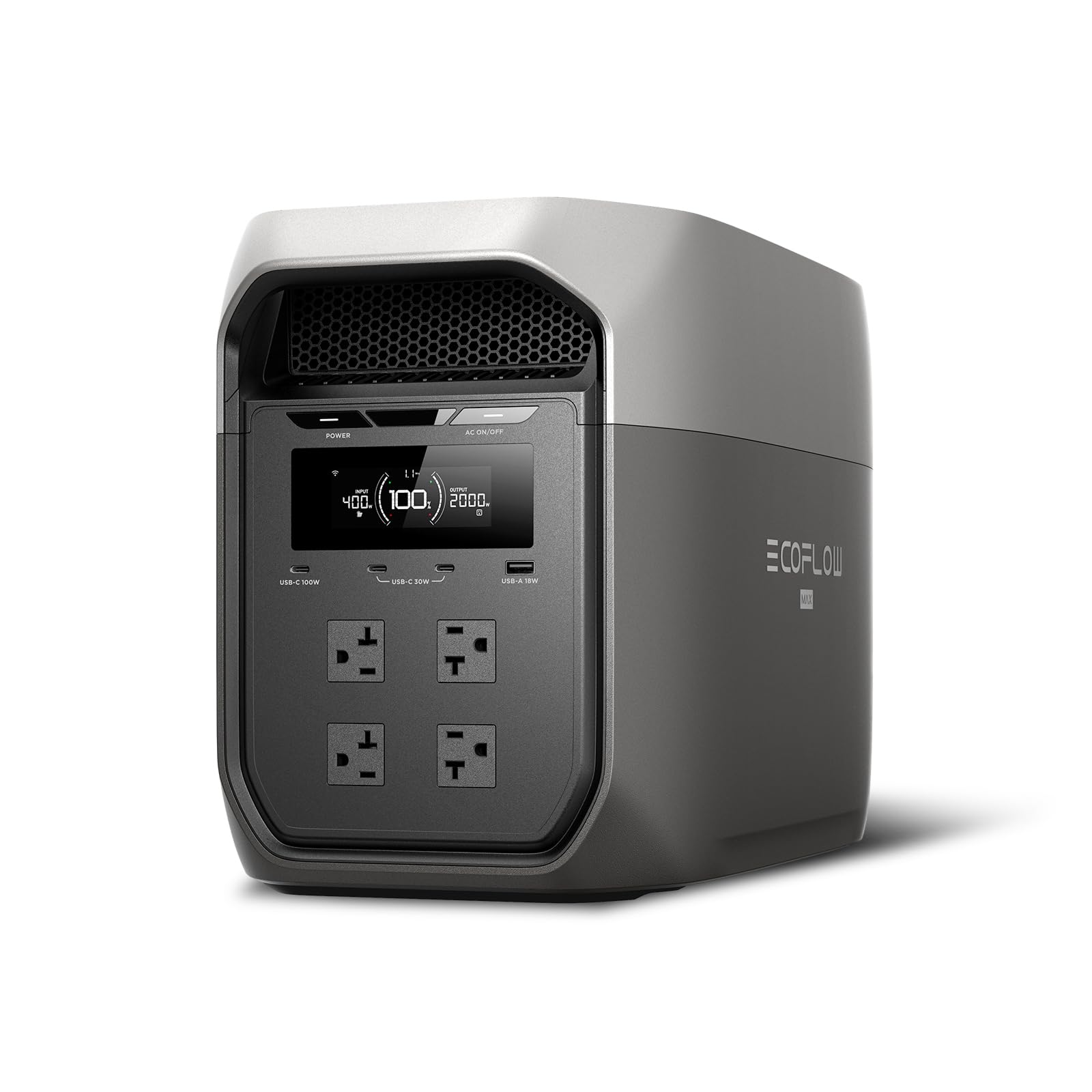
| EF ECOFLOW DELTA Pro | Top-tier expandable home backup | 3600Wh (expandable to 25kWh) | 3600W (4500W X-Boost) | 99 lb | Amazon |
In‑Depth Reviews
1. Anker SOLIX C2000 Gen 2 Portable Power Station, 2,048Wh, 2,400W, Camping
Our pick — over 4.5★ from 650+ verified ratings; the strongest balance of quality and price.
Stores enough to run a dual-door fridge for a day, then refills before dinner.
This is the pick to beat because it nails the two numbers that matter. It holds 2,048Wh and can run a dual-door fridge for up to 32 hours, so a storm-day fridge stays cold while you decide what to do about dinner. Standby drain is only 9W, which is the power it sips while on but doing nothing — a tiny leak instead of a steady bleed. Add an expansion battery and capacity climbs to 4kWh, doubling that fridge runtime to up to 64 hours.
Recharging is where it pulls ahead of the AFERIY P210 and the smaller BLUETTI Elite 100 V2. On AC and solar combined it reaches 100% in 58 minutes, while the BLUETTI Elite 100 V2 needs about 70 minutes for the same job. The 4,000W peak figure is the brief spike it can survive, which is why it handles most window and RV A/Cs at startup even though its steady rating is 2,400W. Output covers 2,400W rated, and it can top itself up in three hours from a car with 800W alternator charging.
Portability is the pleasant surprise. At 41.7 lb it is one of the lighter 2kWh-class units here — the AFERIY P210 sits at 54 lb and the BLUETTI Elite 200 V2 at 53.4 lb. As owners put it: “Used weekly for remote karaoke/outdoor events: drops to ~70% after 4hrs.” That matches the real-world feel: several hours of entertainment gear costs you a slice of capacity, not the whole pack. The recurring gripe is the app’s usage estimates, which read confidently but do not always match reality, so trust the battery percentage, not the projection.
Where it earns its keep
- 2,048Wh runs a dual-door fridge up to 32 hours; expansion battery pushes that to 4kWh and up to 64 hours
- 58-minute full AC-plus-solar recharge is the fastest 1kWh-class refill in this lineup
- 41.7 lb and 18.1 × 9.8 × 10.1″ — noticeably lighter and smaller than the 2kWh competition
- 9W standby draw means it barely bleeds power sitting ready for an outage
What to plan around
- Real buyers report the app’s runtime estimates can be optimistic, so run to the percentage instead
- 2,400W rated output will not carry a small A/C indefinitely — reviews describe roughly two-hour runs on that load
Reach for it if: you want the single strongest all-rounder for fridge backup and campsite power, with the fastest recharge here and weight you can actually lift.
Look elsewhere if: you need a unit light enough for one-handed carrying in and out of a vehicle every week — the 41.7 lb is manageable, not featherweight.
2. EF ECOFLOW DELTA 3 Max Portable Power Station, 2048Wh LFP Battery, 2400W
The everyday-outlet cheater that runs appliances their labels say it cannot.
X-Boost is the headline here. Instead of a straight 2400W ceiling, this unit pushes up to 3400W continuous in X-Boost mode, which is how it claims to run appliances you would normally assume are out of reach. That is measured against the Anker SOLIX C2000 Gen 2’s 2,400W rated output — a real, usable gap if you want to run a hair dryer or a shop vacuum without checking the label first. The 2048Wh LFP battery matches the Anker for stored energy, so pick between them on ports and output ceilings, not capacity.
Charging is where the DELTA 3 Max leads its own class: 0–80% in 1.13 hours on X-Stream, and the app lets you pick charging modes and schedule off-peak top-ups if your utility offers them. The 10ms transfer time is the near-instant switch to battery when the grid drops — fast enough that a desktop computer and router keep running through the flicker. At 10kW-class output claims aside, this is a real working-machine station for RV and job-site use.
The trade-offs are honest ones. The battery is not user-replaceable, and the app is dense if you have never used the EcoFlow ecosystem — a few owners note the mode descriptions take exploring to understand. Physical weight lands around 48 lb, which is heavy but not back-breaking, and the dual end handles help. If you own other EcoFlow gear, the app and charger ecosystem is a real bonus; if you do not, expect a short learning curve.
Why it stands out: 3400W of X-Boost headroom in a 2048Wh frame is the specific combination you want if the appliances you most need to run sit just above the standard 2,400W line.
The caveat: X-Boost is clever, but it is not magic — continuous heavy loads still draw the battery down fast, so the rated wattage, not the boosted number, is what determines how long you can run.
Best for: anyone who wants near-instant recharge, app-driven scheduling, and real 3400W headroom for appliances that barely clear the usual 2,400W bar.
Skip if: you want the absolute lightest 2kWh option — heavier units in this lineup do exist, but they trade the X-Boost ceiling to get there.
3. BLUETTI Elite 200 V2 Portable Power Station 2073.6Wh 2600W Solar Generator
Built around the longest cycle rating in this lineup, with real appliance headroom to match.
Over 6,000 cycles is the headline. That is the number of full charge-and-discharge rounds a battery can take before it measurably loses capacity, and BLUETTI pairs it with a genuine 2,073.6Wh LiFePO4 cell. If you plan to use one of these weekly for years, the cycle count is the single most important number on the spec sheet, and this is the highest one here. Rated output is 2600W continuous with 3900W in Power Lifting mode for the startup spikes that fridges and compressors demand.
You get long runtimes even when the unit is just sitting there. Standby draw is only 10W (watts), so the same battery can push a 60W diesel heater for 3.3 days per charge — the company says that is 13% longer than its own baseline numbers. You can pick from three charging modes in the app: Turbo gets you 0–80% in one hour at 1800W AC (standard wall power), Standard is battery-friendly at up to 1440W, and Silent runs at 800W with a 16–30dB noise floor (decibels, a measure of sound), which is quiet enough to sleep beside.
It is heavier than the Anker SOLIX C2000 Gen 2 — 53.4 lb against 41.7 lb — so the trade for that cycle life and output ceiling is real heft. Portability aspects in the owner feedback skew positive, but a fair share of complaints land on the 53.4 lb figure, so plan to move it on a cart if it stays in one spot. The power capacity and reliability aspects attract the most consistent praise, with reviewers describing it as the smallest and most powerful 2kWh station they have used.
The keeper angle: 6,000+ cycles and 2,073.6Wh in a single box is the strongest combination here for a unit you intend to own for a decade.
The trade: 53.4 lb is noticeable if you intend to carry it regularly, so a cart or a permanent home spot pays off more with this unit than with the lighter Anker.
Pick this if: you value long-term durability above all and want the highest cycle rating here paired with 2600W of real output and a quiet sleep-friendly charge mode.
Think twice if: you need to move your station weekly without wheels, because 53.4 lb gets old fast on the way out to the car.
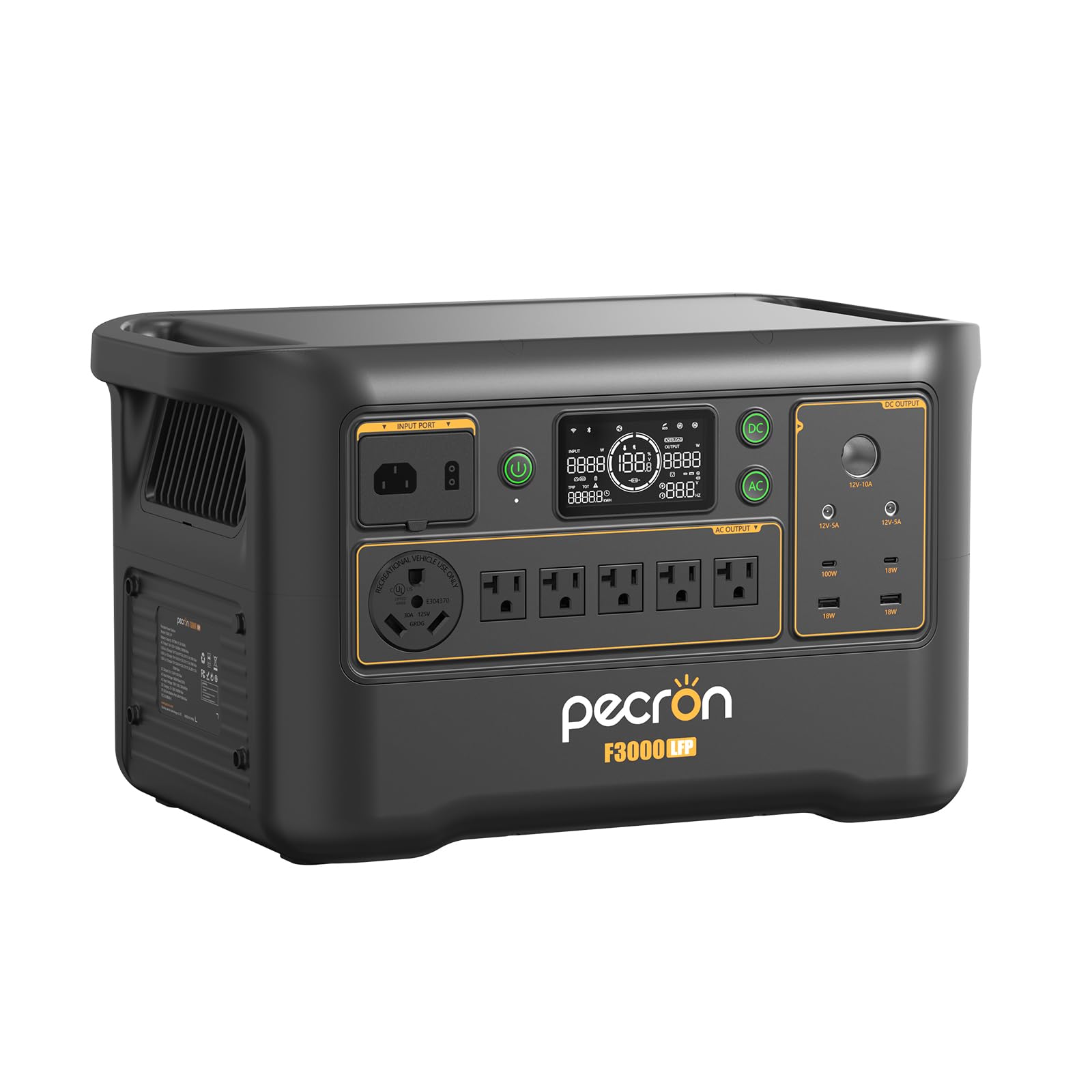
4. PECRON Portable Power Station F3000LFP, 3072Wh Solar Generator, 3600W LiFePO4
A cascade-ready backup that grows with you instead of making you buy twice.
3,072Wh in the box, expandable to 10,752Wh with add-on batteries, is the pitch. That expansion is the single feature most RV and home-backup owners want, because you can buy the station now and grow the capacity later without replacing the whole unit. The 3600W output runs heavy appliances — fridges, air conditioners, and power tools — and the battery is LiFePO4 for long life. In practice, reviewers describe running a 1200W load over 24 hours on a fridge and getting real usable energy out of it, which lines up with the capacity rating.
You can refill the battery fast: 0–100% in about 2 hours from an 1800W AC input (standard wall power). Solar tops out at 1600W with a 25–120V input window (volts, a measure of electrical pressure), which is generous enough to accept most panel arrays you would realistically carry. The 13-port layout puts 6 AC outlets, 2 USB-C PD 100W ports for laptops, 2 USB-A, a carport, and 2 DC 5525 outputs on one box, so a whole desk of gear stays powered without a power strip in sight.
The trade-offs are honest. This is a 63.3 lb unit, and weight is the single aspect that skews most negative in the feedback — not because it is badly built, but because 63 lb is genuinely heavy to move solo. Noise and charge speed land mixed: fans are audible when charging at full tilt, and a few buyers wish the manuals were clearer. For a stationary home-backup role where it lives on a shelf or in a garage, none of that matters much.
Why owners keep it: the expansion path from 3,072Wh to 10,752Wh is the feature that separates it from one-and-done stations, and the 3600W output matches the heaviest appliances in a typical home.
The catch: 63.3 lb and audible fan noise while charging are real, so treat it as a stay-put station unless wheels or a cart are part of your plan.
Fits you if: you are building toward serious home backup over time and want an affordable entry point that expands as your needs grow.
Not for you if: you expect to carry it between campsites alone — 63.3 lb asks for wheels or a second set of hands.
5. Jackery Explorer 2000 v2 Portable Power Station, 2042Wh, 2200W AC Output

The lightest 2kWh-class station here, built around carry-along practicality.
At 39.5 lb, this is the lightest high-capacity unit in the roundup that still delivers a full 2,042Wh. That matters because portability is the trait that quietly decides whether you take the unit camping at all, or just leave it in the garage. Jackery builds it with CTB (Cell-to-Body) construction, the same structural idea used in electric-vehicle battery packs, which keeps the case compact and rigid while staying light. Rated output is 2200W across 3 AC outlets, with a USB-C PD 100W port for laptops and phones.
Recharge is fast for this class: 0–80% in about 66 minutes on AC Fast Charging, or a full charge in 102 minutes using Emergency Super Charging in the app. Solar reaches full charge in as few as 6 hours with 400W panels, and the Silent Charging mode runs at 30dB — quiet enough to leave running in a bedroom overnight. The 20ms UPS switchover covers router and computer backup, and Jackery explicitly certifies the UPS behavior to UL1778.
The weight figure comes with a trade that honest owners will notice. Idle losses can feel higher than the raw capacity suggests on some heavy loads, which several longer-term owners have flagged, so plan around typical appliance draw rather than expecting every hour of stored energy to convert perfectly. The Bluetooth app connection can also drop when you walk away with your phone, requiring a reconnect.
Where it fits best: 39.5 lb with a full 2,042Wh is the lightest way here to keep a fridge running through a day-long outage without wrecking your back.
The catch to size: long heavy loads can draw the battery down faster than the raw number implies, and the app connection can drop, so this is a light-carry unit, not a heavy-draw one.
Choose it if: you will actually pick it up and take it with you — camping, tailgating, or moving it room to room during an outage.
Look past it if: you plan to run a small A/C or space heater for hours, where a heavier 3kWh unit is the better fit.
6. ABOK Ark3600 Portable Power Station 3600W, 3840Wh LiFePO4 Battery
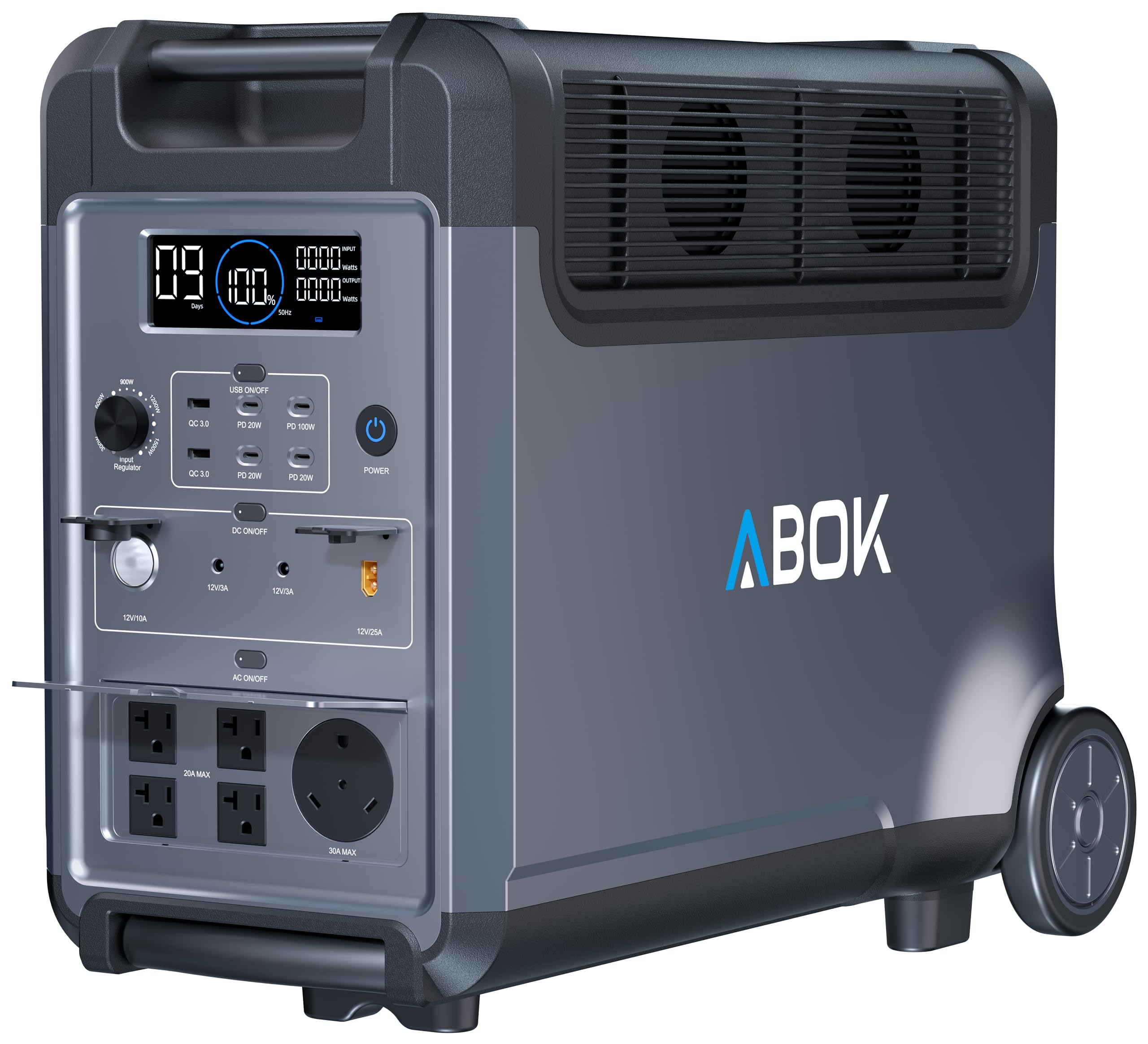
The one with wheels, so its 92 lb does not turn into a two-person job.
This is a full home-backup box: 3,840Wh (watt-hours, a measure of stored energy) expandable to 11,520Wh, 3,600W rated output with 4,500W peak, and 15 output ports including a 30A AC outlet, 3 USB-C PD 20W, one USB-C PD 100W, USB-A QC3.0, DC5521, an XT60, and a cigarette lighter port. That is enough path for the two-fridge household — reviewers describe running two full-size refrigerators for nearly two days, which lines up with the capacity math. EVs have moved to this battery chemistry for exactly the durability reason ABOK cites here: over 4000 cycles and up to a 10-year rated lifespan.
The telescoping handle and wheels are the deciding feature. Other heavy units here weigh less but have no transport aid; the Ark3600 rolls, which is why it lands practical even at 92 lb. Charging is flexible: 1,500W AC, up to 2,000W of solar, and a 120W car input, with a combination of AC and solar bringing it to full in 1.29 hours. Solar alone takes a while if the weather fights you, which one owner described honestly as roughly three days of Pacific Northwest clouds.
The trade-offs are note before you commit. Ports and mobility carry the strongest owner sentiment, while output and weight land mixed. A few buyers want a 240V outlet — it delivers 120V only — and the app lacks written documentation, so plan on discovering its behavior yourself. For a household that mostly plugs in fridges, entertainment gear, and lights during a long outage, none of these stop it from being a strong value.
The case for it: 3,840Wh with a 4,500W surge and an honest 15-port layout, all rolling on wheels, is a lot of backup in one box.
The limit: no 240V output means any appliance expecting split-phase power is off the list, and the app is on you to figure out.
Pick it if: you want big stored energy, plenty of ports, and a unit that moves on wheels so heavy does not mean immobile.
Look elsewhere if: you need 240V output for a specific appliance, or want a polished app experience on day one.
7. Jackery HomePower 3000 Portable Power Station, 3072Wh, 3600W AC Output
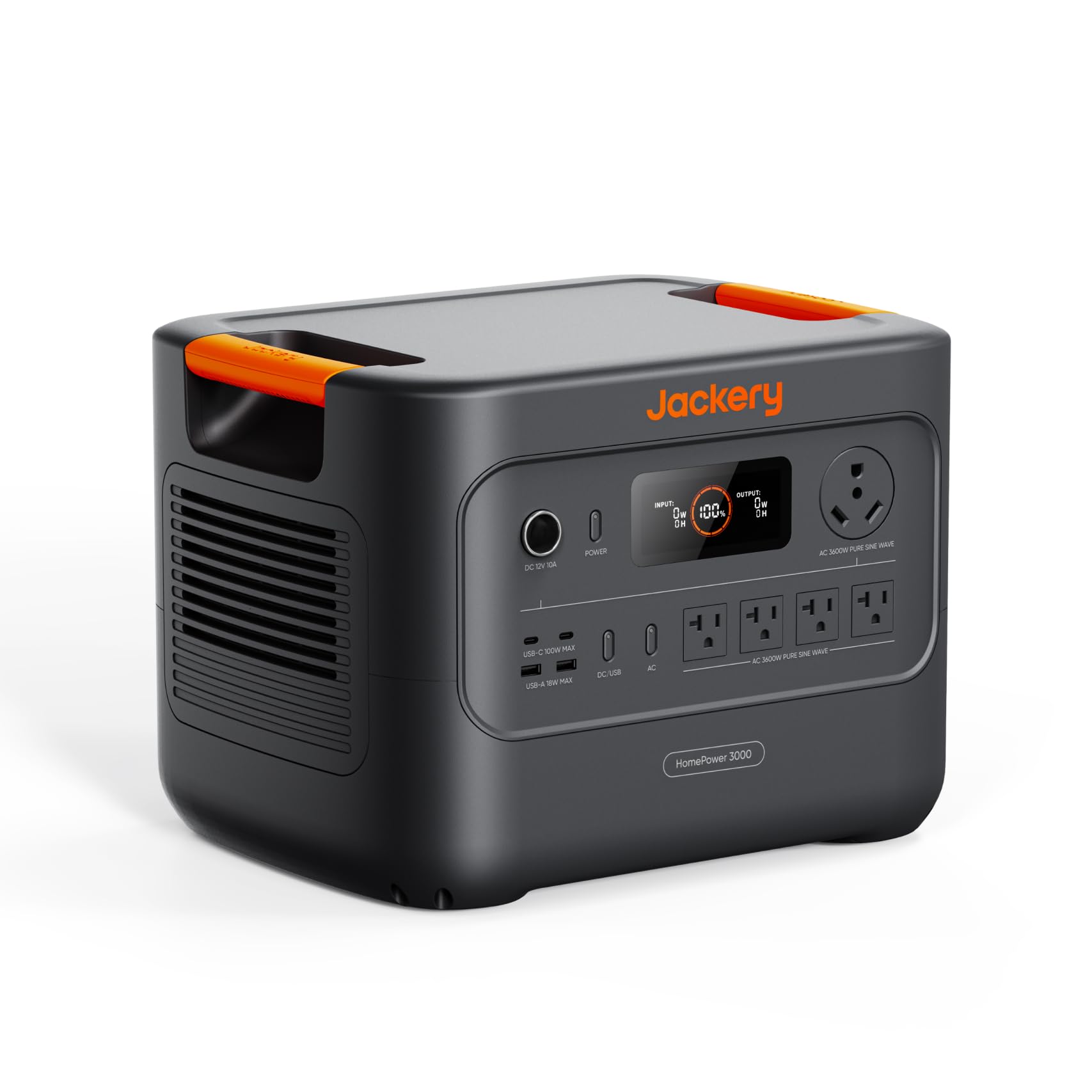
A whole-home essentials box with an RV plug built straight in.
3,072Wh with a 3600W output and a 7200W surge ceiling runs a household’s essentials — fridge, fan, router, lights — for up to 15 hours, or a refrigerator alone for 1 to 2 days. The 7200W surge is what lets the compressor kick on without tripping; the rated 3600W is what your running appliances actually have to fit under. For an RV owner this is the rare unit with a built-in TT-30 port, which is the standard 30A connector travel trailers use, so you plug the camper in directly without an adapter dongle.
The UPS side is where HomePower 3000 differentiates. It carries a UL-certified UPS rating and switches in 20ms or less, which is fast enough to keep security cameras, medical refrigerators, and Zoom calls alive through an outage without a blink. Recharge is quick too: 1.7 hours via hybrid AC and DC, 2.2 hours via AC alone, or up to 80% in 9 hours with two SolarSaga 200W panels. The LiFePO4 battery is rated at 4,000 cycles while retaining 70% of its capacity.
This is where the honest caveat lands. The unit weighs 59.5 lb, and weight is the single aspect most owners flag as a drawback — but it is not dead weight, because two side handles make the lift manageable. The fan is also audible under any real power draw, which one owner measured at roughly 60dB and noted is too loud for daily UPS duty on a desk. If it lives near the fridge or in the garage, that fan noise rarely matters.
Why it earns a slot: a UL-certified UPS plus a built-in TT-30 port covers both the home essentials and the camper in one box, which few units here do.
Sized trade-off: 59.5 lb is real, and the fan is audible under heavy load, so give it a dedicated home in the garage or near the fridge rather than your office desk.
Right for you if: you want a certified UPS for home essentials and a direct TT-30 RV connection without adapter clutter.
Look past it if: you need a silent unit sitting on a desk — the cooling fan here is audible under any real draw.
8. Anker SOLIX F3000 Portable Power Station, 3,072Wh, 6,000W, Solar Generators
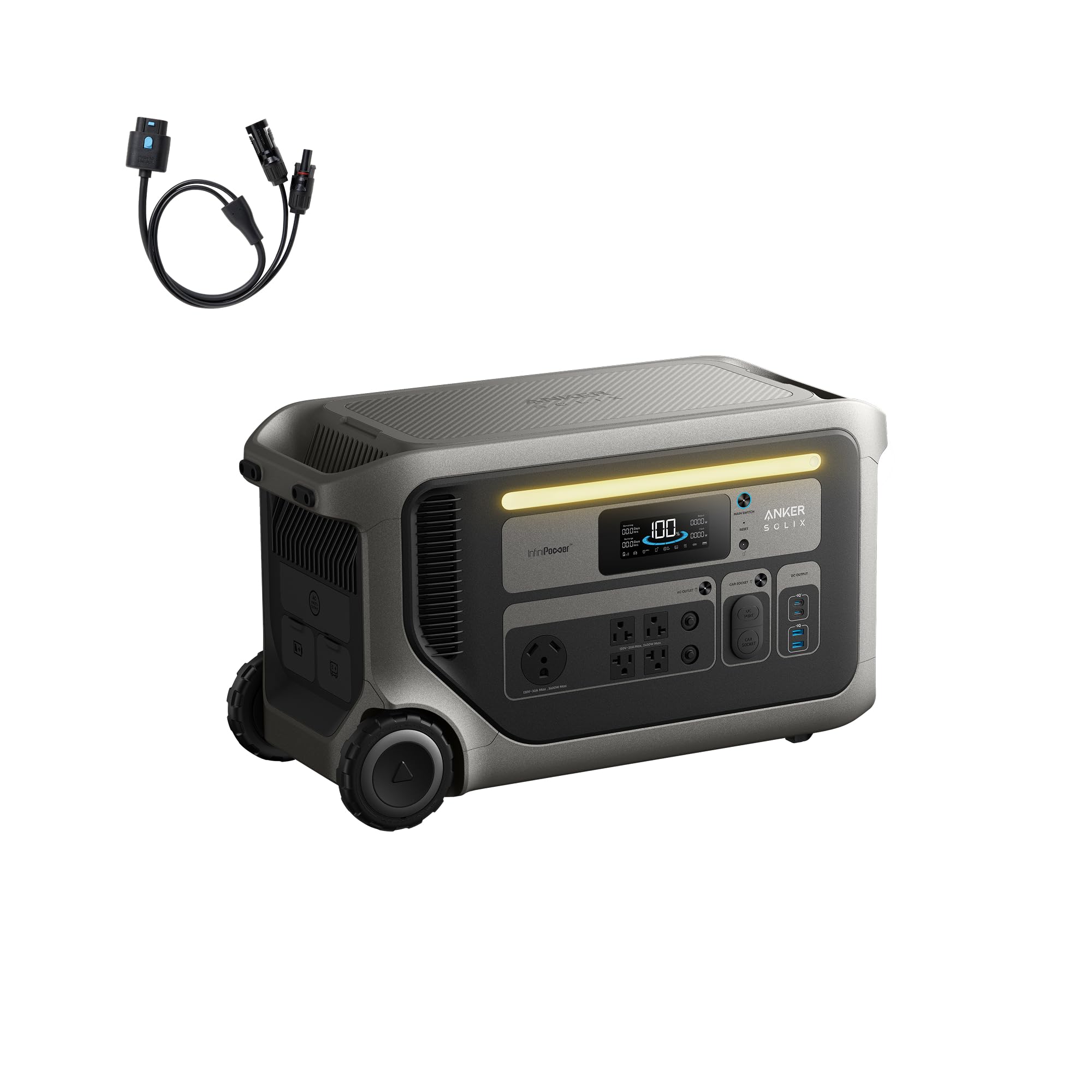
Built for the household that already owns a fuel generator and wants to stop running it overnight.
The signature feature is 3,600W of pass-through charging: you plug a 120V generator in, and the F3000 passes that power to your appliances while it recharges. That means you can run a fuel generator for a couple of hours to fill the battery, then shut the generator off and let the battery carry the load quietly through the night. Paired two-up, it can reach 240V for split-phase appliances, which single units here cannot do. Start at 3,072Wh and expand with batteries to 24kWh — a household that sized carefully for a 10-hour outage can push toward 80-hour coverage with the expansion path.
Idle efficiency is strong: 125 hours of AC idle standby time or running a 190W fridge for 42 hours on a single charge. Solar tops out at 2,400W across 165V and 60V ports, so it accepts both portable and rigid panels. On the heavy end, 6,000W of combined fuel-generator-plus-solar input can refill in an emergency, which is the fastest charge window in this lineup. The 91.5 lb figure is honest heft, so plan on wheels if it will not sit permanently.
The trade-offs are about weight and complexity. Wi-Fi drops are a recurring note in owner feedback, and RV A/C runs top out around six to seven hours on low cool — usable, but not overnight with the compressor cycling hard. The app is dense if you have not used the Anker SOLIX ecosystem. For a main home-backup unit that rarely moves, these are reasonable caveats.
The specific win: 3,600W pass-through lets you use a fuel generator for topping up while running your house normally — a bridge between gas and battery that no other unit here matches.
The catch: 91.5 lb and app-dependent setup reward the household that leaves it in one place, not the camper hauling it daily.
The right buyer is: a homeowner with an existing fuel generator who wants pass-through top-up and 240V pairing without running the noisy unit all night.
Think twice if: you need to move 91.5 lb regularly or want an app that never drops off Wi-Fi.
9. BLUETTI Elite 100 V2 Portable Power Station for Camping 1024Wh 1800W
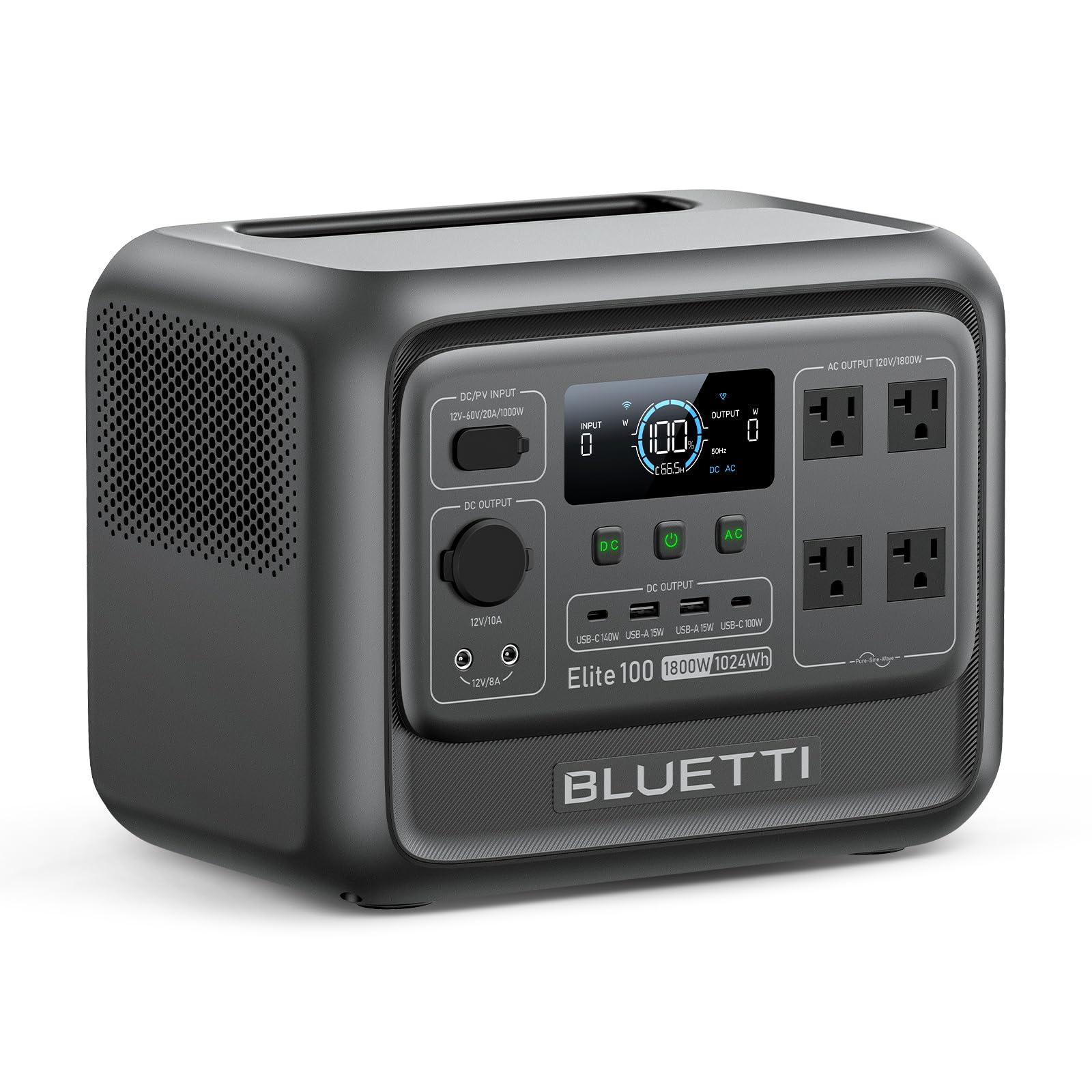
A one-hand carry that refills in roughly the length of a lunch break.
You get 1024Wh (watt-hours, a measure of stored energy) at just 25 lb — light enough to grab one-handed by the hidden handle, big enough to carry a fridge through a real outage. The 1800W rated output with a 2700W surge does most of what a household turns to during a grid drop without exceeding the small unit’s comfort zone. It reaches a full charge in about 70 minutes with 1200W TurboBoost AC charging, or with solar at up to 1000W, which keeps it useful whether you have a wall outlet or full sun.
The 10ms UPS (uninterruptible power supply, which switches to battery almost instantly) covers router and PC backup through the flicker of an outage, and the silent mode runs at 30dB (decibels, a measure of sound) for overnight camping or bedside use. The LiFePO4 battery (a durable lithium chemistry) is good for over 4,000 cycles to 80%, which lines up with the durability standard of the larger BLUETTI picked above — the Elite 200 V2 — but here you are trading raw capacity for less than half the weight. Eleven ports and app control over Wi-Fi and Bluetooth round out the package.
This is not a heavy-draw unit. The 1024Wh capacity sets a real ceiling: it will run a fridge and the usual small loads for hours, but heavier continuous appliances will outpace it. It is also noticeably less capable for big appliances than the AFERIY P210 and the larger 2kWh-class units — trade heavier storage for bigger loads, or take this unit for the light-carry role. One damaged unit among many does show up in the reviews with hardware issues, which happens with any electronics brand and speaks to why buying from a seller with a clear return path matters.
Its lane: 25 lb with a full 1024Wh and a 70-minute recharge is the best light-carry combination in this lineup.
The ceiling: 1024Wh is honest, not generous, so heavy continuous loads are off the menu and the unit is best treated as a two-to-six-hour solution, not an all-weekend one.
Right for you if: you want a station you can pick up with one hand, top up fast, and carry anywhere — campsite, camper, or rental.
Look past it if: you need overnight fridge coverage, because the smaller capacity here meets its limit faster than the 2kWh picks.
10. AFERIY P210 Solar Generator 2048Wh Portable Power Station 2400W (4800W Peak)

Brings the biggest port count and a rare 7-year warranty to the entry tier.
You get sixteen ports on one unit, which is the giveaway that this is built for the household that wants everything plugged in at once. Six 20A AC outlets handle the big appliances, four USB-C ports cover laptops and phones, and the DC5521, car, and XT60 ports round out the small-gear loadout. Capacity is 2048Wh (watt-hours, a measure of stored energy), matching the Anker SOLIX C2000 Gen 2 exactly, and the peak power ceiling of 4800W is well above the 4000W peak of that Anker — meaningful headroom if you plan to start compressors and motors under load.
Recharge is fast: about two hours from AC, and the adjustable charge current lets you dial it back so you do not trip a breaker — an honest feature that owners specifically call out as useful. Solar charging tops out lower than the marketing spec suggests at around 350W of real-world input regardless of panel configuration, which is a known limitation rather than a defect. The LiFePO4 battery rates over 3500 cycles, and the 7-year extended warranty is the longest listed in this lineup — genuinely important on a battery-backed appliance.
One design quirk worth knowing: the UPS mode (uninterruptible power supply, which switches to battery almost instantly) cannot be fully disabled, so on AC input the unit bypasses to a limited output rather than running the full inverter — meaning the full 2400W is best drawn on DC (XT60/XT90) or solar. That is a hardware design choice, not a fault, but it changes how you would wire it during an outage. The unit is also 54 lb, so it is closer to the mid-2kWh weight class than the light end.
The value case: 2048Wh, a 4800W peak ceiling, and 16 ports at the entry tier — with the longest warranty here at seven years.
The honest limit: solar tops out around 350W in real use and the UPS mode cannot be turned off, so heavy loads at 2400W want DC or solar rather than an AC wall feed.
Buy it if: you want the most ports, the biggest peak-power headroom, and the longest warranty at the lowest tier here.
Think twice if: you plan to recharge primarily from solar — the effective input ceiling is the one real compromise at this price level.
11. EF ECOFLOW Portable Power Station 3600Wh DELTA Pro, 120V 3600W AC Output
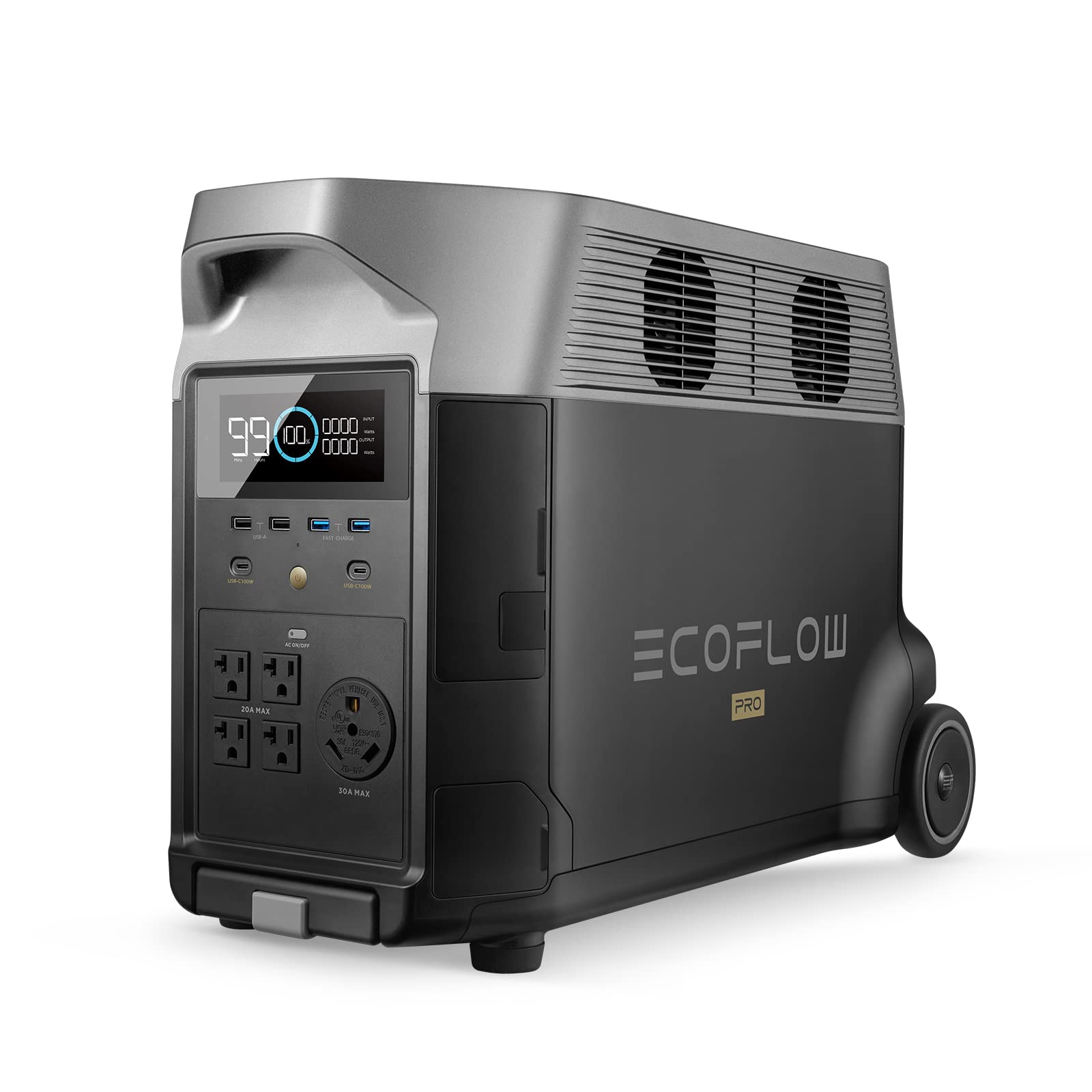
The biggest single-unit capacity here, with expandability that reaches a whole-home scale.
3,600Wh in a single unit is the largest stock capacity in this lineup, and it grows to 25kWh with extra batteries or a smart generator — the widest expansion path offered by any pick here. That makes this the natural end-game for households who plan gradually, adding capacity as their needs grow. Output is 3600W, expandable to 4500W with X-Boost, and two units pair for 7200W. Fifteen output methods — including five 120V AC outlets, two USB-C 100W, and an Anderson port — mean a small business, an RV, or a workspace can plug in nearly everything without a second station.
You can charge fast in every direction: 1.8 hours from 240V outlets at 3000W, 2.7 hours from a standard 1800W wall outlet, or 2.8 hours from four 400W solar panels, with a solar conversion efficiency stated at up to 23%. Five charging inputs — EV station, solar, wall, smart generator, and car — give you options nearly everywhere you plug in. The battery management system handles safety, and the EcoFlow app tracks charge level, temperature, and charge/discharge timing over Wi-Fi or Bluetooth.
The honest scaling point is weight.At 99 lb, this is not a portable unit in the carry-around sense — it is a stay-put home backup that happens to have handles. Expect to keep it on a cart or in one spot. Charging performance and reliability earn the most consistent praise, and the real-world feedback on longevity is strong, with owner-reported runtimes of up to 15 days on a single charge under light loads. The main trade-off is that 99 lb figure — it anchors the unit in place, which is exactly right for home backup and wrong for campsite hopping.
The power position: 3,600Wh stock and expandable to 25kWh is the largest capacity and widest growth path here, which is why it sits at the premium tier.
The honest weight: 99 lb means home-backup duty, not tailgate duty — plan on wheels or a permanent spot.
Built for: a household planning serious multi-day backup who wants the largest stock capacity and the option to grow toward whole-home scale.
Not built for: anyone who expects to carry it up a flight of stairs or load it solo into a car — 99 lb settles that argument.
Understanding the Specs
Watt-hours (Wh) vs watts (W)
Watt-hours is the size of the tank — it sets how long your fridge, router, or CPAP runs. Watts is the width of the pipe — it sets what you can start and run at once. A common mistake is buying the biggest watt-hours number you can find and ignoring the watts, then discovering the unit cannot start a well pump. Match watt-hours to your expected runtime and watts to your heaviest appliance’s startup demand, and the choice usually narrows itself down quickly.
LiFePO4 cycle life explained
LiFePO4 (lithium iron phosphate) is a lithium chemistry that keeps more of its capacity after repeated charges than older lithium types. Cycle life is stated as the number of full charge-and-discharge rounds a battery can take before it drops to a defined retained capacity — often 80% in these listings. A higher cycle number, like the 4,000–6,000-plus ratings in this roundup, is your real durability signal, and it is why almost every serious unit here now uses LiFePO4.
UPS switchover time
The UPS figure — typically 10ms, 15ms, or 20ms — is how fast the unit swaps from grid power to battery when the outlet dies. Smaller is better for anything with a sensitive internal clock or a boost converter, because the computer or router can ride through the gap without a reboot. For fridges and lights, a slightly longer switchover is fine. For a desktop rig or a network rack, look for 10ms or lower.
Solar input and recharge speed
Solar input is the maximum wattage of panels a unit will accept, and it is capped by the input’s voltage window — so a 1,600W-compatible port may only deliver that if your panel array fits the voltage range. Recharge speed from the wall matters more during a visible storm; solar matters more for multi-day off-grid use. Read both numbers against your actual panel setup, not against the marketing ceiling.
FAQ
How long can a battery-based generator run a fridge on one charge?
Is a battery-based generator really quieter than a gas generator?
Can a battery-based generator power a window air conditioner?
What is a UPS mode and do I need it?
How many years does a LiFePO4 battery last in one of these units?
Do I have to use solar panels with a battery-based generator?
Can these power a whole home during an outage?
Can I recharge these from a car while driving?
Are battery-based generators safe to use indoors?
What is the difference between rated watts and peak watts?
Final Thoughts: The Verdict
For most buyers, the best battery-based generator winner is the Anker SOLIX C2000 Gen 2 because it hits the best combination of stored energy, output, and carry weight — with the fastest recharge here and a 2,048Wh capacity that runs a dual-door fridge for up to 32 hours. It also carries a 4.7-star rating across 600+ owners and, at 41.7 lb, is the lightest 2kWh-class station in this group. If you want the longest cycle life in this lineup, grab the BLUETTI Elite 200 V2. And for serious home backup with a pass-through top-up strategy, the Anker SOLIX F3000 is the one to reach for.
How We Picked
We do not accept paid placement. Every pick is matched to a real buyer and a real use-case; we do not hands-on test units.
Sources & Methodology
Specifications: manufacturer listings and product documentation. Review insights: verified customer reviews, as of September 2026. Pricing: not shown on this page (it changes often); check the current price via the retailer link.
As an Amazon Associate, KitchPrep earns from qualifying purchases. This does not affect which products we feature.
Related Guides
