
Specs are compiled from manufacturer listings and verified buyer reviews and can change over time — please confirm the key details on the product page before buying.
Most basement floods blamed on the pump were actually caused by a stuck float switch or a discharge line that never fit the hose you had lying around. This guide fixes that by focusing on one thing: which 1/4 HP motors actually clear a residential pit at 1,800 gallons per hour or more, and which ones come with a switch design that survives years of on-off cycling. You will see float type, cord reach, discharge thread sizing, and housing material compared side by side.
I’m Mohammad Maruf — the founder and writer behind KitchPrep. This guide is built by comparing the manufacturers’ published specifications and the patterns across verified customer reviews, so you get each pick’s real strengths and trade-offs instead of marketing spin.
You do not need a plumber to sort this out, and you do not need to guess at horsepower math. The trick is matching a quarter-horsepower motor’s 25-foot lift rating to your pit depth and discharge line. That single decision separates a 1/4 hp sump pump that runs for a decade from one that quits in a storm.
Our Picks at a Glance


How To Choose The Best 1/4 HP Sump Pump
Start with the number that decides everything else: gallons per hour, or GPH. That figure tells you how fast the pump empties your pit once the water hits the switch. A quarter-horsepower motor is the standard size for a residential basement pit that collects a few hundred gallons after a hard rain — bigger motors are usually overkill and louder for that job.
Read the float switch before the motor
The float is the part that actually starts and stops the pump, and it is the part that wears out first. A tethered float hangs on a cord and swings up as water rises, which gives you more adjustment room in a wide pit. A vertical float rides up a fixed rod and suits a narrow pit. A snap-action float clicks on and off quickly, which reduces the sloshing that makes a pump restart over and over.
Match the discharge to your hose
Look at the discharge port size, written as NPT (a standardized pipe thread). A 1-1/4-inch or 1-1/2-inch NPT port moves high volumes but will not accept a garden hose without an adapter. Some pumps ship with a 3/4-inch garden hose adapter already in the box. Others expect PVC pipe. Check this before you buy, because a wrong thread is the most common reason a new pump sits unused.
Understand maximum lift
Maximum lift, also called shutoff head, is the vertical height the pump can push water before it stops moving it entirely. A 25-foot rating means the pump can raise water a long way up and out — useful if your discharge line has to climb to a distant drain or a high window well.
Quick Comparison
| Model | Best For | Flow Rate | Maximum Lift | Discharge / Cord | Amazon |
|---|---|---|---|---|---|
| Superior Pump 92250★ Best Overall | Overall basement pit duty | 1,800 GPH | 25 ft | 1-1/4″ or 1-1/2″ NPT / 10 ft | Amazon |
| Saker Automatic On OffTop Performer | Pool covers and standing water | 2,377 GPH | — | 3/4″ check valve adapter / 25 ft | Amazon |
| Red Lion RL-SP25THigh Flow Pick | High-flow pit replacement | 51.4 gpm | 23 ft shutoff | 1-1/2″ FNPT / 8 ft | Amazon |
| PUMPMAN Utility Pump | Hose-friendly pool and spa draining | 2,110 GPH | 25 ft | 1-1/4″ NPT with 3/4″ and 1-1/2″ adapters / 10 ft | Amazon |
| KioGro Pool Cover Pump | Tight pool cover spaces | 1,800 GPH | 25 ft | NPT 1-1/4″ to G3/4″ adapter / 25 ft | Amazon |
| Little Giant 5.5-ASPA | Sump systems and emergency transfer | 2,100 GPH at 5-ft head | 25 ft | 1.5″ FNPT with 3/4″ GHT adapter / 10 ft | Amazon |
| Superior Pump 92260 | Convertible sump or utility use | 1,800 GPH | 25 ft | 1-1/4″ or 1-1/2″ discharge / — | Amazon |
| Jackel Laundry/Sink Tray System | Laundry and sink tray drainage | — | — | 6-gallon basin included / — | Amazon |
In‑Depth Reviews
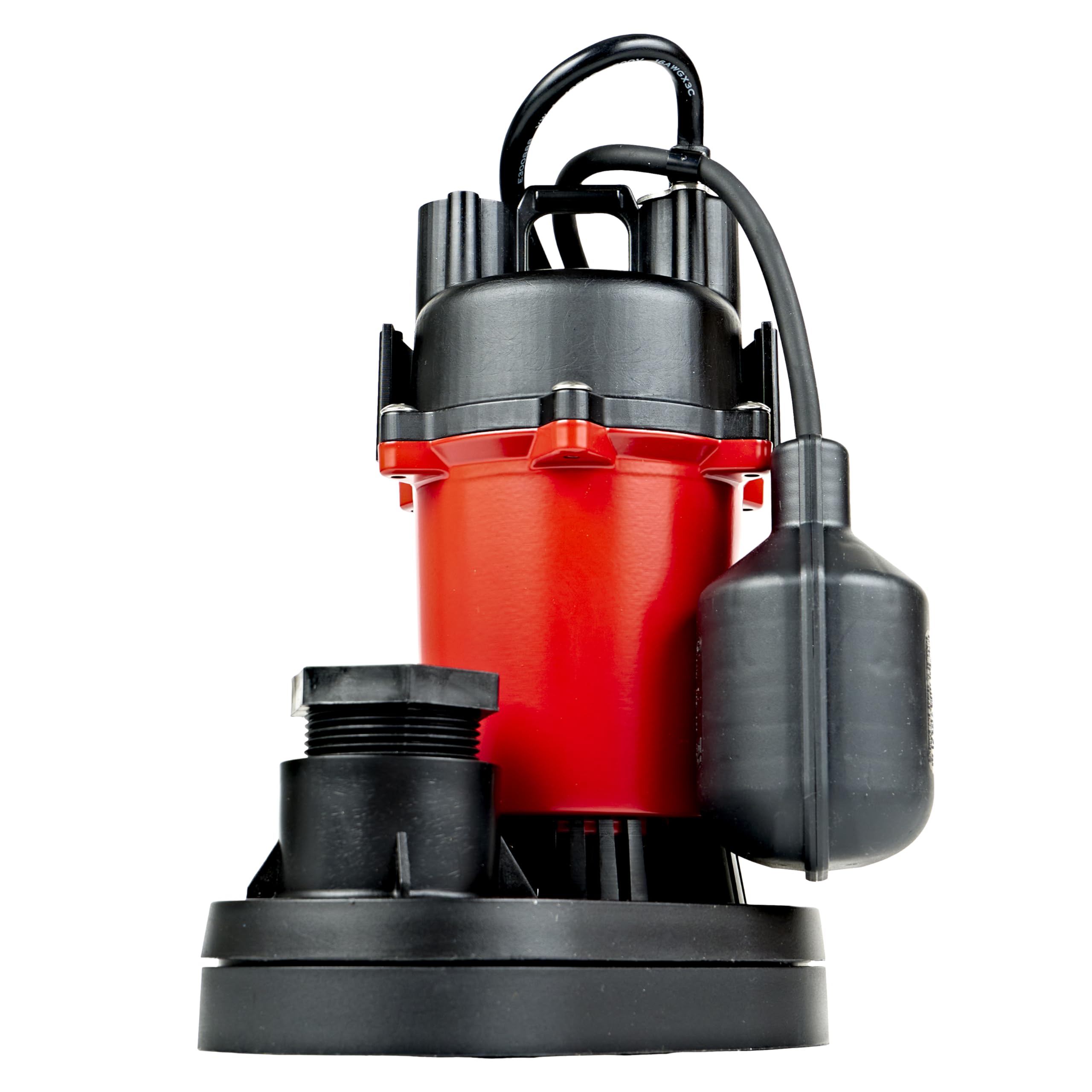
1. Superior Pump 92250 1/4-HP Thermoplastic Submersible Sump Pump with Tethered Float Switch
Our pick — over 4★ from 950+ verified ratings; the strongest balance of quality and price.
The pit standard: 1,800 gallons an hour in a housing that shrugs off years of wet cycling.
If you are replacing a failed pump in a standard residential basin, this is the one to start with. The thermoplastic body — a tough molded plastic shell that resists rust in a constantly wet pit — houses a 1/4 HP motor that moves up to 1,800 gallons per hour and lifts water up to 25 feet of vertical height. The discharge accepts either 1-1/4 inch or 1-1/2 inch NPT, so you can reuse the fittings already in your pit instead of buying new ones. The cord runs 10 feet, which is enough to reach an outlet on the basement wall without an extension.
What wins people over is the build. The thermoplastic construction and the tethered float — a float that hangs on a cord and swings upward as water rises — get the most praise by far, with quality the most-cited strength and value for money close behind. A steel-ball tethered float like this one is mechanically simpler than a magnetic or mercury switch, which is why owners tend to trust it to last. Quiet operation and ease of use also come up consistently. One buyer’s full account of swapping out an oversized pump is worth repeating: the pit “empties in 2-3 min, barely audible, no backup,” with installation done in under an hour.
The honest catch is the float switch, which draws mixed feedback — some units cycle properly for years while others arrive with a switch that does not trigger right from the start. Durability lands in the same mixed column: plenty of pumps are still running strong, and a few stop within the first year. The warranty softens that risk considerably, since the maker replaces a failed pump without requiring a return. It holds a 4.4 rating, which is respectable but not the top score on this list, so if you want the highest-rated option you will trade some flow rate for it.
Where It Earns Its Place
- 1,800 GPH clears a residential pit fast, with a 25-foot lift height.
- Accepts 1-1/4″ or 1-1/2″ NPT discharge, so existing fittings usually work.
- Thermoplastic housing resists corrosion in a permanently damp basin.
- Warranty replacements are handled without shipping the old unit back.
What To Weigh First
- Float switch reliability is the recurring wild card across owner reports.
- Durability is inconsistent — most run for years, a few quit inside twelve months.
- Rated 4.4, below the highest-rated picks here.
Settled choice: Buy this if you want maximum flow and lift for a standard basement pit at a mid-range cost, and you value a no-hassle warranty.
Think it over if: your pit is shallow and narrow, where a vertical float gives you finer on-off control.
2. Saker Automatic On Off Submersible Water Pump, 1/4 HP Sump Pump, 2377 GPH
The highest flow here, and the longest cord — built for water that sits far from an outlet.
Pool covers, rooftops, window wells and hot tubs are the jobs this pump was designed around, and it handles them without you standing there watching. The 1/4 HP motor removes up to 2,377 gallons per hour, the largest flow figure on this list. A 25-foot power cord lets you set it down at the far end of a cover or across a roof without hunting for an extension cord. The 3/4-inch check valve adapter comes pre-installed inside the hose adapter, so the fitting you need is already threaded on — a detail worth knowing, because it will not appear as a separate part in the box.
Two design choices do the heavy lifting. First, a strainer base and filter net cut down on leaves and dirt entering the housing, which keeps the impeller clear through a full season. Second, the pump switches between automatic and manual operation at will, so you can leave it on auto for ongoing cover drainage or flip it to manual for a one-off job. The shutoff delay keeps it running briefly after the water level drops, which drains the last shallow layer instead of leaving a puddle. Owners describe it as saving hours of manual bailing after storms, with automatic on-off doing the work unattended. Take the review pages at face value: “this thing saved my basement from flooding! put it into a 50 gallon rain bucket catcher and then pumps the water out to a field.”
Here is the trade-off you should weigh before buying. The motor housing is metal, which holds up well, but the pump body reads as plastic construction in owner feedback — fine for water transfer, not a cast-iron bomb shelter. It sits at the premium end of the price range, and its 4.9 rating comes from a smaller pool of buyers than the mid-range picks, so you are trusting a shorter track record over a long one. The upside is that the flow and cord length beat everything else in this guide outright.
Why it stands out: 2,377 GPH outruns the Red Lion’s real-world 51.4 gpm and the Superior 92250’s 1,800 GPH, and its 25-foot cord is more than double the Red Lion’s 8-foot reach.
Honest read: Plastic-bodied and premium-priced, with fewer owner reviews behind the score — buy it for the flow and the cord, not for heavy cast-iron durability.
The right call for: anyone draining a pool cover, rooftop, or window well where the water sits well away from a power source.
Not the pick when: your priority is a long, proven durability record rather than the fastest drain rate.
3. Red Lion RL-SP25T, 115V, 1/4 HP, 2900 GPH Automatic Sump Pump, 8′ Cord
Corrosion-resistant aluminum housing and the fastest measured flow of any pit pump in this lineup.
This is the pump to look at if your old pedestal unit died and you want a drop-in replacement that moves serious water. The piggyback tethered float switch kicks on automatically when the water reaches 14.5 inches and shuts off when it falls to 5.5 inches, and because the switch is a piggyback type, it plugs inline and can be swapped independently of the motor. The housing is epoxy-coated aluminum with a thermoplastic volute, base and motor cover — an anti-rust combination that matters when the pump sits submerged for months.
The motor is where this one separates itself. The item listing quote for the Red Lion is a 1/4 HP, 2900-gallon-per-hour unit, and its published flow rate is 51.4 gpm — decisively faster than the Superior 92250’s 30 gpm, which is the biggest real-world flow gap in this whole comparison. Lift is rated to 23 feet of shutoff. On weight, the aluminum body comes in at 8.5 pounds versus the Superior 92250’s 8.1 pounds, so neither is a chore to hoist out of a pit by hand. The 1-1/2-inch FNPT discharge with a 1-1/4-inch adapter means it slots into most existing pits without re-plumbing.
Where the reviews get candid is the switch and the motor protection. Buyers describe an amazing flow rate when it is running, with one noting it “sounds solid, and quieter than Menards Barracuda brand.” But there are reports of the motor seizing if it ingests a blockage, with one complaint that the unit “got a blockage and ran till she fried,” and another buyer said it “died after 2nd use.” That is a small slice of the conversation, and the piggyback switch and 2-year warranty are genuine safeguards against it, but for a pump that will run unattended through a storm you should keep the pit clear of debris. Also worth knowing before you buy: the discharge connection is a hose-fitting size that will not accept a standard garden hose.
Straight verdict: The fastest-flowing pump in this roundup with a swap-friendly piggyback switch — best if raw drainage speed and corrosion resistance top your list.
Before you commit: Keep the pit clear of debris — a jamming blockage is the failure mode buyers report — and check that your discharge hose matches, because a garden hose will not fit.
Built for: replacing a dead pedestal pump in a standard pit where you want maximum flow and a switch you can swap without buying a new motor.
Look elsewhere if: you need the longest cord reach or you plan to run water through a garden hose directly.
4. PUMPMAN 1/4HP Utility Pump, 2110 GPH Submersible Water Pump with 3/4” Garden Hose Check Valve Adapter
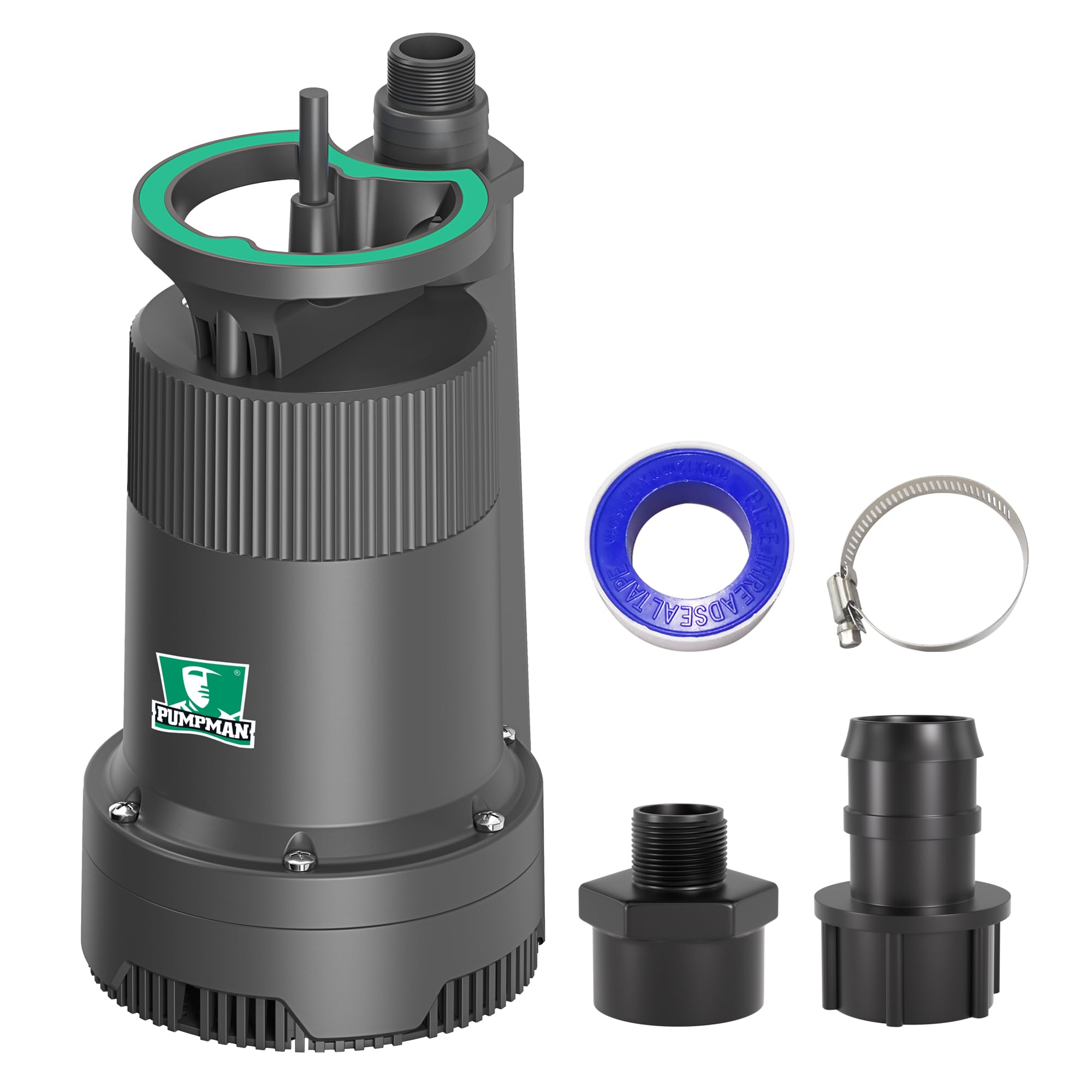
Comes with a garden hose adapter in the box, so it works the day it arrives.
For a pool, a hot tub, or a flooded basement corner, this pump solves the single most annoying problem in the category: making the discharge fit your hose. The 1/4 HP motor delivers a maximum flow rate of 2,110 gallons per hour with a head height up to 25 feet, which is capacity enough for most household jobs. The 1-1/4-inch NPT discharge port ships with two adapters, a 3/4-inch one that threads onto a standard garden hose and a 1-1/2-inch one for discharge hose — you pick the fit instead of hunting for parts.
The design details matter for messy jobs. A stainless steel shaft inside a thermoplastic housing resists wear, and the 360-degree all-angle suction pulls water from every corner of a basin while keeping debris out of the impeller. Built-in thermal protection shuts the motor off automatically if it hits high temperature or runs dry, which is your best defense against burning it out when the water level drops below the intake. Owners mention it starts pumping as soon as it is plugged in and threads onto a garden hose without adapters. It has been used to circulate water in an above-ground pool and to drain a hot tub in minutes.
Two things to know before committing. First, it weighs 10.5 pounds, the heaviest unit on this shortlist, so hauling it out of a deep basin takes a bit of wrist. Second, the suction is strong enough that on a small container it can drain fast enough to run the source dry and cycle — the reliable fix from owner experience is to keep the intake fully submerged and match the pump to the size of the job. It is a utility-first pump, so if you specifically want a float switch that turns a basement pit on and off automatically, that feature is not built in here.
Why buy it: It is the only quarter-horsepower pick here that hands you both a garden hose adapter and a large-hose adapter, and the 25-foot lift covers tall climbs.
The catch: No automatic float switch and the heaviest body here — you turn it on and off yourself, and you lift 10.5 pounds when you are done.
Reach for this if: you drain hot tubs, pools, or puddled spaces and want a hose-ready pump with thermal protection and no plumbing fuss.
Skip it for: a permanent basement pit that needs to run on its own during a storm with no one home.
5. 1/4 HP Automatic Swimming Pool Cover Pump, Submersible Sump Pump
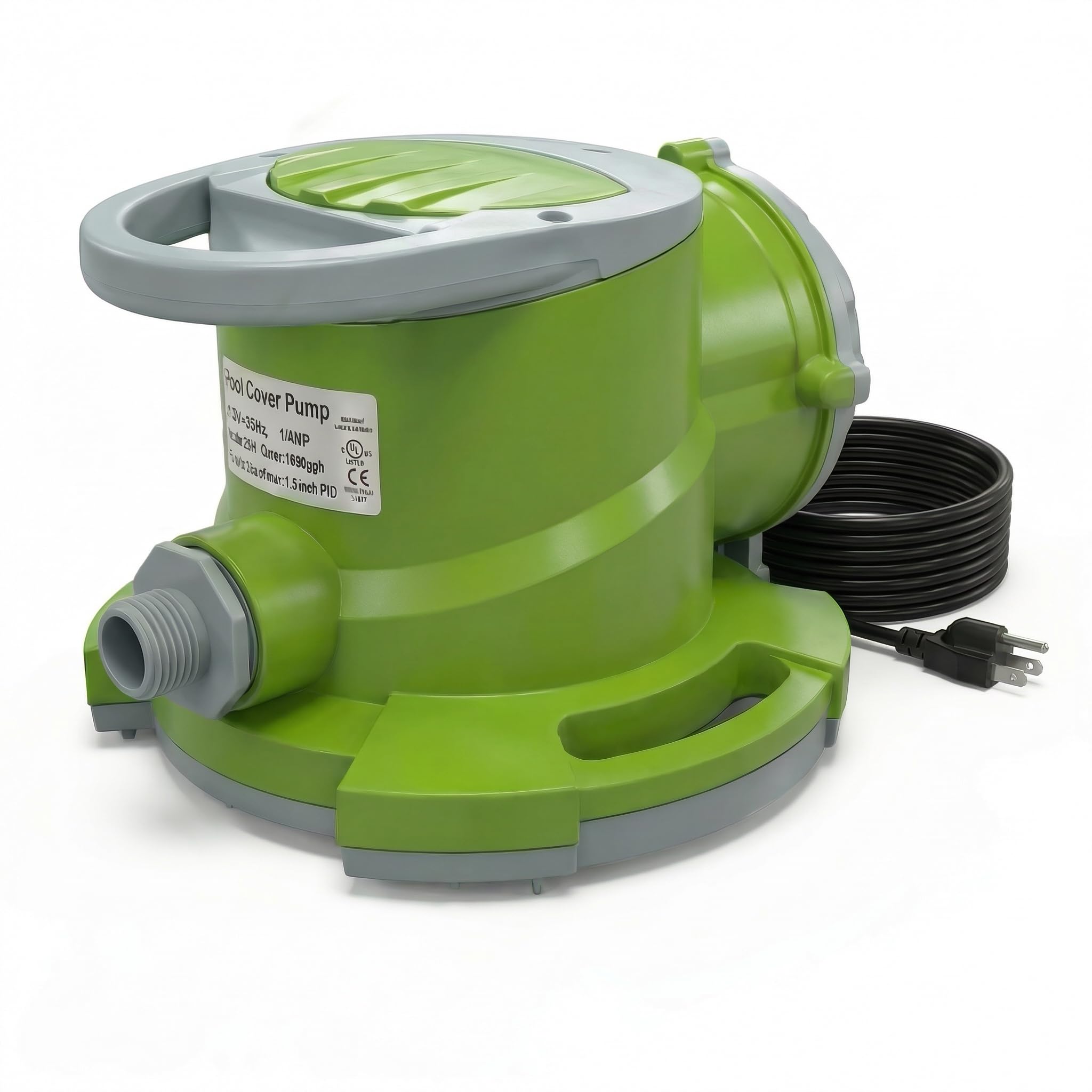
Shallow, compact, and built to sit flat under a sagging pool cover.
The job this pump handles best is the one that is hardest to reach: a low pool cover, a tarp, or a terrace where water collects in a shallow sheet. Its compact body measures 9.06 by 8.86 by 6.3 inches and weighs 8.4 pounds, so it slides into tight cover space and lifts out with one hand. The 1/4 HP motor moves 1,800 gallons per hour with a 25-foot maximum lift, and it supports a 7-meter maximum submersible depth for deeper basins. A 5mm particle passing capacity means small debris slips through instead of jamming the impeller.
The control design is where this one earns attention. It runs in either automatic or manual mode, with a 1-inch auto start water level and a 1/2-inch minimum suction height — shallow enough to pull water down to almost nothing. A 60-second delay shut-off keeps pumping past the point a normal switch would quit, so it removes the last layer instead of leaving residue. Owners using it on pool covers report it empties a winter cover fast, and its 25-foot cord reaches a distant drain point.
One honest limitation surfaces in owner feedback: in a very small container, the gap between the on and off levels is tight enough that backflow can restart the pump and cause short cycling, even with a check valve fitted. That is not a problem on a broad pool cover, where the water surface is wide, but it makes this a poor match for pumping condensate out of a dehumidifier bucket. The included check valve and conversion adapter mean it is ready to use straight from the start.
What Buyers Appreciate
- Compact 9.06 x 8.86 x 6.3-inch body fits tight cover space.
- Drains to a 1/2-inch minimum suction height, leaving almost no residue.
- Shallow 1-inch auto start plus a 60-second delay for thorough removal.
- 25-foot cord and included check valve cut setup time.
Worth Knowing
- On small containers the auto range is narrow, so backflow can cause cycling.
- Too shallow a job suface makes automatic mode fussy.
Best match: Pool owners and anyone draining a wide, shallow water surface who wants automatic operation with a short minimum suction height.
Pass on this: if you need a pit pump for a deep, narrow basement sump where a vertical float fits better.
6. Little Giant 5.5-ASPA 115V, 1/4 HP Aluminum Automatic Sump Pump, 10′ Cord
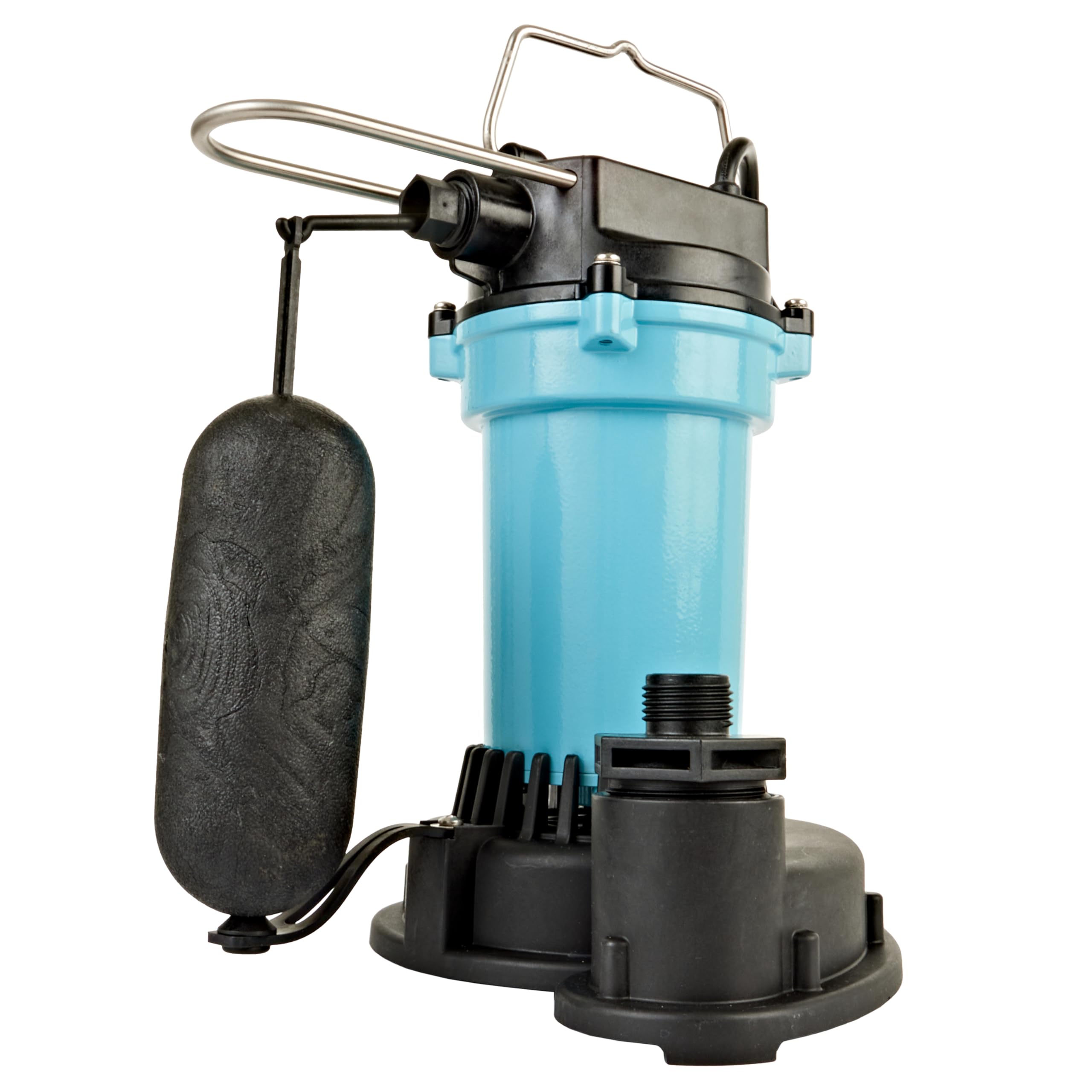
The premium build: aluminum housing, snap-action float, and a motor that sips 3.5 amps.
Reliability is the reason to consider this pump. It uses an integrated snap-action float switch that clicks on when water reaches 7 to 10 inches and off when it drops back to 2 to 5 inches — a mechanism that switches firmly rather than hovering, which cuts down on the dithering that wears motors out. The aluminum housing is the sturdiest material on this list, and the permanent split capacitor motor runs on just 3.5 amps and 350 Watts, which is easy on a household circuit. The 1.5-inch FNPT discharge plus a 3/4-inch garden hose adapter means it can serve either a permanent sump system or a quick emergency transfer.
The solids handling is a real differentiator: this pump passes up to 3/8-inch semi solids, which keeps small debris from stalling the impeller before it can pump. It delivers 2,100 gallons per hour at 5 feet of head and is rated to 25 feet of maximum lift, so it handles a shallow kitchen sink drain line and a deeper basement basin with the same motor. Customers note it as a drop-in replacement — one swapped out a 29-year-old original, another drained a 10,000-gallon pool. The auto shutoff prevents dry-running, which is the fastest way to kill a pump.
The premium cost is the obvious consideration here, and this is the priciest dedicated pump on the list. It also carries aluminum rather than cast iron, so if you specifically want the heavy cast-iron durability some owners prefer for a permanently submerged pit, that is a different class of pump. The 3-year manufacturer warranty is the longest of any standalone pump in this guide, which offsets the higher upfront outlay.
Editor’s take: The strongest combination of premium housing, snap-action switching, solids handling, and warranty coverage — the pick when reliability is worth paying for.
Trade-off to note: It costs the most of any single pump here and uses aluminum rather than the cast iron some buyers prefer in a permanently submerged pit.
Worth it for: buyers running a permanent sump system who want a snap-action float, 3/8-inch solids handling, and the longest warranty in the group.
Consider alternatives if: you are on a tight budget or specifically want cast iron construction.
7. Superior Pump 92260 1/4 HP Thermoplastic Sump Pump with Vertical Float Switch, Black
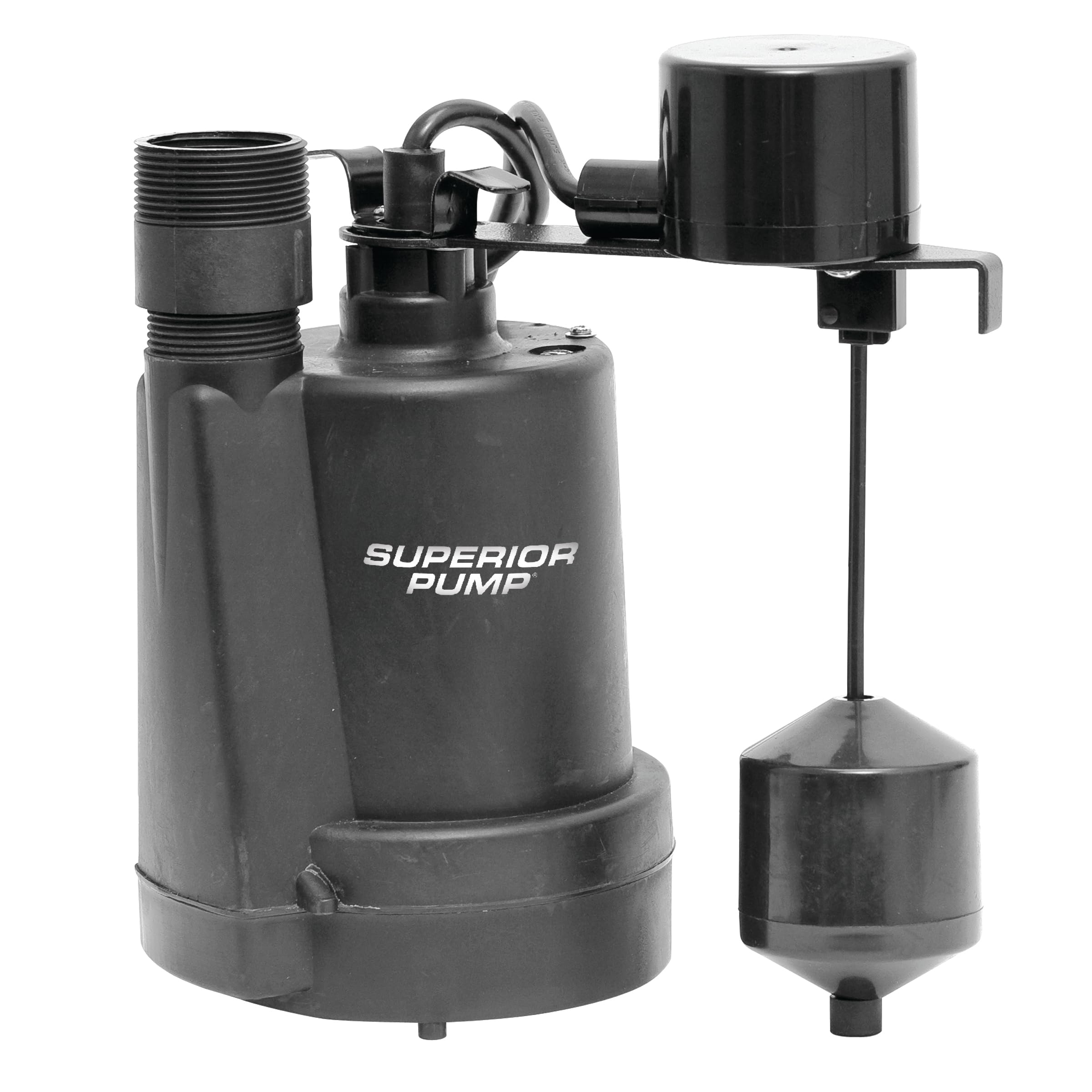
A sump pump and a utility pump in one, if your pit is narrow enough for a vertical float.
Two things set this model apart from the other Superior pump in this guide. The first is the vertical float switch — a float that rides up a fixed rod instead of swinging on a cord — which suits a narrow pit where a tethered float would catch on the wall. The second is that the float can be removed entirely, turning the unit into a manual utility pump for jobs like draining a water heater or emptying a footwell. The 1/4 HP motor moves up to 1,800 gallons per hour and lifts water up to 25 feet, with a large 1-1/4 or 1-1/2-inch discharge for high-capacity pumping. It runs a continuous-duty, thermally protected split capacitor motor built for longer cycles.
The continuous-duty rating is the spec that matters most for a pit that refills during a long storm — the pump is designed to keep cycling without overheating. Thermoplastic construction keeps it corrosion-proof, the same material advantage the 92250 offers, and the remove-the-float trick gives you a second job for the same money. That flexibility is uncommon at this size, and it is the reason this pick holds a spot despite the note below.
Fair warning on noise: this is the quietest-titled pick on paper but the loudest in owner experience. Reviewers point out a gear-vibration rumble rather than water noise, loud enough that one described it waking the house from an insulated utility room two rooms away. If you want a pump you will not hear through a basement floor, budget for a quieter model. The 4.3 rating reflects that mixed noise feedback, and it is the lowest score in this roundup, so this is a pick for someone who values the convertible float design over quiet operation.
Where it wins: The removable vertical float turns one pump into two tools, and the continuous-duty motor is made for long storm cycles.
What to accept: It is noticeably louder than the rest of this list — a gear-vibration hum, not a quiet operator — so it suits a utility room away from living space.
Choose this: For a narrow pit where you want a vertical float, and you value being able to pull the float and use it as a utility pump.
Not for you if: the pump sits under a bedroom floor, because the noise travels further than most.
8. Jackel Pre-Plumbed Laundry/Sink Tray System with 1/4 HP Sump Pump

Everything in one box: pump, basin, and check valve, already plumbed for you.
This is the pick for someone who does not want to piece together a system. Instead of buying a pump, then a basin, then a check valve, you get all three in one unit — a 1/4 HP sump pump, a check valve, and a 6-gallon basin, pre-plumbed for easy installation. The octagonal basin shape boost capacity while taking up less floor space than a round one, and it runs on 115 volts. Setup connects to standard PVC piping and glue, so the whole assembly drops into a laundry or sink tray location without custom fabrication.
The 4.7 rating is the highest in this entire guide. Owners describe it as compact, easy to install, and quietly operating, with the pre-plumbed design removing the most error-prone step of a sink tray install. Being able to swap it in for an existing tray of the same size and shape without drips or leaks is the kind of thing that matters when the unit sits under a washer. It arrives pre-plumbed, so you skip buying the pump, basin, and check valve separately.
Two practical notes. First, it costs the most of anything here by a wide margin, because you are buying a full tray assembly rather than just a pump. Second, the front intake line is a fragile point — an owner reported the intake cracking on a previous unit’s casing, so treat that area carefully during installation and avoid putting stress on it. If the casing does crack, the black housing cover is replaceable. For a clean, quiet, self-contained laundry or sink drainage setup, though, there is nothing else in this roundup quite like it.
What Makes It Different
- Pump, check valve, and 6-gallon basin arrive pre-plumbed as one package.
- Octagonal basin shapes more capacity into less floor space.
- Highest rating in this guide among a loyal owner base.
- Quiet operation suits a laundry or utility room.
Points To Consider
- The top price in this roundup by a clear margin.
- The front intake line needs gentle handling during install.
Good fit for: laundry rooms and utility sinks that need a tidy, complete 6-gallon drainage system installed with minimal fuss.
Wrong fit when: you just need a replacement motor for an existing pit, in which case a standalone pump is far cheaper.
Understanding the Specs
Flow Rate (GPH vs gpm)
Flow rate tells you how fast water leaves your pit once the pump starts. It is written two ways: GPH for gallons per hour, and gpm for gallons per minute. Higher numbers drain faster, and for a basement pit the difference between 1,800 GPH and a faster unit is often the difference between keeping ahead of a storm and falling behind. Clear a clear-pit decision by estimating how fast water enters, not by motor size alone.
Float Switch Type
The float switch is what turns the pump on and off automatically. A tethered float rides on a cord and swings up, which works well in a wide pit with room to move. A vertical float rides a fixed rod and suits a narrow pit. A snap-action float clicks firmly between on and off, which reduces the back-and-forth cycling that wears a motor out. The switch, not the motor, is the part most likely to need attention down the road.
FAQ
Will a 1/4 HP pump keep up with water during a heavy storm?
What does maximum lift or shutoff head mean on a sump pump?
Why does my sump pump need a check valve?
Will this pump connect to a standard garden hose?
How deep should my sump pit be for a 1/4 HP pump?
Is a tethered float switch better than a vertical float switch?
What happens if my sump pump runs dry?
Do these pumps need regular maintenance?
Can I use a pool cover pump for a basement sump?
How much noise should a 1/4 HP sump pump make?
Final Thoughts: The Verdict
For most basement pits, the 1/4 hp sump pump that gets it right is the Superior Pump 92250, because its 1,800 GPH flow and 25-foot lift cover a standard residential basin and its corrosion-proof housing and no-hassle warranty make it the safest all-round buy. If your priority is raw drainage speed or a very long cord, reach for the Saker Automatic On Off. And for a permanent system where reliability matters most, the Little Giant 5.5-ASPA is the one to trust with its snap-action float and longest warranty. The real decision is matching flow rate and discharge fitting to your pit and hose.
How We Picked
We do not accept paid placement. Every pick is matched to a real buyer and a real use-case; we do not hands-on test units.
Sources & Methodology
Specifications: manufacturer listings and product documentation. Review insights: verified customer reviews, as of September 2026. Pricing: not shown on this page (it changes often); check the current price via the retailer link.
As an Amazon Associate, KitchPrep earns from qualifying purchases. This does not affect which products we feature.
Related Guides
