
Specs are compiled from manufacturer listings and verified buyer reviews and can change over time — please confirm the key details on the product page before buying.
A whole-home generator keeps your heat, fridge, and well pump running when a storm knocks the grid out for days. Here’s the honest answer up front: if you want the safest bet, the Westinghouse tri-fuel model at the top of this list is the one most owners end up happy with, because it runs on gasoline, propane, or the natural gas line already plumbed into your house. That last option means no fuel cans, no fuel runs, and no storing gasoline in your garage.
I’m Mohammad Maruf — the founder and writer behind KitchPrep. This guide is built by comparing the manufacturers’ published specifications and the patterns across verified customer reviews, so you get each pick’s real strengths and trade-offs instead of marketing spin.
One thing to know before you read: not every pick here lands on the exact number you searched. A generator that makes roughly 11 to 13 kW does the same job for a typical home, so I matched by capability rather than by a single figure. That is how you end up with the strongest options for 12 kw generator.
Our Picks at a Glance


How To Choose The Best 12 kW Generator
The single most common mistake buyers make is shopping by peak watts. Peak watts is the short burst a generator can produce for a moment, usually when a motor first kicks on. Running watts is what it can hold steady, hour after hour, and that is the number that decides whether your fridge, furnace, and well pump all survive the night.
Peak Watts vs Running Watts — and Why the Gap Matters
Your air conditioner’s compressor pulls a hard surge on startup, then settles down. A generator with a healthy peak figure handles that surge and then drops into its running rating. Read both numbers before you buy, and plan your household around the running figure, not the peak.
The gap is also fuel-dependent. A machine may make 12,000 peak watts on gasoline and a noticeably lower figure on natural gas, because piped gas arrives at lower pressure than a propane tank. If you plan to run on the gas line, check the natural gas column specifically.
Fuel Choice: Gasoline, Propane, or Piped Natural Gas
Gasoline gives you the most power and the most refueling hassle. Propane stores indefinitely and burns cleaner, which matters if the unit sits in a shed for months between storms. Natural gas never runs out and never needs a refill, as long as the gas line itself stays pressurized during an outage — and you should confirm that with your utility, because it is not guaranteed everywhere.
Dual-fuel and tri-fuel machines let you keep options open, and owners consistently say the flexibility is the reason they bought one. The trade-off is that output drops as you move from gasoline to propane to natural gas.
Transfer Switch, Interlock Kit, and That 50 Amp Outlet
A transfer switch is a dedicated panel that lets you feed generator power into your home’s wiring safely instead of running extension cords through doorways. Many owners wire in with a 50 amp outlet and a manual transfer switch and report the job going quickly, though a licensed electrician should do the connection.
Running long cords to individual appliances is the workaround, but it limits you to whatever you can physically reach, and you cannot power a hardwired furnace or well pump that way.
Quick Comparison
| Model | Best For | Running Watts (Gas) | Peak Watts (Gas) | Fuel Types | Amazon |
|---|---|---|---|---|---|
| Westinghouse 12500 Tri-Fuel★ Best Overall | Whole-home tri-fuel backup | 9500 | 12500 | Gas, Propane, Natural Gas | Amazon |
| Pulsar G12KBN-SGBest Value | Budget dual-fuel whole house | 9500 | 12000 | Gas, LPG | Amazon |
| All Power America 12000WBudget Champion | Simple gasoline-only backup | — | 12000 | Gasoline | Amazon |
| Pulsar PG12000B | Switch-and-go dual fuel | 9500 | 12000 | Gas, Propane | Amazon |
| Westinghouse 12500 Dual Fuel | Gas and propane flexibility | 9500 | 12500 | Gas, Propane | Amazon |
| Champion 12,500 Tri-Fuel | Hoses included for all fuels | 10000 | 12500 | Gas, Propane, Natural Gas | Amazon |
| DuroMax XP12000E | MX2 outlet flexibility | 9500 | 12000 | Gasoline | Amazon |
| DuroMax XP13000HXT | Premium tri-fuel with CO Alert | — | 13000 | Gas, Propane, Natural Gas | Amazon |
| Champion 15,000-Watt | Heavy-duty high-output backup | 12000 | 15000 | Gasoline | Amazon |
In‑Depth Reviews
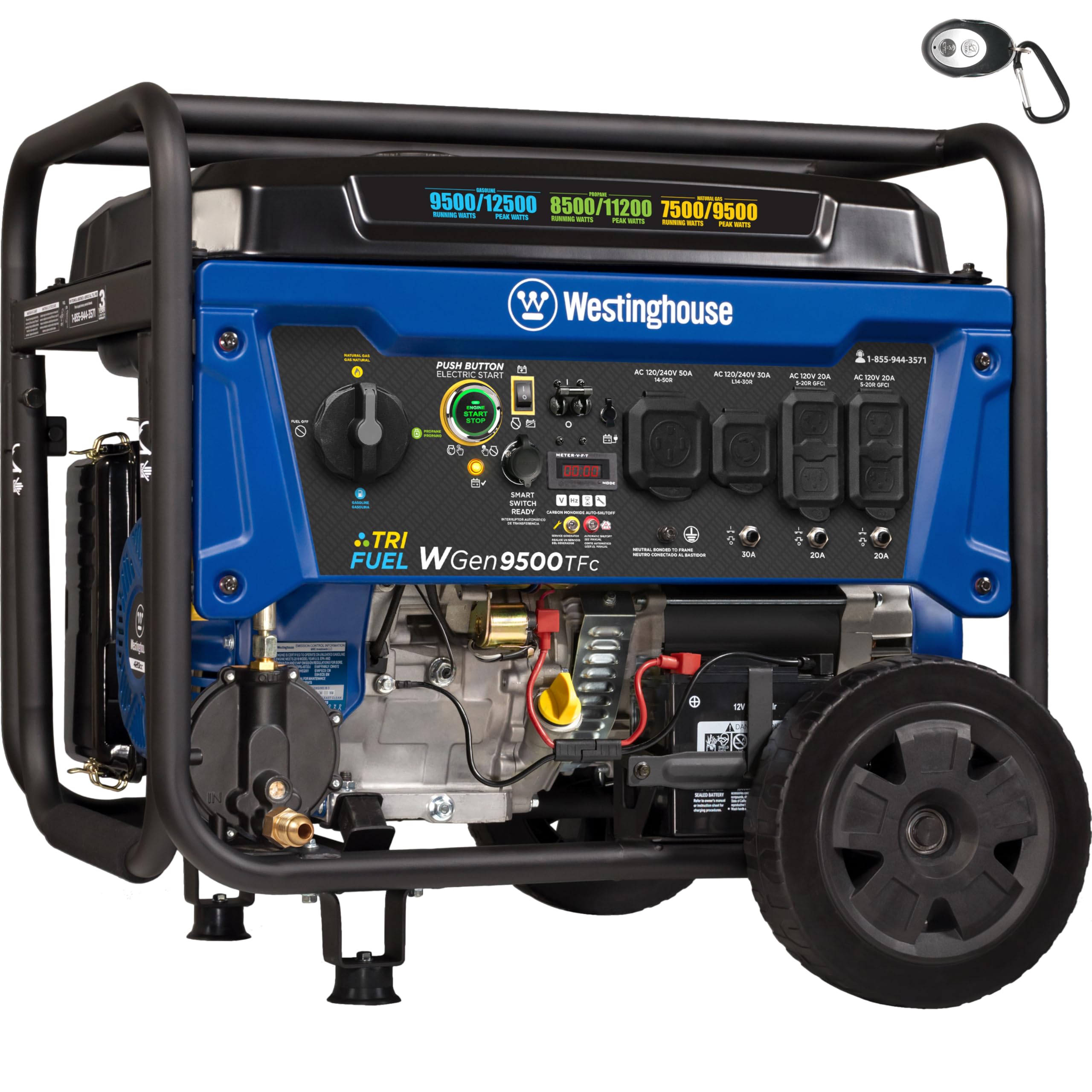
1. Westinghouse 12500 Peak Watt Tri-Fuel Home Backup Portable Generator
Our pick — over 4.5★ from 1,500+ verified ratings; the strongest balance of quality and price.
Three fuels, a key fob, and enough grunt to keep a 4,000 square foot house running.
If your outage plan involves a permanently piped gas line, this is the pick that makes the most sense. On gasoline it makes 12,500 peak watts and 9,500 running watts. Switch to propane and you get 11,200 peak with 8,500 running. On natural gas it delivers 9,500 peak and 7,500 running watts — that is the column to read twice if you intend to plumb this into your home’s gas supply. A 6.6 gallon fuel tank with a built-in gauge carries it for up to 12 hours of run time.
The 457cc Westinghouse four-stroke engine uses a cast iron cylinder sleeve, which is the part designed to take the wear over years of use. It shuts itself down automatically if oil runs low or if the carbon monoxide sensor detects fumes. Starting is a key fob, a push button, or a recoil pull — your choice, and the key fob matters when the machine sits outside in the rain and you would rather not walk out to it.
What wins people over is the build. The Westinghouse tri-fuel unit leads this whole list on owner satisfaction, with the most-discussed thing being overall quality, and performance close behind. Owners routinely describe wiring it into a home and having it carry the load without complaint. As one buyer put it, describing a 4,000 square foot house on a 220V 50A circuit plumbed to natural gas: “Ran flawlessly 3 days, powered everything incl. heating; propane also fine.” That is a real outage, not a test run.
Where it pulls ahead
- Three fuel sources on one machine: gasoline, propane, and natural gas
- Remote key fob start plus electric and recoil backup
- Automatic CO shutdown and low-oil shutdown built in
- Plug-and-play kit includes key fob, battery charger, oil, and funnel
Where it asks something of you
- 215 pounds — plan the wheel install before it comes off the truck
- Natural gas output is lower than gasoline, so size your loads to the gas column if that is your primary fuel
- Factory testing can leave a faint fuel or oil odor on arrival
Reach for this if: you have a natural gas line at the house and want one machine that covers all three fuel scenarios without a permanent install.
Think twice if: you need to move it by hand regularly — at 215 pounds it is a two-person job until the wheel kit is on.
2. Pulsar G12KBN-SG Heavy Duty Portable Dual Fuel Generator
An 8 gallon tank and a whole-house load capacity, without the premium price tag.
Here is the number that separates this Pulsar from the Westinghouse gas-only model below: fuel capacity. The Pulsar carries 8 gallons against the Westinghouse unit’s 6.6 gallons, and it gives you up to 12 hours of continuous operation at half load on gasoline. It also runs on LPG, producing 10,800 peak watts and 8,550 running watts on propane versus 12,000 peak and 9,500 running on gasoline. The 457cc single-cylinder four-stroke engine with electric start sits inside a powder-coated frame.
Outlets are generous here: four 120V 20A sockets, a 120V/240V 30A twist-lock, a 120V/240V 50A outlet, and a 12V DC output. That 50 amp outlet is what lets an owner feed the house panel directly. It is physically the largest machine in this group, at 28.5 inches long by 26 inches wide by 25.5 inches tall — worth measuring your shed door before it arrives.
Owners of this Pulsar talk about years of dependable service rather than feature lists. The generator powers a 2,600 square foot house plus a large air conditioner, a fridge, a freezer, lights, TVs, and a microwave at the same time, and one reviewer noted running it 16 hours on a single tank. Assembly runs about 15 minutes and the tank is metal with a fuel gauge. The honest catch is the break-in routine — three oil changes before you trust it — and the noise, which is loud even though owners say it is quieter than the smaller unit they replaced.
The value read: for a dual-fuel machine with an 8 gallon tank, a 50 amp outlet, and a 4.6 star score, you are getting the whole-house formula without paying tri-fuel money.
Best fit: a household that wants propane backup capability and the longest run time between refills.
Hold off if: you need natural gas from the pipe — this one stops at gasoline and LPG.
3. All Power America 12,000 Watt Gasoline Powered Portable Generator
The straightforward gasoline machine for buyers who just want the lights back on.
There is nothing complicated about this one, and that is the point. It makes 12,000 watts from a 459cc four-stroke engine on gasoline only, with electric start, a battery, a wheel kit, and an hour meter in the box. No propane plumbing, no gas-line connection, no fuel selector knob. If you already keep gas cans for a mower or a snowblower, this fits the routine you have.
Weighing in at 233 pounds on a 29.4 by 20.1 by 28.7 inch frame, it is not a machine you lift — the included wheel kit is the answer. Owners describe unwrapping it, adding oil, and having it fire on the first attempt, then powering most household appliances smoothly. One buyer runs a 30 amp circuit off it and got 10 hours of runtime during a three-day outage.
The one detail to take seriously comes from the oil fill plug, which a buyer reported rattling loose on both uses — a reminder to torque it firmly and check it every time you run the machine. This is also the smallest-sample pick here, and one review describes a rough ownership experience with repeated rebuilds, so treat a used or long-stored unit with more caution than a new one.
One thing to know: the 29.4 inch length is the shortest frame in this lineup, so it tucks into a tighter corner of a garage than the Pulsar or DuroMax units.
Built for: budget-minded buyers who want gasoline-only simplicity and a smaller footprint.
Not your machine if: propane or natural gas flexibility is on your list, or if you want a long track record to lean on.
4. Westinghouse 12500 Peak Watt Home Backup Portable Generator with Auto Choke

A 500cc tri-fuel machine with a 50 amp transfer-switch outlet and a built-in fume shutdown.
The DuroStar DS13000MXT makes 13,000 watts from a 500cc four-stroke OHV engine — the largest displacement in the tri-fuel group here, matching the DuroMax XP13000HXT. It burns gasoline, propane, or natural gas, and it switches between them with a fuel selection knob on the panel rather than a hose swap. Starting is push button or remote, with recoil as a backup. A transfer-switch-ready 50 amp outlet is on the panel.
CO Alert is the feature worth understanding before you buy. A carbon monoxide sensor watches the air and shuts the generator down automatically if it detects dangerous fumes, which is the same safety concept as the CO shutdown on the Westinghouse units and the CO Shield on the Champion. This is a safety cutoff, not a substitute for running the machine outdoors — the manual is clear on placement and so should you be.
Owners describe it handling a whole house with a 1.5-ton air conditioner, a split unit, fridge, stove, microwave, TVs, and a water heater, with a slight strain only when the main AC kicks in. Monthly test runs start reliably. Two things to weigh: the 30.5 inch frame is wide, and one owner reports the CO alarm tripping a shutdown within 20 minutes even in open air with no obstructions. That is a single case and it may be a sensor issue rather than a design flaw, but if you buy this and see the same pattern, contact support before you assume it is your setup.
The bottom line: you get tri-fuel flexibility and CO Alert protection at a mid-range tier, with the largest engine here outside the Champion V-twin.
Take this home if: you want tri-fuel plus an automatic fume shutdown, and you have the width in your storage spot for a 30.5 inch frame.
Reconsider if: you want the smallest footprint available — the Pulsar PG12000B is 21.8 inches wide.
5. Pulsar 12,000W Dual Fuel Portable Generator with Switch & Go Technology

Fuel switching without a shutdown, and the lightest frame in the gasoline-and-propane group.
Switch & Go is the feature that sets this Pulsar apart. You flip the fuel selector between gasoline and propane and the machine keeps running — no shutdown, no restart. On gasoline it produces 12,000 peak watts and 9,500 running watts; on LPG that drops to 10,800 peak and 8,550 running watts, from the same 457cc OHV engine. Pulsar states it is CARB approved and it carries a three-in-one digital meter on the panel.
The practical advantage is size and weight. At 209 pounds and 28.5 by 21.8 by 22.2 inches, it is the only machine in the dual-fuel group under 22 inches wide, and it ships with drop-down handles and 10 inch never-flat wheels. Those solid wheels matter because you are not chasing air pressure in a wheelbarrow tire every few months. It has four 120V outlets, a 120/240V twist-lock, a 120/240V 50 amp RV outlet, and a 12V DC output.
Buyers report running everything from a whole house on a 100 pound propane tank to an off-grid solar battery bank, and the propane performance holds up in real outages. The trade-offs are honest and expected: it is loud, it is heavy, and it is not an inverter, so it does not have the low total harmonic distortion that sensitive electronics want. A pair of 20 pound propane tanks will freeze within one to two hours under load, so size up to 40 pound tanks if you plan to ride out a long outage on propane.
Note on the outlet setup: that 50 amp RV outlet and a max current rating of 43.75 A make home panel feeding possible with the right interconnect hardware.
Suits: owners who want dual-fuel without giving up storage space, and who like the idea of switching fuels mid-run.
The catch to plan around: no inverter-grade power for sensitive electronics, and you will want 40 pound propane tanks over 20 pound ones.
6. Westinghouse 12500 Peak Watt Dual Fuel Home Backup Portable Generator

The dual-fuel Westinghouse that carries a 100 amp home on a key fob press.
Owners gravitate to this one for the combination of gasoline and propane without the natural gas plumbing requirement. Numbers: 9,500 running watts and 12,500 peak watts on gasoline, 8,500 running and 11,200 peak on propane, from the 457cc Westinghouse four-stroke engine. The 6.6 gallon tank carries up to 12 hours of run time with a fuel gauge. Remote key fob start plus electric and recoil backup, and the automatic CO and low-oil shutdowns are present here as on every Westinghouse unit.
The dimensions and weight match the tri-fuel Westinghouse closely: 27.2 by 26.1 by 26.5 inches at 212.1 pounds, so whether you pick the tri-fuel or dual-fuel version, the storage footprint is the same and the wheel kit does the same job. You get the same 50 amp and 30 amp outlets with rubber covers, plus the same hour meter and automatic voltage regulation.
What surprised owners most here is how far the power goes. One owner runs an entire 100 amp home with an air conditioner off the 50 amp output and reports the machine never complains. The recurring gripes are the ones that show up on all wheeled Westinghouse portables: the machine is noisy in the way a gas lawnmower is, and at around 200 pounds you want a second person until the wheels and feet are bolted on. The manual and quick-start guide both need reading before that first start — the instructions assume more mechanical familiarity than some buyers have.
Why it holds up over time
- Propane flexibility without natural gas infrastructure
- Runs a 100 amp home on the 50 amp outlet
- Remote start plus electric and recoil backup
- Same frame and wheel kit as the tri-fuel Westinghouse
What to plan for
- Noisy under load, like any open-frame machine
- Heavy enough that the wheel install should be a two-person job
- Gasoline-to-propane output drop means sizing loads to the propane column matters
Solid pick for: propane-and-gasoline households that want maximum output on a key fob.
Not the one if: your plan depends on piped natural gas — that requires the tri-fuel version.
7. Champion 12,500-Watt Electric Start Tri Fuel Home Backup Portable Generator

Both fuel hoses in the box, a 500cc engine, and the fastest starts in the tri-fuel group.
Champion ships this one ready to run on anything — natural gas and propane hoses are both included, so you are not buying a regulator kit afterward. The output ladder: 12,500 starting watts and 10,000 running watts on gasoline, 11,250 starting and 9,000 running on propane, and 10,000 starting with 8,000 running on natural gas, all from a 500cc engine. Electric start runs off a rocker switch with the battery included.
The Intelligauge is the panel to watch: it tracks voltage, frequency, session run time, and total run time, which is how you know when maintenance is due instead of guessing. CO Shield is Champion’s version of the carbon monoxide auto-shutoff. It also has a fuel gauge. The whole package weighs 231 pounds on a 29 by 28.5 by 25.8 inch frame.
Starting is what owners mention most about this generator, and how quickly the first press catches even on propane in cool weather. Assembly takes about half an hour — wheels, stands, battery, oil — and then a buyer fired it immediately on propane. The honest caveat is quality control on the hardware: one owner had the entire operator panel come loose during break-in, with three of four mounting nuts missing, and another found the bottom frame slightly bent near the wheel bracing. Those are individual cases rather than a pattern across all units, but they are worth checking on delivery day before the return window closes.
Quick take: the two-included-hoses detail is the quiet advantage — most tri-fuel machines make you buy the natural gas line separately.
Choose this when: you want tri-fuel with all the plumbing in the box and a 10,000 watt gasoline running figure.
Inspect carefully if: you are sensitive to assembly quality — check the operator panel bolts and frame bracing the day it lands.
8. DuroMax XP12000E Gas Powered Portable Generator

MX2 outlet logic and an idle-down mode, built for intermittent power on a work site.
MX2 technology is the DuroMax feature worth understanding: it lets you pull full power from each 120 volt receptacle individually, or run 120V and 240V at the same time. If you need to run a 240V welder and a standard 120V grinder off the same machine, that flexibility is the reason to buy this one. It makes 12,000 starting watts and 9,500 running watts from a 457cc DuroMax OHV engine on gasoline. The idle control drops engine RPM when nothing is drawing power, which saves fuel and cuts noise on jobs where the load comes and goes.
Owners run this one hard in exactly that setting. One buyer has been running it six days a week, eight hours a day at around 80 percent load, with clean oil at 30-day change intervals and no problems to report. Another has powered a 1.5 horsepower 520 foot deep well off-grid for two years, getting roughly 10 hours per tank. The 200 amp house on a 3-ton HVAC surge also gets handled, per another owner. It weighs 217 pounds on a 30 by 30 by 26 inch frame with electric and recoil start.
The recurring frictions are worth knowing before you buy. The solid-filled tires develop flat spots when the machine sits, which makes it harder to roll. The engine is loud, as expected in this class, and several owners mention the battery is awkward to reach for maintenance. The one that matters most is support: some owners wait a long time on hold and describe slow responses, though one buyer who needed a starter replacement got a free one shipped in four to seven days with no hassle. If support speed is high on your list, factor that in.
Note on longevity: one owner reports this machine sat unused for four years with no oil, fuel, or battery, then started on the pull rope and ran the fridges and freezer fine once fuel was added.
Worth it if: you want MX2 outlet flexibility and idle-down fuel savings on a work site or homestead.
Steer clear if: you need dual-fuel or tri-fuel capability — this one is gasoline only.
9. DuroMax XP13000HXT 13,000-Watt 500cc Tri Fuel Portable Generator with CO Alert
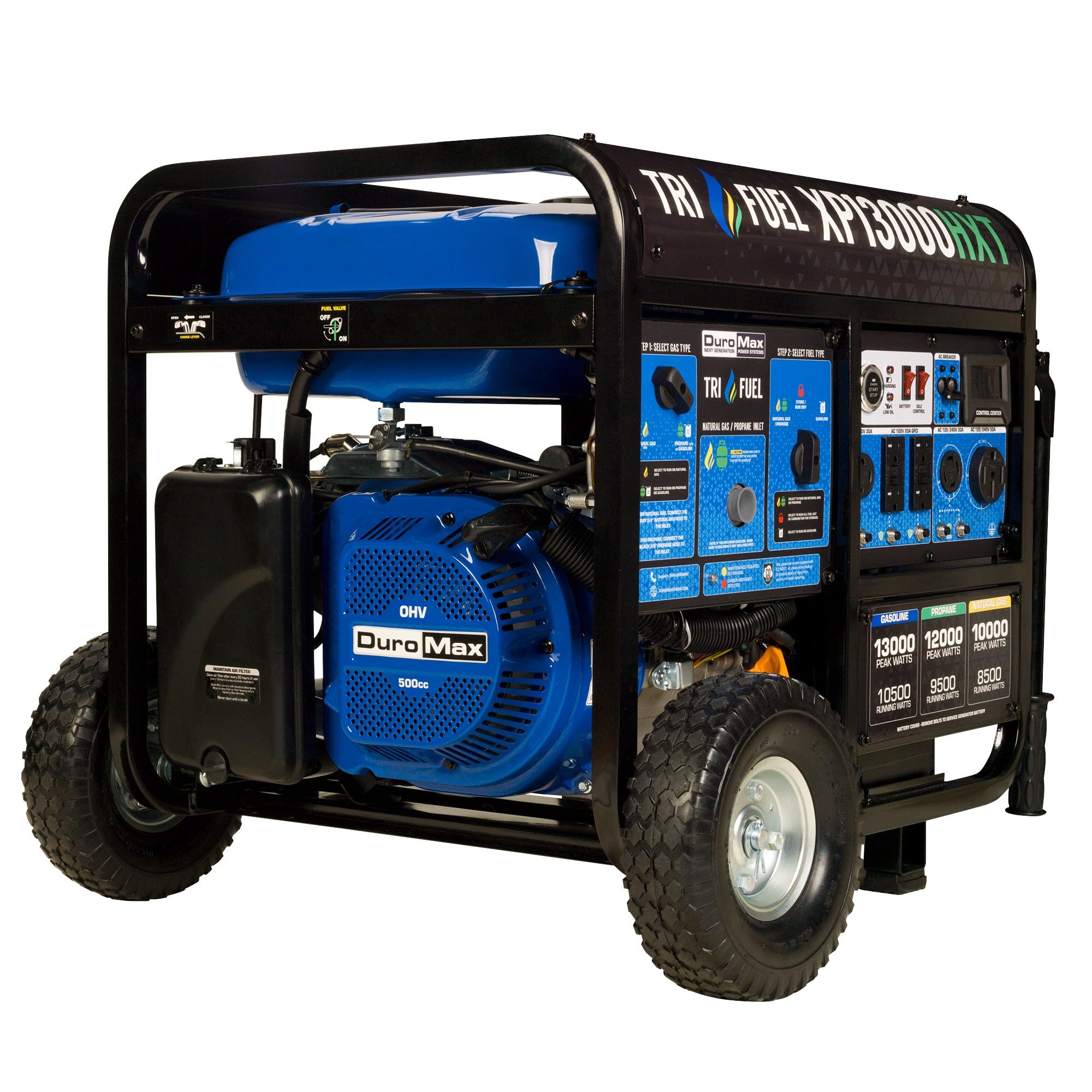
A 500cc tri-fuel flagship with a 50 amp outlet, digital gauge, and both hoses in the crate.
This is the top of the DuroMax tri-fuel line, making 13,000 watts from a 500cc OHV engine. It runs gasoline, propane, or natural gas, with the fuel type changed at a front-facing panel in seconds rather than by re-plumbing hoses. Starting is push button or remote. A transfer-switch-ready 50 amp outlet handles home panel feeding, and the included components list is the most complete here: a 15-foot by 3/4-inch natural gas hose, a propane regulator, a spark plug wrench, tool set, wheel and handle kit, oil funnel, and remote control.
The digital display is a real upgrade over an analog panel — it shows output and lets you monitor the machine without walking around it. CO Alert is the carbon monoxide auto-shutoff, same concept as the other tri-fuel models. It weighs 240 pounds, the heaviest machine in this group outside the Champion V-twin, on a 30 by 30 by 26 inch frame that matches the DuroMax XP12000E footprint.
The catch on the natural gas side is worth planning for: piped natural gas delivers lower pressure than a propane tank, so this machine pulls a substantial volume of gas at full load and wants a 3/4 inch supply line. Owners who have it set up on a proper line report running a small air conditioner, two fridges, lights, and computers at around 60 percent load without strain. One buyer compared the setup cost favorably against a permanently installed home standby unit, citing the flexibility to fall back on propane or gasoline if the gas line ever fails.
Where the premium goes
- 500cc engine with the highest tri-fuel output in the DuroMax line
- Natural gas hose, propane regulator, and remote all included
- CO Alert automatic fume shutdown
- Front-facing fuel selector changes fuel type without a shutdown
What you accept
- 240 pounds — the heaviest frame in most of this lineup
- Wants a 3/4 inch natural gas supply line to run full load cleanly
- Engine oil is not included in the box
Best for: buyers who want the highest tri-fuel output plus the most complete included kit and expect to wire it into a home panel.
Overkill if: you only need dual-fuel, or your gas line runs smaller than 3/4 inch.
10. Westinghouse 12000 Peak Watt Dual Fuel Portable Inverter Generator
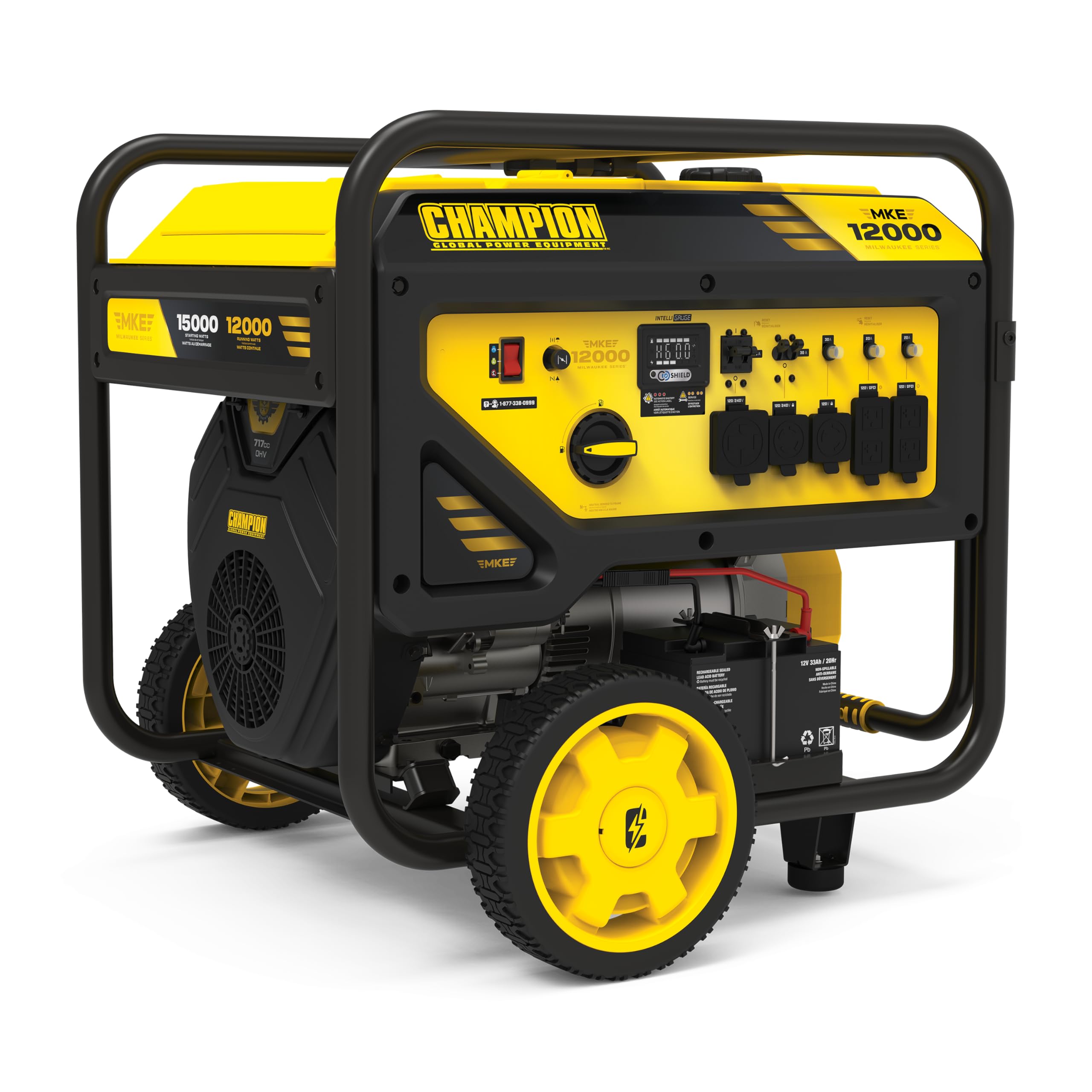
A 717cc V-twin that outmuscles everything here, with a lift hook built for transport.
If your household load is genuinely large — multiple air conditioners, a well pump, a shop, or a camper setup — this is the ceiling of the lineup. It produces 15,000 starting watts and 12,000 running watts on gasoline from a 717cc Milwaukee Series V-twin engine, which is the largest engine and the highest output here. Run time is up to 9 hours on a full tank, and the noise figure is given as 78 dBA from 23 feet. Electric start runs off a toggle switch with the battery included, and Champion builds in Cold Start Technology for easier starts in cold weather.
The panels and safety hardware are built out: one 120V 30A locking outlet, a 120/240V 30A locking outlet, a 120/240V 50A outlet, and four 120V 20A GFCI outlets. Volt Guard is Champion’s built-in surge protector, which cuts the generator before overloads reach your appliances. The lift hook is the detail that matters most at this size — at 332 pounds on a 33.7 by 33 by 33.1 inch frame, you are not wheeling this into a truck bed by hand, and the lift hook is how you load it safely with equipment.
Owners run it in demanding settings: a camper gets nearly 12 hours on a tank, and another owner says it has kept heat and running water going through a four-day ice storm outage. It has also powered a dryer, a washer, 220V MIG welders, and chop saws. Two honest notes: it is the loudest machine here on paper, and one owner had a failure under a year with a dead display and reported difficulty getting the warranty resolved, while another replaced diaphragm fuel pumps before wiring in an electric fuel pump. This is also the smallest review sample in the lineup, so weigh that.
One spec to know: this is not an inverter generator, so it does not carry the sub-3 percent THD rating the Westinghouse inverter models have — check your sensitive electronics before plugging into it.
Right for: camper setups, shops, and large homes that need the most watts per machine and have a way to lift it.
Not worth it if: you want quiet operation or low-distortion power for sensitive electronics — quieter inverter options above serve that better.
Understanding the Specs
Peak Watts vs Running Watts
Peak watts is the short burst a generator can produce for a moment, usually when a motor first spins up. Running watts is what it holds steady, hour after hour, which is what actually powers your house. A machine listed at 12,500 peak watts usually runs at 9,500 to 10,000 watts continuously, which is the number to use when you are adding up what your home draws.
Fuel Type and Output
Every tri-fuel generator in this guide produces its highest numbers on gasoline and its lowest on piped natural gas, with propane in the middle. That drop is real — the gas line delivers lower pressure than a propane tank. If natural gas is your main fuel, plan around the lower output figure rather than the gasoline headline number.
Total Harmonic Distortion (THD)
THD measures how clean the electrical wave is. Inverter generators hold it at or below 3 percent, which is the threshold where laptops, TVs, and appliances with circuit boards are considered safe to plug in. Traditional open-frame generators run much higher and can damage sensitive electronics, so if you have a home office or a lot of smart devices, that THD figure is a deciding spec, not a detail.
Carbon Monoxide Shutdown and Transfer Switch Wiring
A CO sensor shuts the generator down automatically if it detects dangerous fumes, and every model here except the All Power America unit includes one. A transfer switch or interlock kit is a dedicated panel that lets you feed generator power into your home’s wiring instead of running extension cords, and every tri-fuel pick here has a 50 amp outlet ready for that connection. A licensed electrician should make the actual panel connection.
FAQ
What size generator do I need to run my whole house?
Will a 12 kW generator run a central air conditioner?
Is propane or natural gas better for a backup generator?
Do I need a transfer switch to use a portable generator for home backup?
What is THD and do I need an inverter generator?
How long can a 12 kW generator run on a full tank?
Are these generators safe to run indoors or in a garage?
What is the difference between dual fuel and tri fuel?
How heavy is a 12 kW generator and can one person move it?
Do I need to break in a new generator before using it for an outage?
Final Thoughts: The Verdict
For most homes, the 12 kw generator winner is the Westinghouse 12500 Peak Watt Tri-Fuel because it covers all three fuel scenarios, includes the key fob start and CO shutdown, and carries the strongest owner-backed reputation in this group. If your goal is to spend less while still getting a dual-fuel machine with a larger 8 gallon tank, grab the Pulsar G12KBN-SG. And for a home full of sensitive electronics where quiet operation matters most, the Westinghouse iGen12000DFc inverter is the one to reach for. Whichever fuel setup you pick, match the output to the fuel you will actually burn, and the machine will earn its space in your garage.
How We Picked
We do not accept paid placement. Every pick is matched to a real buyer and a real use-case; we do not hands-on test units.
Sources & Methodology
Specifications: manufacturer listings and product documentation. Review insights: verified customer reviews, as of September 2026. Pricing: not shown on this page (it changes often); check the current price via the retailer link.
As an Amazon Associate, KitchPrep earns from qualifying purchases. This does not affect which products we feature.
Related Guides
