
Specs are compiled from manufacturer listings and verified buyer reviews and can change over time — please confirm the key details on the product page before buying.
A humidity-sensing bath fan is meant to run itself — it detects the steam, turns on, and shuts off once the room dries out. The catch is that sensors are calibrated differently across brands, some fans are far louder than their marketing implies, and a few models quietly need extra wiring before the sensor will work at all. This guide ranks eight humidity-sensing fans by how they behave in a wet room, not by how they look on a spec sheet.
I’m Mohammad Maruf — the founder and writer behind KitchPrep. This guide is built by comparing the manufacturers’ published specifications and the patterns across verified customer reviews, so you get each pick’s real strengths and trade-offs instead of marketing spin.
The biggest mistake buyers make with a humidity-sensing exhaust fan is assuming the sensor is plug-and-play — many need a three-switch setup or a dedicated wire before the auto mode does anything. That one detail decides whether your best bath fan with humidity sensor earns its keep in a steamy room.
Our Picks at a Glance

How To Choose The Best Bath Fan With Humidity Sensor
A humidity-sensing fan is really three decisions in one: how much air it moves, how loud that air movement sounds in a tiled box, and whether the sensor will switch the fan on without you ever flipping a wall plate. Get the airflow wrong for your room size and the mirror stays fogged; get the loudness wrong and you will not use it; get the sensor wiring wrong and it becomes an ordinary fan with a useless box attached.
Match the CFM rating to the bathroom’s square footage
CFM means cubic feet per minute — the volume of air the fan pushes out of the room each minute. As a working rule of thumb in the trade, you want roughly one CFM for every square foot of bathroom floor that actually gets steamy. A 110 CFM fan comfortably handles a mid-size bathroom, while a 70 CFM unit suits a small powder room or shower stall you do not want to overpower. In this lineup the OREiN moves 160 CFM for the largest spaces, and the Delta BreezSlim is the opposite end at 70 CFM for tight rooms.
Understand the sone rating before you buy
A sone is a unit of perceived loudness — one sone is roughly the sound of a quiet refrigerator hum, and every extra sone is noticeable, especially in a hard, tiled room that bounces sound around. A fan rated under 1.0 sone disappears into the background; a fan at 2.5 sones starts competing with the shower itself. If you are installing right above where you stand, treat the sone number as seriously as the airflow.
Check your duct size and your wiring first
Most humidity fans want a 4-inch duct, and if your old fan used a 3-inch line you will likely need a reducer before the new housing connects cleanly. Wiring matters just as much: several sensors here only run automatically when the fan is fed constant power on its own wire, so a house with just one hot line to the old fan may need a sparky before the auto mode works.
Quick Comparison
| Model | Best For | Airflow (CFM) | Noise (Sones) | Sensor Trigger | Amazon |
|---|---|---|---|---|---|
| Panasonic WhisperSense FV-0511VQC1★ Best Overall | Overall best pick, small to mid bathrooms | 50 / 80 / 110 CFM | < 0.3 sone | Humidity + motion | Amazon |
| Panasonic WhisperFit FV-0511VFC1Premium Retrofit | Retrofit with attic access | 50 / 80 / 110 CFM | Not listed | Condensation sensor | Amazon |
| OREiN OL17003Most Powerful | Large bathrooms wanting one all-in-one unit | 160 CFM | 1.0 sone | Humidity above 60% | Amazon |
| breez Delta GreenBuilder GBR80HLED | Quiet operation with a dimmable light | 80 CFM | 0.8 sones | Humidity sensor | Amazon |
| Tech Drive Bathroom Fan | No-attic-access replacement installs | 110 CFM | 1.5 sones | Humidity above 60% | Amazon |
| Delta BreezSlim SLM70H | Tight ceilings and small openings | 70 CFM | 2.0 sones | Humidity above 60% | Amazon |
| VIVOHOME Bathroom Exhaust Fan | Budget-friendly full kit for DIY | 110 CFM | 1.0 sone | Humidity above 55% | Amazon |
In‑Depth Reviews
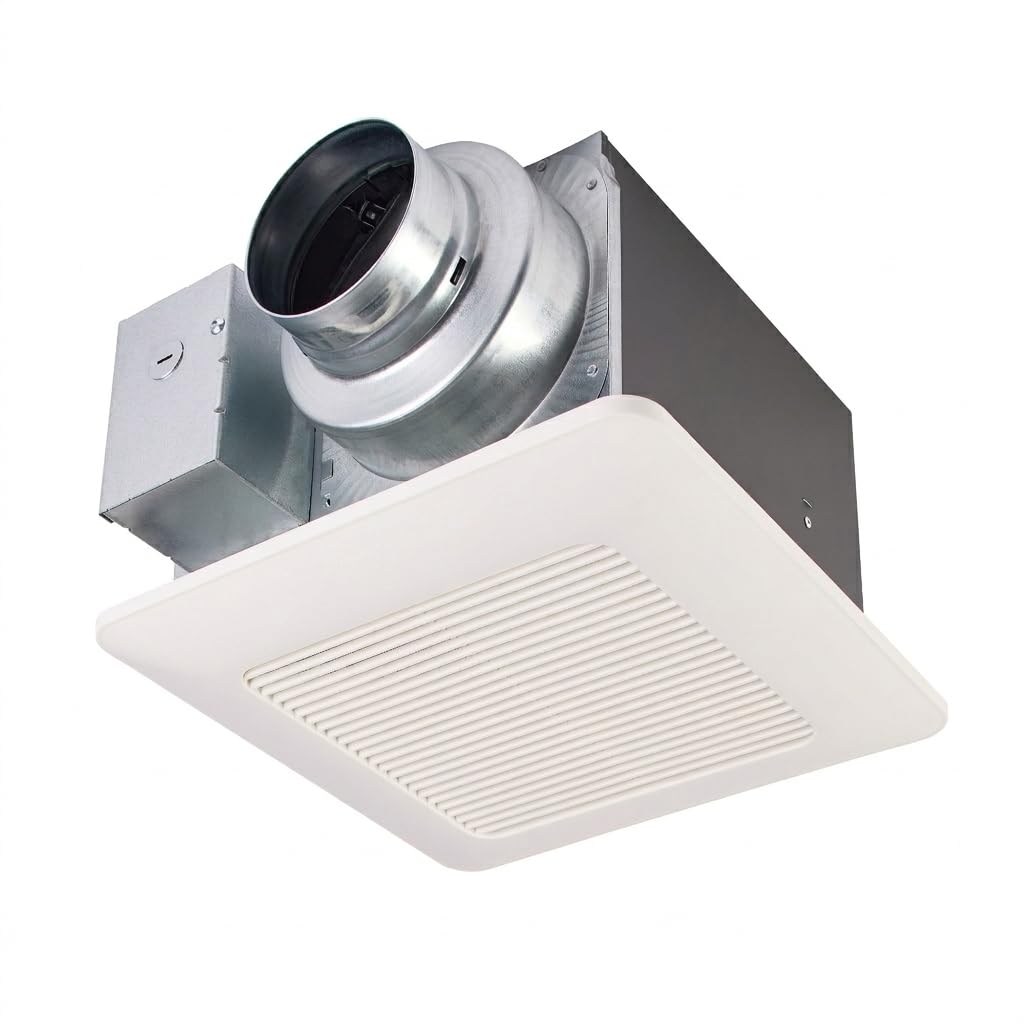
1. Panasonic FV-0511VQC1 WhisperSense Fan, Motion + Humidity Sensor, 50-110CFM
Our pick — over 4.5★ from 450+ verified ratings; the strongest balance of quality and price.
Two sensors and a whisper motor — the quietest way to stop babysitting a bathroom switch.
If your guest bath sits unused for days and then gets hammered by a long shower, this is the fan that handles both jobs without a hand on the wall plate. The motion sensor turns the fan on when someone walks in, and the humidity sensor takes over when the steam arrives. Together they cover the two ways a bathroom fan normally gets forgotten — nobody flips the switch, or everybody does and then leaves it roaring for an hour.
What wins people over is how quiet it runs. It is rated below 0.3 sone — for comparison, a fan rated at 2.0 sones is the kind you can hear from the next room, so this one basically vanishes into the tile. The Pick-A-Flow selector lets you dial the same fan down to 50 CFM for a small bath or up to 110 CFM for faster clearing, so a 5 by 8 guest bath and a bigger master can share the same model. Buyers report the humidity mode kicking in fast: “Turn on, turn off, turn on and automatic moisture mode engaged.”
The 4-inch outlet is worth checking before you buy, since a 3-inch duct needs a reducer, and the mounting bracket is designed for installation from above with attic access rather than from below with a floor above. One recurring gripe is the motion sensor overreacting — it can catch movement from an adjacent room and hold the fan on, and angling the door-side sensor away fixes it. The humidity side also wants a bit of patience, since it may cycle on and off in quick bursts until the set point settles.
Why This Wins the Top Slot
- Under 0.3 sone, so the fan is inaudible outside the room while still moving 110 CFM at full tilt.
- Two sensors in one housing cover both the just-walked-in and the just-showered scenarios.
- Pick-A-Flow lets one model serve 50, 80, or 110 CFM by room size, so you can order the same fan for every bath in the house.
Before You Order
- The bracket is built for top-down installs with attic access; a below-ceiling retrofit needs a different mounting plan.
- The motion sensor can be tripped by movement just outside the doorway until you angle it away.
- A 3-inch duct line needs a reducer before the 4-inch outlet connects.
Best for: Anyone who wants the fan to run itself in a bathroom that gets used in short, unpredictable bursts — and who has attic access for installation.
Think twice if: Your old fan was mounted from below with a finished floor above, or your duct is 3-inch, since both cases add work to the swap.
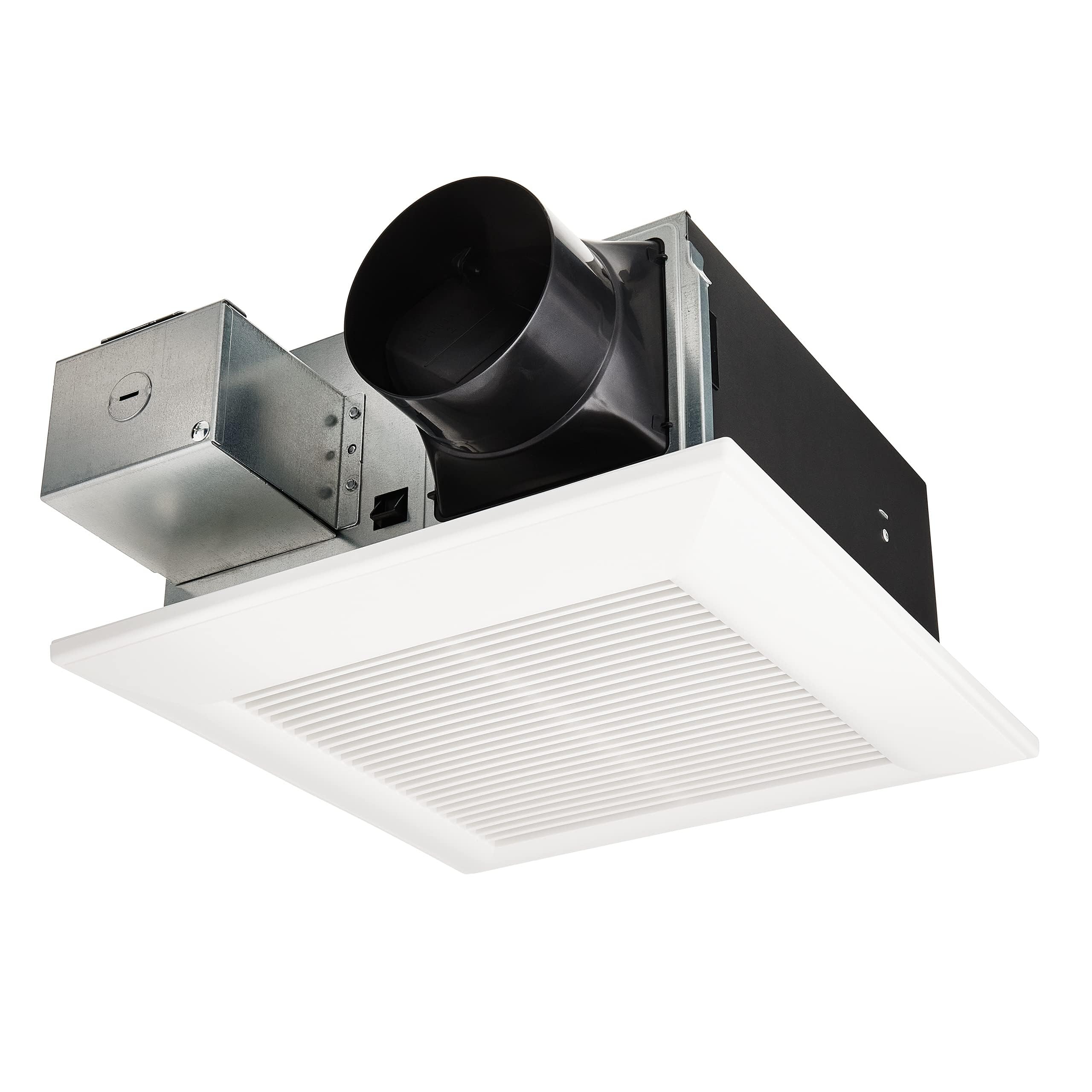
2. Panasonic FV-0511VFC1 WhisperFit Bath Fan + Humidity Sensor, 50-80-110 CFM
Built for the swap-in job: a slim housing that slips into tight joist bays without tearing up the ceiling.
Panasonic’s WhisperFit line exists for one reason — replacing an old fan in an existing ceiling without a full remodel. The housing is 5-5/8 inches deep, shallow enough to sit in a 2 x 6 joist bay or larger, and the Flex-Z Fast bracket is a single-hinge arm that swings the body into position. If your bathroom is in a wall of joists and you have a hatch to reach them, this is the shape that fits.
The sensor here is a condensation sensor rather than a plain humidity meter, and it drives a 20-minute delay auto timer, so the fan keeps pulling air after the shower cuts off instead of quitting the moment the steam clears. You can toggle the airflow between 50, 80, or 110 CFM with a switch on the unit, so the same model suits a small powder room and a larger bath. The DC/ECM motor is the field-proven Panasonic powertrain that makes the whole line so quiet.
The honest catch is calibration. The stated plus-or-minus five percent humidity accuracy is optimistic in practice — owners mention the fan firing at 50 or 70 percent when set to 60, and one unit failed to trigger at 87 percent. If the humidity sensing is the entire reason you are buying, budget for some trial and error in finding the right set point. The top speed is also noticeably louder than the low speed, so if you need near-silent operation, plan around running it at 50 CFM.
What actually delivers: The retrofit fit and the 20-minute delay timer. The Flex-Z bracket means most of the work happens from inside the joist bay, and the delay keeps moisture moving out the duct after you have stepped out of the shower.
The trade-off: Sensor accuracy is looser than the spec implies, so treat the humidity set point as a starting point, not a promise. The airflow is also top-heavy — 50 CFM is whisper quiet, but 80 and 110 are noticeably louder.
Pick it when: You are replacing an old fan in tight joist framing and want the same make and motor as the top pick in a shape built for retrofit work.
Look elsewhere if: You need perfectly predictable humidity triggering right from the start, or you can only fit the housing from below.
3. OREiN 3-in-1 Bathroom Exhaust Fan with Light & Humidity Sensor, 160 CFM, 1.0 Sone
A whole-bathroom upgrade in one ceiling opening: 160 CFM, a dimmable-style LED, and a night light.
If your bathroom is on the roomy side — say a master with a double vanity — most small fans just take too long to clear the steam, and the mirror stays fogged after the shower ends. This one moves 160 CFM, the most airflow in this lineup, and it does it at 1.0 sone, meaning it sits at roughly the loudness of a quiet refrigerator rather than a small aircraft. For a big, damp room, that combination is the whole reason to spend on this tier.
The humidity sensor trips when the room passes 60 percent and runs the fan automatically, with a green LED confirming the auto mode is armed. Day to day you get a 1500-lumen LED main light with three color temperatures — 3000K, 4000K, or 5000K via a switch — plus a soft 2200K night light for the middle-of-the-night trips. That single fixture replaces both your old fan and your old ceiling light, and it draws one wire run instead of two.
The 160 CFM number is also a step up on quieter mid-size units — the Delta BreezSlim moves 70 CFM, for reference, so this one moves more than double that airflow — which makes it the right call for a larger room and the wrong call for a tiny powder room you would rather not blast. Buyers routinely mention the auto-sensing as the feature they actually notice: “Love the fact that it’s so quite and senses the humidity and turns it’s self on and off.”
Two things to plan for. The housing is heavier than a basic fan, so the manual’s instruction to anchor both sides is not optional — an installer who skimped on that pulled drywall down. And dimmer or timer wall switches will not work with this unit, so commit to the built-in light controls or plan around them.
What Earns It a Spot Here
- 160 CFM at 1.0 sone — the most airflow in the group while still qualifying as quiet operation.
- Built-in 1500-lumen LED with three color temperatures and a separate low night light, replacing two ceiling fixtures with one.
- Humidity sensor fires automatically above 60 percent, with a green indicator light to confirm it is armed.
- ENERGY STAR, HVI, ETL, and FCC certified, and backed by a 5-year limited warranty.
What To Know Up Front
- It is heavier than a standard bath fan, so both mounting sides have to be anchored per the manual.
- Dimming and timer wall switches are incompatible — the light controls live on the unit itself.
- At 160 CFM it is overkill for a tight powder room.
Worth choosing for: A larger, humid bathroom where you want one fixture to handle light, ventilation, and a night light — and you want it to switch itself on after a shower.
Not the one if: You have a small bathroom or a wall switch setup built around dimmers and timers.
4. breez Delta GreenBuilder GBR80HLED 80 CFM Exhaust Bath Fan/Dimmable LED Light with Humidity Sensor

A fan so quiet you may question whether it is on, plus an 850-lumen dimmable LED in the same opening.
Delta’s GreenBuilder series is the pick for people who hate fan noise above everything. At 0.8 sones it is one of the two quietest models in this lineup, and it pairs that silence with an LED module that puts out 850 lumens at 3000K — warm, bright, and dimmable. If your current fan sounds like a small engine every time you shower, the difference after the swap is the thing owners call out over and over.
Airflow is 80 CFM, sized for a bathroom up to 80 square feet, and the sensor triggers automatically when humidity rises. If you are downsizing from a noisier 110 CFM unit, the trade is less rush and far less racket. Where this really shines is in a room you use several times a day — the fan disappears into the background, so you actually leave it in auto mode instead of switching it off because it grates on you.
The wiring has one quirk worth knowing: the light, fan power, and sensor mode are meant to run on separate wires, so a single-switch bathroom needs planning. Several customers note that the humidity sensing mode defaults to around 60 percent and 50 CFM unless you add a specific timer switch. A few also notice a faint high-pitched tone when the sensor is in standby, audible only if you are directly under the grille. The dimmable LED is also warm-toned, so it will look different next to daylight bulbs if you mix them on one ceiling.
The reason to pick it: The silence plus the light. At 0.8 sones and 850 lumens, you get a fixture that lets you shower in quiet with warm even illumination, without a separate light fitting in the ceiling.
The detail to plan for: Three-wire installation is the expected setup. A single-switch bathroom can still run it, but the sensor may not have its own line without a switch change.
Reach for this if: You are finally replacing a loud builder-grade fan and want the quietest possible experience with a built-in light.
Look elsewhere if: Your existing wiring gives you one switch for both light and fan and you have no appetite for adding wiring.
5. Tech Drive Bathroom Fan with Humidity Sensor, 110 CFM, 4 Inch Duct
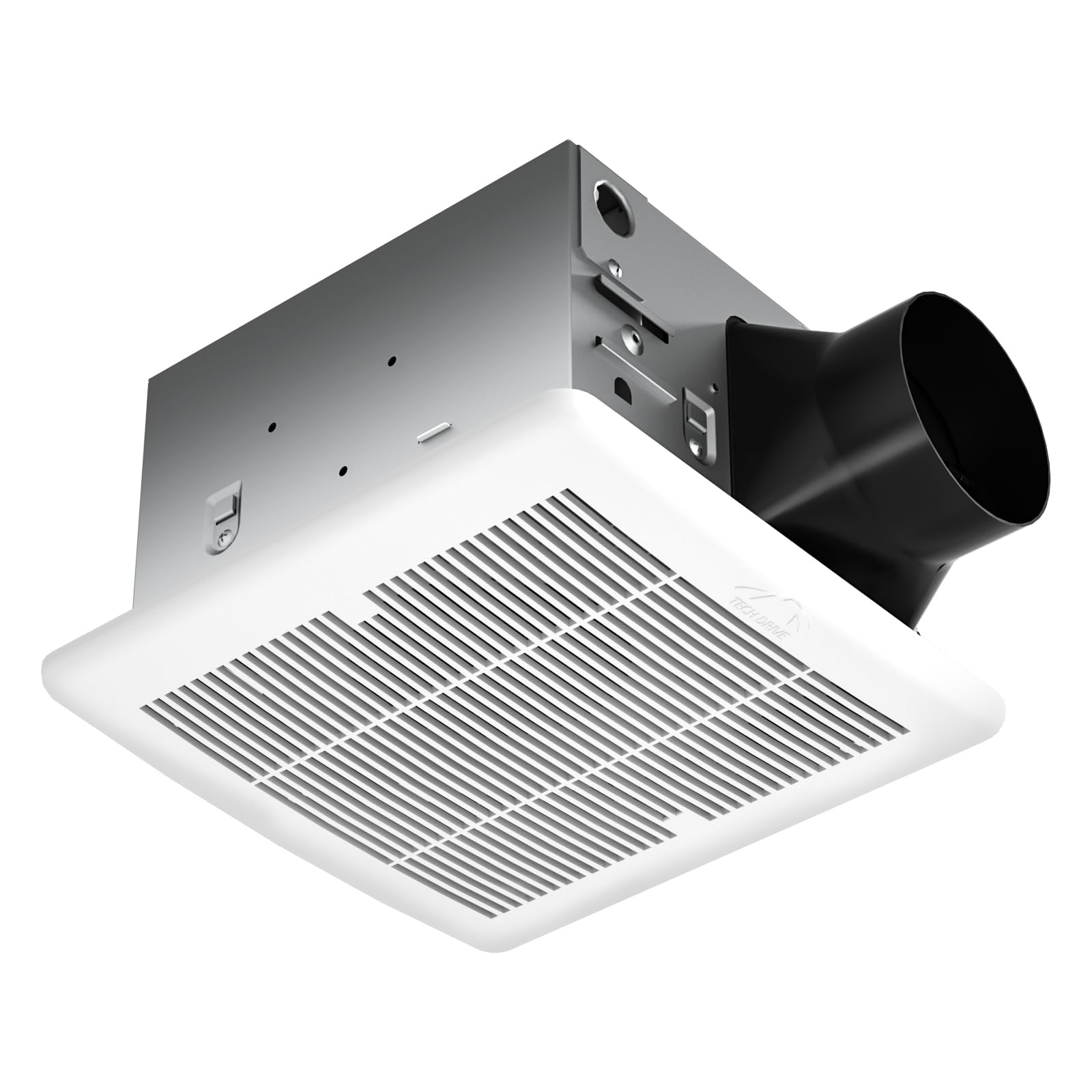
The one made for a bathroom with no attic above it — the entire swap happens from the floor side.
If your bathroom is on the ground floor with a bedroom above, or you simply have no crawl space to reach the old fan, most models in this lineup are ruled out on access alone. This one is explicitly built to be installed from the room-ceiling side, replacing most existing bathroom fans without a single trip into an attic. For a first-floor powder room, that is the whole reason to shortlist it.
Once installed, you get two modes and an easy read on which one is active — a red LED means the fan is running continuously in manual mode, and a green LED means the humidity sensor is armed. In sensing mode the fan kicks on above 60 percent humidity and off when the room drops back down. Airflow is 110 CFM at 1.5 sones, so it clears a large bathroom quickly. There is also a UL and HVI certified rating, plus an acceptable use over a tub or shower when the circuit is GFCI-protected.
Be honest with yourself about the sones here. Some owners find 1.5 sones surprisingly quiet and a few find it louder than expected, so if you can hear the fan from the next room on your current setup and you were hoping for whisper operation, you may want one of the sub-1.0 sone picks above. Reviewers point out it as a clear step up in reassuring ways: “Extremely quiet. Couldn’t be happier.” The 4-inch duct and a 9.25 by 8.9-inch ceiling opening matter too — check both against your old fan before ordering.
Where it is genuinely useful: Room-side installation. If you cannot get above the fan, this is one of the few models here that is designed for exactly that scenario.
What to weigh: The 1.5 sone rating is honestly middle of the pack — quieter than builder-grade, but noticeably louder than the sub-1.0 sone picks in this list.
Best suited for: Ground-floor bathrooms with no attic access, where the fan has to be swapped from below.
Not ideal if: Absolute silence is your number-one priority, or your old opening is not close to 9.25 by 8.9 inches.
6. Delta BreezSlim SLM70H 13.1W Exhaust Bath Fan with Humidity Sensor

Built for the opening you already have: a slim housing that slips between tight ceiling rafters.
When your ceiling cavity is barely wide enough for anything and your old fan grille is set into a stiff, awkward corner, most of this lineup will not go in. This Delta BreezSlim is the exception — a housing just 7.5 by 7.25 inches, with the manufacturer calling it the only 7.5 by 7.25-inch small bath fan on the market. If your existing opening is unusually compact, this is the model to start with.
It is rated to UL standards for both ceiling and wall mounting, so a bathroom where the only exhaust spot is above the mirror rather than overhead is still served. Airflow is 70 CFM, matched to a small bathroom or a shower-stall-sized space, and it runs with a brushless DC motor under the Energy Star program. Humidity mode kicks in above 60 percent and shuts off when humidity drops back below 60. Two LED indicator colors — blue for humidity sensing and amber for full speed — tell you what the fan is doing without any guesswork.
There is a real quirk to the humidity sensing worth knowing. Owners occasionally report the fan sticking on in humidity mode even after the room has dried, so if your bathroom is small and stays humid, plan to nudge the wall switch rather than trust it to shut off unattended. The reported performance and quiet operation are the parts that consistently land, and one owner even replaced their old fan with only a housing swap — same opening, same duct, no ceiling patching.
Why It’s Worth a Look
- Very slim footprint for tight ceiling rafters and existing small openings.
- UL approved for both ceiling and wall mount, which opens up spots other fans cannot use.
- Blue and amber LED indicator lights make it obvious whether the fan is in sensor mode or full speed.
- 0.9 CFM-per-watt energy efficiency and Energy Star qualification.
What to Accept Going In
- 70 CFM suits a small bathroom, not a large one — a bigger room needs a higher airflow pick.
- Shoppers say the humidity sensing mode occasionally runs longer than expected after the room has cleared.
- 2.0 sones is audible from the doorway on high speed.
The niche it owns: Tight ceiling spaces and awkward openings where nothing else in this lineup will physically go.
Not for you if: You have a large bathroom or want the fan to shut itself off the moment humidity drops without ever needing a manual nudge.
7. VIVOHOME Bathroom Exhaust Fan with Humidity Sensor 110CFM, Auto On/Off
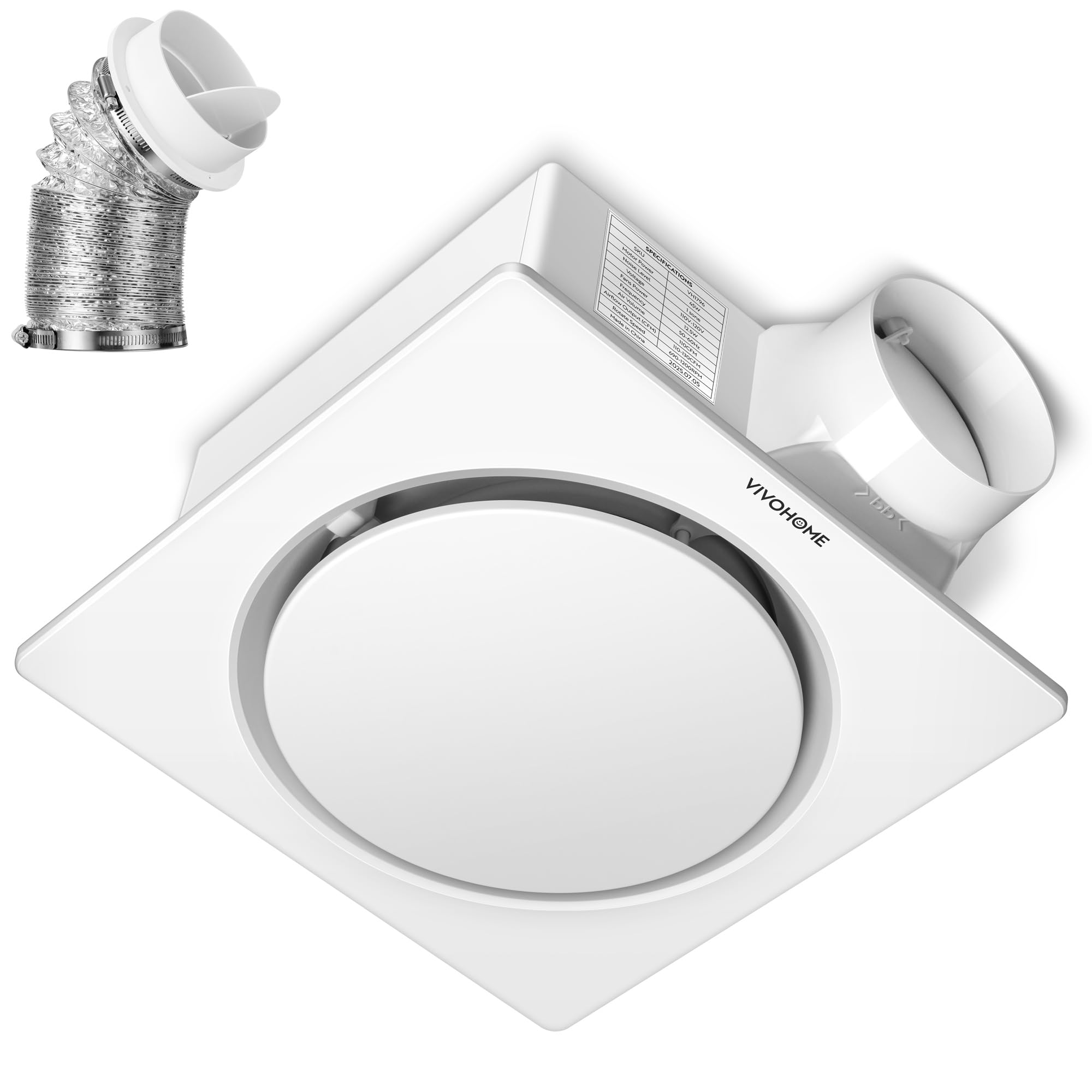
The full kit version — duct, vent, cord, and damper arrive together so you can mount it without a second trip.
If you are doing the install yourself and do not want to buy a duct, vent cover, cord, and backdraft damper separately, this fan ships as a ready-to-go package with all of it. The housing expands with four brackets that snap into eight latches, with a cutout template to line up the ceiling opening. For a weekend DIY install in a small to medium bathroom, that is a real time saver.
Two operation modes give you flexibility — a manual mode that holds a steady 110 CFM, and an auto humidity-sensing mode that turns the fan on when the room passes 55 percent humidity and off at 50 percent, both at the same 110 CFM. So one fan handles your normal routine and your long-shower days. The brushless EC motor runs the fan at 12.5W at 110 CFM, and the manufacturer rates the run life at 30,000 hours. At 110 CFM and 1.0 sone, it is sized for rooms up to about 129 square feet.
The catch to know before you buy is the shape of the install. You may need to cut a little drywall, the roof-side duct is 4-inch so a 3-inch line wants a reducer, and the wall switch is not included in the box. Plan for a small amount of DIY finesse and one or two additional hardware-store items. If you have never done a ceiling cutout before, read the instructions twice before you start.
What you get in the box: A complete kit — fan, duct, ABS vent, extended power cord, and backdraft damper — plus a 30,000-hour rated brushless motor and a two-mode humidity/continuous setup.
What to source separately: A wall switch, a duct reducer if you are coming off a 3-inch line, and a modest amount of DIY confidence around a ceiling cutout.
Great for: A DIY install on a mid-size bathroom where you want a full kit in one box and a real 110 CFM grab with auto humidity sensing.
Consider another pick if: You are replacing an existing fan with your own duct in place, or you want a whisper-level quiet model rather than a kit-centric one.
Understanding the Specs
CFM and Sones
CFM is the volume of air the fan moves each minute, and sones measure the perceived loudness — two completely separate numbers that both matter. A 110 CFM fan that runs at 1.0 sone will clear a mid-size bathroom quickly and feel quiet. A 110 CFM fan at 2.5 sones moves the same air but you can hear it down the hall. Look for the two numbers side by side, and match the CFM to your room size and the sones to how close the fan sits to where you stand.
Humidity Sensor Thresholds
Most humidity-sensing fans here trigger when the room passes a specific humidity level — commonly 55 or 60 percent — and shut off when the room drops back below it. In a small bathroom the humidity spikes fast and falls just as fast, so a fan with a fixed trigger can help immediately; in a larger bathroom the trigger point matters less than raw CFM. If a fan needs its own switch or a specific wire to run the sensor automatically, treat that as part of the spec sheet even though it is not printed on the box.
FAQ
How does a humidity-sensing bath fan decide when to turn on?
What size bathroom does a 110 CFM bath fan actually cover?
What is a sone, and how quiet is one sone in real life?
Does my humidity-sensing bath fan need a special wall switch or extra wire?
Will a humidity-sensing bath fan fit my current 3-inch duct, or do I need a 4-inch reducer?
Is a 0.8 sone fan really that much quieter than a 2.0 sone one?
Can I install a humidity-sensing bath fan without attic access?
Will a bath fan with a humidity sensor also clear cooking smells and odors?
How long does a humidity-sensing bath fan last?
Which humidity-sensing bath fan is best for a small bathroom?
Final Thoughts: The Verdict
The humidity-sensing bath fan with humidity sensor that handles the widest range of bathrooms is the Panasonic WhisperSense FV-0511VQC1 — dual motion and humidity sensing, under 0.3 sone, and a Pick-A-Flow selector that lets one model serve 50, 80, or 110 CFM by room size. If you need to clear a large, steamy master bath and want the light built in, the OREiN 160 CFM is the one to grab. And for a small bathroom or tight ceiling cavity where nothing else physical will fit, reach for the Delta BreezSlim SLM70H — the compact 7.5 by 7.25-inch housing and dual ceiling-or-wall mount are the reason to pick it over the rest.
How We Picked
We do not accept paid placement. Every pick is matched to a real buyer and a real use-case; we do not hands-on test units.
Sources & Methodology
Specifications: manufacturer listings and product documentation. Review insights: verified customer reviews, as of September 2026. Pricing: not shown on this page (it changes often); check the current price via the retailer link.
As an Amazon Associate, KitchPrep earns from qualifying purchases. This does not affect which products we feature.
Related Guides
