
Specs are compiled from manufacturer listings and verified buyer reviews and can change over time — please confirm the key details on the product page before buying.
If stepping over a high tub wall has turned bath time into a daily gamble, a tub insert is the cheapest way out — you cut a section out of your existing tub and drop in a lower step-through entry instead of tearing the whole bathroom apart. The three kits below do exactly that, and they range from a simple walk-through cutout to a convertible unit that keeps full-bath soaking intact. Which one you want depends on one question: do you still need to take a bath in that tub?
I’m Mohammad Maruf — the founder and writer behind KitchPrep. This guide is built by comparing the manufacturers’ published specifications and the patterns across verified customer reviews, so you get each pick’s real strengths and trade-offs instead of marketing spin.
The main differences between these kits come down to whether the insert is removable, how heavy the support structure is, and what tub materials it is built for — and the best bath tub insert for your home is the one that matches your tub’s shape and your bathing habits.
Our Picks at a Glance

How To Choose The Best Bath Tub Insert
A tub insert is a plastic shell plus a support frame that sits in a hole you cut through your tub’s outer wall. It drops the entry lip low enough that you step through rather than climb over. Picking the wrong one is expensive and permanent, because once the blade goes into the tub there is no going back.
Match the kit to your tub material
All three kits here work on steel, fiberglass, and cast iron tubs, but cast iron changes the job completely. Cutting through a cast iron wall is slow, loud work, and owners describe grinding through it taking the better part of an hour with more than one blade used up. Fiberglass and steel cut far faster with an ordinary jigsaw. Know which one sits in your bathroom before you order, because it decides whether this is an afternoon job or a whole weekend.
Decide if you still want to take baths
This is the fork in the road. A plain walk-through insert converts the tub into a shower permanently — simple, fewer parts, nothing to reseal. A convertible kit keeps a removable water-tight panel in the middle, so you step through for showers and lock the panel back in for a full soak. That flexibility costs more and adds a seal to maintain, so only pay for it if the tub is still used for bathing.
Measure the tub wall before anything else
The templates in these kits assume a reasonably standard tub edge. Rounded, outward-slanting walls are the common problem — owners facing that shape end up building their own cardboard template and stacking pressure-treated lumber and plywood instead of using the plastic blocks that ship in the box. Measure the wall height, the step depth, and how the wall curves outward near the top, and compare it against the sizing guide before you order.
Quick Comparison
| Model | Best For | Insert Type | Item Weight | Tub Compatibility | Amazon |
|---|---|---|---|---|---|
| CleanCut Step Tub Conversion Kit, Beige, Large★ Best Overall | Straight shower-only conversion | Fixed step-through | 14 pounds | Fiberglass, steel and cast iron | Amazon |
| Walk-Thru Insert Accessibility Kit – Bath to Shower Conversion, White (Wide) | Small-space and trailer installs | Fixed step-through | — | Steel, fiberglass and cast iron | Amazon |
| CleanCut Convertible Tub Conversion Kit, Beige Large | Keeping baths and showers both | Removable water-tight insert | 20 pounds | Fiberglass, steel and cast iron | Amazon |
In‑Depth Reviews
1. CleanCut Step Tub Conversion Kit, Beige, Large
Our pick — over 4.5★ from 500+ verified ratings; the strongest balance of quality and price.
The fixed-step kit that turns a tub wall into a doorway and keeps the floor dry.
This is the kit for anyone who wants the tub gone as a bathtub and just needs a shower they can walk straight into. You are cutting one opening in the outer wall, setting the Walk-Thru Insert into it, and bolting the support structure underneath so the cut edge stays rigid. There is no removable panel, no seal to redo, and no second step to think about — just a lower lip and a non-skid step pad where your foot lands every time.
That makes it the lightest of the CleanCut kits here, and the difference is real: this one is 14 pounds against the 20 pounds of the convertible CleanCut, so the support structure you are maneuvering into a wet tub is the slimmer of the two. Its footprint measures 28 x 7 x 10.25 inches versus 28.75 x 7 x 10.75 inches on the convertible model, so it tucks into a slightly smaller cutout. Everything you need is in the carton: the insert, the support structure, industrial grade adhesive, waterproof wrap, a cutting template, and the install guide. Material is polyethylene, it ships in beige, and it is designed to work with fiberglass, steel, and cast iron tubs.
What wins people over is installation — it is the single thing this kit is praised for most. Owners consistently describe getting it in and standing back to find it looks like the tub was built that way originally. The straightforward path is a few hours with a YouTube video playing next to you. But be honest with yourself about your tub’s shape first. Rounded, outward-slanting walls force you to make your own cardboard template and stack pressure-treated lumber and plywood in place of the plastic blocks, which pushes a simple job into a full day. Adhesive cure is the other thing nobody mentions upfront — you wait 48 hours before the first shower, so plan the install around a day you can use the other bathroom.
What The Kit Gets Right
- Non-skid step pad where you actually plant your foot
- 14-pound kit — the lightest support structure of the CleanCut pair
- Ships with template, adhesive, waterproof wrap and guide in one box
- Works on fiberglass, steel and cast iron tubs
- Made in the USA by a manufacturer with 25+ years in bathroom accessibility
Where It Pushes Back
- No removable panel — once it is in, it is a shower for good
- Rounded or outward-slanting tub walls demand custom templating
- Plan for the 48-hour adhesive wait before first use
Reach for this if: you want a permanent shower conversion and your tub wall is straight enough to match the template.
Think twice if: anyone in the house still wants to soak — the fixed insert removes that option.
2. Walk-Thru Insert Accessibility Kit – Bath to Shower Conversion, White (Wide)
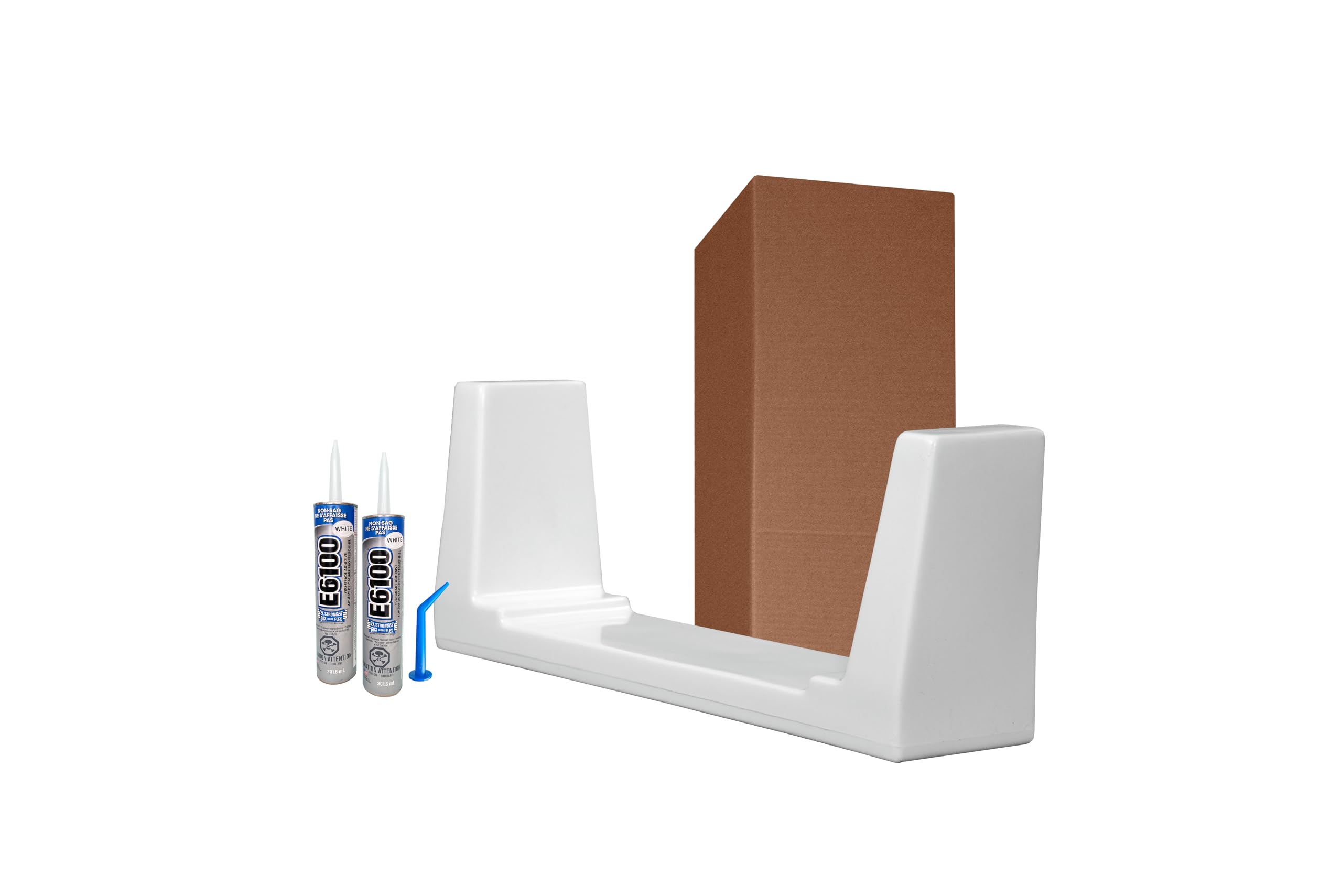
Extra step-through depth for soaker tubs, built for jobs where space is tight.
The standout here is depth. The seat drops to 12 inches with a minimum height of 12 inches, and that deeper cut is what makes this kit work in a soaker tub where a shallow step would still leave you lifting a leg over the wall. If your tub is deep or narrow, or if you are squeezing the install into a small bathroom or a trailer, this is the one that fits where the bigger frames will not. It ships in white in a Wide size, which blends into a white tub instead of announcing itself.
Quick Tub’s kit arrives with one insert, one cutting template, two tubes of industrial strength adhesive, a nozzle extension, and instructions — the nozzle extension is the small detail that makes pushing thick adhesive into a tight corner possible. It installs on all tub types: steel, fiberglass, and cast iron. The manufacturer also pairs it with a Quick Tub Cap if you want a fully convertible setup, though that cap is a separate piece. Material is plastic, it comes as a single unit, and Bathe Again Inc. is the manufacturer.
Fitting is the trap to avoid, and Quick Tub is direct about it — measure the tub correctly against the sizing guide in the product photos and the step-by-step video before ordering. When the measurements line up, the install is genuinely approachable. A 77-year-old owner fitted hers in about three hours in a FEMA trailer, and another household had a handyman who had never done one finish it without trouble. Buyers report it “made it much easier to get in the tub” for someone who had been struggling to lift her legs over the wall. The honest catch is the cut itself. The directions read as daunting to anyone staring at a tub they cannot afford to replace if the job goes wrong, and that hesitation is fair — this is a one-way cut, so measure twice.
Why it fits small rooms: the deeper 12-inch step-through and the Wide white trim let this kit sit in soaker tubs and cramped trailer bathrooms that a bulkier frame would crowd.
The measuring matters most: fit is the one thing that decides success here, so use the sizing video before a single cut is made.
Made for: deep or narrow tubs, small bathrooms, and anyone who wants the extra step depth.
Not the one if: you want a removable panel for baths — that needs the convertible kit instead.
3. CleanCut Convertible Tub Conversion Kit, Beige Large
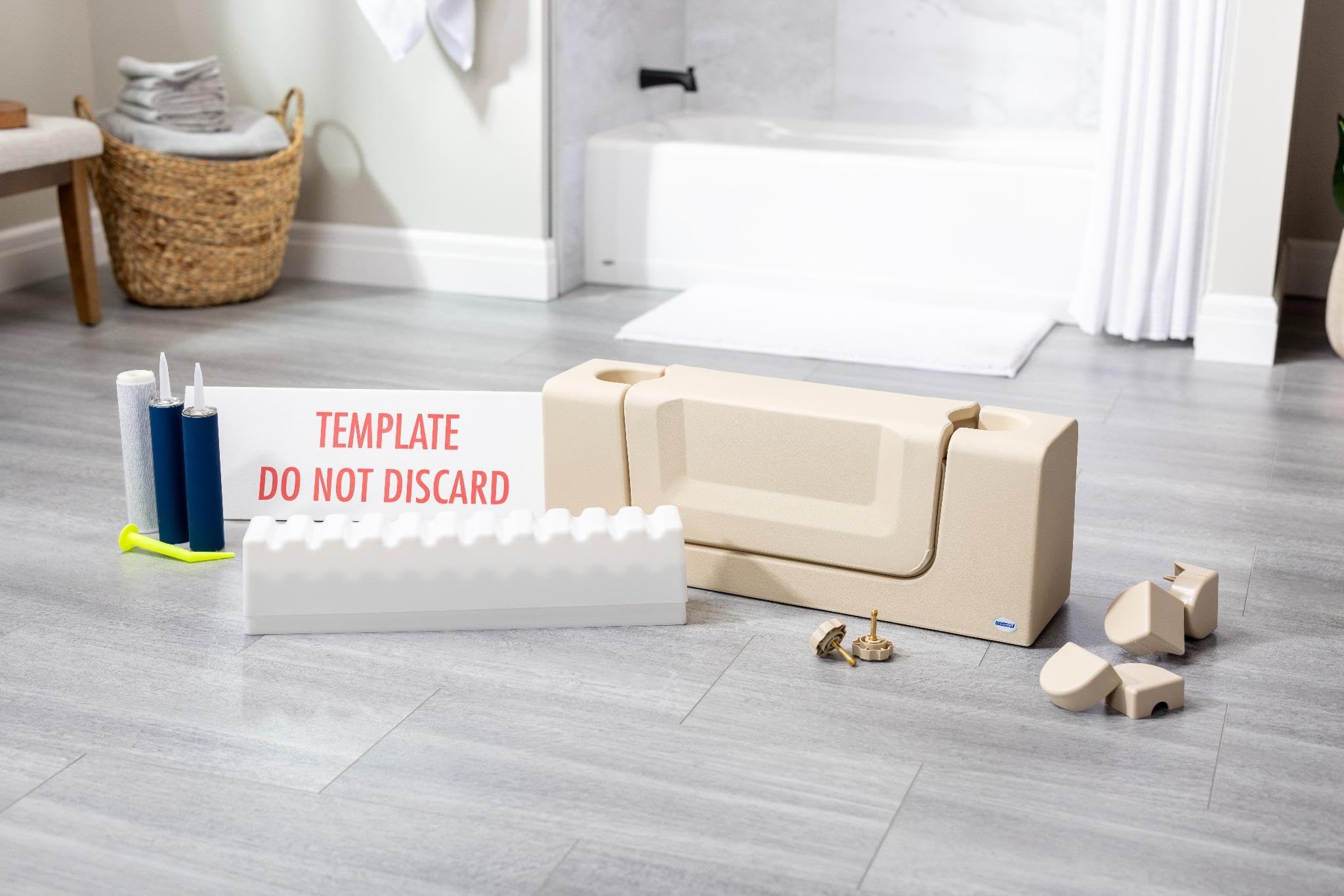
Step through for a shower, lock the panel back in for a full soak.
Buy this one if the household is split — someone needs a low, safe step in, and someone else still wants to lie back in a full tub on a Sunday. The Convertible keeps a removable water-tight insert that locks into the center opening for bathing and lifts out in seconds for showers. You are paying for the choice, not for better plastic.
It is also the heavier build of the two CleanCut kits at 20 pounds against the 14-pound fixed model, and the larger footprint shows it: 28.75 x 7 x 10.75 inches versus 28 x 7 x 10.25 inches. That extra mass is in the support structure that holds the removable panel rigid, and it is the trade-off for the convertible design. Inside the box you get the convertible unit with its water-tight insert, a two-part support structure, two bottles of industrial grade adhesive with an application nozzle, the waterproof wrap, a cutting template, and the written installation guide. Polyethylene construction, beige finish, and it is rated for fiberglass, steel, and cast iron tubs.
What owners praise most is how well it does the job and how little it costs compared with the alternative. As the review pages put it, this is a “great way to convert the bathtub to walk in.” The savings are the other headline — owners describe it as a fraction of what a tub replacement runs, with one household avoiding a remodel outlay and another sidestepping a tub replacement. The honest caveat is installation, where feedback splits. A straightforward steel-tub job can be done in under two hours with the video guide, while a 6-inch cast iron tub took one owner about five hours, 55 minutes of that spent grinding the cast iron with two blades used up. Leaks around the insert come up too — a smaller set of owners hit them, while plenty report years later with “still no leaks.” Getting the seal right on day one is the whole game.
Where It Earns Its Place
- Removable water-tight insert keeps full-bath soaking alive
- Removes in seconds for shower use, locks back for bathing
- 2-part support structure holds the panel firmly at 20 pounds
- Owners cite avoiding a full tub replacement
- No leaks reported years after install by plenty of owners
The Real Trade-Offs
- Heavier frame than the fixed CleanCut kit
- Install feedback is mixed — cast iron run times stretch past five hours
- Leaks around the insert are a reported risk if the seal is rushed
Pick it when: both baths and showers need to survive the conversion.
Skip past it when: you are never taking a bath again and would rather keep the lighter, simpler fixed kit.
Understanding the Specs
Item Weight And Why It Matters
Weight in these kits is mostly the support structure — the frame that keeps your cut tub wall rigid once the opening is there. A 14-pound kit is noticeably easier to maneuver into a wet tub than a 20-pound one, particularly if you are doing the job alone or in a cramped bathroom. The heavier frame is not automatically better; on the convertible kit it is there to hold a removable panel steady, which is a job the fixed kits simply do not have to do. Pick the weight that matches the job, not the biggest number on the page.
Fixed Versus Removable Insert
A fixed step-through insert is one piece of molded plastic sealed permanently into the cutout. Fewer seams, nothing to re-seal, and the simplest install of the lot. A removable water-tight insert adds a locking panel in the center of the opening — it lifts out for showering and drops back in for bathing, but every one of those transitions rides on a seal that has to hold. If the tub will only ever be a shower, the fixed insert is the lower-maintenance answer. If someone still soaks, the removable panel is the only version that allows it.
Step Depth And Entry Height
Step depth is how far in your foot sits once it passes through the opening, and it is the difference between a comfortable entry and one that still feels like a stretch. A deeper cut, like the 12-inch seat depth on the Walk-Thru kit, suits soaker tubs where the wall is tall and the interior is narrow. The minimum height spec tells you how much of the tub wall stays intact above the step — enough to hold the insert firmly without leaving an obstacle to clear. Match both numbers to your actual tub before cutting anything.
Cutting Templates And Tub Wall Shape
The template is a paper or plastic guide that traces the opening shape onto your tub wall so the insert drops in flush. It works cleanly on a tub with a straight, vertical wall. It struggles on rounded walls that slant outward toward the top, because the template cannot follow that curve — owners in that situation trace their own template from cardboard and build up the support with pressure-treated lumber and plywood instead of the included plastic blocks. If your tub edge curves outward, expect to do that extra work regardless of which kit you buy.
FAQ
Will a tub insert work on a cast iron bathtub?
Can I still take a bath after installing a tub insert?
How long does the adhesive need to cure before I can use the shower?
My tub wall is rounded and slopes outward, will the cutting template still fit?
Is a tub insert cheaper than replacing the tub or remodeling?
What is the difference between a fixed and a convertible tub insert?
Can I install a tub insert myself or do I need a professional?
Do tub inserts leak around the insert over time?
How deep is the step-through opening on these inserts?
Will a tub insert work in a small bathroom or a mobile home?
Final Thoughts: The Verdict
For most homes converting a tub for safer daily showering, the bath tub insert worth starting with is the CleanCut Step Tub Conversion Kit — it is the lightest frame of the two CleanCut kits at 14 pounds, ships with the full install kit including the non-skid step pad, and the owner consensus backs up the install. If your tub is a deep soaker or the bathroom is tight, the Walk-Thru Insert Accessibility Kit and its deeper 12-inch step is the better fit. And if someone in the house still wants a full soak, spend the extra on the CleanCut Convertible Tub Conversion Kit — the removable water-tight insert is the only one of the three that keeps bath night alive.
How We Picked
We do not accept paid placement. Every pick is matched to a real buyer and a real use-case; we do not hands-on test units.
Sources & Methodology
Specifications: manufacturer listings and product documentation. Review insights: verified customer reviews, as of September 2026. Pricing: not shown on this page (it changes often); check the current price via the retailer link.
As an Amazon Associate, KitchPrep earns from qualifying purchases. This does not affect which products we feature.
Related Guides
