
Specs are compiled from manufacturer listings and verified buyer reviews and can change over time — please confirm the key details on the product page before buying.
If you are shopping for a long air hose, the single question that decides everything is whether the hose still bends when it is cold and whether it holds pressure overnight — not how it looks on the shelf. A 100-foot run is a lot of rubber or polymer to drag around, so the wrong pick means a stiff snake that kinks at every corner and bleeds air while your compressor cycles on and off all afternoon. This guide covers nine real 100-foot hoses, what each one actually does well, and which buyer each one fits.
I’m Mohammad Maruf — the founder and writer behind KitchPrep. This guide is built by comparing the manufacturers’ published specifications and the patterns across verified customer reviews, so you get each pick’s real strengths and trade-offs instead of marketing spin.
Every hose here is a genuine 100-foot length with a 1/4-inch or 3/8-inch inside diameter, so the reach is never the issue. What separates them is flexibility in cold weather, how they seal at the coupler, and how much weight you haul at the end of the day — the three things that decide which 100 ft air hose earns a spot on your reel.
Our Picks at a Glance

How To Choose The Best 100 Ft Air Hose
A 100-foot hose is a commitment, because you will carry or drag all of it every time you move to a job. The honest starting point is deciding what you will actually run off the end of it. A finish nailer sips air and rewards a light, thin hose. An impact wrench or a sander gulps air and punishes anything restrictive. Match the hose to the tool and you avoid buying twice.
Inside Diameter Sets Your Airflow
The inside diameter — the width of the hollow channel the air travels through — is the number that limits your tool. A 1/4-inch hose is the standard for nailers, blow guns, tire inflators and light spray work, and it stays easy to coil. A 3/8-inch hose moves more air over the same distance, which matters once you are running high-consumption tools far from the compressor. Over 100 feet, that difference in flow becomes noticeable at the tool.
Flexibility and Temperature Range
Cold is where cheap hoses fail. A hose rated down to a low temperature keeps bending instead of going stiff, which means fewer kinks and less fighting it across a cold shop floor. Hybrid hoses blend rubber and PVC to stay supple without the weight, while polyurethane hoses stay flexible at very low temperatures and wipe clean easily.
Working Pressure vs Burst Pressure
Working pressure is the pressure the hose is built to handle every day; burst pressure is the point where it finally gives out. A wider gap between the two is your safety margin. Look for the working figure to match or beat what your compressor puts out, and treat the burst number as headroom you never want to test.
Quick Comparison
| Model | Best For | Hose I.D. | Working Pressure | Material | Amazon |
|---|---|---|---|---|---|
| Flexzilla HFZ14100YW2-D★ Best Overall | All-around home and pro shop | 1/4″ | 300 psi | Hybrid polymer | Amazon |
| SYXQT Hybrid Air HoseBest Value | Cold garages on a budget | 1/4″ | 300 psi | Rubber and PVC blend | Amazon |
| Metabo HPT 19413QPMTop Performer | Finish nailers and propane lines | 1/4″ | 300 psi | Polyurethane blend | Amazon |
| SANFU PU Reinforced | Interior trim and spray work | 1/4″ | 300 psi | Polyurethane | Amazon |
| Furesn Hybrid Air Hose | Daily outdoor use in the cold | 1/4″ | 300 psi | PVC and rubber blend | Amazon |
| Amflo 12-100E | Finish work that must not mark | 1/4″ | 1200 psi | Polyurethane | Amazon |
| DEWALT DXCM012-0202 | Heavy home shop and sandblasting | 3/8″ | 300 psi | Rubber and brass | Amazon |
| BLUBIRD BB38100 | High-flow tools in deep cold | 3/8″ | 300 psi | Rubber, polyester, brass | Amazon |
| Flexzilla HFZ12100YW3 | High-volume airflow on a reel | 1/2″ | 300 psi | PVC hybrid | Amazon |
In‑Depth Reviews
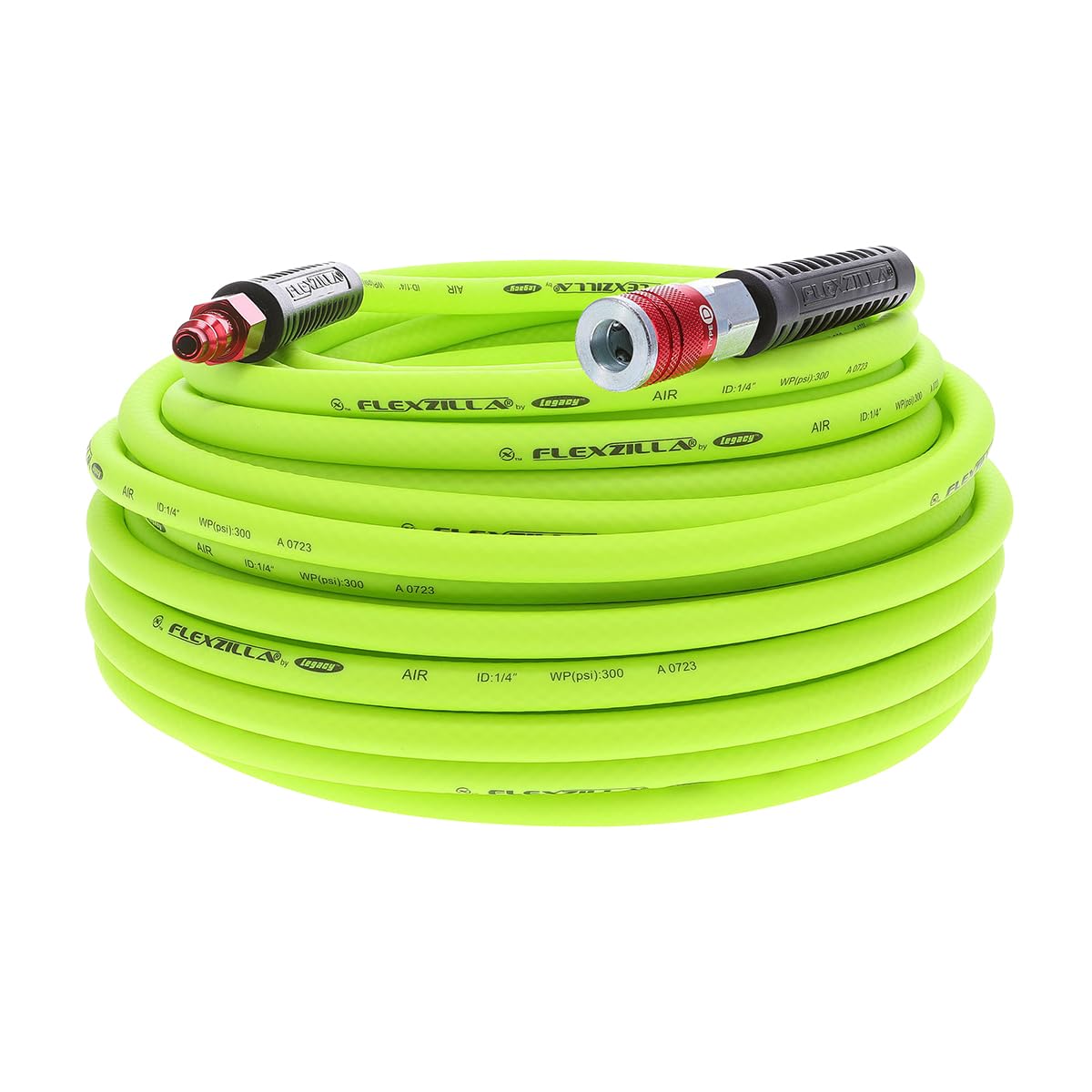
1. Flexzilla HFZ14100YW2-D Air Hose with ColorConnex Industrial 100 Feet
Our pick — over 4.5★ from 900+ verified ratings; the strongest balance of quality and price.
The hose that lies flat when you unroll it and keeps bending when the shop turns cold.
If you want one hose to cover a home garage and a working shop without thinking about it again, this is the one. what separates it is zero shape memory — the hose forgets it was ever coiled, so it lays flat the moment you roll it out instead of fighting you with leftover curls. It handles 300 psi (pounds per square inch, the everyday working pressure the hose is built to carry), and the 1/4-inch inside diameter is the balance for nailers, blow guns and light spray work.
The pre-sealed threads are the quiet win here. The coupler and plug arrive with thread sealer already installed, so you connect it the second you reach the jobsite rather than hunting for tape. Being a hybrid polymer build, it is dramatically lighter than an equivalent rubber hose, and it stays flexible in cold weather. The ColorConnex plug and coupler add a red industrial Type D fitting, so you can color-code this hose to one tool set and grab the right line at a glance. For a sense of the size difference between hoses, this one’s outside diameter is 0.31 inches, noticeably slimmer than the 0.25-inch Metabo HPT unit, which keeps the coil tighter on a reel.
The one thing to plan for is the coupler feel. It is not the smoothest connection to seat the first few times, and it takes a moment to get the hang of, though it seals solidly once you do. Length is also worth an honest thought: a 100-foot run reaches the far corners of a garage without moving the compressor, which is the whole point, but a shorter hose is easier to manage if your workspace is small.
Where it earns its keep
- Zero shape memory means it lays flat and never kinks in use
- Pre-sealed threads on the coupler and plug, ready the moment it arrives
- Hybrid polymer stays flexible in cold weather and stays light in hand
- 300 psi working pressure with a 1/4-inch inside diameter
Worth knowing before you buy
- The coupler is not the smoothest to seat until you get used to it
- A full 100 feet is more hose than a small shop strictly needs
Settle on this if: you want a light, flat-lying hose for both home projects and real jobsite work, and you value not fighting tangles.
Think twice if: you only ever reach 20 feet across a bench — the length and the coupler fuss are more than you need.
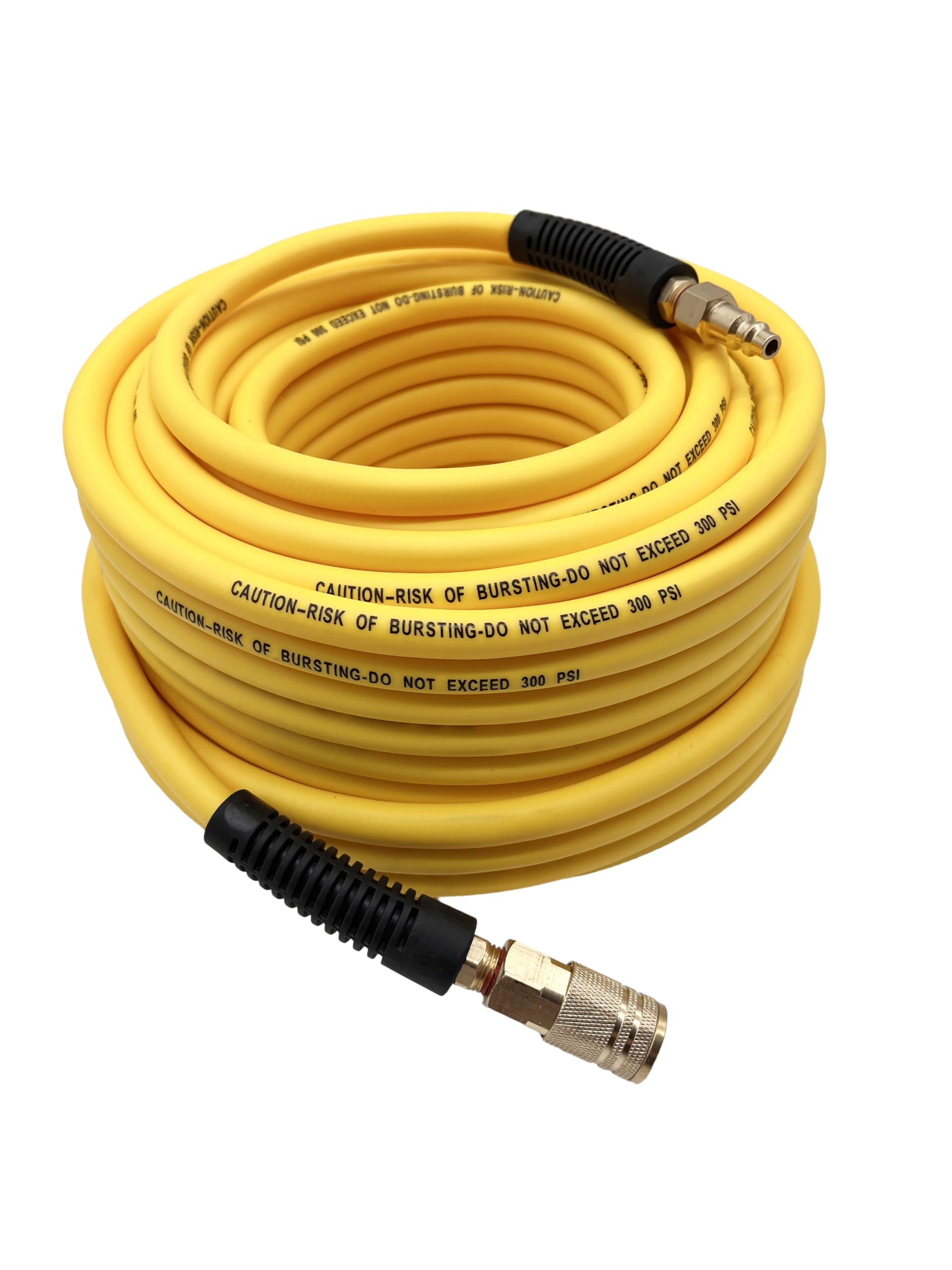
2. SYXQT Hybrid Air Hose 1/4-Inch x 100FT, 300 PSI Heavy Duty
A budget hybrid that treats cold mornings as a routine, not an event.
For a garage that dips below freezing, this hose is the value play. It is built from a blended rubber and PVC material (a mix that keeps rubber’s grip and PVC’s lightness), rated to stay flexible from -40°F to 150°F. That range is the reason it works when the thermometer drops — it does not turn into a stiff rod the way a plain PVC hose does.
The pressure numbers give you room to work: 300 psi working pressure, which is what the hose carries day to day, and 1200 psi burst pressure, which is the point it would finally fail. The 1/4-inch inside diameter matches most home tools. Bend restrictors sit at both ends to reduce kinking right where hoses usually wear out, and the 1/4-inch brass industrial coupler and plug come pre-installed, so there is no extra shopping trip. A 3-year limited warranty backs it, which is longer coverage than several pricier hoses here carry.
What wins people over is the overall quality of the build — it feels like a real upgrade from a cheap plastic hose, and the bright color makes it easy to spot across the shop floor. The recurring gripe is leaks at the connections for some owners, so check your coupler seating early and you sidestep the disappointment. Compared with the Flexzilla above, this one trades that hose’s premium feel for a lower entry point and a longer warranty.
Where the money goes: rubber-and-PVC blend, sealed 1200 psi burst rating, and pre-fitted brass fittings — practical value rather than a premium finish.
One thing to check: seat the couplers carefully on day one; that is the spot where leaks show up.
Reach for this if: you work in a cold garage or shop and want a flexible 100-footer without paying premium money.
Look elsewhere if: you need the flattest-laying hose on a reel and prioritize the smoothest fitting connection.
3. Metabo HPT 19413QPM Poly Air Hose, 1/4-Inch x 100 Ft
Barely noticeable on the end of a finish nailer, yet built to shrug off a jobsite.
Running a finish nailer all day means you want a hose you forget you are dragging, and that is exactly where this polyurethane hose shines. At 3.6 pounds for the whole 100-foot run, it hangs light off the tool and stays maneuverable in tight trim work. The polyurethane material also reaches places the beefier hybrid hoses do not — its 0.25-inch outside diameter makes it noticeably slimmer than the 0.31-inch Flexzilla, so the coil stays compact on a hook or reel.
The strength story is genuine: 300 psi working pressure with a 3-to-1 burst ratio, which is the safety gap between everyday pressure and the point the hose would fail. It is spiral reinforced for durability, so it resists the kinks and knots that wreck cheaper hose, and it is rated to stay flexible in cold weather. Buyers report it works hard enough to be rated for propane use — owners have run it on a propane line and found it holds up well with periodic checks, which is a much cheaper option than a dedicated propane hose.
Flexibility is the honest split point. Some owners find it does not twist or knot up at all, while others describe it as stiff. That is largely a temperature and workload story — the colder or the more coiled the run, the stiffer it feels. A 100-foot length of thin hose can also get unwieldy when fully deployed, so if your workspace is tight, a shorter length may serve you better than the full run.
Why it stands out
- Light at 3.6 pounds, so it hangs barely noticeable off a nailer
- 300 psi working pressure backed by a 3-to-1 burst ratio
- Spiral reinforcement resists kinks and knots
- Works hard enough to be rated for propane use
The honest caveat
- Flexibility divides owners — some find it stiff depending on temperature
- A full 100 feet of thin hose gets unwieldy for small spaces
Best matched to: trim carpenters and finish workers who want a featherweight 100-footer that vanishes on the tool.
Pass it over if: you prize maximum suppleness above all and work in the coldest conditions.
4. SANFU Polyurethane (PU) Reinforced 1/4-Inch ID x 100ft Air Hose, Blue

The hose you can drag across fresh trim without leaving a mark behind.
Interior finishing work lives or dies on not scarring what you just installed, and this polyurethane hose was built for exactly that. Its smooth surface glides over painted surfaces, wood flooring and trim without scuffing them, which is the difference between a clean job and a callback. The polyurethane is reinforced to stand up to the kinks and twists that come with any long run, and at 4.4 pounds it is light enough to carry one-handed.
The pressure spec is strong for the class: 300 psi working pressure and a 1200 psi burst ceiling, with a temperature range stretching from -65°F to +250°F. That vast range is what makes it a year-round hose — genuinely cold mornings on a roofing job and hot afternoons in a closed shop are both inside its comfort zone. Both ends carry independent swivel brass fittings plus strain relief, so the fittings rotate instead of twisting the line when you move the tool. The bend restrictors cut kinking right where hoses typically give out, and a 2-year limited warranty covers it.
Where it gets mixed is flexibility. Some owners find it beautifully supple, while others describe it as stiff — this is a firmer-feeling hose than the flat-lying Flexzilla above, so if your only goal is a hose that drapes like rope, that one is the better fit. Buyers do consistently call out the quality and the value, and roofers and trim crews in particular lean on its light weight for all-day use.
What it does best: a non-marring surface for finished interior work, with swivel fittings that keep it easy to steer.
Where it sits: firmer in hand than the softest hybrids, so it suits deliberate finishing work more than constant coiling and uncoiling.
Choose it for: trim crews, roofers and finishers who need a light, mark-free hose that reaches across a whole floor.
Skip it for: work where you want a plush, drape-like feel above all else.
5. Furesn Hybrid Air Hose 1/4 in x 100 ft, Heavy Duty, 300 PSI

A three-layer hybrid built to take a beating on a daily outdoor run.
This one uses a hybrid construction with the outer and inner layers the same blended rubber-and-PVC material, plus a woven middle layer that resists snags, abrasions, punctures, chemicals, oil and grease. That woven core is the reason it survives being dragged over concrete day after day rather than fraying the way a single-layer hose does.
The weather range is rated from -40°F to 150°F, so it stays flexible in extreme cold instead of stiffening up and developing cracks. Working pressure is 300 psi, with a 1200 psi burst ceiling for headroom. Bend restrictors sit at both ends to reduce kinking, and the 1/4-inch NPT industrial fitting and universal quick-connect coupler are both brass, which resists the rust and corrosion that eventually kills steel fittings. A two-year limited warranty backs it.
The durability is what owners rave about — a daily outdoor user reported it stayed flexible straight through a Michigan winter. One fitting eventually broke after that extended use and was easy and cheap to replace, which is a fair trade for a hose that holds up under that kind of punishment. It also does double duty as a lead-in hose between your compressor and an air hose reel, where it absorbs shock loads from pneumatic tools and reduces fatigue on the operator. Compared with the SYXQT above, this one leans harder into the woven reinforcement at a similar tier.
What earns praise
- Woven middle layer resists snags, punctures, oil, grease and chemicals
- Rated from -40°F to 150°F for true all-weather use
- Brass fittings resist rust and corrosion over time
- Doubles as a lead-in hose to absorb tool shock loads
Fair to flag
- End fittings are the first thing to wear under hard daily use
- Bulkier than a polyurethane hose for tight coil storage
Suited to: owners who leave a hose hanging outdoors or on a reel and work year-round in the cold.
Not the one for: you if you want the lightest possible hose to carry in one hand all day.
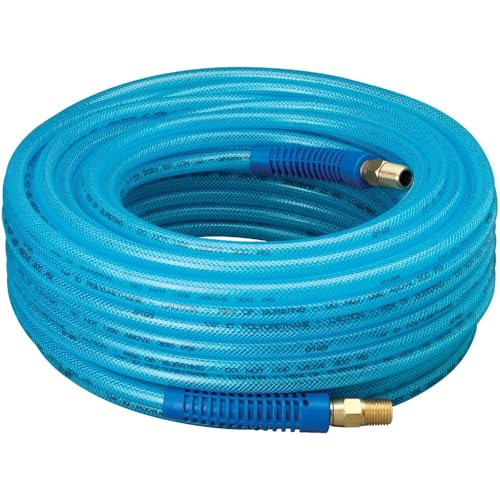
6. Amflo 12-100E 1/4-Inch x 100 Ft Poly Air Hose
A light, clean-running poly hose for nailers, sprayers and powder coating.
This polyurethane hose was designed around not leaving mess or marks. The smooth, non-marring surface is meant for indoor finishing work, so dragging it across painted surfaces, wood flooring, trim and laminates will not scuff them. It is also one of the lightest approaches here, and its thin wall makes it ideal for nailers, blow guns, inflation, paint sprayers and powder coating without pulling hard on the tool.
Cold weather is handled notably well: the polyurethane is rated for year-round use down to -30 degrees F, so it stays workable in a cold shop. It is built tough for harsh environments too, with oil and chemical resistance and a reinforced braided nylon core that suits automotive repair shops and industrial settings. The 1/4-inch NPT swivel fittings cut twisting at the tool, and rugged bend restrictors protect the hose ends. The spec sheet lists a 1200 psi maximum pressure, which is the headroom figure rather than the everyday rating.
Here is the trade-off worth planning around: this is a small-diameter hose, so it is not built for high-flow tools like impact guns, ratchets and sanders. It also has real coil memory from the start, and owners note it can be a chore to deploy and put away until you break that curl in — laying it out on a warm driveway to relax the memory helps. It is supple, kink-resistant once settled, wipes clean and does not attract dirt or oil the way some hoses do.
the balance: precision tools that need a light, clean, thin hose — nailers, sprayers, inflation and dust-off work.
The honest limit: tight inside diameter means air-hungry tools will feel starved, so it is not your impact-wrench hose.
Made for: finishers and woodworkers who run nailers, spray guns and blow guns and want a mark-free, featherweight line.
Look past it if: your main tools are high-consumption air hogs that need more flow than a thin 1/4-inch bore can deliver.
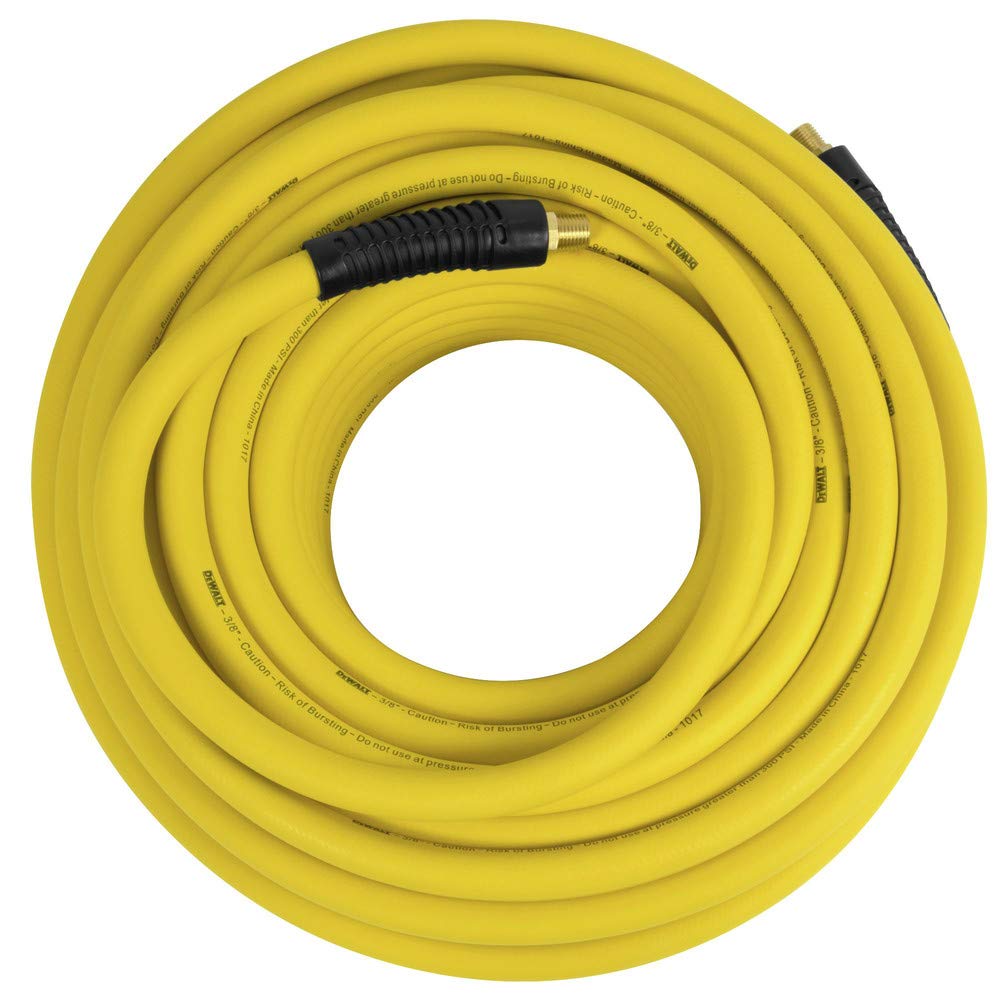
7. DEWALT DXCM012-0202 3/8-Inch x 100-Ft Premium Rubber Hose, Yellow
A big-bore rubber hose for the tools that truly drink air.
When you are running an impact wrench or a sandblaster, this is the hose that feeds them properly. The 3/8-inch inside diameter moves far more air than a 1/4-inch line over the same 100 feet, which is what your high-consumption tools need to hit full power instead of wheezing. Max pressure is 300 psi, and it is oil and kink resistant to hold up in a working shop.
The safety margin here is worth a mention on its own: DEWALT rates it at a 4-to-1 safety factor between burst pressure and working pressure, which is a generous cushion compared with the thinner ratios on some hoses. Fittings are 1/4-inch NPT solid brass male on both ends with bend restrictors to protect the ends from wear. The temperature range runs from -40°F up to 150°F, so it keeps working through cold winters and hot summers alike.
The honest cost of that capability is weight. Being an all-rubber 100-foot hose, it is genuinely heavy to haul around, and that is the main thing owners flag. One reviewer noted it kinks fairly easily when rolled up, so it rewards careful coiling rather than a quick wrap. There is also an isolated report of one hose cracking after about six months — rare against the overall record, but a reason to store it out of harsh sun and respect the coil. Set against the lighter hybrid options above, this trades portability for real airflow and durability.
Built for hard use
- 3/8-inch bore feeds high-flow tools far better than a 1/4-inch line
- 4-to-1 safety factor between burst and working pressure
- Solid brass male fittings with bend restrictors at both ends
- Rated from -40°F to 150°F with oil and kink resistance
The weight trade-off
- All-rubber build is heavy to drag around at 100 feet
- Can kink when coiled quickly, so roll it with care
Built for: impact wrenches, sandblasters and other high-consumption tools in a home shop that needs real airflow.
Less ideal if: you hate dragging a heavy hose and would rather keep everything light and nimble.
8. BLUBIRD BB38100 3/8-Inch x 100 Ft Rubber Air Hose
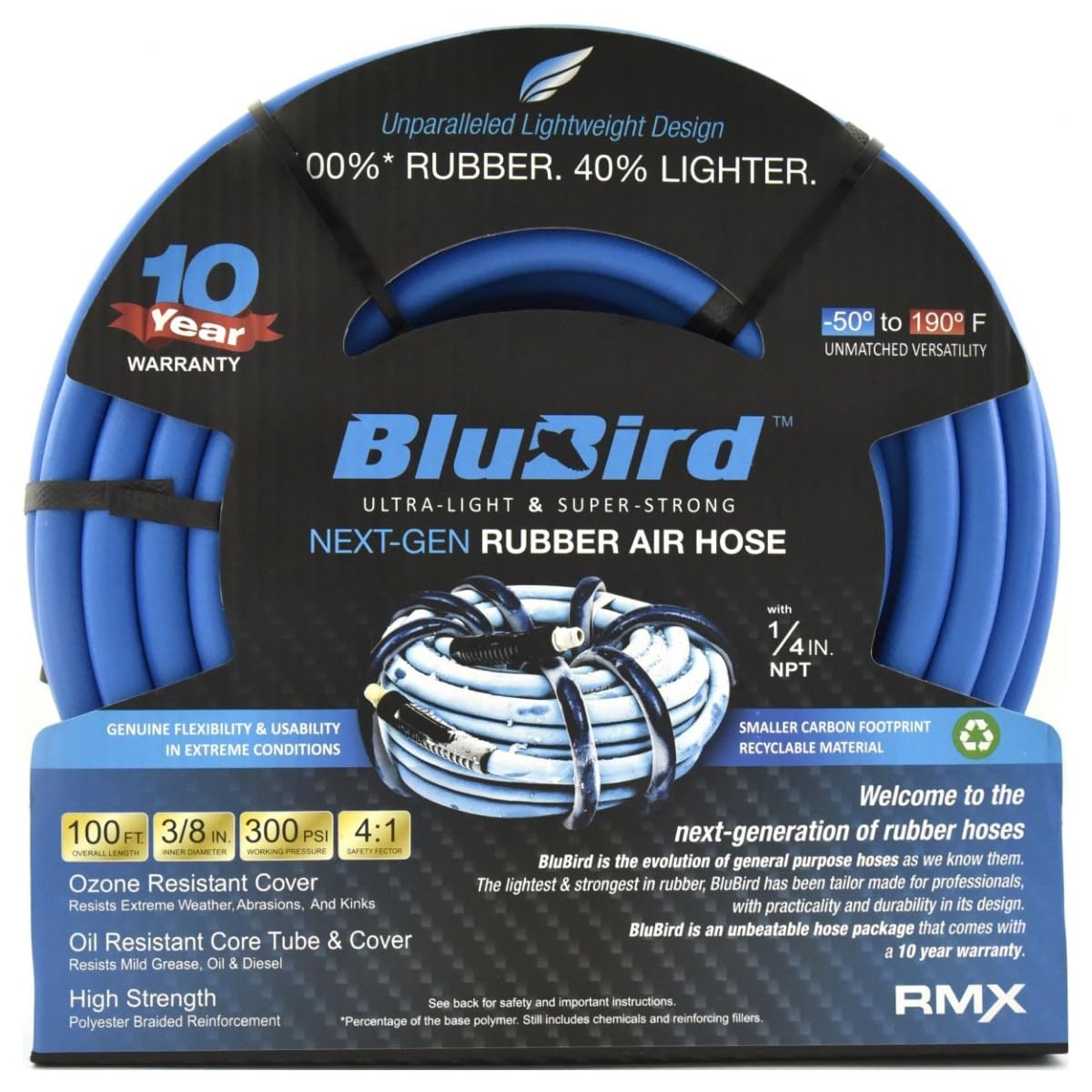
A rubber hose that stays a rubber hose down to brutal cold.
For a 3/8-inch rubber hose, this one does something unexpected: it keeps its flexibility in serious cold. BLUBIRD rates it to remain as flexible at -50°F as premium hybrids are at 0°F, and to stay usable all the way up to 190°F. That wide range is the reason it is a favorite for high-flow work in unheated shops, where rubber hoses normally turn stiff and hybrids risk going brittle.
The construction is 100% rubber with a high-strength polyester braid, which gives it 300 psi working pressure from -50°F to 190°F and a 1200 psi burst ceiling. It lays flat, does not kink under pressure, and will not get sticky or dirty the way plastic and hybrid hoses can, so it cleans up far more easily. The brass end fittings resist rust better than steel and stay stronger than aluminum, and it carries a 1-year warranty on material and workmanship.
The catch, as owners will tell you, is heft and feel. A 100-foot rubber hose carries real weight, and a few owners find it less flexible than the marketing suggests — one describes it as a little hard to work with sometimes. Those reviews are the minority against a broadly strong record, but it pays to know that “lightest” here is relative to other 3/8-inch rubber hoses, not to a thin polyurethane line. If you want easy suppleness above all, the polyurethane picks above will feel easier in hand.
What it delivers: 100% rubber, a polyester braid and a massive -50°F to 190°F range for high-flow tools in the deepest cold.
Where it asks for patience: genuine rubber weight and a feel that some find firmer than expected — this is a workhorse, not a featherweight.
The right hose for: high-flow tools in unheated shops and deep-cold climates where most hoses stiffen and quit.
Better to skip if: light weight and easy one-hand handling matter more to you than raw cold-weather rubber performance.
9. Flexzilla HFZ12100YW3 Air Hose, 1/2 in. x 100 ft., ZillaGreen

Half-inch bore airflow that still rolls up like a light, easy line.
When your compressor has the volume and your tools need to feel it at the far end of 100 feet, the inside diameter becomes the whole game. At a full 1/2 inch, this hose moves more air than any other pick here, which is exactly what large-format spray work and blast cabinets demand. Despite that size, it stays remarkably light and easy to handle, and it rolls up without a fight.
It shares the Flexzilla all-weather story: extreme flexibility down into subzero temperatures at -40°F to 140°F, so it will not kink under pressure and lays flat with no memory. The outer cover is durable and abrasion-resistant, and a bend restrictor caps the fitting to reduce wear and extend hose life. Max working pressure is rated at 300 psi at 70°F. It is the kind of hose owners use to replace the stiff stock hoses that come with blast cabinets, precisely because it is so much easier to steer.
The honest note is that a 1/2-inch hybrid does not feel like a heavy rubber 1/2-inch — it is thinner-walled, and owners notice it can swell a bit in diameter under pressure and feels somewhat frail next to a solid rubber hose. It also carries the most weight of the Flexzilla pair, so storage space and reel capacity are worth checking. If what you need is genuine half-inch airflow rather than a super-tough rubber feel, that trade is well worth it.
Why it moves air
- Full 1/2-inch bore delivers the most airflow of any pick here
- Stays flexible from -40°F to 140°F and will not kink under pressure
- Lays flat with no memory and rolls up easily despite its size
- Durable, abrasion-resistant cover with a bend restrictor at the fitting
What to weigh
- Thinner wall than solid rubber, so it feels lighter-built in hand
- Heaviest of the two Flexzilla hoses, so it takes more storage room
Pick this when: your compressor has the volume and you run spray or blast work that needs maximum airflow at the end of a long line.
Leave it if: you want a solid, heavy-rubber feel or your compressor cannot push that much air to begin with.
Understanding the Specs
Inside Diameter and Airflow
The inside diameter — the width of the channel the air travels through — decides how much air reaches your tool, and it matters more over a long run than the hose material does. A 1/4-inch hose suits nailers, blow guns and inflation, where the tools sip air and you want a light line. A 3/8-inch hose moves more air and feeds impact wrenches, sanders and sandblasters without starving them. A 1/2-inch hose is the widest here and pours the most volume down the line, which is why it suits large spray and blast work.
Working Pressure, Burst Pressure and Temperature Range
Working pressure is what the hose is built to carry every day, and you want it to match or beat your compressor’s output. Burst pressure is the point the hose would finally fail, and the gap between the two is your safety headroom — a wider ratio means more cushion. The temperature range tells you how cold and how hot the hose stays flexible. A hose rated to a low number, like the -40°F to 150°F range on several hybrids here, keeps bending in a cold shop instead of going stiff and cracking. The temperature rating often decides whether you enjoy the hose or fight it all winter.
Material and Fittings
Material drives feel, weight and price. Hybrid hoses blend rubber and PVC to stay light and flexible; polyurethane hoses are thin, light and cold-tolerant but reach less airflow at a small bore; rubber hoses are heavier and tougher, and some stay flexible at very low temperatures. Fittings matter just as much — brass resists rust better than steel and holds stronger than aluminum, and swivel fittings reduce twisting at the tool. Bend restrictors at each end are the quiet protector, cutting the kinks that usually kill a hose right where it wears first.
Kink Resistance and Coiling
Kinks happen when a hose curls back on itself and pinches off flow, and over 100 feet you will fight them unless the hose resists it. Zero shape memory — a hose that forgets its coil — is what lets a hose lay flat and pull straight instead of snagging on itself. Reinforced designs, either a woven middle layer or a braided core, help it hold up under twists and repeated rolling.
FAQ
Will a 1/4-inch air hose run an impact wrench at 100 feet?
What is the difference between working pressure and burst pressure?
Do hybrid air hoses really stay flexible in freezing weather?
What does zero shape memory mean on an air hose?
Which air hose material is best for indoor finishing work?
How long should a 100 ft air hose last?
Are brass fittings better than steel or aluminum on an air hose?
What temperature range do I need in an air hose?
Does a thicker 3/8-inch hose weigh more than a 1/4-inch hose?
Can I use a longer hose than 100 feet without losing power?
Final Thoughts: The Verdict
For most people, the 100 ft air hose that makes the most sense is the Flexzilla HFZ14100YW2-D: its zero shape memory keeps it flat and tangle-free, and its pre-sealed threads mean it is ready the moment it arrives. If cold weather is your real enemy and you want a flexible hose for less, grab the SYXQT Hybrid Air Hose with its -40°F to 150°F range and long warranty. For finish work that must not mark a surface, the SANFU PU Reinforced Hose is the one to reach for, and if you run high-airflow tools in deep cold, step up to the BLUBIRD BB38100.
How We Picked
We do not accept paid placement. Every pick is matched to a real buyer and a real use-case; we do not hands-on test units.
Sources & Methodology
Specifications: manufacturer listings and product documentation. Review insights: verified customer reviews, as of September 2026. Pricing: not shown on this page (it changes often); check the current price via the retailer link.
As an Amazon Associate, KitchPrep earns from qualifying purchases. This does not affect which products we feature.
Related Guides
