
Specs are compiled from manufacturer listings and verified buyer reviews and can change over time — please confirm the key details on the product page before buying.
You want hot water the second you turn the tap, without a rusty tank squatting in your basement. The catch every buyer hits is power: a 220 volt tankless water heater draws serious current, so the wrong model trips your breaker or leaves you with lukewarm showers in January. This guide sorts the real 240V electric units by how much hot water they actually deliver, what wiring they demand, and who each one genuinely fits. The Eemax EEM24013 holds the top spot here on the strength of its 13 KW output.
I’m Mohammad Maruf — the founder and writer behind KitchPrep. This guide is built by comparing the manufacturers’ published specifications and the patterns across verified customer reviews, so you get each pick’s real strengths and trade-offs instead of marketing spin.
Every unit here runs on 220/240 volt electric power rather than gas, which means no venting and no propane line, but also a serious look at your electrical panel before you buy. Here is what separates a genuinely capable 220 volt tankless water heater from one that disappoints.
Our Picks at a Glance


How To Choose The Best 220 Volt Tankless Water Heater
Buying one of these is really an electrical decision first and a plumbing decision second. Get the power side right, and the unit simply works. Get it wrong, and you are looking at tripped breakers or a shower that never quite warms up.
Match Kilowatts To Your Household Demand
A kilowatt (kW) is just a measure of heating power, and more of them heat more water faster. A lower-kilowatt unit handles a single sink or shower comfortably, while a higher-kilowatt unit can run two showers plus a dishwasher. Think about how many hot-water taps you truly use at once before you decide.
Your incoming water temperature matters as much as the unit’s rating. Cold ground water in winter takes far more energy to heat than warm summer water, so the same heater performs differently across the seasons.
Check Your Breaker And Wiring Before Buying
Every one of these units needs a dedicated double-pole breaker and specific copper wire, and the bigger the wattage, the heavier the demand on your panel. A whole-house unit often needs a larger electrical service than a point-of-use model. Verify this before you order, because rewiring a home is the most expensive part of the job.
Quick Comparison
| Model | Best For | Heat Output | Flow Rate | Wiring Demand | Amazon |
|---|---|---|---|---|---|
| Eemax EEM24013★ Best Overall | Whole-home hot water in a compact body | 13 KW | 13 gallons capacity | #6 AWG wire, dedicated circuit | Amazon |
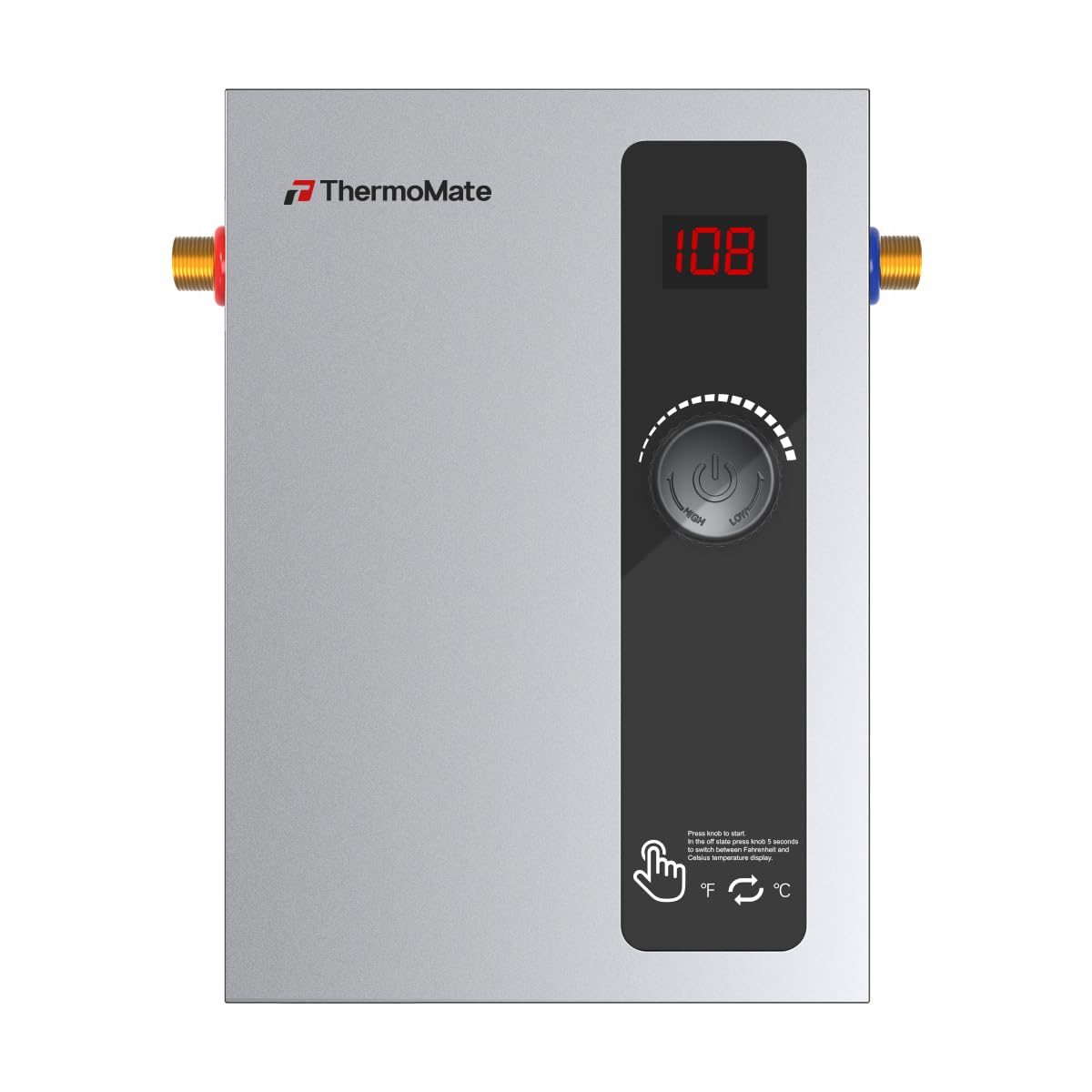
| ThermoMate 8kWCompact Pick | Point-of-use sinks and small spaces | 8000 watts | 1.9 gpm | 40A double-pole breaker, 8 AWG wire | Amazon |
| Rheem 8kW (RTEX-08)Best for Campers | Single-bathroom or camper use | 8 KW | 1.95 GPM | 40A double-pole breaker, #8 AWG wire | Amazon |
| Titan N-160 SCR3 | Multiple fixtures in warm climates | 16000 watts | — | 220 volt, 66 amp | Amazon |
| Stiebel Eltron DHX 15-2 Plus | Point-of-use with flow control | 14400 watts | — | 60A breaker, 60A draw | Amazon |
| Stiebel Eltron Tempra 24 Trend | Whole-house hot water from a compact body | 24 KW | — | 2x50A breakers, 100A draw | Amazon |
| Rheem RTEX-24 | Whole house with high simultaneous demand | 24 KW | 5.9 gpm | Three 40A breakers, 200A service | Amazon |
| Mount Steel Pioneer Series | Adaptable output for older panels | 27 KW | — | Three double-pole breakers | Amazon |
In‑Depth Reviews
1. Eemax EEM24013 Electric Tankless Water Heater, Blue
Our pick — over 4★ from 300+ verified ratings; the strongest balance of quality and price.
For homeowners short on floor space but hungry for endless hot water, the Eemax EEM24013 quietly does the heavy lifting.
The number that anchors this pick is 13 KW, which is the heating power behind its 13-gallon flow capacity. That combination lets it keep a whole household fed with hot water at once, unlike the ThermoMate 8kW’s much smaller 1.56 gallons. It also outpaces the Rheem 8kW’s output by a wide margin, so if you have ever waited on a tank to recover, this is the leap you want.
What wins people over is the sheer simplicity of it — it self-modulates, meaning it draws only the power your current demand requires rather than blasting full tilt every time. Owners who moved off a traditional tank describe setting up a small cabin or a two-person home and simply leaving it alone, with steady temperature even when a shower and a sink run together. One buyer summarized the appeal plainly: “for the price,quality, energy efficiency ease of installation and durability this works great.” The 8-inch-wide, 11.5-inch-tall body slips into tight utility corners and frees up the space a tank once hogged.
The honest catch is your existing wiring, and it is worth naming. This unit wants a dedicated circuit with heavy 6-gauge wire, which is stiff and awkward to bend, so plan on an electrician and a real panel check. A small handful of units have also shown a flickering LED segment over time, a minor ongoing niggle rather than a reason to pass. The upside is that the reviews lean strongly on function and steady heat, so for most buyers the wiring is a one-time hurdle, not a daily annoyance.
Where it shines
- 13 KW heat output delivers continuous hot water for a whole small home
- Self-modulating design adjusts power to match how much hot water you pull
- Compact 8″W x 11.5″H footprint frees up valuable storage space
- Straightforward controls keep daily use simple
What to weigh
- Demands a dedicated circuit and hard-to-bend 6-gauge wire
- Professional install and any panel upgrade add real cost
- A few owners see a faint LED indicator lit over time
Made for: A household that uses hot water at multiple taps and wants one compact unit to cover it all.
Think twice if: your panel is already near capacity, since the 6-gauge wiring requirement is the real gate on this pick.
2. Tankless Water Heater Electric, ThermoMate 8kW at 240 Volt, On Demand Instant Hot Water Heater for Point of Use
A 9.9-pound wall box that mounts anywhere and puts near-instant hot water right at the sink or shower it feeds.
At 8000 watts on 240 volt power, this is firmly a point-of-use heater, meaning you place it close to the single tap or two you want served. Its 1.9 gpm flow rate pairs with a 131°F maximum temperature, and the self-modulating design auto-adjusts the energy it pulls based on how much hot water you draw. The standout feature is the cast aluminum heating chamber that keeps the heating element separated from the water lines, cutting down on scale and corrosion over the years.
You can install this mid-power unit yourself if you have a 40-amp double-pole breaker (a switch that trips both live wires at once) and 8 AWG wiring (a thick wire gauge for high current), plus 1/2 NPT side connections (a standard pipe thread size). Owners who size their setup correctly report the whole thing coming together without a hitch. The efficiency story is a genuine draw: tankless units heat only when a tap opens, so no energy is spent holding a tank warm. The recurring honest note is output at high flow, where the real-world ceiling sits below the marketing numbers, so it is happiest serving one fixture at a time rather than a whole house.
Where it beats the smaller Rheem 8kW is the wider 8.58-inch body and the scale-resistant separated-element design, which points toward easier long-term upkeep. If your goal is a single sink, a remote bathroom, or a small point-of-use application, this keeps the job simple and compact.
Sharpest detail: The separated cast aluminum heating chamber keeps the element clear of your water lines, which is the design choice that most affects how this unit ages.
The limit to respect: At 1.9 gpm it serves one tap well; running a kitchen faucet and a shower together will stretch it past its comfort zone, so size it to a single fixture.
Reach for this: when you want hot water fast at one sink or shower and your breaker panel can spare a single 40-amp double-pole slot.
Look past it: if you need a whole house covered at once, where a higher-kilowatt unit is the smarter call.
3. Rheem 8kW Multi Fixture Tankless Electric Water Heater – 240V
An 8 KW heater that shines exactly where a single tap needs feeding, not where a whole house does.
This Rheem runs at half the power of the Titan N-160 SCR3’s 16000 watts, so it serves one fixture or a camper comfortably and struggles to do more. Its 1.95 GPM (gallons per minute) matches the point-of-use crowd, meaning it can feed a single shower or sink without a drop in pressure. The digital thermostatic control dials temperature in 1-degree increments from 80°F to 140°F — a precise range that lets you set an exact shower temperature rather than guessing at a knob.
The compact body sits 12.63 inches tall and frees up real space, 90% smaller than a traditional tank in this same line. Digital thermostatic control in single-degree steps is the standout here, giving you genuine precision. RV owners routing it inline with a propane heater describe it wired through a 50-amp plug to a campsite 30-amp receptacle, delivering unlimited hot water and ending the three-minute showers a 4-gallon tank used to force. In a studio apartment, the fix for a shower cutting out mid-use is simply throttling the output valve or adding a flow limiter to keep the unit within its range.
Be clear-eyed about where this one lives: it is built for one bathroom, a camper, or a single sink, and stretching it across simultaneous fixtures asks too much. The wiring spec is a 240V single-phase supply with one 40-amp double-pole breaker and #8 AWG copper, along with a recommended minimum 100-amp panel. Sized correctly, it is a reliable, easy-to-mount performer; pushed past its limit, it complains.
Best used for: a camper, a studio, or a single-bathroom setup where one well-defined hot-water demand is the whole job.
Not the one if: you expect a bath and a shower to run together — that is above this unit’s 8 KW ceiling, so step up to a higher-kilowatt model instead.
4. Titan N-160 SCR3 Tankless Water Heater Electric 16 KW 220 Volt 66 AMP

The multi-fixture workhorse for warm climates, where 16 KW and a slim steel chassis handle baths, kitchens, and laundry.
Sixteen kilowatts is a big jump over the 8 KW point-of-use units here, and the Titan N-160 SCR3 puts it to work covering several fixtures at once. The copper-brass and steel construction carries a 150 psi maximum pressure rating, and the trim 2.75-inch depth means it mounts flat against a wall without stealing usable space. It can be wall or floor mounted, which gives you flexibility in a tight utility room.
In warm regions, owners describe feeding two bathrooms, a kitchen, and a washer from this one box. The easy-install reputation comes through clearly: one long-time buyer noted they had put in a third unit of this type without trouble. The compact design leaves room to add a water filtration or RO (reverse osmosis) setup alongside it. Buyers value the fit-and-finish and trouble-free installation most, then the fast, steady heating once everything is running.
The trade-off is distance. This unit heats beautifully at close range, but if a faucet sits at the far end of the house you will wait, and you will run a fair amount of water down the drain before it arrives. In a colder climate, 16 KW may also feel stretched for a full house, so match it to a warm-climate home or a multi-fixture layout near the heater. On the electrical side plan for a 66-amp 220 volt demand, which is a serious dedicated circuit.
Strong points
- 16 KW output feeds several fixtures including two baths, kitchen, and laundry
- Copper-brass and steel build rated to 150 psi maximum pressure
- Slim 2.75-inch depth mounts on wall or floor to save space
- Simple, intuitive interface and a reputation for easy installation
Worth knowing
- Far-off faucets still mean a wait for hot water to travel
- A 66-amp 220 volt draw demands a sturdy dedicated circuit
- Full-house performance depends on a warm incoming water supply
The right call if: you live somewhere mild and want one unit serving multiple fixtures without a giant footprint.
Skip it when: you are in a cold region heating many distant taps, since the wait and the incoming water temperature work against it.
5. Stiebel Eltron DHX 15-2 Plus POU Electric Tankless Water Heater 14.4kW 240V

Made in Germany and barely 5.5 pounds, this point-of-use unit trims its own flow to nail the exact temperature you set.
Here is the feature that puts the DHX 15-2 Plus in a class of its own: an exclusive motor control valve that reduces flow rate to hold output temperature steady. Instead of delivering lukewarm water when demand rises, it slows the flow so the 14.4 kW heating element can keep up, which is exactly the behavior you want in a cold-weather kitchen or bath. A backlit multifunction display, output temperature presets, and a built-in energy savings calculator round out the control set.
Owners lean hard into how well this unit hits and holds its temperature. The auto flow control slows a high winter flow down to a trickle to reach the set point — adaptive behavior that keeps your shower consistent no matter the season. The graphical interface gets consistent praise for being intuitive, and installs are clean and straightforward for those prepared to run a 60-amp breaker. A contractor-fed kitchen setup here replaced a long propane run that took minutes to deliver hot water with near-instant delivery, cutting wasted water in the process.
The honest limitation is small and specific: the inlet temperature sensor only displays during an over-temperature condition rather than at all times, so you do not get a constant read on incoming water. It is a minor convenience gap, not a performance problem, and it does nothing to undermine the core temperature-holding strength. At 5.5 pounds and 7.95 inches wide, it is one of the lightest and most installable units in this group.
The defining feature: That motor control valve is the reason the temperature stays locked — it trades a little flow to guarantee the heat, which is the right bargain for point-of-use.
The small gap: If you like to watch incoming water temperature constantly, this unit won’t show it except during an over-temp state.
Ideal for: someone who wants precise, preset temperature control at a single point of use and values a light, easy-mounting unit.
Pass on it if: you need to centralize hot water for an entire house, since this is engineered for point-of-use duty.
6. Stiebel Eltron Tempra 24 Trend Electric Tankless Water Heater, 24kW, 240V
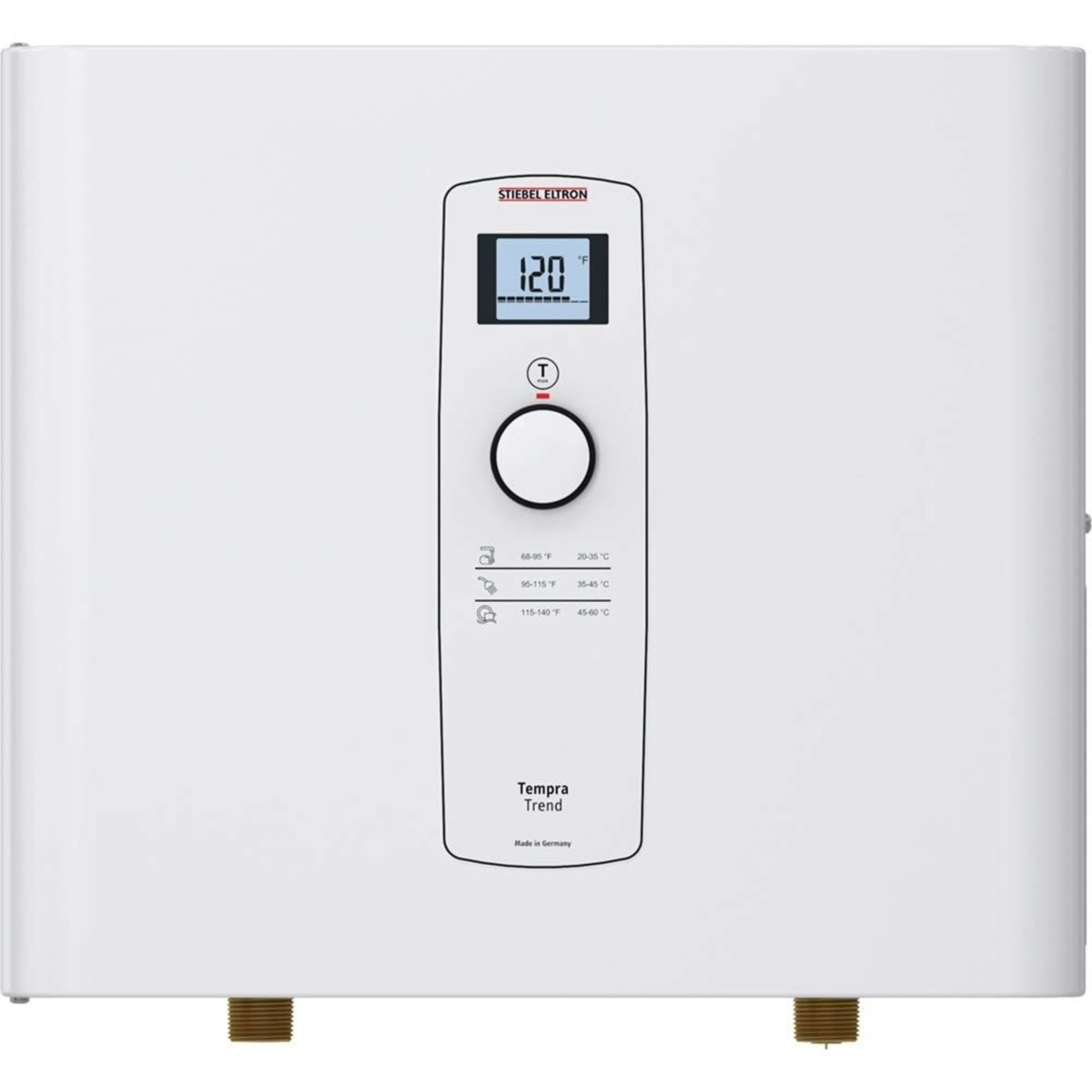
A 24 KW whole-house unit with a solid copper heating core and a digital display, built to pour endless hot water.
At 24 KW and 240V, this is a genuine whole-house heater, offering output from 68° to 140°F so you can dial in exactly the shower temperature you like. Because it is electric, it needs no venting — a real advantage over a tankless gas unit that demands a flue. The interior solid copper heating system does the heavy lifting, and a single electronic switch activates the unit, which runs noise-free while a digital temperature display stays easy to read.
Owners gravitate to the reliability and the endless-supply promise. One owner replaced the same model after an 18-year run, with a 20-minute install once the plumbing and electrical were in place. Others running it for a couple of years report it compact and quiet, with the only recurring note being a shower-pressure dip when laundry runs at the same time. The energy story holds up too: owners who came off a tanked unit describe power bills dropping once the always-on tank was gone.
The electrical reality is the catch you must plan around. This model wants a minimum recommended electric service of 150 A and runs on two 50-amp breakers drawing 100 amps total, so a service upgrade may be in your future. It also wants a professional install with both a plumber and an electrician, which is more involved than simply swapping a tank. Get the service right, though, and it delivers on the whole-house brief.
Why it earns its slot
- 24 KW delivers continuous whole-house hot water with no venting needed
- Digital temperature control from 68° to 140°F for precise showers
- Solid copper heating core and silent, noise-free operation
- Backed by 7-year leakage and 3-year parts coverage
Before you commit
- Needs a 150 A minimum recommended service and two 50-amp breakers
- Professional plumbing and electrical installation is expected
- Shower pressure can dip if laundry runs at the same time
Best matched to: a whole-house buyer with modern electrical service who wants endless hot water and no venting.
Look elsewhere if: your panel cannot support a 100-amp draw, because the service upgrade becomes the deciding cost.
7. Rheem RTEX-24 24kW 240V Electric Tankless Water Heater, Gray

Built to keep up with a busy household, this 24 KW heater pushes a generous 5.9 GPM through three dedicated circuits.
The headline figure is the 5.9 GPM flow rate, matching the unit’s 24 KW heat output for handling multiple hot-water draws at once. Compare it to the point-of-use crowd — the Rheem 8kW moves 1.95 GPM and the ThermoMate 8kW just 1.9 gpm — and you can see why this one is aimed at real simultaneous demand. Digital thermostatic controls step in single-degree increments from 80°F to 140°F, and its 99.8% efficiency reflects the absence of a standby tank to keep warm.
What owners praise is the performance: it keeps up with demand and provides an endless supply, all from a small footprint that frees floor space. Apartment and small-home users find it easily installed, and one owner who had it over a year noted the first descaling was simple and that the reclaimed utility space was a welcome bonus. It runs fine on warm incoming groundwater and handles two showers plus laundry, with a slight temperature dip at the shower farthest from the unit.
This one carries the heaviest wiring requirement in the whole group, so treat it as a project rather than a plug-in. It calls for a 200-amp household service with three 40-amp double-pole breakers and three sets of #8 AWG copper conductors. Owners in colder regions also flag that bath-filling on cold ground water needs a larger unit or an indoor holding tank. Where it beats the smaller Rheem 8kW is simply raw capacity — 5.9 GPM versus 1.95 GPM is the difference between one fixture and a whole home.
The one to grab: when you have the electrical service to back it and want plenty of hot water across the house at once.
Consider the smaller units if: a 200-amp service and three breakers are more than your home can offer.
8. Electric Tankless Water Heater, 19kW–27kW Adjustable, 240V, Configurable Power, Self-Modulating Whole House Hot Water Heater

A heater whose whole trick is flexibility: dial its output up or down to match the panel you actually have.
This Mount Steel Pioneer unit supports various power configurations and a 19kW–27kW adjustable range, so an electrician can set it to what your panel can support rather than forcing a costly upgrade. Its dry-heating design separates the heating elements from the water and uses aluminum to reduce the mineral buildup and corrosion that shorten a heater’s life — the same separated-element thinking found in the ThermoMate, but at a much higher power ceiling.
Temperature stability is the other strength. Accurate sensors and processors adapt to changing demand across the house to hold a steady output, and owners confirm it keeps temperature even when a dishwasher and a shower compete. The compact 3.3-inch depth and wall mount let it fit where full-size units cannot — one owner tucked a point-of-use setup inside a cabinet near the vanity for steady temperature at the shower while the kitchen sink ran. Build quality draws repeated praise, and an 8-year limited warranty covers the heat exchanger.
Two things to weigh before buying. It still wants three double-pole breakers, and a few owners note that the internal passages are narrow, so feeding a high-flow shower may call for careful install planning or slight throttling rather than maximum flow. The English wording in the manual is not perfect, so a clean install leans on an electrician’s judgment over the printed steps. Get those right, and the flexible output solves the exact panel-fit problem that stops most buyers.
Why it stands out: The adjustable power range means you size the heater to your electrical reality instead of the other way around, which is the headache this category creates for most homes.
The practical note: An electrician is essential here — the manual’s translation is imperfect, and the three-breaker requirement plus narrow internal passages reward careful setup.
The pick for you if: you want whole-house capacity but your panel is the limiting factor and you value setting the output to fit it.
Reconsider if: you plan to feed a high-flow shower at full blast, since the narrow internal passages prefer balanced demand.
Understanding the Specs
Kilowatts And Flow Rate
A kilowatt (kW) is the heating muscle — more of them heat more water in less time. Flow rate, measured in GPM (gallons per minute), is how much hot water the unit can push through. The two work together: a 5.9 GPM unit needs serious kilowatts behind it, while a 1.9 gpm point-of-use model gets by on far less. Before you buy, add up how many hot taps you run at once and match the pair to that number, not to a single faucet.
Voltage, Breakers, And Wire
All of these units run on 220/240 volt electric power, which is why they skip venting entirely. But 240V supply also means a dedicated double-pole breaker and a specific copper wire gauge — often #8 or #6 AWG. A whole-house 24 KW unit may call for a 200-amp service and several breakers, while a point-of-use model can ride on one 40-amp double-pole breaker. Check your panel’s spare capacity and your incoming water temperature before you order, because those two facts decide what will actually work in your home.
FAQ
Can a 220 volt tankless water heater run a whole house?
What size breaker does a 220 volt tankless water heater need?
Do I need an electrician to install one of these?
What is the difference between point-of-use and whole-house tankless heaters?
Why does my tankless heater feel cooler in winter?
How much space does a 220 volt tankless water heater save?
Does a tankless electric water heater save money on my bill?
Can I install a tankless water heater in a camper or RV?
What maintenance does a tankless electric water heater need?
Will a tankless water heater run a bath?
Final Thoughts: The Verdict
For most households, the 220 volt tankless water heater to beat is the Eemax EEM24013, because its 13 KW output and 13-gallon capacity cover a small home’s taps at once while staying compact enough to reclaim your storage space. If your priority is precise temperature control at a single sink or shower, the Stiebel Eltron DHX 15-2 Plus trims its own flow to hold the set point, which no other unit here does. And when you need whole-house hot water on high simultaneous demand, the Rheem RTEX-24 at 5.9 GPM is the one to reach for — just confirm your panel can feed the three breakers it needs before you commit.
How We Picked
We do not accept paid placement. Every pick is matched to a real buyer and a real use-case; we do not hands-on test units.
Sources & Methodology
Specifications: manufacturer listings and product documentation. Review insights: verified customer reviews, as of September 2026. Pricing: not shown on this page (it changes often); check the current price via the retailer link.
As an Amazon Associate, KitchPrep earns from qualifying purchases. This does not affect which products we feature.
Related Guides
