
Specs are compiled from manufacturer listings and verified buyer reviews and can change over time — please confirm the key details on the product page before buying.
When the grid drops, you want the power back before the fridge starts sweating. An automatic transfer switch does that one job: it senses your generator is running, waits for the voltage to settle, then flips your panel over without you touching a cord. The catch is that “50 amp” printed on two boxes can mean two very different things — one is a drop-in relay for an RV, the other is a service-entrance device a licensed electrician has to bond to your meter. Buying the wrong one wastes an electrician’s time. So this guide separates the RV swap-outs from the whole-home service switches, walks you through amperage and service ratings in plain words, and points you at the pick that fits your panel.
I’m Mohammad Maruf — the founder and writer behind KitchPrep. This guide is built by comparing the manufacturers’ published specifications and the patterns across verified customer reviews, so you get each pick’s real strengths and trade-offs instead of marketing spin.
You will see 50 amp RV units, 100 amp whole-home switches, and one meter-mounted option that skips the panel entirely. The differences come down to amperage, delay timing, and whether your service entrance is involved. Here is how to pick the auto transfer switch for generator that actually matches your wiring.
Our Picks at a Glance


How To Choose The Best Auto Transfer Switch for Generator
The first question is not which brand — it is what the switch is switching. An RV transfer switch lives in a compartment and swaps between a shore power cord and an onboard generator. A whole-home switch sits at your service entrance and swaps between the utility line and a standby generator. Those are two different products that happen to share a name, and shopping them as one category is where most buyers go wrong.
Match the amperage to your feed, not to your generator’s peak
A rating like 50 A (amps, the amount of current the switch is built to carry continuously) tells you the largest feed it can handle. If your generator feeds a 50 amp inlet, you want a 50 amp switch. If a licensed electrician is tying the switch into your 200 amp service entrance, you want a switch rated for that service. A 30 A switch on a 50 A feed is a mismatch no amount of good wiring fixes.
Understand the time delay before you blame the switch
Every automatic switch here waits before it transfers. The pause lets the generator reach stable voltage and frequency (the speed it spins at, which sets the power quality). Generac’s 100 amp unit sequences HVAC loads through its own module; the GenerLink units and the RV switches hold a set delay at power up. If your air conditioner is short-cycling the generator on transfer, the delay is usually the first thing to check.
Confirm generator compatibility before you order
Two-pole switches are picky about control wiring. Generac’s Legacy switch is engineered for Generac standby generators with Evolution or Nexus controls. The KUTTOLE 100 amp switch is built as a replacement for the RXSW100A3 switch used with Evolution or Nexus controllers on 8-24 kW home standby units. Get that pairing wrong and the switch may be physically identical but electrically inert.
Quick Comparison
| Model | Best For | Amperage | Voltage | Install Type | Amazon |
|---|---|---|---|---|---|
| Progressive Dynamics PD52V★ Best Overall | RV shore-to-generator swap | 50 A | 240 VAC | DIY-friendly replacement | Amazon |
| Technology Research 40100Surge Guard Pick | RV replacement with surge protection | 50 A | 120/240 V | RV bay install | Amazon |
| Surge Guard 40100 BasicBudget Champion | Direct-fit RV replacement | 50 A | 120/240 V | Screw-terminal RV install | Amazon |
| Elkhart LPT50BRD | Quiet RV replacement | 50 A per pole | 120/240 V | Terminal-strip RV install | Amazon |
| Furrion F50-ATS | RV install in vibration-heavy bays | 50 A | 125/250 V | Crimp-terminal RV install | Amazon |
| KUTTOLE 100 Amp ATS | Generac standby home backup | 100 A | Single phase | Electrician, NEMA 3R outdoor | Amazon |
| Generac 100 Amp Legacy | Whole-home Generac standby systems | 100 A | 120/240 V | Service-entrance, licensed electrician | Amazon |
| GenerLink 30 Amp | Whole-panel backup, smaller generator | 30 A | 240 V | Meter-mounted by utility | Amazon |
| GenerLink 40 Amp | Whole-panel backup, larger generator | 40 A | 240 V | Meter-mounted by utility | Amazon |
In‑Depth Reviews
1. Progressive Dynamics PD52V 5200 Series Automatic Transfer Switch
Our pick — over 4.5★ from 550+ verified ratings; the strongest balance of quality and price.
The RV switch that makes a failed factory unit into a weekend job, not a shop bill.
If your Jayco Designer’s Iota transfer switch finally gave up, or your Holiday Rambler has a dead unit in the electrical bay, this is the replacement to reach for. It carries a 50 A rating at 240 VAC, so it suits the standard 50 amp shore and generator feeds on a big Class A or fifth wheel. The housing is steel rather than the plastic used on plenty of original equipment, and it arrives with an easy-to-remove protective cover and the wiring schematic printed inside it — which matters when you are standing on your head in a basement compartment trying to remember which lug is which.
The reason it sits at the top is the time delay circuit board. That board holds the transfer until your generator’s voltage settles instead of slamming the load on the instant the generator coughs to life — the exact failure mode that kills cheap switches. It also prevents two power sources from entering the AC distribution panel at the same time, which is the safety rule everything else here is built around. Screw-type wiring terminals land on a contactor base with real structural support. Progressive backs it with a one-year limited warranty.
Buyers report that it simply works. By far the heaviest stream of praise is about plain functionality, with installation right behind it — owners describe it as a plug-and-play swap for a failed unit, and plenty of them are doing the job themselves with the schematic in hand.
The case for the PD52V
- Steel enclosure resists the thermal wear that destroys plastic-housing RV switches
- Time delay board waits for stable generator voltage before it transfers
- Screw-type terminals and an internal schematic make a same-weekend swap realistic
- 240 VAC at 50 A covers standard RV shore and generator feeds
What you should know going in
- Wire clamps are not included — the knockouts fit 1-inch clamps, and many 50 amp cables need larger ones
- The jumper that removes the 30-second switchover for inverter use is not in the box
- Footprint differs from some original 50 A switches — taller and narrower, though similar in total size
- Longevity reports split: some owners are going strong at eight months, a few saw failure around four
Right call for: RV owners replacing a failed factory 50 amp transfer switch who want a metal box, a real time delay, and a schematic to work from.
Think twice if: your generator feeds a home service entrance rather than an RV bay — this is a 50 A, 240 VAC RV switch, not a service-rated unit.
2. Technology Research (40100 50 Amp Surge Guard Automatic Transfer Switch
A 50 amp RV switch that also guards the whole coach against dirty park power.
Two things are happening in this box. It is a 50 A automatic transfer switch with mechanical interlocking contactors, meaning the utility feed and the generator feed physically cannot close at the same time — a mechanical block rather than relying on electronics to behave. But it is also Surge Guard hardware, which is the part that carries weight with RV owners, because it means the protection is permanently installed in the coach rather than hanging off the shore pedestal where it can walk away.
The transfer logic matches the rest of this class: a 30 second delay at power up lets the generator find its footing before the load lands, and the contactors are rated to 50 A. Installation is ordinary in the best way — the summary of owner experience is that it goes in with regular hand tools, and one person who bought it as a contactor replacement said it was an exact swap at a much better price, which is about the highest compliment a replacement part gets.
Here is the honest wrinkle. Owners consistently report a low electrical buzz once it is running, and the fix that keeps showing up is rubber washers behind the mounting holes, which nearly eliminates it. That is a real annoyance in a bedroom-mounted unit, but it is a dampening problem, not a failure problem. There is also a small punch-out hole that is not a standard size, which means some installers get creative with conduit. As buyers put it: “Works 100% after ~1 month 24/7 use.”
Why it earns a slot: It combines two jobs — automatic 50 A transfer and permanent surge protection — inside one enclosure that mounts in the coach rather than on the pedestal.
The honest trade: Plan on rubber washers if the switch will live in a living space, and check your knockout sizes before you cut conduit.
Ideal match: RVers who want surge protection permanently wired in, not a loose pedestal unit, and who want a mechanical interlock backing up the electronics.
Look elsewhere if: you need a switch rated above 50 A, or you cannot tolerate any audible hum in a sleeping area even after dampening.
3. Surge Guard 40100 Basic Automatic Transfer Switch – 50 Amp
The stripped-down 40100 that gets a dead motorhome panel live again.
This is the no-frills version of the 40100 chassis — screw terminals instead of a fancy connector, 120/240 V at 50 A, 60 Hz, and a generator-dominant transfer that favors the onboard generator whenever it is energized. Time delay at power up is built in, and the contactors are mechanically interlocked so the two feeds cannot meet. It is explicitly built to work with generators and shore power sources on an RV.
The install story is the good part. Because it is a direct replacement for the Model 40100 transfer box, it drops into the same footprint with the same terminal layout. One owner’s unit had been smoking on the electrical side and the fix was a same-day swap — after which it handled all the coach’s electrical loads with no smoke and no burnt-wire smell.
The one difference worth flagging before you order is the case: it is plastic where the original was metal. That is a manufacturing change rather than a functional one, and the unit operates identically, but it is the kind of detail that will bother you at unboxing if you were expecting the old steel housing. Screw terminals also mean you should check the torque on every lug — one failure in this lineage traced back to insulation left clamped under a screw terminal at the factory.
Buy this if: you are replacing a failed 40100 and want the same wiring layout in a direct-fit unit.
Not your pick if: you specifically want the metal enclosure, or you need anything above a 50 A rating.
4. Elkhart (LPT50BRD) 50 Amp Automatic Transfer Switch

Relay-based silence for the switch mounted under your bed.
Plenty of RV transfer switches hum. If yours lives in the electrical bay this is a non-issue, but if it sits under the bed platform on a fifth wheel, a constant hum at 2 a.m. is the whole reason you are shopping. The LPT50BRD is relay based with no humming in the quiet reports — the factory unit that hummed all night under the bed got replaced with this one, which stays silent except for the initial power-on click.
It is a 50 A per pole, 120/240 V switch with a 70 A neutral, a 12.0KW rating, a terminal strip for wiring, and a shore power pass-through design. It is rated 110VDC with a 22 second nominal time delay for generator spin-up, and that delay is defeatable for instant switching.
Owners swapping out an IOTA ITS-50R on older Holiday Rambler and Monaco coaches describe it as a drop-in replacement, slightly larger but sturdy metal where the old plastic had been melting and humming. Expect to allow for the larger footprint and to have some wiring experience before starting. The genuine annoyance reported is the packaging — some units land with shattered styrofoam and minimal bubble wrap, so inspect the internals before you mount anything.
The standout: 70 A neutral capacity and a defeatable 22 second delay give you headroom and control that most 50 A RV switches do not offer.
The caveat: Rough shipping packaging has turned up repeatedly, so open the box and look at the internals before the install window closes.
Reach for it if: your transfer switch sits anywhere near where you sleep, or you are replacing an IOTA ITS-50R and want metal instead of melting plastic.
skip it if: you are short on bay space and cannot accommodate a slightly larger enclosure than your old unit.
5. Furrion 50 Amp Automatic Transfer Switch with VibrationSmart and ClimateSmart

Engineered for the road’s vibrations and the sun’s worst days.
Furrion built this one around the two things that actually kill RV electrical gear: constant vibration and heat. The casing is UL 94 fireproof plastic, the terminals are nickel-plated solid brass for corrosion resistance, and the unit is certified to UL 1008, the transfer switch safety standard. It swaps between two separate 125/250 volt AC sources, whether those are a generator, a shore power cord, or an inverter.
The transfer behavior is 20 to 30 seconds of delay once the generator is sensed at the input terminals, which gives the generator time to run up to speed before it takes load. The safety architecture is the interesting part: a mechanical interlock between the contactors guarantees both cannot close in parallel, which prevents overvoltage on the output line. For anyone who has opened an old switch and found arcing marks, that interlock is the feature doing the real work.
Most of the owner enthusiasm here is about the install itself — going from an old IOTA or TODD unit to this one cleaned up the wiring considerably, and one owner reported the job took about an hour. The honest issue is noise: these have a tendency to develop a low hum over time. One long-term owner traced it to the shore power relay and found replacement expensive. It is not a safety problem, but it is a real one if you are sensitive to hum in a small space.
Where the Furrion delivers
- UL 1008 certification and a UL 94 fireproof enclosure
- Mechanical interlock prevents both contactors closing in parallel
- Brass terminals, nickel plated for corrosion resistance
- Handles generator, shore power, or inverter as its two inputs
Where it asks you to compromise
- Hum can develop over time as the shore power relay ages
- Replacing that relay is not a cheap fix
- Terminal wiring needs re-routing on some swaps from older units
Suits you if: you want certified safety architecture, corrosion-resistant terminals, and a clean install replacing an aging IOTA or TODD switch.
Not ideal if: the switch will sit in a quiet sleeping area and any future hum would be a problem for you.
6. KUTTOLE 100 Amp Automatic Transfer Switch, Single Phase
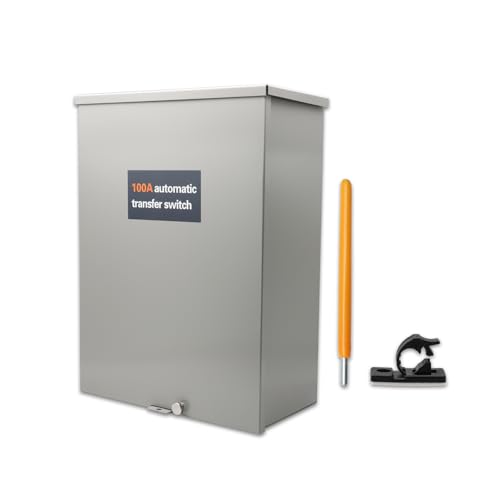
A 100 amp home standby switch that does its own load management.
This one is for the homeowner running a Generac standby unit between 8 and 24 kW who wants the whole panel backed up without adding load-shedding hardware. It is a 100 A single phase switch built as a replacement for the RXSW100A3 automatic smart transfer switch, and it works with Evolution or Nexus generator controllers. Integrated load management handles four separate HVAC loads with no additional accessories, which is the piece most competing switches make you buy separately.
The enclosure is the outdoor story: NEMA 3R rated and described as rust-proof and weatherproof, with an aluminum partition inside to keep you away from internal components during service. It is UL listed, the certification a service-entrance inspector checks for. A detailed installation manual ships in the box alongside the switch and an accessory kit, and KUTTOLE backs it with a one year replacement period.
Owners describe the transfer as practically smooth through real outages, which is the whole point of the product. “Works just fine,” reads one account of two separate power losses on a Generac system. The genuine caution is the install itself: the manufacturer’s own wording recommends a professional electrician if you are not already familiar with this kind of work, and at 100 A tied to a home panel, that guidance is worth taking seriously rather than reading as a formality.
The right buyer: a Generac Evolution or Nexus owner who wants 100 A of whole-home backup with four HVAC loads managed in the switch itself.
Wrong tool if: you are on a different generator brand or controller — the RXSW100A3 compatibility is specific, not universal.
7. Generac 100 Amp Legacy Automatic Generator Transfer Switch, SE Rated

Whole-panel backup that flips itself the second the utility drops.
Service entrance rated is the phrase that separates this switch from everything else on this page. It functions as your main service disconnect, which means it ties directly into the utility service — and that is exactly why local code requires a licensed electrician and a permit for the install. If you were hoping to do this one yourself on a Saturday, this is not that product. If you are hiring out whole-home backup anyway, this is the ceiling of the category.
The capability matches the rating. At 100 A it handles up to 24,000 watts across your full 120V and 240V panel, including big 240V loads like well pumps and dryers. That means you back up the entire panel rather than choosing a handful of circuits. Open transition switching mechanically isolates utility and generator power so both can never connect at once — the same backfeed protection principle as the RV switches here, but at service scale, where it protects line workers as much as your wiring. A built-in Smart AC Module sequences up to four HVAC loads without extra hardware. The powder-coated aluminum enclosure is NEMA 3R and IP54 rated for outdoor mounting.
The single most important compatibility fact: this is engineered for Generac home standby generators with Evolution or Nexus controls. It is not a universal switch, and it is not for portable units from other brands. That one restriction is the most common cause of a return — buyers discover after ordering that they assumed a two-wire switch. What arrives is the switch enclosure, contactor, Smart AC Module, and manual, backed by a five year limited warranty; the generator and inlet materials are separate purchases.
What you are paying for: A service-entrance rated 100 A switch that carries your entire 120V and 240V panel up to 24,000 watts, with four HVAC loads sequenced in-switch and a five year limited warranty.
What you must not miss: Generac Evolution or Nexus controls only, and a licensed electrician plus permit for the install.
Made for: Generac standby owners who want the entire panel backed up and are hiring a licensed electrician anyway.
Move on if: you own a different brand of standby generator or a portable unit — this switch will not control it.
8. GenerLink Automatic Transfer Switch for Home Generator with Surge, 30 Amp

Skip the panel entirely — this one mounts behind your power meter.
Every other switch on this page gets wired into something. This one mounts directly behind your electrical meter and transfers power to your entire breaker panel with no limit on circuits. That is a genuinely different install path: no subpanel, no circuit selection, no extension cords running through a window. It is designed for generators running below 8,500 watts, on 30 A service, and it comes with a 20-foot GenerLok Power Cable with an L14-30 plug.
The flexible piece is the service rating. It works with electrical services up to 200 amps even though the generator input itself is 30 A — so the switch is sized to your home’s service, while the amp rating tells you what generator it accepts. Surge protection is integrated at 75kA, which is meaningful hardware rather than a token suppressor, and it includes an audible alarm for surge events. Like the Generac above, it prevents back-feeding utility lines. It is UL listed to UL1008M and stated as 2020 NEC compliant.
Installation routinely involves your utility rather than just an electrician — one owner had the local electric company approve and install it, and another paid for an electrician to mount it on the meter. The housing is UV-resistant and weatherproof for outdoor mounting, and the contacts are stainless steel. What tips owners into recommending it is the simplicity of the payoff: hook the generator up, flip nothing, and the house is live.
Why owners choose the meter mount
- Backs up the entire breaker panel with no limit on circuits
- Integrated 75kA surge protection with an audible surge alarm
- Compatible with electrical services up to 200 amps
- UL listed to UL1008M and stated as 2020 NEC compliant
The limits to weigh
- Generator input is 30 A, so it suits units running below 8,500 watts
- Utility company involvement is typical, and approval timing can add lead time
- Nothing about this install is a DIY job for a homeowner
Grab it if: you run a smaller portable generator and want the whole panel live without a panel-mounted switch or extension cords.
Step up if: your generator runs at or above 10,000 watts — the 40 A version is the one built for that.
9. GenerLink Automatic Transfer Switch for Home Generator with Surge, 40 Amp

Same meter-mount trick, sized for generators near ten thousand watts.
This is the 40 A sibling of the GenerLink above, and the difference is the ceiling on what generator it will accept. Where the 30 A unit tops out below 8,500 watts, this one is compatible with generators running below 10,000 watts — so if your portable unit is a larger dual-fuel or a big inverter machine, this is the version to order. The connector changes with the rating too: this one ships with a 20-foot GenerLok Power Cable with an L14-50 straight connector, a heavier plug than the 30 A unit’s L14-30.
Everything else carries over from the platform. It mounts directly behind your meter and feeds your entire breaker panel with no limit on circuits, and it works with electrical services up to 200 amps. Surge protection is the same 75kA with an audible alarm, and the same back-feed prevention keeps utility line workers safe. It is UL listed to UL1008M with 2020 NEC compliance, and its contacts are brass and stainless steel.
The owner experience here is unusually focused on timing. This is equipment people buy before storm season, and the reports read like a to-do list that got finished: one buyer paid extra to have it shipped before the winter storm, had a one-day delay, still got it to the electric company in time for a free install, and tested it that day. Another praised the verification call before shipping to confirm the order matched their electric provider — a small step that prevents the wrong-model return that plagues this category. Owners also note it moves with you to a new home.
Where it wins: A heavier L14-50 connection and support for generators below 10,000 watts, with the same 75kA surge protection and unlimited whole-panel circuits.
What to plan around: Utility approval and install scheduling are part of the process, so order well before storm season rather than during it.
Your pick if: your portable generator sits between the 30 A unit’s ceiling and 10,000 watts, and you want whole-panel backup without touching the breaker panel.
Choose the 30 A version instead if: your generator runs below 8,500 watts — the extra rating would be unused capacity.
Understanding the Specs
Amperage and voltage ratings
Amperage is the amount of current a switch is built to carry, and voltage is the pressure pushing it. A 50 A switch at 240 VAC is the standard RV rating for a big coach’s shore and generator feeds. A 100 A switch at 120/240 V handles a full residential panel. The 30 A and 40 A GenerLink units are the exception to watch: their input rating tells you what generator they accept, not what your home service is — they work with services up to 200 amps regardless. Match the amperage to the feed you are actually switching, and confirm the voltage matches your panel or coach before ordering.
Time delay and mechanical interlocking
Time delay is the pause between the switch sensing generator power and actually transferring the load. It exists so the generator can reach stable voltage and speed before appliances hit it — the Elkhart unit holds a 22 second nominal delay, the Furrion holds 20 to 30 seconds, and Progressive’s board waits for stable voltage. Mechanical interlocking is the separate, more important safety layer: it physically prevents the utility contactor and the generator contactor from closing at the same time. Without it, both power sources could feed the panel at once, which is precisely the back-feed condition that endangers utility line workers. Every switch in this list uses some form of it.
FAQ
Can I install an automatic transfer switch myself?
Will this switch work with my portable generator?
What does a 50 amp per pole rating mean on an RV switch?
Why does my transfer switch hum and is it dangerous?
How long does the delay last before power transfers?
Can a transfer switch protect my appliances from a power surge?
What is the difference between the GenerLink 30 amp and 40 amp versions?
Do I need a Generac transfer switch for a Generac generator?
Is a meter-mounted transfer switch better than a panel-mounted one?
Final Thoughts: The Verdict
For RV owners whose factory transfer switch has failed, the Progressive Dynamics PD52V is the one to order — it pairs a steel enclosure and screw-type terminals with a time delay board that protects your generator, and it is the pick here with the deepest pool of owner experience behind it. If you want that same 50 A job done with surge protection permanently wired into the coach, the Technology Research 40100 is the switch to reach for, and if hum is the thing keeping you up at night, the relay-based Elkhart LPT50BRD is the quiet one. For whole-home backup, decide between the panel and the meter: the Generac 100 Amp Legacy is the ceiling of the category if you run Generac Evolution or Nexus controls, while the GenerLink 40 Amp gets your entire panel live off a portable generator without touching a breaker. Whichever direction your wiring points, buy it before storm season, not during it.
How We Picked
We do not accept paid placement. Every pick is matched to a real buyer and a real use-case; we do not hands-on test units.
Sources & Methodology
Specifications: manufacturer listings and product documentation. Review insights: verified customer reviews, as of September 2026. Pricing: not shown on this page (it changes often); check the current price via the retailer link.
As an Amazon Associate, KitchPrep earns from qualifying purchases. This does not affect which products we feature.
Related Guides
