
Specs are compiled from manufacturer listings and verified buyer reviews and can change over time — please confirm the key details on the product page before buying.
If you are taping a whole house and your wrist is already aching from a manual knife and mud pan, an automatic taper is the tool that changes the job. It holds a roll of paper tape and a hopper of joint compound inside one tube, so you pull the trigger, walk the joint, and the machine lays down tape with mud already behind it. That single change turns a weekend of taping into an afternoon.
I’m Mohammad Maruf — the founder and writer behind KitchPrep. This guide is built by comparing the manufacturers’ published specifications and the patterns across verified customer reviews, so you get each pick’s real strengths and trade-offs instead of marketing spin.
The picks below split into two clear groups. On one side you have the standalone tapers — the banjo-style tools that lay tape on flat seams and around corners. On the other you have full finishing sets that add flat boxes, angle heads, and corner rollers so one purchase covers the whole taping and finishing flow. Which one you want depends entirely on how many joints you face and whether you already own boxes. This guide breaks down every automatic drywall taper here by its real specs.
Our Picks at a Glance

How To Choose The Best Automatic Drywall Taper
An automatic taper is not one tool — it is a family of tools, and the wrong pick leaves you hand-finishing half the room anyway. The three questions below settle almost every buying decision before you ever look at a model number.
Standalone taper or full set
A standalone taper, often called a banjo, does one job: it feeds paper tape with mud onto seams and corners. If you already own flat boxes and angle heads, that is all you need, and a lighter, cheaper tool is the smart buy. If you are starting from scratch, a full set bundles the taper, flat boxes for wide seams, angle heads for inside corners, and a corner roller for bedding tape — one purchase, one case, no hunting for the missing piece mid-job.
Weight is the spec that decides your day
Fill the hopper with joint compound and you carry that added weight along every joint and ceiling seam. A tube that looks light on paper can feel heavy by the third wall. Carbon fiber and aluminum tapers sit at very different weights, and that gap shows up in your shoulders long before lunch.
Mudflow control and cleanup
The mudflow adjustment is what lets you match the bead to the joint — a thin bead for a tight seam, a fuller one for a wide gap. Get it right and the tape beds without squeezing compound down the wall. Cleanup is the part buyers always forget: a taper with a quick-release lid and simple cable changes saves you real time at the end of every shift, while a fiddly one turns cleanup into a chore.
Quick Comparison
| Model | Best For | Type | Tube Material | Item Weight | Amazon |
|---|---|---|---|---|---|
| LEVEL5 4-600 Automatic Taper & Finishing Set★ Best Overall | Full taping and finishing setup | Full set | Aluminum | — | Amazon |
| Marshalltown TapeShooterBest Value | One-handed loading, fast seams | Standalone taper | Aluminum | 2.3 pounds | Amazon |
| TapeTech EasyClean 07TT | Quick cleanup and cable swaps | Standalone taper | — | 9.78 pounds | Amazon |
| TapeTech Carbon Fiber 07TT-C | Less fatigue overhead | Standalone taper | Carbon Fiber | 5.65 pounds | Amazon |
| LEVEL5 4-621 Full Taping Set | Extendable-handle finishing set | Full set | Aluminum | — | Amazon |
| LEVEL5 4-625 High Capacity Set | Big jobs, high-capacity boxes | Full set | Aluminum | — | Amazon |
In‑Depth Reviews
1. LEVEL5 Automatic Drywall Taping and Finishing Tool Set | 4-600
Our pick — 4.5★ from 70+ verified ratings; the strongest balance of quality and price.
The one purchase that covers taping and finishing without hunting down the missing head.
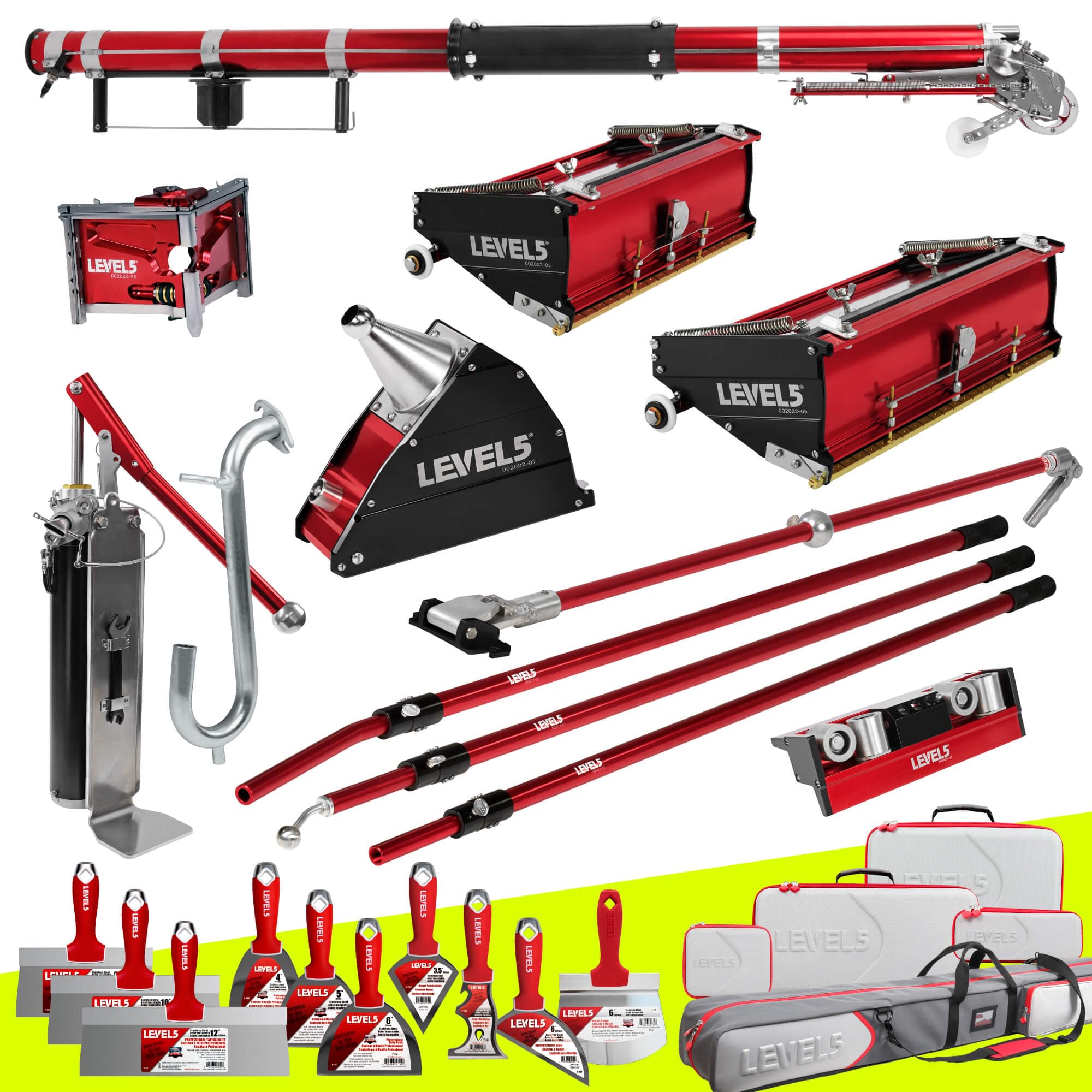
Buy this if you are moving off hand tools and want the whole taping and finishing flow in a single case. The 4-600 set pairs an automatic taper with 10” and 12″ flat boxes for wide seams, a 3” angle head and a 7” corner applicator box for inside corners, plus a corner roller, pump, and gooseneck. Everything runs on standard handles, and LEVEL5 throws in protective cases and a set of hand tools at no extra charge. It is the setup professional finishers reach for when they want fast, high-quality taping without giving up finish quality.
Build quality is the thing people rave about here — the blades are stainless steel and the body is aluminum, so the tools feel solid in the hand rather than flimsy. Owners describe the auto taper taking a little practice to master, then becoming the tool they miss when there are no joints left to tape. The seller support backs it up too, with buyers reporting a small part issue months in that was replaced with no questions asked. The set spans 57″L x 16″W when laid out, so a dedicated spot in the truck is the practical move.
The honest catch is learning curve. This is a pro-grade set and the taper does not hand you a perfect bead on day one — you have to tune the mudflow and get the trigger timing into your hands. That is normal for automatic taping tools, but it is worth knowing before you commit to a full kit. If you want a single tool to lay tape and nothing more, the standalone Marshalltown TapeShooter further down is the lighter path.
What earns the top spot
- Complete kit: taper, 10”/12″ flat boxes, 3” angle head, 7” corner applicator box, corner roller, pump, and gooseneck in one buy.
- Stainless steel blades and an aluminum body hold up to daily finishing work.
- Protective cases plus a set of premium hand tools are included at no extra charge.
Where it asks something of you
- The auto taper needs practice before your beads come out clean and even.
- It takes up real space — a 57″L x 16″W footprint when the tools are laid out.
Best fit: a finisher who wants taping and finishing covered by one order and does not mind a weekend of practice.
Look elsewhere if: you already own flat boxes and angle heads — you would be paying for tools you have.
2. Marshalltown TapeShooter Drywall Taper, Taping Tool
At 2.3 pounds, this is the taper you can carry up a ladder without thinking about it.
Here is the weight gap that decides who buys this tool: the TapeShooter weighs 2.3 pounds, while the TapeTech EasyClean 07TT comes in at 9.78 pounds. If your day is spent on a ladder or working overhead joints, that difference is the whole argument. The body is lightweight aluminum, and Marshalltown builds it in both right- and left-handed versions, so lefties are not forced to adapt. A latched door on the tape spool holder lets you load a roll with one hand — genuinely useful when the other hand is holding a ladder rung.
The mudflow is adjustable, so you can set a thin bead for tight seams or open it up for wider gaps. It applies compound to the tape as it dispenses, and the DuraSoft handle with its adjustable web side handle and thumb rest keeps the grip steady through a long run. What owners mention most is functionality — it simply does the job and speeds up the work. Time-saving is the other big theme: buyers report running 85 sheets, 1,400 feet of tape, and 3 boxes of mud in 4 hours as a first-timer on the tool, and one describes it as making taping “3x faster at least.”
Two things to weigh honestly. The tool holds roughly 40 feet of tape per fill and gets heavy once it is full, so refills mean a trip back down the ladder. And durability comes in mixed — the latch that holds the hopper closed is the recurring weak point, held by rivets that can let go under hard use. That is a fixable hardware gripe, not a reason to skip the tool, but treat the latch gently and keep a couple of small bolts nearby.
Why owners keep it: it is light enough to carry all day and fast enough that first-timers finish a room in an afternoon, and the one-hand tape load removes the fumbling that slows a manual setup down.
The trade-off to accept: about 40 feet of tape per fill means regular refills, and the hopper latch is the part to baby on this otherwise solid aluminum build.
Reach for this if: you want one light, affordable taper that lays tape and mud on seams without a learning curve that eats your weekend.
Think twice if: you tape huge commercial runs where a sturdier latch and bigger refill capacity matter more than carry weight.
3. TapeTech EasyClean Automatic Drywall Taper 07TT

TapeTech’s cleanup-first taper — the lid pops with one turn and the tape bail swaps without set-down.
This tool is built for the finisher who is tired of scrubbing compound out of a taper at the end of every shift. The EasyClean lid releases with a quick turn of a single attachment screw, so cleanup and cable changes stop being the worst part of your day. The tape bail uses a quick-change design that locks into place, which means you can swap tape rolls without setting the taper down — and there are no loose parts to misplace when you do. The plunger stop is a smooth rounded plastic piece that twists off a quarter turn for a cable change instead of the exposed metal screw heads you get on older tapers.
The control tube is lengthened by 2.5″ over the earlier design and now carries glide wheels recessed into flanges at each end. Those wheels act as stops for your hands, so you need far less grip force to work the cutter on a long run of joints. The 07TT spans 54 x 6 x 6 inches and weighs 9.78 pounds. Commercial finishers with decades on the tools rate this brand as a reliable performer for high-level smooth wall and custom work, and describe it as pricier than other automatic taping tools but worth it. A separate account of using this taper on a job notes it fills with joint compound, loads paper tape rather than fiberglass, and lays a nice bead at any speed — especially useful on ceilings that are hard to reach by hand. It still needs hand touch-up afterward, and finishing boxes are a separate purchase for seams.
Weight is the real conversation here. At 9.78 pounds it is one of the heavier tapers on this list, and that is the price you pay for the EasyClean hardware and the longer control tube. If overhead fatigue is your main worry, the carbon fiber version below solves exactly that problem. What buyers do not dispute is the cleanup: the single-screw lid and quarter-turn plunger stop are the reason this model exists, and they deliver on that promise.
The feature that sells it: a lid that opens with one turn and a tape bail that swaps rolls hands-free — cleanup and reloads stop costing you working minutes.
Price of admission: at 9.78 pounds the tube asks more of your shoulders than the light aluminum alternatives.
Suits: anyone running tape daily who values a fast cleanup and quick cable changes above shaving weight off the tube.
Step past it if: you finish long ceiling runs and feel every pound by mid-afternoon.
4. TapeTech Carbon Fiber Automatic Drywall Taper 07TT-C

A 5.65-pound carbon fiber tube that stays warmer in cold weather and shrugs off dents.
If overhead joints are what wreck your shoulders, start here. The 07TT-C weighs 5.65 pounds, and it is 20% lighter than the standard tapers — a real figure TapeTech prints on the spec sheet, not a feel-good claim. The tube is carbon fiber instead of aluminum, so it will not dent or bend the way a metal body can when it takes a knock in the truck. Carbon fiber also does not conduct cold, so the tube stays warmer on your hands in winter — a detail anyone who has taped an unheated site in January will appreciate.
It carries the same advanced hardware as the EasyClean model: the Easy Grip control tube, a quick-change tape bail, simplified cable changes, and an adjustable braking system. The control tube is longer with glide wheels for easier cutting and better comfort on long runs. Owners describe it as very easy to use and very efficient, and note that it weighs so little that handling it all day is no strain at all. One practical note from the review pages: you should know how to run a taper before you buy it, because the tool rewards skill and punishes carelessness.
Two honest caveats. Carbon fiber is tough against impact but this is still precision hardware, and a few units arrive with a bent section on the wheel’s metal teeth — the kind of shipping damage worth inspecting for right from the start. And like any premium taper, it assumes you already own flat boxes and angle heads for the finishing stages. If you want the entire finishing flow in one order, the LEVEL5 sets cover that instead.
Worth it for: tall ceiling work and cold-season jobs where a warm, featherweight tube keeps you productive longer than an aluminum taper.
Pass if: you need boxes and corner tools bundled in, or you are not comfortable with a taper’s learning curve yet.
5. LEVEL5 Full Drywall Taping and Finishing Set 4-621
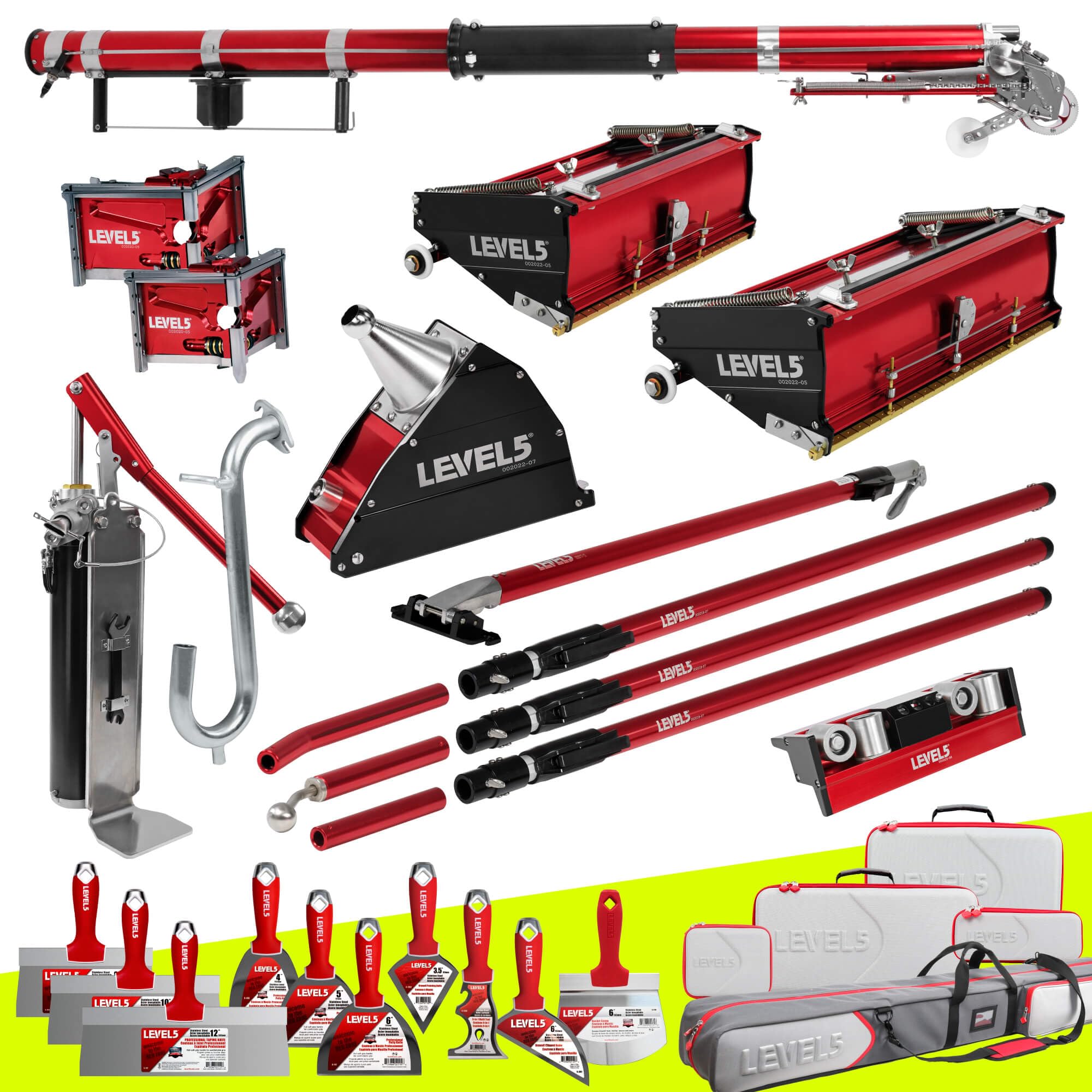
The full taping set that swaps the standard handles for extendable ones.
This is the 4-600 set grown up. You get the automatic taper, the 10”/12″ flat boxes, and a pair of angle heads — one 3” and one 3.5” — for covering both standard and wider inside corners. There is a 7” corner applicator box, a corner roller, a pump, and a gooseneck, and the handle set is extendable, which changes how you work ceilings and high seams without dragging a ladder along. The blades are stainless steel and the body is aluminum, spanning 44″L x 13″W when laid out. Buyers describe it as a genuine helper for a clean sheetrock job and say it makes the work far easier than finishing by hand.
The extendable handles are the defining upgrade over the entry set, and they matter most on tall walls and ceilings where reaching the joint is half the battle. Level 5 builds this for finishers who want to quote bigger jobs and get through them faster, and the included protective cases keep the kit organized between sites. A full set of premium hand tools rides along at no extra charge.
The recurring note is cleanup — the set works well and speeds things up considerably, but it takes a while to clean it properly when you are finished. That is the trade for having multiple heads and boxes that all need clearing out. If you want to spend less time cleaning and more time on the wall, the standalone tapers higher up this list are simpler to service.
The upgrade that counts: extendable handles turn ceiling seams and high joints into reachable work without repositioning a ladder for every run.
The honest chore: more heads and boxes in the kit means more parts to clean when the day ends.
Choose this when: you want the complete taping and finishing lineup plus longer reach, and you are ready to quote larger jobs.
Skip it when: you only need a taper — the standalone tools cover that for far less kit to manage.
6. LEVEL5 Full Taping/Finishing Set, High Capacity Boxes 4-625
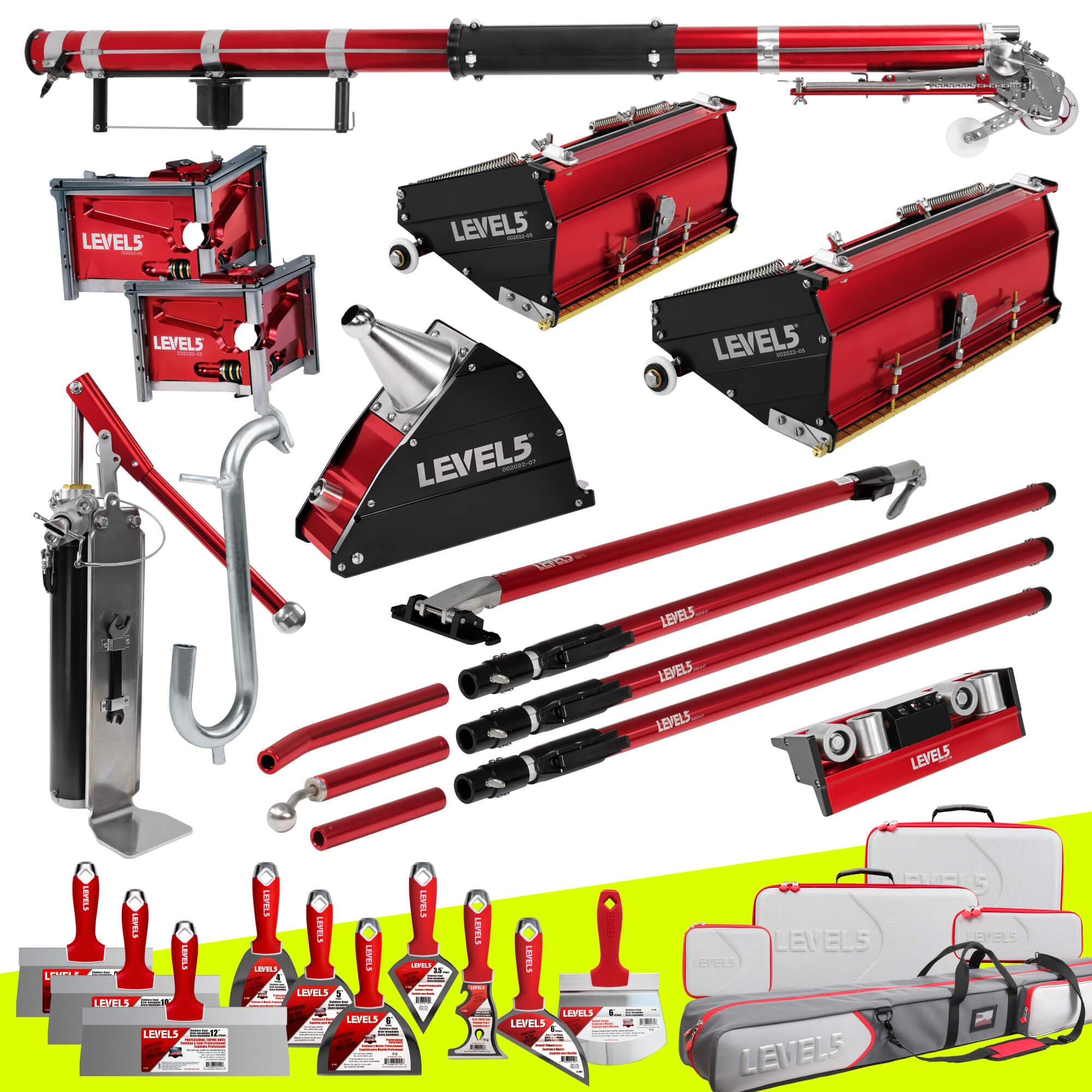
The set with MEGA flat boxes and an 8” corner applicator for fewer mud refills.
This is the biggest kit of the group. Where the 4-621 uses standard 10”/12″ flat boxes and a 7” corner applicator box, the 4-625 upgrades to MEGA boxes and an 8” corner applicator, plus 3” and 3.5” angle heads, a corner roller, extendable handles, pump, and gooseneck. Larger boxes hold more compound, so you make fewer trips back to the mud pan on long seams — exactly what you want if you are finishing a large home or a commercial run in a single push. Blade material is stainless steel and the handles are stainless steel as well, with an aluminum body and a 44″L x 13″W footprint. It ships as a 10-count package with a set of premium hand tools included.
Owners mention the MEGA boxes and 8” corner applicator cut mud refills on long commercial runs. One long-term owner, three years in, still says the same thing: it takes practice, but they love the set. That is the consistent theme with professional-level taping kits — the tools reward a finisher who puts in the reps and penalize one who expects instant results.
The catch is weight and upkeep. Bigger boxes put more compound and more metal in your hands on every run, and cleaning a full set of MEGA boxes takes longer than a bare taper. If your jobs are smaller and cleanup time matters more than carrying capacity, the standard 4-621 set is the more balanced choice.
Built for: high-volume finishers who would rather reload boxes fewer times than save weight on the wall.
Not the one if: you run small jobs or dread long cleanup sessions — the standard-capacity set is friendlier there.
Understanding the Specs
Tube material: aluminum versus carbon fiber
An aluminum tube is the classic build — sturdy and familiar in the hand, which is why the Marshalltown TapeShooter and the LEVEL5 handles use it. A carbon fiber tube, like the one on the TapeTech 07TT-C, is a different beast: it resists denting better than aluminum and does not conduct cold, so the tube stays warmer in your hands on a cold site. The trade is cost and the need to treat precision hardware with respect. Neither material is wrong — one favors durability against knocks and the other favors a lighter, temperature-neutral feel.
Item weight and why pounds matter
Weight decides how long you can work overhead before your arms give out. A taper at 2.3 pounds and one at 9.78 pounds feel like different tools after an hour of overhead joints, and the gap only grows once the hopper is full of compound. The printed weight on the spec sheet is the dry number — your working weight is always higher once you load tape and mud, so a lighter tube pays off on long runs and tall rooms.
Boxes and angle heads
Flat boxes do the wide seams, and their stated sizes — 10” and 12″ — set how much of a seam you cover per pass. Angle heads handle inside corners, and having both a 3” and a 3.5” head means you can match the corner you are finishing instead of forcing one size everywhere. A corner applicator box, whether 7” or the 8” on the high-capacity set, feeds compound into those corners, and the corner roller beds the tape down after. Buying a set means all of these arrive matched to one handle system.
Mudflow adjustment and cleanup
The mudflow control dials the bead to the joint: thin for tight seams, fuller for wide gaps. It is the setting you will adjust most while learning the tool. Cleanup hardware matters just as much: a lid that releases with one turn, a tape bail that swaps rolls without setting the tool down, and a plunger stop that twists off a quarter turn are the features that keep the end of your shift short.
FAQ
What is an automatic drywall taper and how is it different from a manual tape knife?
Do I need a full set or just a standalone taper?
What kind of tape does an automatic taper use?
How much tape does a taper hold and how often will I refill?
Is a lighter taper worth the extra cost?
How hard is it to learn an automatic taper?
What is the difference between a taper and a flat box?
How do you clean an automatic taper after a job?
Can you use an automatic taper for ceiling joints?
Which taper should a beginner buy first?
Final Thoughts: The Verdict
For most people taking on a real taping job, the automatic drywall taper winner is the LEVEL5 4-600 Automatic Taping and Finishing Set, because it puts the taper, the 10”/12″ flat boxes, the angle head, and the corner tools in one case so you never stop mid-job for a missing head. If lightness is what you are after and you already own boxes, the Marshalltown TapeShooter at 2.3 pounds is the tool to grab. And for overhead ceiling work where a warm, dent-resistant tube saves your shoulders, the TapeTech Carbon Fiber 07TT-C is the one worth stretching for.
How We Picked
We do not accept paid placement. Every pick is matched to a real buyer and a real use-case; we do not hands-on test units.
Sources & Methodology
Specifications: manufacturer listings and product documentation. Review insights: verified customer reviews, as of September 2026. Pricing: not shown on this page (it changes often); check the current price via the retailer link.
As an Amazon Associate, KitchPrep earns from qualifying purchases. This does not affect which products we feature.
Related Guides
