
Specs are compiled from manufacturer listings and verified buyer reviews and can change over time — please confirm the key details on the product page before buying.
If your kitchen only has a standard wall socket, a 120V electric stove (one that runs on ordinary household power) gets you cooking tonight instead of waiting on an electrician. These cooktops arrive with a plug already attached, so there is no rewiring, no special circuit, and no 240V outlet to install. The trade-off is real, though: a 120V appliance draws far less current than a full-size range, so the difference between loving and regretting one usually depends on how much wattage it pushes into the burner and how many burners it splits that power across. Below you get nine cooktops with the exact wattage, burner count, control type, and real owner experience laid out side by side so you can match one to your counter, your pots, and the way you actually cook.
I’m Mohammad Maruf — the founder and writer behind KitchPrep. This guide is built by comparing the manufacturers’ published specifications and the patterns across verified customer reviews, so you get each pick’s real strengths and trade-offs instead of marketing spin.
Good countertop cooking starts with matching the wattage and burner layout to how you really cook. That is what separates a useful pick from a frustrating one when you are shopping for the 120v electric stove. The Karinear 12-inch two-burner electric cooktop with its simple knob controls and nine heating levels is the overall crowd favorite here — 4.6 stars across 200+ ratings. It plugs straight into a standard socket, sits on your counter or drops into a cutout, and gives you the two things that matter most: heat you can control and a size that fits a small kitchen.
Our Picks at a Glance

How To Choose The Best 120V Electric Stove
A 120V cooktop is a small appliance, not a full range, and the whole buying decision hinges on three things: how much heat it can make, how you control that heat, and whether it fits the space you have. Get those right and you will never miss the big stove. Get them wrong and you will be waiting on water that never boils.
Wattage Is The Number That Decides Everything
Every burner’s real-world speed comes from its wattage. A burner rated at 1500W will bring a pot to a boil noticeably faster than one rated at 600W. On a two-burner unit the power is often split unevenly, so a large burner does the heavy lifting while a smaller one handles warming. If you cook real meals rather than just reheating, look for the higher total wattage and give your big pot to the strongest burner. Remember that two burners running at once share the total power the unit can pull from the socket.
Radiant Versus Induction Cooking
A radiant ceramic cooktop heats a glowing element under the glass, and that heat transfers to whatever pot you set down. Induction builds heat directly inside the pan using a magnetic field, so the glass stays cooler to the touch and the pan reacts faster. The catch is cookware: radiant accepts iron, stainless steel, glass, and ceramic, while induction needs a magnetic base, and a simple fridge magnet is the fastest way to test your pans before you buy.
Countertop Or Built-In Installation
Most of these units do both. Placed on the counter they need their rubber feet or bottom brackets attached, and they can be moved out of the way when you need the space. Dropped into a cutout they look built-in and free up counter room, but you must measure your existing hole carefully against the cut-out size the maker lists. If you are renting or unsure, countertop mode is the safer first step.
Quick Comparison
| Model | Best For | Total Power | Burners | Control Type | Amazon |
|---|---|---|---|---|---|
| Karinear 110v Electric Cooktop 2 Burners | Small kitchens and backup cooking | — | 2 | Knob | Amazon |
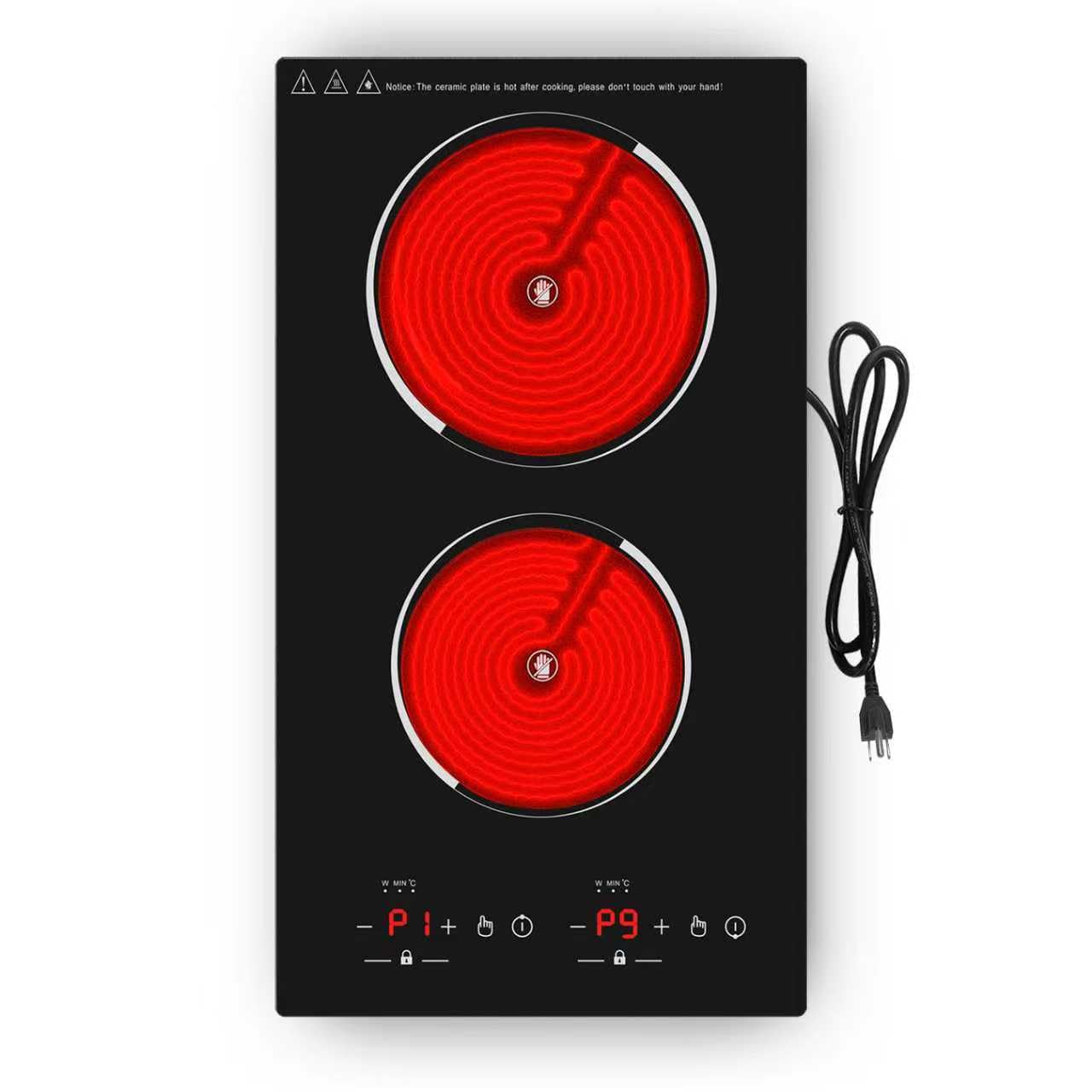
| VBGK 12 Inch Built-in Radiant Electric Stove Top 110V 2100W | Touch-control cooking with safety extras | 2100W (1200W + 900W) | 2 | Sensor touch | Amazon |
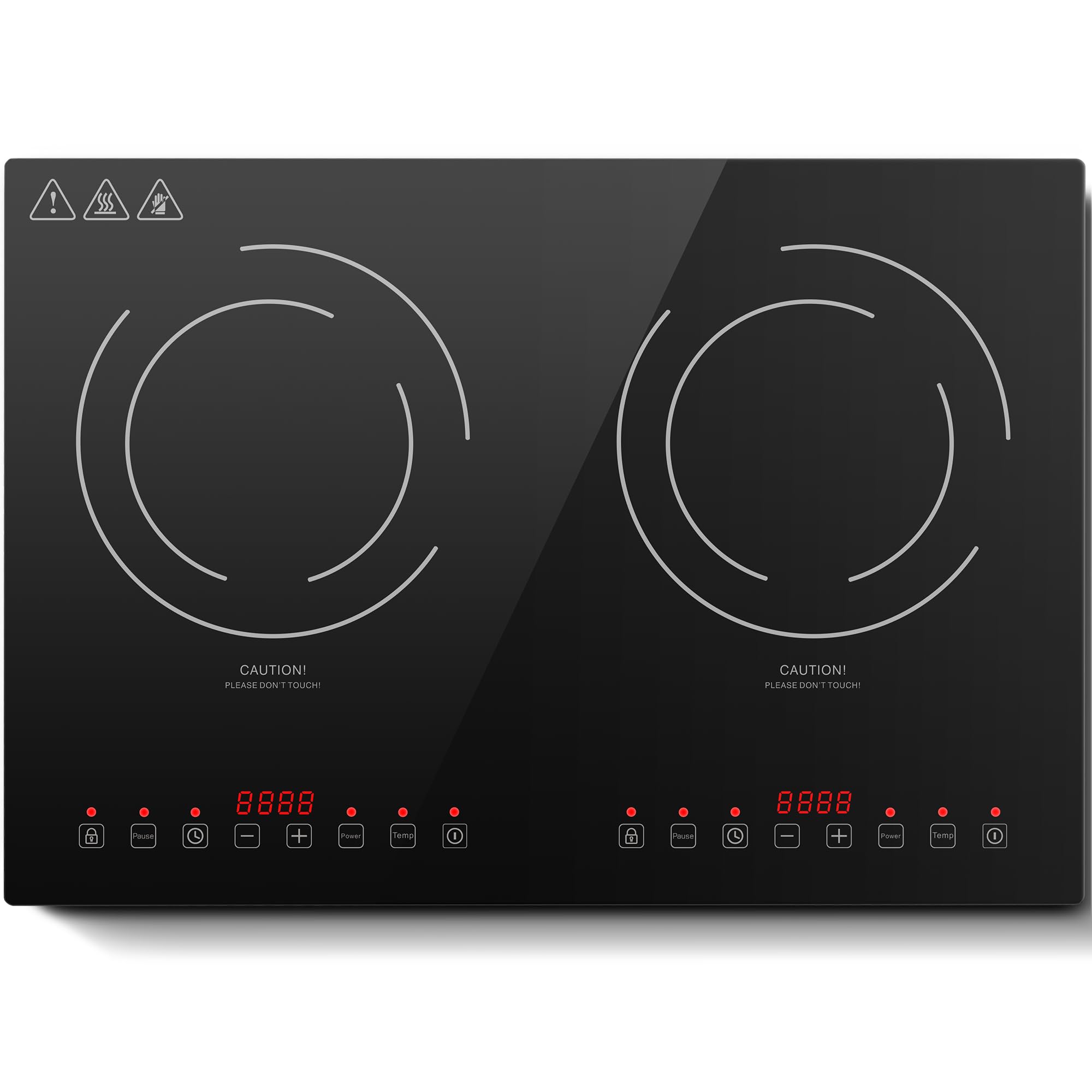
| Induction Cooktop 2 Burner, Countertop/Drop-in, 120V/1800W | Fast induction heat in an RV or dorm | 1800W per burner | 2 | Digital touch | Amazon |
| GTKZW Double Induction Cooktop 12″ 2 Burner | Compact induction with a long timer | 1200W + 1100W | 2 | Touch | Amazon |
| VBGK 110V 3000W Electric Stove Top with Knob Control | Big pots and serious countertop cooking | 3000W (1500W + 1500W) | 2 | Knob + touch | Amazon |
| Jessier 2 Burner Electric Cooktop 110V 2000W | Budget-friendly plug-and-play cooking | 1400W + 600W | 2 | Knob | Amazon |
| Empava IDC12B2 Horizontal Electric Induction Cooktop | Built-in induction in a small kitchen | 1800W left / 1300W right | 2 | Touch | Amazon |
In‑Depth Reviews
1. Karinear 110v Electric Cooktop 2 Burners, 12” Electric Stove Top Plug in
The plug-in ceramic cooktop that turns a dead burner into dinner tonight
If your full-size range has quit, or your kitchen simply never had room for one, this is the cooktop that gets you cooking again without a single trip to the breaker box. It runs on 110 to 120 volts and arrives with the plug already attached, so you set it on the counter, twist a knob, and you have heat. Setup is genuinely a two-minute job, which is exactly why it keeps winning over people replacing a broken stove or cooking in a small apartment.
Two burners give you a fast-heating panel for your big pot and a slower, gentler one for simmering, so you can run rice on one side and a sear on the other. Knob control is the quietly smart choice here — no menus, no touch panels that ignore wet fingers, just a twist that an older parent or a guest can figure out on the first try. What wins people over most is the footprint; the 12-inch size tucks into kitchens that were never designed for a real range, and the glass surface wipes clean with a damp cloth once it cools.
One honest catch worth knowing before you buy: it pulls more than 15 amps when running, so it needs a circuit that can carry that load rather than an old shared 15-amp socket. The finish is also a little delicate, and a few owners have noticed it scratches and stains more than they expected, so a quick wipe after each cook goes a long way. If your small kitchen has only one outlet on a busy circuit, budget for that reality. Otherwise this is the easiest way to add real cooking power to a counter.
What earns it the top spot
- Plug in and cook with no wiring or electrician visit
- Knob control is simple enough for elderly users and guests
- Nine heating levels cover simmer through a hard boil
- Countertop or drop-in, with a cut-out of 19.3 in by 10.6 in
- Works with iron, stainless steel, glass, and ceramic pots
What to watch for
- Draws more than 15 amps at 120V, so a shared socket will not keep up
- The glass finish scratches and stains if you skip the wipe-down
- Burners sit close together, so two wide pans can crowd each other
Reach for this if: you want plug-in cooking with real heat today and want the largest, most proven following in this group.
Look elsewhere if: you plan to run two big pans side by side — at 19.3 by 10.6 inches the burners are close, and a widemouth pot can bump its neighbor.
2. VBGK Electric Cooktop,12 Inch Built-in Radiant Electric Stove Top,110V 2100W 2 burner cooktop
A touch-panel cooktop that remembers the timer so you do not have to
Owners who want a cooktop that behaves like a modern appliance tend to land here. The glass panel responds to a light tap, and the bright LED display shows exactly which zone is running, which matters when you are cooking two dishes at once. If a smooth glass top with a clean digital readout is what you picture on your counter, this is the pick that delivers that feel.
Where it gets genuinely useful is the extras a knob unit cannot match. You get 9 power levels paired with 20 temperature settings, two independent cooking zones you can set separately, a child safety lock, and overheat protection. The timer runs from 1 minute up to 120 minutes, so a slow braise can shut itself down while you walk away. It works with flat-bottomed iron, stainless steel, aluminum, copper, glass, and ceramic pots, which means it does not force you to replace your cookware the way induction does.
The honest trade-off is speed. Several owners find it takes its time climbing to temperature and cooks more gently than a gas flame, so if your style is high-heat searing you may want to give the pan a head start. It is also worth clearing ventilation around it rather than tucking it into a closed drawer, since the unit needs room to shed heat. Treat it as a steady, precise cooktop for everyday meals rather than a rocket, and it holds up well — buyers report theirs still working like new after a few years of use.
What it is best at: hands-off cooking. Set a zone, set a timer, walk away. The 20 temperature settings span roughly 80°C to 650°C, so you can dial in a temperature rather than guess at a dial position.
The honest fine print: the ceramic radiant element heats slowly, so plan a little extra time before the pan is sizzling.
For the gadget-lover’s kitchen: this suits anyone who wants a digital display, timer, and child lock on a plug-in countertop unit.
Think twice if: you want immediate roaring heat — the radiant surface ramps up gradually.
3. VBGK Electric Cooktop,110V 2400W Electric Stove Top with Knob Control
Induction speed in a portable body that boils a full pot in minutes
This is the model for the camper, the dorm, and the backyard party where you want serious heat from a standard socket. It is induction, so the pan itself becomes the hot element and the glass stays comparatively cool to the touch. Owners mention a full pot of water boiling in a couple of minutes, far quicker than the radiant coil it replaced. Each burner is rated at 1800W, and the two zones run independently with their own LED display, so you can sear on one and simmer on the other.
What makes it flexible is the twin personality: set it on the counter with the pre-installed 120V plug, or drop it into a cutout to free up space. It brings 9 precise temperature settings from 120°F to 460°F and 9 power levels from 100W to 1800W, plus a Pause function that lets you step away mid-cook without killing the heat. A child lock, timer up to 179 minutes, automatic pan detection, and an “H” hot-surface indicator round out the safety package. It also carries cTUVus certification, so the electrical side is third-party tested.
Two things to plan for. First, the 1800W is shared across both burners, so running two big pans at max splits the power rather than doubling it — and the unit needs a 20-amp breaker, not a standard 15-amp circuit. Second, it only plays with magnetic cookware; if a fridge magnet will not stick to the bottom of your pan, it will not work here, and the surface will chirp an alert if you try. For anyone already cooking on cast iron or steel, that is a non-issue.
Where this one pulls ahead
- Induction heats the pan directly, so water reaches a boil in a couple of minutes
- 9 power levels from 100W to 1800W plus 9 temperature settings
- Pause function keeps your settings while you step away
- Child lock, pan detection, auto shut-off, and a 179-minute timer
Before you commit
- 1800W total is shared across both burners, so two big pots split the power
- Needs a 20-amp breaker and magnetic-base cookware only
- On low settings the element cycles on and off rather than holding a gentle glow
Pick it for: an RV, camper, or campsite setup where you want induction speed and cool-touch glass from a standard plug.
Pass if: your pans are aluminum or non-magnetic, or you routinely run two large pots — the shared 1800W and induction-only rule work against you.
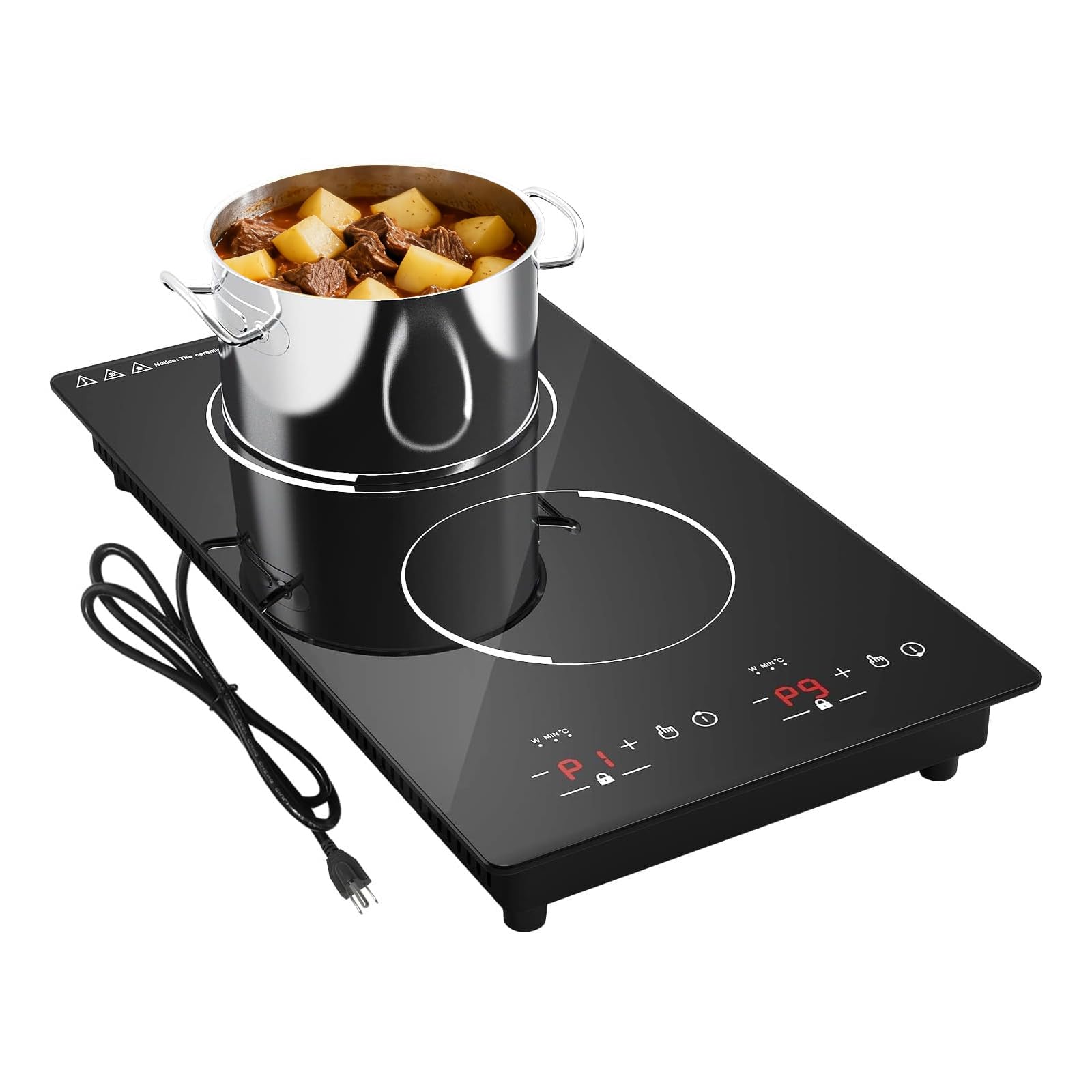
4. GTKZW Double Induction Cooktop 12″, 2 Burner 110v-120v Electric Stove Top
Two magnetic burners in a 12-inch footprint that slides out of the way
If your counter is short on real estate but you still want dual induction, this 12-inch unit is built for exactly that squeeze. It splits 1200W and 1100W across two independent zones with their own LED displays, so both burners run on their own settings. One owner timed an egg starting to fry roughly 40 seconds from a cold start on a magnetic pan.
The glass panel is the scratch-resistant, high-temperature kind you can wipe down after it cools, and it is rated for magnetic cookware with at least 30 percent iron content — cast iron, steel, and enameled iron up to a 6 to 11 inch base. If there is no pan on a zone, it turns itself off after 30 seconds, which is a tidy safety touch for a household with kids. A child lock, a timer up to 120 minutes, and overheat protection round out the controls, and the unit is CE and FCC approved.
The thing to know is that it is not built for a hard sear. Owners consistently find it excellent for heating, simmering, and sides, but not hot enough to put a real char on a steak. If your cooking style leans toward gentle weeknight meals and reheating rather than steakhouse crusts, it hits the mark. For those wanting full sear power, this is one to weigh against a higher-wattage radiant model.
Standout strength: quick, responsive induction in a compact body — cold to frying pan in about 40 seconds — with a long 120-minute timer for set-and-forget cooking.
The catch to weigh: it tops out well short of searing heat, so it is a simmering and reheating partner, not a grill.
Great fit for: a small kitchen or apartment where magnetic cookware is already on hand and gentle everyday cooking is the routine.
Skip if: you want a hard sear on meat — the top end of the heat range will not get you there.
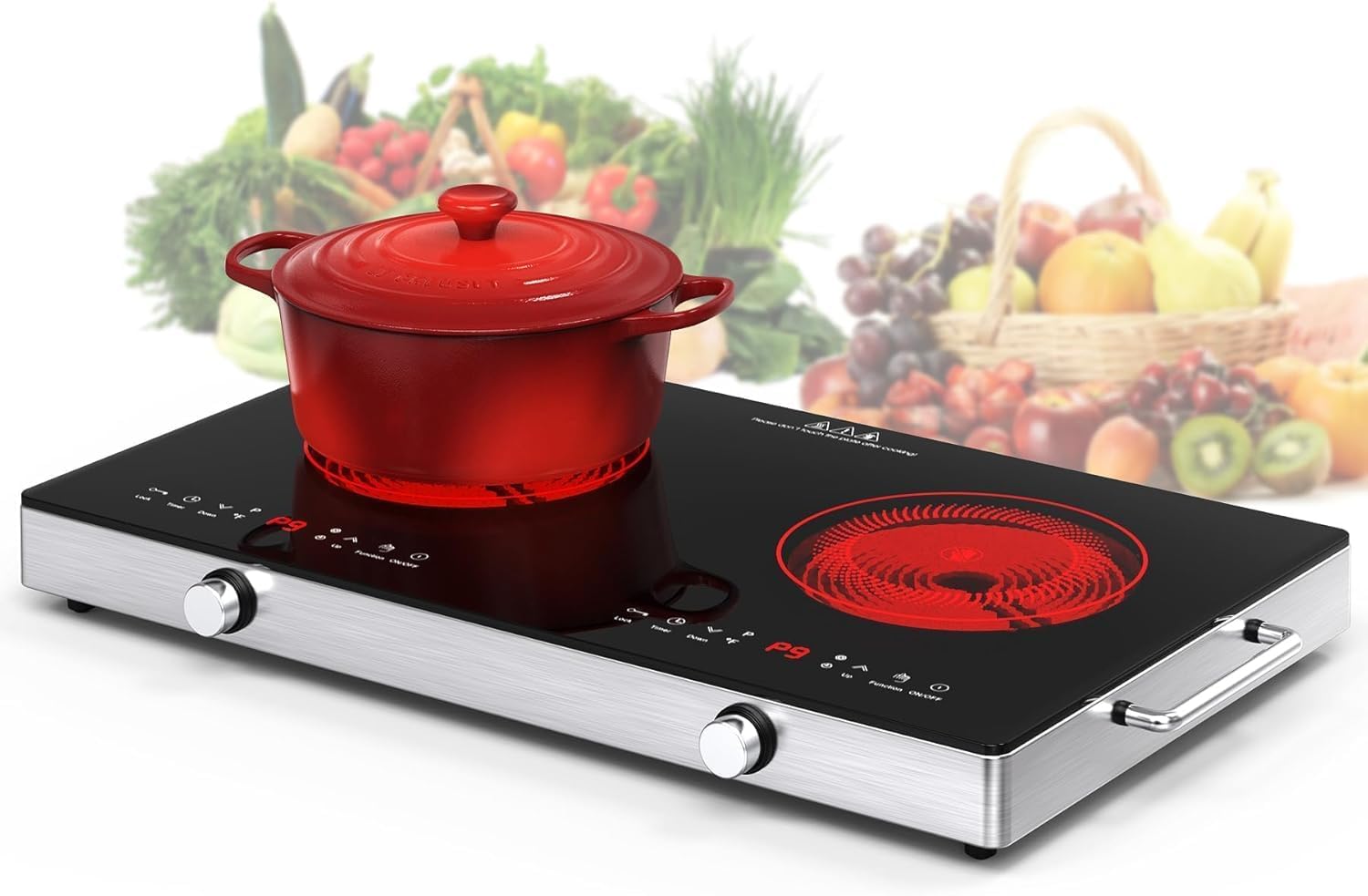
5. VBGK Electric Cooktop,110V 3000W Electric Stove Top with Knob Control
3,000 watts split evenly across two burners — this is the power pick
When you want a plug-in cooktop that keeps up with a real range, this is the one to look at first. It rates 3000W total, split into 1500W per burner, and that even split means neither side feels like the weak one. Owners describe it heating as well as a normal range and far faster than the 1800W unit it replaced. Customers note a big pot reaching a boil in roughly ten minutes, where a 600W burner can take three times that.
You get the best of both control styles here: physical knobs for the everyday on-off-and-adjust, plus an LED function panel with a timer and a child safety lock. That knob-plus-touch combo is why it suits both a senior who wants a dial and a cook who wants the digital extras. The black ceramic glass is scratch-resistant and cleans with a wipe when cool, and it happily accepts aluminum, copper, cast iron, and non-magnetic stainless pans.
The honest caveat is that a 3000W appliance is a serious electrical load, so this belongs on a dedicated outlet rather than a shared kitchen circuit where a kettle and microwave are also drawing. The touch panel is also quite sensitive, so it can be triggered by a passing pet if it is left plugged in — the manual locking feature solves that. For a small countertop kitchen that wants genuine cooking muscle, the even power split makes this the strongest cooking pick on the list.
Why it earns premium placement: 1500W on each burner means two pots cook at the same serious speed — no weak second zone to work around.
What to plan for: 3000W needs its own dedicated outlet, and the sensitive touch panel wants the child lock switched on between cooks.
Buy this for: countertop cooking with real muscle — big pots, two dishes at once, and no burner that lags.
Only if you have headroom: a 3000W draw wants a dedicated outlet, so a busy shared circuit is not ideal.
6. Jessier 2 Burner Electric Cooktop 110V 2000W Countertop or Built-in

The straightforward plug-in cooktop that just does the simple job
If your mom’s stove gave out and she only ever needs two burners, this is a sensible, no-drama solution. It plugs into a standard 110 to 120V outlet, and the two knobs keep operation dead simple — one for the left burner, one for the right. There is no digital layer to confuse anyone, and the unit works for anyone from a child to an elderly cook learning it in a minute. Owners call the ceramic top sleek and the knobs quicker to adjust than a touchscreen.
The power is split unevenly on purpose: the large burner is rated 1400W for real cooking, while the small burner is rated 600W and intended for keeping food warm rather than heavy-duty pots. Reviewers point out the glass surface wipes clean and still looks new after months of use. It installs either as a countertop unit with the included rubber feet or as a drop-in, and you get a scraper and manual in the box along with the plug.
The one genuine caution is countertop use. At least one owner found the exposed base gets very hot when the unit runs on the counter and risks a burn, and reported it works much better as a built-in where the base is tucked into the cutout. The two burners also sit close, so two large pots will crowd each other. Set it up as a drop-in or keep it away from the counter edge, and it is a tidy, honest little cooktop for the budget.
Best used as: a drop-in replacement burner or a simple second cooktop where a single 1400W zone handles the real cooking and the 600W zone warms.
One real caution: on the countertop the exposed underside runs very hot — built-in mounting is the safer setup.
Ideal for: a broke-down stove replacement, a rental, or anyone who wants two knobs and no learning curve.
The trade-off: its strong burner is a single 1400W zone and its warm burner is just 600W, so it is not a two-pot powerhouse — and countertop mode runs hot underneath.
7. Empava IDC12B2 Horizontal Electric Stove Induction Cooktop 120V, 12 Inch

A drop-in induction unit that gives a small kitchen a built-in feel
Say you want a flush, permanent replacement for an old gas burner but only have a standard 120V socket. This Empava drops into your counter and reads as a genuine built-in cooktop rather than a portable hot plate. It is designed and engineered in the USA by Empava Appliances, carries ETL certification for both the USA and Canada, and comes with a two-year US-based manufacturer warranty, which is more coverage than most picks here can claim. RV and marine owners who swapped out a gas cooktop for this one report it working perfectly and looking better than expected.
The left burner runs 8 power levels from 300W to 1800W, while the right burner runs 6 levels from 300W to 1300W, and the two share power across the surface. You also get 9 temperature settings from 120°F to 460°F, a red LED display, a 179-minute timer, a hot-surface “H” indicator, a pan-size sensor that adjusts to your cookware and cuts off when no pan is present, and a child control lock. Because it is induction, the glass stays cooler to the touch than a radiant element, and the surface wipes clean without scratching.
The honest limitation here is boiling power and longevity. Owners note it is better at small, snug, covered pans than a rolling boil, so large uncovered pots take patience, and it only accepts magnetic cookware — a fridge magnet is your fast test. Some units have failed within their early months, and the power draw sits in the 700 to 730 watt range for many setups, so it is important to have realistic expectations. For a look-first, gentle-cooking countertop, it earns its premium spot; for a boiling-heavy kitchen, weigh it against the 1500W-per-burner radiant options above.
What it brings to a small kitchen
- ETL certified with a two-year US-based manufacturer warranty
- 8 power levels up to 1800W on the left, 6 up to 1300W on the right
- Pan-size sensor, child lock, hot-surface indicator, and 179-minute timer
- Induction coil keeps glass cooler to the touch and wipes clean
What to be realistic about
- Magnetic cookware only — a fridge magnet is the quick test
- Strong for small, snug, covered pans; slow to bring a large uncovered pot to a boil
- Reliability is uneven over time, so some units fail within their early months
Choose it if: you want a clean built-in induction look, certified safety, and a two-year warranty for gentle everyday cooking in a small kitchen.
Weigh the trade-off: uneven long-term reliability and modest boiling power mean it suits simmering over heavy pot-boiling — and it insists on magnetic pans only.
Understanding the Specs
Wattage And Amp Draw
A plug-in cooktop’s wattage tells you two things: how fast it heats and how much current it pulls. A 1500W burner draws more than 12 amps; add a second burner and you can exceed 15 amps, which is why a shared household circuit may trip. A 120V plug-in appliance often needs a circuit rated for 20 amps rather than the usual 15-amp socket. If your outlet shares a line with a toaster and a kettle, expect trouble — give the cooktop a dedicated outlet whenever possible.
Radiant Versus Induction Cookware
A radiant ceramic cooktop glows hot under the glass and passes heat to any pot you set down — iron, stainless steel, glass, or ceramic all work. An induction cooktop relies on the magnetic iron content of the pan itself, so only cast iron, steel, and enameled iron with a magnetic base will register. A quick fridge-magnet test on your pan’s bottom settles it: stick means compatible, no stick means not. Neither style is inherently better for everyday cooking — the choice is really about which cookware you already own.
FAQ
Will a 120V electric cooktop work in my regular kitchen outlet?
Can I use all my existing pots on an induction 120V cooktop?
Is 2100W enough to actually boil a pot of water?
What is the difference between a radiant ceramic and an induction 120V stove?
Can I install a 120V electric cooktop in a countertop cut-out?
How much power do I need for two burners at once?
Do these cooktops have child safety features?
What size cooktop fits a small kitchen counter?
How long do these 120V cooktops usually last?
Can I run a 120V electric cooktop in an RV, camper, or tiny home?
Final Thoughts: The Verdict
For most people adding real cooking power on a standard socket, the 120v electric stove to start with is the Karinear 110v Electric Cooktop — it is the strongest blend of proven owner experience, plug-in simplicity, and a size that fits a real small kitchen. If raw power is what you are chasing, grab the VBGK 110V 3000W Electric Stove Top for its even 1500W-per-burner split. And for induction speed in a camper or dorm, the 1800W Induction Cooktop is the one to reach for. Whichever you pick, give it a circuit that can carry the load and airflow around the base, and a plug-in cooktop will earn its spot on your counter faster than a full-size range ever could.
How We Picked
We do not accept paid placement. Every pick is matched to a real buyer and a real use-case; we do not hands-on test units.
Sources & Methodology
Specifications: manufacturer listings and product documentation. Review insights: verified customer reviews, as of September 2026. Pricing: not shown on this page (it changes often); check the current price via the retailer link.
As an Amazon Associate, KitchPrep earns from qualifying purchases. This does not affect which products we feature.
Related Guides
