
Specs are compiled from manufacturer listings and verified buyer reviews and can change over time — please confirm the key details on the product page before buying.
If your 1 x 30 belt sander keeps eating belts before the job is done, the fix is almost never the machine — it is the abrasive. The picks below cover every job a 1 x 30 inch belt sander actually does, from hogging steel off a knife blank to polishing a weld seam smooth.
I’m Mohammad Maruf — the founder and writer behind KitchPrep. This guide is built by comparing the manufacturers’ published specifications and the patterns across verified customer reviews, so you get each pick’s real strengths and trade-offs instead of marketing spin.
Buying the wrong belt wastes money and time. You will see which grit ranges suit knife work, which suit wood and paint, and why material matters as much as the number printed on the back. Every pick here fits the same 1 x 30 inch frame (1 inch wide by 30 inches around), so the real differences are grit, grain, and seam quality — and this guide to the 1 x 30 sanding belts breaks down exactly how to tell them apart before you buy.
Our Picks at a Glance


How To Choose The Best 1 X 30 Sanding Belts
Your belt must match your machine first — this is a 1 inch wide by 30 inch circumference belt, and a 1 x 42 or 3 x 21 will not fit your platen (the flat backing plate on your sander) no matter how good the grain is. Once the size is right, three things decide whether you get a belt that cuts for weeks or one that snaps on the first pass.
Match The Abrasive Grain To Your Material
Aluminum oxide is the all-rounder — it handles wood, paint, rust, and general metal cleanup without fuss. Silicon carbide is harder and sharper, so it suits glass, stone, composites, and fine metal finishing. Zirconia ceramic is built for heavy stock removal on steel, where you are pressing hard and generating real heat. Picking the wrong grain for your material is the fastest way to burn through a pack.
Read The Grit Range Before You Buy
Low grits (40 to 80) remove material fast — shaping a knife bevel, stripping paint, grinding down a weld. Mid grits (120 to 400) clean up and refine. High grits (600 to 1000) polish and sharpen. A kit that stops at 400 will not finish a knife edge, and a kit of nothing but 1000 grit cannot reshape anything.
Check The Joint And Backing
The seam is where cheap belts fail. A bi-directional tape joint lets the belt run smoothly in both directions with no bump as it crosses the platen. Heavy cloth backing — J-weight or Y-weight polyester — resists tearing and holds its shape under tension. Thin paper backing is the first thing to give out.
Quick Comparison
All nine picks fit the same 1 x 30 inch frame, so compare grit range, abrasive grain, and belt count at a glance.
| Model | Best For | Grit Range | Abrasive Grain | Belt Count | Amazon |
|---|---|---|---|---|---|
| WORKPRO 36-Pack★ Best Overall | All-round shop use | 60 / 80 / 120 / 180 / 240 / 400 | Aluminum Oxide | 36 | Amazon |
| 30 Pack Sanding Belts AssortmentFine Finishing Pick | Fine finishing and polishing | 120 / 240 / 400 / 600 / 800 / 1000 | Aluminum Oxide | 30 | Amazon |
| 24 PCS Silicon Carbide AssortmentKnife Maker’s Pick | Knife sharpening and metalwork | 80 / 120 / 240 / 400 / 800 / 1000 | Silicon Carbide | 24 | Amazon |
| Feekoon 12 Pack with Angle Guide | Consistent knife bevels | 120 / 220 / 400 / 600 / 800 / 1200 | Metal-backed kit | 12 | Amazon |
| 12 Pack Zirconia Ceramic Kit | Heavy metal grinding | 40 / 60 / 80 / 100 / 120 / 180 | Zirconia Ceramic | 12 | Amazon |
| 15 Pack 600/800/1000 Grit | Fine sharpening only | 600 / 800 / 1000 | Silicon Carbide | 15 | Amazon |
| 20Pcs Zirconia Belts | Coarse stock removal | 40 / 60 / 80 / 120 | Zirconia | 20 | Amazon |
| 18 Pack Extra Fine Grit | Polishing and finishing | 600 / 800 / 1000 | Silicon Carbide | 18 | Amazon |
| 24 Pack 80 Grit | Stripping and heavy sanding | 80 | Aluminum Oxide | 24 | Amazon |
In‑Depth Reviews
1. WORKPRO 36-Pack 1 x 30 Inch Sanding Belts, Aluminum Oxide Abrasive Belts
Our pick — over 4.5★ from 450+ verified ratings; the strongest balance of quality and price.
Six grits, six belts each, and a seam that runs smooth in both directions.
If you want one box that keeps a 1 x 30 inch belt sander fed through every stage of a project, this 36-belt set is the one to reach for first. It gives you 6 belts each of 60, 80, 120, 180, 240, and 400 grit — enough to go from stripping a rough surface all the way to a smooth finish without stopping to order more. That spread is why it earns the top spot for general shop use.
The grain here is premium aluminum oxide, a tough abrasive that resists heat and moisture while cutting wood, paint, rust, and general metal. It is anti-static too, meaning the dust does not cling to the belt and clog it up, so it keeps cutting instead of glazing over. The joint is a precision-engineered bidirectional one with an oblique lap — that is a slanted overlap where the two belt ends meet, so there is no bump as it crosses the platen. WORKPRO prints that joint differently from a flat seam, and it shows in faster, steadier grinding. The cloth base underneath is solid rather than paper-thin, which is what holds the belt together under tension.
What wins people over is the quality of the belt itself — it is the single thing buyers keep coming back to, and you can feel why the moment you load one. A buyer running hardened steel through three grits reported the belts held up beautifully. That is the whole point of this set — it takes a beating and keeps going, and the interchangeable 1 x 30 inch fit means it works with most belt sanders of that size. The mix of grits covers furniture, auto body panels, paint removal, rust cleanup, deburring, solder joint grinding, and knife sharpening — about as wide as a 1 x 30 belt gets.
What Earns Its Keep
- 36 belts across six grits, so you cover rough to refined in one order
- Aluminum oxide grain resists heat and moisture and sheds dust instead of clogging
- Oblique-lap bidirectional joint reduces bump and breakage during grinding
- Solid cloth backing holds up under tension far better than thin paper belts
The Trade-Off To Know
- It stops at 400 grit, so if you want a mirror polish you will need a finer belt set
- Aluminum oxide is not the fastest cutter on hardened steel versus zirconia ceramic
Made for the busy shop: if you run one belt sander through wood, paint, and light metal all week, this spread keeps you from running out mid-job.
Rethink it if: your work lives entirely above 400 grit — a dedicated fine-grit set will serve you better.
2. 30 Pack Sanding Belts 120 240 400 600 800 1000 Grits (1 x 30 Inch)
Thirty fine-grit belts that let you chase a mirror finish without a second order.
This kit skips the coarse end entirely and loads up on the fine side — 5 belts each of 120, 240, 400, 600, 800, and 1000 grit. It is the pick for anyone whose work is refinement rather than removal: smoothing a lathe-turned handle, polishing a blade after shaping, or cleaning up a surface you already leveled.
The grain is high-quality aluminum oxide again — tight grit that resists shedding, stays sharp, and wears evenly. The backing is hard cloth, so the interface holds tight and resists breaking, and the belts are built to run wet or dry, which means you can cool a hot workpiece when you want to. At 10.39 x 8.43 x 2.01 inches the box is the larger of the two packing formats in this lineup, so it takes more shelf room than the slimmer 24-piece silicon carbide set. The belts seat with a butt-seam method — the two ends meet flush, and buyers report that the belt does not fly apart under load.
The part worth planning around is grit labeling. Several belts arrive unmarked, so you will end up picking them out by feel or by elimination, and the higher grits cut a little coarser than the number suggests — a 1000 grit here behaves more like a coarser paper than a sandpaper sheet of the same number. That means you may still want a hand-sanding pass at the very top of your progression. The upside is you get a lot of usable belt for the money, and the kit flexes nicely for lathe work — owners mention cutting the belts down into strips instead of buying pre-cut ones, which saves a step and stretches each belt further.
Where it wins: fine grits for blades, handles, and polish work, with a waterproof cloth backing that lets you work wet when heat builds up.
Plan around this: unmarked belts mean sorting by feel, and the top grits cut coarser than their number implies.
Reach for it when: your projects live above 120 grit and you want a deep bench of fine belts to burn through.
Look elsewhere if: you also need to strip or shape from scratch — there is no coarse belt in this box.
3. 24 PCS 1 x 30 Inch Silicon Carbide Sanding Belts Assortment
Silicon carbide cuts fast, runs cool, and finishes a blade without overheating the steel.
Silicon carbide is a harder, sharper abrasive than aluminum oxide, and that is exactly why this 24-belt set is the one knife makers and metalworkers reach for. You get 4 belts each of 80, 120, 240, 400, 800, and 1000 grit, a spread that walks a blade from rough shaping to a fine edge without a gap. At 1.17 pounds it is compact and easy to store, and the box itself is 7.72 x 6.06 x 1.69 inches — noticeably tighter than the 30-pack aluminum oxide kit’s 10.39 x 8.43 x 2.01 inches, so it slides into a drawer where a bulkier set will not.
The build is serious. Heavy backing supports the grain, an anti-clogging stearate coating stops dust from loading up the surface, and a resin-over-resin bond locks the abrasive down so it lasts. The bi-directional tape joint runs smooth both ways, with no bump as it passes the platen. And the belts are waterproof, so you can grind wet to keep heat — the enemy of a fine edge — under control. That combination is what makes silicon carbide the right call for glass, stone, granite, composites, plastics, and fine metal work.
Knife makers put these to work, and the results show. A buyer who moved from whetstones to a 1 x 30 belt sander reported the 1000-grit belt gave clean arm-shaving and semi-comfortable face shaving in one pass, with no seam bump or vibration. The trade-off is edge wear: that same buyer found the belt lost its bite after 2 to 3 sharpenings, far sooner than a dozen-plus on the older belt, so plan on using more belts per job. It is also worth saying plainly that silicon carbide shines for finishing up to 400 grit and handle work — it is not a replacement for ceramic belts when you are hogging stock off a blade at low grit.
Why Knife Makers Favor It
- Silicon carbide cuts fast and resists heat, so blades do not overheat during grinding
- Six grits from 80 to 1000 cover shaping through final sharpening
- Waterproof and wet-or-dry capable for cooler grinding
- Resin-over-resin bond and bi-directional joint hold up under heavy use
Honest Limits
- Belts can lose their edge after a few sharpenings, so you will use them faster than a premium ceramic belt
- Not the right grain for heavy stock removal at low grit on hardened steel
Best suited to: anyone sharpening knives, tools, or broadheads who wants a fine, water-cooled edge with a tight storage footprint.
Skip this if: you are shaping thick steel from scratch — start with a ceramic set and finish here.
4. Feekoon 12 Pack 1 x 30 Sanding Belts with Adjustable Knife Angle Guide
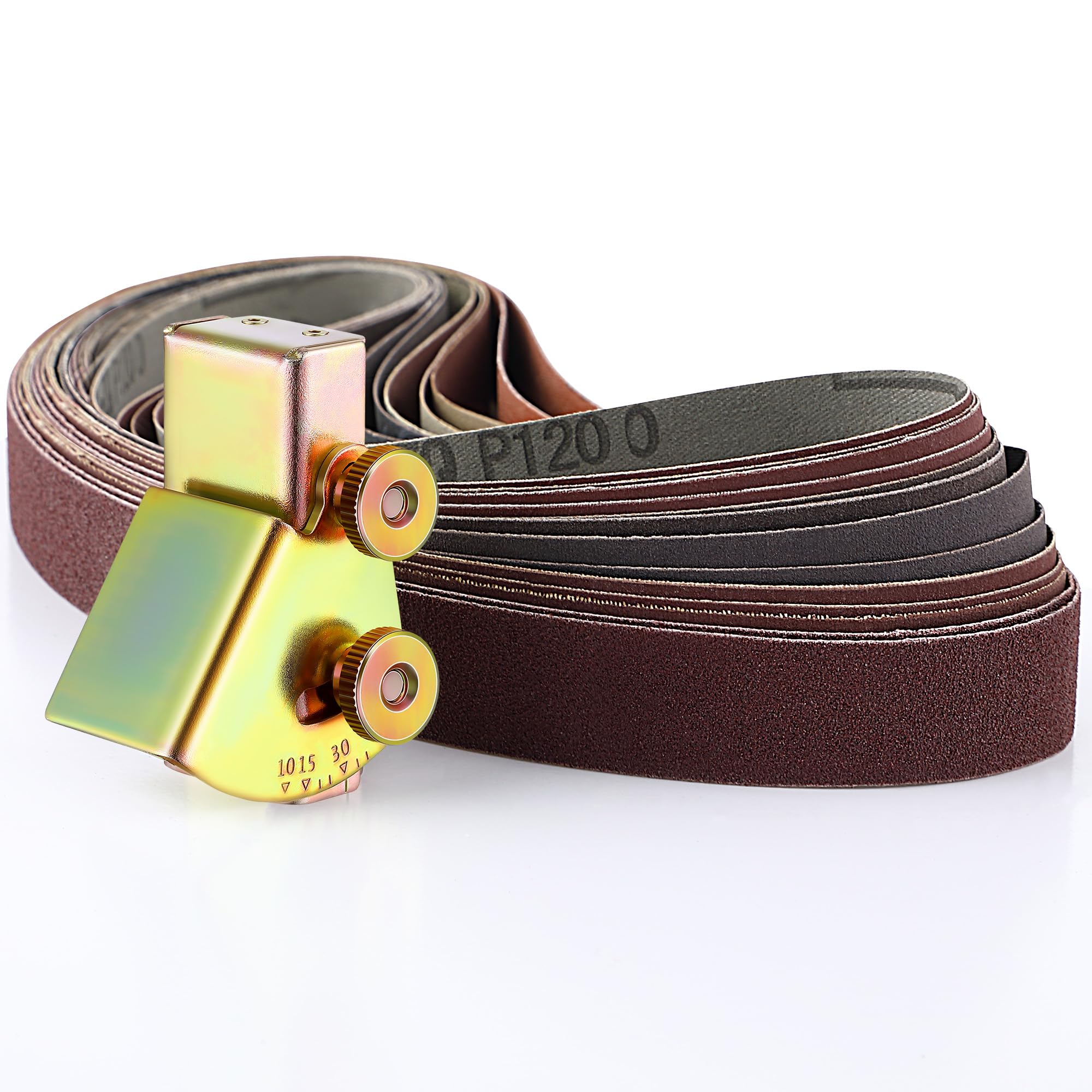
The only pick here that hands you the angle guide along with the belts.
What sets this kit apart is not the belts — it is the adjustable knife angle guide that turns a standard 1 x 30 inch belt sander into a repeatable sharpener. The guide labels angles from 10 to 45 degrees, so instead of eyeballing a bevel you dial in the angle you want and get the same result every pass. The guide is a cast metal piece with yellow zinc coating for corrosion resistance, and it slides onto the platen — the metal bar behind the belt — in just a few seconds.
You also get 12 belts in a wide spread: 2 each of 120, 220, 400, 600, 800, and 1200 grit. That is the widest grit range of any kit here, topping out at 1200 for a fine edge, and the low end covers rust removal up through mirror polish. The design is clever in one specific way — the belts run between the base and the guide, so you do not have to remove or readjust the guide when you swap belts. That keeps your setup locked in from grit to grit.
The honest catch is in the belts themselves, not the guide. They feel light, and the higher-grit belts especially tend to fail early — there is a pattern of belts breaking with little use, so if durability is your top concern look at the heavier-backed sets here. Narrow or small blades may also need a pressure-plate adjustment to bring the angle plate closer to the belt, which is a small fiddly step the guide maker flags. None of that touches the guide’s real value: it is what makes a 1 x 30 sander sharpen like a dedicated machine, and for a beginner it is the difference between a wobbly bevel and a consistent one.
The real draw: a 10-to-45 degree angle guide plus a 120-to-1200 grit range makes this a complete starter sharpening setup.
What to watch: the thin high-grit belts are prone to breaking early, and small blades may need a pressure-plate tweak.
Get it if: you want consistent, repeatable knife bevels and do not already own an angle guide.
Pass it by if: you only need belts, or you run a beefier sharpening rig where the guide will not fit.
5. 12 Pack 1 x 30 Inch Zirconia Ceramic Sanding Belts Kit
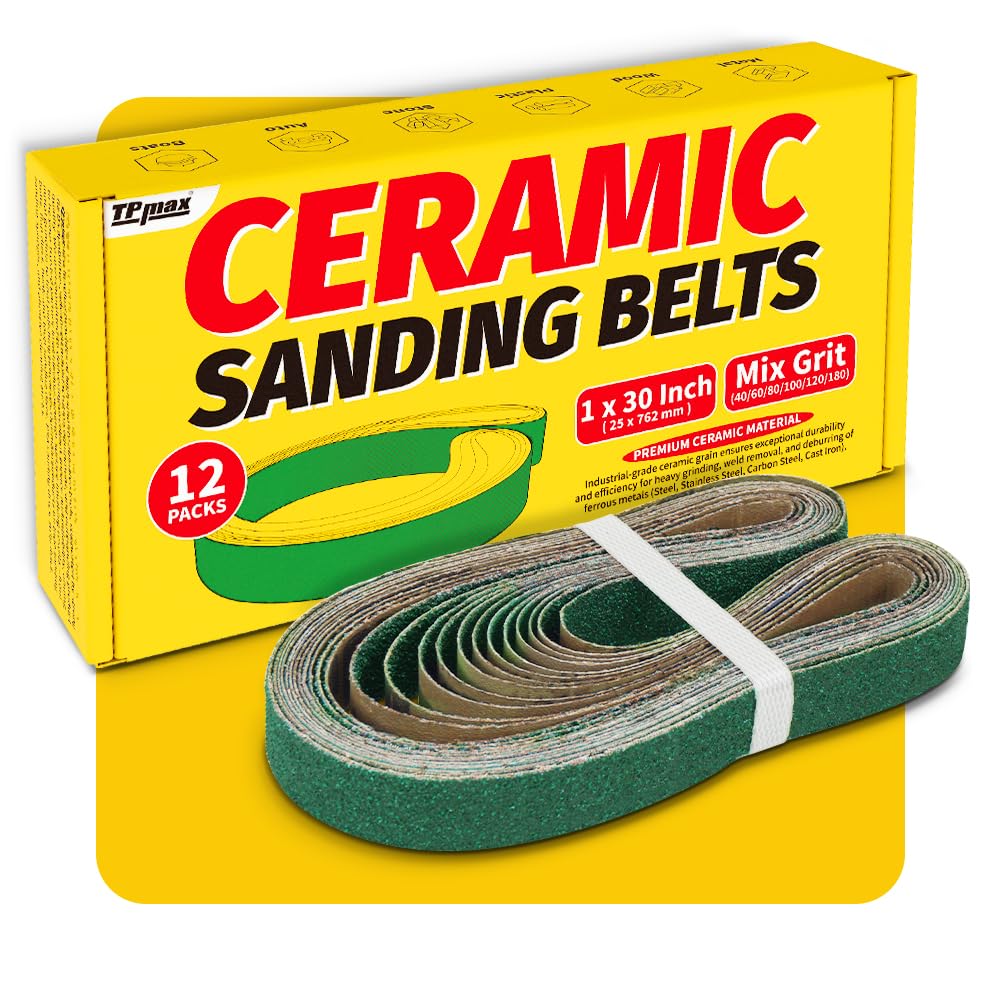
Industrial ceramic grain built for hogging steel, not finessing it.
When your job is stock removal — shaping a knife blank, grinding down a weld, deburring thick steel — zirconia ceramic is the grain that does it. This 12-belt kit runs 40, 60, 80, 100, 120, and 180 grit, all on the coarse end where the metal actually disappears. The grain is industrial-grade zirconia ceramic, built for ferrous metals like steel, stainless, carbon steel, and cast iron, and it is a big step up in cutting power from standard aluminum oxide.
The construction supports heavy work. The joint is a precision-engineered tape joint that runs smoothly both ways, cutting downtime when you flip a belt. The backing is heavy-duty polyester, and a stearate top coat — a waxy additive that resists loading — keeps heat down so the belt cuts cooler and longer. And it is fully waterproof, so you can grind wet or dry depending on how much heat you are generating. It also handles non-ferrous metals like aluminum, titanium, brass, bronze, and copper, plus dense woods.
The one thing to verify when yours arrives is the low end. There is a pattern of the 40 grit belts showing up with cracks or chips in the abrasive surface and some backing damage, while the higher grits come through clean — the kind of thing that looks like a shipping or batch issue rather than a design flaw, and it touches only the coarsest belts in the pack. Check the 40 grits over before you load them. When they are intact, though, ceramic belts earn their keep fast: An owner running them in a forge over a month found they cut and polished beautifully, barely heated up, and outlasted a pack of aluminum oxide belts on the same machine.
Built For Steel
- Zirconia ceramic grain cuts ferrous metals faster and cooler than aluminum oxide
- Coarse 40-to-180 grit range is right for stock removal and bevel work
- Waterproof polyester backing with stearate coat for cooler, longer grinding
- Handles steel, stainless, cast iron, and non-ferrous metals alike
Check On Arrival
- Some 40 grit belts arrive with surface cracks or backing damage — inspect the coarsest ones first
- Stops at 180 grit, so you will want a finer set to finish a blade
Ideal for: fabricators and knife makers doing heavy stock removal who want ceramic cutting power at a mid-range price.
Think twice if: you need a do-everything set — this one lives in the coarse end and stops at 180.
6. 15 Pack 1 x 30 Inch Sanding Belts 600 800 1000 Grit for Knife Sharpening

Fifteen belts of nothing but the three finest grits, built for a razor edge.
This is a single-purpose set, and that is its strength. You get 15 belts — 5 each of 600, 800, and 1000 grit — all silicon carbide on a heavy J-weight polyester cloth backing. J-weight is a thick, strong cloth that resists stretching, so the belt holds its shape against the platen and the grain stays where it belongs. The grain is closed-coat, meaning the abrasive covers the backing fully for an even, consistent cut.
Because these are the fine grits, they are the belts you reach for after you have already shaped and refined an edge — the last steps that turn a working blade into a sharp one. The construction is serious for a fine grit: precision bi-directional tape joint, anti-clogging stearate to keep dust from loading, and resin-over-resin bonding for long belt life. It runs wet or dry on heavy backing. This is the profile that suits glass, stone, granite, cement, composites, plastics, and light metal finishing as much as it suits knife edges.
Owners put these to work on edges across the shop. A buyer used one on a bench-top sander for everything from kitchen knives to yard tools, reporting the belts last a long time and cut quickly when you start coarse and progress to fine. That matches how these belts are meant to be used — they are the finish, not the whole process. One honest note: some buyers find the belts do not last as long as they might hope on heavy repeated use, but expect it going in and you will not be disappointed, because the value per belt is solid for fine-grit work.
The niche it fills: 600 through 1000 grit silicon carbide on heavy cloth backing — the finishing stage for any edge or fine surface.
Fair warning: fine grits wear faster under heavy pressure, so these are best used as a finishing pass, not a workhorse.
Best for: anyone who already owns coarse belts and wants a dedicated supply of fine grits for blades and polish work.
Not the one for: beginners buying their first belts — you need coarse grits in the mix too.
7. 1 x 30 Inch Zirconia Sanding Belts, 20Pcs of 40/60/80/120 Grits
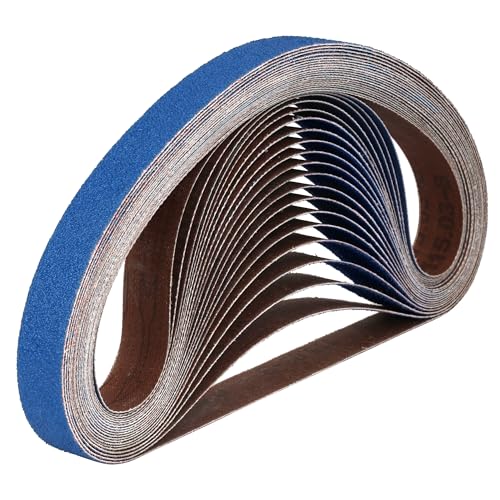
Twenty coarse zirconia belts for the jobs that start with a lot of metal to move.
Zirconia grain is harder and tougher than aluminum oxide — it grinds harder metals and holds its edge longer — and this set puts it to work at the coarse end. You get 20 belts in 40, 60, 80, and 120 grit, 5 of each, sized for a 1 x 30 inch air belt sander as readily as a bench-top unit. The grain is waterproof, heat-resistant, and built for exactly the jobs where you are pressing hard into metal.
The construction is thought through for that abuse. The resin bond is fully bonded between the sand and the belt, which improves heat dissipation so you get fast results and less grain shedding. The joint is a precision bi-directional tape joint that transitions smoothly both ways — the maker points to it as the reason you do not get jumping, wear patterns on a polished surface, or belts coming apart. That is the failure mode that ruins a coarse grinding job.
The pattern to know here is durability — it is the mixed part of this set. Some users get belts that hold up beautifully, and some hit the opposite: belts that break or come apart seconds into a cut. It is not a one-size answer, and the split is real. The upside is that the grits cut true and the seams are strong when they are good, and the value per belt is hard to argue with for rough shaping jobs where belts are consumables anyway. Read the reviews expecting a mixed bag on long-term durability and you will make a fair call.
The appeal: 20 coarse zirconia belts that grind harder metals and cut longer than aluminum oxide at the removal stage.
The honest split: durability is uneven across units — some belts hang on, others fail early, so treat this as a rough-use consumable set.
Count on it for: coarse shaping, deburring, and derusting where you go through belts fast and want a big pile of them.
Bypass it if: you need one belt to survive many sessions — a ceramic set will be the tougher bet.
8. 1 x 30 Silicon Carbide Sanding Belts, Extra Fine Grit, 18 Pack
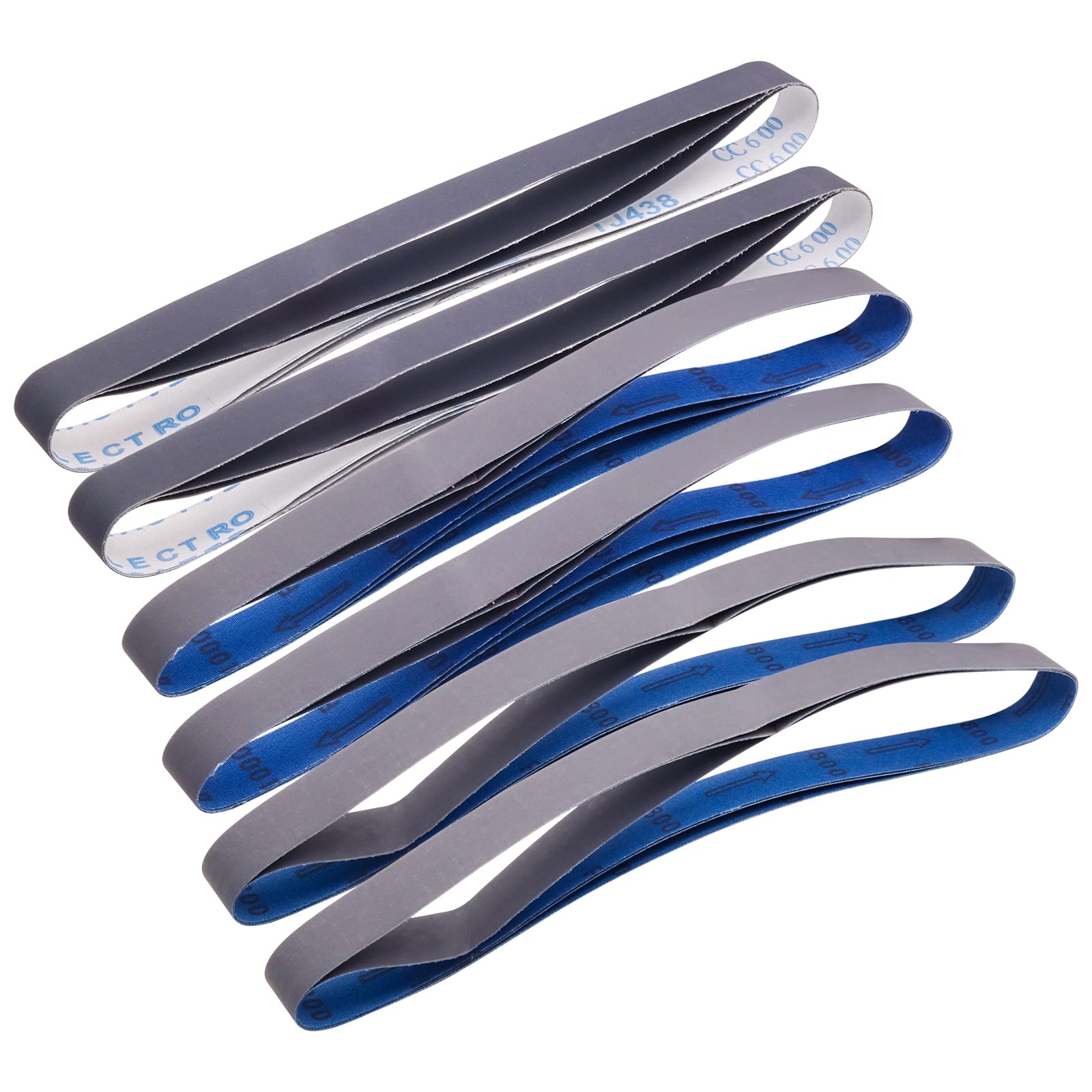
A slim box of fine silicon carbide belts that holds up far longer than the price suggests.
Silicon carbide for fine work, six belts each of 600, 800, and 1000 grit — that is the whole recipe here, and it is a tight one. The grain is premium silicon carbide, hard and tough, paired with a heavy-duty Y-weight polyester cloth backing that is wear-resistant and washable. A flat seam construction and bi-directional joint keep the belt running smooth both ways for fast grinding and long life, and the surface resists clogging so it does not stop cutting halfway through a job.
The standout is how far these go. One user ran a single belt through three months of constant use on brass, steel, and bone for musical instrument work without wearing it out. Another took a super-hardened blade to the point where it could be finished on water stones. Buyers also reported success polishing stainless steel exhaust.
Two things to know going in. First, the belts have a strong odor out of the package — one buyer found it noticeable and planned to air them out — so give them a day before your first session. Second, it is a fine-grit-only box, so it is a finishing set, not a start-to-finish one. But for what it does — high-grit finishing and polishing at a value that is hard to match for the volume you get — it earns its place, and the exact fit on common bench sanders means no fuss when you load it.
What stands out: fine silicon carbide on washable Y-weight backing that lasts through months of real use, not just a job.
One heads-up: a strong odor straight out of the pack — air the belts out before you use them.
Grab it if: you want a durable, value-priced supply of 600-to-1000 belts for polishing and fine edge work.
Look past it if: you need coarse grits to shape first — this box starts at 600.
9. 1×30 Sanding Belt 80 Grit, 24 Pack
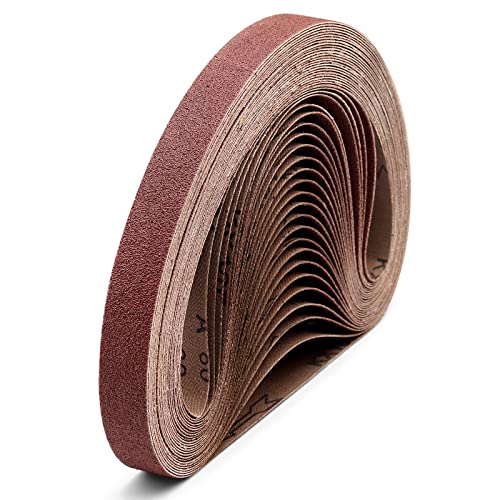
Twenty-four identical 80 grit belts for the one job you do over and over.
If you have a single task that eats belts — stripping a batch of boards, knocking rust off steel, hogging down a stack of parts — this is the buy. It is 24 belts of one grit, 80, so you are not paying for variety you will never touch. The grain is premium open-coat aluminum oxide, which resists heat and moisture and stays anti-static so the dust does not load the surface. Open coat means the abrasive is spaced rather than fully packed, which is what keeps it from clogging on wood and gummy materials.
The construction matches the job. A precision bi-directional tape joint with anti-clogging stearate reduces heat and buildup, and resin-over-resin bonding holds the grain on for long sanding life. It is washable and anti-static, so you can clean it and keep using it rather than tossing it early. And it works with a 1 x 30 inch mini belt sander on wood, aluminum, fiberglass, rubber, plastic, and non-ferrous metals — the stripping and heavy-sanding tasks that 80 grit exists for.
The honest catch sits in one place: durability on the joint. A subset of belts have failed early, breaking almost immediately, and the belt attachment itself drew mixed notes. For most buyers these hold up well, but it is worth knowing the failure point when it shows up is the seam, not the grain. The upside is that an 80 grit belt is a consumable, and 24 of them at a single-grit price will carry a stripping job a long way — just load them carefully and keep the belt tracking true to get the most from each one.
Where It Delivers
- 24 belts of one useful grit — no waste on sizes you will not use
- Open-coat aluminum oxide resists loading on wood and soft materials
- Anti-clogging stearate and resin-over-resin bonding extend belt life
- Washable and anti-static for repeated use
What To Know
- Some belts fail early at the seam — load and track them carefully
- Only one grit, so it is a companion set, not a full range
Perfect when: you know your job is 80 grit, over and over, and you want a deep supply without buying a mixed kit.
Not your pick if: you need a range of grits or you want finer finishing belts in the same order.
Understanding the Specs
Grit Number
The number on the belt is a measure of how coarse or fine the abrasive is. Low numbers (40 to 80) cut fast and remove material quickly — good for shaping, stripping, and rust removal. Mid numbers (120 to 400) refine a surface after the shaping is done. High numbers (600 to 1000) polish and sharpen, taking a surface to a smooth finish. A complete kit usually spans several grits so you can step from one to the next.
Belt Joint
The joint is where the two ends of the belt are joined into a loop, and it is the spot most likely to fail. A bi-directional tape joint runs smoothly in both directions with no bump as it crosses the platen, which is the metal bar behind the belt. A good joint resists breaking and keeps the belt tracking flat. The oblique lap is a slanted overlap that reduces bump, and the butt seam is a flush join between the ends.
Abrasive Grain
Aluminum oxide is the all-rounder — tough, heat-resistant, and good on wood, paint, rust, and general metal. Silicon carbide is harder and sharper, best for glass, stone, and fine metal finishing. Zirconia and ceramic grains are the toughest, built for heavy stock removal on steel where you are pressing hard and generating heat. The right grain depends on the material you are cutting.
Backing Material
Underneath the grit is the backing that holds the belt together. Cloth backing — J-weight or Y-weight polyester — is strong and stretch-resistant, so the belt holds its shape under tension. Paper backing is thinner and wears faster. A heavy cloth backing is what gives a belt its durability and keeps it from stretching out of shape under load.
FAQ
Will a 1 x 30 inch belt fit my sander?
What is the difference between aluminum oxide and silicon carbide belts?
Can I run these belts wet or dry?
What grit should I use for knife sharpening?
How do I stop belts from breaking?
Is a mixed-grit kit better than a single-grit pack?
How long does a 1 x 30 sanding belt last?
Do I need an angle guide for sharpening with a belt sander?
What grit range covers most general shop work?
Are the belts labeled with their grit?
Final Thoughts: The Verdict
For general shop use, the 1 x 30 sanding belts winner is the WORKPRO 36-Pack because it covers the full working range from 60 to 400 grit in one box, with an oblique-lap joint (a diagonal seam that resists catching) and solid cloth backing that hold up under a real workload — and at 4.7 stars across 400+ owners, it earns the top spot on more than just grit variety. If your work is sharpening blades rather than stripping surfaces, the 24 PCS Silicon Carbide Assortment runs cooler and finishes finer, with a compact footprint that slides into a drawer. And for heavy steel removal where you are hogging material all day, reach for the 12 Pack Zirconia Ceramic Kit — ceramic grain is the one that keeps cutting when the pressure is really on.
How We Picked
We do not accept paid placement. Every pick is matched to a real buyer and a real use-case; we do not hands-on test units.
Sources & Methodology
Specifications: manufacturer listings and product documentation. Review insights: verified customer reviews, as of September 2026. Pricing: not shown on this page (it changes often); check the current price via the retailer link.
As an Amazon Associate, KitchPrep earns from qualifying purchases. This does not affect which products we feature.
Related Guides
