
Specs are compiled from manufacturer listings and verified buyer reviews and can change over time — please confirm the key details on the product page before buying.
Buying a 12-foot step ladder is really a question of how much wobble you are willing to tolerate at full stretch. A 12-foot ladder puts your feet roughly 12 feet up, which is high enough that a shaky frame stops feeling annoying and starts feeling dangerous. The picks below are all fiberglass or steel ladders with real load ratings — 300 pounds, 375 pounds, even 450 pounds — and they split cleanly into three jobs: painting and wiring indoors, heavy professional work, and rolling around a warehouse floor. One honest note before you scroll: this list uses flexible matching for 12-foot ladder height, so it favors the standard 12-foot class and nearby same-type sizes rather than one single exact model number. Every pick here serves the same reach-and-stability purpose.
I’m Mohammad Maruf — the founder and writer behind KitchPrep. This guide is built by comparing the manufacturers’ published specifications and the patterns across verified customer reviews, so you get each pick’s real strengths and trade-offs instead of marketing spin.
The crowded field of fiberglass and steel climbers breaks down fast once you separate indoor reach from industrial duty. What separates a good pick from a frustrating one is step rise, load rating, and how the feet grip, and that is exactly what this best 12 step ladder guide sorts out for you.
Our Picks at a Glance

How To Choose The Best 12 Step Ladder
A 12-foot step ladder is not a one-size purchase. Two people with the same ceiling height can need completely different ladders depending on whether they are wiring a light fixture or rolling across a warehouse aisle. Read the four things below before you pick a model.
Load capacity tells you the real ladder class
Load capacity is the combined weight of you and everything you carry up — paint, tools, a bucket. A 300-pound rating (called Type IA) covers most household work. A 375-pound rating (Type IAA) is the heavier-duty tier, and it also tends to mean thicker rails and a beefier frame. If you are a larger person or you haul a paint bucket up with you, the higher rating is not a luxury — it is the whole point.
Fiberglass versus steel near live wiring
Fiberglass is non-conductive, which means it does not carry electricity the way metal does — that is why electricians favor it. Nearly every ladder on this list is fiberglass. The one steel pick here is built for warehouse and industrial use, not for working around a live panel. If your job involves anything electrical, stay with fiberglass.
Step rise and platform depth
Step rise is the vertical distance between one rung and the next. A 12-inch rise is comfortable for most adults and keeps your knee bend natural on the way up. Wider, deeper steps cost more but they reduce foot fatigue on a long job, especially if you stand on the ladder for hours.
Feet, bracing, and where you will actually stand
Slip-resistant rubber feet and spreader braces are what stop a ladder from sliding or folding while you are on it. Look for thick tread on all four legs and a spreader that locks the two halves in place. If the ladder will live on concrete, dirt, and grass in the same week, thicker feet matter more than a lighter frame.
Quick Comparison
| Model | Best For | Load Capacity | Material | Item Weight | Amazon |
|---|---|---|---|---|---|
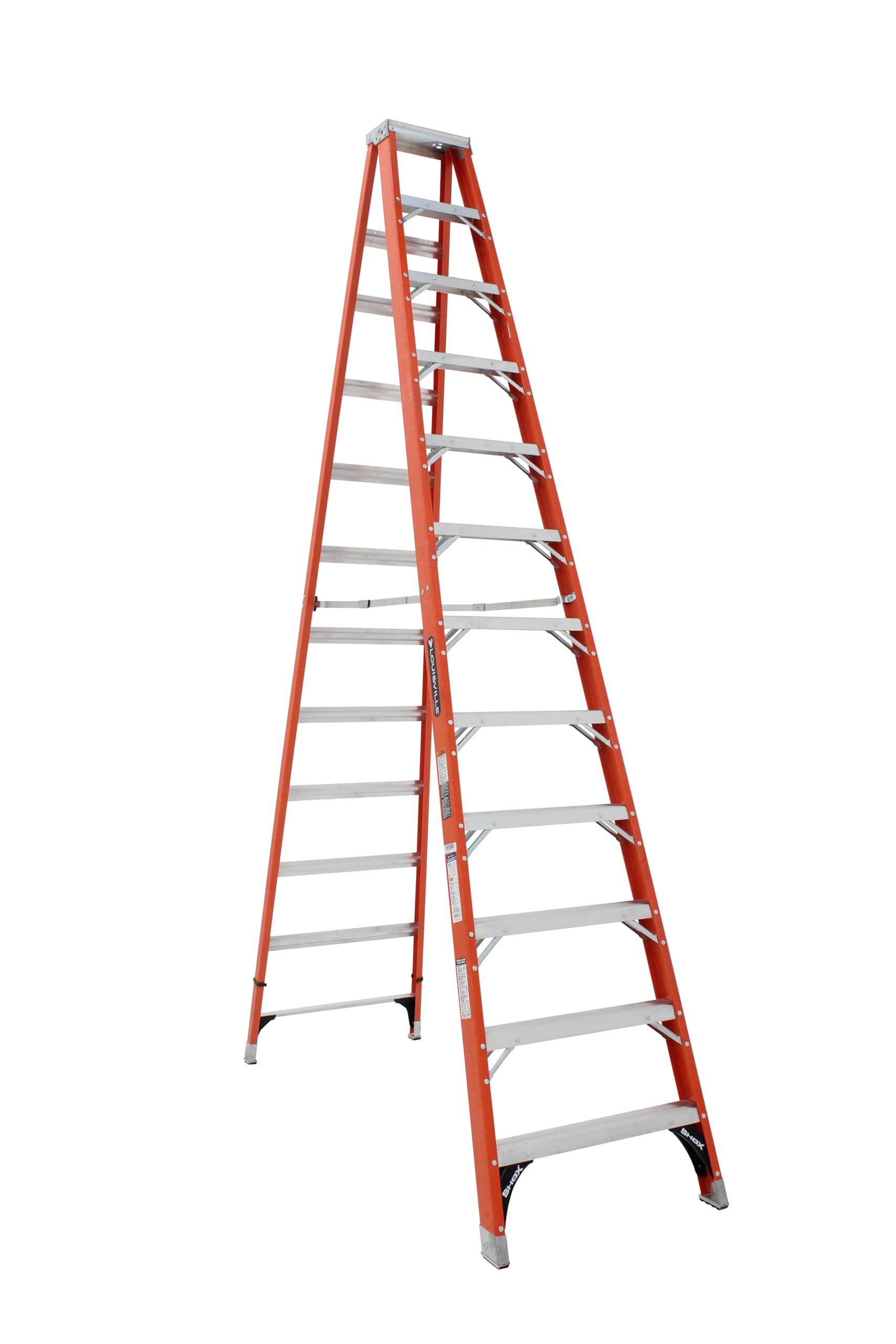
| Louisville Ladder 10 ft Fiberglass Step Ladder, FS1510★ Best Overall | Everyday home and yard jobs | 300 Pounds | Fiberglass | 34 pounds | Amazon |
| Louisville Ladder 12-Foot Fiberglass Step Ladder, FS1312HDHeavy-Duty Reach | Heavy-duty pro and home use | 375 pounds | Fiberglass | 51 pounds | Amazon |
| DeWalt Type IA 300lb Rated FG Stepladder 12′ DXL3010-12 | Wider steps for long jobs | 300 Pounds | Fiberglass | 46.4 pounds | Amazon |
| DeWalt Type IAA 375lb Rated FG Stepladder 12 DXL3410-12 | Heaviest household loads | 375 Pounds | Fiberglass | 57 pounds | Amazon |
| Werner Stepladder,Fiberglass,12 ft H,375 lb Cap (OBEL12) | Trades and extended work sessions | 375 pound | Fiberglass | 50 pounds | Amazon |
| Tri-Arc KDRF112162 12-Step All-Terrain Roll and Fold | Warehouse and industrial rolling use | 450 pounds | Alloy Steel | 189 pounds | Amazon |
In‑Depth Reviews
1. Louisville Ladder 10 ft Fiberglass Step Ladder, FS1510, Type IA, 300 lbs
Our pick — over 4.5★ from 4,000+ verified ratings; the strongest balance of quality and price.
A 34-pound fiberglass 10-footer for gutters, closet shelves, and trim touch-ups.
For a homeowner who climbs three or four times a month to clean gutters, reach a closet shelf, or touch up trim, this is the ladder that outlasts the projects. It stands 34 pounds on the frame, which is light enough to carry one-handed from the garage to the yard, and every step rises 12 inches so your footing stays predictable all the way up. The 300-pound capacity covers you plus a paint bucket without a second thought. The rails are fiberglass — non-conductive, so it will not carry current if you bump a wire — and they are wrapped in a polyester veil that resists the scuffing and fading that eats cheaper ladders. Each step is pinned with six large-headed, semi-tubular steel rivets, which is why the steps feel dead-solid underfoot rather than springy.
The stabilizing details are what owners talk about most. Thick rubber tread sits on all four legs, and the angle feet are built to bite on uneven ground, so the ladder does not skate when you shift your weight at the top. Louisville also rates it as meeting or exceeding ANSI and OSHA safety standards — two industry codes that spell out how much a ladder must hold and how it has to behave under load. In the real world, that translates to stepping onto the top rung without the frame flexing away from you.
Here is the honest catch, and it is a small one. This is a 10-foot ladder, not the full 12, so if your job is a two-story exterior wall or a tall vaulted ceiling, you will want to size up. The Pro Top also does not arrive with the magnet tray, hardware tray, drill slots, or paint bucket holder that the pricier Louisville models carry, so you give up a little tool storage at the top. At 4.7 stars across thousands of owner ratings, though, it is the crowd favorite for a reason — buyers report it as “sturdy not too heavy,” with expectations that it lasts for years of household use.
Why it holds the top spot
- 34-pound fiberglass frame carries easily one-handed between jobs
- 12-inch step rise keeps your footing predictable on every rung
- Six steel rivets per step for a solid, non-springy feel
- Non-conductive fiberglass rails are the safe choice near wiring
- Meets or exceeds ANSI and OSHA safety standards
- Slip-resistant rubber tread and angle feet on all four legs
Where it falls short
- 10-foot frame, so it will not reach a full two-story exterior
- No magnet tray, hardware tray, or paint bucket holder included
Bottom line: If your climbing is home maintenance and yard work, buy this and stop shopping — it is the balanced pick of the whole list.
Sizing caution: If you need to reach a second-story roofline, step up to a full 12-foot frame instead.
2. Louisville Ladder 12-Foot Fiberglass Step Ladder, 375-Pound Load Capacity, Type IAA, FS1312HD
A 12-foot fiberglass frame rated Type IAA for 375 pounds, with double-rivet steps and gusset bracing.
Buyers who need genuine height and honest weight capacity land here. The frame reaches a stated maximum height of 269.07 inches, which is the long-reach number you want for a two-story exterior wall or a vaulted entryway. It holds 375 pounds — the Type IAA load rating that sits a tier above the standard 300-pound household class. If you compare it against the Louisville 10-footer above, that is 75 more pounds of allowance and roughly 263 inches more reach before you even pull the ladder out. The frame carries 51 pounds, so it takes both hands to move, but it stays planted once it is up.
What wins buyers over is the build quality most often called out in reviews — 12 separate positive notes about it, the most-discussed trait of the model. A double-rivet step design and heavy-duty gusset bracing keep the frame stiff, and a heavy-gauge metal top gives you a flat surface for tools instead of a bare rung. The slip-resistant boot on the feet and the inside spreader braces work together to kill wobble, which is exactly what you want when you are carrying something heavy to the top. It is rated to meet or exceed ANSI, CSA, and OSHA standards — the three safety certifications that matter most, including the Canadian standard (CSA) that household ladders often skip.
The one realistic trade-off is weight. At 51 pounds, a smaller or older climber will feel the lift, and there is even a “a lite heavy for a 67 year old guy” note in the review pages that admits the weight pays off in stability once you are up at max extension. As owners put it, the ladder “is sturdy and easy to use” with a feeling of safety even when fully extended. It sits in the mid-tier of this list on value, which is fair for a Type IAA frame that carries 375 pounds.
The value read: A 375-pound Type IAA fiberglass frame with ANSI, CSA, and OSHA certification at a mid-tier price is a straightforward safety buy, not a luxury.
Where it costs you: The 51-pound frame is heavy to haul up from the basement, and it offers no magnet top or built-in tool slots — you trade accessories for pure frame strength.
Reach for this if: you need real 12-foot height plus a 375-pound rating and value a certified, wobble-free frame over a lighter ladder.
Look elsewhere if: you only climb a few times a year and want something you can carry with one hand.
3. DeWalt Type IA 300lb Rated FG Stepladder 12′ DXL3010-12
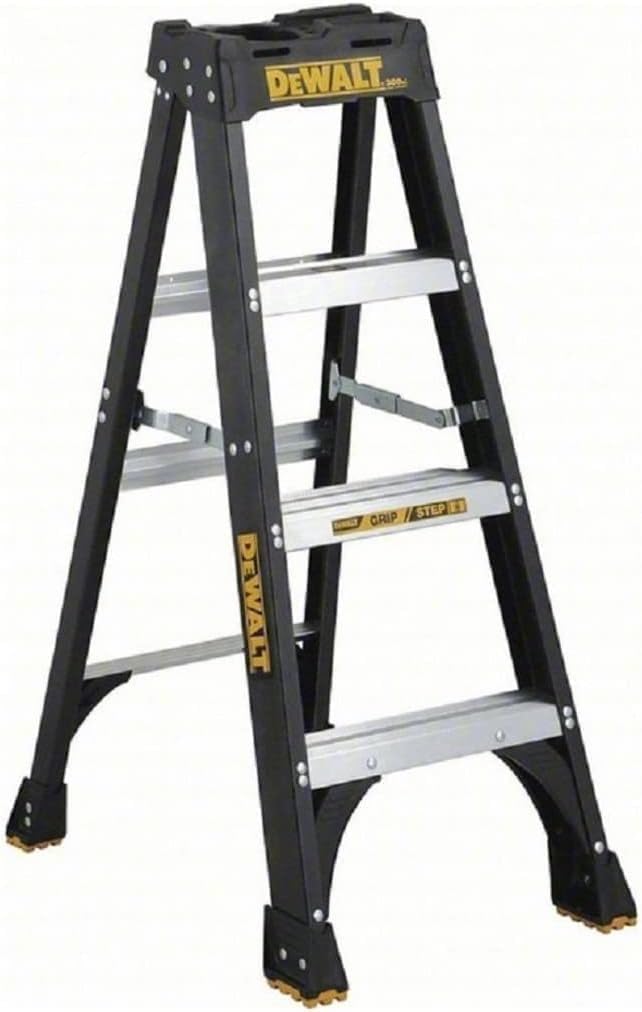
A 12-foot fiberglass ladder with a magnetic steel tool top and wider steps from the second rung up.
Anyone who spends a full afternoon up a ladder knows the real enemy is not height, it is where you set your drill. This DeWalt solves that problem before it starts. The top is a heavy-gauge metal tool tray with a magnet strip for bits and screws, and the steps themselves are wider than standard from the second rung up, which adds standing comfort on long jobs. It rates to 300 pounds and the frame weighs 46.4 pounds, so it is light enough to move with one hand yet still firm underfoot. The fiberglass rails keep it non-conductive, and the four wider feet spread your weight to reduce sinking on soft ground.
What buyers mention most is straight-up quality — 158 separate positive notes about it, easily the model’s defining trait, with sturdiness right behind. As owners describe it: “Light but sturdy,” and a few point out the added bonus of being able to pivot on the wider top. One reviewer who stands 6’4″ and weighs over 200 pounds lays out a simple height ladder: 4 feet for 8-foot walls, 6 feet for 8-foot ceilings, 8 feet for attics and outside work, and 20 feet for a single-story wall or roof. That kind of owner guidance is more useful than any spec sheet, and it fits the way most trades size their ladders.
The honest note is durability. Some owners say the frame feels built to last, but a handful report surface scratches arriving from the start — a cosmetic gripe, not a structural one. The other thing to know is that with only a 300-pound capacity, this is the lighter class of ladder, so if you regularly haul a loaded bucket or you exceed that weight, one of the 375-pound picks will suit you better. It is also a mid-tier buy rather than an entry-level one, which is fair for the tool top and wider steps.
The standout feature: The magnetic steel top and wider steps are the parts you will appreciate every time you climb with a power tool in one hand.
The cosmetic caveat: A few frames arrive with scratches on the finish, and the 300-pound capacity is the lighter tier — fine for most household loads, tight for heavy daily tool hauling.
Best matched to: the DIYer or tradesperson who wants a tool-holding top and wider steps, and whose loads sit under 300 pounds. Give it a pass if your usual climb includes a loaded bucket or you exceed that weight.
4. DeWalt Type IAA 375lb Rated FG Stepladder 12 DXL3410-12
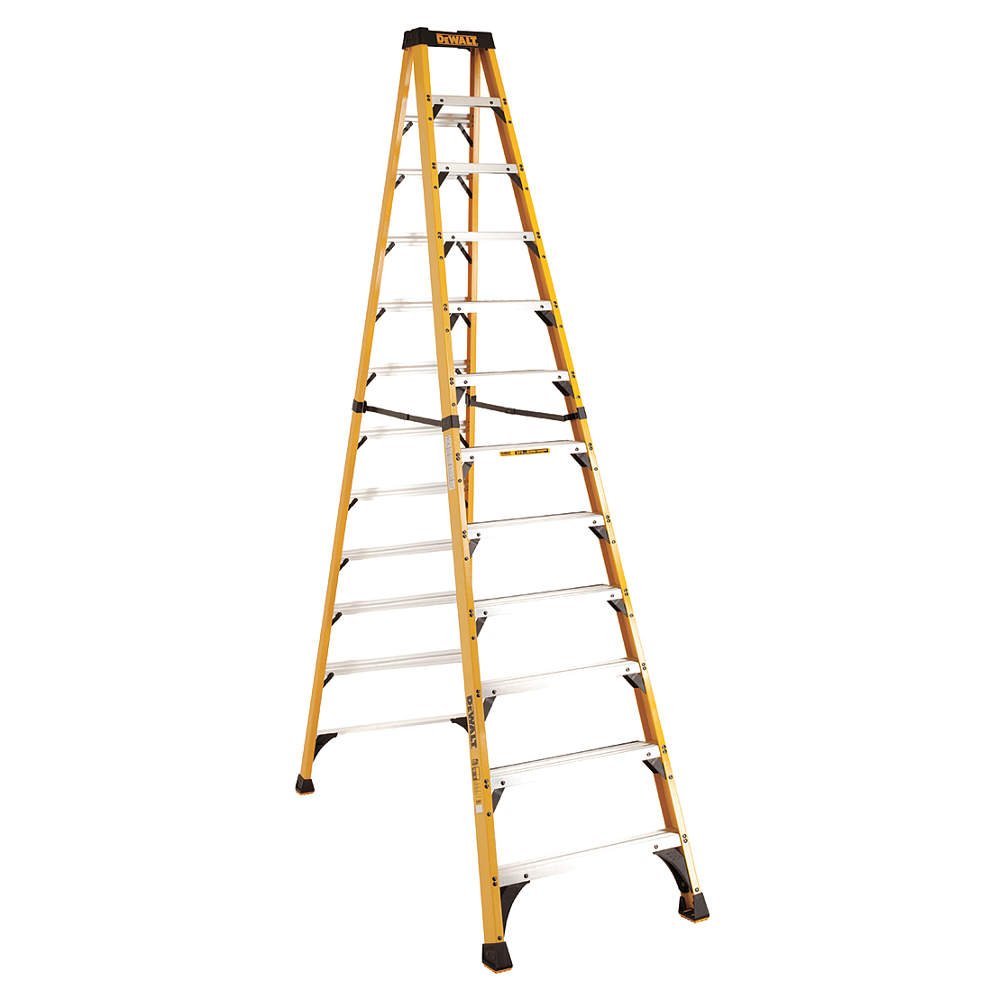
The 57-pound DeWalt fiberglass 12-footer rated Type IAA for 375 pounds.
If you carry serious weight up with you — a tool belt, a loaded bucket, a heavy fixture — this is the DeWalt built for it. The frame holds 375 pounds, a full tier above the 300-pound DeWalt above, and it reaches a maximum height of 144 inches. It weighs 57 pounds, the heaviest fiberglass ladder here, which is the physical cost of that extra load rating. Step onto the top and the frame stays stiff, helped by wide steps, rubberized feet, and a locking bridge that stops the legs from buckling or drifting outward while you work. The top tray carries a magnet plus slots that fit a screwdriver, pliers, a hammer, and a drill, and a back hook that holds a paint bucket.
What earns the trust here is frame quality — the most-discussed positive by a wide margin, with sturdiness close behind. One large owner describes it as “easily strong enough for me,” and others like the roomy footprint for changing lights indoors without wrestling furniture aside. Owners also note it looks heavier than it feels, a pleasant surprise for anyone who skipped reading the weight spec before ordering. It is the jump-up model for people who want the magnet top and tool slots in a frame that does not flex under load.
Two honest notes to weigh before you buy. First, this is the highest-priced fiberglass pick here, so it fits the buyer who wants the tool top and the 375-pound rating and does not mind paying the premium tier for them. Second, a small number of frames arrive with wobble or a finish that looks used — the recurring gripe in the review pages is legs that are not perfectly square to the ground, treat that as the first thing to check on arrival and return it if it does not sit flat. Structural bending complaints are rare, but they exist.
What makes it worth the premium
- 375-pound Type IAA capacity for heavy tools and fixtures
- Magnet top with screwdriver, plier, hammer, and drill slots
- Locking bridge and rubberized feet resist buckling and drift
- Wide steps for standing comfort on long jobs
- Frame reaches a stated 144-inch maximum height
What to check on arrival
- 57 pounds is the heaviest fiberglass model on this list
- A few frames arrive with wobble from legs not sitting square
- Top of the fiberglass price tier
My read: The strongest household fiberglass ladder here, and the tool top is worth it if you climb with both hands full.
The trade-off: You pay a premium and carry 57 pounds, and you should test the feet for wobble the moment it arrives.
5. Werner Stepladder,Fiberglass,12 ft H,375 lb Cap (OBEL12)

Eleven steps on a 12-foot fiberglass frame, with a top drilled for a Werner AC52-UB utility bucket.
This is the one for the person who climbs all day, every few days. Eleven steps on a 12-foot frame with a 375-pound capacity means a long, tall climb with steady footing the whole way up. It carries 50 pounds and reaches a stated 144-inch maximum height, matching the taller frames on this list. The fiberglass rails stay non-conductive, and the top is drilled with tool holes and notches sized for a Werner AC52-UB utility bucket, which snaps in solidly so your gear rides with you instead of on the floor. The pivoting brackets sit inboard of the legs, so they do not catch and bend when the ladder is stored in a truck bed.
What this ladder is known for is steadiness — the frame stays put whether it is on concrete, dirt, or grass, and owners describe using it month after month without a hint of sway. It has held up under moderate use for years at a stretch in the review pages, and a large owner treats it as a home-maintenance workhorse he can climb with confidence. The build and sturdiness are the two things people single out most. The inboard brackets and the utility-bucket notches are the kind of details you only appreciate after two seasons of truck storage.
The honest note is two-fold. This is a premium-tier fiberglass pick, so the price reflects the trade-grade build. The manufacturer does not offer a written warranty, which is worth knowing up front so you plan on maintenance rather than a replacement claim.
Why trades like it: A wide 11-step climb, 375-pound capacity, and a top that holds a utility bucket are the details that make long days on a ladder less punishing.
What to plan for: No written manufacturer warranty and a premium-tier price, so you buy this as a maintain-and-inspect tool rather than a set-and-forget one.
This one is for: the tradesperson who wants an 11-step, 375-pound fiberglass platform with serious tool-carrying design. It is overkill if you only climb a few times a year.
6. Tri-Arc KDRF112162 12-Step All-Terrain Roll and Fold Steel Industrial & Warehouse Ladder with Grip Strut Tread

A 189-pound rolling steel warehouse ladder on 10-inch semi-pneumatic wheels, not a folding step ladder.
This is a different animal from everything else on the list, and it should be, because it is built for warehouse aisles and shop floors, not living rooms. It rolls on 10-inch semi-pneumatic wheels, folds for storage, and holds 450 pounds — the highest capacity here — on 12 grip-strut steps. The steps are 16 inches wide with a 10-inch deep top platform, so there is real room to stand and work instead of balancing on a rung. It is built from 1-inch tubular steel with a scratch-resistant powder-coat gray finish and ships knocked down for straightforward assembly.
What makes it a favorite for the right buyer is stability and ease of movement on flat, hard floors. It admits being on wheels, it stands steady and the wide tread does not flex underfoot, which makes it feel safer than a folding step ladder for reaching high windows, ceiling fans, or roof edges. The rolling motion takes very little effort on a smooth surface once you get the hang of leaning into it, and the folding design compresses it for storage between jobs.
Now the honest part, and it is a big one: this is a 189-pound industrial unit and it is specifically not intended for residential use. It only rolls in a straight line, so it is hard to maneuver in a tight warehouse corner, and folding it back down requires removing locking bolts each time. It also takes real strength to move when you are not on a smooth floor, and running it up on uneven ground or stairs is a two-person job. At 3.6 stars, this is the lowest-rated pick here, and the honest read is that it is a niche tool for the warehouse or venue manager who needs a mobile 450-pound platform — not a household ladder.
The best fit: A shop or venue where you roll the same 450-pound platform to different spots on a hard floor and want maximum step width and load rating.
The hard limit: At 189 pounds, it is not portable in the everyday sense — it rolls straight only, cannot handle stairs, and is not designed for home use.
The selection: Buy it if your job is moving a heavy-duty platform around a warehouse or venue with hard floors. skip it if your ladder lives in a house or you need to carry it up stairs.
Understanding the Specs
Load Capacity and Ladder Type
The load rating stamped on the frame is the sum of your weight plus everything you carry up. Type IA covers up to 300 pounds and Type IAA covers up to 375 pounds, which is why the heavier-rated frames use thicker rails and gusset bracing. When you look at a 375-pound ladder, you are buying a stiffer frame, not just a bigger number. Match the rating to the heaviest load you realistically climb with — a paint bucket and a full tool belt can push a 220-pound climber past a 300-pound rating.
Fiberglass, Steel, and Where You Climb
Fiberglass is favored around live electrical work because it does not conduct current the way metal does, so it stays non-conductive if you bump a wire. Steel is stronger and cheaper to build heavier, which is why industrial rolling units use tubular steel, but a steel ladder should never be your electrical-work ladder. The environment matters just as much as the material: soft grass, dirt, and loose gravel reward thick rubber tread and angle feet, while smooth warehouse concrete rewards a rolling base with grip-strut tread. For a ladder that goes anywhere and near any wiring, fiberglass with slip-resistant feet is the safe default.
FAQ
How do I know my 12-foot step ladder can actually reach my ceiling?
Is a fiberglass 12-foot step ladder better than aluminum?
What does the Type IA or Type IAA rating actually mean?
Can I use the steel Tri-Arc ladder in my garage instead?
How do I store a 12-foot step ladder without it getting damaged?
Why do some 12-foot ladders wobble even when they are new?
What is step rise and does it matter on a tall ladder?
Do I need a magnet top and tool slots on my step ladder?
Final Thoughts: The Verdict
For most people shopping for a best 12 step ladder for home and yard work, the Louisville Ladder FS1510 is the pick — a 34-pound fiberglass frame with a 300-pound rating, a 12-inch step rise, and the highest owner satisfaction of anything here. If you truly need to reach a second-story exterior wall, go with the DeWalt DXL3410-12, whose 375-pound frame and magnetic tool top carry a heavier load at full 12-foot height. Tradespeople who want the roomiest climb, and a top that holds a utility bucket, will feel at home on the Werner OBEL12. And if your job is moving a heavy platform around a warehouse floor, the 450-pound Tri-Arc KDRF112162 is the one to roll into place.
How We Picked
We do not accept paid placement. Every pick is matched to a real buyer and a real use-case; we do not hands-on test units.
Sources & Methodology
Specifications: manufacturer listings and product documentation. Review insights: verified customer reviews, as of September 2026. Pricing: not shown on this page (it changes often); check the current price via the retailer link.
As an Amazon Associate, KitchPrep earns from qualifying purchases. This does not affect which products we feature.
Related Guides
