
Specs are compiled from manufacturer listings and verified buyer reviews and can change over time — please confirm the key details on the product page before buying.
Buying batting is where most quilts quietly succeed or fall apart. Pick the wrong one and your finished quilt turns lumpy, beardy, or stiff as cardboard — pick right and it drapes softly, washes well, and holds up for years. Here is exactly what separates the nine battings worth your money, from loft and fiber blend to stitch spacing limits.
I’m Mohammad Maruf — the founder and writer behind KitchPrep. This guide is built by comparing the manufacturers’ published specifications and the patterns across verified customer reviews, so you get each pick’s real strengths and trade-offs instead of marketing spin.
From thin hand-quilting cotton to plush extra-loft rolls, each pick here serves a different kind of quilt. This breakdown of the batting for quilting goes loft by loft so you match the right one to your next project.
Our Picks at a Glance


How To Choose The Best Batting for Quilting
Batting is the invisible middle layer of your quilt — the layer nobody sees but everybody feels. It controls how warm the finished quilt is, how softly it drapes, how well it survives the wash, and how far apart you can stitch without the filling shifting. Getting it right is mostly about three variables: fiber content, loft, and the maximum stitch spacing the manufacturer allows.
Fiber Content: Cotton, Blend, or Scrim-Stabilized
Pure cotton batting (100% cotton fibers, no polyester mixed in) breathes naturally and gives that traditional crinkled look after washing. Blends mix cotton with a percentage of polyester — that added fiber gives structure and reduces how much lint sheds during quilting. Then there are scrim-stabilized options, which layer in a thin non-woven grid so the batting resists bunching, bearding, and creeping even in wide quilts that get heavy use.
Loft: The Thickness That Determines Your Quilt’s Feel
Loft is simply how thick the batting is when it’s lying flat. Request loft is the thinnest option, ideal for hand quilting where you want thread to show. Select or mid-loft is the everyday middle ground — enough puff for definition, still easy to stitch through. Extra loft is the plush end, warmer to sleep under and better for tied quilts or showy trapunto work. Match the loft to how the quilt will be used, not just to what looks good before quilting.
Maximum Stitch Spacing: How Far Apart You Can Safely Quilt
Every manufacturer publishes a maximum distance you can sew between lines of stitching before the batting risks shifting inside the quilt. Tight limits (3.5″ or 4″) demand denser quilting — more work, more time. Generous limits (8″ or 10″) let you quilt wide and still keep the layers stable. If you love big open free-motion designs or plan to tie a quilt instead of stitch it, check this number before you buy.
Quick Comparison
| Model | Best For | Size | Fiber | Max Stitch Spacing | Amazon |
|---|---|---|---|---|---|
| Hobbs Batting Heirloom 80/20 Queen★ Best Overall | Bed quilts and larger projects | 90″ x 108″ | 80% Cotton / 20% Polyester | — | Amazon |
| Natural Cotton Batting 68″x86″ 150g/m²Best Value | Summer quilts and lightweight projects | 68″ x 86″ | 100% Natural Cotton | — | Amazon |
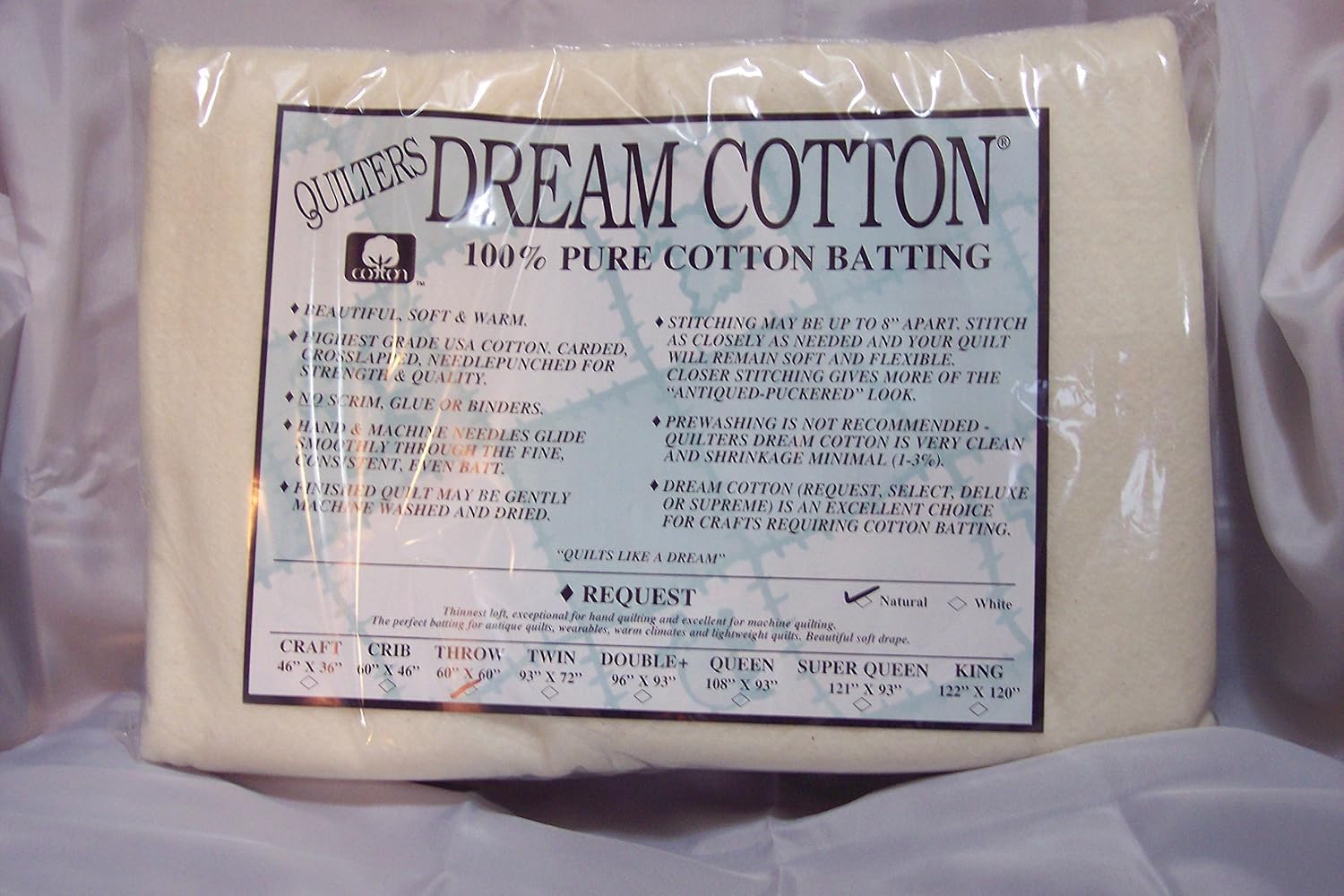
| Quilters Dream Natural Cotton Request ThrowTop Performer | Hand quilting and heirloom work | 60″ x 60″ | 100% Cotton | 8″ apart | Amazon |
| Hobbs HL72 Heirloom Cotton Blend | Throws and everyday quilting | 72″ x 90″ | 80% Cotton / 20% Polyester | 4″ apart | Amazon |
| Quilter’s Dream Request Loft Twin | Big-stitch hand quilting and table runners | 93″ x 72″ | 100% Cotton | — | Amazon |
| Warm Company Warm and Natural Twin | Machine quilting for everyday quilts | 72″ x 90″ | 100% Cotton | — | Amazon |
| Quilter’s Dream Select Loft Twin | Quilts needing mid-loft definition | 93″ x 72″ | 80% Cotton / 20% Polyester | — | Amazon |
| Warm & Natural Cotton Batting Queen | Wide-spaced quilting and larger quilts | 90″ x 108″ | 87.5% Cotton / 12.5% Polypropylene | 10″ apart | Amazon |
| Warm & Plush Cotton Batting Bolt | Multiple quilts and bulk purchase | 45″ x 10 yards | 100% Cotton | 10″ apart | Amazon |
In‑Depth Reviews
1. Hobbs Batting Heirloom 80%/20% Cotton/Poly Queen Size: 90″ x 108″ Quilt Batting
Our pick — over 4.5★ from 950+ verified ratings; the strongest balance of quality and price.
The queen-size blend that quilts smoothly with barely any lint left behind
If you are making a bed quilt and want one batting that does most jobs well, the Hobbs Heirloom Queen is the safest pick. The size is the headline here: a precut 90″ x 108″ sheet means no piecing and no midnight wrestling match trying to line up two smaller pieces. At approximately 1/8″ loft, it sits in the low range — thick enough to give your quilting design definition, thin enough that hand needles slide through without a fight. The 80% cotton / 20% polyester blend is lightly needle-punched and resin-bonded, so the fibers stay put instead of shedding all over your floor.
What owners rave about is how consistently it quilts, hand or machine. The blend reduces lint compared to 100% cotton, and the finished quilt drapes softly without the stiffness you get from heavier battings. Machine washable with roughly 3–5% shrinkage means the quilt gets that desirable puckered antique texture after its first wash, not a sagging one. It is also soft enough to fold around a baby, which makes it equally useful for baby quilts as for full bed quilts.
Here is the catch worth knowing: the maximum sewing distance is 3.5″ apart. If you like big open quilting designs with wide spacing, you will need to add denser stitching or simpler quilting lines to hold the batting in place. For most machine quilting designs, that limit is not a problem — but if you tie quilts or use wide free-motion spacing, check this number before you commit.
What stands out
- Precut 90″ x 108″ queen size — no piecing needed for standard bed quilts
- 80/20 cotton-poly blend cuts lint significantly versus all-cotton batting
- Smooth stitching on both hand quilting needles and a domestic sewing machine
- Machine washable with approximately 3–5% shrinkage for a traditional crinkle finish
What to weigh first
- Maximum stitch spacing is 3.5″ apart — wider free-motion designs need more quilting lines
- Low loft of about 1/8″ may feel too thin if you want a puffy finished quilt
Go for this if: you want one dependable batting for a queen-size bed quilt without piecing.
skip it if: your quilting plan relies on wide spacing beyond 3.5″ between lines.
2. Natural Cotton Batting for Quilting Sewing Crafting & DIY Projects (68″x86″, 150g/m² Lightweight)
A lightweight 100% cotton sheet that turns warm months into quilting season
You get a summer quilt that stays warm without feeling bulky, because this batting weighs just 150g/m² — about 30% thinner than traditional cotton batting. The 68″ x 86″ size fits a twin bed with room to spare, so you can layer it without trimming. The 3mm-per-inch thickness is uniform thanks to industrial needle-punching (a process that locks fibers together with barbed needles), so when you lay it flat you won’t find thin spots or clumped patches. And because the cotton fibers are natural and additive-free, your finished quilt won’t carry a chemical smell or residue.
What stands out here is how easily the 150g/m² cotton sheet cuts, layers, and stays put under a fusible adhesive. Smooth texture and moderate loft make cutting, sewing, and layering simple, and the batting stays put under a fusible adhesive without shifting or knotting as you work. Owners use it for bowl cozies, wall hangings, lightweight summer quilts, and even design walls. One quilter even used it to repair an existing quilt because the batting was easy to handle and the sheet covered the job generously.
One thing to know before you order: do not pre-wash the batting before quilting. The manufacturer specifically says to wait until the quilt is fully assembled — then you can machine wash the finished quilt and air-dry it in sunlight. Unrolling it and letting it rest for 24 hours before you start is recommended to reach maximum fluff. And because it is natural cotton, minor cotton flecks may appear from processing, which the manufacturer confirms does not affect quality. If you are working on a light-colored quilt and want a spotless white batting, keep that in mind.
The value read: at a lightweight spec and a precut 68″ x 86″ size, this is the pick that covers the widest range of small-to-mid projects without asking you to buy more than you need.
Reach for this if: your quilt is for warm weather or you want a light, breathable layer for wall hangings and cozies.
Think twice if: you need a thick, plush finish or a batting that tolerates pre-washing.
3. Quilters Dream Natural Cotton Request Batting (60” x 60”) Throw
The thinnest batting on this list — made for stitching you want the world to see
Request loft is the whole point of this pick. At 60″ x 60″, it is a square throw size built for lap quilts and small heirloom work, and the ultra-thin build means your hand-quilting stitches show up clearly on the surface. What wins people over is the smooth, no-scrim surface that lets hand needles glide through without resistance — exactly what long hand-quilting sessions demand. The 8″ maximum stitch spacing is the most generous on this list, so you get real design freedom even if you hate dense quilting.
It is 100% cotton, carded and cross-lapped without glues, scrim, or binders. Its Thermal Value of R=3.8 means the batting holds warmth in winter while wicking moisture in summer, making it a year-round option rather than a summer-only pick. Drape is beautifully soft for a traditional quilt look, and finished quilts machine wash and dry with minimal shrinkage. The 60″ x 60″ square is worth measuring against your project before ordering — a full bed quilt will need more than one sheet.
The one caution is thickness. It is intentionally the thinnest Request option in the Quilters Dream line, so if you want visible puffy loft in your finished quilt, this is the wrong family entirely. Some quilters do note that the thinness reads quite flat after quilting. But for hand quilting, micro-stitching, and wearable projects where you want the threadwork to dominate, this is exactly right.
Where it wins: the 8″ stitch spacing is the widest here — two inches past the Hobbs HL72, which caps at 4″. That is real design freedom for wide hand-quilted lines that do not look busy.
Where it feels thin: at Request loft, it is by design the flattest option in the lineup — no loft, no puff.
The right pick for: hand quilters who want their stitches to be the focal point of the finished quilt.
Look elsewhere if: you want visible puff and loft in your finished quilt.
4. Hobbs HL72 Batting Heirloom Premium Cotton Blend, 72″ x 90″

An 80/20 twin-size workhorse that stays stable across throws and bed quilts
This batting suits throws and twin-bed quilts at 72″ x 90″, and it uses the same 80% cotton, 20% polyester recipe as the Hobbs Queen. What makes it different is scrim stabilization — a thin non-woven layer needle-punched into the batting so the fibers resist shifting and bunching even after repeated washing. That means your quilt keeps its shape wash after wash. The loft is low at about 0.13″ thick, so it drapes softly, and you can expect the same 3–5% shrinkage typical of an 80/20 blend.
The catch with this one is the stitch limit: maximum 4″ apart, which is slightly roomier than the Queen’s 3.5″ but still demands that you plan your quilting lines or designs with some density. If you want to quilt 8″ or 10″ apart, look at Quilter’s Dream for the wide-spacing option, or step up to the Warm Company battings later in this list. For machine quilting and moderate hand quilting, 4″ is workable and just asks a little more quilting effort on your end.
Quality is where this batting clearly lands. The blend shrugs off lint, the cotton-poly mix keeps quilts from getting stiff, and the scrim means the batting will not end up lumped in the corners of a quilt after a few washes. It works just as well for craft projects and home décor as for quilts, making it a solid cross-purpose sheet to keep on hand.
Why quilters pick it
- 80/20 cotton-poly blend is light on lint and holds a soft drape
- Scrim stabilization resists shifting and bunching during washing
- 72″ x 90″ is a useful throw and twin size that does not need trimming
- Works for hand quilting, machine quilting, and craft projects
What to know before buying
- Maximum stitch spacing of 4″ apart keeps you working closer than wide-spaced battings allow
- Low loft may feel thin if a plush quilt is what you want
The right call if: you want a scrim-stabilized blend that survives repeated washing without clumping.
Better options elsewhere if: your design needs maximum stitch spacing wider than 4″ apart.
5. Quilter’s Dream Natural Cotton Batting Request Loft Twin

A thin 100% cotton sheet sized for big-stitch hand quilting and small décor pieces
If you hand quilt with thick thread and want your stitches to stand out, this Request Loft Twin delivers exactly that. It is the thinnest Dream batting, made from 100% natural cotton in the USA, and the 93″ x 72″ twin size is generous enough for larger lap quilts, placemats, table runners, and quilted totes. Because 100% cotton has no synthetic fibers filling out the loft, your stitches show crisply with a nice traditional surface texture underneath.
What makes it work for hand quilters is the flat, pucker-free surface that needs no prewash. It does not produce that glue-like or popcorn smell when you iron it, which seasoned quilters know is a real annoyance with some battings. After quilting, it washes well without unfriendly surprises. Durability holds up to repeated use, and a finished quilt made with it drapes softly without that stiff, board-like feel.
One caution: this is a thin batting, and thinness is a mixed bag depending on the project. If your quilt is meant to be a warm winter cover, the low loft means it will not add much insulation — you might want a double layer or a thicker batting for cold-weather quilts. Also, the batting arrives folded, and while wrinkles relax in the dryer or with light ironing, you may want to plan for that step before you lay out the quilt.
Hand-quilter’s review: the thin Request Loft is the reason your hand stitches show up rather than disappearing into a dense surface — it is designed for the thread to be the star, not the filler.
Ideal for: hand quilters making placemats, wall hangings, table runners, or thin lap quilts with big stitches.
Not ideal for: warm winter bed quilts where thick loft is the goal.
6. Warm Company Batting 72-Inch by 90-Inch Warm and Natural Cotton Batting, Twin

The 72″ x 90″ cotton sheet quilters have trusted for years of Sunday-morning quilting
There are two words that matter here: 90″ x 72″. That is the standard twin size for throw quilts and regularly sized bed quilts, which means you can lay it out, layer it up, and start quilting without cutting or piecing. It is 100% cotton batting, made in the USA, needing no pre-wash before quilting — just layer and go. Once your quilt is finished, it is machine washable like any other quilt you would own.
What earns this a premium slot is how consistently the same 100% cotton batting performs batch after batch. This is the same batting experienced quilters return to over and over, and the review pages reflect that kind of repeat use. The batting performs well through repeated washing and handling without breaking down at the edges or developing thin spots. Pins go in with ease, and layers stay aligned through the quilting process — that quiet, unglamorous reliability is exactly what keeps this on so many quilters’ shelves.
The honest note here is that 100% cotton batting produces some lint during quilting, especially if you are running a fast machine needle through it. If a low-lint surface is your priority, the 80/20 cotton-poly blows in a different direction — the Hobbs Heirloom is specifically the pick for reducing lint. But if you want 100% natural cotton under your hands, this is a well-loved sheet that delivers exactly what it says.
what separates it
- Standard 72″ x 90″ twin size covers throw and bed quilts without piecing
- No pre-wash required — layer and quilt straight out of the package
- Machine washable after quilting, so the finished quilt stays low-maintenance
- Made in the USA with 100% cotton fibers
The honest caveat
- 100% cotton batting sheds more lint during quilting than a cotton-poly blend
Best if: you want a proven 100% cotton twin-size batting that skips the pre-wash step.
Consider a blend instead if: lint during quilting is something you would rather avoid.
7. Quilter’s Dream Select Loft Batting for Quilting (Twin, White)

The mid-loft blend that lets you quilt far apart and still get definition
Select Loft is the just-right of the Quilter’s Dream lineup — not as thin as the Request loft, not as plush as the plush versions, but just enough thickness that a lowered quilt still shows definition. The 93″ x 72″ twin size works for lap quilts, bed runners, and standard twin quilts. It is the same 80% cotton / 20% polyester blend as the Hobbs options, but the specifically “Select” loft gives it that mid-range loft the Hobbs low-loft sheets do not have.
What makes this a long-term favorite is how the mid-loft 80/20 blend handles repeated handling and washing without stiffening. Hand and machine needles both glide easily through the soft fibers, and because it has no resins, scrim, or binders, the finished quilt stays soft rather than stiff. It tolerates wide quilt spacing without shifting — the manufacturer specifically notes it provides enough loft even when quilted far apart, which is not a claim most low-loft battings can make. That makes it a real option for quilters who want visible loft without denser stitching.
The one thing to know is that the Select Loft is heavier than the Request Loft version, so a finished twin quilt will feel noticeably warmer to sleep under. That is welcome in winter, but a bit much for the middle of summer. Choose this over the Request Loft if warmth outweighs the visibility of your hand stitches, and choose the Request Loft if stitch definition matters more than loft.
Long-run value: the 80/20 blend with mid loft holds up across multiple quilts and stays soft after every wash, which is why experienced quilters keep it in their favorites.
Suited to: quilters who want visible loft and wide quilt spacing in the same batting.
Possibly not for you if: you prefer a very thin batting for exposed hand stitching.
8. Warm & Natural Cotton Batting Queen Size, 90″ x 108″

The queen-size sheet that lets you quilt a full ten inches apart
Ten inches between stitching lines is a big deal for quilters who dislike dense work. The Warm & Natural Queen batting holds together beautifully with lines of stitching as far as 10″ apart, which makes it a serious choice for large-format quilts and tied quilts. The fiber content is 87.5% cotton with 12.5% polypropylene — that second fiber is what makes the batting resist bunching, bearding, and creeping no matter how much the quilt gets washed or dragged around.
The construction matters here: the batting is needle punched with no resins or glues added, so the finished quilt stays soft and breathable rather than stiff. The 90″ x 108″ queen size covers a standard queen bed quilt in one sheet — no piecing, no seams to hide, no trying to line up multiple batting pieces flat on your floor. After the quilt is finished, you can machine wash and dry it; pre-wash instructions are on the packaging if you want to hand wash instead.
The trade-off worth knowing: 87.5% cotton with 12.5% polypropylene is a slightly different fiber mix than pure cotton or 80/20 blends. Some quilters prefer pure cotton feel and this mix reads a bit different under hand. Also, at 90″ x 108″, the sheet is big enough that laying it out flat on a small floor is real work. But for quilters who mostly run wide stitch patterns or tie their quilts, this is the king of positioning flexibility.
Why it works: 10″ maximum stitch spacing is the widest limit on this entire list — nothing else here gives you that much breathing room to wrap up a quilt quickly and confidently.
The one for you if: your quilting style uses wide stitch patterns or you tie quilts instead of machine stitching.
Reconsider if: you want a pure 100% cotton batting feel with zero synthetic fiber mixed in.
9. The Warm Company – Warm & Plush Cotton Batting – 45″ x 10 Yard Bolt, Extra Loft 100% Cotton
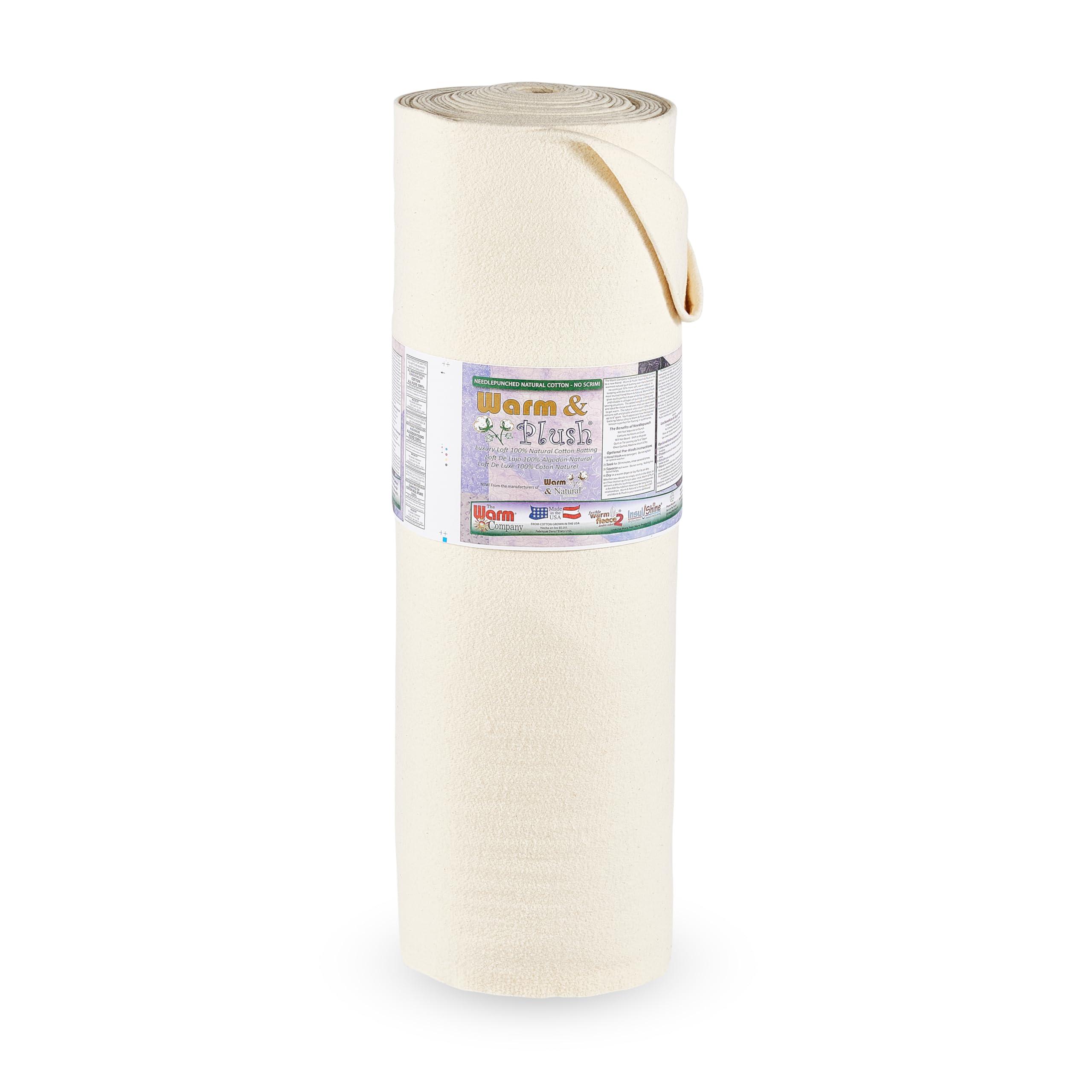
A ten-yard bolt of extra-loft cotton for quilters who go through batting fast
Forty-five inches wide by ten yards long is what you are looking at here — enough batting to cover multiple small-to-mid quilts, craft projects, or a classroom’s worth of hands. It is 100% cotton batting grown in the US, needle-punched with a scrim to resist shifting, tearing, and bunching, and it is quilted to hold together with stitches up to 10″ apart. The extra-loft build packs more cotton fibers per square inch than standard batting, which is exactly what gives the finished project a plush, cozy weight.
What makes it stand out is how the scrim-stabilized needle-punch holds up to repeated washing without thinning or clumping. Because the extra-loft cotton gets a scrim-stabilized needle-punch treatment, it stands up to repeated washing and heavy use without developing thin spots or clumps. Tied, machine quilted, hand stitched — this batting holds together. Many quilters run through this bolt for designs where a thick, warm layer matters more than low-loft stitch visibility, from baby quilts to winter throws.
One thing worth planning for: this is a bolt rather than a precut sheet. You will need to unroll it, measure, and cut for each project — a real advantage if you want to custom-size, but a bit more prep work than opening a precut sheet. And because it is 100% cotton with extra loft, expect a bit of lint during cutting and quilting. If you run through batting regularly, the ten-yard length is by far the most efficient format on this list.
What buyers value
- 10-yard bolt covers multiple projects — efficient for frequent quilters
- Extra-loft 100% US-grown cotton makes for a plush, warm finished quilt
- Scrim-stabilized needle-punch resists shifting, tearing, and bunching
- Quilt up to 10″ apart for wide stitch patterns or tied quilts
Small caveats
- Bolt format requires measuring and cutting per project rather than opening a precut sheet
- 100% extra-loft cotton can generate more lint than a blend during cutting and quilting
Reach for this if: you quilt often and want one bulk roll that covers many projects at extra loft.
Skip if: you prefer the cut-and-go convenience of a precut size that matches your quilt top.
Understanding the Specs
Loft: The Thickness That Decides Your Quilt’s Feel
Loft refers to how thick the batting is when lying flat, and it drives everything about the finished quilt’s look and feel. Request loft is the thinnest — designed for hand quilting where you want the stitches to clearly show. Mid loft (also called Select or regular loft) sits between thin and plush, giving the finished quilt visible definition without extra bulk. Extra loft is the plush end of the scale, well suited to tied quilts and winter throws that need warmth. There is no universally right loft — it all depends on how the quilt will be used and how much puff you want.
Fiber Content: How Cotton, Polyester, and Scrim Change Your Quilting Experience
100% cotton batting is soft, breathable, and gives the traditional puckered look after washing — but it can shed more lint during quilting. A cotton-poly blend reduces lint significantly and adds structure, which is why 80/20 blends stay popular for machine quilting. Polypropylene-scrim battings — like the Warm & Natural — add a thin internal grid that resists bearding, bunching, and creeping. None of these is better across the board — they each suit a different kind of quilter and quilting style.
FAQ
Should I pre-wash batting before quilting?
How far apart can I quilt before the batting shifts?
Does 80/20 cotton-poly batting shed less lint than 100% cotton?
How much will batting shrink after the first wash?
Can I use the same batting for hand quilting and machine quilting?
What size batting do I need for a queen-size quilt?
What does “request loft” mean and who is it for?
Is a 10-yard bolt cheaper per project than precut batting?
Does cotton batting work for summer quilts?
What is the difference between Warm & Natural and Warm & Plush?
Final Thoughts: The Verdict
For most quilters, the winner of this batting for quilting lineup is the Hobbs Batting Heirloom 80/20 Queen because the precut 90″ x 108″ queen size saves you from piecing, the 80/20 blend cuts lint, and the low loft quilts smoothly by hand or machine. If you plan wide stitch spacing or a tied quilt, grab the Warm & Natural Cotton Batting Queen for its 10″ stitch limit and scrim-stabilized build. And if you want a thin 100% cotton sheet where every hand stitch shows clearly, the Quilters Dream Request Throw is the one to reach for.
How We Picked
We do not accept paid placement. Every pick is matched to a real buyer and a real use-case; we do not hands-on test units.
Sources & Methodology
Specifications: manufacturer listings and product documentation. Review insights: verified customer reviews, as of September 2026. Pricing: not shown on this page (it changes often); check the current price via the retailer link.
As an Amazon Associate, KitchPrep earns from qualifying purchases. This does not affect which products we feature.
Related Guides
