
Specs are compiled from manufacturer listings and verified buyer reviews and can change over time — please confirm the key details on the product page before buying.
When the power dies at 2 a.m. or an evacuation order hits your phone, you have minutes to grab what keeps your household alive for three days — and that is exactly what a 72 hour emergency kit is for. The problem is that most of these bags look identical online, yet differ wildly in what they actually hold, how they carry, and whether the food and water inside will still be good years from now. Below are nine kits worth owning, sorted by what they genuinely do best, so you can match one to your household instead of guessing.
I’m Mohammad Maruf — the founder and writer behind KitchPrep. This guide is built by comparing the manufacturers’ published specifications and the patterns across verified customer reviews, so you get each pick’s real strengths and trade-offs instead of marketing spin.
Every kit here covers a full three days, but they split into two camps: throw-it-in-the-car grab bags and build-your-own starter shells. Knowing which camp you want is the fastest way to narrow down the best 72 hour emergency kits for your home.
Our Picks at a Glance


How To Choose The Best 72 Hour Emergency Kits
A 72 hour emergency kit is only useful if it is complete, carryable, and still fresh when you actually need it. Three things decide whether a kit earns its closet space: how many people it feeds, how it distributes weight on your back, and whether the food and water inside will outlast a year of sitting untouched.
Match the kit to the number of people, not the bag size
A kit labeled for four people and a kit labeled for one can look similar in a photo. Read the food and water math instead. Two 2,400-calorie bars and six water pouches feed two people for three days; one 2,400-calorie bar and five pouches feed one. If a kit promises four people but lists single-person rations, you will be sharing a snack, not surviving.
Households also grow. A kit with room left over for a change of clothes, medications, and extra water bottles is worth more than a tightly packed one that leaves no margin. Several kits on this list are explicitly built as starters for exactly that reason.
Weight distribution beats raw weight
A loaded bag can weigh anywhere from five pounds to over twenty-five pounds depending on what is inside. Light bags suit children and smaller adults. Heavy bags with padded straps and a proper back panel carry far better than a light bag stuffed into a cramped shell, where the load shifts and digs into your shoulders.
If you plan to carry the kit any distance, prioritize padded shoulder straps and a bag that holds its shape. If it lives under a bed for shelter-in-place, prioritize contents and leave the carry comfort to chance.
Shelf life is the quiet dealbreaker
Emergency food bars and water pouches in these kits typically carry a 5-year shelf life. That is the window before you need to rotate them. Check the printed dates when the box arrives and set a reminder well before they lapse, because a kit with expired supplies is just an empty backpack.
Quick Comparison
| Model | Best For | People Covered | Food & Water | Weight | Amazon |
|---|---|---|---|---|---|
| Emergency Zone 2 & 4 Person 72 Hour Survival Kit★ Best Overall | Families wanting a multi-person starter kit | 2 to 4 | 3600-calorie bars, water pouches, collapsible container | 11.52 kg | Amazon |
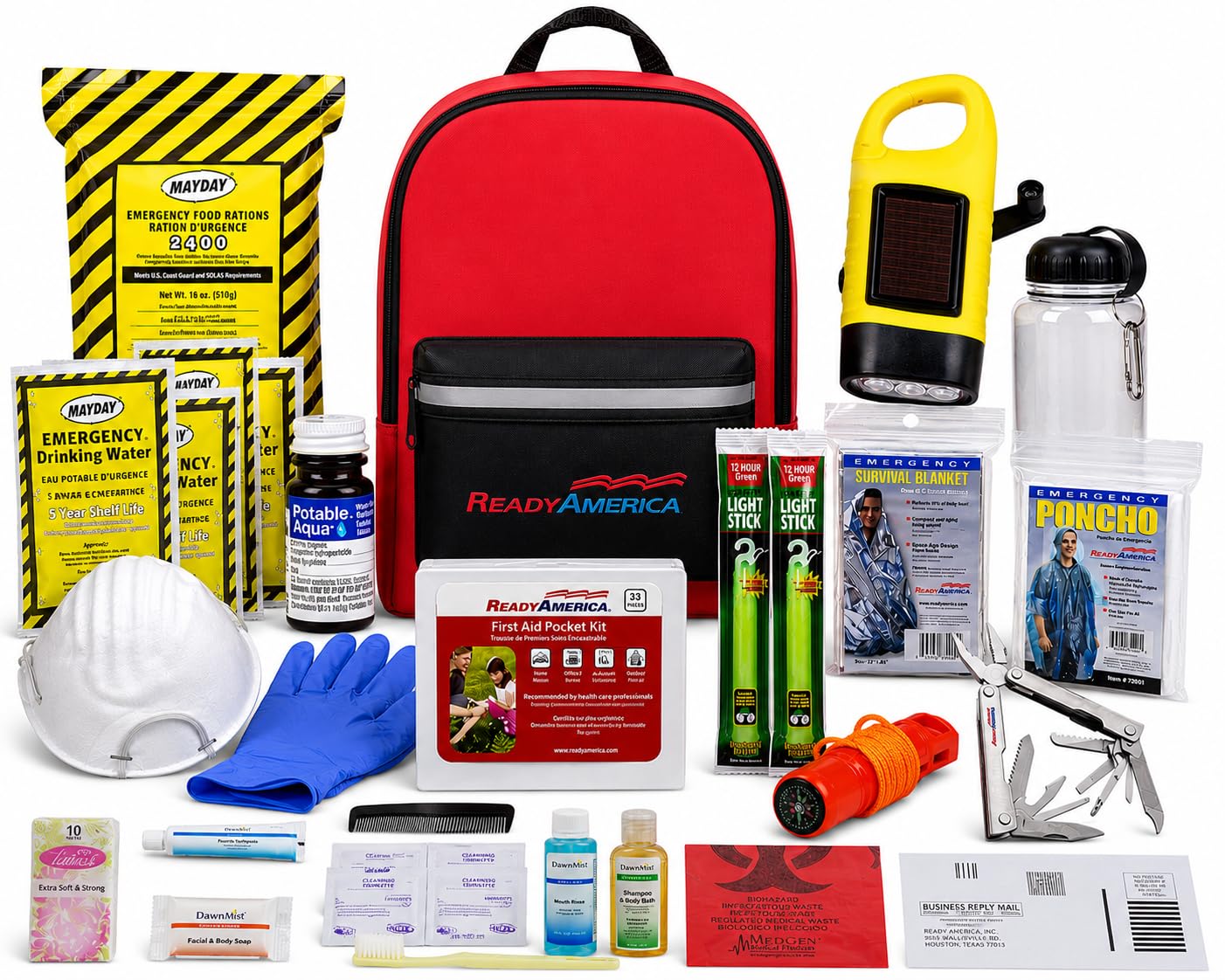
| Ready America 72 Hour Deluxe Emergency KitBest for One Person | One-person grab bag for car or office | 1 | 2,400-calorie bar, six water pouches, 32 oz bottle | 5 pounds | Amazon |
| Blue Seventy-Two Pro Series (Red)Best for Road Trips | Road trips and power outages | 1 | 2,400-calorie bars, five 4.22 oz pouches | — | Amazon |
| Blue Seventy-Two Pro Series (Camo) | Bug-out with extra cooking gear | 1 | 2,400-calorie bars, five 4.22 oz pouches | 4.22 ounces | Amazon |
| Ready America 70285 Deluxe 2-Person 3-Day Backpack | Two-person households and older kids | 2 | Two 2,400-calorie bars, six 4.225 oz pouches, purification tablets | 2 pounds | Amazon |
| 72HRS Essential Emergency Preparedness Kit | Weather-radio coverage and visibility | 1 | 3600-calorie ration, twelve 125ml pouches | 7 pounds | Amazon |
| Sirius Bug Out Bag Starter Kit | Preppers building a custom go bag | 1 | SOS Labs US-made rations and water pouches | 12 pounds | Amazon |
| Family 4 Pack Blue Seventy-Two Standard | Equipping a whole household at once | 4 | 2,400-calorie bars, five 4.22 oz pouches per bag | — | Amazon |
| Complete Earthquake Bag 3 Day Emergency Kit | Organized one-person earthquake and storm prep | 1 | 3600-calorie bars, twelve water pouches, purification tablets | 11 pounds | Amazon |
In‑Depth Reviews
1. Emergency Zone 2 & 4 Person 72 Hour Survival Kit
Our pick — over 4.5★ from 650+ verified ratings; the strongest balance of quality and price.
The multi-person kit that turns one backpack into a household plan for three days.
Households of three or four people face a specific problem: a one-person backpack leaves half the family uncovered. This Emergency Zone kit solves that by packing for two to four people in a single 18 x 12 x 12 inch bag. The food side carries 3600-calorie SOS food bars and water pouches with a 5-year shelf life, plus a collapsible water container and Chlo-Floc so you can refill and treat water long after the pouches run out. The 121-piece first aid kit, multitool knife, flashlight, work gloves, whistle, duct tape, and rope round out the tool side.
You get shelter and hygiene items that most starter bags leave out. Sleeping bags, a tube tent, ponchos, and hand warmers keep you warm and covered, while toothbrushes, soap, and toilet paper cover basics other kits skip. The nylon backpack swallows the load — multiple buyers report they added their own safety gear without running out of room, and several note the bag holds extra capacity once you pull items out of their packaging.
Buyers love how complete it feels right from the start — the sheer number of items is the most praised quality, and buyers consistently call it a great starting point rather than a finished kit. One recurring caution: the straps are the weak point, with some reporting tearing after regular use. Treat the shoulder straps gently and check them before a real carry. This is the pick for a family that wants coverage for several people in one purchase and plans to top it up over time.
What earns it the top slot
- Covers two to four people for a full three days in one backpack
- 3600-calorie food bars and water pouches carry a 5-year shelf life
- Includes a collapsible water container and Chlo-Floc for refilling and treating water
- 121-piece first aid kit plus multitool, flashlight, rope, and duct tape
- Sleeping bags, tube tent, ponchos, and hand warmers handle warmth and shelter
Where it asks for care
- Shoulder straps are the known weak point and can tear under regular use
- Some items are basic rather than premium, so upgrades are worth planning
The right fit: a whole household that wants one bag covering several people for three days.
Where it strains: if you need a single light pack for one person to carry miles, this bag’s breadth works against you.
2. Ready America 72 Hour Deluxe Emergency Kit
A compact one-person bag light enough for a child to carry out the door.
At 5 pounds and 10 x 6 x 13 inches, this is the smallest kit on the list — and that compactness is the point. A 2,400-calorie food bar, six emergency drinking water pouches, and a BPA-free 32 ounce bottle handle food and water for one person over the critical first 72 hours. The hand-crank LED headlamp, emergency poncho, survival blanket, and waterproof matches cover lighting and shelter without needing batteries.
Compare it directly to the Family 4 Pack further down: this is a single bag sized for one person, while that bundle ships four separate backpacks. If you live alone or want one kit per person in the car, this is the lighter, simpler route. The BPA-free bottle is the detail that matters most day to day, since it lets you refill from any safe source instead of rationing pouches. The included hygiene kit, pocket tissues, and emergency contact card round out the package.
The recurring gripe is where the supplies sit rather than what they are. The load is packed tight and small, so the weight feels concentrated and digs in more than you would expect from a light bag — buyers describe the distribution as the awkward part. On completeness and speed of grabbing, though, it holds up. Sized for one person, light enough to pass to a child, and quick to toss in a trunk.
The safety read: a one-person kit should be light and complete, and this hits both targets — 5 pounds fully loaded, with food, water, lighting, shelter, and hygiene all present.
The awkward bit: the compact shell ends up concentrating the weight, so it carries heavier than the number suggests.
Reach for this if: you live alone, want a spare kit in the office or dorm, or need something a child can grab and carry.
Look elsewhere if: you want a two-person bag or plan to strap extra gear on the outside — this shell is tightly packed.
3. Blue Seventy-Two Pro Series Red 72 Hour Emergency Backpack
Toss it in the trunk and forget it — until a storm strands you on the shoulder.
Power outages, road closures, and getting stuck on a shoulder are everyday emergencies, and this kit is built around exactly that. The red triple-pocket Grab-N-Go backpack holds a 2,400-calorie pack of food bars with a 5-year shelf life, five 4.22 oz emergency drinking water pouches, a first aid kit, a mask, and an emergency whistle and compass combo, plus a tissue pack, blanket, and rain poncho. The Pro Series adds a canteen cup and playing cards on top of the standard gear.
Set it against the 72HRS kit further down and the difference shows up in the bag itself. The 72HRS is a water-resistant polyester shell with limited pockets; this one reads as a larger tactical-style pack with multiple pockets and storage areas — the single most praised trait in the reviews. The 11 x 7.5 x 17 inch frame leaves room for a change of clothes and your own add-ons, which is why so many owners treat it as a foundation rather than a finished bag.
The honest caveat is item quality: several owners note that what ships inside is lightweight and emergency-grade rather than rugged, and a few say the included supplies do not quite stretch to a full three-day mountain of gear. That is a fair trade for the price bracket — the bag is the real purchase, the contents are the starter. Keep it in the car or by the door and top up the contents yourself.
Why it works in a trunk: a durable triple-pocket pack, food and water with a 5-year shelf life, and the essentials to handle a stranded-car scenario without unpacking anything.
The fair caveat: the supplied items lean lightweight, so treat the bag as the anchor and the contents as a starting point.
Best for: keeping in the vehicle, in a dorm, or by the door for outages — anywhere you want one grab and go.
Skip if: you want every item inside to be premium-grade from the start.
4. Blue Seventy-Two Pro Series Camo 72 Hour Emergency Backpack
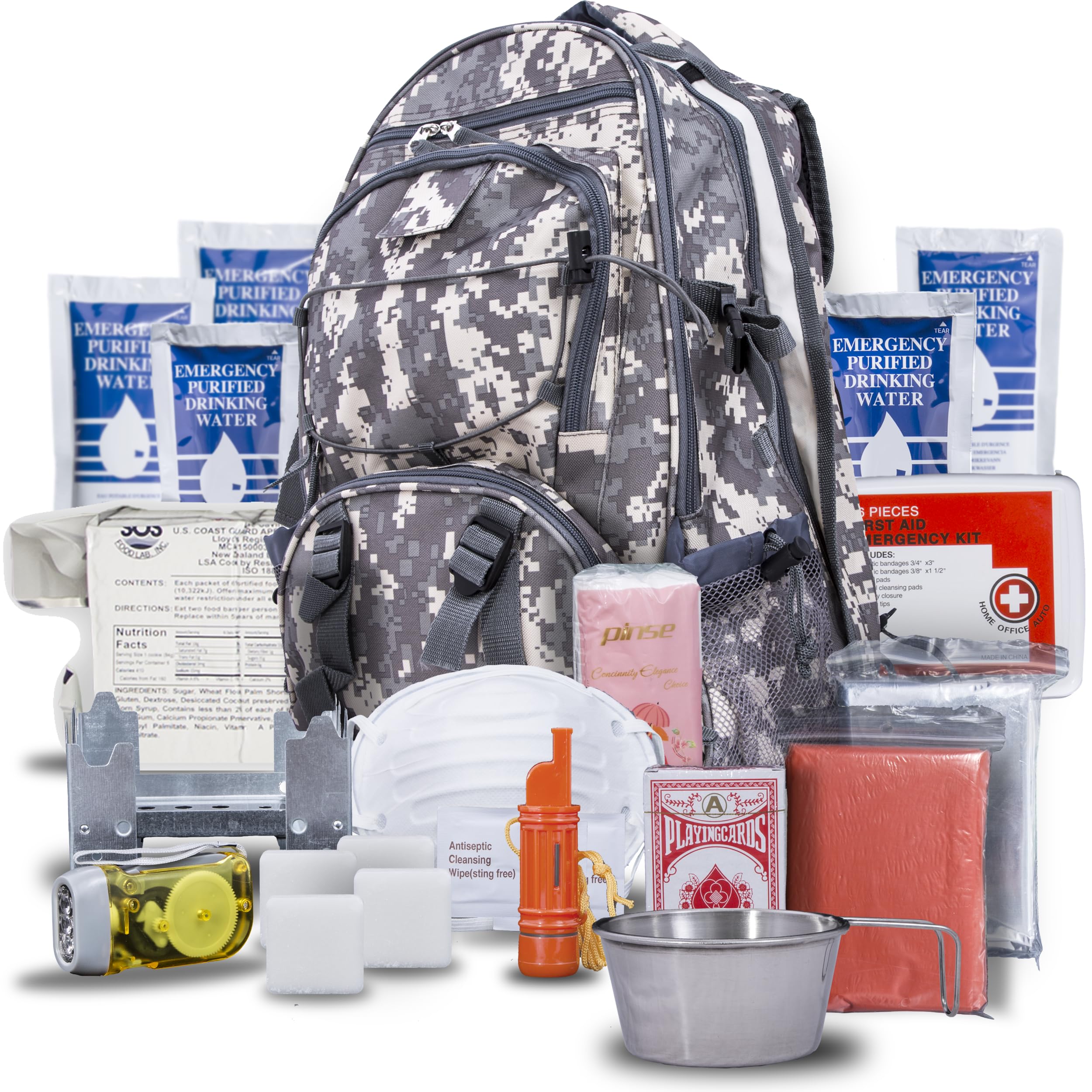
The camo sibling with a stove and crank light packed inside.
Two additions separate this camo Pro Series from the red version above: a battery-free crank flashlight and a small emergency stove. Everything else is the same battle-tested package — 2,400-calorie food bars with a 5-year shelf life, five 4.22 oz water pouches, a 36-piece first aid kit, mask, whistle and compass combo, blanket, poncho, and tissue pack, all inside the larger tactical-style Grab-N-Go backpack.
The crank flashlight matters because it removes batteries from the equation entirely. Twist the handle and you have light; no guessing whether the cells died in your drawer. The emergency stove adds a way to boil water or heat a meal when the power is out for days, which most basic 72-hour kits skip. The camo finish is the cosmetic divider; the stove and crank light are the functional ones.
Owners describe it as a well-thought-out kit for its class, and the one consistent complaint concerns the shell rather than the supplies. The bag has no dedicated bladder sleeve, which is a real limitation for anyone who wants hands-free hydration on the move. The bag is budget-tier construction, built to sit ready in a car or closet rather than survive years of trail abuse.
Standout additions: a battery-free crank flashlight and an emergency stove push this above a bare kit — both solve problems that appear only after the grid goes dark.
Where it falls short: no bladder sleeve and a plainly budget bag construction mean it is built for storage, not expedition duty.
Choose it if: you want a grab bag with a stove and crank light included and plan to keep it in a car or closet.
Pass if: you need a hydration bladder sleeve or a pack that will survive heavy field use.
5. Ready America 70285 Deluxe 2-Person 3-Day Emergency Backpack
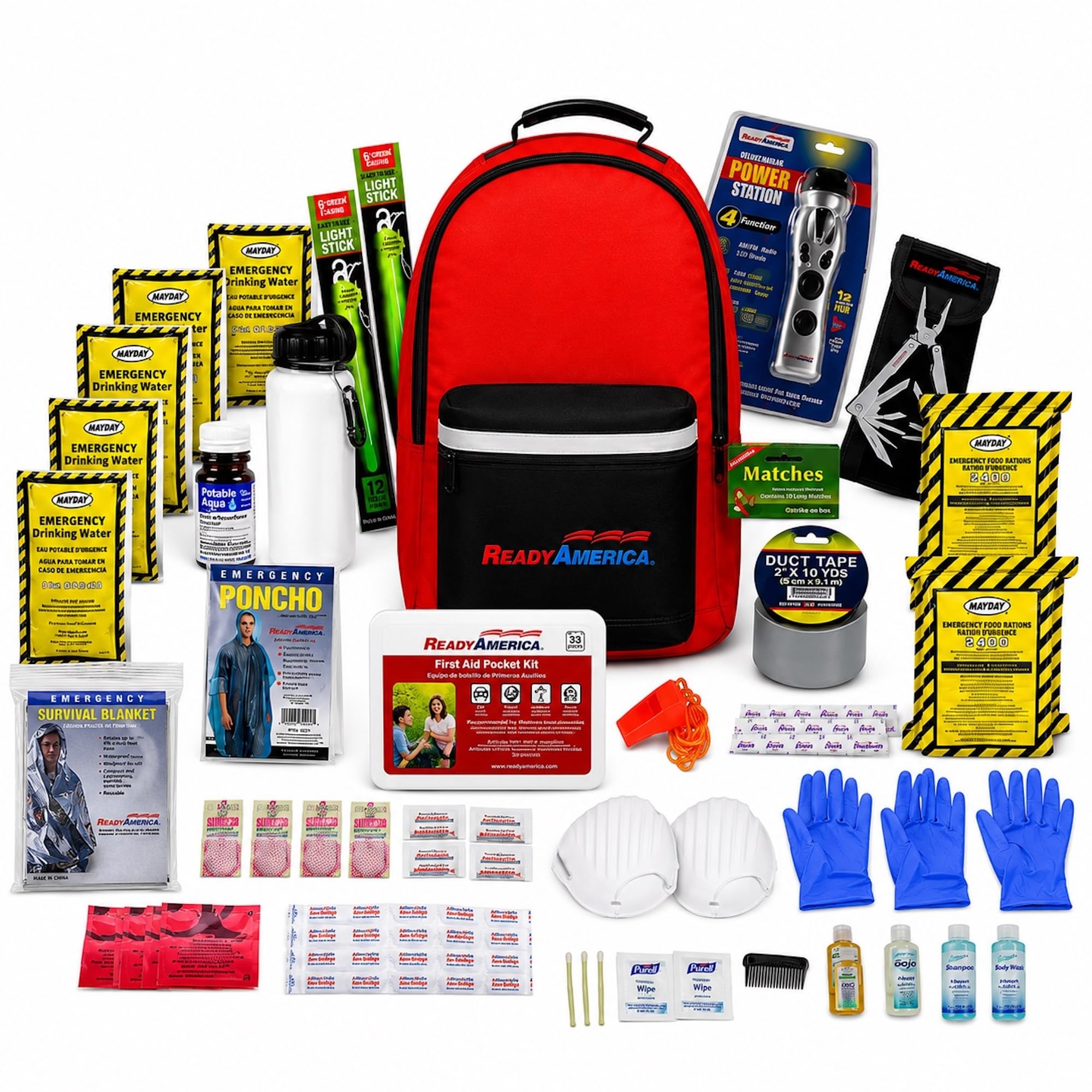
A two-person kit that carries everything, packs light, and takes up almost no room.
Two people, three days, one backpack — this is the version of the Ready America formula scaled up to cover a couple. Two 2,400-calorie food bars, six 4.225 oz water pouches, water purification tablets, and a 32 ounce BPA-free bottle handle food and water. A 33-piece first aid kit, two N95 dust masks, nitrile gloves, and two hygiene kits handle medical and sanitation, with ponchos, survival blankets, and tissues for shelter.
The power station is the standout addition. It is a hand-crank unit that pairs a flashlight with an AM/FM radio, a siren, and cell phone charging — so you keep light, information, and a topped-up phone even when the grid is down. Two emergency lightsticks and a 3-in-1 whistle, compass, and thermometer fill in the rest. A multi-function tool, duct tape, and a bio-hazard bag round out the tools.
Compared with the single-person Ready America above, this delivers double the food and water in a bag that still carries comfortably — the balanced weight is the most-praised trait, and the compact size slips under a bed or into a closet. Owners also note that older children and smaller adults can carry it without trouble. The trade-off is the lightweight construction across the whole kit; nothing here is overbuilt, and if you want premium components you will upgrade some items over time.
What makes it practical: a full two-person load in a compact pack under a bed or in a closet, with a hand-crank power station that keeps a phone alive and a radio playing.
The trade-off: everything is light-duty, so treat it as a foundation and upgrade individual items to your own standard.
This suits: couples, roommates, and small households that want one well-organized bag with power and communication built in.
Not for: anyone expecting heavy-duty construction or premium-grade tools throughout.
6. 72HRS Essential Emergency Preparedness Kit 3-Day Survival Kit
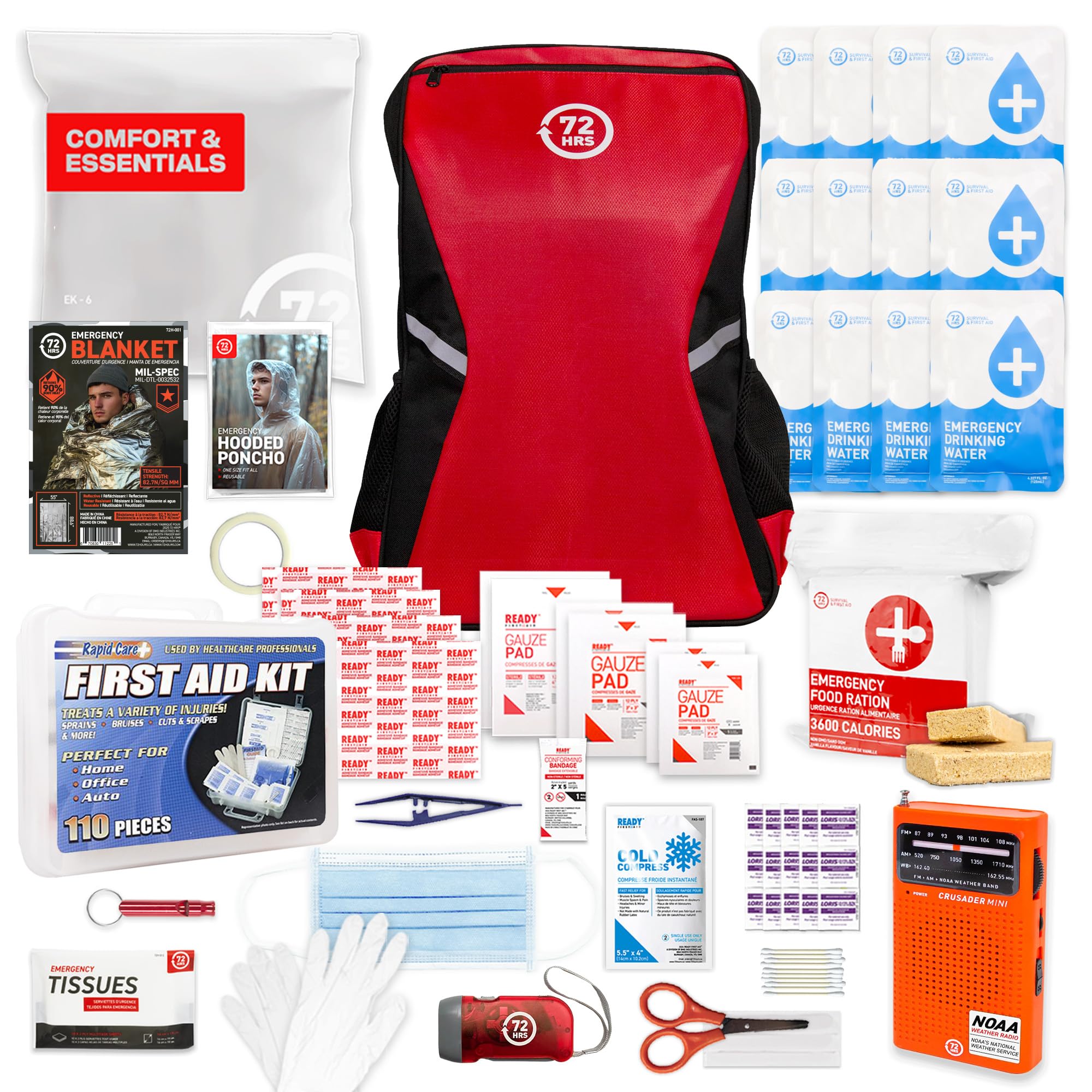
A three-day bag built around a weather radio that keeps you informed when towers drop.
When a hurricane or wildfire is moving, information saves lives. This kit centers on a Crusader Mini NOAA weather radio that pulls all 7 NOAA channels for warnings, forecasts, and all-hazard updates around the clock, with a headphone jack for quiet listening. Food and water are generous for one person: a 3600-calorie ration and twelve 125ml water pouches rated to last three to five days, both with a 5-year shelf life. The pouches are built to survive a vehicle rolling over them without bursting.
See how this reads against the Ready America single-person kit above — this one carries far more food and water and a dedicated weather radio, in a heavier polyester bag with padding and a 17 x 12 x 7 inch footprint. The heavy-duty fabric shell, reflective strips front and back, and multiple compartments show this was designed for actual evacuation rather than pantry storage. It handles shelter, lighting, first aid, sanitation, and communication in a single grab bag.
The recurring frustration is the bag layout rather than the contents. There are no extra outer pockets for quick access, so finding a specific item means digging through the main compartment. That is a minor annoyance in an otherwise capable kit — everything works, and the radio and generous rations are the reasons to pick this one.
The information edge: NOAA weather radio access across all 7 channels is a genuine differentiator — most kits ship a hand-crank light, not a full weather receiver.
The everyday annoyance: the shell lacks quick-access outer pockets, so expect to dig for small items.
Pick this if: you live in a storm or wildfire region and want a kit that keeps you informed while evacuating.
Consider another if: quick reach-in access to small items is important to you.
7. Sirius Bug Out Bag Starter Kit
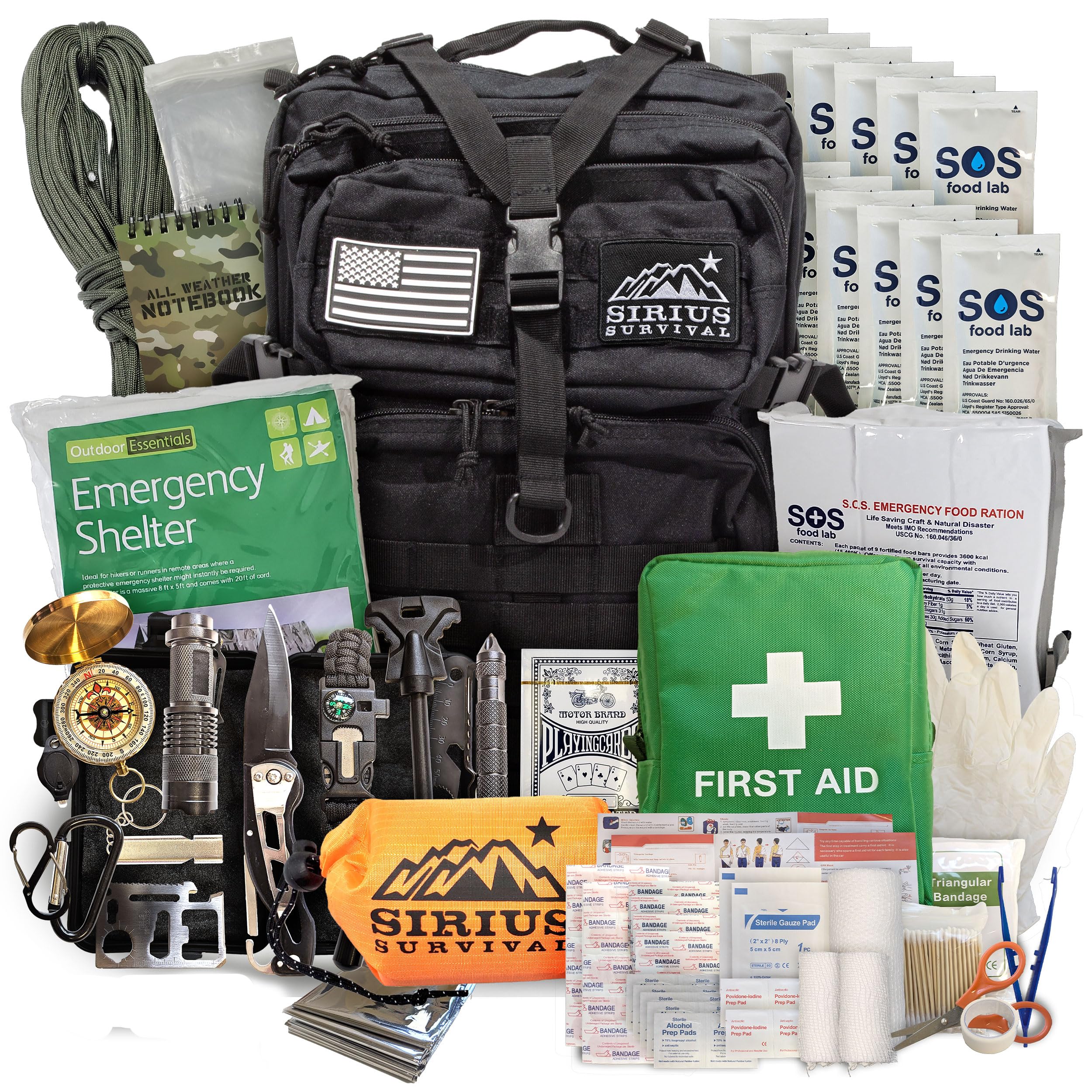
A starter shell for the prepper who wants to finish the job themselves.
This is the kit for the buyer who already knows they will customize. A 50-liter 900D Oxford backpack anchors the package — that fabric is the dense, water-resistant weave used in heavy tactical gear, and the padded back and shoulder straps are built to carry a loaded bag comfortably. Inside you get SOS Labs 100% US-made food rations, emergency water pouches, and a 176-piece assortment of survival tools, medical supplies, a camp knife, ferro rod, compass, wire chainsaw, 100ft of paracord, emergency sleeping bag, and survival tent.
Set against the standard one-person kits above, the draw here is the frame, not the fill. The 50L pack is far more spacious than the smaller ready-to-go bags and is built from a heavier material — so you have a durable, comfortable vessel for a personalized setup rather than a disposable shell. The kit ships unpacked on purpose, which lets you arrange gear the way you want from day one.
The starter nature cuts both ways. Because it is meant to be finished, it does not hold your hand — there is no included contents guide or item list, which is a rough edge for someone new to prepping. There is also a real quality-control caveat: some owners mention that water packets arrived punctured and leaked in transit, and one noted a flashlight that was broken on arrival. Those are shipping and inspection issues rather than design defects, but check your supplies carefully the day the box lands.
Why preppers gravitate to it
- A 50L 900D Oxford backpack with padded straps carries a heavy, customized load
- 176 pieces include a camp knife, ferro rod, compass, wire chainsaw, and 100ft of paracord
- Food rations are SOS Labs 100% US-made
- Ships unpacked so you can organize it your own way
- Built in Buffalo, NY by a small business that stocks every component
What to watch for
- No included contents list or guide, so beginners have to research their own layout
- Some shipments arrive with punctured water packets or a dead flashlight — inspect on arrival
The right buyer: an experienced prepper who wants a strong 50L backpack and quality food as the starting point for a custom build.
Probably not for you if: you want a fully loaded kit you can trust from the start without adding or checking anything.
8. Family 4 Pack – Blue Seventy-Two Standard 72 Hour Emergency Backpack Survival Kit
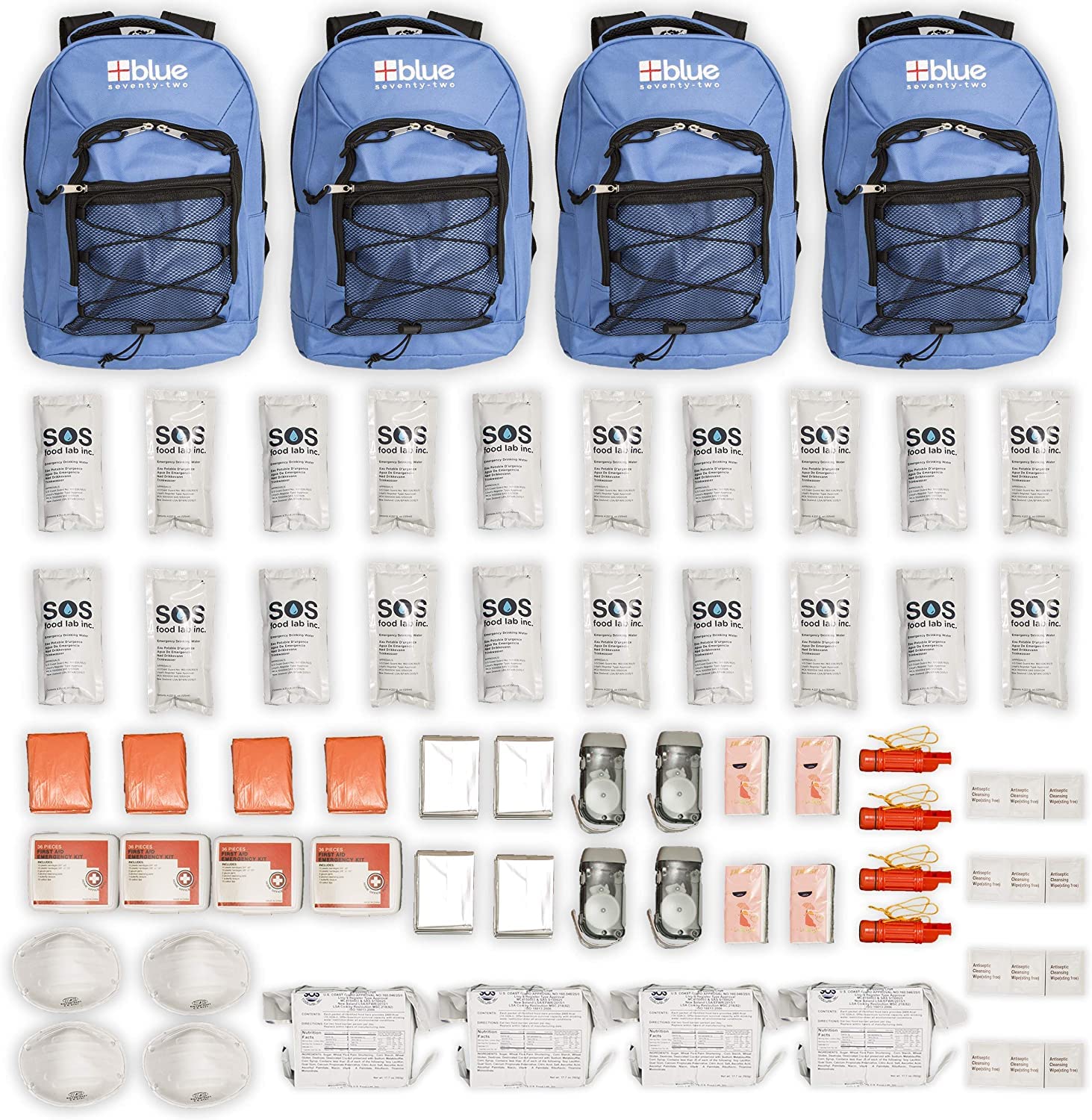
Four identical backpacks so every person in the house gets their own.
Equipping a family of four usually means buying the same kit four times and hoping nothing gets mixed up. This bundle eliminates that: four separate Grab-N-Go backpacks, each loaded for one person over three days, all in one purchase. Each bag holds a 2,400-calorie pack of food bars with a 5-year shelf life, five 4.22 oz emergency drinking water pouches, a 36-piece first aid kit, mask, whistle and compass combo, battery-free crank flashlight, tissue pack, blanket, and rain poncho.
Each of the four bags carries food, water, and an emergency blanket — the three items the American Red Cross names as a starting point. That shared baseline is what makes this the most orderly way to prep a household: no one is carrying gear meant for someone else, and everyone has their own complete kit.
The trade-off worth naming is that the kits are intentionally standard, not premium. The single bags in this bundle match the basic Blue Seventy-Two formula, so if you want upgraded components or a stove, the Pro Series versions are the better route. For a straightforward “everyone gets a bag” solution, though, this is the cleanest option on the list — no piecing together four separate orders.
The household logic: four complete, one-person bags in a single order is simpler, tidier, and easier to distribute than buying four individual kits.
The honest limit: these are standard-spec bags, so anyone wanting premium components should look at the Pro Series instead.
The pick for: families of four who want everyone equipped equally without any mix-ups.
Not the pick if: you want only one bag or prefer premium-grade contents.
9. Complete Earthquake Bag – 3 Day Emergency Kit
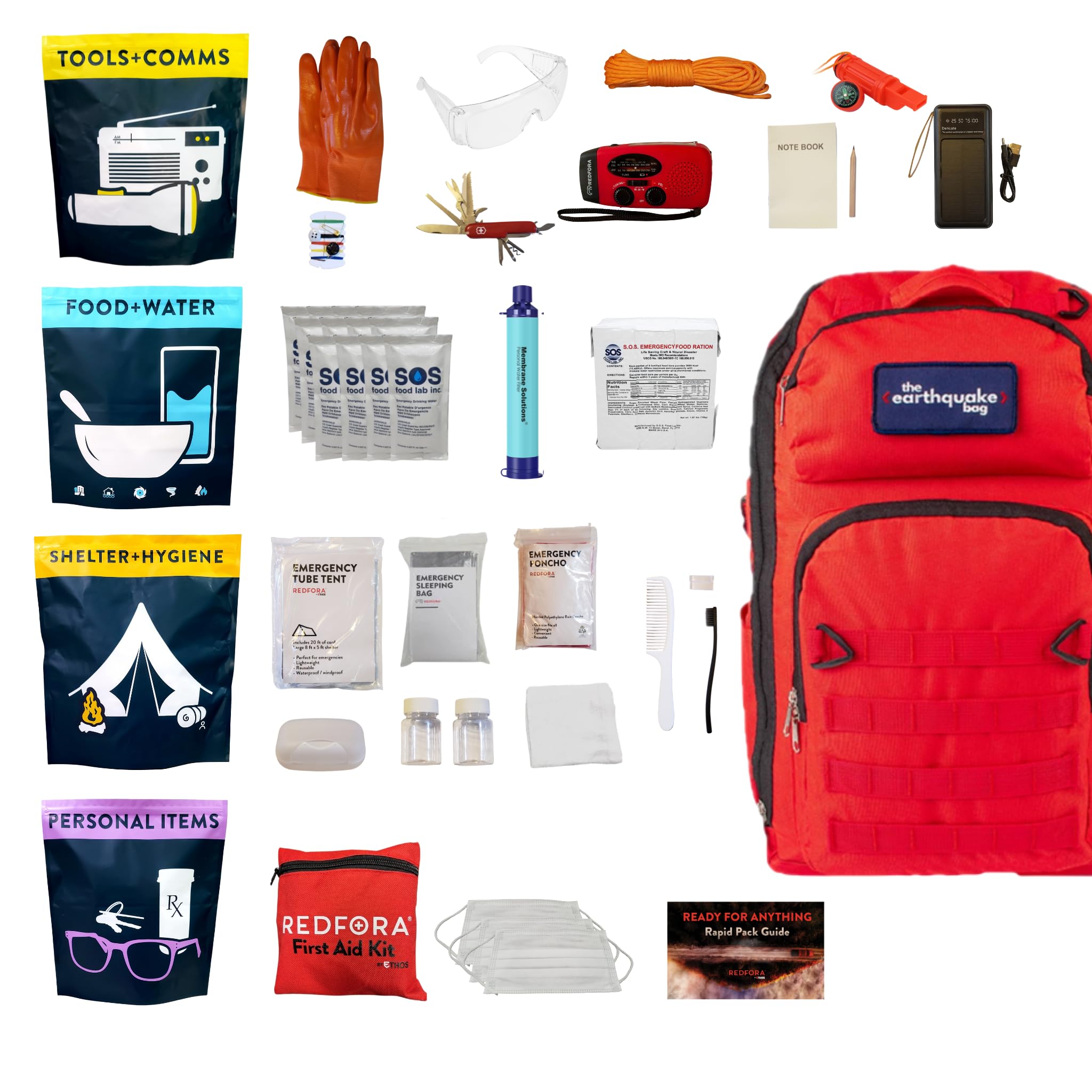
A one-person kit so neatly packed that finding the right item is the point.
Panic makes people fumble, and this is the kit designed to prevent that. The 40-plus supplies arrive organized in re-sealable waterproof packs under a color-coded system, so the flashlight stays with the flashlight and the medical gear stays with the medical gear instead of becoming one jumbled bag. Food and water cover a single person for three days: 3600-calorie food bars with a 5-year shelf life, twelve water pouches, and 10 water purification tablets.
The tool set runs deep for a one-person kit. A NOAA hand-crank flashlight, radio, and phone charger handles power, light, and communication in one unit; a first aid kit, multi-tool, sleeping bag, two-person tube tent, 30-ft nylon rope, and 5-in-1 whistle fill out essentials. A 107-piece total makes this among the most thoroughly equipped single-person kits on this list, and it includes a video guide covering how to use each category of supplies — a helpful touch for anyone new to readiness.
What earns the most praise is the contents themselves — from the radio to the tent, owners find it genuinely complete. The mixed feedback centers on weight and durability: the full bag is heavy for a smaller person to carry, and some items feel light-duty. A few note the water bags can leak in transit, and the backpack zippers are not the strongest. Keep it at home or in the car rather than carrying it on a long trek.
Why it stands out: the color-coded waterproof packs and the included video guide make it the easiest kit to actually use under pressure.
The honest caveat: it is heavy for a smaller adult and some individual items feel light-duty — best suited to home or car storage.
Choose it for: a single person who values organization, a NOAA radio, and a thorough supply set — kept at home or in a vehicle.
Think twice if: you need a lightweight pack for a smaller person to carry on foot.
Understanding the Specs
Food bars and calories per person
A 2,400-calorie food bar feeds one person for three days at roughly 800 calories a day. A 3600-calorie bar stretches that coverage further or backs up a second person. Higher calorie counts mean more meals on hand, which is why the 3600-calorie kits here stretch further. All bars here carry a 5-year shelf life, meaning you can leave them sealed and swap them out after that window passes.
Water pouches and purification
Water pouches are sealed single servings — a pouch rated at 125ml or 4.22 oz gives you a measured drink without any guesswork. Kits that add purification tablets or a collapsible container let you top up from a tap or natural source instead of rationing pouches. Shelf life sits at 5 years on the sealed pouches here, and durability varies: the 72HRS pouches are built to survive a vehicle driving over them, while other kits’ water bags can leak in transit.
Hand-crank power, radio, and lighting
A hand-crank unit removes batteries from the equation entirely — you turn a handle to generate power for a flashlight, a radio, or even a phone charge. Kits with a NOAA weather radio can pull emergency weather channels, which matters when cell service drops. A plain crank flashlight covers light but not information. Battery-free light and a radio together give you both at once.
Backpack material and carry weight
The bag carries the load, so material and strap design matter as much as contents. 900D Oxford fabric and padded straps on a 50L pack handle heavy, customized loads better than a light starter shell. Total weight varies widely here, from 5 pounds to over 25 pounds, and balance beats lightness — a balanced two-person kit carries more comfortably than a cramped single-person pack, even when the smaller one is lighter on paper.
FAQ
How long does food and water in a 72 hour kit actually last?
How many calories per day does one person need in an emergency kit?
Do these kits come with enough water or should I add more?
What is the difference between a 72 hour kit and a 24 hour kit?
How heavy is a fully loaded 72 hour emergency kit?
What does a hand-crank radio add to an emergency kit?
Which 72 hour kit is best for a family of four?
Can I fly with a 72 hour emergency kit in checked luggage?
How often should I replace the supplies inside my kit?
Are these kits suitable for earthquakes or just for hurricanes?
Final Thoughts: The Verdict
For most households, the 72 hour emergency kits winner is the Emergency Zone 2 & 4 Person 72 Hour Survival Kit because it covers several people in one bag and includes genuine extras like a collapsible water container, Chlo-Floc, and a 121-piece first aid kit. It holds the top spot on rating and breadth of coverage despite trailing the Ready America kit on total ratings — a trade most families will happily make. If you want a single-person bag you can hand to a child, the Ready America 72 Hour Deluxe Emergency Kit is the lightest route. And for storm regions where staying informed matters most, the 72HRS Essential Emergency Preparedness Kit with its NOAA weather radio is the one to reach for.
How We Picked
We do not accept paid placement. Every pick is matched to a real buyer and a real use-case; we do not hands-on test units.
Sources & Methodology
Specifications: manufacturer listings and product documentation. Review insights: verified customer reviews, as of September 2026. Pricing: not shown on this page (it changes often); check the current price via the retailer link.
As an Amazon Associate, KitchPrep earns from qualifying purchases. This does not affect which products we feature.
Related Guides
