
Specs are compiled from manufacturer listings and verified buyer reviews and can change over time — please confirm the key details on the product page before buying.
If you want trim that stays put without dragging an air hose across the room, a cordless 16 gauge finish nailer is the tool that changes your whole workday. This guide covers eleven real cordless options — angled and straight, kit and bare tool — and tells you plainly which one fits your projects, your budget tier, and your existing battery platform.
I’m Mohammad Maruf — the founder and writer behind KitchPrep. This guide is built by comparing the manufacturers’ published specifications and the patterns across verified customer reviews, so you get each pick’s real strengths and trade-offs instead of marketing spin.
You will see which guns sink nails flush in hardwood, which ones choke in the cold, and which battery platform makes the most sense for your shop. The short answer: the 16 gauge cordless nail gun that earns its place is the one that fires the moment you squeeze the trigger.
Our Picks at a Glance


How To Choose The Best 16 Gauge Cordless Nail Gun
Trim work fails or succeeds on three things: whether the nail sinks flush, whether the gun fires the moment you pull the trigger, and whether you can carry the thing up a ladder without your arm quitting first.
Angled versus straight magazines
An angled magazine loads nails at a slant so the nose can reach into corners a straight gun cannot — inside cabinet frames, crown moulding returns, and the tight spots where baseboard meets door casing. Straight magazines hold more nails and cost less per strip, but they struggle in corners. Angled nails also carry less selection at local stores, so plan to buy in bulk.
Bare tool versus kit
A bare tool means no battery, no charger. You save upfront but you must already own the matching platform. A kit includes the battery, charger, a starter strip of nails, and usually a bag — better if this is your first gun on that platform. Count what you already own before you commit.
Power system and cold weather
Pneumatic-style guns use compressed air stored in a chamber; flywheel guns spin a wheel to strike the nail. Air-spring and onboard-pump designs generally fire faster with no ramp-up wait. Lithium-ion batteries lose punch in freezing temperatures, so if you work in an unheated garage in winter, expect slower cycling and warm the pack before you start.
Quick Comparison
| Model | Best For | Nail Type | Bare Tool or Kit | Weight | Amazon |
|---|---|---|---|---|---|
| DEWALT 20V MAX* XR Angled (DCN660D1)★ Best Overall | All-day trim on one battery | 16GA Angled | Kit | 6 lb | Amazon |
| RYOBI ONE+ 18V AirStrike (P326)Budget Entry | Budget entry on the RYOBI platform | 16GA | Bare Tool | 7.3 lb | Amazon |
| WORX WX841L.9 (20V)Warm-Weather Only | Warm-weather finish carpentry | 16GA Straight | Bare Tool | 6.6 lb | Amazon |
| CRAFTSMAN V20 CMCN616B (Bare Tool) | V20 owners wanting the gun alone | 16GA | Bare Tool | 7.6 lb | Amazon |
| Metabo HPT NT1865DSA (18V Angled Kit) | Pro finish work, angled nails | 16GA Angled | Kit | 5.7 lb | Amazon |
| CRAFTSMAN V20 CMCN616C1 (Kit) | DIY crown molding and casings | 16GA Straight | Kit | 9.1 lb | Amazon |
| Milwaukee M18 2841-20 (Angled, Tool Only) | M18 owners doing detailed trim | 16GA Angled | Bare Tool | 8.63 lb | Amazon |
| RIDGID HyperDrive R09892B | Fence, attic, and repair tacking | 16GA Straight | Bare Tool | 8.95 lb | Amazon |
| Metabo HPT NT1865DMST (18V Straight Kit) | Straight-nail work on MultiVolt | 16GA Straight | Kit | 6.5 lb | Amazon |
| DEWALT 20V MAX* XR Straight (DCN662B) | Line-of-sight accuracy work | 16GA Straight | Bare Tool | 6 lb | Amazon |
| Milwaukee 3020-20 M18 FUEL (Gen II, Tool Only) | High-volume M18 trim work | 16GA Straight | Bare Tool | 8.1 lb | Amazon |
In‑Depth Reviews
1. DEWALT 20V MAX* XR Angled Finish Nailer (DCN660D1)
Our pick — over 4.5★ from 800+ verified ratings; the strongest balance of quality and price.
The angled trim gun that runs a full day on one charge and sinks nails where straight guns cannot reach.
The DCN660D1 hands you the whole system on day one — the nailer, a 2.0Ah battery, a charger, and a hard kit box. It fires 16 gauge angled finish nails from a magazine that sits on a slant, which is what lets the nose tilt into inside corners and against door casings where a straight gun bottoms out. A brushless motor drives the whole thing, meaning fewer moving parts to wear and more runtime squeezed from each charge.
What separates this from a lot of cordless guns is how few excuses it makes. Buyers report it matches pneumatic performance — one 13-year finish carpenter puts it plainly: it “works as well as air nailers, no misfires, batteries last 10-hr day at <50%.” In plain terms, a full shift of trim work can run on a single pack without hunting for a charger. It drives 2.5″ nails into hardwood, the 16 gauge pins leave holes close to an 18 gauge brad, and jams are rare and easy to clear with the tool-free release. Compare that to the RYOBI P326 at 7.3 pounds or the RIDGID at 8.95 pounds — this gun weighs 6 pounds and gives up nothing in power.
The everyday conveniences matter as much as the motor. A tool-free depth dial lets you set precise countersinking without a hex key. A selectable trigger toggles between sequential and contact firing. An LED lights the work area and doubles as a diagnostic indicator, and the inline magazine handles multiple orientations and tight spaces. The honest trade-offs are on the record: angled 16 gauge nails cost more and are harder to find in small project packs than straight ones, and the gun feels heavier than expected alongside a slightly loud exhaust bark during rapid fire.
What earns the top spot
- Brushless motor that owners say lasts a full 10-hour day on one battery
- Angled magazine for corner and toe-nail work a straight gun cannot handle
- Tool-free depth adjustment, jam release, and trigger-mode switching
- Full kit — battery, charger, and hard case included
What to weigh first
- Angled nails are pricier and stocked in fewer stores than straight 16G nails
- Owners describe it as heavier and noisier than they expected
- Premium price for the kit configuration
- Only compatible with the DEWALT 20V MAX battery platform
Built for: full-shift trim contractors and serious DIYers already on the 20V MAX platform who want an angled gun that runs on one battery.
Think twice if: you work mostly in wide-open runs of straight casing where angled nails are a needless cost.
2. RYOBI ONE+ 18V 16-Gauge Cordless AirStrike Finish Nailer (P326)
The friendly-priced path into cordless nailing for anyone already holding a stack of RYOBI 18V batteries.
AirStrike Technology is RYOBI’s onboard air-compression system — it builds up its own shot of air inside the tool, which cancels the need for a compressor, a hose, or a gas cartridge. That last point matters if you have avoided gas guns because of fumes or costly cartridges. If you already own RYOBI 18V tools, the appeal is stronger: one buyer put it as the reason they bought — “I already other Ryobi cordless products, I didn’t have to buy more Chargers and Batteries.”
The P326’s nose is 78% smaller than the earlier P325’s, which opens access to tighter spots and improves drive quality. A dial on the side regulates the air pressure speed — a feature that lets you back the power down for soft trim and push it up for harder stock. The 18V platform runs the same 18-volt battery family as the rest of the ONE+ line, so you can add this gun to a shop that already has batteries waiting.
Its 30-day limited warranty is far shorter than the 3-year CRAFTSMAN coverage and the lifetime Metabo HPT tool warranty. On quality and value the gun has a genuinely strong following — it is praised for exactly those two things across a large share of its ratings — but a smaller share of owners struggled with tight-spot maneuverability and inconsistent battery runtime. The honesty here is simple: this is the value play, not the precision tool.
Where it wins: best-value cordless 16G for ONE+ platform owners who want to ditch the compressor without dropping a fortune.
The catch: heavier than class leaders, a short 30-day warranty, and an ease-of-use reputation that splits between “brilliant” and “fiddly” depending on the job.
Reach for it: you are stacked with RYOBI 18V batteries and want to start nailing today.
Look elsewhere: you need pro-grade warranty coverage or you will be working in tight interior corners all day.
3. WORX WX841L.9 20V 16GA Brushless Cordless Finish Nailer
A fast brushless nailer built for warm workspaces — but you will want to check the calendar before you reach for it.
The WX841L.9 fires up to 70 nails per minute in Contact Actuation Mode and drives finish nails up to 2-1/2″ into hardwood using NailForce Air Impact Technology. Translation: it hits speed and penetration figures that put it in genuine contractor territory on paper. The brushless motor is rated by the maker at 25% more power and 50% longer run time than a standard brushed motor. The 20V PowerShare battery system spans 140+ tools, so WORX owners only need to buy the bare body.
The most important thing to know before buying is temperature sensitivity. The tool’s biggest practical limit is that cold stops it: as one verified buyer reports verbatim, “When the temp is below 45F (that’s 7C in non-freedom units) the tool simply doesn’t work until I warm up the batteries.” That same buyer also owns the brand’s 10″ chainsaw and hit the same problem — noteworthy because it points to a design pattern, not a one-off. If your workspace is a heated shop, no issue. If it is a cold garage or an unheated job site in winter, plan to keep the batteries warm.
Warm-weather performance punches well above the price tier. It countersinks nails in hardwood easily and, per buyers, outperforms rival battery finish nailers that fail to sink flush even in softwood — a real-world edge that flatters the brushless motor rating. Owners call it sturdy and bulky but not problematic. The honest counterweight is that functionality reviews skew both ways: some love it, some get a unit that will not drive nails reliably, and a small handful report overheating cutouts and start-up delays. If you are working in a mild climate, the odds are in your favor.
Real-world speed: 70 nails per minute with hardwood countersinking that surprises owners who expected less from a compact-orange cordless unit.
The honest limit: below 45°F the tool will not fire until the batteries warm up — documented across multiple owner reports, including on the brand’s other tools.
Choose it if: you nail trim in heated spaces and already own WORX PowerShare batteries.
skip it if: your shop hits freezing temperatures and cold-weather reliability is non-negotiable.
4. CRAFTSMAN V20 16 Gauge Finish Nailer, Bare Tool (CMCN616B)

Buy the body, not the battery — a solid V20 finish nailer for a shop already stocked with red packs.
If you already own CRAFTSMAN V20 batteries, this bare-tool version of the CMCN616 gives you the same firing power without paying twice for power cells. The motor drives up to 375 nails per charge, and the 20-volt platform runs on the same packs that power the brand’s other V20 tools. A belt hook keeps it handy at waist level, and the VERSATRACK clip system (accessories sold separately) gives you a wall-mount option if you like a tidy shop.
The feature set is aimed at predictable, repeatable results. Tool-free jam and stall settings clear a stuck fastener without a wrench. The motor is built to fire consistently across a range of climate conditions and materials, which matters if you work outdoors or in a seasonal shop. At 7.6 pounds, the balance is tuned so it still runs comfortable at odd angles — one shorter user notes “I’m a small female and wish it wasn’t as heavy as it is, but it does the job well.” Translations work both ways: light enough for many, not the featherweight of the class.
Where it shines beyond the spec sheet is reliability. Owners mention it drives nails into hardwood floors with no trouble and one long-time owner ran 200 nails over 3 hours without changing the battery. That same owner described the depth control as “tunable” and consistent to the set depth — the kind of feedback that matters on a visible trim job where every nail hole shows. CRAFTSMAN backs the tool with a 3-year limited warranty.
The honest gaps are minor for the tier. Jam complaints run alongside the zero-jam reports — the split matters if you run long, fast sequences on thicker stock. Weight also splits down the middle: some owners find it “not too heavy or too light,” others feel it after an hour on a ladder. Neither is a fault so much as a matter of what your arms are accustomed to.
Good fit: V20 platform owners chasing a reliable bare-tool finish nailer with a 3-year warranty behind it.
Consider the kit: you own no V20 batteries yet — the bundled version saves you the separate purchase.
5. Metabo HPT 18V MultiVolt 16 Gauge Angled Finish Nailer Kit (NT1865DSA)
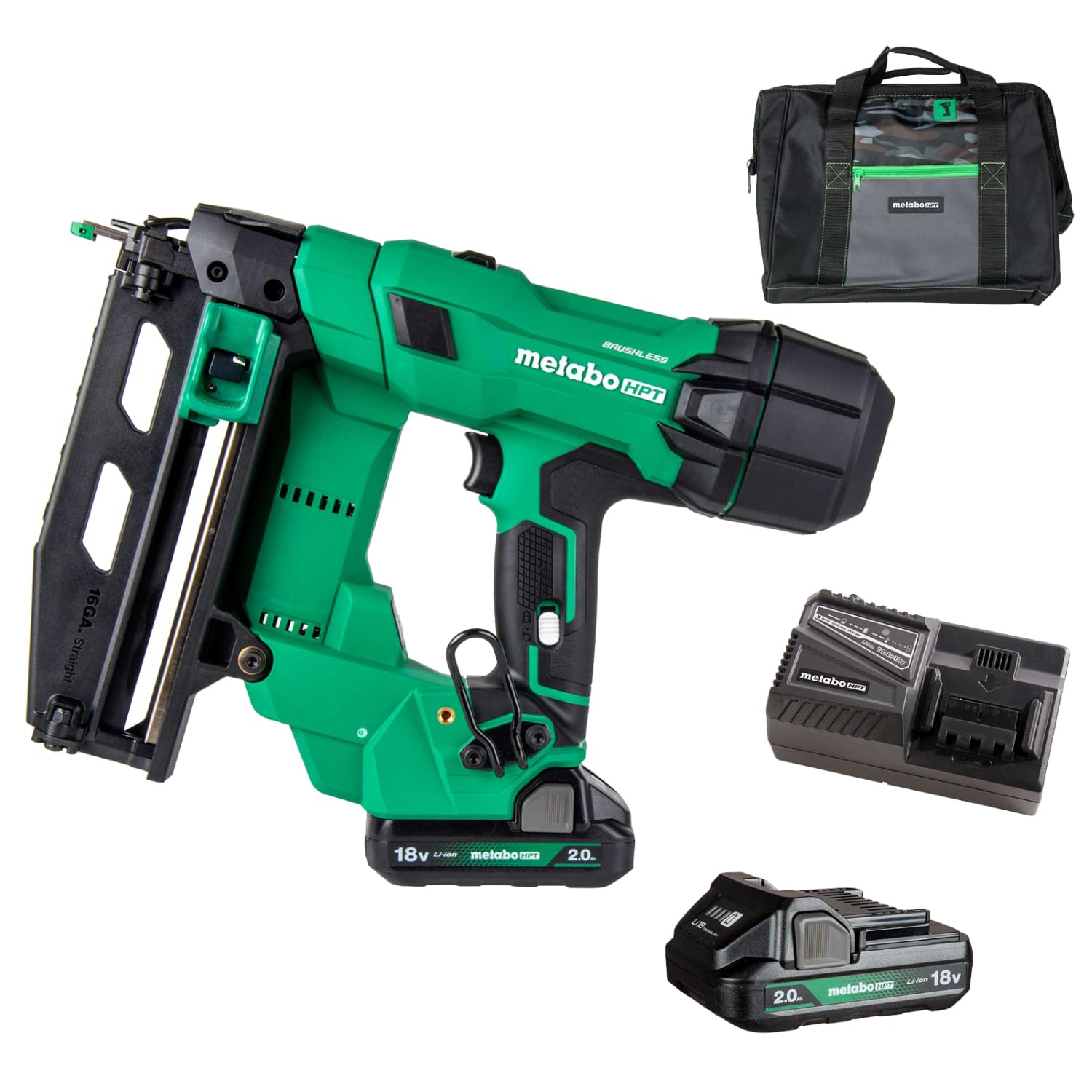
The 5.7-pound angled kit that lets you forget the compressor ever existed.
At 5.7 pounds without the battery, the NT1865DSA is the lightest gun in this whole roundup — noticeably trimmer than the 8.63-pound Milwaukee 2841-20 and easier to maneuver one-handed up a ladder. The 18V MultiVolt platform is a Metabo HPT system: 18-volt batteries drive the tool, and the same packs step up to the brand’s 36V MultiVolt line, so the battery investment carries forward if you expand your kit later.
The Air Spring Drive System is what puts pneumatic-grade feel into a cordless body — it stores compressed air in a chamber and releases it in a burst, which is why owners say it fires like an air tool without the hose. It accepts 1″ to 2-1/2″ 16 gauge finish nails in an angled magazine, drives up to 3 nails per second with no ramp-up wait, and fires up to 800 finish nails per charge off the included 2.0Ah lithium-ion battery with fuel gauge. The brushless motor extends runtime and durability over the life of the tool.
The result is pro-shelf reliability. Buyers describe it as one of the best cordless nailers in its class, with performance that rarely misfires — one veteran contractor verdict sums up the tool’s reputation: “Powerful, professional, lightweight – no windup wait as with others.” Setup is quick: a tool-less depth adjuster, a bump-to-sequential mode switch, and a side lock to prevent accidental firing. The kit arrives with the nailer, battery, charger, bag, and safety glasses, and the tool body carries Metabo HPT’s lifetime warranty with the battery backed separately on a 2-year term.
For context on the tier, Metabo HPT has been rated Pro Preferred for Nailers for 11 years running, a brand-level track record behind this kit. The honest trade-off is that this specific angled kit lists above the straight-nail Metabo elsewhere in this roundup — the straight model costs meaningfully less if angle capability is not essential to you. Finally, this is the brand whose promotional materials describe the tool as having won recognition (a “2025 Pro Tools Innovation Award” per the manufacturer’s own product copy) — that is the maker’s claim, not an independent endorsement.
What makes it standout
- Lightest bare weight in the group at 5.7 pounds
- Air Spring Drive fires up to 3 nails per second with no ramp-up
- 800 finish nails per charge with the included 2.0Ah battery
- Lifetime tool body warranty
- Angled magazine for corner and toe-nail work
What to know before you buy
- Kit configuration carries a higher price than the straight-nail sibling
- Angled 16G nails are less widely stocked than straight
- Lower magazine capacity than pneumatic guns per owner reports
- 2-year battery and 1-year charger warranties are shorter than the tool warranty
Reach for this if: you need the lightest angled 16G cordless nailer you can buy and lifetime warranty coverage matters to you.
Look elsewhere if: you mostly shoot straight nails and want the lower tier of the same brand’s kit lineup.
6. CRAFTSMAN V20 16GA Finish Nailer Kit (CMCN616C1)

The kit that arrives with everything a first-timer needs to shoot crown molding right from the start.
Buy the CMCN616C1 and you get the CMCN616 straight 16GA finish nailer, a V20 20V MAX lithium-ion battery, a matching charger, 100 2″ finish nails, and 100 2-1/2″ finish nails — a complete starter package. The straight magazine loads collated adhesive 16-gauge nails from the bottom, and the tool puts out consistent firing power across a range of climate conditions and materials.
Ease of use is the reason this kit does well for new buyers. Tool-free depth settings set up in seconds, tool-free jam and stall controls clear problems without a wrench, and the contoured over-molded handle reduces fatigue on long runs. A belt hook keeps the gun at hand. What owners keep coming back to is that it just performs — one buyer describes it as “the convenient tool” for indoor trim, and the broader pattern is that the same reliability shows up on greenhouses, green lumber, and craft wood. It handles 2-1/2″ nails easily, and the safety lock, bottom-load magazine, and fast charging are the practical details first-timers appreciate.
Where the kit fits well is the middle of the road. It is the strongest halfway point between light-weight maneuverability and real holding power: nail a crown molding return or a full baseboard run without frustration. One owner’s summary — “This is my second one” — hints at a pattern worth knowing: the piston can wear out after enough volume, and second-generation replacement is a real thing for heavy users. Filling the magazine occasionally takes effort, and the 9.1-pound listed weight is the heaviest in this roundup, so an owner who shoots rarely will not mind while a daily user will notice.
One note that saves a call later: CRAFTSMAN sizes the battery specifically — higher-amperage V20 20V MAX packs (the 4Ah class and up) run longer than the standard pack in the kit, and the drill-capacity numbers on the listing are tool-tree details not relevant to nailer use.
Straight to the win column
- Complete kit — battery, charger, and 200 nails included
- Tool-free depth, jam, and stall controls for fast setup
- Reliably drives 2-1/2″ nails, per owner reports
- Contoured handle and belt hook for long sessions
Where it is honest about limits
- 9.1-pound listed weight makes long sessions tiring
- Weight and battery life split between owners across the reviews
- Magazine loading occasionally takes effort
- Piston wear reported after heavy extended use
Suits: new and occasional V20 platform owners — the kit removes every separate purchase decision from day one.
Skip if: lighter weight on a ladder or a shorter reload cycle outranks a ready-to-run starter package.
7. Milwaukee M18 FUEL 16-Gauge Angled Finish Nailer (2841-20, Tool Only)
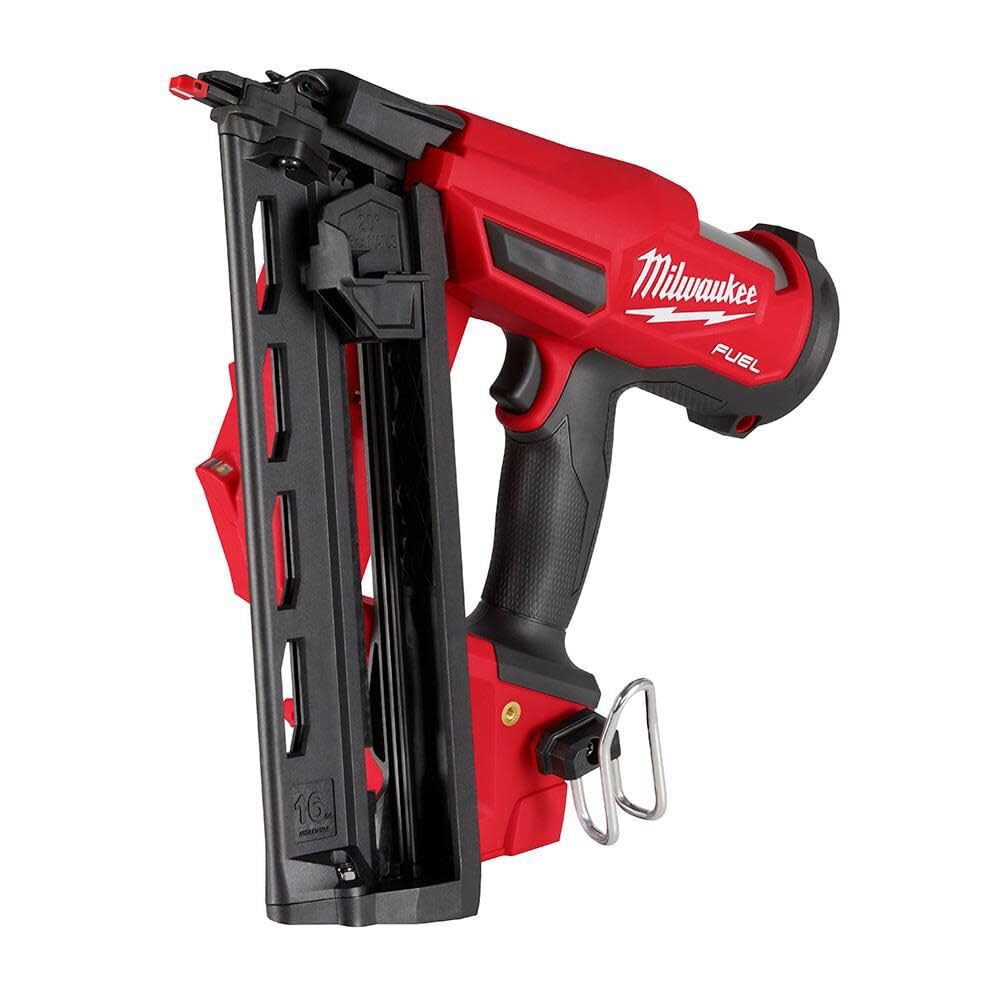
The angled M18 gun that converts pneumatics loyalists — provided you already have batteries and the right nails.
Part of the M18 system, the 2841-20 runs on the M18 FUEL brushless motor platform that many tradespeople already own across drills, impacts, and saws. It fires 16 gauge angled finish nails from a slant-loading magazine, giving you corner access that straight magazines cannot match. Buyers describe its functionality in no uncertain terms — one summary from an owner is simply “Every shot goes right where you want it.”
Loading is where it earns praise: nail removal and reloading are quick, and a jam-clearing feature lets you deal with a stuck fastener without disassembly. Owner reports note that it drives 2″ nails deep into oak with firm pressure, and there is no wood splitting with normal use. Battery runtime is a non-issue for average users — one long-time user reports the indicator never dropped during a full project cycle, and another says it “consistently drives nails flush.” That reliability is the quality that gets mentioned most in owner feedback.
The critical prep step before you buy: this gun needs 16 gauge angled finish nails, and it will not work with straight nails. One buyer learned the hard way — straight nails “shot through the cartridge on first firing.” Angled 16G nails cost more than straight and are stocked in fewer home-center project packs. Also worth knowing: the 8.63-pound listed weight is on the heavy side of the class, and grip gets tired on long ladder runs. Cover the two simple prep steps — angled nails in hand, M18 batteries charged — and this gun behaves.
The M18 argument: brushless M18 FUEL power in an angled trim gun at a price that makes sense if you already own the platform.
First-timer alert: what looks like a nail gun is only half the system — angled 16G nails are non-negotiable, and non-stock in most hardware aisles.
Right for: M18 platform owners who want flush-setting angled performance and already know the difference between straight and angled nails.
Not for: anyone brand new to nailers who has not yet priced the angled nail supply chain.
8. RIDGID HyperDrive 16 Gauge 18V Brushless Straight Finish Nailer (R09892B)

A straight-magazine workhorse for repairs and tacking — heavy in the hand, honest about it in the reviews.
The R09892B runs on the RIDGID 18V battery platform with a HyperDrive brushless motor and a straight 16 gauge magazine. Buyers describe it as a time-saver versus drag-and-set compressor routines, and it is easier to bring up a ladder than a hose-and-tank setup on the ground. Typical jobs: fence repairs, attic vent boards, and any tacking where setting up air feels like more work than the job itself.
The recurring theme in owner feedback is weight and durability in equal measure. At 8.95 pounds it is the heaviest gun in this roundup — noticeably heavier than the 6-pound DEWALT DCN660D1 or the 5.7-pound Metabo NT1865DSA. Buyers call it heavy but say it is still one-hand usable at angles, and they credit the build quality as worth the weight — a common line is that it “is a Man’s tool,” a blunt way of saying it is built beefy. Depth control and safety features earn their own praise, and one long-time owner reports it outperforms the big brands in the same category at a lower price.
Two structural facts any buyer should know before deciding: this listing is a refurbished product that has been tested, cleaned, inspected, and repackaged, and it arrives as a bare tool — no battery, no charger, and no combo kit is offered. RIDGID’s lifetime service agreement is one of the platform’s selling points, and the fine print matters: check the warranty terms for the specific retail channel used at purchase. If that aligns with where you buy tools, it is a solid fire-and-hammer platform pick for repair workloads.
What actually holds up
- Saves setup time vs compressor on ladder and remote jobs
- Brushless HyperDrive motor rated for durable run
- Depth control and safety features get credit from owners
- Straight 16G magazine — the easiest nail type to source
What trips up new buyers
- Refurbished unit, arrives in a generic box
- Bare tool only — battery and charger sold separately
- 8.95 lb — heaviest nailer in this roundup
- Warranty terms are channel-specific; verify before you commit
Best for: RIDGID 18V owners with batteries already in hand who want a straight-magazine repair gun and do not mind a refurbished unit.
Think twice if: you want a new-in-box tool with a bundled battery, or you need the lightest gun in the class for overhead work.
9. Metabo HPT 18V MultiVolt Brushless 16 Gauge Straight Finish Nailer Kit (NT1865DMST)

A straight-nail kit that behaves like an air tool, sips battery, and hands you everything you need to start.
The NT1865DMST ships as a proper kit: 18V MultiVolt finish nailer, 2.0Ah lithium-ion battery with fuel gauge, charger, contractor bag, safety glasses, and a No-Mar nose cap. The straight 16 gauge magazine accepts 1″ to 2-1/2″ nails and fires up to 3 nails per second with no ramp-up wait. The Air Spring Drive System is the reason it feels pneumatic when you pull the trigger.
Runtime is where this specific kit edges the field. Metabo HPT’s marketing copy rates it at 950 finish nails per charge off the included 2.0Ah Compact battery, which is the highest quoted per-charge count among the tools listed here. The tool-less depth adjuster sets precise countersinking without tools, selective actuation toggles between bump and contact drive, and a side lock prevents accidental firing. The brushless motor adds runtime, cuts maintenance, and extends durability compared to a brushed design.
No-Mar nose cap, low-nail indicator, and front light are the details that make jobsite use easy. The tool body carries a lifetime warranty, the battery 2 years, and the charger 1 year. If you already own 18V MultiVolt packs, you get the same performance your other tools deliver.
The weight is the honest cost of the class: this gun feels heavier than it looks on the listing, and one five-foot, 115-pound reviewer confirms it still works fine with a firm two-handed grip. Otherwise, this is among the most complete and reliable kits in the roundup, and the straight-magazine configuration means you are working with the most widely-stocked 16G finish nails in North America.
The kit advantage: battery, charger, bag, glasses, and nose cap in one box — no follow-up purchases before your first nail.
The honest trade: air-spring performance and light trigger feel come bundled with more physical weight than a first-time buyer might expect.
Perfect for: MultiVolt owners, or anyone ready to commit to the Metabo HPT platform and get a lifetime tool warranty plus a complete starter kit.
Wrong pick if: lighter weight matters more to you than runtime — the Metabo HPT angled version in this roundup is lighter.
10. DEWALT 20V MAX* XR Straight Finish Nailer (DCN662B, Bare Tool)
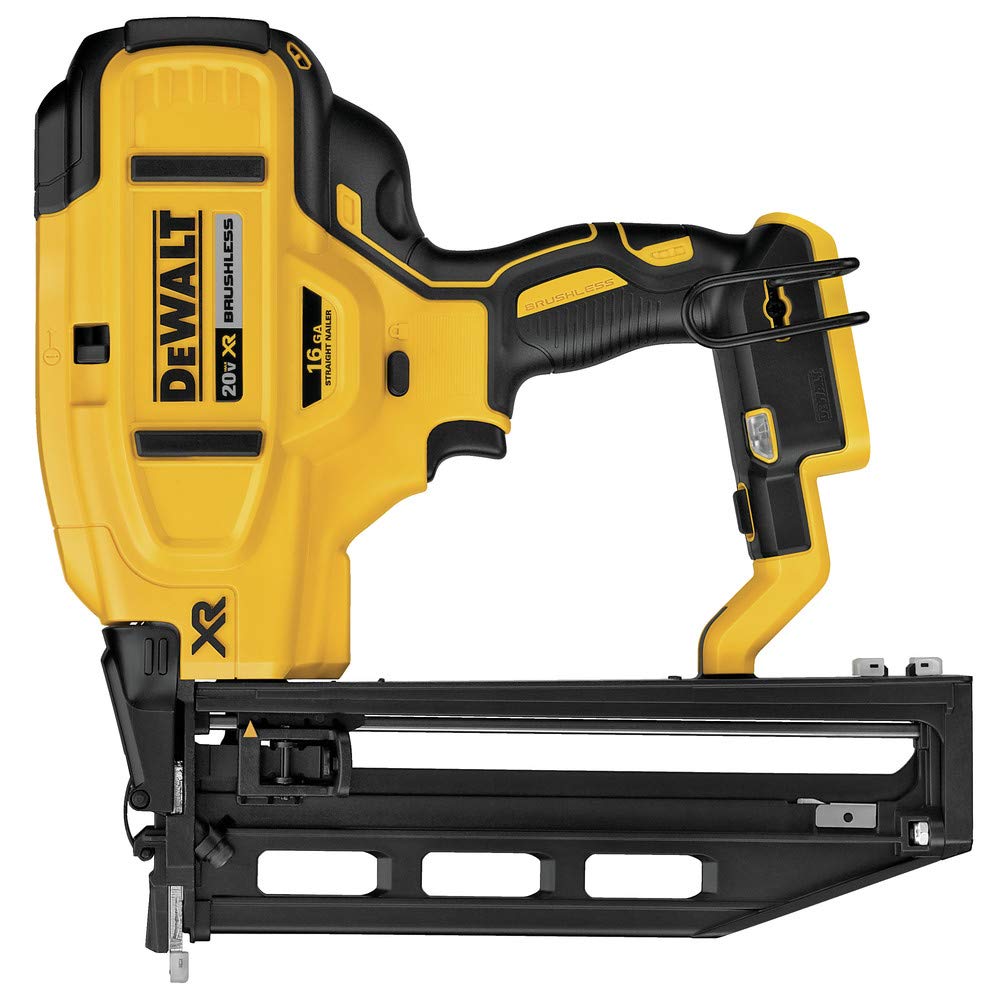
A precision straight-magazine nailer that trades corner access for line-of-sight accuracy — and wins on that trade.
The DCN662B takes the straight-magazine approach and engineers around it. The micro nose improves line of sight and accuracy of nail placement compared to DEWALT’s earlier DC616, which is a real difference when you are placing a 16-gauge pin along a visible casing line and every millimetre shows. That accuracy change was engineered specifically for the revision, not a marketing retrofit.
Under the hood, the same DEWALT DNA as the angled kit: 100% battery powered, no gas or compressor or hose, a brushless motor for runtime and durability, tool-free selectable trigger for sequential or contact modes, and tool-free depth adjustment for countersinking. It runs on any DEWALT 20V MAX battery — meaning if you already own DEWALT 20V power tools, you already own the fuel source. On the scale, it weighs 6 pounds — matched with the angled version and lighter than the RIDGID at 8.95 pounds or the Milwaukee 2841-20 at 8.63 pounds.
The owner verdict arrives in the form of tool loyalty — long-time carpenters describe it as their favorite new tool, note that running it without a cord is a relief, and one calls out the “excellent nose” and good light in the same breath, plus a toe-nailing capability they rely on. That is a real-world answer to the micro nose spec: workers can place nails accurately even when the nose is angled toward them.
The honest caveats are worth flagging. The 16-gauge angled nail family is not as widely stocked as the 18GA brad family it replaces for some buyers, so plan your nail supply before you commit to the caliber. The bare tool leaves you reliant on the 20V MAX battery line — fine if you are already in it, a further investment if you are not.
Why owners rate it
- Micro nose improves placement accuracy versus the earlier DC616
- Runs on any DEWALT 20V MAX battery you already own
- Weighs 6 lb — same as the angle version, lighter than most rivals
- Tool-free depth and trigger-mode selection for fast switching
- Brushless motor for runtime and long motor life
Where it asks for tradeoffs
- Bare tool — no battery or charger in the box
- Straight magazine — not the gun for inside corners
- 16G nails less common in stores than 18GA brads
- Battery-life feedback splits between owners
Pick it for: precise straight-run trim work where you place nails by sight and already run DEWALT 20V MAX batteries.
Pass if: your next job is all inside corners — that is where the angled magazine in this roundup does what a straight gun cannot.
<
11. Milwaukee M18 FUEL 18V Gen II 16-Gauge Straight Finish Nailer (3020-20, Tool Only)
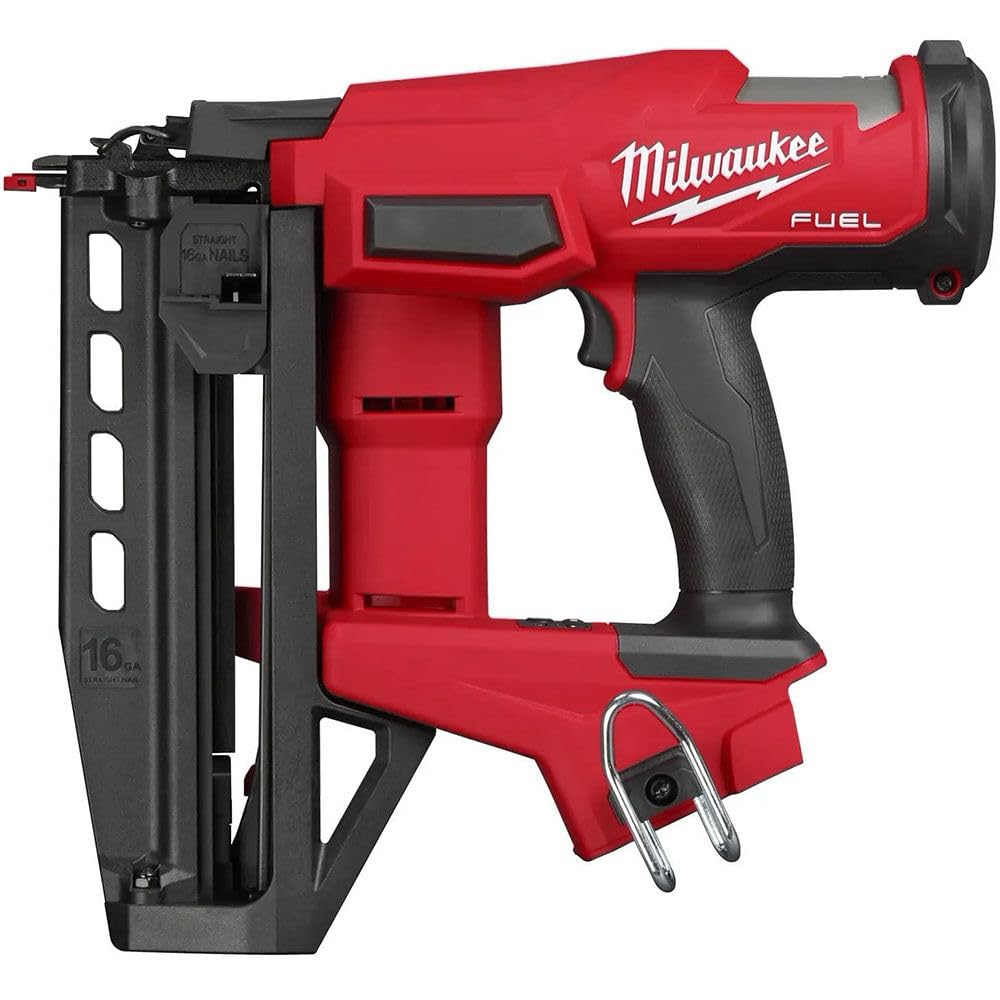
The high-volume M18 workhorse that fires 700 nails on a charge and holds 110 in its magazine at once.
If you run trim jobs by the box of nails, the numbers here matter: this Gen II 3020-20 fires 3 nails per second and drives up to 700 nails per charge on an M18 CP2.0 battery. The 110-nail magazine capacity is the largest in this roundup — you spend less time crouched on the floor reloading and more time working. It accepts all 1″ to 2-1/2″ 16GA straight finish nails, so sourcing fasteners is easier than with an angled gun.
The internals are the M18 FUEL recipe: a POWERSTATE brushless motor for longer life and higher output, plus REDLINK PLUS intelligence that communicates between tool, battery, and charger to protect against overload. It runs on the M18 system, which the manufacturer counts at over 200 tools, so M18 owners share one battery family across the truck. Straight-magazine design keeps it a natural fit for baseboards, casings, and long runs where angle access is not the constraint.
Trim work also gets easier with the small conveniences: tool-free depth adjustment, a tool-free jam-clearing latch, sequential and contact actuation modes, an LED work light, a reversible belt hook, and tip storage on the magazine. The gun fires with no gas cartridge and has enough punch for both hardwoods and softwoods. Like the angled 2841-20 above, this one is a bare tool — buy it only if you already own M18 batteries and a charger.
The honest cost of the straight-magazine trade is weight. At 8.1 pounds this sits toward the heavy end of the class — noticeably heavier than the 6-pound DEWALT DCN662B and the 5.7-pound Metabo NT1865DSA. Owners who use it for building bee equipment and general trim describe it as smooth, reliable, and easy to load, with straightforward adjustments. A small share of customers note receiving units without original packaging from third-party sellers — worth knowing, though it does not describe the tool’s operation.
What justifies the tier: 700 nails per charge and a 110-nail magazine mean high-volume jobs stop asking you to reload or recharge as often.
The weight trade: 8.1 pounds is real on a ladder, but the balance keeps it one-hand usable at trim-pace angles.
Right tool if: you already own M18 batteries and want maximum runtime and magazine capacity for straight-nail trim work.
Look further if: a lighter bare-gun weight or angled corner access matters more to your daily jobs than sheer shots per charge.
Understanding the Specs
Gauge and Nail Length
Gauge is the thickness of the nail wire, and it works in reverse — a 16 gauge nail is thicker and stronger than an 18 gauge brad, but thinner than a 15 gauge nail. That middle position is why 16 gauge gets so much use on trim: strong enough to hold casing and baseboard, slim enough that the head hole nearly vanishes under a dab of filler. Nail length tells you what stock the gun can handle — the tools here accept 1″ to 2-1/2″ nails, which covers door casing, baseboards, crown, and most trim details. Check the length range before buying; a gun that tops out short will not sink a 2-1/2″ nail into stacked trim.
Battery and Runtime
Runtime is quoted as nails per charge or hours of use, and the numbers vary widely across this category. A 2.0Ah pack fires hundreds of nails on a full charge depending on the tool’s drive system; higher-amperage packs push those numbers further. Cold shrinks performance — lithium-ion cells lose voltage in freezing temperatures, so a gun that reliably drives nails in a heated shop can stall in an unheated one until the pack warms up. If you work cold, keep a spare battery warmed indoors and swap as needed.
Actuation Modes Explained
Every gun here can run in one of two firing modes: sequential (one trigger squeeze, one nail) or contact (hold the trigger, tap the nose, and nails fire as you tap). Sequential is the safer mode for finished trim where you want each nail placed deliberately; contact mode is faster for sheathing and long structural runs. Most of these tools switch modes without tools, and several include a side lock to prevent accidental firing while you carry the gun. Learn the switch location before your first firing so you are not fumbling for it mid-job.
Weight And Carrying Considerations
Bare-gun weight is a bigger deal than it looks: a lighter tool tires your forearm slower and climbs ladders more comfortably, while a heavier one can swing more punch and — crucially — may absorb recoil better on hard stock. In this roundup the bare weights range from 5.7 pounds at the lightest to 8.95 pounds at the heaviest — roughly a three-pound spread depending on the model. If you work overhead or one-handed a lot, that difference compounds over a shift. If your work is shop-floor and one-handed at hip level, the heavier tools rarely cause complaint.
Bare Tool Versus Kit Math
A bare tool makes sense only if you already own the matching battery and charger. The math flips the moment you price a fresh battery and charger separately: the kit version usually costs less than the bare tool plus a brand-new battery, charger, and one starter strip of nails. When comparing bare-tool prices with a kit elsewhere, add the cost of a second battery and a charger before you call the bare tool cheaper. This is the single most common buying mistake in the category — people buy the bare tool and then discover their old packs do not fit.
Angled Versus Straight Magazines Revisited
The magazine angle is the geometry that decides whether the gun fits a corner. A straight magazine runs parallel to the nose, keeping the whole assembly compact for long baseboard and casing runs. An angled magazine tilts the nails back so the nose can reach inside corners where a straight gun physically cannot. There is no universally better choice — it depends entirely on where you nail. If your jobs are mostly inside work (door casings, cabinets, crown returns), lean angled. If your jobs are long straight runs, lean straight. If it is a coin toss, buy the one whose nail family is better stocked near you.
FAQ
What is the difference between 16 gauge and 18 gauge in a cordless finish nailer?
Can I use straight nails in an angled finish nailer?
Why does my cordless finish nailer stop working in cold weather?
How many nails can a cordless 16 gauge nailer fire per charge?
Do I need a compressor with a cordless finish nailer?
What nail lengths do 16 gauge cordless finish nailers accept?
Are cordless finish nailers as powerful as pneumatic ones?
Which battery platform should I choose for a cordless 16 gauge nailer?
Should I buy a cordless nailer as a bare tool or as a kit?
Do these cordless finish nailers jam easily?
Final Thoughts: The Verdict
For most buyers chasing the 16 gauge cordless nail gun that just works, the winner is the DEWALT 20V MAX* XR Angled Finish Nailer (DCN660D1). It pairs brushless reliability with an angled magazine that reaches corners, and it arrives as a complete kit so you are firing nails the day it lands — with the platform’s battery ecosystem already behind it.
If angled corner access is not a priority and you want the lightest pro-grade option, the Metabo HPT NT1865DSA at 5.7 pounds without the battery is the body that feels easiest on the ladder, backed by a lifetime tool warranty. And if you are buying your first cordless nailer on a V20 platform, the CRAFTSMAN CMCN616C1 Kit hands you the tool, battery, charger, and 200 nails in one box — the shortest path from unboxing to finished trim.
The simplest honest nudge: DEWALT’s 20V MAX ecosystem and the DCN660D1’s 4.7-star record tell you this is a gun buyers keep coming back to, and the same pattern holds across the Metabo HPT and Milwaukee picks here. Match the gun to the batteries you already own and the nail angle your jobs demand, and any of these will end the compressor era at your shop.
How We Picked
We do not accept paid placement. Every pick is matched to a real buyer and a real use-case; we do not hands-on test units.
Sources & Methodology
Specifications: manufacturer listings and product documentation. Review insights: verified customer reviews, as of September 2026. Pricing: not shown on this page (it changes often); check the current price via the retailer link.
As an Amazon Associate, KitchPrep earns from qualifying purchases. This does not affect which products we feature.
Related Guides
