
Specs are compiled from manufacturer listings and verified buyer reviews and can change over time — please confirm the key details on the product page before buying.
Buying a 1 1/2 HP electric motor is a fitment job before it is a power job. The horsepower is already decided — what actually trips people up is the frame number, the flange shape, the shaft, and whether your wiring runs on 115V or 230V. Get the frame number, flange shape, shaft, and voltage right and the swap takes an afternoon. Get one wrong and you are boxing up a motor that never should have been ordered. Below you will find eleven real 1.5 HP motors sorted by what they are genuinely best at: pool pump replacements, table saw and bandsaw upgrades, and general-purpose workhorses.
I’m Mohammad Maruf — the founder and writer behind KitchPrep. This guide is built by comparing the manufacturers’ published specifications and the patterns across verified customer reviews, so you get each pick’s real strengths and trade-offs instead of marketing spin.
This breakdown of the best 1 1/2 HP electric motor options starts with fitment, because a wrong frame code is what sends motors back.
Our Picks at a Glance


How To Choose The Best 1 1/2 HP Electric Motor
You check the horsepower first, and that number is rarely the problem. The trouble is everything around it. A 1.5 HP motor that spins at 3450 RPM (revolutions per minute — how fast the shaft turns) will not do the job of one that spins at 1725 RPM, so a motor built for a pump running at half speed will burn out or underperform. And a 56J round flange (a round mounting face with a threaded shaft) will not seat against a square-flange pump housing no matter how hard you push it.
Match the frame code first, the horsepower second
The frame number — 56, 56J, 56Y, or 56H — describes the physical mounting footprint and the flange shape. Read the code straight off the old motor’s nameplate and compare it to the listing. On pool pumps, 56Y and 56J are both common and they are not interchangeable: 56Y is the square-flange bolt pattern, 56J is the round C-face. A square plate with four corner bolts simply will not mount to a round C-face pump end.
Work out your voltage before you order
Most 1.5 HP motors here run on dual voltage — 115V or 230V, switchable at the terminal box. The nameplate lists two amp draws, and the lower number always belongs to the higher voltage. A motor rated 15.0/7.5A pulls 15.0 amps at 115V and 7.5 amps at 230V. If your shop circuit is 15 amps at 115V, a motor drawing 15.0 amps leaves you nothing to spare, so 230V is usually the calmer path on a motor this size.
Speed decides the application
Nearly every motor in this group spins at 3450 RPM, which is the standard speed for pool pump wet ends, table saws, and air compressor duty. The exception is the one farm-duty motor turning at 1725 RPM — half the speed, aimed at gear that needs turning force rather than blade speed. Buying a 3450 RPM motor for a slow-turning application, or the reverse, is a mistake the nameplate cannot fix later.
Quick Comparison
| Model | Best For | Frame | Speed | Voltage | Amazon |
|---|---|---|---|---|---|
| VEVOR 1.5HP 3450 RPM 56 Frame★ Best Overall | Table saws and general equipment | 56 | 3450 RPM | 115/230V | Amazon |
| VEVOR 1.5 HP Pool Pump Motor 56YQuietest Swap | Quiet square-flange pool pump swap | 56Y | 3450 RPM | 115/230V | Amazon |
| Grizzly Industrial G2535Heavy-Duty Pick | Heavy shop equipment upgrades | NEMA 56 | 3450 RPM | 110V/220V | Amazon |
| Cuilvu TEFC 56 Frame | Dusty or damp shops | 56 | 3450 RPM | 115/230V | Amazon |
| Century UST1152 | Proven Hayward pump replacement | 56J | Rated 3450 RPM class | 115/230V class | Amazon |
| Aquastrong 56Y Square Flange | Pentair and Sta-Rite owners | 56Y | 3450 RPM | 115/230V | Amazon |
| Zynovate UST1152 | Super Pump repairs on a budget | 56J | 3450 RPM | 115/230V | Amazon |
| US Motors AST165 | Direct Hayward Super Pump fit | 56J | 3450 RPM | 115/230V | Amazon |
| Century HST150 | 56J round-flange pump ends | 56J | 3450 RPM | 115/230V | Amazon |
| ATVMaster UST1152 | Budget replacement on known models | 56J | 3450 RPM | 115/230V | Amazon |
| Leeson Farm Duty Motor | Bandsaws and slow-turning gear | 56H | 1,725 RPM | 115/208-230V | Amazon |
In‑Depth Reviews
1. VEVOR 1.5HP Electric Motor 3450 RPM, AC 115V/230V, 56 Frame, Air Compressor Motor Single Phase, 5/8″ Keyed Shaft, CW/CCW Rotation for Agricultural Machinery and General Equipment
Our pick — over 4★ from 100+ verified ratings; the strongest balance of quality and price.
A general-purpose 56-frame motor that revives dead table saws instead of replacing them.
If you are staring at a burned-out motor on a bench tool and would rather swap the motor than buy a whole new machine, this is the pick to start with. It’s a 1.5 HP single-phase motor running at 3450 RPM (revolutions per minute — how fast the shaft turns), on 115V or 230V at 60Hz. The nameplate draws 15.0 amps at 115V and 7.5 amps at 230V, with a service factor of 1.15 — that’s a built-in overload margin meaning the motor can carry a little extra load for short bursts without damage. The 56 frame and 5/8″ keyed shaft are the common bench-tool footprint, and the shaft runs 1.88″ long with a 0.188″ keyway to seat your pulley.
What earns this motor its spot is the sheer number of buyers using it as a resurrection part. It replaced a 50-year-old motor on a Craftsman table saw, and the same story repeats across reviews: a machine that had been dead for years comes back to life for the cost of a motor. Reversing rotation is handled at the terminal box, so wiring can run clockwise or counterclockwise depending on how your machine is set up. And the heavy-duty rolled steel shell is tested to CSA standards (a certification body that verifies the motor’s safety testing), so you are not gambling on an uncertified import.
The honest trade-off is the paperwork inside the box. Buyers report the wiring instructions mixed — usable if you have some electrical background, frustrating if you don’t, and the 120V/230V and rotation chart is the specific stumbling block. The knockouts also draw a recurring gripe: several buyers gave up on punching them out and drilled or milled the hole instead. A few note the motor body is larger than the 3/4 HP unit it replaced, which meant pulling the fan housing to get it seated. None of that is a dealbreaker — it just means a half hour of patience with a drill and a wire diagram.
Where It Wins
- Reversible CW/CCW rotation lets you match your machine’s direction on the bench
- Runs on either 115V or 230V, so it works with a standard shop outlet or a dedicated circuit
- Service factor of 1.15 gives real overload headroom on startup and heavy cuts
- Heavy-duty rolled steel shell, tested to CSA standards
- Manual reset overload protection keeps the motor recoverable instead of disposable
What To Know Before Buying
- Wiring instructions and the voltage/rotation chart read as outdated and confusing
- Knockout holes are stiff — plan on a hole saw or drill instead of a punch-out
- Physically larger than some 3/4 HP motors it replaces, so clearance can be tight
- No cable clamp included in the box
Best for: Anyone reviving a table saw, compressor, or piece of farm equipment who has basic wiring chops and a drill handy.
Think twice if: You need plug-and-play instructions and a compact housing — the fit and the manual both demand some mechanical finesse.
2. VEVOR 1.5 HP Pool Pump Motor, 56Y Frame, 115V((12.8 Amps))/230V(6.4 Amps) 3450 RPM, 60Hz, 1.1 Service Factor, 90μF/250V Capacitor, CCW Rotation Square Flange Replacement Motor
A pool motor that runs at 70 decibels — quiet enough to forget it is on the pad.
Pool pump motors sit outside and run for hours at a time, so a quiet, cool-running motor matters as much as horsepower. This VEVOR is a 56Y square-flange replacement (a square mounting face that bolts to the pump housing) that pulls 12.8 amps at 115V or 6.4 amps at 230V, so you can wire it to either household voltage. It has a 1.1 service factor (a measure of how much extra load the motor can handle beyond its rated horsepower) and a 90μF/250V capacitor (a start capacitor — the component that gives the motor its kick on startup). It spins at 3450 RPM, and the maker rates it at 70 decibels — about the volume of a dishwasher running a room away, so you can hold a conversation next to the pump. The steel housing resists corrosion, and the shaft extends 0.9 inches.
Owners mention the quiet-running claim holds up in practice. People who replaced a tired OEM pump (the original equipment manufacturer’s motor that came with the pool) consistently describe this one as noticeably softer at the pad than the motor it replaced. A pool pro installing these as direct square-flange replacements compares the build quality and power to Century motors — high praise in a category where Century sets the standard. It matched up perfectly as a replacement for a Century-branded motor, though the same buyer noted it runs about 3 inches longer and several pounds heavier than the motor it replaced, so measure your pump pad clearance before ordering.
This motor weighs 31.7 pounds. Compare that to the UST1152-style 56J motor further down at 26.8 pounds, and you are adding roughly 5 pounds of cast iron and copper to the pad. That extra weight buys you the thicker housing and the quieter ride, but it also means the flanges carry more load. One buyer’s unit failed almost immediately, which in a pool of successful installs reads as an occasional miss rather than a pattern — but it is worth powering the motor up and confirming CCW rotation (counter-clockwise — the direction the shaft should spin) before you finish mounting it.
Why it earns the slot: The 70db rating and corrosion-resistant steel housing make this the sensible pick when your pump sits near a patio or bedroom window.
The reality check: CCW rotation is fixed, and the larger body can crowd a tight pump pad — verify clearance and direction before you commit.
Reach for this if… You are replacing a square-flange 56Y pool motor and want the noise level to drop while the circulation stays the same.
Look elsewhere if… Your pump end takes a round C-face motor — this square flange will not seat.
3. Grizzly Industrial G2535 – Heavy-Duty Motor 1-1/2 HP Single-Phase 3450 RPM TEFC 110V/220V
The motor that turned a bogged-down walnut cutter into a saw that eats 2x like butter.
This is the pick for anyone running a table saw that stalls the moment a real board hits the blade. It’s a 1.5 HP single-phase motor at 3450 RPM with a TEFC enclosure — totally enclosed fan cooled, meaning the housing seals the windings off from dust and chips while a fan moves air over the outside. That sealing is exactly what you want on a saw that throws fine sawdust all day. It runs on 110V or 220V and weighs 40.8 pounds, making it the heaviest motor in this lineup — a sign of the iron and copper inside.
Performance is where the praise piles up, and it centers on torque. Buyers describe a 1977 Craftsman getting a Grizzly transplant specifically to stop scorching oak and maple, and one says it cut right through rock maple afterward. Another swapped out a 1.5 HP Dayton and reports the Grizzly starts softer and feels stronger. A third took it to 220V with a twist-lock plug and a 12-gauge cord and says the saw now cuts 2x material like butter. It beats the factory motor it replaces on power, which is why it is the pick for a contractor saw that bogs down in thick stock.
The catch is mounting. The NEMA 56 plate is common, but buyers with older Craftsman and Ridgid saws report needing to drill fresh holes in the cast-iron mount because the existing holes aligned lengthwise rather than widthwise. One describes a two-hour fitting job. Others note it is larger than the original and can need cabinetry adjusted for blade tilt. Wiring instructions are on the vague side and benefit from some electrical background. Budget for a fitting afternoon and you will be rewarded with the smoothest, strongest motor in this group.
The standout spec: A 40.8-pound TEFC-enclosed motor that brings real torque to old table saws — the difference between stalling and slicing.
Plan for it: Drilling new mounting holes is common on older saws, and the instructions assume some electrical comfort.
Best for: Rehabbing a contractor table saw that needs genuine cutting power, with a drill and basic wiring skills on hand.
skip it if: You need a drop-in swap with zero fabrication — the hole pattern may not line up.
4. 1.5HP Electric Motor Single Phase 115/230V 3450RPM CW/CCW TEFC 60HZ

A sealed 56-frame motor built to survive dust, damp, and year-round shop abuse.
Two specs define this motor: the TEFC enclosure and an IP55 rating. IP55 is a water- and dust-ingress rating — the “5” for dust means it is protected against dust ingress, and the “5” for water means it shrugs off spray from any direction. Put those together and you have a motor that belongs in a workshop that gets humid, gritty, or both. It runs 1.5 HP at 3450 RPM on 115V or 230V, drawing 14.2 amps at 115V or 7.1 amps at 230V, with a 56 frame and the familiar 5/8″ keyed shaft and 1.88″ shaft length. Insulation class is F and it reverses CW/CCW.
The cooling fan is the quiet hero here. A large fan at one end keeps the motor cool through hours of running even in dusty or damp environments, which is exactly the condition that kills cheap open motors early. Buyers keep coming back to the same theme: this replaces old Craftsman and Ridgid table saw motors and just works. The wiring diagram sits right on the label and covers 110/240V and rotation, with the color code spelled out — blue for neutral, brown for hot. A buyer who converted to CCW says the saw ended up smoother, quieter, and more powerful once the belt was aligned.
The friction lives in the fine print. The wiring diagram works, but the terminal labels can be small, and one buyer with a 20-year-old Ridgid had to modify the junction box to get the new motor seated. There is also a report of a unit that failed to start after a 115V attempt — the majority of these run fine, so treat that as the rare miss rather than the rule. If you plan for a possible junction-box tweak and double-check your rotation before powering up, this is among the most durable general-purpose motors in the group.
Strengths Worth Paying For
- IP55 rating plus TEFC sealing holds up in dust and spray
- Big cooling fan keeps running temperature down in long sessions
- Reversible CW/CCW with a wiring diagram printed on the label
- Class F insulation and 56 frame fit many table saw brackets
Things To Sort First
- Terminal labels are small and can be hard to read
- Junction box may need modifying on some saw models
- An occasional unit has arrived not functioning on 115V wiring
Who should grab it: Shop owners who want a sealed, cooling-fan-equipped motor at 3450 RPM for dusty or damp conditions.
Who should pass: Anyone with no tolerance for even a small junction-box modification on install day.
5. Century Electric UST1152 1 1/2-Horsepower Up-Rated Round Flange Replacement Motor (Formerly A.O. Smith)
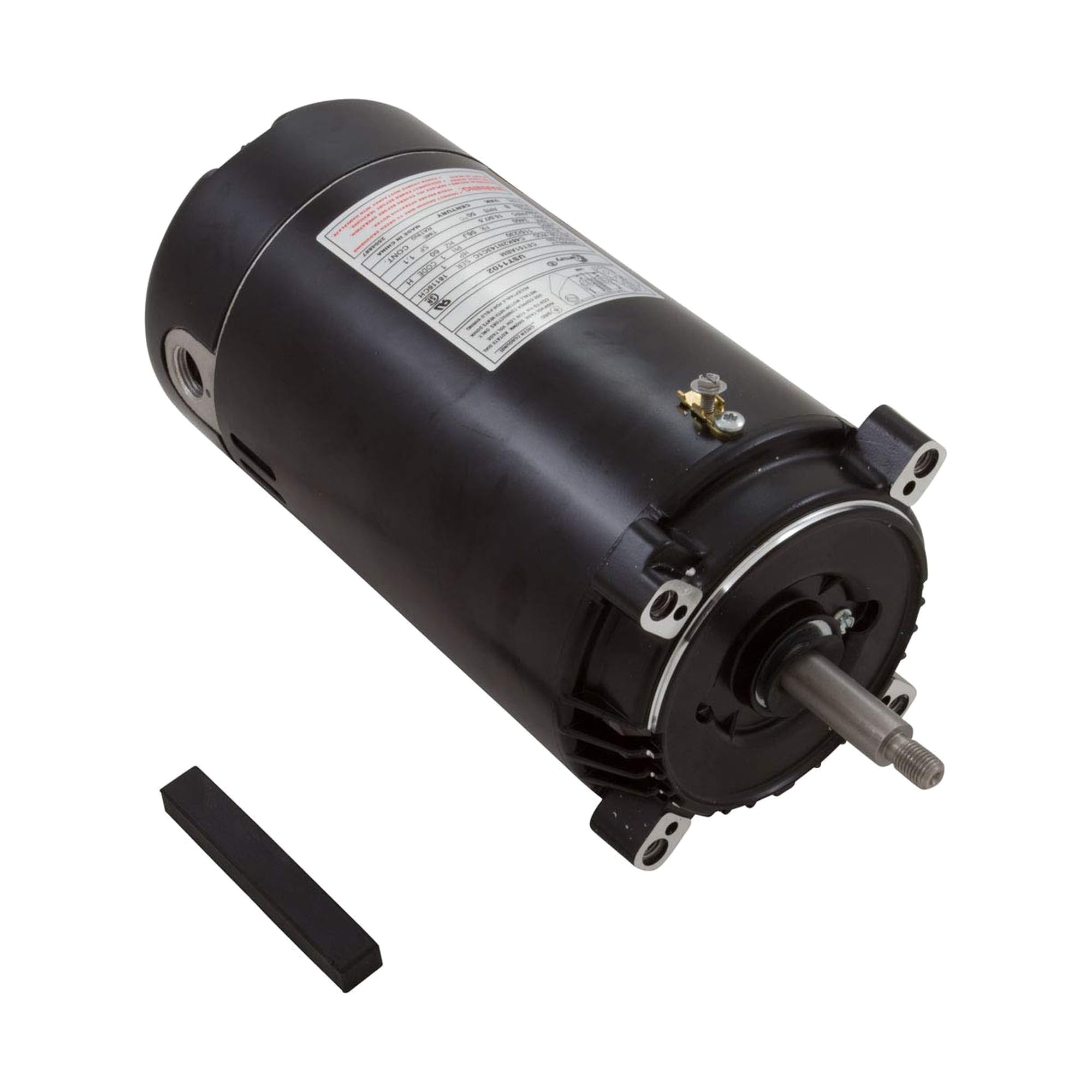
The name pool pros trust most — a round-flange workhorse with the deepest track record here.
If you have ever searched for a pool pump motor, you have already met the UST1152. This is the Century (formerly A.O. Smith) version, the 1.5 HP round-flange replacement that contractors reach for by default. It’s a 56J round C-face motor running at the rated 3450 RPM class on 115/230V, drawing 18.6 amps, with copper windings and a corrosion-resistant outer shell. It weighs 24.5 pounds — noticeably lighter than several of the square-flange options here. Reliability is the headline: this is the most-reviewed pool motor in the roundup, and buyers keep coming back to buy a second one years later.
What wins people over is how undramatic the swap is. The gaskets fit, the wiring access is easy, and customers note getting a pump back online in under an hour. One buyer’s motor served 7.5 years before it was finally replaced. It fits perfectly as a replacement for an old A.O. Smith motor and runs quiet. One buyer swapped the gaskets, and this motor brought a dead pump back for a fraction of a new pump’s cost. When a round-flange motor is what your pump end takes, this is the safest money you can spend in the category.
The two things to watch are bolt holes and gasket quality. Buyers on a small number of units report arriving with unthreaded holes despite listings showing threaded ones, forcing a self-tap with a 3/8×16 tap — open the box on arrival and check. The bundled gaskets also draw mixed notes, with some replacing them from a pool store. And like every motor here, replacing the pump seal at the same time is the move that prevents leaks from toasting your new motor. Replace the pump seal when you install it, and this motor should outlast the pump it sits on.
The reason it wins: Copper windings, a corrosion-resistant shell, and the most established reliability record of any motor here — it is the default for a reason.
Open the box first: A few units ship with unthreaded bolt holes, so verify before install and replace the pump seal while you are in there.
Best for: Round-flange pump owners who want the proven, low-drama motor and will replace the seal kit at the same time.
Not for: Square-flange housings — this round C-face will not mount to a four-bolt square pump end.
6. Aquastrong Pool Pump Motor, 56Y Frame, 1.5 HP, Single Speed, 115/230V Dual Voltage, 3450 RPM, Square Flange Pool Motor for Swimming Pool Pumps

The square-flange motor aimed squarely at Pentair and Sta-Rite pump owners.
This one is for the pool owner whose old motor carries a Pentair or Sta-Rite badge. It’s a 56Y square-flange motor at 1.5 HP, running 115/230V single-speed at 3450 RPM, with 1.65 THP and a 1.1 service factor. THP — total horsepower — is the brake horsepower a motor produces when its service factor is folded in, and 1.65 THP is the number to match against your old nameplate, not just the 1.5 HP label. The angled terminal box is a thoughtful touch: wiring, inspection, and maintenance are easier to reach than on many stock motors.
The compatibility list is what earns this motor its own pick, because it names real pump families: Pentair Challenger, Pinnacle, and WhisperFlo, plus Sta-Rite Max-E-Glas, Max-E-Glas II, Max-E-Pro, Dura-Glas, Dura-Glas II, Dyna-Glas, and Dyna-Max. When your wet end is one of those, you know in advance the flange and shaft will line up. Buyers confirm it — a standard 56Y frame that bolted in without modification, output matching the original motor fresh, and a back cover that actually gives better wiring access than the Pentair stock part it replaces.
The honest caveat is plumbing balance. One buyer swapped a 1 HP motor onto an older pool with 1.5″ plumbing and got cavitation at the impeller — the pump wanted to move more water than the pipe could feed. The listing also does not spell out flow specs, so match your existing motor’s THP and your pipe size before ordering. Get that right and the result is a quieter motor moving noticeably more water.
Why Pentair Owners Choose It
- Names the exact Pentair and Sta-Rite pump families it fits
- 1.65 THP and 1.1 SF for matching against OEM nameplates
- Angled terminal box makes wiring access easier than stock
- 2-year after-sales support
Match Before You Buy
- Listing omits flow specs, so verify your plumbing can feed 1.5 HP
- Undersized plumbing can cavitate the impeller
- Square flange only — not for round C-face pumps
Made for: Owners of listed Pentair or Sta-Rite pumps who want a documented fit and easier wiring access.
Buy carefully if: Your pool runs narrow plumbing — confirm your pipe size supports the flow before installing.
7. Zynovate UST1152 1.5HP Swimming Pool Pump Motor Replaces Century/AO Smith Pump Motor
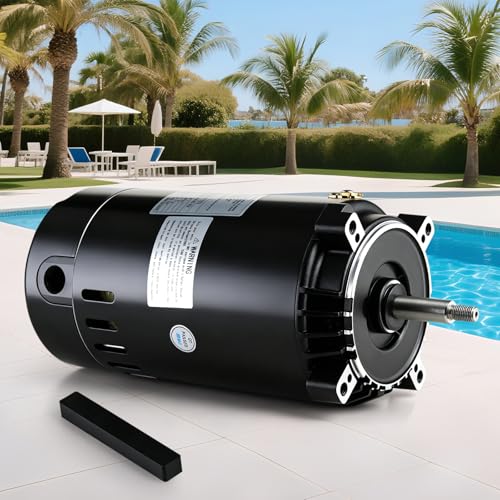
A budget round-flange replacement with copper windings and a stainless shaft.
For a pool owner who wants the UST1152 fit without paying the top dollar, this Zynovate is the value-first option. It’s a 56J round C-face motor running 1-1/2 HP at 115/230V with switchable dual voltage, 9.3 amps at 230V or 18.6 amps at 115V, 3450 RPM, a 1.0 service factor, and Class B insulation. Internally it packs high-purity copper windings and a 304 stainless steel threaded shaft, and the casing carries an IP55 waterproof grade so it stands up to outdoor weather. It runs single-phase at 60Hz with a continuous-duty rating.
Across the reviews, this motor does what a drop-in replacement should. It bolts onto a Hayward Super Pump with no modification, holds prime, and returns flow and pressure comparable to the original. Buyers running 230V praise the smooth start and consistent 3450 RPM, and several note it runs quieter with less vibration than the motor it replaced. The dual-voltage jumper setup is called out repeatedly as something to verify before powering up — wire it at the wrong voltage and it will not end well.
The one honest limitation is the same on every single-speed pump motor: it is single-speed, so there is no variable-speed energy saving here. If you wanted the quiet, low-cost operation of a VS pump, this is not that — it is a straight replacement for a single-speed wet end. A small number of reviewers point out over-temp cutouts that shut the motor down sooner than expected, which is worth watching on a unit with a tighter thermal margin. On a healthy pump with correct voltage, though, it delivers OEM-grade fit at an entry-level point.
The buy signal: 304 stainless threaded shaft, copper windings, and IP55 casing at the value end of the round-flange field.
The limit to know: Single-speed only — no variable-speed savings — and verify the voltage jumper before first power-up.
Grab it if: You need a low-cost 56J round-flange replacement for a Hayward-style wet end and want stainless-shaft durability.
Look past it if: You are chasing variable-speed efficiency — this is a straightforward single-speed motor.
8. 1 1/2 hp 3450 RPM 56J 115/230V Swimming Pool Pump Motor – US Electric Motor # AST165
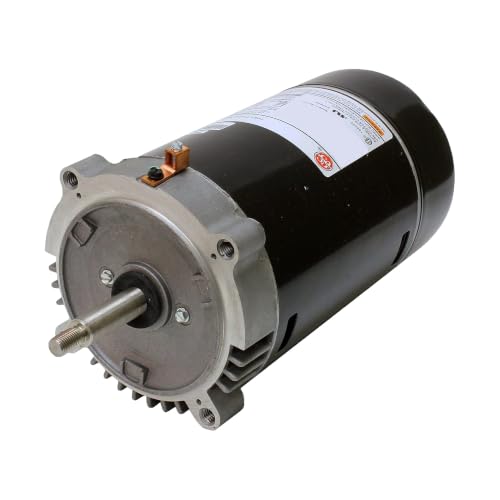
A dedicated Hayward Super Pump motor with a nameplate built for exact matches.
This US Motors AST165 is a purpose-built pool pump motor — 1 1/2 HP, 3450 RPM, 56J frame, drawing 17.0 amps at 115V or 8.5 amps at 230V on 60Hz. It uses an automatic overload protection system with a 1.0 service factor, has a C-face mount with a round body and no base, and spins only CCW facing the shaft, meaning it is non-reversible. The shaft is 5/8″ diameter threaded stainless steel. A stainless threaded shaft matters on a pool motor because the shaft sits in a wet environment and plain steel rusts and seizes.
Where this motor shines is a known target: the Hayward Super Pump. Buyers describe it as a great replacement that fits perfectly and runs great, and it is repeatedly called out as an outstanding-value, carefully packaged option for that exact pump. One buyer notes it runs quiet and smooth, and adds that ordering a gasket and seal kit alongside it turns the swap into a near-new pump. As a motor-only purchase, it is one of the more economical ways into a Hayward replacement.
The reliability picture, though, is mixed rather than glowing. It is the highest-count theme in the reviews, and it cuts both ways: some units run for years and some have thrown problems. One buyer’s motor ran hot and struggled to start when hot, leading to a replacement after a year of waiting for cool-downs. That is the specific weakness to keep in mind on this model — load it within its rating and give it air, and keep in mind it is not the freshly-redesigned option. It is best thought of as a good-value direct fit for a common pump, not a guaranteed lifetime part.
Fit you can count on: A 56J 5/8″ stainless threaded shaft and round C-face aimed straight at the Hayward Super Pump.
Size the risk honestly: Reliability trends mixed — some run for years, some not — so give it airflow and load it within its rating.
Suits: Hayward Super Pump owners wanting an economical, exact-fit stainless-shaft replacement motor.
Reconsider if: You want long-term reliability guarantees — this one is a value-fit option, not a premium long-haul motor.
9. Century HST150 Pool Pump Motor 1.5HP 1.50THP 56J Round 3450RPM 115/230V

A genuine Century Centurion PRO motor with the round-flange fit spelled out plainly.
This is the Century HST150, part of the Centurion PRO line, built for pool and spa pumps that take a round-flange threaded-shaft motor. It carries a 1.5 HP nameplate, a 1.00 service factor (a measure of how much extra load the motor can handle beyond its rated horsepower), and 1.50 THP (total horsepower — the motor’s actual power output), which means the nameplate horsepower and the total horsepower read the same number — a subtle but important detail when you are matching against an old nameplate. It’s a 56J round C-face motor (a round mounting face with a threaded shaft) with a 7/16″ threaded 303 stainless shaft, 5/8″ diameter and 2.562″ length, spinning single-speed at 3450 RPM on 115/230V, 60Hz, drawing 17.2 amps at 115V or 8.6 amps at 230V.
The listing does the buyer a favor by being blunt about the fit trap. Round versus square flange is the single most common reason pool motors get returned, and this page spells out that 56J is round and that a square plate with four corner bolts will not mount. It cross-references UST1152, EUST1152, C1319, and others, so if your old motor wears one of those numbers, you are in the right neighborhood. It is also motor-only — no capacitor, wet end, base, seal kit, or mounting hardware ships in the box, so order what you need alongside it.
Shoppers say it as good-quality, efficient, and easy to self-install. One notes only three wires to connect and describes the job as genuinely simple, saving the cost of a service call by doing it themselves. Another confirms it fits and works like the original and runs more efficiently. The one caution, echoed throughout the category, is that a motor with an air-temperature-sensitive overload will cut out earlier on a hot day — keep it in airflow. Match the frame and read the shaft spec, and this is a clean, genuine-Century round-flange replacement.
What Makes It Solid
- Genuine Century Centurion PRO build with copper windings
- 1.50 THP matching the nameplate 1.5 HP for easy replacement matching
- 303 stainless threaded shaft resists pool-water corrosion
- Clear round-vs-square flange warning prevents the common wrong-fit order
Order-Alongside Notes
- Motor only — no capacitor, seal kit, base, or mounting hardware included
- 56J round C-face will not fit square-flange pumps
- Open drip proof design, not fully sealed against spray
The pick for: Round-flange pump owners who want a genuine Century part and are ready to order the seal kit and capacitor alongside it.
Wrong choice if: Your pump end is a square-flange four-bolt — this round C-face simply will not bolt on.
10. UST1152 Pool Pump Motor 1.5 HP 56J Frame Fit for Hayward SP2610X15 AST165

An entry-level 56J replacement that matches a long list of Hayward pump numbers.
At the value end of the round-flange field sits this ATVMaster UST1152, a 56J frame motor listed as a 1:1 match for the A.O. Smith Century UST1152 and a direct replacement for Hayward SP2610X15, US Motors AST165, and A.O. Smith B229. It runs single-speed at 115/230V switchable, drawing 9.3 amps at 230V or 18.6 amps at 115V, at 3450 RPM with a 1.0 service factor and Class B insulation. It is rated for continuous duty and can operate in 50°C ambient temperatures — useful headroom for a motor sitting in summer sun on a concrete pad.
The build centers on a 5/8″ 1045 steel threaded shaft for load-bearing and wear resistance, with four 3/8″ threaded mounting holes distributed 360° around the flange and a weather-resistant casing with a built-in pedestal base. It uses capacitor-start design for higher starting torque and includes automatic thermal protection that shuts the motor off before it burns out. The pedestal base is a genuine convenience for above-ground pool setups where the motor needs a stable seat.
Where it gets real is in the mixed reputation. Quality is the most-praised theme, and the fit and easy install are cited often — but performance and noise split down the middle, and that split is the whole story on a budget motor. Some units run fine and quiet as expected; others develop bearing noise early or arrive with a mishandled thread that needs re-tapping. If your Hayward-style wet end is healthy and you want the lowest-cost path back to circulation, the value math works — just inspect the housing threads on arrival and set your expectations to value-tier rather than premium durability.
Value case: Matches a long list of Hayward and A.O. Smith numbers at the entry level, with a sturdy pedestal base and broad voltage support.
The split to weigh: Performance and noise get mixed marks — that variability is the price of the value end of the round-flange market.
Best for: Cost-conscious owners of the listed Hayward models who do not mind inspecting threads on arrival.
Pay more if: You want predictable noise and durability — the upper tier of this category earns its premium there.
11. Farm Duty Motor, Capacitor-Start/Run, 1 1/2 HP, 115/208-230V AC, 1,725 Nameplate RPM, 56H Frame – 1 Each

A slow-turning Leeson built for bandsaws that need grunt, not blade speed.
Every other motor in this article spins at 3450 RPM. This Leeson turns at 1,725 nameplate RPM — roughly half the speed — which is the whole point. It is a capacitor-start/capacitor-run farm duty motor at 1 1/2 HP, running 115/208-230V AC in a 56H frame, made in the United States, and weighing 40 pounds. Capacitor-start/run means two capacitors work together: one provides the heavy kick to get the shaft moving under load, and one keeps the motor running with steady torque. Where blade speed does not matter and turning force does, that combination performs a job a 3450 RPM motor can’t.
Bandsaw owners are the ones who get the most from it. A buyer who swapped a 3/4 HP motor onto a 14″ Ridgid bandsaw with a riser block says it now resaws 11″ boards without stalling, up from 5″ before, cutting smoother than the old motor. Another replaced a 1/2 HP motor on a Central Machinery 14″ bandsaw and reports it resaws 6″ hardwood at max height with no slowdown. The wiring diagram is printed on the label, and buyers report the wire labels (T2, P2) are small and hard to read but repeated along the wires themselves, so tracing is manageable. It arrives well-packaged and, in buyer descriptions, quiet and dependable.
The trade-off is fitment, not performance. Buyers flag that the wiring box sits on the opposite side from some setups and can interfere slightly with a machine’s door — a five-minute repositioning, not a rebuild. And with 56H as the frame code, this is not a universal drop-in: it pays to measure your existing mount and confirm the frame before ordering, especially if you are upgrading a smaller machine. Intended as farm-duty equipment, it rewards anyone who wants low-speed torque and does not need the 3450 RPM speed of a saw arbor.
Where It Shines
- 1,725 RPM low-speed torque that pulls hard through hardwood
- Capacitor-start/run design for strong startup and steady running force
- Made in the United States and ships well-packaged
- 56H frame fits a range of slow-speed equipment like bandsaws
Fit Notes
- Wiring box may sit opposite some machines and intersect a door
- Small wire labels (T2, P2) can be hard to read
- 1,725 RPM speed is wrong for pool pumps or table saws needing 3450 RPM
Reach for it if: You own a bandsaw or slow-speed machine that needs torque and takes a 56H frame motor.
pass on it if: Your equipment runs at 3450 RPM or takes a round or square pool-pump flange — this is a different animal entirely.
Understanding the Specs
Frame code and flange shape
The frame code is the make-or-break spec on any 1 1/2 HP motor. It’s a short code — 56, 56J, 56Y, 56H — and it describes the motor’s mounting footprint and flange shape, not its power. A 56Y is a square-flange pattern that bolts into a matching square pump end; 56J is a round C-face flange. Round and square do not interchange. A square plate with four corner bolts will not seat on a 56J round C-face pump, and vice versa. Before ordering, read the frame code off your old motor’s nameplate and look at the shape of the pump-end face. That two-minute check is what keeps a motor out of the return box.
Voltage, amps, and service factor
Dual-voltage motors list two amp figures, and the lower number belongs to the higher voltage — a 15.0/7.5A motor draws 15.0 amps at 115V and 7.5 amps at 230V. That matters because a 15-amp household circuit running a motor drawing 15.0 amps leaves no headroom, so 230V is usually the calmer choice. Service factor (SF) is the built-in overload margin: an SF of 1.15 lets a motor carry about 15% beyond its rated load for short bursts, while an SF of 1.0 means no extra margin. On pool pumps, THP (total horsepower) folds the service factor into the brake horsepower, so a 1.5 HP nameplate with a 1.1 SF lands around a higher THP — match that number, not just the HP label.
FAQ
How do I know if I need a 56J or a 56Y frame motor?
Can I run a 1 1/2 HP motor on a standard 115V household outlet?
What does service factor mean on an electric motor?
Why do pool pump motors fail after a couple of years?
Do I need a capacitor for a pool pump motor?
Can a 1 1/2 HP motor replace a smaller or larger motor on my equipment?
What shaft size and type should my replacement motor have?
Is a 3450 RPM motor better than a 1725 RPM motor?
What is the difference between capacitor-start and capacitor-run?
Do these motors come with wiring instructions?
Final Thoughts: The Verdict
The best 1 1/2 HP electric motor is the one whose frame code, speed, and voltage match the motor you are replacing. For reviving a table saw, compressor, or farm equipment on 115V or 230V, the VEVOR 1.5HP 3450 RPM 56 Frame motor is the strongest all-rounder, with a reversible shaft, a 1.15 service factor, and a proven record of bringing dead bench tools back to life. If you want the most trusted name in pool replacement, the Century UST1152 carries the deepest reliability record of the round-flange set. And if you are chasing real cutting muscle for a contractor saw, the Grizzly G2535 is the heaviest, hardest-pulling motor here — just budget an afternoon for the mounting holes. One honest nudge: the Century’s long list of seven-year survivors speaks louder than any spec sheet, so match your frame and grab the one that fits.
How We Picked
We do not accept paid placement. Every pick is matched to a real buyer and a real use-case; we do not hands-on test units.
Sources & Methodology
Specifications: manufacturer listings and product documentation. Review insights: verified customer reviews, as of September 2026. Pricing: not shown on this page (it changes often); check the current price via the retailer link.
As an Amazon Associate, KitchPrep earns from qualifying purchases. This does not affect which products we feature.
Related Guides
