
Specs are compiled from manufacturer listings and verified buyer reviews and can change over time — please confirm the key details on the product page before buying.
If your screws keep stripping and your wrist keeps aching, the problem is usually the tool, not you. A quarter-inch impact driver spins in short, hammering bursts instead of one steady twist, so the bit bites and the fastener sinks without your forearm doing the work. The list below covers nine drivers sorted by what they actually do best — battery platform, size, and control — so you can match one to your own toolbox rather than guess.
I’m Mohammad Maruf — the founder and writer behind KitchPrep. This guide is built by comparing the manufacturers’ published specifications and the patterns across verified customer reviews, so you get each pick’s real strengths and trade-offs instead of marketing spin.
Your first decision is which battery platform you already own, because that locks in every tool you buy next. Your second is if you need a compact driver or a full-size powerhouse. The crowd favorite here holds 4.7 stars across 400+ ratings, and the rest of the field splits cleanly into tool-only bargains and kit-included starters. This guide breaks down the best 1/4 impact drill.
Our Picks at a Glance

How To Choose The Best 1/4 Impact Drill
The single biggest decision is not the driver itself — it is the battery you already own. A 1/4-inch hex impact driver (the standard bit-fitting size for screwdriving, as opposed to a 1/2-inch anvil meant for sockets) will only run on its own brand’s battery platform. Switching brands means buying new batteries and a new charger, which usually costs more than the tool. Pick the platform first, then the tool inside it.
Torque, Speed, and Control Modes
Torque is the twisting force, measured in inch-pounds (in-lb), and it decides whether a driver sinks a long deck screw or stalls halfway. Speed, measured in RPM (revolutions per minute), decides how fast the bit spins once it has grip. What actually matters day to day is control: a variable-speed trigger lets you feather the power, and multi-speed modes let you dial down the torque so you do not snap small screws or crack drywall. A driver with a gentle or precision mode is worth more to a cabinet installer than one with a higher peak rating.
Brushless vs. Brushed Motors
A brushed motor uses carbon contacts that physically rub against a spinning part, which wears them down over time. A brushless motor swaps those contacts for electronic switching, so it runs cooler, lasts longer, and gets more work out of each battery charge. If you plan to use the driver regularly, brushless is the version to buy; if it will mostly sit in a drawer, a brushed driver still works fine.
Tool-Only vs. Kit Bundles
Tool-only listings give you just the driver, so they are the cheaper route if you already own compatible batteries and a charger. Kit bundles add a battery and charger, which is the way to go for a first purchase on a new platform. Read the listing carefully — bare tools are sometimes sold as returned or bulk-packaged units, which is why they cost less.
Quick Comparison
| Model | Best For | Torque | Speed | Weight | Amazon |
|---|---|---|---|---|---|
| Ryobi ONE+ 18V Impact Driver Kit (P235AK1)★ Best Overall | First-time buyers | — | — | — | Amazon |
| 1/4-Inch Hex Impact Driver (DeWalt 20V/60V Compatible)Top Performer | Budget power | 2212 in-lb | 4-speed | 2.4 lb | Amazon |
| Ryobi ONE+ HP 18V Brushless PSBID01Compact Control | Compact control | 1,700 in-lb | 2,900 RPM | 2.1 lb | Amazon |
| DEWALT XTREME 12V MAX DCF801B | Tight-space work | — | — | 1.8 lb | Amazon |
| Milwaukee M18TRADE Compact Brushless | All-day trade use | — | 0–3600 RPM | 2 lb | Amazon |
| DEWALT 20V MAX DCF840B | Deck and framing | 1,700 in-lb | 3,200 RPM | — | Amazon |
| Milwaukee M12 FUEL 1/4 HEX 3453-20 | Pocket-size power | — | — | 1.8 lb | Amazon |
| Bosch GDR18V-1950CN | Quiet precision | 1,950 in-lb | 3,400 RPM | — | Amazon |
In‑Depth Reviews
1. Ryobi ONE+ 18V Cordless 1/4 in. Impact Driver Kit with 1.5 Ah Battery and Charger (P235AK1)
Our pick — over 4.5★ from 400+ verified ratings; the strongest balance of quality and price.
The one that hands you everything you need to drive the first screw from the start.
Buying a bargain tool-only unit means you still need a battery and a charger, which is the expensive part. This kit sidesteps that entirely. You get the driver, a 1.5 amp-hour (Ah) battery — a small pack that fits in the palm of your hand — and a charger in one box, on Ryobi’s ONE+ 18V platform (their shared battery system, where one pack runs every tool in the line).
The variable speed trigger is the quiet hero here. You squeeze lightly for a slow start so the bit seats in the screw head, then press harder once it bites. That one habit is what keeps you from overturning screws and stripping the head on a soft pine board. Ryobi also built this for long sessions, so hand and shoulder strain stays low when you are driving a hundred screws into a fence.
The honest catch is the starter battery. Plenty of owners run this thing daily and love the power, but the smart move is upgrading to a bigger pack down the road — a 4 Ah battery gives more runtime and noticeably more punch on stubborn fasteners. The 1.5 Ah pack that ships in the box handles light jobs fine, then taps out sooner on a big build. It is also bulk-packaged, meaning it arrives in a plain box rather than retail packaging, which is how the price stays where it does. And the platform decision cuts both ways: this locks you into Ryobi batteries, so if your garage is already full of another brand, start there instead.
What works from the start
- Battery and charger included — no hidden second purchase
- Variable speed trigger gives real control over small screws
- ONE+ platform means one battery runs your whole tool shelf
- Bulk packaging keeps the starter kit budget-friendly
What to plan around
- The 1.5 Ah starter battery is small; a 4 Ah upgrade adds runtime
- Bulk-packaged, not retail-boxed
- Locked into Ryobi ONE+ batteries going forward
Start here if: you are buying your first impact driver and want a complete, working kit on a homeowner budget.
Look past it if: you already own a different brand’s batteries, or you need maximum runtime right away.
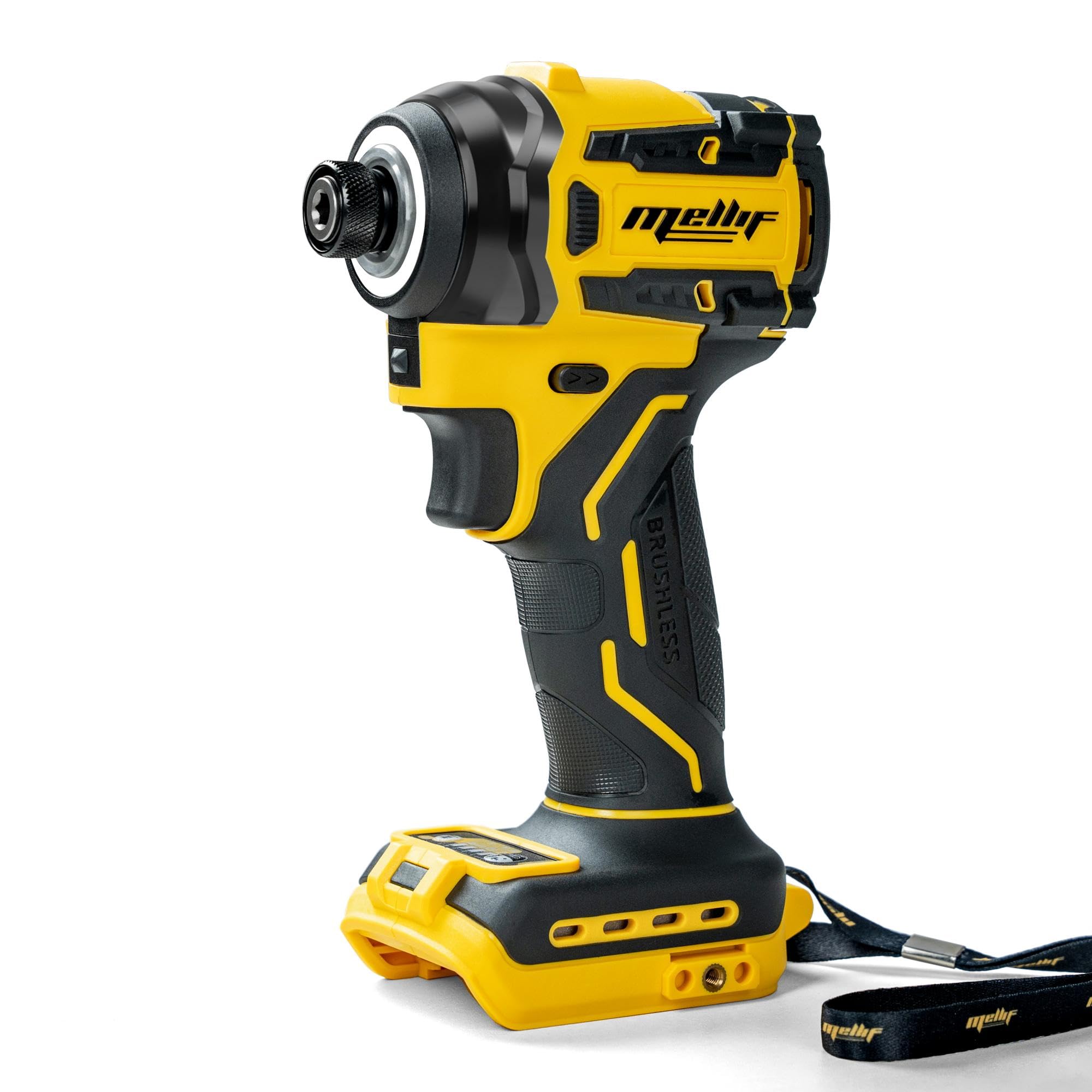
2. 1/4-Inch Hex Impact Driver Compatible with Dewalt 20V 60V Max Battery
Tool-only, but it out-torques drivers that cost twice as much.
Here is the standout number: 2212 inch-pounds of torque from a driver that is only 4.3 inches long at the head. That head length is the whole trick — it lets you get behind a cabinet face or between two studs where a full-size driver physically will not reach. And if you already own DeWalt 20V or 60V Max batteries, this is a tool-only pickup, so you are paying for the driver alone and nothing else. Worth flagging clearly: this is a third-party tool that works with DeWalt batteries and is not affiliated with DeWalt, so it is a compatibility play, not a genuine DeWalt product.
Against the Ryobi kit in the top spot, the power gap is real. This driver claims 2212 in-lb of torque, while the Ryobi ONE+ HP PSBID01 below is rated at 1,700 in-lb — a meaningful difference when you are sinking long screws into treated lumber and do not want to stop and pre-drill. It also carries a 4-speed setting dial, so you can drop into a low-speed gear for delicate assembly work and crank it up for framing.
What surprises people most is how quiet the doubts get once it is in hand. Buyers report it feels genuinely solid and handles light to medium household jobs without complaint, and the brushless motor adds runtime and a longer motor life over a brushed unit. It even comes with a 5-year warranty and a ring LED light that wraps 360 degrees around the nose for shadow-free visibility. The fair caveat is build durability — some owners find it less rugged than a genuine brand-name tool and would not push it into heavy professional use, so treat this as a serious homeowner and light-trade driver rather than a jobsite beater.
The power-to-size ratio: 2212 in-lb of torque in a 4.3-inch head is a lot of muscle for tight cabinet and furniture work.
Where it gives ground: build quality is the trade-off, so it will not shrug off the abuse a full pro tool takes.
Reach for it if: you already own DeWalt batteries and want maximum torque per dollar in a compact body.
Skip the leap if: you need a tool built to survive years of rough jobsite handling.
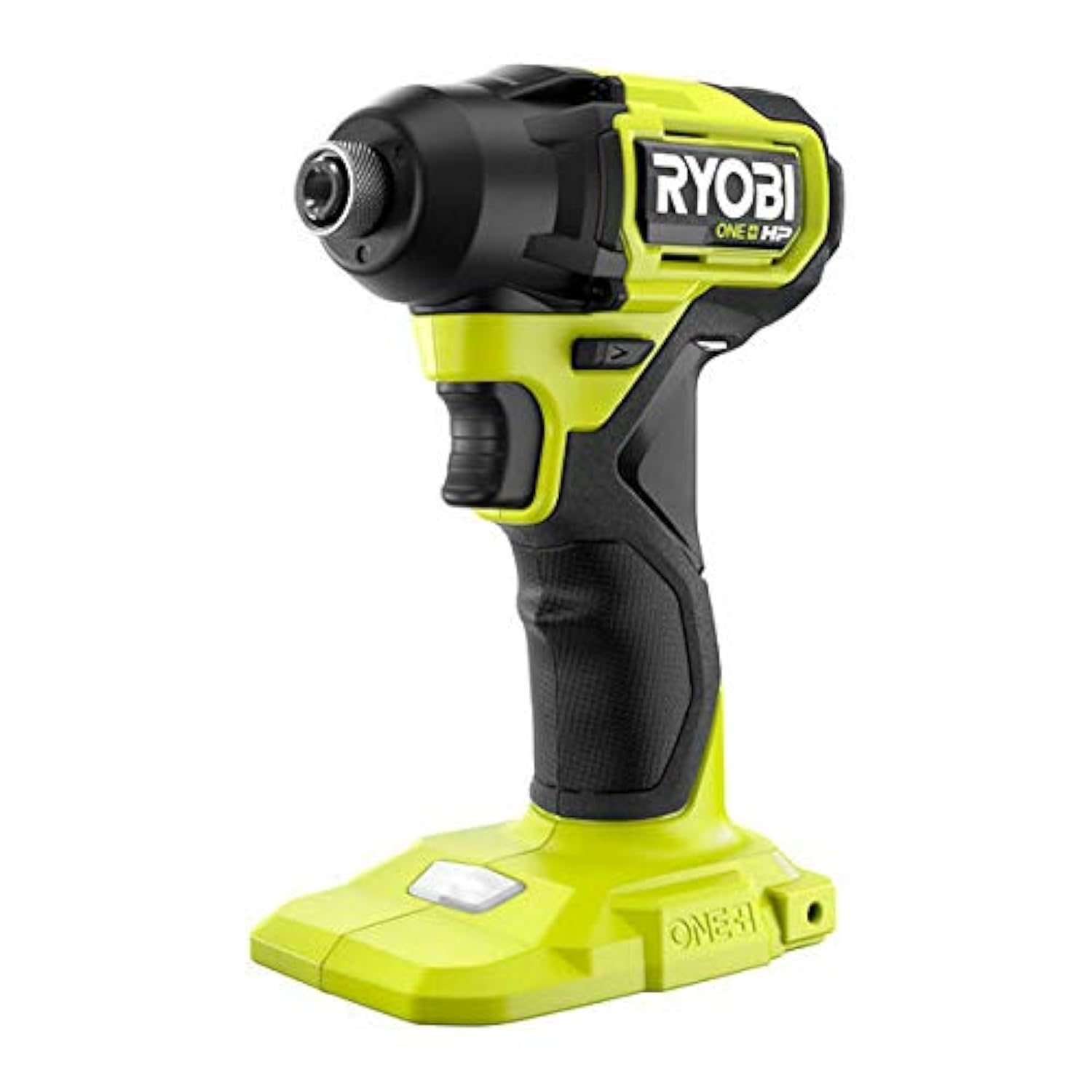
3. Ryobi ONE+ HP 18V Cordless Compact Brushless 1/4″ Impact Driver PSBID01 (Tool Only)
A brushless one-hander that slips into spaces the big drivers cannot reach.
Start with the head-to-head, because it decides who should buy this. The PSBID01 is rated at 1,700 in-lb of torque and 2,900 RPM on a 2.1-pound body, while the third-party DeWalt-compatible driver above claims 2212 in-lb — so if raw breakaway power is your priority, that one wins. This Ryobi is the pick for the opposite buyer: the person who works overhead in a cabinet, drives hundreds of small fasteners, and wants the tool to disappear in the hand.
The specs back that up. It is 8.27 inches long, 6.42 wide, and 3.7 high — meaningfully trimmer in the head area than the bulkier full-size drivers on this list, and at 2.1 pounds it is lighter than the 2.4-pound DeWalt-compatible tool. The brushless motor stretches runtime and motor life, the tune impacting mechanism fires at up to 3,800 IPM (impacts per minute — how often the driver hammers the bit forward), and the knurled 1/4-inch hex collet lets you swap bits one-handed without fumbling for a second hand to hold the chuck.
Two gripes are worth knowing before you buy. The first is noise — this thing is loud under load, so ear protection stops being optional if you are driving screws for an afternoon. The second is the trigger. There is no multi-mode torque dial here, just variable speed, so the trigger is sensitive and can crack drywall or over-drive a small screw if you mash it. Owners who use it for light DIY and small projects love it; owners who want precision fastener control for cabinet hardware should look at the Bosch or Milwaukee 2953-20 lower down. As a tool-only buy, this is the smarter value if you already own ONE+ batteries.
Why owners keep it: compact, brushless, and light enough to work overhead all afternoon without arm fatigue.
The honest limits: no multi-mode torque dial, a sensitive trigger, and plenty of noise under load.
Made for the DIY crowd: small projects, minor home repairs, and anyone already on the ONE+ platform.
Not your tool if: you need dialed-in torque modes for delicate cabinet hardware.
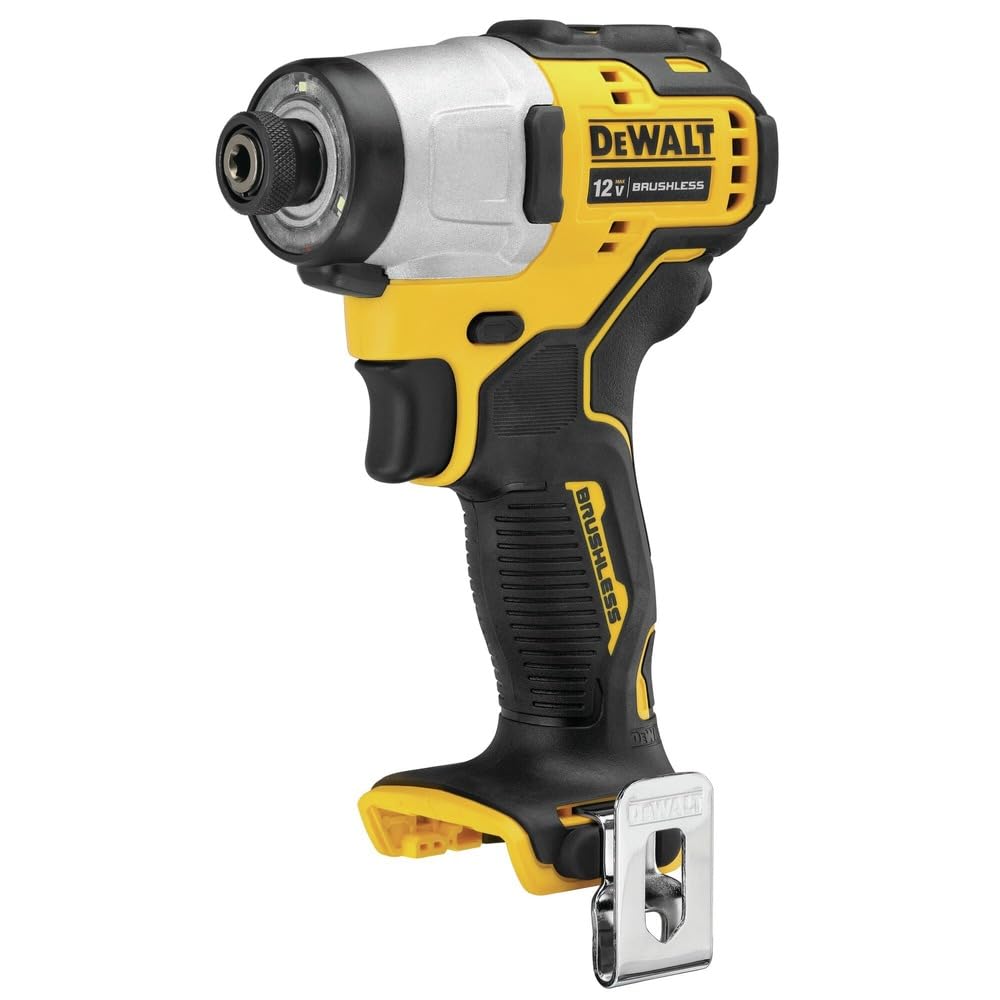
4. DEWALT XTREME 12V MAX* Impact Driver, Cordless, 1/4-Inch, Tool Only (DCF801B)
Small enough to vanish in a tool pouch and tough enough to survive a drop.
If you work in cabinets, ceiling fixtures, or under a hood, physical size is the spec that matters, and this is where the XTREME 12V earns its spot. The numbers tell the story: the driver is 19% shorter than the 20V standard, it offers 52% more torque than the previous generation, and it weighs 1.75 pounds as a bare tool. That combination is what lets you push your hand into a gap that a full-size 18V driver simply will not enter. It runs on DEWALT 12V MAX batteries and chargers, so it is a tool-only purchase — battery and charger are not in the box.
Three metal LEDs sit right on the nose, angled at the work surface so the light lands where the bit goes rather than glowing off into the room. Owners mention driving in automotive work daily, cleaning oil and debris off the tool and putting it right back to it, and some are still running 15-year-old Japan-made 12V batteries. It shrugs off drops, and the included belt clip keeps it within reach.
The question most shoppers ask is whether 12V is enough. For screws and assembly, yes — the compact size is the point, and it drills fine in wood. What it will not do is muscle through the heavy fastening an 18V driver handles, and durability is the mixed note: most owners find it dependable for years, though a few report one failing earlier than they expected. Note also that at 1.8 pounds measured, it is actually a hair heavier than the 1.75-pound figure in the marketing copy — but both are light enough that it disappears in a pouch.
Why it earns a spot
- 19% shorter than the standard 20V body — built for tight gaps
- 52% more torque than the model it replaces
- Three nose-mounted LEDs for shadow-free drilling
- 1.75 lbs bare tool with a belt clip included
What to weigh honestly
- Tool only — no battery or charger in the box
- 12V ceiling means it is not the muscle for heavy fastening
- A minority report durability issues earlier than expected
Best fit: cabinet installers, automotive techs, and anyone working overhead who needs compact access.
Think twice if: you expect 18V-level power or want batteries included.
5. Milwaukee Electric – M18TRADE Compact BRUSHLESS 1/4 HEX Impact Drive

An all-metal heart inside a compact body, ready for a real workday.
What sets this one apart is what it is made of. The gearcase and gears are all metal — that is the housing and the toothed parts that transfer the motor’s spin to the bit — which is the part that wears fastest on cheaper drivers. Combine that with a brushless motor running 0–3600 RPM and an enhanced variable speed trigger tuned to reduce damage to fasteners and material, and you get a driver built for people who use it as a job, not a hobby. It comes as a bare tool, so you bring your own M18 battery and charger.
The size findings are the appeal. Owners describe it as compact and light enough for tight spaces and overhead work, with more power than its frame suggests — cabinetry, decking screws, and stubborn fasteners all go down without the motor bogging. The smooth trigger is the part people call out as preventing stripped heads, which matters if you are driving finished work and cannot afford a repair. Build quality and balance feel solid over an extended session, and it holds up beside the Milwaukee 2953-20 further down this list as the trade-grade alternative if you want more speed and modes.
Two things to weigh before you buy. First, it is a bare tool, and the listing components confirm no battery or charger ships with it, so if you are buying into M18 for the first time, budget for those separately. Second, the triggers of high-torque work drain a battery fast — several owners on heavy fastening keep a spare pack in their bag. The all-metal build also means this is not the lightest driver on the page; if featherweight overhead work is your priority, the DEWALT XTREME above is the smaller tool.
The durability play: an all-metal gearcase and gears put the wear point where it belongs — on materials built to take it.
The practical catch: it drinks battery on hard fastening, so a second pack is smart, and it ships without one.
The trade user’s pick: reliable power, low fatigue, and a build that stands up to daily work.
Hold off if: you want the smallest, lightest body or a complete kit with battery and charger.
6. DEWALT 20V MAX* 1/4 in. Brushless Cordless Impact Driver (Tool Only) (DCF840B)

The one that treats long deck screws and big boards as everyday work.
Numbers first: 1,700 in-lb of torque and 3,200 RPM from a brushless motor, packaged in a compact body designed to reach difficult spots. That is the recipe for a driver that drives large-diameter screws without stalling, which is exactly where a light-tool driver quits. If you are framing, building a deck, or putting a fence up, this is the class of tool that keeps pace. It runs on the DEWALT 20V MAX battery platform and ships as a tool-only unit, so your existing yellow batteries and charger are all you need.
Against the DEWALT XTREME 12V above, the split is clean: the XTREME is shorter and lighter for tight-space work, while this 20V model brings the torque and speed to keep up when you are pulling a fastening marathon. Against the third-party DeWalt-compatible driver that claims 2212 in-lb of torque, this comes in lower on peak power, but it is the genuine tool with genuine-build confidence behind it. The variable speed trigger gives pro-level control for detail work, and three integrated LEDs brighten those dark corners under a car or inside a cabinet.
What the review pages show is a tool people bring back to the same task year after year. Owners drive long fasteners like 6-inch Timberloks, and crews chain-drive large quantities of screws into decking while it stays light even with a high-capacity battery on board. The one thing to sort before ordering is a battery: this is the bare tool, so you need a 20V MAX pack and charger, neither of which ships in the box.
Where it delivers
- 1,700 in-lb and 3,200 RPM for long, hard fastening jobs
- Brushless motor for runtime and motor life
- Three LEDs brighten dark work areas
- Variable speed trigger for precision work
Before you order
- Tool only — a 20V MAX battery and charger are not included
- Peak torque falls short of the 2212 in-lb third-party driver
- Not the shortest head for the tightest spaces
The deck builder’s answer: fast, powerful, and made for crews and serious homeowners running long fasteners all day.
Choose another if: you already own a different battery platform, or you need the mountaineering of compact heads.
7. Milwaukee Electric – M12 Fuel. 1/4 HEX Impact Driver

A 12V driver that punches well above its size class on small jobs.
If you already live in Milwaukee’s M12 system, this is the place your existing batteries earn their keep. FUEL is Milwaukee’s brushless line, so you get the efficiency and longer motor life that brushless brings, wrapped in a driver that runs on the smaller 12V batteries rather than the full-size 18V packs. It arrives as a bare tool too — no battery and no charger. That makes it the ideal addition if you have M12 packs already, and a poor first purchase if you do not.
Owners describe it as nearly as powerful as a full-size 18V driver — reports of sinking 4-inch deck screws without trouble, and even some small 1/2-inch drive bolts with a suitable adapter. That is a lot of biting force out of a 12V package that weighs in around 1.8 pounds. It carries the same warranty as the rest of the M12 line, and owners treat it as a grab-and-go tool for assembly and light fastening.
Here is the consideration that keeps it honest. It is a pocket tool with a ceiling — ask it to drive a whole fence or run heavy fastening all afternoon and the 12V packs will drain faster than a bigger driver’s would. It also ships bare, so you are only getting the tool. For small bolts, screws, and quick assembly work, that trade is an easy one to make; for framing, look at the 18V drivers on this list.
The value of the M12 platform: nearly 18V-class driving force in a body small enough to live in a pocket.
The trade you accept: a lighter battery means quicker depletion on long, heavy runs.
The M12 owner’s companion: assembly, small bolts, and quick jobs where compact size beats raw grunt.
Look elsewhere if: you need a driver for all-day heavy fastening, or you have no 12V batteries yet.
8. Bosch GDR18V-1950CN 18V Brushless Impact Driver (Bare Tool)

It acts like a gentle drill — until it decides the screw is ready for impact.
The headline here is control. Bosch gives you three speed/torque settings — 800, 2,300, and 3,400 RPM — so you can start slow for delicate work and click up as the job demands. The brushless motor delivers 1,950 inch-pounds of torque, which sits just below the Milwaukee 2953-20’s 2,000 in-lb but above the 1,700 in-lb of the Ryobi PSBID01. The head is 4.45 inches long, close to the Milwaukee 2953-20’s 4.47, so both slip into tight spaces more easily than a full-size driver. As a bare tool, you bring your own Bosch 18V battery and charger.
What owners notice is the smoothness. It stays quiet and runs like an ordinary driver through most of the fastening, then switches to impact only as the screw bottoms out — so you get a calmer, less fatiguing experience than a driver that hammers the whole way. On the spec sheet, the dual LED worklights illuminate dim spaces, the onboard user interface lets you confirm the speed setting and check tool status, and the quarter-inch quick-insert hex lets you load a bit one-handed. It works through 4-inch-and-up wood screws cleanly and is covered by a five-year limited warranty.
Two things to keep in mind before ordering. It is a bare tool with no battery in the box, and this is an 18V platform, so if you are new to Bosch you will need to buy the battery and charger separately — which is where the cost stacks up against a strong Milwaukee alternative. There is also a small wear-and-tear note to know about: on the side rubber bumper, heavy pouch use can cause it to come loose, an occasional observation rather than a pattern. For a quiet, precise driver with excellent fit and finish, it is among the most refined picks on this list.
The precision play: three torque settings and a smooth trigger make it the cabinet-friendly choice.
The setup reality: bare tool, and if you are not already on Bosch, the batteries and charger are a separate purchase.
Best for the detail work: anyone who values quiet power, tight-space access, and speed control over the brawniest spec sheet.
Weigh the cost if: you would be starting fresh on Bosch’s platform — the tool is bare, so batteries and a charger come on top.
Understanding the Specs
Torque in Inch-Pounds (in-lb)
Torque is the twisting force the driver applies to the bit, measured in inch-pounds. A higher number tells you the driver can force a longer or tougher screw into harder material before it stalls. On this list, the range runs from the 1,700 in-lb rating shared by the Ryobi PSBID01 and the DEWALT DCF840B up to the 2,000 in-lb of the Milwaukee 2953-20, so the spread is real but modest. Pick based on fastener size: light assembly work rarely needs the top figure, while decking and framing reward more of it.
Speed in RPM and Impacts Per Minute
RPM (revolutions per minute) is how fast the bit spins, and IPM (impacts per minute) is how often the driver hammers it forward once it hits resistance. High RPM speeds up the work once the screw is turning; IPM is the force that keeps it moving when things get tight. The fasted-rated driver here hits 3,900 RPM (the Milwaukee 2953-20), while the Ryobi PSBID01 fires at up to 3,800 IPM. Neither number alone tells you how a driver feels — trigger control and speed modes matter just as much in real use.
Brushless vs. Brushed Motors
A brushed motor uses carbon pieces that physically rub as it turns, generating friction and heat and wearing down over time. A brushless motor replaces that with electronic switching, so it runs cooler, lasts longer, and squeezes more work from each charge. Every driver on this list runs a brushless motor, which is why the group performs above its compact size. If you are comparing a brushless driver against an older brushed tool, expect the brushless one to feel stronger and run longer between charges.
Head Length and Weight
Head length is how far the tool extends from the bit — the shorter the number, the deeper into a cabinet or engine bay you can reach. The DEWALT XTREME measures 19% shorter than a standard 20V body, and the Bosch is 4.45 inches at the head. Weight matters for the same reason: the DEWALT XTREME is 1.75 pounds as a bare tool and the Ryobi PSBID01 is 2.1 pounds, so both stay comfortable overhead. A lighter, shorter driver costs you nothing in usability on lightweight work.
FAQ
What is a 1/4-inch impact drill actually used for?
Can I use a 1/4-inch impact driver with a drill bit?
What does brushless motor mean on an impact driver?
Which battery platform should I choose?
Is a 12V impact driver strong enough for real work?
How much torque do I need for deck screws?
Should I buy tool-only or a kit with battery and charger?
What torque setting should I use for small screws?
How long does a battery last in an impact driver?
Is the DEWALT XTREME 12V the same as a 20V MAX driver?
Can an impact driver strip or crack screws and drywall?
Final Thoughts: The Verdict
For most people buying their first impact driver, the winner among these 1/4 impact drill picks is the Ryobi ONE+ 18V Impact Driver Kit, because it hands you the driver, battery, and charger in one box so you can drive your first screw the day it arrives. If you already own DeWalt batteries and want maximum torque from a compact body, grab the 1/4-Inch Hex Impact Driver Compatible with Dewalt 20V 60V Max Battery. And for deck building, framing, or any job where you are running long fasteners all day, reach for the DEWALT 20V MAX DCF840B. One owner-praised detail worth knowing: the platform you pick today decides every tool you buy next, so choose the batteries you want to grow into — the battery platform you commit to today is the one you will keep buying into.
How We Picked
We do not accept paid placement. Every pick is matched to a real buyer and a real use-case; we do not hands-on test units.
Sources & Methodology
Specifications: manufacturer listings and product documentation. Review insights: verified customer reviews, as of September 2026. Pricing: not shown on this page (it changes often); check the current price via the retailer link.
As an Amazon Associate, KitchPrep earns from qualifying purchases. This does not affect which products we feature.
Related Guides
