
Specs are compiled from manufacturer listings and verified buyer reviews and can change over time — please confirm the key details on the product page before buying.
If you rent, live in an older house, or just refuse to pay for central air, a 120V window AC unit is the cheapest way to make one room livable in July. These plug into a standard wall outlet — the same 115V or 120V circuit your lamp uses — so you do not need an electrician or a special outlet. What actually matters is matching the BTU rating to your room size and knowing which controls you will live with every day.
I’m Mohammad Maruf — the founder and writer behind KitchPrep. This guide is built by comparing the manufacturers’ published specifications and the patterns across verified customer reviews, so you get each pick’s real strengths and trade-offs instead of marketing spin.
You want a cool room without rewiring your house. Every unit here runs on 115V or 120V, so it plugs into a normal household outlet. We have eleven picks, from compact bedroom coolers to whole-floor machines. The only real question is which one fits your window and your square footage. To choose the right 120V Window AC Unit, match BTU (British Thermal Units — a measure of cooling power) to room size, then pick controls you can live with.
Our Picks at a Glance


How To Choose The Best 120V Window AC Unit
Buying a window unit is mostly a measuring job. Get the room size, window opening, and power situation right and you will be happy for years. Get them wrong and even a great machine will disappoint you on the first hot night.
Match BTU to the room, not the room to the BTU
BTU (British thermal units) is the cooling power number. A 5,000 BTU unit typically handles a small bedroom, while a 12,000 BTU model can push cold air through an open living area. Oversizing seems safe but it is not — a unit that cools too fast shuts off before it removes the humidity, leaving the room clammy. Undersizing means the compressor never rests.
Measure your window opening first
Every unit lists a supported window width range and a minimum height. A model built for windows 21 to 35 inches wide will not seat properly in a 40-inch opening without extra material. Write down your actual measurements before you shop — this single step rules out more returns than any other.
Know your outlet before the delivery truck arrives
All the units here run on 115V or 120V household power, which means a normal grounded outlet. But a big window unit pulls serious amps when the compressor kicks on. On older wiring, that can trip a breaker. If the outlet on that wall shares a circuit with a microwave or a space heater, plan to free it up before summer.
Quick Comparison
| Model | Best For | Cooling Power | Room Coverage | Efficiency | Amazon |
|---|---|---|---|---|---|
| Midea 5,000 BTU EasyCool★ Best Overall | Small bedrooms on a budget | 5000 BTU | 150 sq ft | CEER 11.0 | Amazon |
| GE 5,000 BTU MechanicalBest for Simple Setup | Simple dial control | 5050 BTU | 150 sq ft | — | Amazon |
| LG LW5023 5,000 BTUBest for Narrow Windows | Narrow window openings | 5000 BTU | 150 sq ft | — | Amazon |
| GE 6,000 BTU Electronic | Bedrooms and dorms | 6000 BTU | 250 sq ft | CEER 12.1 | Amazon |
| LG 8,000 BTU LW8024RD | Medium living rooms | 8000 BTU | 350 sq ft | — | Amazon |
| Frigidaire 10,000 BTU | Large living rooms | 10000 BTU | 450 sq ft | 10.9 | Amazon |
| hykolity 12,000 BTU WiFi | App and voice control | 12000 BTU | 550 sq ft | CEER 11.0 | Amazon |
| Frigidaire 8,000 BTU Inverter | Silent bedroom cooling | 8000 BTU | 350 sq ft | Energy Star | Amazon |
| Midea U-Shaped 8,000 BTU | Window light and fresh air | 8000 BTU | 350 sq ft | 5 Star | Amazon |
| ROVSUN 12,000 BTU Inverter | Fast cooling large rooms | 12000 BTU | 520 sq ft | 15.0 CEER | Amazon |
| BLACK+DECKER BD12WT6 | Whole-floor cooling | 12000 BTU | 550 sq ft | — | Amazon |
In‑Depth Reviews
1. Midea 5,000 BTU EasyCool Small Window Air Conditioner
Our pick — over 4★ from 12,000+ verified ratings; the strongest balance of quality and price.
The small-room workhorse that owners keep buying a second time.
For a bedroom, dorm, or home office up to 150 square feet, this is the window unit to beat. It runs on 5,000 BTU of cooling power — enough to drop a small room several degrees in the first half hour — and it draws from a standard 115V outlet, so no special wiring. The mechanical controls are dials you turn by feel, which is exactly what you want at 2 a.m. when you are half asleep.
What sold most owners is the raw cooling-per-watt value. A 5,000 BTU Midea paired with a 10,000 BTU LG upstairs maintains a 1,200 square foot apartment at 66°F versus 90°F outside, as buyers report. That is a tiny unit doing heavy lifting in a big space. It also edges out other 5,000 BTU brands that owners measured landing at 68-70°F, and it steps the temperature down 2-3°F in 20-40 minutes, then roughly 2°F per hour down to 65-66°F. The CEER (the efficiency score that decides your summer bill) sits at 11.0, which is strong for this price tier.
The honest catch is durability on the plastic side. The build is light and easy to set in a window frame, but it is not a machine you want to drop off a ladder. One owner’s unit arrived with a bent rear grill from shipping and still ran fine, and a few units develop a setting fault down the road — the kind of risk that is real but not the norm. The one-year parts and labor warranty covers the early failures.
What owners keep raving about
- CEER 11.0 efficiency keeps long summer runs affordable
- Cools a 12×12 space well and stays small and unobtrusive
- Quieter than a household refrigerator, which matters in a bedroom
- Fits windows 23-36 inches wide and at least 13 inches high
Where it asks you to be careful
- Plastic chassis is light — handle it gently during install
- No remote and no sleep mode; you walk over to change settings
- A screwdriver is required and not included
Best for: Anyone cooling a bedroom or office under 150 sq ft who wants strong efficiency without fuss.
Think twice if: You want app control or a remote on the nightstand — this model is deliberately dial-only.
2. GE 5,000 BTU Mechanical Window Air Conditioner
Dial-controlled cooling that hits 72°F from an 87°F room in two hours.
Where the Midea above tops out at 5,000 BTU, this GE pushes 5,050 BTU — that 50-unit gap is what the spec sheet shows, and both are built for the same 150 square feet. What you are really choosing is the interface. GE went fully mechanical here: three rotary dials, no thermostat readout, no digital display. You turn the dial to a number between 1 and 10 and let the compressor work.
Owners mention the dial scale is intuitive once you learn it — level 5 is a gentle cool, level 7 is chilly, and level 10 feels near-freezing. The auto-adjust between cooling and fan keeps it steady. In a 90°F-plus heat wave, owners watched an 87°F room drop to 72°F in about two hours, and the same unit cooled three upstairs bedrooms to 74°F with the door open and a fan pushing air. The included EZ Mount kit makes a double-hung window install quick — one owner described it as “easy to install, not too heavy, works great.”
The trade-off you accept with mechanical controls is no set temperature. You will not type in 70°F and walk away; you will nudge the dial until the room feels right. Some owners call the air whoosh somewhat loud on high, and the lack of an electronic thermostat means it runs less efficiently than a digital unit at the same BTU. For a guest room or a garage, that irregularity rarely matters.
Read the dial, not a screen: The lack of a thermostat is the defining choice here. You trade precision for durability — rotary knobs do not fail the way electronic boards do.
Reach for this if: You want a no-frills bedroom unit where the controls never break and the install takes an afternoon.
Look elsewhere if: You want to set an exact temperature and forget it — you need a digital thermostat.
3. LG LW5023 5,000 BTU Window Air Conditioner
The mobile-home fix — it squeezes into windows most units cannot.
This is the pick for anyone whose window is the problem, not the room. LG built the LW5023 to install in a double-hung opening as narrow as 21 inches wide and as short as 12 inches high. That is a tighter envelope than the Midea above (which needs 23-36 wide and 13 high) and it is the reason this model keeps showing up in mobile homes and older houses with odd-sized frames. Owners have run one for four months in a mobile home bedroom and called it reliable, reasonably quiet, and easy to set up with every piece of install hardware in the box.
The other distinguishing feature is the airflow direction. Instead of blowing straight out into the room, this unit sends cold air upward — so if you sit or sleep in front of it, you do not get the direct blast. One owner called the temperature knob “vintage/old school feeling,” and that sums up the design language: tactile, mechanical, and slightly retro. It runs as low as 50dB on low mode (a normal conversation is around 60dB), with two cooling and two fan speeds.
Where it falls short is consistency. LG’s own customers note split results on cooling — some say it chills the room fast, others report it barely cools and sounds loud. That split is the honest picture of this model: when it works, it works well, but it is not a uniform experience across units. If you want the surest bet, the Midea above has a longer track record. If your window is 21 to 35 inches wide, this one often fits where nothing else will.
Best fit for: Mobile homes, RVs, and old houses with narrow window openings no standard unit will seat in.
Consider skipping if: Your window is standard width and you want the most predictable cooling performance — read the wider-fit picks first.
4. GE 6,000 BTU Electronic Window Air Conditioner

A real thermostat, a remote, and a 250-square-foot reach.
Step up to 6,000 BTU and you get a machine that covers a bedroom, dorm, or small apartment up to 250 square feet — roughly a 10-by-25 space. The electronic thermostat lets you dial in a precise temperature from 64°F to 86°F, and the included full-function remote means you adjust it from across the room. That is the exact control the mechanical GE above does not give you. The CEER here is 12.1, a real notch above the sub-6,000 BTU field for efficiency.
GE loaded this one with the convenience features that matter for daily life. Auto-restart remembers your settings after a power outage, so you are not reprogramming after a summer storm. The 24-hour programmable timer lets you schedule cooling for the hours you are actually home. Energy Saver Eco mode cycles the compressor intelligently to maintain temperature rather than running continuously. One owner summed up the experience: “Works great for 250 sq ft room for my son. It is Worth my money.”
The honest warning is a real one. This model carries more split reviews than the 5,000 BTU picks — a small share of reviewers point out units that blew room-temperature air, and a couple describe a chemical smell after months of use. The majority report strong cooling over multiple seasons, including one owner running two summers without issue. Read the return policy before you buy, and test the unit thoroughly in the first 30 days. That is standard advice for any electronic control AC.
The digital upgrade: If you want set-and-forget temperature control, this is the entry point. The 12.1 CEER and 64°F floor are the two specs that separate it from the dial-only units above.
Right call for: Anyone who wants a precise thermostat, a remote, and a schedule timer in a small-to-medium room.
Not the pick if: You want the lowest-risk reliability in this size class over convenience features.
5. LG 8,000 BTU Window Air Conditioner LW8024RD
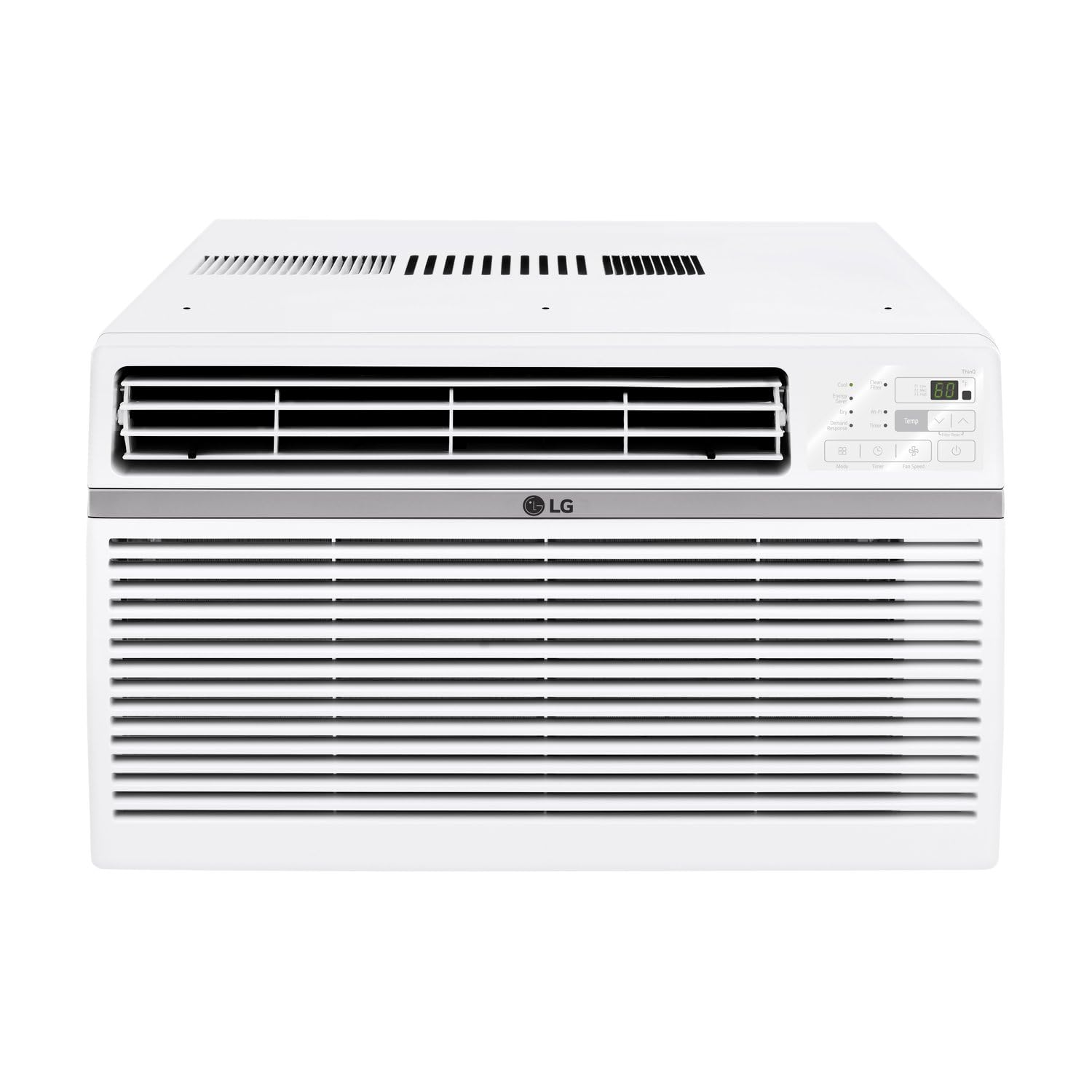
The living-room step-up — 350 square feet of real cooling power.
Once you get past 250 square feet, 5,000 and 6,000 BTU units run out of headroom. This LG jumps to 8,000 BTU and covers rooms up to 350 square feet — think a 14-by-25 living room or an open kitchen area. It runs on 115V, so it plugs into a normal outlet, and the auto-restart feature brings the unit back on with your last settings after a power blip. What owners love most is the build quality: the machine feels solid and the manufacturing holds up under constant summer use.
On cooling, shoppers say real temperature swings. One watched an 81°F room drop to 73°F in under an hour. Another kept a 1,000 square foot mobile home at mid-70s when it was 95-100°F outside, then bought four more for rentals and a shed. The 3 cooling and fan speeds plus Auto Cool mode give you full control — turn it to full for a hot afternoon, drop it to low for bedtime. You also get a remote and a washable filter, and the “Clean Filter” reminder light prompts you when it needs a rinse.
Two honest caveats. First, the noise is genuinely mixed — some owners describe it as quiet, others say it is loud enough to notice during conversation. That variability is normal in window units of this class. Second, it is heavy. Setup can require a second pair of hands or a support brace bar, and one owner found the printed instructions unclear even after a smooth install. Auto-restart is a real bonus when the power flickers.
What the reviews keep agreeing on: Quality is the thing owners praise most, followed closely by raw cooling performance — two things that rarely go hand-in-hand at this price tier.
The reality check: Noise is the mixed variable. If you are a light sleeper, plan to run it on lower speeds at night.
This is the one for: Medium living rooms and open floor plans where you need real cooling headroom.
Pass it up if: You want whisper-quiet operation for a bedroom — the noise feedback here is genuinely split.
6. Frigidaire 10,000 BTU Window Air Conditioner

Six-way airflow and 10,000 BTU built for a whole living room.
When you are cooling a genuine living room — 450 square feet — this is the class to be shopping in. The Frigidaire runs 10,000 BTU and pushes air in six directions, so you can aim it toward the sofa or bounce it off a wall instead of blasting one spot. Owners consistently say the airflow is the star: one watched a 420 square foot house drop from 78°F to 72°F in an hour on Low. That is real cooling without running the compressor flat out.
Frigidaire packed this unit with the modes that make daily life easier. Eco Mode cuts power when the compressor does not need to run. Sleep Mode gradually raises the temperature overnight so you do not wake up shivering at 4 a.m. You also get a 24-hour on/off timer to match your schedule and Dry Mode to pull excess moisture out of the air — a real difference in humid climates. At 53 dBA on low, it stays quiet enough for a living room, and the Clean Filter alert tells you when to rinse the washable filter.
The honest trade is loudness at the top end. Some owners find it noticeably loud on high fan, and a few report settings that froze or broke after months of use. The majority run it for years — one owner has had theirs working perfectly since two summers ago — but a small number of units have failed within a few months and needed warranty help through Frigidaire. Test it thoroughly in the first weeks after install. The control panel defaults to Eco mode on power-up, and one owner noted the room felt warmer than the display suggested when Eco plus Auto were both on.
What keeps owners coming back: Raw performance is what owners gush about most, with cooling performance right behind. That pairing is why this size class stays popular for whole-house cooling on a single floor.
The honest limit: On its highest fan setting, it makes itself heard — expected for a 10,000 BTU machine working a large room.
Buy it if: You are cooling a large living room or open floor plan and want airflow you can aim.
skip it if: Budget is the main constraint — you can cover a small room for a fraction of the cost.
7. hykolity 12,000 BTU WiFi Window Air Conditioner

12,000 BTU you can turn on from the parking lot.
This 12,000 BTU unit cools up to 550 square feet, so it handles a large bedroom or open living area. It uses an inverter compressor (a variable-speed compressor that adjusts cooling instead of switching on and off) for steadier cooling. It connects to your phone through the SmartLife app, so you can chill the room before you walk in. Sensors and scheduling add convenience, but the biggest win is arriving home to a room that is already cold instead of waiting 30 minutes.
The specs back up the pitch. Set temperature anywhere between 61°F and 88°F, choose from three fan speeds including an automatic setting, and pick between cooling, dry, fan, and auto modes. Eco Mode saves energy while Sleep Mode adjusts temperature through the night. The washable, reusable filter keeps maintenance simple. The timer runs from half an hour to a full day so you can schedule cooling precisely. It installs in double-hung windows 26-36 inches wide and at least 16 inches high. Owners say it cools warm rooms fast and holds temperature steady — one ran it in a 240 square foot desert room at 100°F without tripping a breaker.
Two things worth knowing before you commit. First, it is heavy at around 60-plus pounds, so bring a helper for install. Second, the controls take a learning curve — buyers report the four fan speeds feel similar to each other and the unit cycles on and off every 15 minutes or so after reaching its target. That cycling is how inverter units behave, but it feels odd if you have never owned one. There is also the risk that comes with any 12,000 BTU appliance: it will not run on a shared or weak circuit.
Why owners keep recommending it
- Covers 550 square feet on a 115V standard outlet
- App and voice control let you pre-cool before arriving home
- Inverter compressor holds a steadier temperature than a basic unit
- Runs on Eco Mode when you are not home to save power
Where buyers ask for more
- Around 60-plus pounds — plan for two people to install
- Four fan speeds can feel nearly identical in practice
- The 15-minute cycling takes some getting used to
The smart-living pick: If you want app and voice control plus enough power for a large room, this delivers both.
The alternative: If you would rather not depend on an app, choose a model with a remote-only interface.
8. Frigidaire 8,000 BTU Smart Inverter Window Air Conditioner
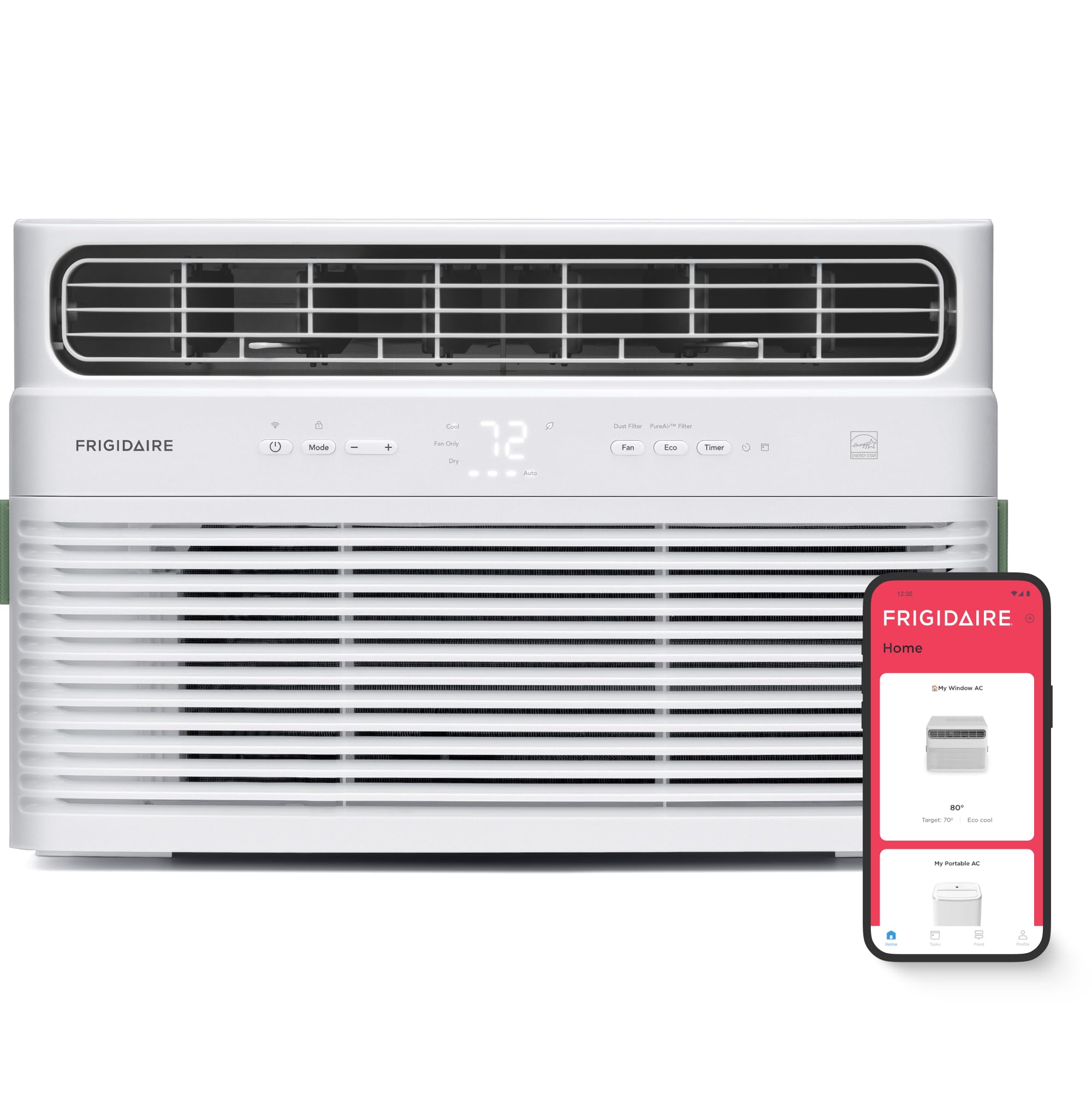
Inverter technology turns bedroom cooling into near-silence.
The defining spec here is the inverter compressor. Unlike the on-off compressors in cheaper units, an inverter varies its speed continuously, which means it holds a steady temperature instead of swinging up and down. One owner measured the difference the old way: their previous unit fluctuated 7-8°F, while this Frigidaire maintains a constant temperature. It is also Energy Star certified and, per the spec sheet, stays lighter and quieter than a standard 8,000 BTU unit — no wall vibrations even at full speed.
Square footage is 350, so this fits a bedroom, a home office, or a small living room. You get a 24-hour on/off timer, Dry Mode to strip moisture from the air, three fan speeds, and 6-way directional airflow. Wi-Fi plus Alexa and Google Home support let you control it hands-free. Owners mention installs taking as little as 15 minutes, and one notes the phone app lets you adjust temperature from the couch — useful when you want to cool the room before bed without getting up.
The Frigidaire inverter runs different from a traditional AC in one way worth naming: it does not have that satisfying “kick on” blast of cold. It just holds the target quietly for hours. If you grew up with window units, that peaceful steadiness may feel strange at first. There is also a rare failure to know about — one owner reported theirs stopping after two months and struggling with warranty service — but honestly, that is the same risk profile as any new appliance. The 4.3 rating holds up.
Ideal for: A bedroom or office where constant, quiet cooling matters more than raw cooling speed.
Not the one if: You want the lowest upfront cost — a standard non-inverter unit costs noticeably less.
9. Midea 8,000 BTU U-Shaped Smart Inverter Window AC
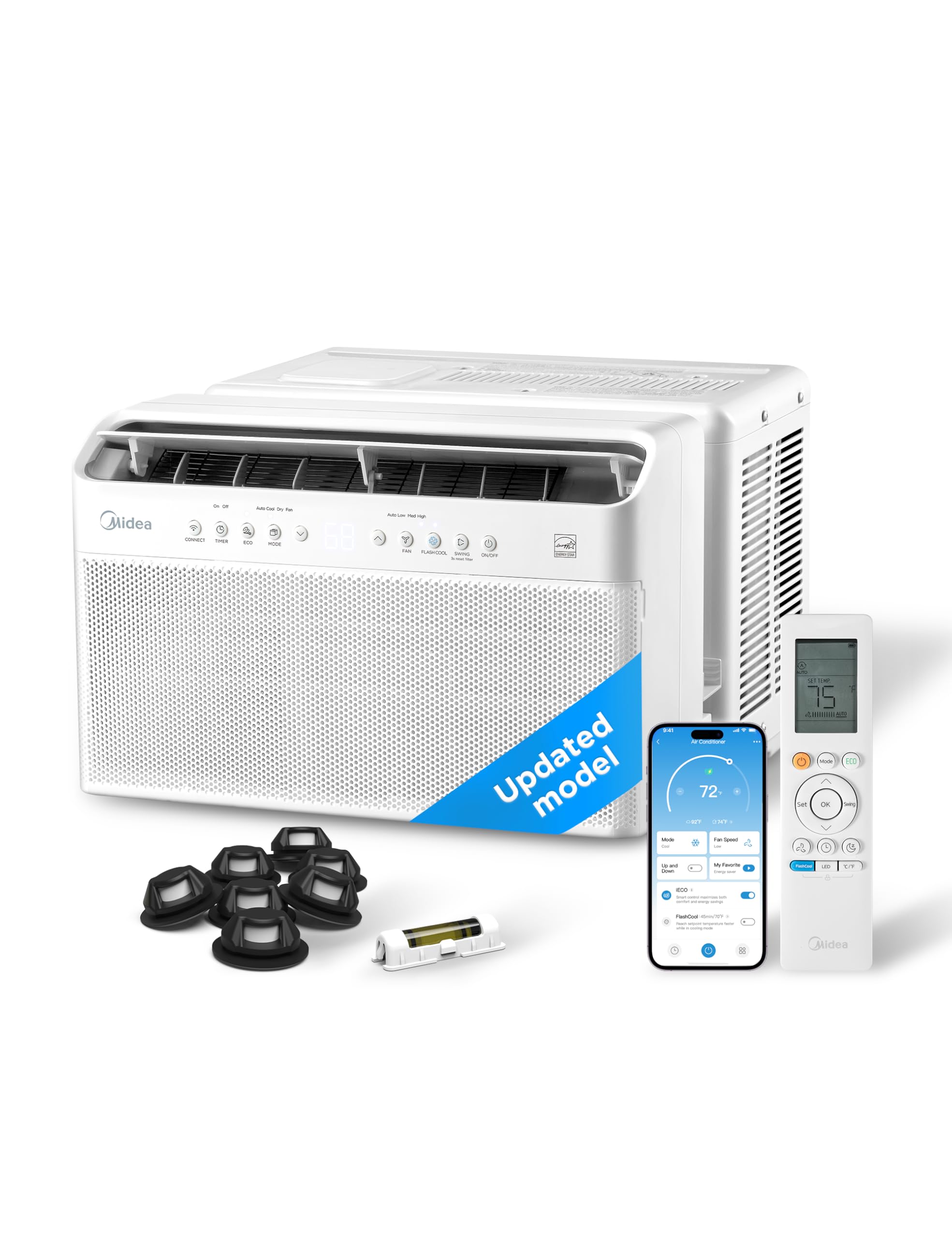
A U-shaped wonder that lets your window still open and close.
This unit solves a problem no other AC on this list can: it keeps your window working. The U-shaped body wraps around the sill, so you can still open the window for fresh air, and you keep more of your view. An anti-theft mechanism locks the window closed for safety. Setup uses a quick-snap bracket and sidearms instead of screws. That design novelty is not a gimmick — it is the whole reason people choose the Midea U over everything else.
The inverter compressor runs at noise levels as low as 32 dBA (roughly a whisper), quiet enough to sleep or watch TV through. Midea claims this unit runs 10x quieter than traditional window units. Midea credits the DC inverter with over 35% energy savings versus traditional units and says this was the first window AC to earn Energy Star certification. Wi-Fi plus Alexa and Google Assistant let you control it by voice from anywhere in the house. The 8,000 BTU model covers 350 square feet.
The honest issue with the U-shape is drainage. The tall rim design that makes the shape work also traps water, and one owner reported mold developing in the drain area, ultimately becoming a health concern, while several report the drain plugs fit loosely and need attention. If you live in a high-humidity climate, inspect and clear the drain monthly. The upside is real: owners running theirs since 2018 still call it whisper-quiet and functional, and the window keeps letting light in. Weigh the drainage upkeep against the light and airflow you gain.
What everyone notices: Noise is the standout — owners consistently describe it as whisper-quiet, and that includes people who have owned standard window units. The U-shape design is what they rave about most.
The caveat to plan for: The drain area collects water. Clear it routinely to keep the unit healthy.
Top pick for: Anyone who will not give up their window view or fresh air for cooling.
The caveat: Budget extra effort for drain maintenance and inspect the plugs on arrival.
10. ROVSUN 12,000 BTU Inverter Window Air Conditioner
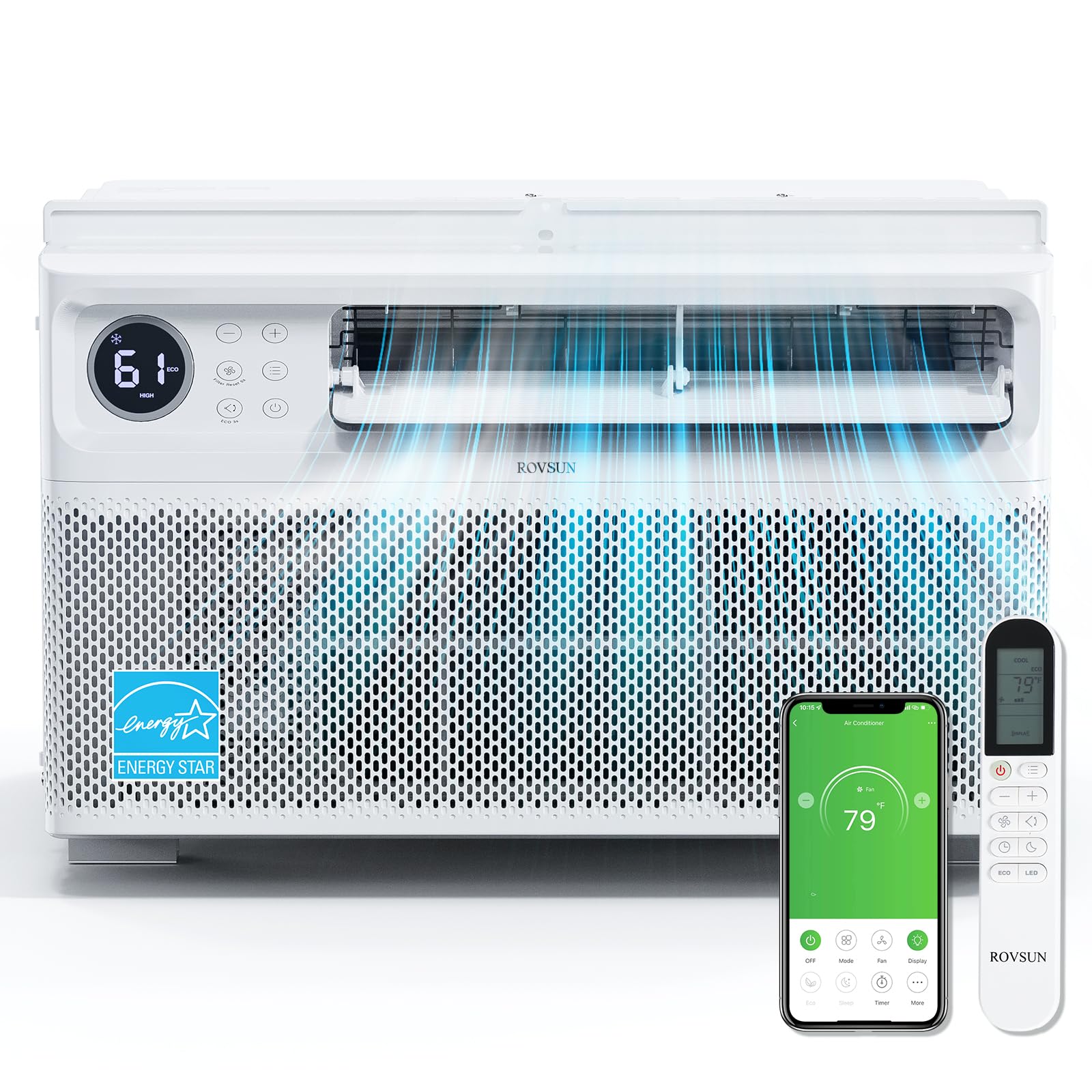
The fastest-cooling inverter in this list — 42 dBA silence at 12,000 BTU.
This unit cools a large room fast while staying quiet. The 12,000 BTU compressor covers up to 520 square feet, so it suits a big living room or open-plan space. Its CEER (Combined Energy Efficiency Rate — the higher the better) is 15.0, clearly ahead of most units in the category, which means lower running costs. The inverter is credited with 35% more energy savings than traditional units, and it carries a 5 Star energy rating. Wi-Fi plus Alexa and Google Assistant work fully here — voice commands to turn on and adjust temperature.
The ultra-quiet pitch is real from owners. One owner measured 42 dBA in sleep mode. Users also report their light bill dropped noticeably after switching to this model. The 4-way swing function lets you direct cold air where you want it. The pre-assembled side panels save install time, and the kit works with double-hung windows between 25 and 36 inches wide and at least 14.5 inches high. Owners who operate it correctly — starting it before the peak heat of the day — report consistent cooling.
The honest risk here is more visible than most of the picks above. A couple of users have hit a P8 error code within days of install, and one had to call an HVAC tech for service. The brand name is also less established than the big three, so repair support can be slower. That is a real-world trade for the high efficiency and low noise. Two owners bought a second unit after loving the first, which tells you most units work fine — but test yours thoroughly within the return window before committing to it for the summer.
Where the value shows up
- 15.0 CEER efficiency is among the highest here
- 42 dBA sleep mode — very quiet for the BTUs delivered
- Inverter compressor handles steady cooling without cycling hard
- Meets 5 Star energy standard with full Alexa and Google support
How to buy it safely
- Occasional P8 error codes reported within days of install
- No-name brand means slower repair and warranty support
- Setup needs sill adjustments on non-standard windows
The high-efficiency pick: Best for a large room where you want the lowest electric bill over the summer.
The risk note: Test it within the return window — service support is the trade for the efficiency.
11. BLACK+DECKER Window Air Conditioner 12000 BTU BD12WT6

12,000 BTU of whole-floor coverage with a name you already know.
This is the biggest cooling machine in the group at 12,000 BTU and 550 square feet, and the one that covers a master bedroom plus an adjoining bath or an entire open floor. Four fan speeds — auto, low, medium, and high — give you dial-in comfort. The full-function remote controls every setting, plus sleep mode, energy saver, and a 24-hour timer. It uses R32 refrigerant, which has zero ozone-depletion potential. The accordion side panels make it an easy install in double-hung windows from 23 to 36 inches wide and as low as 15.5 inches high.
What owners praise most is the raw cooling power and how much coverage one unit delivers. One owner watched it cool a 1,000 square foot first floor plus a 1,000 square foot basement by running the furnace fan — replacing failed swamp coolers and skipping a central air install. Others report noticeably lower electric bills after switching to this unit. Cooling, reliability, and quality all rank high in owner feedback, and a year-of-use report confirms the machine keeps running long after the honeymoon.
The real caveat is the amps. This is a 12,000 BTU appliance running on 115V, and it pulls serious power when the compressor kicks in. Owners with older wiring have flagged the risk of tripping a breaker. If your outlet shares a circuit with a kitchen appliance or a space heater, isolate it before summer. A handful of units have arrived with factory-dented side grates — cosmetic only, but worth inspecting. Otherwise this is the pick for anyone who wants the biggest room in the house cool without a whole-home system.
Choose this if: You need cooling across a whole floor or an open-plan space, and you want a name-brand unit backed by a broad review base.
Check first if: Your outlet shares a circuit — this one draws the most power of any pick here.
Understanding the Specs
BTU and Room Size
BTU (British thermal units) is the cooling power rating. A 5,000 BTU unit typically handles small rooms, a 12,000 BTU machine covers a large living area — often up to 550 square feet. Picking the right BTU matters more than any other spec. A unit that is too small never gets ahead of the heat, and one that is oversized cycles on and off without properly removing humidity.
CEER and Your Electric Bill
CEER (Combined Energy Efficiency Rate) is the number that decides how much your summer electric bill climbs. The higher the CEER, the more cooling you get per watt used. A model with an 11.0 CEER runs cheap; a 15.0 CEER model — if the rating and the 5 Star energy mark hold up — will cost noticeably less to run over a season. Efficiency is where the long-term savings hide.
FAQ
What is the difference between 115V and 120V window air conditioners?
Can any of these window ACs run on a standard wall outlet?
What size window do I need for a 120V window AC unit?
How many BTUs do I need for my bedroom size?
Is a window AC unit with a mechanical dial better than a digital one?
Why do some window AC units cost more than others at the same BTU?
Do I need a dedicated circuit for a 12,000 BTU window air conditioner?
How often should I clean the filter on a window air conditioner?
Will a 120V window AC unit dry out a humid room?
Can I leave a window AC unit installed all year?
Final Thoughts: The Verdict
For most people shopping for a 120v window ac unit, the winner is the Midea 5,000 BTU EasyCool. It pairs a strong CEER 11.0 efficiency rating with proven small-room cooling on a standard 115V outlet — the money-saving balance most bedrooms actually need. If you want a precise digital thermostat and a remote in a slightly larger room, grab the GE 6,000 BTU Electronic. For cooling a genuinely large living room with airflow you can aim, the Frigidaire 10,000 BTU is the one to reach for — and if keeping your window view and fresh air matters most, the Midea U-Shaped 8,000 BTU is the only pick here that lets your window still open. Match the BTU to your square footage, measure your window opening, and check your outlet before you buy — those three steps will save you more frustration than any feature on this list.
How We Picked
We do not accept paid placement. Every pick is matched to a real buyer and a real use-case; we do not hands-on test units.
Sources & Methodology
Specifications: manufacturer listings and product documentation. Review insights: verified customer reviews, as of September 2026. Pricing: not shown on this page (it changes often); check the current price via the retailer link.
As an Amazon Associate, KitchPrep earns from qualifying purchases. This does not affect which products we feature.
Related Guides
