
Specs are compiled from manufacturer listings and verified buyer reviews and can change over time — please confirm the key details on the product page before buying.
If your portable band saw is snapping blades mid-cut, the blade is usually not the problem — the wrong tooth count for your metal thickness is. A fine 24 TPI blade (24 teeth crammed into every inch of blade) chews through thin conduit and exhaust pipe cleanly, so you get clean cuts without jagged edges. A variable 10/14 TPI blade (thicker teeth spaced out across the length) is built for solid stock, so it powers through thick metal without stalling. Grab the wrong one and you will rip the teeth off in a handful of cuts. This guide sorts eight real metal-cutting band saw blades by what they actually fit, how long they last, and which metal thickness each tooth pattern is made for.
I’m Mohammad Maruf — the founder and writer behind KitchPrep. This guide is built by comparing the manufacturers’ published specifications and the patterns across verified customer reviews, so you get each pick’s real strengths and trade-offs instead of marketing spin.
Blade length and width decide whether a blade even mounts on your saw, so measure your old blade before you buy anything. The picks below cover compact 27-inch saws, full-size 44-7/8-inch saws, and everything in between, and you can scan every winner in one place with these band saw blades for metal picks.
Our Picks at a Glance

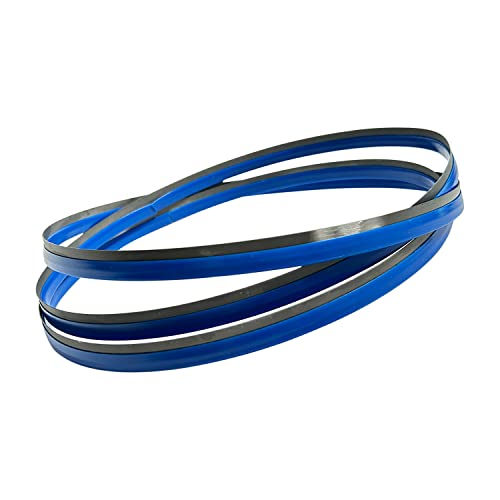
How To Choose The Best Band Saw Blades for Metal
Every metal-cutting blade decision splits into three questions: will it physically mount on my saw, is the tooth count right for the metal I cut, and is the steel good enough to survive the heat.
Match the blade to your saw before anything else
A blade that does not fit is useless no matter how good the steel is. Compact saws like the DeWalt DCS377 and the Milwaukee M12 sub-compact take a 27-inch blade. Mid-size saws take a 32-7/8-inch blade or a 30-9/16-inch blade depending on the model. Full-size portable saws and benchtop machines typically take a 44-7/8-inch blade, and stationary 7 x 12 saws use a 93-inch blade. Measure your old blade or check your saw’s manual — buying the wrong length is the number-one return reason in this category.
Then pick the tooth count for your metal thickness
TPI stands for teeth per inch — more teeth means a finer cut that suits thin-wall material. A 24 TPI blade slices thin conduit and exhaust pipe without snagging. An 18 TPI blade sits in the middle, handling both thin stock and harder material. A 14 TPI or variable 10/14 TPI blade has thicker, wider-spaced teeth built for solid bar, thick-wall tubing, and tall shapes. The practical rule: keep at least two or three teeth touching the metal at all times. Too few teeth touching and each tooth grabs too much metal and chips.
Variable pitch versus straight pitch
A variable-pitch blade like 10/14 TPI alternates between a coarser and a finer tooth spacing along its length. That variable pattern breaks up the vibration that causes chatter on thick or hollow shapes, which is why so many blades for metal list a range instead of a single number. Straight-pitch blades like 14 TPI or 18 TPI are simpler and cheaper, and they cut cleanly as long as you match them to the material. If you cut a mix of thin tubing and solid bar with the same saw, a variable blade does more jobs.
Why blade steel matters more than price tier
Bi-metal blades weld a hard high-speed steel tooth strip to a flexible alloy backer — the teeth hold their edge while the backer flexes around the wheels without cracking. M42 grade steel and Matrix II with 8% cobalt are the two names you will see most in metal-cutting blades. A blade with a harder tooth edge and a fatigue-resistant backer simply survives more cuts before the teeth round off. That backer fatigue is exactly why band saw blades snap rather than wear out — the steel fatigues at the weld before the teeth go dull.
Quick Comparison
| Model | Best For | Length | Width | TPI | Amazon |
|---|---|---|---|---|---|
| Imachinist S933414 M42★ Best Overall | Stationary 7 x 12 saws cutting thick stock | 93″ | 3/4″ | 10/14 | Amazon |
| FOXBC 27 Inch band saw blades for metalTop Performer | Compact DeWalt and Milwaukee M12 saws | 27″ | 1/2″ | 18 | Amazon |
| FOXBC 44-7/8 Inch 10/14 TPIMost Versatile | Full-size saws on mixed thin and thick metal | 44-7/8″ | 1/2″ | 10/14 | Amazon |
| Milwaukee 48-39-0531 | Fast clean cuts on thin stock | 44-7/8″ | 1/2″ | 24 | Amazon |
| DEWALT DW3982C | Chainlink posts and structural shapes | 32-7/8″ | — | 14 | Amazon |
| Milwaukee 48-39-0631 | Stainless steel and extreme metals | 30-9/16″ | — | 12/14 | Amazon |
| Bosch CBS1418 | Conduit runs and mixed metal work | 28-7/8″ | — | 14-18 | Amazon |
| LENOX Tools 8010738PW145 | Repair and fab shops cutting all day | 44-7/8″ | 1/2″ | 14 | Amazon |
In‑Depth Reviews
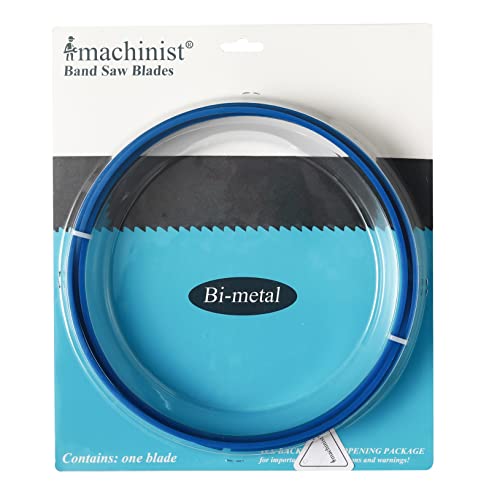
1. Imachinist S933414 M42 93″ X 3/4″ X 10/14tpi Bi-Metal Metal Cutting Band Saw Blades
Our pick — over 4.5★ from 600+ verified ratings; the strongest balance of quality and price.
A 93-inch shop blade that owners run dry for hundreds of cuts without losing the line.
This is a workshop blade, not a toolbox spare. At 93 inches long and 3/4 inch wide, it fits 7 x 12 bandsaws and any machine that takes a 93-inch, 3/4-inch blade — that size is what lets it run the long, stable cuts a benchtop saw is built for, so you can slice through solid stock without the blade wandering. The Imachinist is 3.4x longer and 3.0x wider than the compact FOXBC 44-7/8-inch blade further down this list, and that extra length and width is exactly what gives a stationary saw its stability on solid stock.
The 10/14 variable tooth pitch is the workhorse detail here. Ten teeth per inch at the coarse end hog through thick-wall tubing, and 14 at the fine end keep thin pipe and profiles from snagging. It is rated for soft ferrous metal, so mild steel, DOM tubing, and 4140 stock all fall into its lane. The all-steel M42 bi-metal construction — a hard high-speed steel tooth edge welded to a flexible backer — is what lets the blade flex around the wheels without cracking.
What owners talk about most is how it cuts. As one fabricator put it after a long run: “Made well over 400 cut of 2inch dom.250 wall without any coolant or cutting oil still extremely accurate and cuts straight.” Straightness in the kerf matters more than raw speed here — a blade that wanders means every cut needs cleanup, so you save time on finishing. Durability is the honest split in this blade’s story. Some run it for years of weekend work on plastics, aluminum, and stainless with the weld holding tight; others burn through a blade in a month in a production shop. Soft material and light feed pressure reward it. Abuse it on hard stock with heavy hands and it will not last like a premium Matrix II blade.
What earns its keep
- 10/14 variable TPI covers both thick tubing and thin profiles with one blade
- 93-inch length and 3/4-inch width deliver a stable, straight cut on stationary saws
- Bi-metal M42 construction resists heat without coolant for many owners
- Fits any saw that takes a 93-inch, 3/4-inch blade
What to weigh before buying
- Blade life is genuinely inconsistent — some units run for years, others go in weeks
- A few blades arrive with a bend or a weld that will not run true
- Runs less smooth than premium Matrix II blades on hard alloy steel
Grab this one if: you run a 7 x 12 or other 93-inch saw and want one variable-pitch blade that handles thick DOM and thin profile stock alike.
Look elsewhere if: you cut stainless or hardened alloy all day and need the longer life a cobalt Matrix II edge buys.
2. FOXBC 27 Inch Bandsaw Blades 18 TPI for DeWalt DCS377, Milwaukee 48-39-0572 Portable Band Saw Blade – 3 Pack
Three compact-saw blades with a 27-inch footprint that owners say fit like the factory original.
If you carry a DeWalt DCS377 or DCS375 compact saw, or the Milwaukee M12 sub-compact that takes the 48-39-0572 blade, this is the pack built for your tool. The 27-inch length and 1/2-inch width match that class of saw exactly. Each blade measures 0.02 inches thick — noticeably thinner stock than the 0.035-inch Imachinist above, which is exactly what a compact saw’s tighter wheel radius demands. FOXBC lists the blade for common materials 5/32 to 3/16 inch thick and very hard materials 3/16 to 5/16 inch thick.
The 18 TPI hook-tooth profile is the middle-of-the-road choice, and that is its strength. Eighteen teeth per inch cut thin-wall EMT and conduit cleanly, and the hook tooth does not clog on slightly heavier stock the way a 24 TPI blade can. These are bi-metal M42 high-speed steel blades, the same tooth material family as the premium picks on this list, so the edge holds up on steel and aluminum both. Three blades in the pack means you are not scrambling for a single replacement mid-job.
Buyers consistently call out the fit and the quality, and “Works better than the one that the tool came with for metal conduit” is about as direct as a recommendation gets. The healthy dose of cutting wisdom from the review pages applies to every blade here: “You can’t shove the thing down so hard. You’re ripping its own teeth off when you’re pushing too hard. Let the tool do the work.” Durability and sharpness split opinions — one long-time user found the original equipment blade better and skip-tooth blades faster than 18 TPI. On thin EMT, though, owners cut through in seconds rather than minutes.
Where it fits best: compact band saw owners doing conduit, chain, and light metal work who want a three-pack at a fair price and a blade that mounts without fuss.
The one snag: if you mostly cut solid stock or thick-wall pipe, the 18 TPI hook tooth will bog down where a coarser 10/14 TPI blade would fly through.
Best matched to: DCS377, DCS375, and Milwaukee M12 48-39-0572 owners who want a dependable three-blade rotation on thin metal.
Consider an alternative if: your work is thick bar and heavy tubing rather than conduit and thin profiles.
3. FOXBC 44-7/8 Inch Bandsaw Blades 10/14 TPI for Milwaukee 48-39-0551, DeWalt DCS374B Portable Band Saw, 44-7/8″ x 1/2″ x.020″, 3-Pack
One blade that fits eight different full-size saws and cuts anything from thin struts to thick plate.
Eight machines is the real headline on this pack. The list reads like a full-size saw roll call: Milwaukee 48-39-0551, DeWalt DCS374B, DCS376B, DWM120K, and DW328, Bosch GCB10-5, Makita XBP02Z, and Wen 94396 all take this 44-7/8-inch blade. That is the mid-size saw class balance — long enough for stability, short enough for the smaller wheels of a cordless frame, so you get smooth cuts without the blade slipping off.
The 10/14 variable pitch is the same workhorse tooth pattern the Imachinist uses, so it cuts cleanly from 3/16 to 5/16-inch thick metal and handles thin profiles too. Thickness comes in at 0.020 inches, and each box holds three blades. The blades are bi-metal M42 high-speed steel with a heat-resistant weld, the same premium tooth family found on the more expensive picks here. FOXBC also ships them in a rigid plastic container rather than a paper sleeve, which protects the teeth before they ever touch your saw.
Quality is the aspect owners land on hardest — it is the strongest recurring praise in the feedback for this blade — with cutting performance right behind on mild steel and stainless steel struts. The packaging gets its own call-out: “It comes not in a flimsy paper box but a plastic container. Glad I bought it.” Others simply report “It fit and cut just fine.” Value is the split point: some consider it an excellent deal for a three-pack, a few want more blade life for the money. For an entry to mid-level blade at an accessible tier, the cut quality wins the argument.
Made for: the full-size portable saw owner who wants one reliable blade to cover thin stuff and thicker metal without swapping tooth counts.
Think twice if: you burn through blades fast and would rather stock the premium cobalt edge the stationary-shop crowd favors.
4. Milwaukee 48-39-0531 Band Saw Blade Bi-Metal 24 Teeth per Inch 44-7/8-Inch

Milwaukee’s own Matrix II cobalt blade — the factory edge in a box, tuned for thin-stock clean cuts.
Twenty-four teeth per inch is the defining number, and it tells you exactly what this blade is for: fast, clean cuts through thin stock with a gullet that clears the chip instead of packing it in. Milwaukee lists it for materials up to 5/32 inch thick and very hard materials from 5/32 to 3/16 inch thick. The Matrix II high-speed steel teeth carry an 8% cobalt content — cobalt is what helps the tooth edge resist heat built up during a cut, which is the main way teeth lose their bite. An alloy steel backer handles the flex fatigue that eventually snaps any band blade.
Being the original-equipment brand carries weight here. It fits any portable band saw that runs the standard 44-7/8-inch x 1/2-inch x 0.020-inch blade — the same size class as the FOXBC 44-7/8-inch pack above, so the two are drop-in interchangeable on the same saws. One caution the manual will not tell you: tooth pattern has to match wall thickness, so a 24 TPI edge on heavy stock loads each tooth with too much metal and rounds it fast. Milwaukee sells this same blade in multiple tooth counts for exactly that reason.
Owners describe a blade that cuts mild steel box and angle without wandering, so you get clean edges on everyday jobs. The factory brand brings real loyalty — multiple reviews push the idea of stocking up on both a fine and a coarse pattern since blades wear out and different jobs need different teeth. A couple of units show a noticeable bump at the weld where it joins into a loop, which can cause a slight tick as the weld passes over the wheel. It is a small quibble on a blade with a strong track record. The 24 TPI fine cut is the star; a bushing or light cut with this blade is where it earns its keep, not on thick plate.
The factory-brand advantage: Milwaukee owners get the same tooth geometry the saw shipped with, and the 8% cobalt Matrix II teeth resist heat buildup on steel, aluminum, brass, copper, and iron.
Where it stops: the fine 24 TPI gullet wants thin metal — push it into thick bar and the teeth will die young.
Ideal for: anyone who wants the genuine Milwaukee tooth pattern and cuts thin stock like conduit, angle iron, and tubing on a full-size portable saw.
Skip this size if: your saw runs a 27-inch compact blade or a 32-7/8-inch blade instead.
5. DEWALT Portable Band Saw Blade, 32-7/8-Inch,.020-Inch, 14 TPI, 3-Pack (DW3982C)
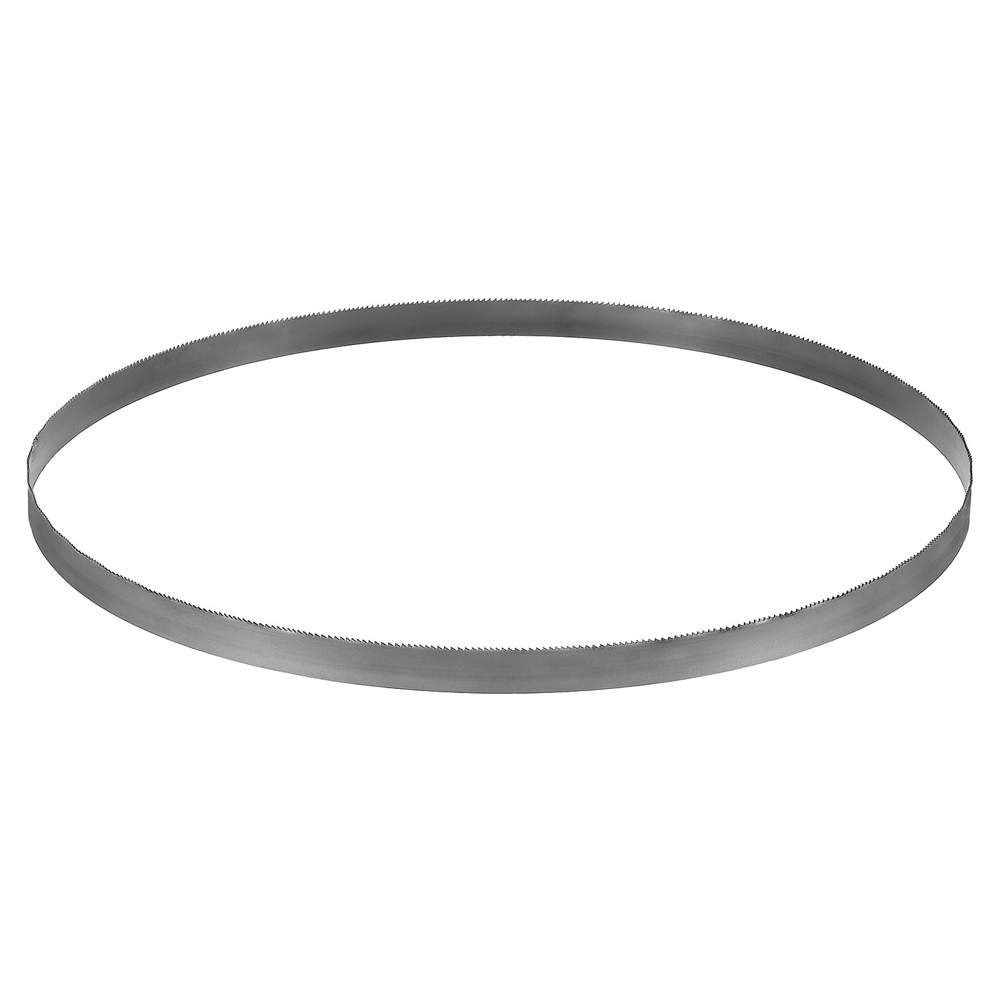
The coarser-tooth DeWalt blade for chomping through posts, toprail, and structural shapes.
At 14 TPI, this blade swings the other way from the fine Milwaukee 48-39-0531. Fourteen teeth per inch leaves a bigger gullet between teeth, so it clears heavy chips from thick stock instead of packing them in — exactly the blade for chainlink posts, toprail, and angle iron. The DW3982C runs 32-7/8 inches long and 0.020 inches thick, a length that suits the mid-size DeWalt portable frames and any saw calling for a 32-7/8-inch blade. The backer uses Matrix II high-speed steel with 8% cobalt for heat and wear resistance, and the alloy steel backer fights the fatigue cracks that end a blade’s life before the teeth even dull.
DeWalt backs the tooth edge hard on paper. The Rc 65-67 rating on the tooth hardness — Rc being the Rockwell C scale, a standard measure of how hard steel is — is a genuine spec for wear resistance rather than a marketing line. Harder teeth stay sharper longer on abrasive steel, and the 14 TPI spacing keeps them chewing.
The cutting physics come with a warning most owners learn the hard way. “Just check tpi for thickness of metal if you get the wrong ones it won’t cut but couple times and they’re shot,” as the review pages put it — matching tooth count to metal thickness is not optional, it is the whole game. Get it right and this blade does exactly what the box promises, with prompt delivery and quality that holds up. One practical frustration surfaced too: this is an oddball blade length, and hunting down the right size on a listing page takes patience. Measure before you order and that friction disappears. The 14 TPI spacing is happiest on structural shapes; on paper-thin metal it can snag.
Why it holds up to abuse
- 14 TPI gullet clears chips from thick posts, toprail, and angle stock
- Rc 65-67 tooth hardness resists wear on abrasive steel
- 8% cobalt Matrix II teeth and alloy backer fight fatigue cracking
- 32-7/8-inch length fits mid-size DeWalt portable frames
The practical catches
- An oddball blade length makes it harder to track down the right fit
- Fine-stock jobs will want a finer tooth count than this
- Tooth pattern must match the metal thickness or the blade dies fast
Choose this when: your daily work is chainlink posts, toprail, and structural steel on a mid-size portable saw that takes a 32-7/8-inch blade.
Look at a finer blade if: you mostly cut thin-wall tubing and conduit, where 14 TPI teeth will snag and hesitate.
6. Milwaukee 48-39-0631 30-9/16″ 12/14 TPI Compact Extreme Thick Metal Band Saw Blade 3 Pack

Milwaukee’s thick-metal specialist with a tooth geometry tuned for stainless and extreme alloys.
Stainless and thick metal are the two materials that kill ordinary blades fastest. Milwaukee rates it at 3x life in stainless steel and other extreme metals, 2X faster cuts in thin metals, and 25% more cuts per charge. Its 12/14 variable pitch is coarser than the 10/14 blades above — wider-spaced teeth that carry heat away from the cutting edge, which is what stainless demands. The 30-9/16-inch length and 12/14 TPI spacing set it apart from the 44-7/8-inch blades in this list, because it genuinely fits a different, more compact saw class.
At 30-9/16 inches, this blade covers compact saws — including brands like Ridgid’s brushless compact bandsaw, where owners fit these to cut conduit and unistrut after the stock blade gave up. The tune tooth design is built for clean cuts, and the three-pack format means fewer interruptions for blade changes. That is the practical advantage of a dedicated extreme-metal blade: you swap blades less often, even on the hard stuff.
Cut performance draws the praise. Owners cutting EMT and rebar describe a blade that goes through “like a hot knife through butter” and lasts a long time. Fitting issues can happen — one buyer found the size wrong for their saw and had to return it, which is why matching the 30-9/16-inch length to your saw before ordering matters. Get the sizing right and the durability claim holds. Milwaukee’s tooth geometry is doing the heavy lifting on stainless where a plain blade would round over fast.
The stainless edge: a 12/14 variable pitch carries heat away from the teeth on hard alloys, which is where ordinary blades fail first.
Know your length: at 30-9/16 inches this is a compact-saw blade — measure your frame before you order or it will not fit.
For you if: you cut stainless steel, tough alloys, EMT, and rebar on a compact saw and want a blade built for metal that eats ordinary edges.
Wrong pick if: your saw takes a full-size 44-7/8-inch blade — this compact length will not mount.
7. Bosch CBS1418 3 Pc. 28-7/8 In. 14-18 TPI General-Purpose Portable Band Saw Blades

A general-purpose variable-pitch blade built to cover steel, iron, and aluminum with one setup.
Bosch pitches this as a do-it-all blade, and the 14-18 TPI variable pitch is what makes that possible. It swaps between a coarser 14 tooth spacing for thicker stock and a finer 18 for thinner material along the same band, so one blade covers more ground than a single-pitch blade can. At 28-7/8 inches long, it fits many standard portable band saws, and the bi-metal construction takes Bosch’s advanced bonding technology — a welded joint between the cutting edge and backer that the maker strengthens for longer blade life.
Bosch claims 3x the life of standard portable band saw blades, with tooth geometry tune for steel, iron, aluminum, and other non-ferrous metal. Heat management is the silent win on any metal blade, and Bosch builds this one with premium metal meant to resist heat buildup so the teeth stay sharp longer. That is the same heat-fatigue principle every good bi-metal blade lives by.
Length of service is the dividing line in owner feedback. An electrician cutting pipe all day puts it bluntly: “I’m an electrician who cuts a lot of pipe and other brands don’t last as long. Band blades never get dull, they break apart before they wear out.” Others report blades still cutting after months and hundreds of conduit cuts, outlasting competitor brands on the same job. The counterweight is breakage — a few buyers see blades fail during installation, and stress cracks tend to creep in from heat and tool twist when the saw is forced. Use this blade with steady feed pressure and it delivers fast cutting and a clean finish; force it and the brittle edge pays you back with an early break.
Good fit when: you run conduit and mixed metal jobs on a standard portable saw and want one general-purpose blade to cover steel, iron, and aluminum.
Reconsider if: you want maximum thick-metal durability and would rather run a coarser dedicated extreme-metal blade.
8. LENOX Tools Portable Band Saw Blades, 44-7/8″ x 1/2″ x.020″, 14 TPI, 5-Pack (8010738PW145)

A five-pack of the blacksmith-shop favorite — 14 TPI teeth built to cut steel all day.
Five blades in one box is the move any high-volume shop makes, and this LENOX pack delivers exactly that. Each blade runs 44-7/8 inches x 1/2 inch x 0.020 inches — the same size class as the FOXBC 44-7/8-inch pack above, so this is a direct upgrade path for anyone who liked that fit and wants a nicer tooth. That is 3.0x the blade count of the single-blade Imachinist up top. The 14 TPI pitch suits general metal cutting, and the high-speed steel teeth keep a biting edge with LENOX’s Tuff Tooth design reinforcing each tooth against wear, so you spend less time swapping blades.
For a cutting edge that lives around steel every day, this blade earns its reputation. What wins people over is the build: a shatter-resistant bi-metal body that bends and flexes rather than shattering, and the Tuff Tooth reinforcement for a longer edge life. A five-pack also means the saw is never down waiting on a single replacement blade, which matters most in a shop running cuts back to back. The 14 TPI tooth spacing cuts through steel cleanly, and the same tip that saves every blade applies — let the tool cut, do not force the feed.
This is the blade for the blacksmith who has been buying it for years and cutting angle iron on the regular. Quality is the strongest praise in the feedback, with cutting performance close behind, and a long-running steel shop simply calls it “Best for cutting steel, hands down.” The honest wrinkle is at the weld: an occasional blade breaks right there where the band is joined, and a few find the edge dulls quicker than expected. That is the standard band-blade failure mode — the loop joint, not the teeth — and it is why serious shops keep spares on hand. With five blades in the box, one early weld failure does not stop the job.
What a shop gets
- Five 44-7/8-inch blades in one box keep the saw running
- Tuff Tooth design reinforces each tooth against wear
- Shatter-resistant bi-metal body flexes instead of cracking
- High-speed steel teeth hold a biting edge on steel and angle iron
Worth knowing
- An occasional blade breaks at the weld joint
- Some find the edge dulls quicker than premium rivals
- Finer or coarser tooth jobs will need a different TPI
Built for: the working shop that cuts steel and angle iron daily and wants a five-pack of dependable 44-7/8-inch blades on the shelf.
Not the fit if: you run a compact 27-inch or 30-inch saw — this full-size length will not mount.
Understanding the Specs
TPI (Teeth Per Inch)
TPI counts how many teeth sit in a single inch of blade — a 24 TPI blade packs 24 teeth into that inch, and a 14 TPI blade has 14 wider-spaced teeth across the same span. The more teeth per inch, the finer the cut and the better the blade handles thin metal like conduit and exhaust pipe. Fewer teeth per inch means bigger gullets that clear chips from thick stock. A variable pitch like 10/14 or 12/14 alternates coarse and fine spacing along the band, which reduces vibration on mixed or hollow shapes. The rule of thumb: keep at least two or three teeth in contact with the metal at all times. Too few teeth touching and each tooth grabs too much metal and snaps.
Bi-Metal Construction and Tooth Steel
A bi-metal blade welds a hard cutting tooth edge to a flexible alloy backer, so the teeth stay sharp while the backer flexes around the wheels without cracking. M42 high-speed steel is a common tooth grade, and Matrix II with 8% cobalt is the other name you will see — cobalt helps the tooth edge resist heat during a cut, which is how teeth lose their bite. The alloy backer matters just as much, since band blades famously snap at the weld before the teeth ever go dull. A fatigue-resistant backer and a heat-resistant tooth edge are what a long-lasting metal blade is made of.
FAQ
How do I know which blade length fits my portable band saw?
What TPI should I use for cutting thin metal tubing?
Can I use a wood blade to cut metal on a band saw?
How long should a band saw blade last when cutting metal?
Why do band saw blades break at the weld instead of wearing out?
What is the difference between 10/14 TPI and 14 TPI blades?
Do I need cutting fluid or coolant with a bi-metal band saw blade?
Will an 18 TPI blade cut through solid steel bar?
Are the blades in a multi-pack the same as buying singles?
How tight should a band saw blade be tensioned?
Final Thoughts: The Verdict
For most workshops, the band saw blades for metal winner is the Imachinist S933414 M42 because its 10/14 variable pitch handles thick DOM tubing and thin profiles with the same blade, and owners run it dry for hundreds of straight cuts. If you cut thin conduit on a compact saw, grab the FOXBC 27 Inch 18 TPI pack — it fits DeWalt DCS377 and Milwaukee M12 frames exactly. And for full-size saws cutting steel and angle iron all day, the LENOX 44-7/8-inch 14 TPI five-pack puts spares on the shelf before you need them. Match the TPI to your metal thickness and every blade here cuts cleaner and lasts longer.
How We Picked
We do not accept paid placement. Every pick is matched to a real buyer and a real use-case; we do not hands-on test units.
Sources & Methodology
Specifications: manufacturer listings and product documentation. Review insights: verified customer reviews, as of September 2026. Pricing: not shown on this page (it changes often); check the current price via the retailer link.
As an Amazon Associate, KitchPrep earns from qualifying purchases. This does not affect which products we feature.
Related Guides
