
Specs are compiled from manufacturer listings and verified buyer reviews and can change over time — please confirm the key details on the product page before buying.
If you are shopping for a large inverter generator, running watts matter more than peak watts. A unit rated near or above 12,000 watts can run a whole house, a fifth wheel, or a job site — but only if the power is clean enough for modern electronics and the outlets can feed your transfer switch without rewiring headaches. This list covers four machines that clear that bar, from a dual-fuel workhorse to a tri-fuel giant with automatic start. One quick note up front: these picks use flexible matching, so not every unit is the exact 12,000-watt number you typed. The nearest same-type size serves the same job, and we flag where each one lands.
I’m Mohammad Maruf — the founder and writer behind KitchPrep. This guide is built by comparing the manufacturers’ published specifications and the patterns across verified customer reviews, so you get each pick’s real strengths and trade-offs instead of marketing spin.
Whole-home backup is unforgiving, so the picks below are ranked by what they can realistically run, how clean that power is, and how loud the job gets done. The safest starting point for most households remains a low-THD 12000 watt inverter generator with transfer-switch-ready outlets.
Our Picks at a Glance
How To Choose The Best 12000 Watt Inverter Generator
Most first-time buyers shop by peak watts alone. Peak watts only matter for the split-second surge when a motor starts — like a central air conditioner compressor kicking on. What you actually live with is running watts, and those come in different numbers depending on which fuel you burn.
Peak Watts vs Running Watts
Peak watts are the short burst a generator can supply — good for starting a well pump or an RV air conditioner. Running watts are the steady number you can draw hour after hour. On these machines, the two figures drop noticeably when you switch from gasoline to propane, and again when you move to natural gas. Always size your critical loads against the running number for the fuel you plan to use most.
Total Harmonic Distortion and Clean Power
Inverter generators convert engine power into a smooth, stable sine wave, and THD tells you how close that wave is to pure. Lower is better. Units rated at 3% or below are safe for sensitive electronics like laptops, phones, and medical equipment. That clean signal is the whole reason to pick an inverter over a conventional open-frame unit in the first place.
Transfer Switch and Interlock Readiness
If you want to feed your home’s breaker panel instead of running extension cords through a window, you need an outlet rated to your panel’s inlet — typically a 120/240V 14-50R or a 30A twist-lock. A transfer switch or interlock kit keeps utility power and generator power from meeting. Match your outlet to your inlet box before you buy to avoid adapters and guesswork.
Sound, Fuel Tanks, and Run Time
Decibel ratings matter when your neighbors are close or you are sleeping upstairs. Eco Mode throttles the engine down as your load drops, which cuts both noise and fuel use. A larger fuel tank extends run time, but only at a given load — the lighter the load, the longer it stretches.
Quick Comparison
| Model | Best For | Gasoline Running Watts | Engine Displacement | Weight | Amazon |
|---|---|---|---|---|---|
| Westinghouse iGen12000DFc★ Best Overall | Whole-home backup on a budget | 9,000W | 457cc | 187.4 lb | Amazon |
| WEN TF1300iX | Tri-fuel flexibility for homes and EVs | 10,500W | 550cc | 246.9 lb | Amazon |
| GENMAX GM13500iETC | Unattended auto-start backup | 11,500W | 550cc | 273.7 lb | Amazon |
| DuroMax XP16000iH | Maximum raw output for large loads | 13,000W | — | 368 lb | Amazon |
In‑Depth Reviews
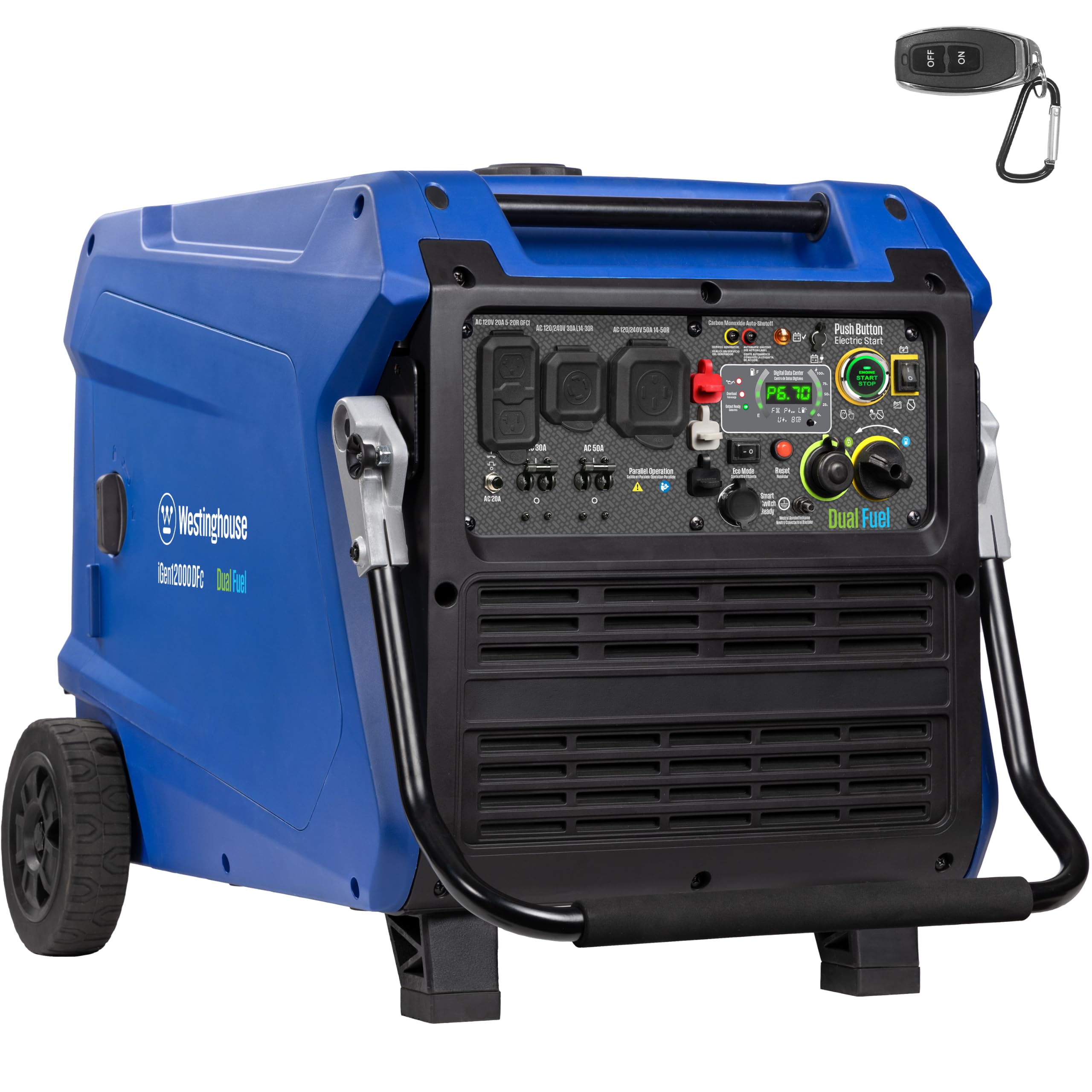
1. Westinghouse 12000 Peak Watt Dual Fuel Portable Inverter Generator
Our pick — 4.5★ from 150+ verified ratings; the strongest balance of quality and price.
The dual-fuel all-rounder that carries a whole fifth wheel without waking the neighborhood.
Start with the number that decides most purchases: 9,000 running watts on gasoline, which is the steady power you can draw continuously rather than the brief start-up spike. On propane that figure lands at 8,100 running watts. Either way, that is enough headroom for a household that pulls central air, lights, television, internet, and a security system at once.
What wins people over is how much load this thing carries while staying calm. It earns the top spot on a 4.5-star rating across hundreds of reviews, and buyers report a 38-foot fifth wheel running at roughly half load.
The second big draw is quiet. Insulation, mufflers, and Eco Mode — which slows the engine automatically as your load drops — keep it as low as 64 dBA, which is roughly the sound of normal conversation across a room. A heavy-duty 457cc four-stroke engine feeds a 7.9-gallon tank that stretches to about 19 hours at a quarter load, so an overnight outage is a non-event.
The Strong Points
- 9,000 gasoline running watts and 8,100 propane running watts, enough for a fifth wheel at half load
- 64 dBA floor and Eco Mode keep it neighbor-friendly
- Three outlets, including 120/240V 14-50R and L14-30R, all transfer-switch and interlock ready
- Remote key-fob start plus a digital display showing fuel, output, and remaining run time
The Trade-Offs
- At 187.4 pounds it rolls fine but still needs two people on stairs
- Break-in procedure is not spelled out in the box, so plan to research it first
Best for: households and fifth-wheel owners who want clean, transfer-switch-ready power from two fuel types without jumping to the top price tier.
Think twice if: your starter battery is your only power source at ignition and you need true unattended auto-start straight from the start.
2. WEN 13,000-Watt 120V/240V Tri-Fuel Inverter Generator with Quiet 550cc Engine
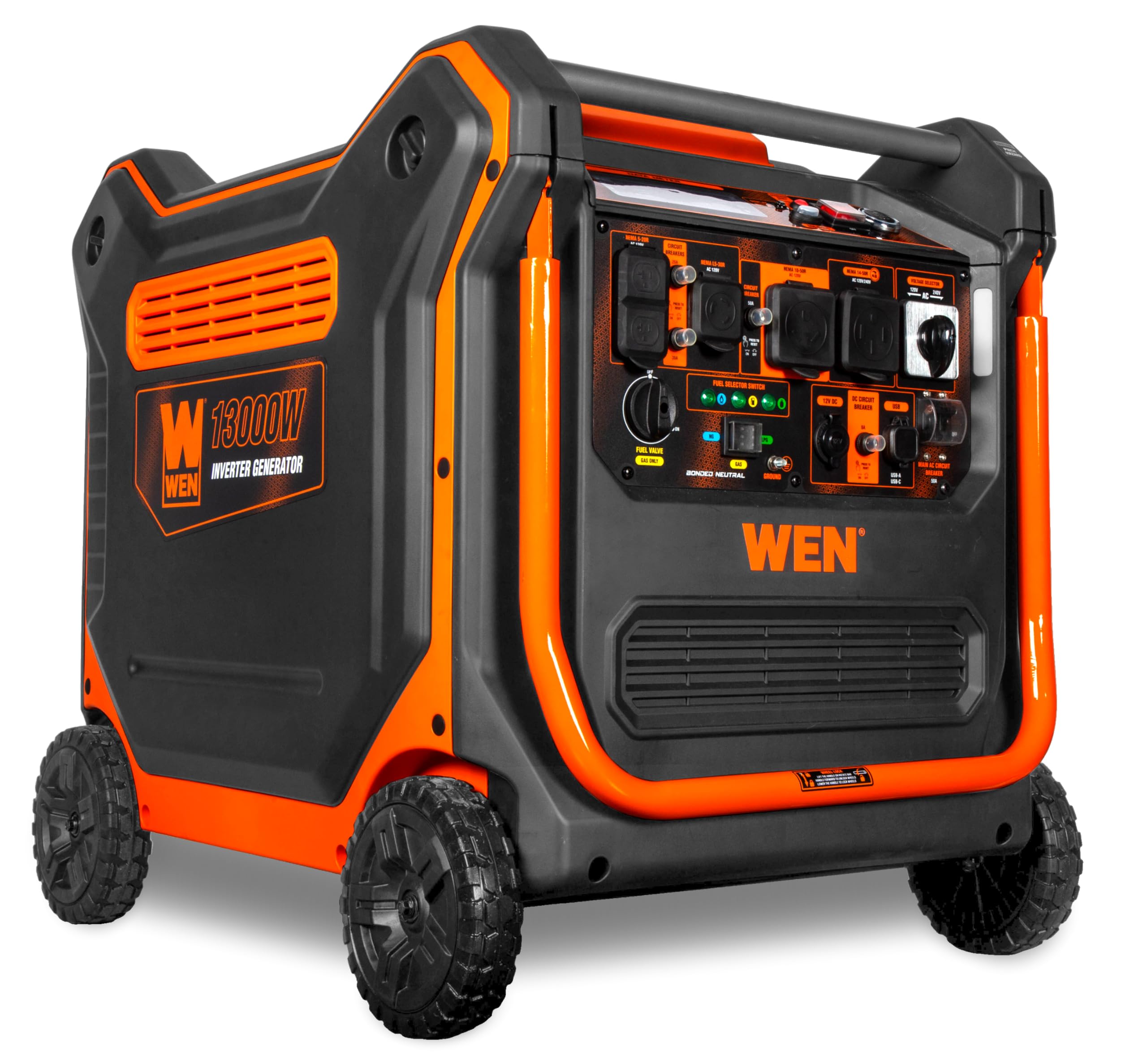
A three-fuel machine that runs the whole house on propane and barely clears a whisper doing it.
The appeal here is choice. Flip one switch and this generator runs on gasoline at 13,000 surge and 10,500 running watts, propane at 11,250 surge and 9,000 running, or natural gas at 10,000 surge and 8,000 running. If you already have a natural gas line plumbed to your house, that last option means you never run out of fuel mid-outage.
Where it separates from the Westinghouse above is the bigger 550cc engine — 550 cubic centimeters versus 457 — and the extra output that comes with it. The broader footprint shows up in displacement and running watts, which matters on load-heavy nights when you want every amp the machine can give. The trade is weight: at 246.9 pounds it is 59.5 pounds heavier than the Westinghouse, a real consideration if you are the one rolling it up a slope.
Run time on this one is shorter — up to 7.7 hours of half-load runtime on a 7.1-gallon tank — so if overnight stretch matters most, the Westinghouse pulls ahead. The bonded-neutral 120V/240V setup makes it a clean match for transfer switches, emergency backup, or Level 2 charging for an electric or hybrid vehicle. The WEN Watchdog CO Shutdown Sensor automatically kills the engine when carbon monoxide builds up, and the 120/240V 14-50R outlet is EV- and transfer-switch-ready as shipped.
Reliability is the honest question: the track record here is genuinely split — some machines run beautifully and some owners hit issues. For a machine at this price it is worth reading the full review history before you commit.
What helps: the unit ships with a 5-foot LPG hose, quick-connect adapter, and a three-year limited warranty, and reviewers call it “a beast of a machine.”
Reach for this if: you want three fuel sources, natural-gas capability, and EV-ready Level 2 charging in one unit.
Look elsewhere if: you need the longest overnight run time, since the tank here tops out near 7.7 hours at half load.
3. GENMAX 13500W Tri-Fuel Inverter Generator
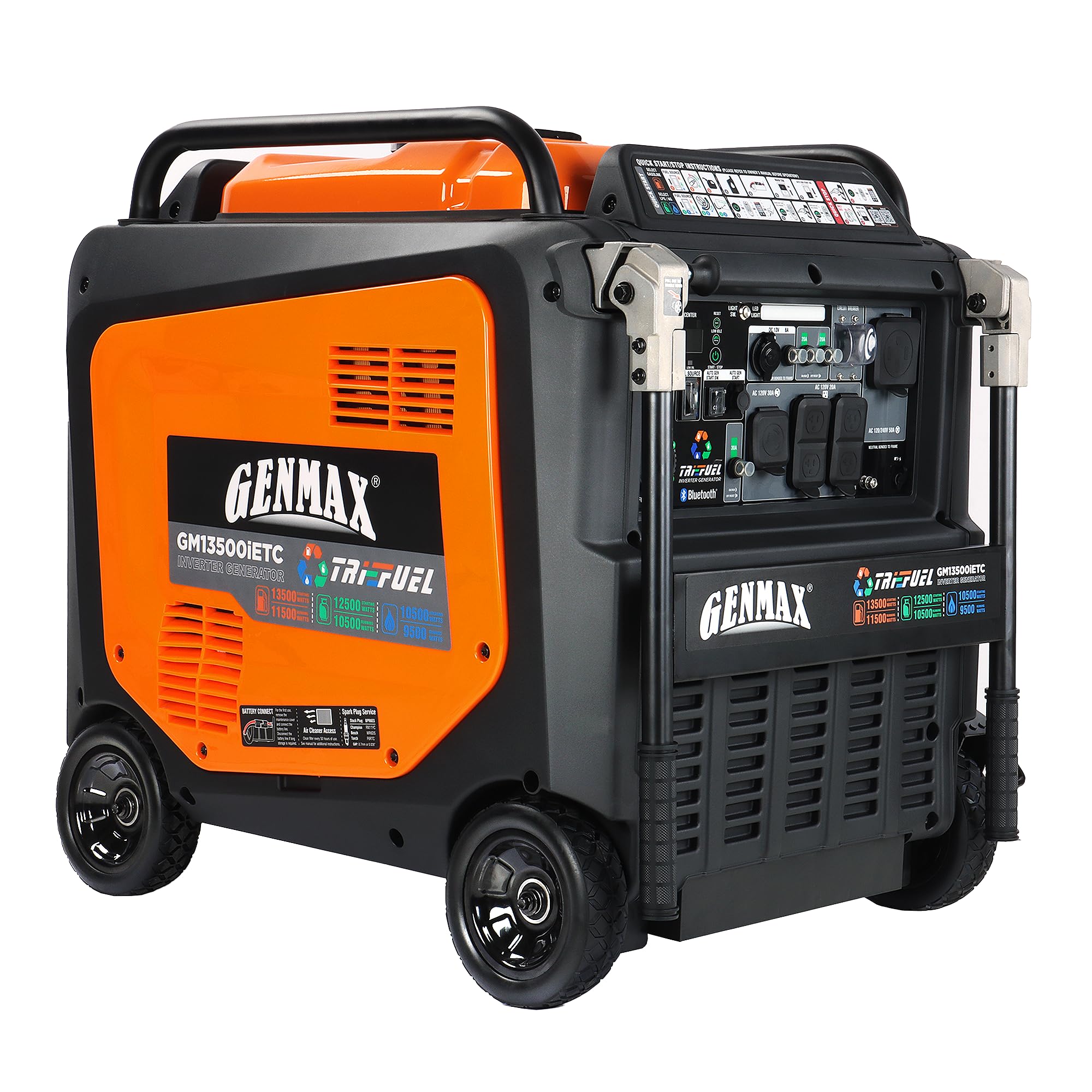
The tri-fuel unit that kicks on by itself when the grid drops, no one at home required.
Count the starting options and you will see what separates this one: five ways to fire it up. That is push-button electric start, remote key fob, Bluetooth app control, recoil backup, and — the standout — ATS 2-Wire Auto-Start, which automatically cranks the generator when utility power drops. For unattended home backup, that last feature is the whole point.
On raw output this one leads the pack. On natural gas it delivers 9,500 running watts against the WEN’s 8,000, a difference you feel when several large loads switch on together. Propane running watts land at 10,500 versus 9,000 on the WEN, and gasoline running watts hit 11,500. The 550cc engine matches the WEN’s displacement, so the extra output is coming from tuning, not a bigger block.
Runtime is the strongest here too — up to 11.2 hours on a 6.9-gallon tank at 25% load, extended by Eco Mode, which trims engine speed to the load and drops noise to 62 dB(A), about the level of a normal conversation. It runs clean at 3% THD or below, so laptops, phones, and sensitive equipment are safe, and it carries a 14-50R outlet plus four GFCI household outlets and L5-30R. A built-in soft LED light illuminates the control panel for night starts, and a CO Shield shutdown system guards against carbon monoxide.
What earns the praise: the functionality is the most-cited strength on this one, and the Bluetooth app is a well-loved specific — remote monitoring and remote starts from inside the house.
The weighty reality: 273.7 pounds means you plan where it lives, not where you carry it. It is on the heavy side, but the handles and folding handle design make short moves manageable.
Best suited to: homeowners who want genuine set-and-walk-away backup, with the automatic start and natural-gas option doing the work while they sleep.
Skip if: you need to move the generator between job sites by hand on a regular basis.
4. DuroMax XP16000iH 16,000-Watt Dual Fuel Portable Digital Inverter Generator
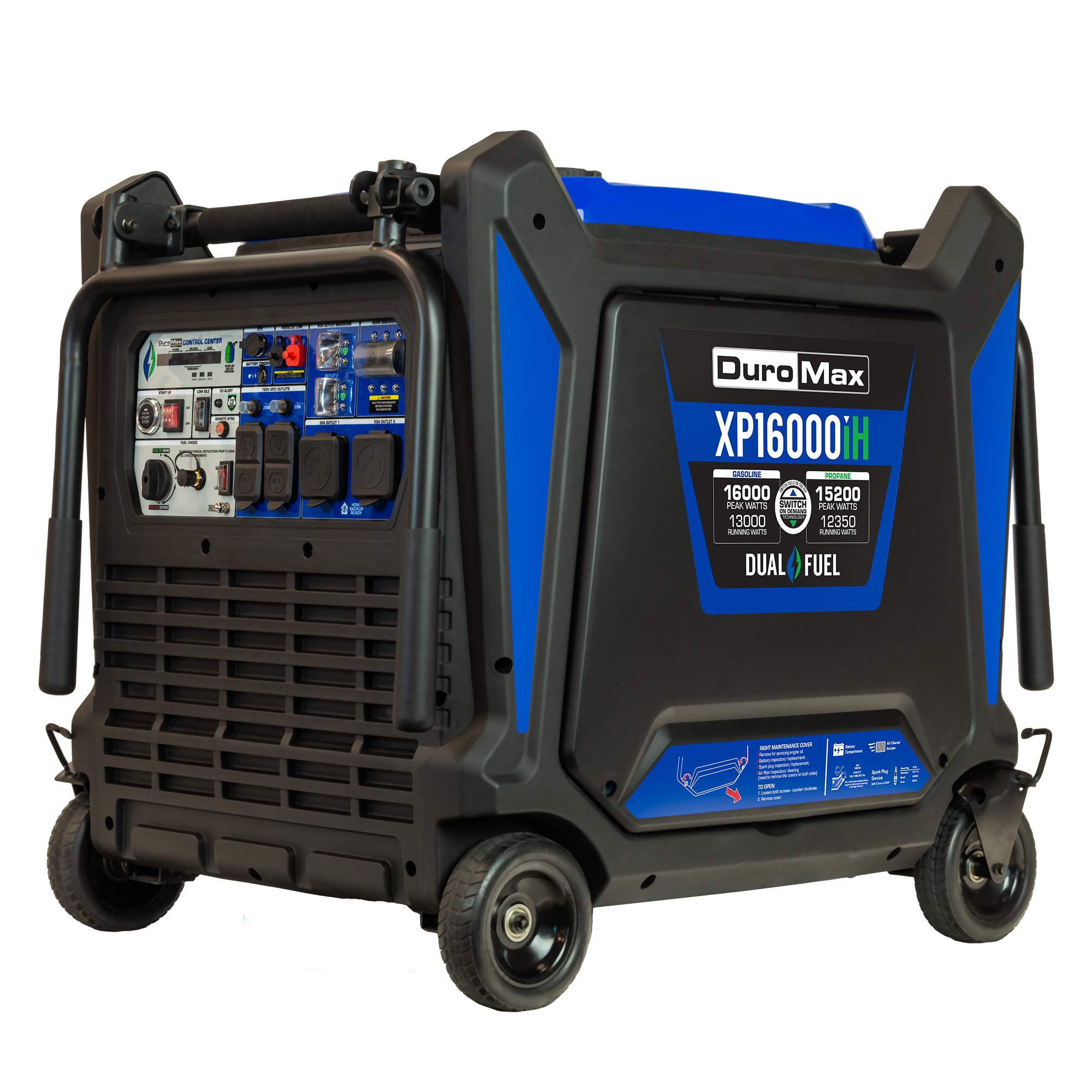
Peak output that flattens the rest of the field, with the weight to match.
If you need maximum headroom, this is the biggest number on the list. It pulls 16,000 peak watts and 13,000 running watts on gasoline, backed by a 16-kilowatt engine. That is the highest running figure here, clearing the GENMAX at 11,500 and the Westinghouse at 9,000. For a mobile sports bar, a large jobsite, or an enormous house, the surplus matters.
Clean inverter power runs sensitive gear safely, and the machine carries its own rechargeable battery — a battery tender keeps the starter battery topped off so it fires at a moment’s notice. Remote start is included, low-oil shutdown protects the engine automatically when oil runs low, and the digital control center shows hours run, voltage output, and load level at a glance. It complies with EPA and CARB emissions standards.
This is also the pick that needs the most care in picking the right buyer. It is rated 3.6, and at 368 pounds — the heaviest unit here — it is a two-person move. Some owners mention eight to twelve hour non-stop commercial runs; a few report early mechanical problems. Treat this one as a serious investment that deserves a conversation with the seller before you commit.
Strong Points
- 16,000 peak and 13,000 running watts on gasoline — the highest output here
- Battery tender keeps the starter battery charged for reliable cold starts
- Digital control center plus remote start and low-oil shutdown
- EPA and CARB compliant for legal use in all states
Where It Needs Care
- Heaviest unit here at 368 pounds, so plan a permanent home for it
- Mixed reliability across the ownership base, so inspect and break in carefully
For the buyer who needs it: an operator whose loads sit near or above 12,000 running watts, and who wants the physical battery management and remote start from the start.
Look elsewhere if: portability is a workflow requirement — the Westinghouse above is less than half the weight.
Understanding the Specs
Surge vs Running Watts
Surge watts are the brief burst of power your generator can supply for a second or two, enough to start a motor-driven appliance like an air conditioner or a well pump. Running watts are the long-haul figure — what your machine can supply continuously without straining. When you compare machines, always size your critical loads against running watts for the fuel you will burn most, since the number drops when you switch from gasoline to propane.
THD and Pure Sine Wave
THD stands for Total Harmonic Distortion — a measure of how clean the electrical signal is. Inverter generators produce a smooth sine wave rather than the choppier output of a conventional generator, and low THD (below 3% on the units above) means laptops, phones, and medical equipment are safe to plug in. Higher THD can cause sensitive electronics to fuss, reboot, or fail over time.
Eco Mode
Eco Mode lets the engine idle down when your load drops, rather than running at full RPM regardless of demand. That means quieter operation and less fuel burned during the low-draw stretches of a backup session — like overnight, when only a fridge and a few lights are running. Every pick here includes it.
CO Shutdown Sensors
Carbon monoxide is invisible and odorless, so a CO sensor is a real safety feature, not a checkbox. It automatically shuts the generator off when dangerous levels of the gas are detected in the air around the unit — important for any machine that might end up running near a living space, garage, or RV.
FAQ
What is the difference between peak watts and running watts on a 12,000-watt inverter generator?
Do I need to add oil before first start?
How do I connect a generator to my home’s breaker panel?
Is it safe to run a generator on natural gas instead of propane or gasoline?
How long can a 12000-watt inverter generator run on a full tank?
Is a 12000-watt inverter generator quiet enough for a residential neighborhood?
What is THD and why should I care about it?
Can I use a generator to charge an electric vehicle?
What does CO shutdown mean and how does it work?
Should I run my generator on gasoline or propane for longer backups?
Final Thoughts: The Verdict
For whole-home backup, the safest starting point is the Westinghouse 12000 Peak Watt Dual Fuel. It carries a 4.5-star rating, backs it with a genuine depth of owner experience, delivers a 64 dBA floor with Eco Mode, and ships with the 50A and 30A outlets most homes need — all in a package lighter than every other pick here. If natural gas convenience and EV-ready charging matter most to you, grab the WEN 13,000-Watt Tri-Fuel. And if you want the generator to kick on by itself when the grid drops, the GENMAX 13500W with its ATS 2-Wire Auto-Start is the one to reach for. For everything else above 12,000 running watts, the DuroMax XP16000iH is the output king — inspect it carefully at delivery and treat it as the long-term investment it is.
How We Picked
We do not accept paid placement. Every pick is matched to a real buyer and a real use-case; we do not hands-on test units.
Sources & Methodology
Specifications: manufacturer listings and product documentation. Review insights: verified customer reviews, as of September 2026. Pricing: not shown on this page (it changes often); check the current price via the retailer link.
As an Amazon Associate, KitchPrep earns from qualifying purchases. This does not affect which products we feature.
Related Guides
