
Specs are compiled from manufacturer listings and verified buyer reviews and can change over time — please confirm the key details on the product page before buying.
If you are tired of walking to the porch switch every evening — and again every morning — an auto light switch timer fixes that permanently. These devices replace your regular wall switch and run your lights on a schedule: some track your local sunrise and sunset automatically, others count down from a set number of minutes or hours. The one that fits you depends on two things: whether your wall box has a neutral wire, and if you want astronomic dusk-to-dawn timing or a simple countdown.
I’m Mohammad Maruf — the founder and writer behind KitchPrep. This guide is built by comparing the manufacturers’ published specifications and the patterns across verified customer reviews, so you get each pick’s real strengths and trade-offs instead of marketing spin.
Most buyers get stuck on the same question: will this fit my wiring, and will it actually adjust itself as the seasons shift? The picks below answer both, and the strongest all-rounder is the Honeywell PLS750C1000 — 4.6 stars across 800+ ratings. Choosing the right auto light switch timer depends on matching its neutral-wire requirement to the box behind your switch.
Our Picks at a Glance


How To Choose The Best Auto Light Switch Timer
The single most important thing to check before you buy is the wiring inside your wall box. Some timers need a neutral wire — a white wire that carries current back — while others work with just the ground and the hot/load wires already in older homes. Get this wrong and the timer either will not power up or will not run at all.
Neutral Wire Or No Neutral Wire
A neutral wire is the white return wire that many digital timers need to power their internal clock. If your switch box has one, your options open wide, and most 7-day programmable timers with backlit displays will work. If your home is older and has no neutral in the box, look for a timer explicitly listed as not requiring one — the ENERLITES HET01-C and the Intermatic ST01A both fall in that camp.
Astronomic Vs. Countdown Timing
An astronomic timer (sometimes called a “dusk-to-dawn” or astronomic feature) uses your region or your latitude and longitude to calculate the actual sunrise and sunset each day, so your lights come on at dusk without you ever touching the schedule again. A countdown timer works the opposite way — you press one button for 15 minutes, 30 minutes, or several hours and the light turns off on its own. Astronomic suits porch and security lighting; countdown suits bathroom fans and heat lamps.
Load Rating And What It Can Control
Every timer carries a load rating — the maximum wattage, amperage, or horsepower it can safely switch. A resistive load like an incandescent bulb is easy; a fan motor or an LED fixture with a driver is harder on the contacts and needs a timer rated for it. Match the timer’s amp, watt, and horsepower ratings to the specific load — a fan motor needs an HP rating, not just a resistive wattage.
Quick Comparison
| Model | Best For | Control Type | Current Rating | Neutral Wire | Amazon |
|---|---|---|---|---|---|
| Honeywell PLS750C1000★ Best Overall | 3-way porch and security lights | Sunrise/Sunset astronomic | 29 A | Required | Amazon |
| ENERLITES HET01-COld-House Hero | Older homes with no neutral wire | 7-day programmable | 15 A | Not required | Amazon |
| UltraPro 40954Easiest Setup | Simple dusk-to-dawn porch lights | Astronomic, 7-day | — | Required | Amazon |
| BN-LINK Astronomical | Vacation-style randomized lighting | Astronomic, 7-day, random | 15 A | Required | Amazon |
| Leviton DT102-1LW | Bathroom exhaust fans | Countdown preset | 15 A | Not required | Amazon |
| Honeywell Home EconoSWITCH | Entry and eave lighting | 7-day programmable | — | Required | Amazon |
| Intermatic EI220W-1 | Whole house fans | Countdown, 1–8 hr | — | Required | Amazon |
| Intermatic ST01A | Old wiring, no neutral | Astronomic, 7-day | — | Not required | Amazon |
| Intermatic ST700W Ascend | Full-scene lighting schedules | Astronomic, 7-day, 42 events | — | Required | Amazon |
In‑Depth Reviews
1. Honeywell PLS750C1000 Timer Switch with Sunrise Sunset Single or 3 Way
Our pick — over 4.5★ from 800+ verified ratings; the strongest balance of quality and price.
A 29-amp workhorse that learns your sunrise and sunset and takes over the porch switch for good.
For anyone running outdoor or security lights on a switch that also gets flipped by hand, this Honeywell is the heavyweight of the group. That 29-amp current rating is the highest here, meaning it can switch heavier lighting loads than the 15-amp timers on this list without straining its contacts. It replaces either a single-pole or 3-way switch, so the two-switch setup at your front door becomes automatic while still working normally when you flip it.
What wins people over is how well it thinks for itself. The schedule auto-calculates dusk and dawn using your latitude and longitude, adjusts for daylight saving time, and holds 21 programs across weekdays and weekends. In practice that means you set it once, and when the seasons shift the lights quietly follow the sun instead of you reprogramming anything. Buyers report the actual setup is quick: “21 programs, weekday/weekend, latitude/longitude auto-calculates dusk/dawn with offsets, DST adjustment, manual override.” The manual override button lets you flip the light on out of schedule without losing the program.
A few things worth knowing before you buy. It does require a neutral wire, which some older homes may lack. In 3-way setups the included red jumper can be confusing, so follow the wiring diagram carefully — one buyer worked around it by landing both wires on the same screw of the existing switch. And a small number of owners have seen seasonal time inversions where the lights stayed on longer than expected — a known quirk of astronomic timers that you can correct with the offset setting.
Where It Wins
- Highest load rating in this list at 29 A — safer margins for heavier lighting loads
- Latitude/longitude auto-calculated dawn and dusk, adjusted for daylight saving time automatically
- 21 programs split weekday/weekend, plus manual override that does not disturb the schedule
- Works on single-pole or 3-way wiring, with a backlit LCD and capacitive memory that survives outages
Where It Tests Patience
- Requires a neutral wire in the wall box
- The 3-way jumper wiring trips up some DIYers — read the diagram twice
- Occasional seasonal inversions can leave lights on longer than expected until you adjust the offset
Reach For This If: you want one timer to run outdoor security lights automatically and it doesn’t bother you to have a neutral wire available.
Look Elsewhere If: your switch box has no neutral wire, or you have never touched a 3-way switch and want the simplest possible installation.
2. ENERLITES Programmable Digital Timer Switch for Lights, Fans, Motors
Built around a problem older homes have shared for decades — a switch box with no neutral wire in sight.
Most programmable timers quietly require a neutral wire to run their clock. This ENERLITES skips that requirement entirely: it wires with just a ground plus your black and white conductors, which is exactly why it turns up so often in homes from the 1950s through the 1970s. Compared to the Honeywell PLS750C1000 above it, it trades away raw switching capacity — 15 amps versus that model’s 29 A — but it opens the door to installation in boxes a Honeywell can’t handle.
The scheduling itself is generous: up to 18 on/off timer settings per day, with individual-day, weekday, and 7-day options. A built-in Ni-MH battery keeps your programs alive through a power outage, the front cover doubles as a manual on/off switch in any mode, and the random mode walks your lights on and off to mimic an occupied home while you’re away. Wiring swaps on this model are forgiving too — the connector is designed so the hot and load leads can be exchanged without permanently damaging the unit, though swapping them will blank the screen until corrected.
The trade-off here is real, and it’s spelled out clearly in the reviews. Programming itself is close to easy — “Intuitive setup like standard digital timers; poor English instructions not needed,” as owners mention. But durability is the recurring complaint, and some units arrive dead or fail outright after installation, which is why the rating sits lower than the others on this list. If you’re buying this as a low-cost entry into automatic lighting and are willing to exercise the 1-year warranty, it’s a fair gamble. If you want the timer to last a decade without a whisper of trouble, look further down this list.
The Value Proposition: for anyone locked out of neutral-wire timers, this is one of the few 18-setting programmable options that actually installs — plus UL and cUL listing, a screwless wall plate, and Ni-MH battery backup for your schedules.
Honest Caveat: reliability is the weak spot. A meaningful share of units fail early, and the 1-year warranty is the only safety net — so treat it as a good-value gamble rather than a long-term set-and-forget.
Best Fit: older BX-wired homes where no neutral exists and the priority is getting an astronomic-capable programmable timer in at the lowest possible cost.
Skip If: a timer that “just works” for years matters more than entry-level price — the Intermatic ST01A further down this list is the better bet for that.
3. UltraPro in-Wall Digital Timer Switch, Auto Adjust Sunrise/Sunset Times
Setup done in about five minutes without ever cracking the manual open.
The UltraPro is the pick for people who want automatic dusk-to-dawn lighting without learning a programming language first. Its Daysmart technology adjusts your on and off times to the local sunrise and sunset automatically, and the programming flow is among the friendliest here — set the date, set daylight savings, pick one of the geographic regions, and you’re done. As one buyer put it, “super easy/intuitive programming (~5 min without instructions).”
Where it differs from the Honeywell PLS750C1000 above is bulk and ambition. At 6.72 ounces it’s a bit heftier than the ENERLITES unit below, and it runs a 7-day cycle with 8 settings and a convenient white or light-almond door that hides the buttons while doubling as the on/off switch. It replaces single-pole or 3-way switches and handles LED, CFL, incandescent, or halogen bulbs.
Two practical notes. First, it needs a neutral wire — same as the Honeywell and the BN-LINK — so check your box before ordering. Second, an owner who tried it in a deep j-box found the timer to be roughly 1.5 to 2x deeper than a standard switch, so measure your wall box depth if space is tight. Programming can also lag the actual sunset by a few minutes, which the offset adjustment handles in a couple of button presses.
Easy Button: great fit if you want an astronomic 7-day timer that programs itself from a preset region list and installs in minutes.
Think Twice If: your j-box is shallow — the deeper body may force a wiring rework.
4. BN-LINK 7 Day Programmable Astronomical in-Wall Timer Switch for Lights
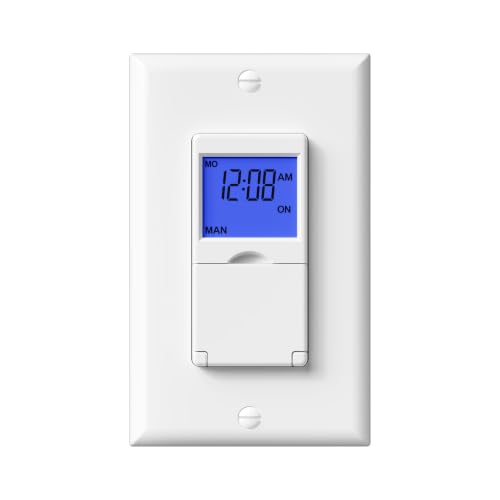
Astronomic dusk-to-dawn timing with a random mode built for the weeks you’re out of town.
For anyone leaving the house empty for stretches, this BN-LINK does something the simpler timers on this list don’t: it randomizes your light schedule so the house doesn’t look robotic. Alongside automatic sunrise and sunset control and 18 on/off programs across a 7-day calendar, it adds a dedicated “Random” vacation mode that shuffles the on/off times. Between that, the DST auto-adjust, and the built-in backup battery that retains settings during an outage, it’s the most security-focused option here.
The functionality is what buyers praise most — 25 reviews single it out as the top-quality aspect — with ease of use right behind it. Setup supports six preset time zones (PAC, MOU, CEN, EAS, HAW, ALA), programs as short as one minute, and individual-day or preset combination scheduling. The 15 A / 1875 W resistive rating is on par with the ENERLITES and Leviton units here, and like all three it runs on single-pole wiring.
Two gripes show up in the reviews. A few buyers found the included orange wire nuts undersized — plan on picking up a packet of yellow ones before you start. And the programming interface is not universally intuitive: while most found it straightforward, one review flatly says “all of the buttons/keys are not labeled. Good luck!” That is the honest trade-off for a device packing this many scheduling options into a wall plate.
Why It Stands Out: random vacation mode, 18 programs, six preset time zones, and DST auto-adjust make it the most security-minded timer on this list.
The Realistic Gripe: the button layout is unlabeled enough that a small share of owners get tripped up during initial setup; if you don’t mind watching a video first, you’ll be fine.
Worth It For: frequent travelers who want automatic lighting that also looks lived-in while they’re away.
Pass On It If: you want a timer you can program on instinct with zero learning curve — the UltraPro above is the friendlier path.
5. Leviton Countdown Timer Switch for household lights and exhaust fans
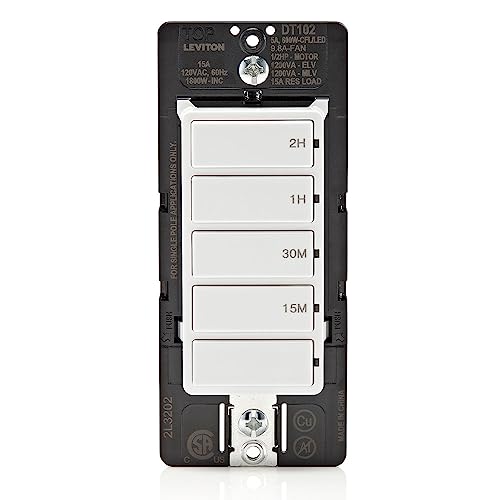
A countdown switch that finally lets your bathroom fan do its job without you remembering to turn it off.
This is the one for exhaust fans, heat lamps, towel warmers, hot tubs, saunas, and attic fans — anything you want to run for a set window and then stop. Four preset buttons (15-30 minutes and 1-2 hours) let you press once and walk away, and the switch turns the load off automatically when the time expires. The lit LED bar slowly ticks down as the time drains, so you can see at a glance how much runtime is left.
What makes installation appealing is the wiring flexibility. Two interchangeable black wires mean line and load can be swapped without risking a miswire, and Leviton’s Green Flex Sleeve lets you wire to ground when no neutral is available in the box. That is the honest reality check on the “no neutral” claim — a current-carrying ground is still required, and in old homes where the wiring run itself forms the ground, the load may not cooperate.
The load ratings cover most household uses: 600 W LED/CFL, 1800 W incandescent/halogen, 1200 VA MLV/ELV/fluorescent, and ½ HP / 9.8 A Fan/Motor. Functionality is the most-praised aspect — 22 reviews call it out — followed by installation. The one gripe is feel: some owners find the plastic housing and buttons less premium than the price implies, and the click when the timer expires is noticeable enough to catch attention in a quiet bedroom. Worth a look if you want it for a fan rather than a bedside lamp.
The Winning Angle: one-finger countdown operation, no programming, and swappable line/load wiring — the cleanest upgrade path for an exhaust fan or heat lamp.
Feedback To Weigh: the plastic build feels lighter than the price suggests for some buyers, and the audible click at auto-off is not for a bedroom wall next to a light sleeper.
Ideal Match: a bathroom fan, sauna heater, or towel warmer where you want automatic shut-off after a set window.
Consider Something Else: if you want silent operation — the Intermatic EI220W-1 below uses an electronic (not click-y) design and is quiet enough for a bedroom.
6. Honeywell Home EconoSWITCH 7-Day Programmable Timer for Lights

Reliability above all — the timer that quietly keeps doing its job, season after season.
If you look at nothing but which timer owners trust the most, this Honeywell Home EconoSWITCH wins that contest. Reliability is by far the most-praised aspect — 92 reviews single it out. Owners pick it to run porch lights, eave receptacles, and seasonal outdoor lighting on a dedicated circuit, and it handles up to 2,400 W or 1 HP at 120 V. Seven programs per week can each repeat daily or run a single day, and both manual and automatic modes are built in, so it behaves like a normal switch whenever you want it to.
What surprises new buyers is how much automation sits inside a plain-looking switch. The dusk and dawn times calculate from your CONUS geographic zone, a 15-minute random function pauses the schedule to make the house look occupied, and the internal battery preserves your program through a power outage before auto-resuming the schedule. It installs like any standard wall switch — three wires (line, load, neutral) and you’re done, though you must kill the breaker first because a live trip during install can damage the unit.
The compromises sit on the face, not the function. The display is small, not backlit, and defaults to a 24-hour clock — a handful of owners have resorted to a flashlight to read it during setup. Buttons can feel sticky on cold fingers too. If you don’t mind programming it once in good light, the reliability you get in return is real.
Ideal For: entry lighting and outdoor circuits where you want a timer you will install once and forget about.
Not Ideal For: low-light programming environments or anyone who insists on a backlit screen — you will need good light to set it up.
7. Intermatic EI220W-1 in-Wall Countdown Timer Switch, Whole House Fan, 1 HP
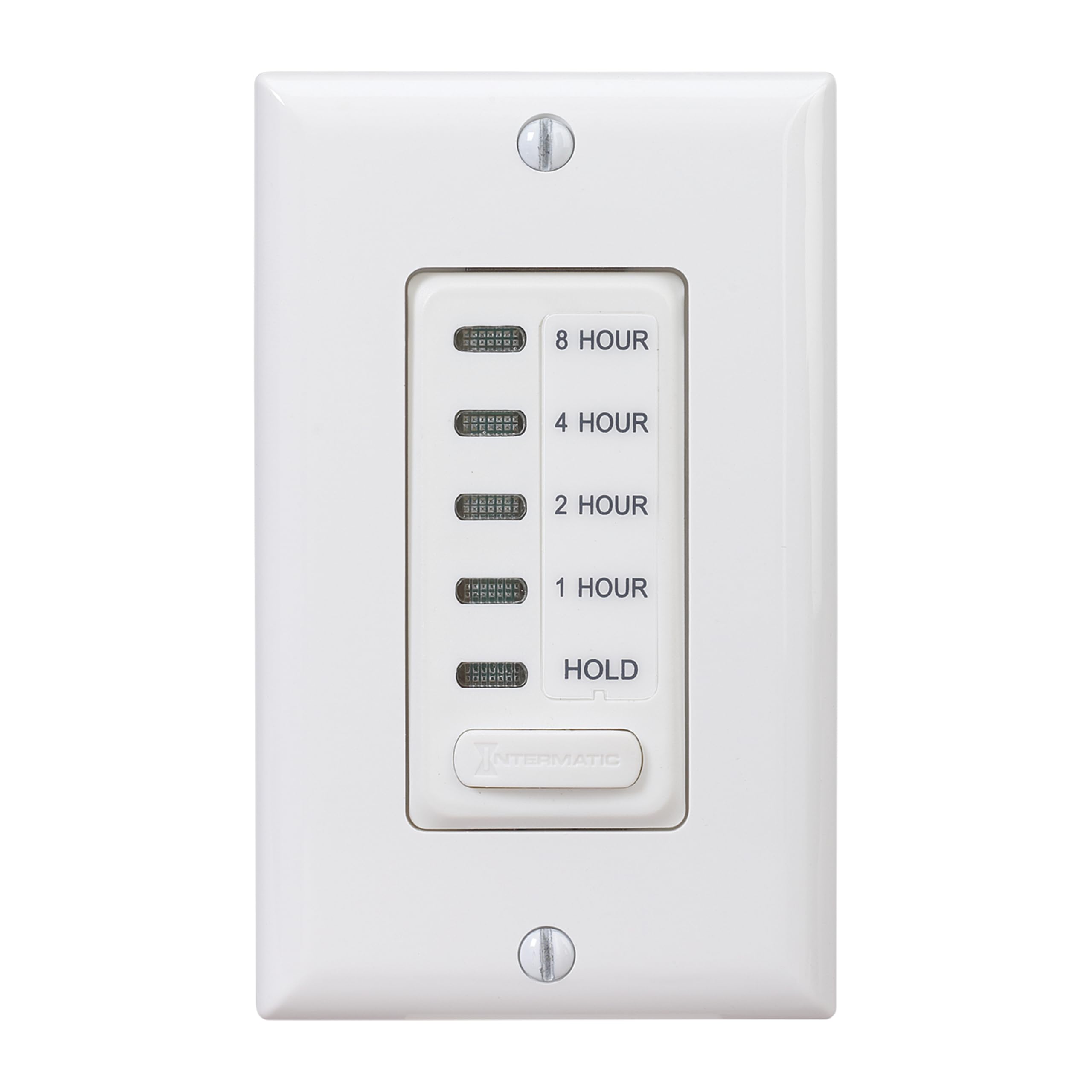
Silent, button-only countdown for a whole house fan that needs to run for hours, not minutes.
Where the Leviton DT102 tops out at two hours, this Intermatic runs the range from one hour to eight, with a HOLD mode for continuous operation. That makes it the right tool for a whole house fan — the job it was clearly built around — though the switches also work for light fixtures, bathroom fans, and anything else you want switched off after a set window. There is no programming: five preset buttons cover every time interval, and the electronic design kills the mechanical ticking you’d hear on a spring-wound timer.
Functionality is what earns the praise here — 55 reviews single it out — with quiet replacement for a failed factory switch running a close second. The unit is a straightforward single-pole swap, uses a standard decorator wall plate (not included), and handles incandescent, fluorescent, CFL, and LED loads. It does require a neutral connection. Rated for 1 HP loads, it’s the right tier for a whole house fan motor.
Two notes to plan around. First, Intermatic’s own documentation flags that it is not for sunlamps, saunas, or any load that could be dangerous if the timer failed to shut off — so this is not a fit for a tanning bed or a heat lamp. Second, durability is a “mileage may vary” situation: some owners have seen 8 years of service from the original unit, while others don’t expect that long. Owner reports range from 8 years of service to units that fail sooner, so the warranty is your only real safety net.
Where It Shines: covering a whole house fan’s long runtime with a five-preset, one-button countdown — no programming, no ticking, and up to 8 hours of automatic shut-off.
What To Know: Intermatic explicitly advises against sunlamps, saunas, or any load where a timer failure could be hazardous, and the neutral wire is mandatory.
Choose This If: you’re replacing a factory whole house fan switch that has ticked its last, or you want a long-run countdown without programming.
skip it if: you want a countdown for 15-30 minute tasks — the Leviton DT102 handles those shorter windows directly.
8. Intermatic ST01A 7 Day Programmable In Wall Digital Timer Switch for Lights and Appliances

An astronomic timer that runs on batteries instead of your home’s neutral wire — rare, and built for ancient switch boxes.
This is the astronomic timer for old homes. Most self-adjusting dusk-to-dawn timers need a neutral wire; the Intermatic ST01A sidesteps the requirement entirely with its own battery power supply, isolating the electronics from the AC line. That also makes it immune to bulb-burnout surges that have killed other timer models. The astronomic feature auto-adjusts dusk and dawn as the seasons shift, with daylight savings handled automatically, and the mechanical contacts give a satisfying click when they switch — the audible indicator many installers prefer as proof the timer is doing its job.
Owners find it lasts. Multiple reviewers have used the same units for years and simply replace the battery when it runs out — a huge advantage over timers with non-replaceable backup cells. Compared with the Intermatic ST700W further down this list, the ST01A is a simpler device: fewer scheduling events, no LCD backlight, smaller capacity — but it needs no neutral conductor and no separate battery for the schedule, just a coin cell every couple of years.
The honest downsides are the instruction manual and the depth. Programming involves multiple layers, dawn settings often appear before dusk in the menu order, and the printed instructions are thin enough that a lot of owners fall back to YouTube. The body is bulkier than a standard switch — one owner needed a Legrand/Wiremold V5751 adapter box for a clean fit — so measure the j-box depth before you commit. Once installed and dialed in, though, it holds the schedule without fuss.
Why It Earns Its Place: battery-powered astronomic control for homes with no neutral wire, immune to bulb-burnout surges, with replaceable batteries that keep the timer going for years.
Honest Friction: programming is layered and the printed manual assumes more than most buyers have, so budget time for a YouTube walkthrough; the larger body also needs a roomy j-box.
The Right Call When: your house has no neutral wire in the switch box and you want self-adjusting dusk/dawn control with replaceable batteries rather than a sealed unit.
Hold Off If: you’d rather have a backlit LCD and one-glance programming — the ST700W below offers both, provided your box has a neutral.
9. Intermatic ST700W Ascend 7-Day in-Wall Programmable Timer
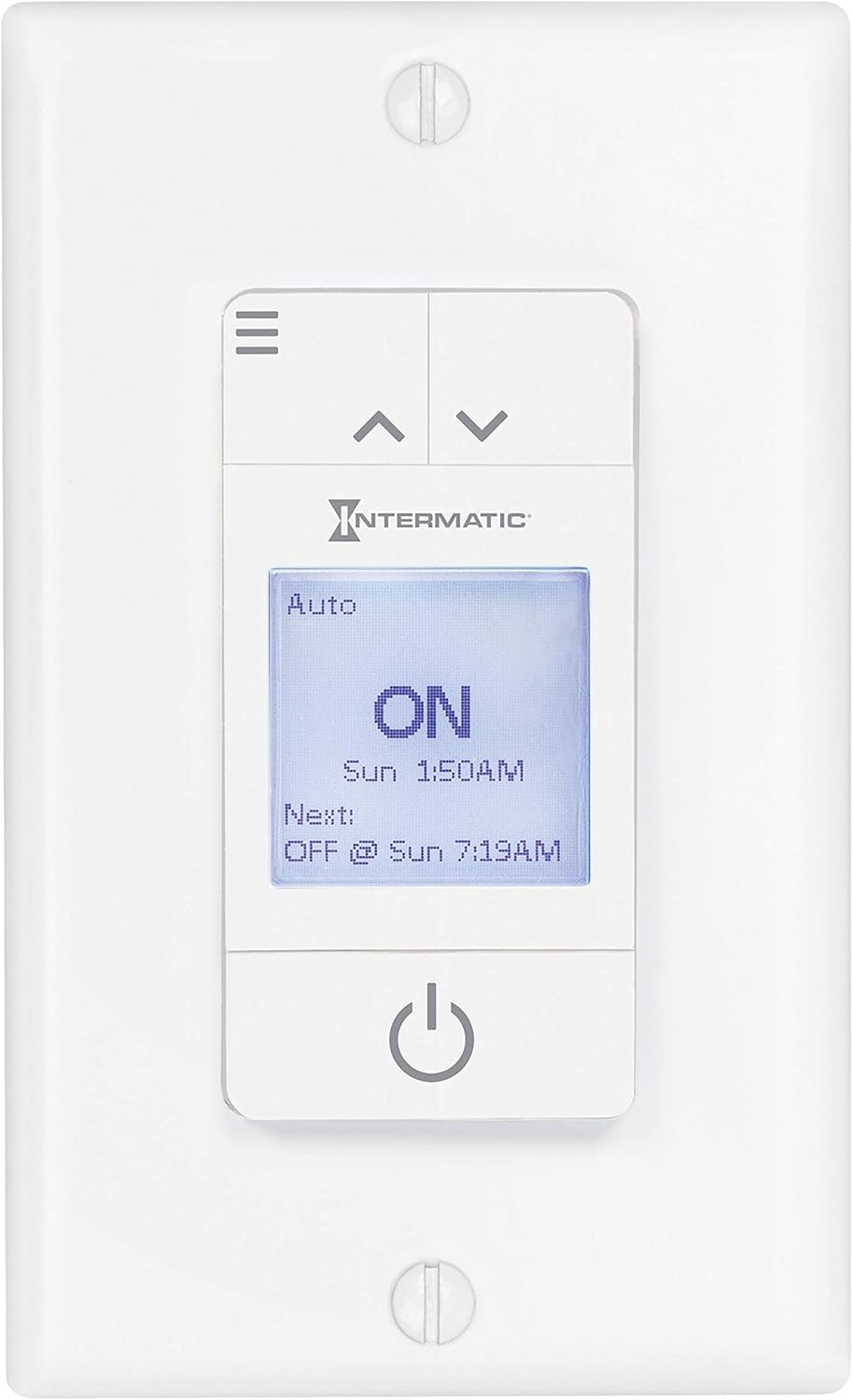
The most-scheduling-per-square-inch timer here — 42 events a week tucked behind a flush faceplate.
If the ST01A above feels a step behind on features, the ST700W Ascend is the answer. It packs 42 programmable events into a 7-day calendar and adds a large backlit LCD behind a modern flush faceplate — the sharpest-looking option on this list. Automatic astronomic control tracks dusk and dawn year-round using your location, DST adjusts itself, and a non-replaceable battery backs up the time and date through a power outage. Functionality is the most-praised aspect (51 reviews) with ease of use right behind, and owners typically describe setup as a standard mechanical switch swap.
Where it stands apart is the mix of scheduling power and display clarity. Intermatic’s own documentation and reviewers both point out the LCD prompts use a small font that may need reading glasses, and the case is actually smaller than the older ST01A despite the bigger screen. Applications run the usual gamut — porch lights, hallway lights, driveway lighting, patio, front door, and outdoor paths — with the astronomic feature handling all the seasonal adjustment once longitude and latitude are entered.
Two honest quirks. First, this is not Wi-Fi-enabled; Intermatic makes a pricier connected model for that, and most owners find the wall unit easy enough to program that connectivity feels unnecessary. Second, the backup power uses a capacitor rather than a replaceable battery — the trade-off is that when the capacitor eventually dies, the whole unit is replaced rather than repaired, but reviewers report it holds for several hours during an outage in the meantime. The push button also feels lighter-duty than the asking price suggests.
Top Choice For: anyone running a whole-house lighting scene with multiple on/off events and wanting the most elegant, backlit interface in this list.
Worth Avoiding If: you need Wi-Fi or app control — this is a stand-alone wall unit and Intermatic’s connected models sit at a higher tier.
Understanding the Specs
What “Astronomic” Actually Means
An astronomic timer does the math on sunrise and sunset for your location, so its on/off moments track the actual sun across the year instead of a fixed clock time. On the Honeywell, UltraPro, BN-LINK, Intermatic ST01A, and Intermatic ST700W, this is the feature that keeps you out of the menu every three months. Cheaper timers make you reprogram the schedule every time daylight saving time rolls around.
Neutral Wire Vs. No Neutral Wire
A neutral wire is the white return conductor many digital timers draw from to power their clock. If your switch box has one, you have the widest choice — the Honeywell PLS750C1000, UltraPro, BN-LINK, Honeywell Home EconoSWITCH, Intermatic EI220W-1, and Intermatic ST700W all need it. If your box has no neutral, look at the ENERLITES HET01-C, Leviton DT102-1LW, or Intermatic ST01A, which are designed to work without one.
FAQ
Do I need a neutral wire for an in-wall timer switch?
Can I install one of these on a 3-way switch setup?
Will an auto timer work with LED bulbs?
Do these timers keep running through a power outage?
How long do the backup batteries typically last?
Can I use one of these for a bathroom exhaust fan?
Will the timer fit my existing wall box?
What load ratings do I need to check?
Do any of these timers have Wi-Fi or app control?
Can I control fans, sprinklers, or motors with these?
Final Thoughts: The Verdict
For most people, the best auto light switch timer is the Honeywell PLS750C1000 — it combines the highest load rating on this list at 29 A with latitude/longitude astronomic control, 21 programs, 3-way compatibility, and a track record owners keep coming back to. If your switch box has no neutral wire and you’re working with older home wiring, the Intermatic ST01A is the one to reach for, running astronomic dusk/dawn control off replaceable batteries instead of a neutral conductor. And for a bathroom fan or whole house fan where you want a set window of runtime and no programming at all, the Leviton DT102-1LW delivers the countdown control you need. Check for a neutral wire in your switch box first — that single detail decides which of these timers you can install.
How We Picked
We do not accept paid placement. Every pick is matched to a real buyer and a real use-case; we do not hands-on test units.
Sources & Methodology
Specifications: manufacturer listings and product documentation. Review insights: verified customer reviews, as of September 2026. Pricing: not shown on this page (it changes often); check the current price via the retailer link.
As an Amazon Associate, KitchPrep earns from qualifying purchases. This does not affect which products we feature.
Related Guides
