
Specs are compiled from manufacturer listings and verified buyer reviews and can change over time — please confirm the key details on the product page before buying.
If your home or job site sits past the end of the cable line, a 4G router turns a cellular signal into ordinary Wi-Fi for every phone, laptop, and camera you own. The trick is picking one whose bands match your carrier and whose modem holds a connection under load. Below you’ll find nine that do, sorted by what each one is genuinely good at.
I’m Mohammad Maruf — the founder and writer behind KitchPrep. This guide is built by comparing the manufacturers’ published specifications and the patterns across verified customer reviews, so you get each pick’s real strengths and trade-offs instead of marketing spin.
You will see which units lock onto a weak tower and which ones fold under load, plus the band and SIM details that decide it. Every pick here is a real 4G LTE unit worth owning, and this guide to the 4g router explains exactly which one fits your address.
Our Picks at a Glance


How To Choose The Best 4G Router
A 4G router does one job: it takes the cellular signal your phone already gets and hands it out as Wi-Fi and Ethernet to everything else in the building. Pick wrong and you get a box that sees the tower but drops the link. Four specs decide whether it works at your address.
Match the bands, not the brand
Every carrier broadcasts on numbered bands — AT&T and T-Mobile lean on B2, B4, B12, and B66, while Verizon lives on B13 and B66. A router only connects on the bands it lists. A unit built for North America will name those numbers on the box; one built for another region often will not.
Some routers also state outright which carriers they refuse. That is a hardware limit, not a setting, so check it before you buy.
LTE Category sets your ceiling
You get steadier speed when the tower is busy if your router can combine bands. The LTE Category (Cat) is a speed class. A Cat 4 router tops out around 150Mbps on paper and cannot combine bands; a Cat 6 or Cat 12 unit can bind several bands together at once, which is what keeps speed steady when the tower is busy. For cable-like reliability, choose Cat 6 or Cat 12.
Dual SIM is insurance, not a gimmick
Two SIM slots let the router switch to a second carrier automatically when the first one weakens. Set the failover trigger to signal strength or monthly data use, and a dead afternoon on one carrier stops being your problem.
Wired ports for the things that cannot buffer
Wi-Fi is fine for phones, but cameras, consoles, and work machines want Ethernet. Count the Ethernet ports you need — some units here carry four Gigabit ports, others carry two, and budget models run them at 100Mbps.
Quick Comparison
| Model | Best For | LTE Category | SIM Slots | Ethernet Ports | Amazon |
|---|---|---|---|---|---|
| Teltonika RUTX11★ Best Overall | Industrial sites and RV rigs | Cat 6 | Dual SIM | 4x Gigabit | Amazon |
| GlocalMe UPPMost Portable | Travel and roaming | 4G LTE | 1 SIM slot plus built-in data | None | Amazon |
| TUOSHI LT16SBest for Backup | Cabin and remote office backup | Cat 4 | Single SIM | 4x Fast Ethernet (100Mbps) | Amazon |
| GL.iNet GL-X750V2 Spitz | Programmable rural gateway | Cat 4 | Single micro SIM | 2x Ethernet (10/100M) | Amazon |
| Yeacomm YF325 | Machinery and smart-grid links | Cat 4 | Dual SIM | RS232 and RS485 plus Ethernet | Amazon |
| GL.iNet GL-E750V2 MUDI | Bag-carried connectivity | Cat 6 module | 1 SIM slot plus eSIM option | 1x 100Mbps | Amazon |
| GL.iNet GL-X2000 Spitz Plus | Home internet replacement | Cat 12 | Dual SIM | Ethernet plus load-balanced WAN | Amazon |
| NETGEAR Orbi LBR20 | Whole-home mesh coverage | AC2200 with Cat 18 LTE | Single Nano SIM | 2x 1G | Amazon |
| Teltonika RUT956 | Vehicles and tracked assets | Cat 4 | Dual SIM | RS232 and RS485 plus Ethernet | Amazon |
In‑Depth Reviews
1. Teltonika RUTX11 Industrial 4G LTE Cat 6 Router
Our pick — over 4★ from 100+ verified ratings; the strongest balance of quality and price.
The rugged aluminium box that switches carriers before you notice the outage
Built for shops, farms, and rigs where the internet cannot be allowed to blink, this is a Cat 6 unit — the speed class that binds several cellular bands together at once instead of using just one. On paper that means a 300Mbps data transfer ceiling, and in practice it means a steadier connection when the tower gets crowded.
Two SIM slots run automatic failover, and you set the trigger yourself: signal strength, monthly data use, or plain network availability. An RV owner who runs Verizon and Google Fi cards describes exactly that setup working — the router picking the better line without anyone touching it. The same hardware is compatible with AT&T, Verizon, and T-Mobile across North America, Central America, and South America.
You can plug in computers, cameras, controllers, and IoT gear without a separate switch. Four Gigabit Ethernet ports separate it from the budget pack. Four Gigabit Ethernet ports plus dual-band Wi-Fi 5 (802.11ac) and Bluetooth LE cover computers, cameras, controllers, and IoT gear. Owners who know pfSense and Cradlepoint rate the operating system in the same conversation. The honest catch: internal throughput falls short of a raw modem feed, with buyers reporting a wired drop from 900 Mbps direct to 600-700 Mbps through the router, so plan around that if your whole job depends on line-rate speed.
Where It Wins
- Dual SIM auto failover triggered by signal, data use, or availability
- Four Gigabit Ethernet ports plus dual-band Wi-Fi 5 and Bluetooth LE
- Rugged aluminium housing across North, Central, and South America coverage
Worth Knowing First
- Buy from an authorised dealer — warranty coverage depends on the seller
- Firmware quirks around SMS events and non-standard IP ranges need attention
- Throughput sits below a direct modem feed at roughly 600-700 Mbps wired
Built for: anyone running a site, trailer, or fleet where an unplanned dropout costs money and four wired devices need to stay up.
Think twice if: you want a plug-and-play box for a spare bedroom — this one rewards someone comfortable in a router admin panel.
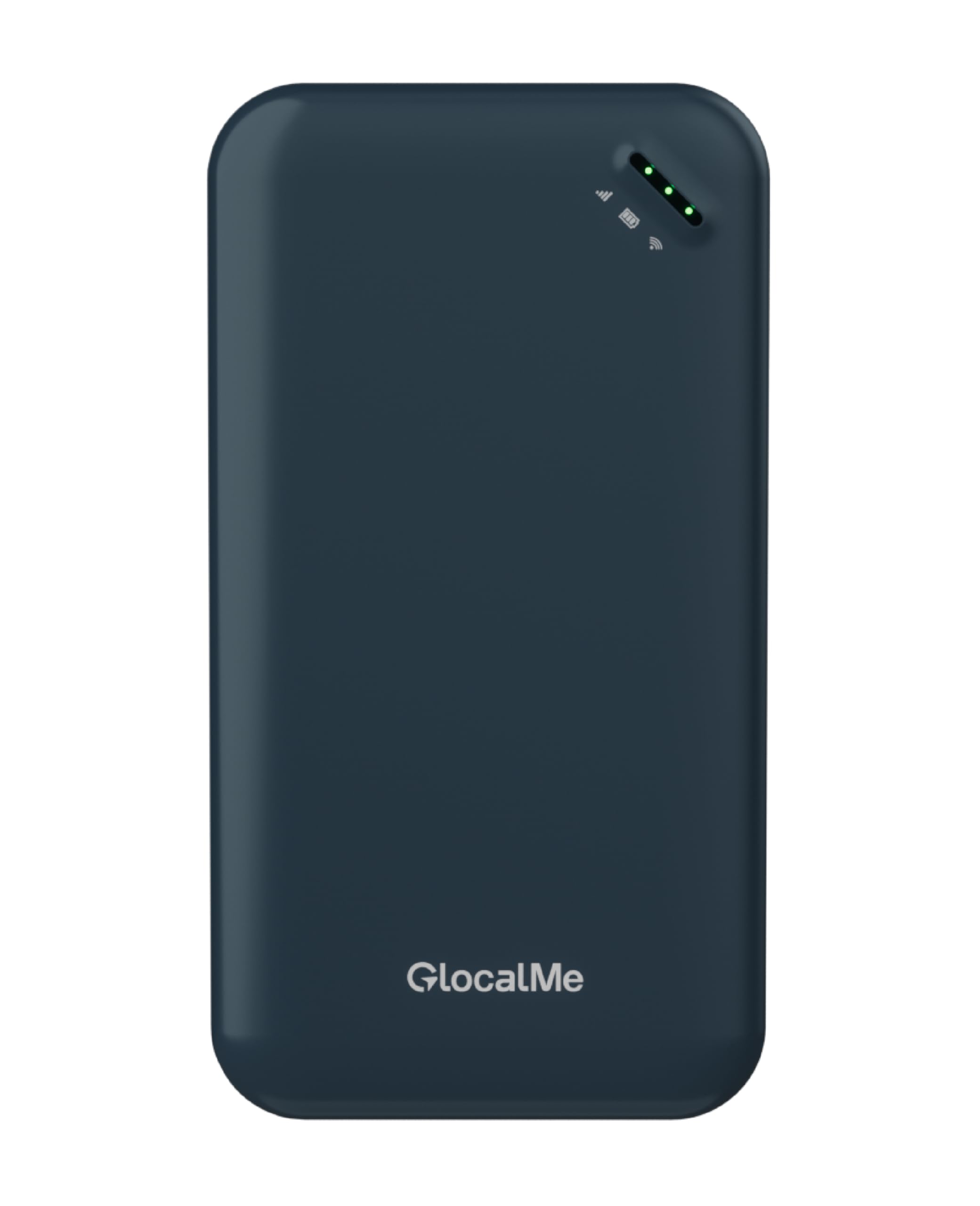
2. GlocalMe UPP 4G Portable WiFi Hotspot
A pocket hotspot that lands in 200+ countries without a SIM card in sight
For a traveller who lands in a new country every few days, this one removes the SIM-shop ritual entirely. It arrives with 1.1GB of global data valid for 90 days, and activating it means downloading the GlocalMe app, registering, and claiming extra data — no contract, no card to swap.
The coverage claim is the headline: 200+ countries and regions with access to 390+ global carriers, and the device picks the strongest local signal on its own. It shares that connection with up to 8 devices at once, and the 3,000mAh battery is rated for over 13 hours of continuous use. Remember 8 devices is the ceiling here — the dual-band LT16S below handles 32.
What buyers consistently praise is how well it simply performs on the road — easy setup, video calls, streaming, and remote work all held together for most owners. The trade-offs are real and worth knowing. Speed, connectivity, and battery all draw genuinely divided feedback rather than a clear verdict, and a small share of users hit constant signal drops or data that drains fast across two phones. If your trip runs through one region, this is the easy answer; if you want rock-solid certainty, test it early.
The travel math: 200+ country coverage plus 390+ carriers with no SIM required is a genuinely rare combination at this tier, and the 13-hour battery rating covers a full travel day.
Set expectations: you are also locked into buying data through the GlocalMe ecosystem, and some owners find the per-GB cost climbs faster than a local SIM.
Reach for it if: you cross borders often and want internet the moment you clear arrivals.
Look elsewhere if: you need one fixed connection that never wavers — the divided speed reports suggest testing yours before a critical trip.
3. TUOSHI AC1200 open up 4G LTE Modem Router LT16S
The quiet failover box that keeps a cabin, office, or classroom online
Insert an activated SIM, power it up, and this Cat 4 router converts a 4G signal into 900Mbps on 5GHz and 300Mbps on 2.4GHz of Wi-Fi, covering up to 300 square meters. It carries the band list that matters for US carriers — B2, B4, B5, B7, B8, B12, B13, B17, B25, B26, B66, and B41 — and works with AT&T and T-Mobile.
The failover logic is the real selling point. One RJ45 WAN port takes your wired broadband, four more Ethernet ports go out to devices, and when the cable drops, the router swings to the 4G link automatically. Setups run from a security-camera SIM to a pooled US Mobile plan feeding a rural home — a ten-minute job once the SIM is active. The connection ceiling of 32 devices is generous, and one owner pushed well past that number with a whole classroom of laptops. If you are comparing ceilings, that 32 beats the UPP’s 8 by a wide margin.
Where it gets murky is consistency. Connectivity is by far the most-discussed topic in the feedback, and the reports split hard — some owners get excellent rural speeds, others watch it stall. So treat this as a fit question rather than a defect: it shines on a stable signal and struggles on a weak one.
Interface reality: the web dashboard is locked down — no SSH, no deep tinkering — which is fine for a set-and-walk-away install and frustrating for anyone who likes to meddle.
What to check first: it cannot report your data balance, so you will be swapping the SIM into a phone to see where you stand.
Suits: holiday homes, remote offices, and RV setups that need a cheap automatic cellular backup behind a wired line.
Skip if: you expect a locked-down interface to give you full control, or your signal is already marginal.
4. GL.iNet GL-X750V2 (Spitz) 4G LTE VPN Router

OpenWrt in a pocket-sized shell, built to be rewritten rather than merely used
If you have ever wanted to change what a router does rather than just configure it, this is the one. The redesigned PCBA and optimised antennas feed a Quectel EC25-AFFA Cat 4 module, and the whole thing runs OpenWrt/LEDE preinstalled on 128MB RAM with 16MB NOR Flash — real open-source firmware with a software repository behind it.
Coverage is aimed squarely at rural places, and the AT&T IoT certification is the kind of paperwork that matters for business data plans. Average 4G speed runs 15-20Mbps, and it pushes 300Mbps on 2.4GHz and 433Mbps on 5GHz of Wi-Fi. Storage is the quiet advantage: a microSD slot takes up to 128GB, plus a USB 2.0 port and two 10/100M Ethernet ports.
Owners use it as a failover WAN behind a main router, feeding a Google Fi data-only SIM on T-Mobile, and as the sole connection for a remote home running Wi-Fi calling. The plug-and-play reputation holds best with T-Mobile; AT&T and Verizon bring IMEI and band friction. And the firmware is the sharp edge here — units shipping with locked firmware 3.104 cannot be upgraded, and some owners who tried anyway ended up with a dead unit. Check the installed version before you start changing anything.
Worth the extra: for anyone who wants to build a bespoke network rather than accept a vendor app.
Be deliberate: firmware upgrades need backing up your configuration first — the hardware does not retain it for you.
Made for: tinkerers and remote-site owners who want OpenWrt flexibility at a modest outlay.
Not for: buyers who want firmware upgrades to be invisible — read the shipping version carefully first.
5. Yeacomm YF325 Industrial 4G LTE Router with Dual SIM

Tin-roof-proof hardware that talks to serial machinery over RS232 and RS485
Two SIM slots, an IP30-rated aluminium case, and a working voltage spread of DC 5V to 36V — this is built to live where consumer routers die. It handles temperatures from -40°C to +85°C and brings 15KV surge protection on ESD-protected interfaces, plus DIN-rail mounting for a proper cabinet install.
The serial ports are the differentiator. RS232 and RS485 let you connect PLCs, sensors, and automation gear directly, and VPN support spans PPTP, L2TP, IPSEC, and GRE alongside static IP, DHCP, PPPOE, and DHCP-4G WAN modes. Band coverage runs B1/2/3/4/5/7/8/28 on FDD and B40 on TDD across North America, South America, Australia, New Zealand, and the Philippines.
Read the carrier caveat before buying: Verizon and Sprint are explicitly not supported. Reliability is the most-discussed subject in the feedback and it lands mixed, with the honest pattern being that most units run fine for a long stretch and a minority stop working somewhere past the one-year mark. One owner calls out a contrast that matters — signal capture can trail a phone, falling to three bars where handsets hold five even with the external antenna attached. Where it does earn clear praise is after-sales: support answers fast and once walked an owner through a firmware patch years after purchase.
The niche it owns: if your equipment speaks RS232 or RS485 and sits on a solar trailer, the field narrows fast and this is on the short list.
Plan the install: the included antenna cable runs short, and extension adapters can cost you signal rather than gain it.
Pick this when: you need serial ports plus dual-carrier failover in a cabinet that sees real weather.
Ruled out for: Verizon or Sprint customers — the hardware does not support those networks at all.
6. GL.iNet GL-E750V2 MUDI 4G LTE Portable Travel Router

A 7000mAh hotspot that doubles as a VPN gateway in your bag
You can work a full day away from a wall outlet. The battery is the reason to look here. A 7000mAh cell rated for up to 8 hours of use, paired with a preinstalled EM060K Cat 6 4G module, means a full working day away from a wall outlet — and the package ships with US, EU, UK, and AU plug adapters for wherever you land.
Wi-Fi runs 300Mbps on 2.4GHz and 433Mbps on 5GHz, and the built-in OpenVPN and WireGuard support reaches 30+ VPN servers with WireGuard speeds up to 50Mbps and OpenVPN up to 10Mbps. Storage is stronger than you would expect from something this portable: DDR2 128MB RAM, 16MB NOR Flash, 128MB NAND Flash, and a microSD slot that takes up to 1TB. A USB-C port replicator and a physical eSIM option round out the travel kit.
Two caveats deserve your attention before you pack it. It is 4G only — no 5G — and several buyers report weak Wi-Fi throughput compared with older hardware, so it is a connectivity tool rather than a network upgrade. It also runs warm and feels heavy for a portable hotspot. The upside owners keep coming back to is battery endurance; the recurring caution is that the interface assumes you already know what a VPN tunnel is.
What Owners Keep
- 7000mAh battery rated up to 8 hours of continuous use
- Up to 1TB of microSD storage on top of 128MB NAND Flash
- OpenVPN and WireGuard preinstalled with 30+ VPN services supported
The Real Trade-Offs
- 4G only, with no 5G option in the hardware
- Wi-Fi throughput trails some older routers on the same network
- Runs warm under load and carries noticeable weight for its size
Best match: a frequent flyer who needs VPN-protected Wi-Fi and a battery that outlasts a cross-country flight.
Less ideal for: anyone expecting 5G speeds — the EM060K module is Cat 6 4G, full stop.
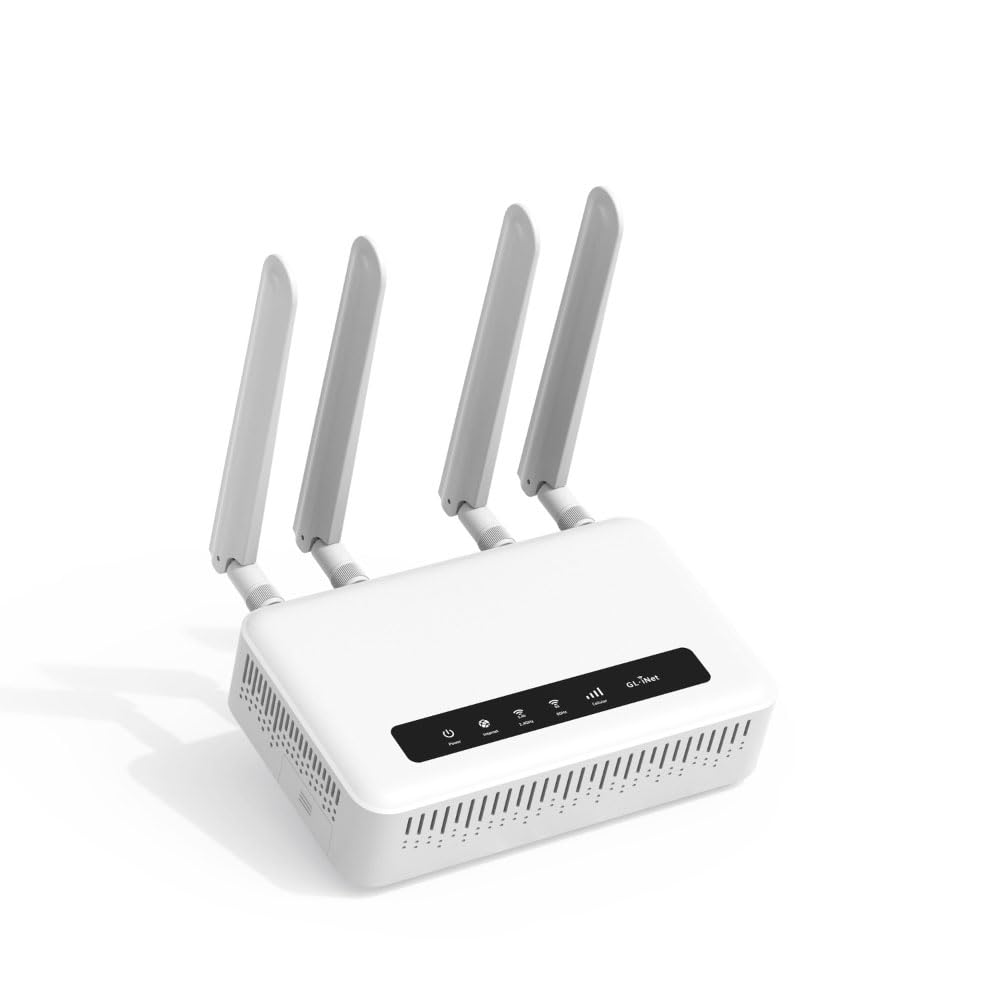
7. GL.iNet GL-X2000 Spitz Plus 4G LTE CAT 12 Wi-Fi 6 Dual-SIM Router
The one that treats cellular like a real broadband line
Cat 12 with DL 3CA — three-carrier aggregation — is the technical answer to why this router holds speed where a Cat 4 box stumbles. It binds three cellular bands together, which widens bandwidth availability and steadies the connection when a single band congests. That is a genuine step past the Cat 4 units elsewhere on this list.
The Wi-Fi side matches the ambition: Wi-Fi 6 delivering up to 574Mbps on 2.4GHz and 2402Mbps on 5GHz, with dual-SIM and single standby letting you pick the stronger carrier. Multi-WAN support takes Ethernet, Repeater, Cellular, and Tethering at once, with load balancing you can proportion yourself. Four interchangeable SMA connectors let you add external antennas later.
It is also certified for both AT&T and T-Mobile, which takes the guesswork out of activation. Homeowners replacing a cable line report strong signal through interior walls and steady streaming, and rural users in weak zones describe hitting solid speeds off a single bar indoors. Do budget for heat — the aluminium chassis runs warm enough that one owner added a small fan, and a minority report trouble holding an AT&T connection in strong-signal areas. If you want the fastest 4G link in this lineup, this is the pick.
The upgrade logic: Cat 12 aggregation plus Wi-Fi 6 is what separates a stopgap cellular box from one that genuinely replaces a wired line.
Two housekeeping notes: there is no active WAN indicator light, and you will want a USB-C PD power source since the chassis pulls real current.
Who it wins for: anyone cutting a landline for a cellular home connection and wanting the speed to match.
Consider another if: you want cool-running silent hardware — this one likes airflow.
8. NETGEAR Orbi 4G LTE Mesh WiFi Router (LBR20)

A mesh system that fills the house with cellular rather than cable
You get whole-home coverage instead of a single-room signal. Most 4G routers cover one room well and the rest of the house badly. This one covers up to 2,000 square feet and 25 devices with Wi-Fi running at up to 2.2Gbps, and it carries the internal antennas to actually do it — a rural farmhouse setup reaches a 30’x60′ building plus 50-100 feet of yard beyond it.
Download speeds head up to 1.2Gbps depending on service and proximity to the tower, and it works as either a primary or backup connection. Plug it in and it is certified with AT&T, T-Mobile, and Verizon, taking a Nano SIM from your carrier’s BYOD plan. Two 1G Ethernet ports cover nearby consoles and computers.
What buyers praise is the overall build quality and the genuinely simple setup, with speed drawing steady positive notes — one remote cabin setup with a Verizon SIM pulled 150+ Mbps downlink on LTE. The mixed signals sit in reliability and compatibility with certain carriers, so treat it as a strong fit for mainstream carrier SIMs rather than an unusual plan. Prepare for one quirk: the app can loop you through repeated QR scans, and the web interface is stripped down enough that you cannot fully disable the Wi-Fi radios.
Strong Points
- Up to 2,000 sq. ft. and 25 devices on AC2200 Wi-Fi
- Certified with AT&T, T-Mobile, and Verizon on a Nano SIM
- Works as a primary line or a backup behind an existing connection
Friction Points
- Carrier compatibility can be picky with unusual BYOD data plans
- The mobile app setup process is clumsy compared with the hardware
- Requires a carrier Nano SIM and an activated BYOD plan to run at all
Made for: rural homes with real square footage where one access point cannot reach the far bedrooms.
Look elsewhere if: you have no existing Orbi satellites and just need cellular in a single room.
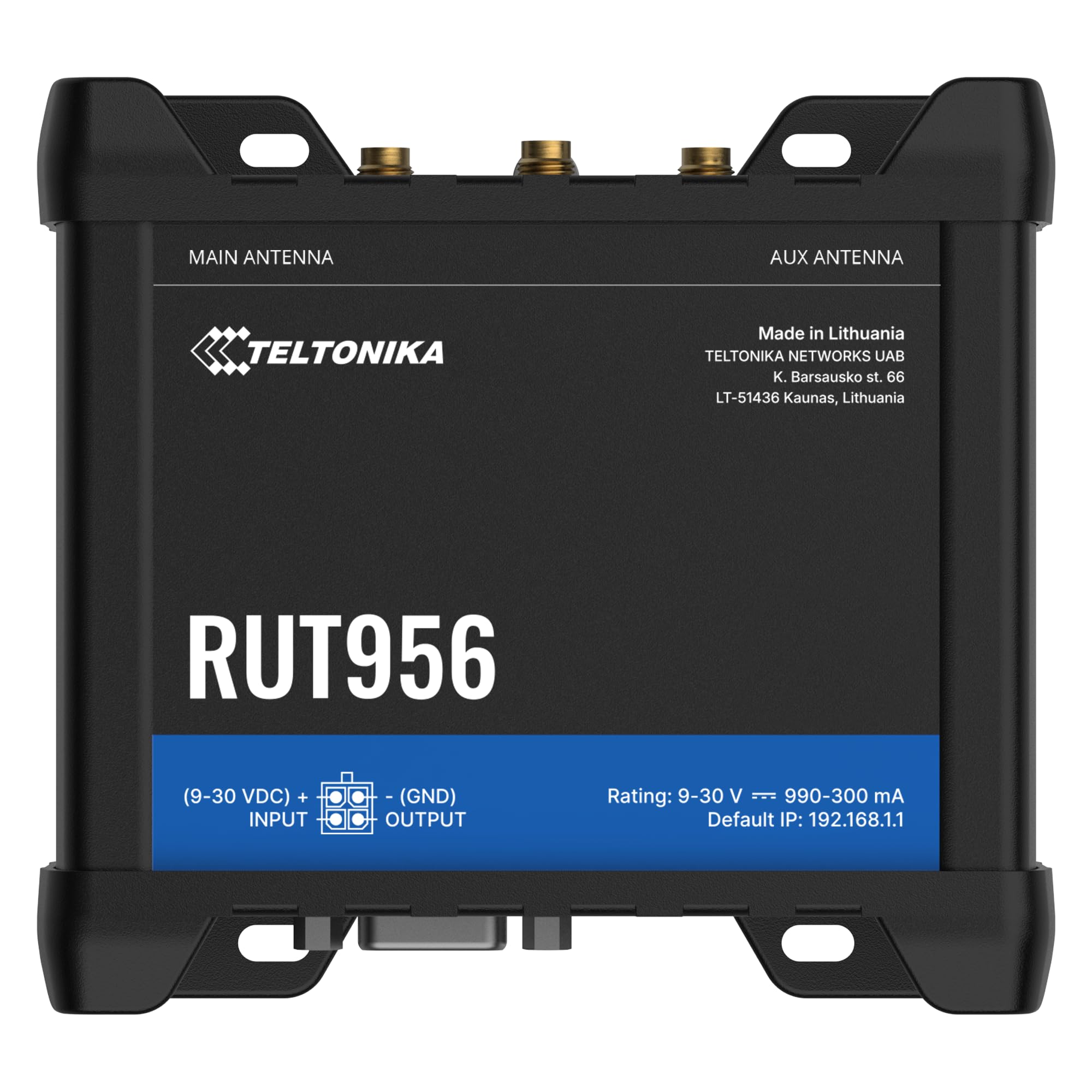
9. Teltonika RUT956 Industrial 4G LTE Router with GNSS
A router that also knows where it is, thanks to built-in GNSS
Location tracking is the reason this model exists separately from the RUTX11 above. Integrated GNSS — the satellite positioning system behind GPS — enables positioning and tracking for vehicles, mobile assets, and remote installations, so a single box handles both connectivity and whereabouts.
Beyond that it is a workhorse: 4G LTE Cat 4 with fallback to 3G and 2G, dual SIM with automatic failover, and Wi-Fi, Ethernet, RS232, and RS485 interfaces for PLCs, sensors, and automation gear. Data transfer is rated at 150Mbps, and Teltonika RMS gives you centralised monitoring, configuration, firmware updates, and troubleshooting from anywhere.
You get a rugged router for industrial deployments, and the design shows it — 287 g of hardware with a power supply in the box and the same secure remote-access stack, firewall features, and multi-protocol VPN support that the higher-end Teltonika units carry. It is the newest arrival here, so long-term field data is still thin. That is not a knock: the platform underneath is proven, and the GNSS addition is what you are paying for.
The real differentiator: GNSS positioning plus dual-SIM failover in one chassis is a combination you will not find on any consumer router in this group.
Worth noting: with a small pool of long-term field reports so far, the spec sheet and the proven Teltonika platform do the persuading here.
Right for: fleet operators and asset managers who need connectivity and location from a single hardened box.
Overkill for: a home or small office — the GNSS and serial ports are wasted on a single laptop.
Understanding the Specs
LTE Category and Carrier Aggregation
The LTE Category is a speed class the modem is certified for. Cat 4 typically means no band combining, Cat 6 and Cat 12 mean the router can merge multiple cellular bands at once. That combining is what keeps your download steady when one band is crowded. If you expect cable-like reliability, aim for Cat 6 or higher.
Band Numbers and Carrier Compatibility
Cellular bands are listed as numbers like B2, B12, or B66, and each carrier owns a set. A router only connects on the bands it lists, so check your carrier’s bands before buying. Some routers state outright which carriers they do not support — that is a hardware limit, not a setting.
SIM Slots and Automatic Failover
Two SIM slots let the router switch to a second carrier when the first weakens. The trigger can be signal strength, monthly data use, or basic network availability. This keeps a remote office or RV online without anyone touching a setting, which is the difference between a backup and a real second line.
Ethernet Port Speed
Wi-Fi is fine for phones, but cameras, consoles, and desktops want a cable. Gigabit Ethernet handles full-speed cellular without becoming the bottleneck, while Fast Ethernet tops out at 100Mbps. Match the port count and speed to the devices you intend to wire in permanently.
FAQ
Will a 4G router work with my carrier’s SIM card?
What is the difference between Cat 4, Cat 6, and Cat 12 LTE?
Do I need a separate data plan for a 4G router?
How does dual SIM failover actually work?
Can a 4G router replace my cable or fiber internet?
Will a 4G router provide Wi-Fi to more than one room?
Do I need an external antenna for better signal?
Is a portable hotspot better than a fixed 4G router?
What does an RS232 or RS485 port let me do?
Can I use a 4G router as a backup for my main internet?
Final Thoughts: The Verdict
For the majority of shoppers, the 4g router winner is the Teltonika RUTX11 because Cat 6 carrier aggregation, dual SIM failover, and four Gigabit ports cover a remote site without compromise. If you want the fastest cellular link here, grab the GL.iNet GL-X2000 Spitz Plus — Cat 12 with three-carrier aggregation and Wi-Fi 6. And for travel across borders, the GlocalMe UPP is the one to reach for. Whichever you pick, verify your carrier’s bands and confirm the router supports them before you order — that single check prevents most of the disappointment buyers run into.
How We Picked
We do not accept paid placement. Every pick is matched to a real buyer and a real use-case; we do not hands-on test units.
Sources & Methodology
Specifications: manufacturer listings and product documentation. Review insights: verified customer reviews, as of September 2026. Pricing: not shown on this page (it changes often); check the current price via the retailer link.
As an Amazon Associate, KitchPrep earns from qualifying purchases. This does not affect which products we feature.
Related Guides
