
Specs are compiled from manufacturer listings and verified buyer reviews and can change over time — please confirm the key details on the product page before buying.
If you want to wash the car, rinse the patio chairs, or knock dried mud off a mountain bike without dragging an extension cord or wrestling a stiff garden hose across the yard, a battery-powered pressure washer is the tool that finally makes it easy. The catch is that cordless models trade raw blasting power for freedom, so picking the wrong one means weak spray, dead batteries in ten minutes, or a machine that turns out to be basically a hose with a handle.
I’m Mohammad Maruf — the founder and writer behind KitchPrep. This guide is built by comparing the manufacturers’ published specifications and the patterns across verified customer reviews, so you get each pick’s real strengths and trade-offs instead of marketing spin.
This breakdown of the best battery powered pressure washers leads with measured PSI and GPM, real runtime per battery, and the tanks, nozzles, and hoses that hold up over a full season of jobs.
Our Picks at a Glance


How To Choose A Battery Powered Pressure Washer
Skip the biggest number on the box and answer two questions first: what surfaces will you clean, and where will the water come from? A car body, a pair of muddy bike tires, and a concrete walkway demand very different amounts of force. Answer those two, and PSI, GPM, and runtime numbers become comparable.
Pressure (PSI) Versus Flow (GPM)
PSI is pounds per square inch — the pushing force of the water, which decides how well it lifts stuck-on grime. GPM is gallons per minute, the volume of water moving through the nozzle, which decides how fast you can rinse a whole panel or patio clean. A unit with modest PSI but strong GPM often finishes a rinse faster than a higher-PSI machine that trickles. That is why the EGO HPW3200 lists 3200 psi at 1.2 GPM and up to 2.0 GPM max — two different numbers describing two different jobs.
Battery Setup And Runtime
A single battery means less weight in your hand but usually less time before you stop. Dual-battery designs like the EGO HPW3200 run two packs together, which buys more minutes but adds heft. Wattage, voltage, and milliamp-hours (mAh — a measure of how much charge a pack holds) all feed into runtime, and so does the mode you pick: a turbo setting that blasts harder will drain faster than an eco setting.
Water Source And Portability
Some cleaners need a garden hose for supply. Others self-prime, meaning they can suck water up out of a bucket, a lake, or a pool through a siphon hose. If your parking spot is nowhere near a tap, a self-priming bucket-fed unit like the SEESII or Ryobi is the difference between using it weekly and leaving it in the garage. Weigh the machine against how far you have to carry it, too — a 2.2 kg to 3.5 lb handheld travels very differently than a 36.2-pound wheeled washer.
Quick Comparison
| Model | Best For | Max Pressure | Max Flow | Weight | Amazon |
|---|---|---|---|---|---|
| EGO POWER+ HPW3200★ Best Overall | Deep cleaning with EGO batteries on hand | 3200 psi | 2 gpm | 36.2 pounds | Amazon |
| Kärcher OC 3 PlusDelicate-Task Specialist | Bike and delicate surface cleaning anywhere | 72 psi | 0.5 gpm | 5.1 pounds | Amazon |
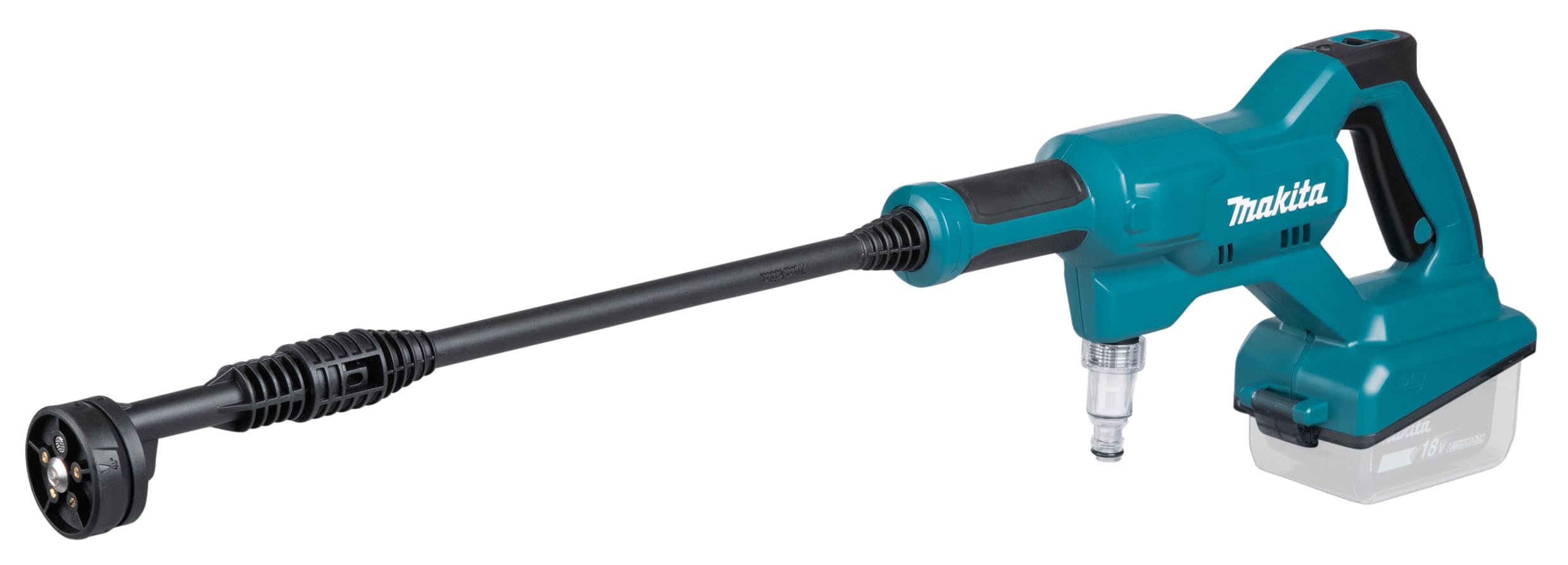
| Makita DHW180ZCleanest Water Access | Light-duty car and siding rinses with LXT batteries | 35 psi | 2.5 liters per minute | 2.2 kg | Amazon |
| Worx WG633 Hydroshot Plus | Compact bucket-fed vehicle washing | 710 psi | 0.9 gpm | 4.4 pounds | Amazon |
| EGO Power+ HPW2100 | Compact EGO-ecosystem cleaning | 2100 psi | 1.2 gpm | 18 pounds | Amazon |
| Ryobi RY18PW22A-0 | Small jobs around the house with ONE+ batteries | 22 bar | 0.05 liters per second | 2 kg | Amazon |
| WORX WG647 | Two-battery heavy field cleaning | 800 psi | 1 gpm | 5.3 pounds | Amazon |
| SEESII Cordless Pressure Washer | Long-reach car and patio washing | 1250 psi | 3 gpm | 3 pounds | Amazon |
| Click Buy Portable Cordless Washer | Budget-first buyers new to cordless washing | 980 psi | 4.1 liters per minute | 3.5 pounds | Amazon |
In‑Depth Reviews
1. EGO POWER+ Electric Pressure Washer, 3200 PSI Power Washer – HPW3200
Our pick — over 4★ from 500+ verified ratings; the strongest balance of quality and price.
Gas-level muscle with a battery socket instead of a pull cord — and a footprint to match.
This is the pick for the homeowner who already owns EGO 56V ARC Lithium batteries and wants a washer that genuinely behaves like a plug-in or gas machine. It pulls from any two of those packs to reach up to 3200 psi at 1.2 GPM, with up to 2.0 GPM max. That pressure figure is 3.3x the 980 psi on the little Click Buy washer down the list — one of these will strip caked mud off a driveway, the other will not.
Runtime is the honest story. Buyers report getting “40 min continuous on two 6Ah batteries at HIGH” with turbo dropping that to roughly 15-20 minutes, and closer to an hour in ECO mode. The build quality is the thing that wins people over: a telescopic handle that extends for transport and collapses for storage, quick-connect points at the hose and wand, and a wand-integrated display showing battery charge. The box includes a flexible high-pressure hose, siphon hose, quick-connect gun, quick-connect wand lance, stainless steel wand, foam cannon, filter, and a set of nozzles spanning 15°, 25°, 40°, a turbo nozzle, and a rinse nozzle.
Two fully charged 6Ah batteries are required together, and only one charger ships in the box — a real practical catch for anyone with a single pack. The other is that at 1.2 GPM it fills slower than high-flow electrics for pure rinsing duties. The recurring gripe is battery appetite: turbo mode drains packs quickly, and a big sidewalk job can eat a 7.5Ah and a 6Ah pack before you finish. Weigh 36.2 pounds against the 3.5-pound Click Buy unit and the trade is obvious — this does real work, but you are wheeling it, not carrying it, and you will want a second pair of charged batteries on standby for long sessions.
Where it earns its keep
- Up to 3200 psi at 1.2 GPM, 2.0 GPM max — gas-comparable force for driveways and vehicles
- Runs on any two EGO 56V ARC Lithium batteries you already own
- ECO, High, and Turbo modes with charge status on the wand
- Includes foam cannon, siphon hose, filter, and five nozzle types
- 5-year tool warranty
The fine print to weigh
- Needs two charged 6Ah packs working together; only one charger included
- Turbo mode burns through battery fast — roughly 15-20 minutes continuous
- 36.2 pounds is heavy; wheel it, don’t carry it
Best matched to: EGO platform owners who want maximum output and already have batteries and chargers.
A real constraint: If you own no EGO packs, the battery outlay stacks on top of the tool — budget for two 6Ah batteries plus a second charger for long jobs.
2. Kärcher OC 3 Plus Mobile Outdoor Cleaner for on-the-go Cleaning
The gentle one — 72 psi of controlled spray that strips mud without blasting paint or seals.
Bike owners are the obvious audience here, and it shows in the design: a detachable 1.8-gallon water tank you fill in the house, a spiral hose and trigger gun that stow under the tank when you are done, and a flat-spray nozzle plus a cone-spray nozzle built for more sensitive cleaning. At 0.5 GPM and 72 psi it is nowhere near the EGO HPW3200’s 3200 psi — and that is entirely deliberate. This is a cleaner, not a stripper.
What makes it click is the self-contained nature of it. Fill the tank, charge the integrated lithium-ion battery, and you can clean a caked e-MTB in a parking lot or on a fifth-floor balcony with no tap and no outlet anywhere near. An LED warns you when the charge is running low, and the battery is built to cover several cleaning rounds per charge. Owners doing exactly this kind of work describe it as easy to refill and maneuver, and gentle enough that it does not damage the components they are rinsing.
The real limit is water capacity, not pressure. The tank empties fast on a real cleaning session, so you will want extra water on hand for anything beyond a quick rinse. And the charger does not fit inside the onboard storage compartment, so it travels separately. If your expectation is driveway-grade blasting, this is not that tool — it is the one you reach for when force would do damage.
What it’s actually for: mountain bikes, gear, and outdoor items that need caked mud removed gently, anywhere with no water or power on hand.
Where it stops: 0.5 GPM through a 1.8-gallon tank means short sessions per fill, and an owner expecting paved-driveway pressure will be disappointed by design.
Reach for this if: you wash bikes, gear, or outdoor furniture away from a tap and want a self-contained unit that won’t disturb delicate finishes.
Look elsewhere if: your jobs are large paved areas — the 1.8-gallon tank needs refilling long before a driveway is done.
3. Makita DHW180Z 18V Li-ion LXT Pressure Washer, Batteries and Charger Not Included
A 2.2-kilogram handheld that turns a bucket and an LXT battery into a car-wash setup.
Anyone already deep in Makita 18V LXT batteries should look hard at this one, because the tool body alone is where the money goes — no packs, no charger in the box. At 35 psi and 2.5 liters per minute it is a rinser, not a blaster, and the review pages are honest about that split: the power draws mixed feedback, with people either describing it as doing a good job on wheels and inner fenders or wishing it hit harder.
The genuinely useful bit is the self-priming function with an absorption connector and filter, meaning you can drop the intake into a bucket and clean with no hose connection at all. It runs up to a 40 degrees centigrade maximum feed water temperature, has a trigger lock, and measures 888 mm overall with the extension pipe fitted. Owners who bought it for quick, easy car baths when the vehicle is not heavily soiled tend to be the happiest — the ones who wanted a gas replacement are not.
Watch the connections before you commit. The fittings are largely proprietary plastic, with the only conventional socket being a male garden-hose inlet, so it will not accept 1/4-inch, M22, or 3/8-inch quick connects without adaptation. It also does not ship with the female-to-female adapter some owners needed to attach it to a hose. Treat this as a light-duty convenience tool for the LXT owner, not a heavy soiling solution.
Why LXT owners like it: it lifts caked grime off wheels and fenders, primes from a bucket, and stows in a footprint of 16.5 by 3.9 by 9.41 inches — small enough to live on a shelf.
The catch to plan for: proprietary plastic fittings limit what you can attach, and buyers wanting deep-cleaning force will find 35 psi short of the mark.
Suits you when: you own Makita 18V LXT batteries and want a grab-and-go rinse for lightly soiled cars, bikes, and camping gear.
Skip it when: you need to tackle heavy mud, or you rely on standard quick-connect fittings — the included plastic connections restrict you.
4. Worx Cordless Pressure Washer, 20V 710 PSI Power Washer, WG633
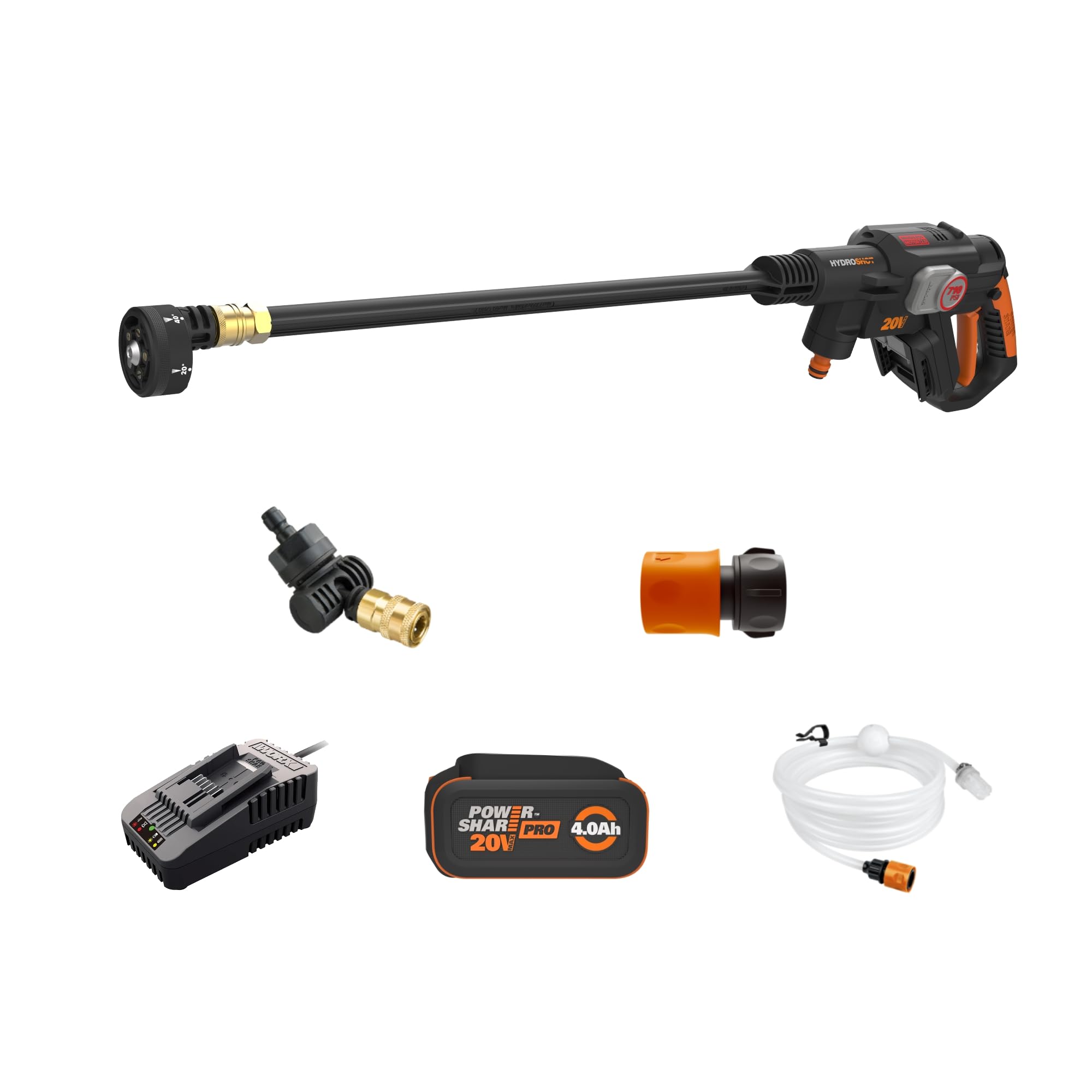
Pulls water from a lake or a bucket and delivers a genuinely useful 0.9 GPM spray.
This is the pick that makes the most sense for someone who washes vehicles somewhere without easy water access. It self-primes, so it can draw from lakes, pools, or buckets instead of needing a hose, and it runs on the same Power Share batteries as 140+ Worx tools. Quality is the thing that wins people over — it is the aspect praised most consistently across the review pages — and it comes with a 3-year limited warranty.
Where it fits against the EGO HPW3200 is instructive: at 710 psi and 0.9 GPM it has a fraction of that machine’s output, but at 4.4 pounds it is a handheld you can work above your head without arm ache. It ships with a cleaning lance, a 5-in-1 nozzle covering 0°, 15°, 25°, 40°, and rinse settings, a 20-foot draw hose, a water bottle adapter, and a 4.0Ah Power Share PRO battery with a quick charger. Owners frequently describe it as ideal where water is limited or jobs are under a thousand psi — a vehicle wash is realistic, a caked-on off-road recovery is not.
The recurring notes to respect: the pump on a faulty unit is a known frustration point, and a couple of owners found it less forceful than they had hoped for heavier soiling. Battery life also draws mixed feedback, though the ECO mode extends runtime. Understand this as a cleaning convenience for moderate grime, and it delivers.
What buyers prize
- Self-priming — draws from buckets, lakes, or pools with no hose needed
- Only 4.4 pounds with a balanced handheld layout
- 710 psi at 0.9 GPM with a 5-in-1 nozzle across five spray settings
- Uses the same Power Share batteries as 140+ Worx tools
- 3-year limited warranty
Points to consider
- Power feedback runs mixed — adequate for moderate grime, tested for stubborn encrustation
- A handful of units have arrived with pump trouble
- Battery runtime is mixed; lean on ECO mode for longer jobs
The fit: car and bike owners washing away from a tap who value light weight and Worx battery compatibility above raw force.
The limit: 710 psi thins out fast against caked mud and heavy driveway grime — this is a rinse-and-wash tool.
5. EGO Power+ Electric Pressure Washer, 2100 PSI Power Washer, Battery and Charger Not Included – HPW2100

Half the bulk of the big EGO, still 2100 psi on the batteries you already own.
If the HPW3200 above feels like more machine than you want to wrangle, this is the smaller sibling for the same ecosystem. It delivers up to 2100 psi at up to 1.2 GPM from any EGO 56V ARC Lithium battery, which you supply separately, and it weighs 18 pounds against that machine’s 36.2 pounds. The whole point here is that it connects to a garden hose or siphons from a fresh water source with the included siphon hose and filter, so it adapts to wherever the water is.
Setup is the part owners rave about — quick connection points at the hose and wand, a built-in handle, and onboard storage so the accessories travel with the machine. You get a flexible 25-foot high-pressure hose, a quick-connect short gun, a stainless steel wand, a foam cannon, and 15°, 25°, and 40° nozzles plus a turbo nozzle. A 6.0Ah ARC Lithium battery is quoted at up to 30 minutes of runtime, and owners confirm roughly that figure in use, with the caveat that tougher jobs drain it faster. The compact 14 by 9.5 by 14.25-inch body is easy to move and store. A 5-year limited tool warranty backs the tool itself.
Two catches matter here. First, no battery or charger is included, so this only makes sense if you are already in the EGO platform — otherwise factor the packs in. Second, the battery-life reports split: some find it lasts longer than expected, others find a single charge short for a long session. Owners who keep a second battery on the shelf treat it as a non-issue; first-time buyers sometimes do not.
The draw: substantial EGO pressure in a compact, hose-or-siphon-fed body that uses batteries you already own.
What to accept: runtime varies sharply by task — quoted up to 30 minutes on a 6.0Ah pack, but tougher cleaning drains it well before that.
Best for: EGO battery owners who want capable pressure in a smaller, easier-to-store package than the flagship.
Think twice if: you have no EGO batteries — you would be buying a tool body you cannot run.
6. Ryobi RY18PW22A-0 Battery Pressure Lance 18V ONE+ 182 l/h 22 Bar (Body Only)

The Ryobi-battery answer to “I just need a quick rinse without dragging out the big washer.”
Build a whole car-wash or cleaning kit out of your existing 18V ONE+ batteries — that is the appeal here. The 3-in-1 nozzle gives you a turbo setting for stubborn soiling, a 15° spray for general cleaning, and a shower function for rinsing. It also includes a siphon kit, so it can pull water out of a bucket or any fresh source, and the PX4 waterproof battery compartment keeps the pack clear of the splash zone.
Performance is claimed at 182 liters per hour at 22 bar, which Ryobi frames as four times the output of a standard garden hose. To get the best from it, the maker recommends running a 18V battery with 4.0Ah or 5.0Ah — runtime is entirely dependent on the pack you slot in, and a bigger pack means a longer session. Owners using it for small, in-between cleanup jobs around the house describe the assembly as quick and the bucket-fed setup as genuinely convenient. It weighs 2 kg, and the 6-meter hose gives usable reach.
Value the realistic expectations here. Owners routinely frame it as stronger than a garden hose but weaker than a full pressure washer, and the recurring note is that the hose connection is not the most secure fit. One reviewer also found a missing part in the box, though that reads as a one-off packing issue. This is the sensible pick for the established Ryobi household wanting an easier routine between the big washes.
Why Ryobi owners choose it: a bucket-feed siphon kit, a 3-in-1 nozzle with turbo, 15°, and shower modes, and PX4 battery protection in a 2 kg body.
Where it falls short: 22 bar delivers roughly four times a garden hose and no more — treat the hose connection carefully and it does small jobs well.
Pick it when: you run 18V ONE+ tools and want an easy, lightweight rinse for jobs between the full pressure-washer weekends.
Pass it by when: the task requires real pressure — a two-kilogram lance built on 22 bar will not strip heavy caked grime.
7. WORX Cordless Pressure Washer, 40V 800 PSI Power Washer, WG647

Shipped with two 20V packs and a 20-foot hose, sized for washing where the hose will not reach.
Buyers of this one are often working somewhere a normal setup is impractical — off-grid cleaning, HVAC servicing, or patio furniture in the far corner of the yard. It pairs two 20V 2.0Ah batteries for up to 800 psi at 1.0 GPM, runs the PowerShare system so you can use 20V, 40V, and 80V tools on the same packs and charger, and weighs 5.3 pounds in hand. The kit is unusually complete for the price tier: 20-foot hose, 5-in-1 nozzle with 0, 15, 25, 40, and watering settings, a long lance, quick-connect adapter, bottle cap, batteries, and a dual-port charger. Quality is the aspect praised most consistently in the reviews.
Two-speed pressure makes it flexible — high for grime, low for watering or light rinsing — and the on-board battery indicator tells you where you stand. Owners talk about it happily knocking out a full patio set, or working a strong spray on real grime off-grid.
The dual-battery design adds weight: with two 20V 2.0Ah packs loaded it outweighs single-battery handhelds, and those small packs drain fast under sustained use. The recurring operational gripe worth knowing is that the pump can lose prime when you release the trigger, so you tend to re-prime more often than you would like. For periodic outdoor cleaning jobs, that is tolerable; for constant back-and-forth trigger work, it gets old.
What’s in its favor
- 800 psi at 1.0 GPM on two included 20V 2.0Ah PowerShare packs
- Two-speed pressure plus a 5-in-1 nozzle from 0° to watering mode
- 20-foot quick-connect hose and extended lance for reach
- On-board battery indicator
- PowerShare compatibility across 20V, 40V, and 80V tools
The drawbacks to weigh
- Heavier than single-battery handhelds with two packs loaded
- Small 20V 2.0Ah packs drain quickly under sustained use
- Loses prime when the trigger is released — repeated re-priming needed
Well suited to: occasional large-area cleaning where you want a complete kit from the start with battery flexibility.
Less suited to: long trigger-pulled sessions — the loss of prime and dual-battery heft make it tiring.
8. SEESII Cordless Pressure Washer 1250PSI, Portable Power Washer
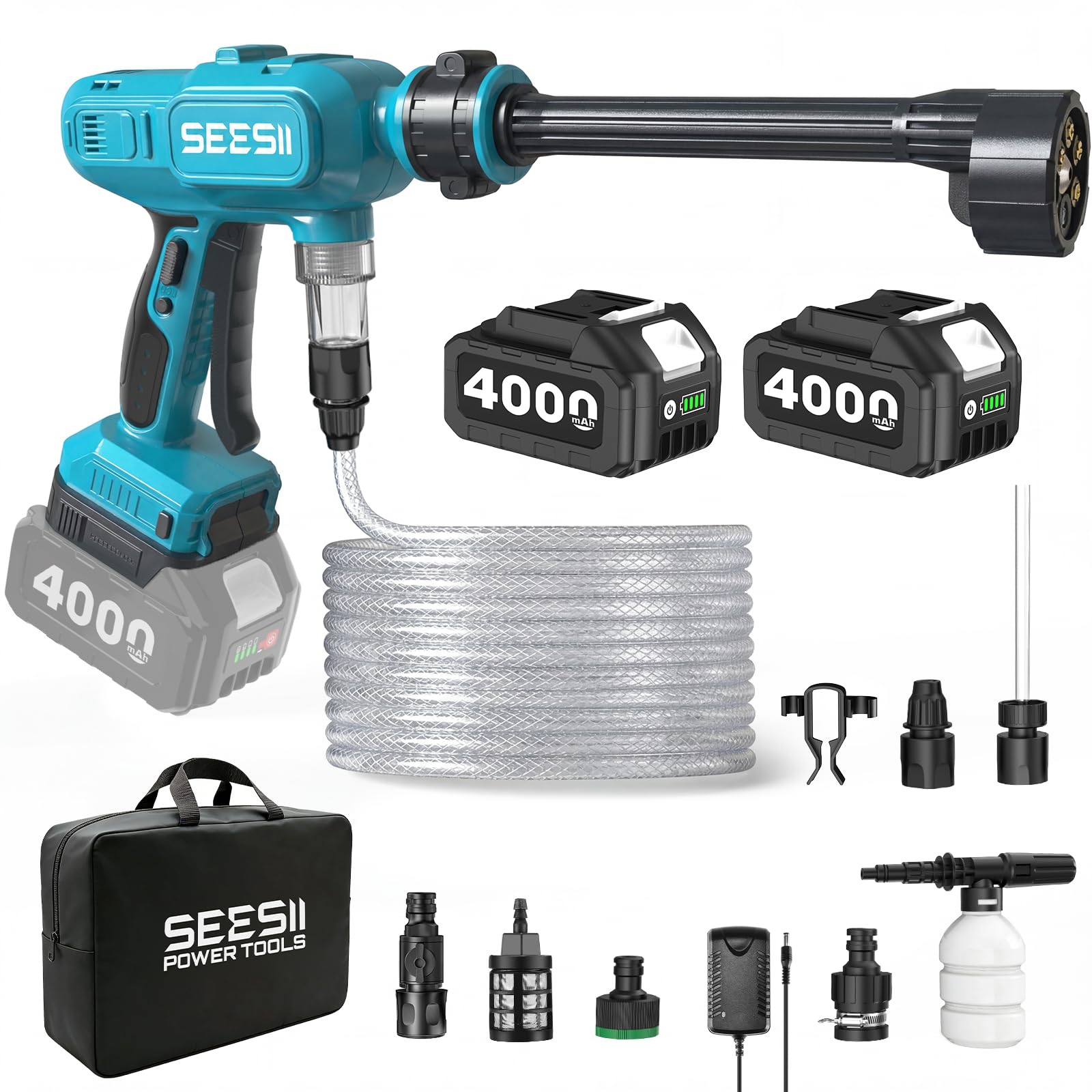
A 3 GPM flow rate that out-pours every other cordless pick here — and a 27-foot hose to match.
It runs a 300W motor spinning to 20000 RPM, and it is quoted at 1250 psi and 3 GPM. That combination suits car washing, patio cleaning, and the kind of home exterior rinse where moving quickly through the water matters more than digging out a stain.
Portability is where it shines. At 3 pounds with a 15 by 7 by 10-inch body, one-handed work is realistic, and the 27-foot hose means you are not shuffling the machine around the car or the deck as you go. The dual 4000mAh batteries are quoted at up to 60 minutes of operation — enough, on paper, to wash two SUVs back-to-back. Cleaning effectiveness is the thing buyers value most about it, with a 6-in-1 nozzle covering spray types, angles, and pressure adjustments without swapping attachments. It draws from any water source via the included filter.
Be clear-eyed about pressure. Several owners find the spray weaker than the numbers imply, and some describe it as closer to a stiff hose than a full pressure washer. The manual is also thin — expect to figure out the connectors yourself, and note that it will not thread onto a regular garden hose without an adapter. For small-to-mid jobs, that is fine; for heavy soiling on a large driveway, it runs out of punch.
Where it’s strong: 3 GPM of flow, a 27-foot hose, and a 3-pound frame make fast work of car panels, railings, and patio furniture.
Where it’s limited: 1250 psi reads softer in real use than it sounds, and the thin instructions plus the missing garden-hose adapter catch first-timers off guard.
Great for: buyers wanting light, one-handed portability and a long reach hose for cars, patios, and exterior surfaces.
A mismatch if: you are chasing high-pressure blasting — treat 1250 psi and 3 GPM as fast rinsing, not deep stripping.
9. Click Buy Portable Cordless Washer, Car Washer with 2 Batteries
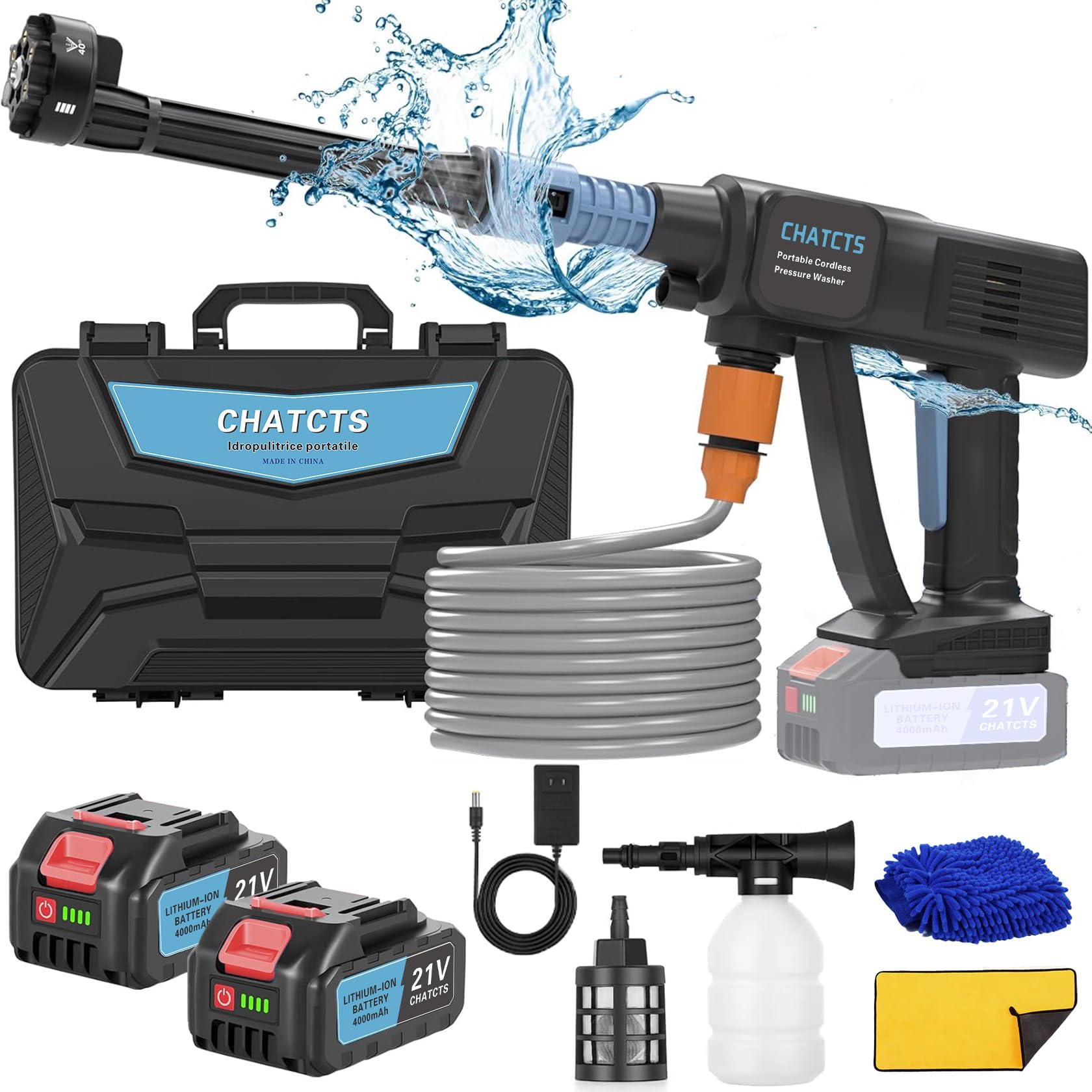
The entry-level pick: 3.5 pounds, two batteries in the box, and a 6-in-1 nozzle to cover the basics.
If you are testing the waters with cordless washing and want a complete kit from the start, this bundle is the practical first step. It comes with two 21V 4000mAh batteries, a fast charger, a 6-in-1 multifunctional nozzle, a foam spray bottle, a 5m water suction hose, a water filter, and 1/2-inch and 3/4-inch faucet connectors — all in a tool box. Quoted runtime is 40-70 minutes on the included packs, and it draws from buckets, garden hoses, pools, rivers, or lakes via the filter.
The package is genuinely well thought out for the money: the 360° rotating nozzle gives you six spray modes, so you can drop foam on grime, then switch back and pick the flow setting that suits the surface. Reviewers working on cars and patios with bucket-fed setups describe good value and usable pressure. One owner used a 5-gallon bucket and diluted dish soap in the bottle for degreasing.
Two honest notes worth knowing. The instruction sheet is vague enough that assembling it takes patience — reviewers suggest pre-filling the suction hose and never running it dry, as dry running harms the seals. And the water pressure is split in feedback: some find it strong for a cordless unit, others say it falls short of the ad copy. Budget-tier expectations suit it best.
Good value details
- Two 21V 4000mAh batteries included — quoted 40-70 minutes of runtime
- 6-in-1 nozzle with 360° rotation for six spray modes
- Draws from buckets, hoses, pools, rivers, or lakes via the filter
- Full bundle: foam bottle, 5m hose, filter, and two faucet connectors
Reasonable caveats
- Instructions are unclear — assembly takes patience
- Must be primed and never run dry, or seals suffer
- Pressure divides opinion; a budget unit will not replace a full washer
Ideal for: first-time cordless buyers who want everything in the box and can accept moderate pressure for light jobs.
Not the pick if: you expect heavy-duty performance — set expectations for small projects and light grime.
Understanding the Specs
Pressure (PSI) And Flow (GPM)
PSI (pounds per square inch) is the force pushing the water at the surface; higher PSI lifts heavier grime. GPM (gallons per minute) is how much water you push through per minute; higher GPM rinses a surface faster. Some machines trade one for the other. Look at both together — a low-PSI, high-flow unit rinses quickly; a high-PSI, low-flow unit digs into dirt but fills slowly. The EGO HPW3200 pairs 3200 psi with up to 2.0 GPM; the SEESII pairs 1250 psi with 3 GPM.
Battery, Wattage, And Runtime
Voltage, amp-hours, and wattage combine to give runtime, and the settings mode matters as much as the pack. A 56V ARC pack is a rechargeable battery that runs steady power to the motor until it is empty; 4000mAh packs have more cells’ worth of charge than a smaller one. Turbo and high-pressure modes drain a pack faster than ECO. A dual-battery design adds minutes but also weight.
Water Source And Self-Priming
Self-priming units can suck water up from a bucket, pool, or river via a siphon hose, with a filter catching debris before it enters the pump. Non-self-priming units need a garden-hose feed. Self-priming is the feature that makes beach, campsite, or parking-lot washing possible. But if you use a bucket, you carry the water — a 1.8-gallon tank or a 5-gallon bucket only goes so far.
Weight And Portability
Handheld cordless units run from 2.2 kg to 5.3 lbs and can be worked one-handed for short bursts. Wheeled or body-with-big-battery units reach 18 to 36.2 pounds and need pushing or rolling. Weigh both the machine and the source water before you buy: a lightweight unit you lift easily, and a heavier one you move rarely, get chosen differently depending on where you clean.
FAQ
Can a battery powered pressure washer clean a car as well as a hose or an electric washer?
How long does the battery actually last on a cordless pressure washer?
Do cordless pressure washers need a garden hose or can they run from a bucket?
Is PSI or GPM more important when buying a battery powered pressure washer?
Can I use my existing tool batteries with a cordless pressure washer?
What is the difference between a battery pressure washer and a garden hose nozzle?
How should I store a cordless pressure washer to keep it working?
Can a battery powered pressure washer strip paint or damage a car?
Are battery powered pressure washers as powerful as gas models?
Do I need to buy a battery and charger separately on cordless pressure washers?
How much maintenance does a cordless pressure washer need?
Final Thoughts: The Verdict
Across the board, the battery powered pressure washer winner is the EGO POWER+ HPW3200 because it delivers up to 3200 psi at 1.2 GPM with the same battery platform as the rest of EGO’s yard tools — gas-comparable force without the cord. If you want a compact, self-priming hand cleaner for bikes and delicate surfaces, the Kärcher OC 3 Plus is the one to reach for. And for the budget-first buyer testing cordless washing with two batteries in the box, the Click Buy Portable Cordless Washer is where to start without overcommitting. The EGO HPW3200’s 3200 psi lead over every other pick here is not a marketing number — it is the difference between a machine that finishes a driveway and one that only rinses it, and if you are already an EGO owner with charged batteries, that is the one worth taking home first.
How We Picked
We do not accept paid placement. Every pick is matched to a real buyer and a real use-case; we do not hands-on test units.
Sources & Methodology
Specifications: manufacturer listings and product documentation. Review insights: verified customer reviews, as of September 2026. Pricing: not shown on this page (it changes often); check the current price via the retailer link.
As an Amazon Associate, KitchPrep earns from qualifying purchases. This does not affect which products we feature.
Related Guides
