
Specs are compiled from manufacturer listings and verified buyer reviews and can change over time — please confirm the key details on the product page before buying.
If your tile edges keep crumbling or your blade slows to a crawl halfway through a bathroom floor, the fix is usually the blade, not your saw. A 10 inch tile saw blade’s diamond rim and kerf width decide whether porcelain comes out clean or chipped. This guide covers nine 10-inch blades, from budget workhorses to premium porcelain specialists, and names the one for your job.
I’m Mohammad Maruf — the founder and writer behind KitchPrep. This guide is built by comparing the manufacturers’ published specifications and the patterns across verified customer reviews, so you get each pick’s real strengths and trade-offs instead of marketing spin.
Wet or dry cutting, arbor size, and rim height all shape how a blade behaves on your saw. Read on for the best 10 inch tile saw blade for your next tiling job.
Our Picks at a Glance

How To Choose The Best 10 Inch Tile Saw Blade
You only need to answer three questions before you buy. What material are you cutting, what arbor does your saw take, and how much tile are you laying. Get the arbor wrong and the blade will not mount on your saw. Get the rim type wrong and you will spend the afternoon sanding chipped porcelain edges.
Match the rim type to the material
A continuous rim has a solid band of diamond around the edge, with no gaps. That solid band is what stops brittle porcelain and marble from breaking away as the blade exits the tile. A turbo rim has small mesh segments that clear dust and run cooler, which helps on long straight runs. If you are cutting porcelain, marble, or glass-look tile, lean continuous rim. If you are plowing through ceramic floor tile all day, the turbo mesh keeps the blade from glazing over.
Check the arbor before anything else
The arbor is the center hole that slides onto your saw’s spinning shaft. Most 10-inch tile saws use a 5/8-inch arbor, though 1-inch and 7/8-inch shafts exist. Several blades here ship with reducer washers, which are thin rings that step the hole down so one blade fits several shaft sizes. If the listing does not state your arbor size, measure your saw spindle first — a blade that wobbles on a loose shaft cuts crooked and wears fast.
Think about kerf and rim height
Kerf is the width of material the blade removes, essentially how thick the cut is. A thin kerf wastes less of expensive stone and needs less motor power, but it flexes more if you push hard. Rim height (usually given in millimeters) is how deep the diamond layer runs from the edge inward. A taller rim means more diamond to wear through before the blade is done, so a 10mm or 11mm rim generally outlasts a shallow one on big jobs.
Quick Comparison
| Model | Best For | Rim Type | Arbor / Fit | Max RPM | Amazon |
|---|---|---|---|---|---|
| PEARL ABRASIVE CO. P4 Thin Mesh Turbo Porcelain Blade 10″★ Best Overall | Clean porcelain and hard stone cuts | Thin mesh turbo | 5/8″, 20mm, 7/8″ | — | Amazon |
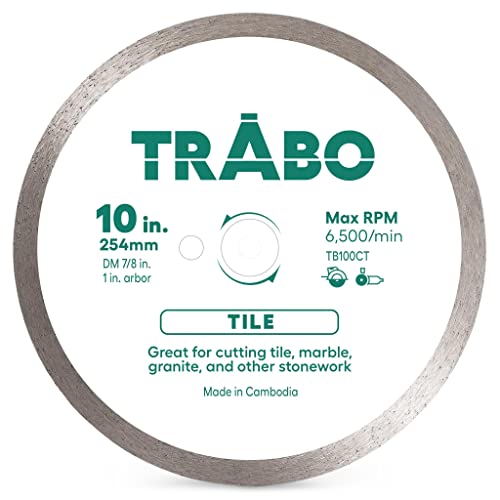
| Trabo 10 Inch Tile Continuous Rim Diamond Metal BondBudget Workhorse | Budget all-rounder for tile and stone | Continuous rim | 1″ arbor + reducer ring | — | Amazon |
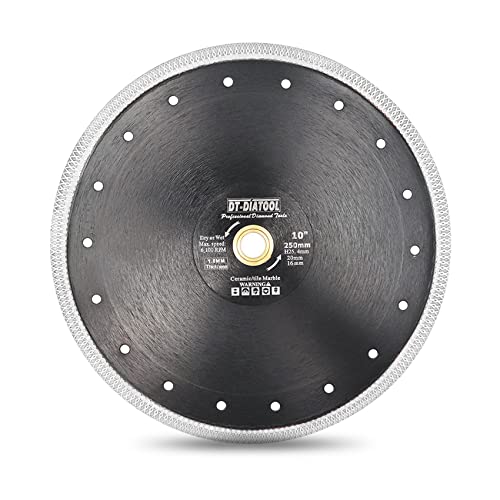
| DT-DIATOOL Diamond Tile Blade 10 InchBest Arbor Range | Replacing a Harbor Freight 1″ arbor blade | X mesh turbo segments | 1″, 7/8″, 4/5″, 5/8″ | 6100 | Amazon |
| LEKOMESH Tile Cutting Disc 10 Inch X Mesh Super Thin | Wet or dry cutting on a budget | X mesh ultra-thin turbo | 25.4mm, 20mm, 15.875mm | 6100 | Amazon |
| OSTEK 10 Inch Super Thin Wet Diamond Porcelain Saw Blade | High-volume tile cutting on a wet saw | X teeth super thin | 7/8″ or 5/8″ | — | Amazon |
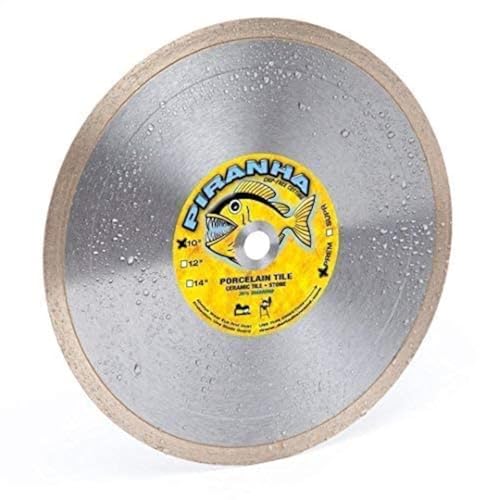
| Delta Diamond Piranha Premium 10 Inch Tile Saw Diamond Blade | Wet cutting porcelain, ceramic and stone | Continuous rim | 5/8″ | 6115 | Amazon |
| DEWALT Diamond Blade for Porcelain or Tile (DW4762) | Fast, clean porcelain and granite cutting | Continuous rim | 5/8″ | — | Amazon |
| DEWALT Diamond Blade for Tile (DW4764) | Large-format porcelain jobs | Continuous rim | 5/8″ | — | Amazon |
| MK Diamond 158436 MK-225 Hot Dog 10″ | Thin-kerf speed on medium and large tile | Continuous thin rim | 5/8″ | — | Amazon |
In‑Depth Reviews
1. PEARL ABRASIVE CO. P4 Thin Mesh Turbo Porcelain Blade 10″ 5/8″-20mm-7/8
Our pick — over 4.5★ from 950+ verified ratings; the strongest balance of quality and price.
The porcelain specialist that leaves factory-smooth edges where cheaper blades chip
The P4 is the blade you reach for when the tile is hard, brittle, and expensive to replace. Its cutting rim is deliberately thin, which means it shaves away less material as it passes through — so a hard porcelain or dense stone tile is far less likely to crumble at the exit edge. Pearl built the diamond bond to bite through tough material quickly, so you are not crawling along a 24-inch tile at a snail’s pace to keep the edge intact.
Two design details earn it the top spot. The mesh pattern on the rim lets water and dust escape while you cut, which keeps heat down and protects both the blade and the tile face. And the diamond layer runs a full 10mm tall from the edge inward, which is a genuinely deep band of diamond compared with blades that wear through at the rim. A laminated center hub stiffens the core, so long straight cuts track true instead of wandering.
What wins people over is the blade quality — it is the single most-praised trait in the feedback, ahead of raw cutting speed. Tilers report it slicing porcelain and marble mosaic like a warm knife, with edges so clean they match the factory finish. One buyer put it plainly: “Cut ~40 12″x24″ porcelain tiles; performed as well on last as first.” Another used it freehand to work a curved cutout: “Was able to cut a roundish 5 inch hole in a piece of ceramic tile for a shower.” The honest trade-off is lifespan: cutter feedback divides on how long the diamond lasts, with some owners going strong after a year and others finding it fades faster than the store-brand blade it replaced. Treat it as a precision blade for finish work rather than a throwaway for rough cuts.
Where it wins on site
- Thin kerf leaves hard, brittle porcelain and stone with little to no chipping
- 10mm tall diamond rim for real cutting life, not a paper-thin coating
- Laminated hub keeps the cut straight on long tile runs
The honest catch
- Diamond life is the dividing line — a few finish jobs per blade rather than endless rough cutting
- Overkill, and over-budget, if you only ever chop soft ceramic floor tile
Buy it when: you are laying porcelain, marble, or hard stone and edge quality is the whole game.
Skip it for: rough framing-style cuts on cheap ceramic where you just need speed and do not mind dust.
2. Trabo 10 Inch Tile Continuous Rim Diamond Metal Bond for Cutting Granite, Ceramic, Porcelain, Quartz, and More with 1 Inch Arbor
A continuous-rim cutter that handles granite, ceramic and porcelain for entry-level money
If you want one blade that will handle a mixed stack of tile without a specialist price tag, this Trabo is worth a hard look. It is a continuous-rim disc, meaning the whole outer edge is one unbroken band of diamond — the layout that resists chipping on brittle material. Trabo specs it for granite, porcelain, ceramic, stone, concrete and similar mineral surfaces, and the diamond is embedded in the metal bond rather than just coated, so it keeps cutting as the surface wears down.
Two numbers matter most here. The diamond rim stands 10mm tall, which is a tall band for the money and the reason it keeps going long after a cheap blade would glazed over. It arrives with a 1-inch arbor and a brass reducer ring pressed inside the package, so it drops onto common wet saws and grinders without an adapter hunt.
Owner feedback backs the value story. Owners praise the cutting performance most, with quality close behind — this is a blade people describe as making clean cuts on basalt and ceramic without chipping out. Speed on shipping and grind quality come in for real praise too. The recurring gripe is thickness: the cut runs a little wide, so if you are trimming a slab down to a tight measurement, you waste more material than a thin-kerf blade would. On glass bottles or any fragile, thin material, that same width makes it the wrong tool entirely.
Straight read: the ideal first 10-inch blade for someone tiling a bathroom or kitchen in mixed ceramic and porcelain, or a second blade to keep on a grinder for trims.
Tape-measure set: reach for another disc if material preservation or thin glass is your priority — the wide kerf eats into the tile edge.
3. DT-DIATOOL Diamond Tile Blade 10 Inch Fits 1″, 7/8″ Arbor
The one that revives an old Harbor Freight saw nobody makes blades for anymore
This blade exists to solve one specific headache: you own an older 10-inch tile saw with a 1-inch shaft and the blades that fit it are hard to find. DT-DIATOOL cuts the bore at 25.4mm and drops TWO reducer washers in the box — a 20mm and a 16mm — so the same disc also seats on 1-inch, 4/5-inch, and 5/8-inch arbors. That is four shaft sizes covered by one purchase, and it is why owners of discontinued saws keep recommending it. One put it plainly: “If you’re looking for a replacement blade for your Harbor Freight tile cutter with the 1″ arbor (which Harbor Freight appears to no longer sell), this is it.”
On spec, it is built to work hard: a 10mm diamond height, 1.8mm segment thickness, and a #60/70 grit that balances fast removal with a reasonably fine finish. The X-mesh turbo rim clears dust and heat as it spins, and a reinforced ring core stiffens the body so the blade holds its line. It is rated for a recommended 3600 RPM with a 6100 RPM ceiling, and it will run dry or wet, which matters when you are on a grinder rather than a wet saw.
Honesty time: quality is the most-discussed topic in the feedback, and it divides. Buyers report smooth, chip-free cuts on porcelain when the saw is set up right and clean water is flowing — but the same feedback flags durability as a weakness, and a pro installer describes the cut running wide and the blade feeling poorly balanced. The pattern behind the good results is unmistakable: keep the blade perfectly square to the tile and it performs; push it off-angle or run it dry and you get chipping or an early death.
Best fit: a DIYer with a discontinued 1-inch-arbor saw who wants to keep using the machine they already own without hunting for a rare blade.
Setup matters: budget a scrap tile to square the saw and dress the blade before you touch finished material — an off-angle table is what turns this into a chipping blade, not the disc itself.
4. LEKOMESH Tile Cutting Disc 10 Inch X Mesh Super Thin

Thin-rim turbo disc for small trims and one-off cuts, not full-floor installs
It is a super-thin X-mesh turbo disc — the mesh segments clear dust and run cooler than a solid rim, and the thin profile keeps the cut narrow. It works wet or dry, fits a 25.4mm arbor with 20mm and 15.875mm reducer washers in the box, and is rated for a recommended 3600 RPM with a 6100 RPM maximum.
On paper the recipe looks solid: hot-pressed hybrid diamond segments at #60/70 grit for strength and wear resistance, plus a reinforced steel core to cut vibration. That combination is exactly what you want for straight, clean cuts on porcelain, ceramic, marble and granite without fighting a wobbling disc.
Here is where you have to be honest with yourself about how much cutting you are doing. Owner feedback on this blade is genuinely split — several users report it breaking after a second cut, and one long-serving reviewer found the diamonds wore off before the end of the second day despite careful wet use. Those experiences are the minority against a wave of straightforward satisfaction, but they cluster around heavier jobs. On light trims and one-off cuts, the value story holds up. On a two-day countertop run, it becomes a false economy.
Where it fits: a homeowner tackling a single countertop cutout, a sink hole, or a small batch of tiles who needs a thin, clean-cutting disc without buying a premium blade.
The limit: this is not a production blade — treat a full floor or heavy daily use as the job it was not set up for and plan a heavier rim instead.
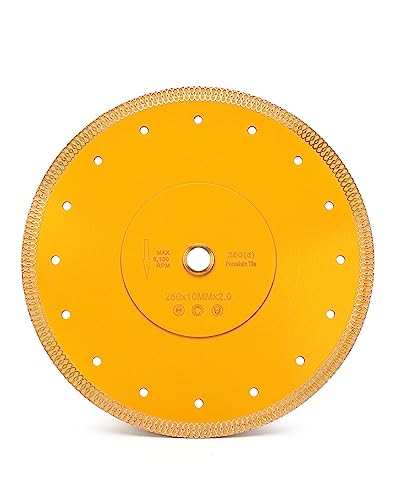
5. OSTEK 10 Inch Super Thin Wet Diamond Porcelain Saw Blade
A high-volume cutter that owners say keeps going through weeks of tile work
It is a super-thin porcelain blade whose X-shaped teeth are designed for fast, smooth cutting, and the diamond rim stands 10mm tall so it has plenty of cutting material to wear through before it gives up. It weighs 0.7 kg, and it runs dry or wet, with a 7/8-inch or 5/8-inch arbor so it fits the common wet-saw spindles.
The standout in the feedback is pure endurance on a working saw. Owners who use this blade daily report running through multiple full shower installs on one disc before needing a change, and porcelain cuts get described as clean and very fast. That is exactly the balance a tiler doing volume wants — enough cutting speed to keep moving, enough rim depth not to stop and swap.
The caveat is edge finish at high speed. Owners note that at very high RPM the cut is fast but not as clean as a smooth-rim blade, so if your visible edges need a mirror finish, slow the blade down or do a final pass with a dressing stone. Choose it for the workhorse role on a big install, and pick a continuous-rim disc like the P4 or the Delta Piranha if presentation edges are the priority.
Volume bet: the pick if you cut tile day in and day out and want a blade that keeps up without polishing every edge before it goes down.
Speed vs finish: dial the RPM back if you need a showroom edge — the fast cut at full speed trades a little finish for a lot of pace.
6. Delta Diamond Piranha Premium 10 Inch Tile Saw Diamond Blade
The stone-capable continuous rim that cuts marble once instead of three times
Delta built the Piranha for people who cut more than tile. It is a continuous-rim disc with a high concentration of diamond in the bond, and the maker lists porcelain, ceramic, granite, marble, slate, terrazzo and similar materials as fair game. If your project mixes tile with a stone countertop edge or a slab, this one blade covers both. It runs on any saw with a 5/8-inch arbor, and the maximum safe speed is 6,115 RPM — a clear ceiling worth matching to your saw’s rating before you spin it up.
Two specs shape its behavior. The cutting rim is.090 inches wide, a deliberately thin profile that the brand positions as the balance between cutting speed and blade life. And the diamond rim runs a full 11mm tall — the same depth class as the widest rims in this lineup — so you get serious cutting material before the blade is spent. A lifetime warranty against warping, cracking and material defects backs it up, which is unusual at this price and worth knowing when you are choosing where to spend.
Owner experience leans on the stone side of the job. Buyers praise fast, clean cutting on marble countertop sections, granite slab bullnose work, and even rock-hobby agate cutting, with minimal dust and no chipping when the blade is used correctly. There is one honest caution the maker’s own spec hints at: on one buyer’s porcelain setup, the first cut or two left a scatter of small 1-2mm chips before the blade settled in and cut clean for the rest of the run. That is not a defect, it is how a diamond rim sharpens itself in use — but it means you should cut a test tile before touching anything visible.
Best used on: a slab or countertop job — the tall 11mm rim and stone-rated diamond make it the natural pick when marble or granite is on the saw.
Test first: run a scrap tile through it to expose the diamond before your finish cuts, and keep the arbor at 5/8-inch, since that is the only shaft this blade seats on.
7. DEWALT Diamond Blade for Porcelain or Tile, Wet Cutting, Continuous Rim, 10-Inch (DW4762)

A continuous-rim porcelain specialist that trades a little lifespan for a clean edge
This is the blade you buy when porcelain is the material and clean edges are non-negotiable. It is a 10-inch continuous-rim diamond disc on a 5/8-inch arbor, and the whole cutting edge is one solid band of diamond — no gaps for brittle porcelain to catch on as the blade exits. It weighs 0.58 kg, which is light for a 10-inch disc, so it spins up quickly on a wet saw without loading the motor.
The brand’s pitch is porcelain above all, but owner experience shows it holds a wider brief. Tiling veterans report it cutting fine edges on porcelain, glazed ceramic, glass, recycled glass and engineered stone, still going clean across multiple showers, backsplashes and floors. In one head-to-head with the MK-225, a contractor building a large tile floor found the MK cut faster and finer — so if raw speed on a huge volume job is the goal, the MK is the sharper tool. This DW4762 is the finish-quality blade of the two.
What wins people over is the raw cutting performance, especially on hard porcelain and granite where cheap blades chip. The honest note is that the rim dulls with use — a pro cutting heavy 2cm porcelain reports noticeable slowdown after about fifteen cuts, and the fix is to dress the blade by cutting a cinder block or paver brick to re-expose fresh diamond. Do that periodically and it stays sharp. Also budget for a diamond file if your cuts will be visible, since joint and edge touch-ups keep the finish looking factory-made.
Why tilers keep rebuying it
- Continuous rim produces near chip-free edges on hard porcelain, granite and glass-look tile
- Light 0.58 kg body spins up fast on a wet saw without straining the motor
- Trusted brand at a fair mid-range price, and cheaper on Amazon than the big-box aisle
What you should know
- Dulls with heavy use — plan to dress the rim with a brick or paver every so often to restore bite
- Locked to a 5/8-inch arbor, so it will not fit a 1-inch or 7/8-inch shaft without a reducer you supply yourself
The decision: pick this if you are laying large-format porcelain and want the cleanest possible edge, not the fastest possible cut.
Look at the MK-225 instead if: your priority is pure speed on a big floor and you can live with a slightly less glassy finish.
8. DEWALT Diamond Blade for Tile, Wet Cutting, 10-Inch x.060-Inch (DW4764)

A wafer-thin rim that rips through thick large-format porcelain in one pass
If you are cutting big, thick porcelain — the kind that needs multiple passes on a cheap blade — the DW4764 is the one to grab. Its cutting rim is.060 inches wide, thinner than the DW4762 above, which means it shaves off less material and slices through density that chokes a thick-rim disc. Owners mention it cutting 3/8-inch large-format porcelain straight through in a single pass where another blade stalled and split, and finishing 24-inch by 24-inch porcelain with long straight runs and no runoff. Hundreds of square feet of ceramic come out clean at slow speeds with no flex.
The thin profile is also where the honest catch lives. A.060-inch rim flexes, and buyers working small precision bevels or tricky edge removal report the blade bending or gliding instead of tracking dead straight. The fix is simple — do not rush the feed — but it means this is a blade you drive gently for accuracy, not shove through the tile. Note too that it needs periodic dressing with a brick or cement block to keep the diamonds exposed and cutting cleanly.
Where it earns its place is the volume job: a bathroom remodel in porcelain-only wet cutting came out precise, fast, clean and easy, with no chips or nicks reported. For large-format work on a wet saw, the thin rim plus the 5/8-inch arbor makes this a serious competitor to the more expensive MK-225 for the same kind of tile. It is a workhorse, and a slow, deliberate hand gets the most out of it.
Best used on: a wet saw loaded with large-format or thick porcelain where one-pass cutting saves hours.
Hands required: keep the feed slow on bevels and small precision cuts — a.060-inch rim rewards patience and punishes a heavy hand.
9. MK Diamond 158436, MK-225 Hot Dog, Wet Cutting Continuous Rim Diamond Saw Blade 10″

The 10-inch disc a contractor reaches for when the floor is measured in thousands of feet
The MK-225 is the blade the volume tiler keeps on the saw. It is a continuous thin-rim diamond blade, 10-inch diameter on a 5/8-inch arbor, and it weighs 12 ounces — enough steel to hold its shape through a big job. The rim thickness is.050 inches, the thinnest in this lineup, and that wafer edge is exactly what lets it cut fast with minimal material loss. Note that.050 inches and the DW4764’s.060 inches are close enough that both are thin-kerf designs, but this MK nominally lays down the narrowest cut of the group.
On long straight tiling runs it is quick. A contractor building a large floor found it cutting appreciably faster than a fresh DEWALT blade with a finer finish, and clean enough to slice a sliver off hard quarry tile without snapping it. The continuous rim means no chipping on the standard 18×18 porcelain that makes up most bathroom floors, and no wobble on the straight edges. A limited lifetime manufacturer’s warranty backs the blade against defects.
The trade-off is that a super-thin rim flexes. On small 2-inch tiles a couple of tilers found it too flexible to hold a dead-straight line, and one long-time user reports the blade slows dramatically after its first third of life and cannot be dressed back. Neither turns this into a bad blade — on medium and large tile it earns its keep, and reviewers who cut 300 pieces of hard rock with it on a wet saw still had roughly half its life left. Watch the water flow, do not jam the feed, and its value holds up.
For big tile: a strong pick for an 18-inch, 24-inch or larger porcelain floor where speed and low chipping on medium and large tile matter most.
Small-tile warning: if your job is dominated by tiny mosaics or 2-inch tiles, the flex makes this the wrong disc — a stiffer blade tracks straighter on small pieces.
Understanding the Specs
Arbor Size
The arbor is the round center hole that mounts on your saw’s shaft. It is the first number to check, because a wrong-size hole means the blade simply will not fit or it will wobble and cut crooked. Common 10-inch shafts are 5/8-inch, 7/8-inch and 1-inch. If your saw uses one size and the blade you want uses another, reducer washers are the answer — thin rings that step the hole down. Several picks here ship with them, so verify what is in the box before ordering.
Kerf Width and Rim Height
Kerf is how wide a channel the blade removes, essentially the thickness of the cut. A thin kerf — like the.050-inch or.060-inch rims here — wastes less stone and cuts faster, but flexes more, so it rewards a slow, steady feed. Rim height is the depth of the diamond layer measured inward from the edge. A taller rim, whether 10mm or 11mm, means more diamond to wear through, so a deep rim typically outlasts a shallow one on a long job.
FAQ
Will a 10 inch tile saw blade fit my saw?
What is the difference between a continuous rim and a turbo rim blade?
Can I cut porcelain tile dry with a 10 inch blade?
How long does a diamond tile saw blade last?
How do I stop porcelain tile from chipping at the edges?
What RPM should I run a 10 inch diamond blade at?
Is a thin kerf blade better for expensive tile?
Do I need a different blade for granite and marble than for ceramic tile?
Why does my tile blade stop cutting and what is dressing?
Should I slow the blade down for a cleaner tile edge?
Final Thoughts: The Verdict
For most people tiling with porcelain or hard stone, the 10 inch tile saw blade worth picking first is the PEARL ABRASIVE CO. P4 because its thin mesh turbo rim and full 10mm diamond band keep hard, brittle tile cutting clean with minimal chipping — the exact combination that saves a whole job from sanding edges. If you need a stone-capable continuous rim that handles marble and granite as well as tile, the Delta Diamond Piranha is the natural next reach. And if you are cutting large-format or thick porcelain on a wet saw where one-pass speed matters most, the DEWALT DW4764 is the thin-kerf specialist for the job.
How We Picked
We do not accept paid placement. Every pick is matched to a real buyer and a real use-case; we do not hands-on test units.
Sources & Methodology
Specifications: manufacturer listings and product documentation. Review insights: verified customer reviews, as of September 2026. Pricing: not shown on this page (it changes often); check the current price via the retailer link.
As an Amazon Associate, KitchPrep earns from qualifying purchases. This does not affect which products we feature.
Related Guides
