
Specs are compiled from manufacturer listings and verified buyer reviews and can change over time — please confirm the key details on the product page before buying.
If your pipes bang when a tap shuts off, or your sprinklers blow apart mid-season, high water pressure is usually the culprit. A back pressure valve rated for your incoming PSI holds the line at a steady, safe level before it reaches your plumbing. This guide covers regulators, relief valves, and backflow preventers for three setups: an RV hose bib, a house main line, and a spray rig.
I’m Mohammad Maruf — the founder and writer behind KitchPrep. This guide is built by comparing the manufacturers’ published specifications and the patterns across verified customer reviews, so you get each pick’s real strengths and trade-offs instead of marketing spin.
Every pick below is judged on connection size, pressure ceiling, and body material. The crowd favorite here holds 4.6 stars across more than 13,000 owners, which tells you a lot about trust in this category. Here is everything worth knowing about choosing the best back pressure valve for your water line.
Our Picks at a Glance
How To Choose The Best Back Pressure Valve
Four things decide whether a valve works for you: the connection size and thread type, the pressure range it can hold, the material it is built from, and whether it just regulates pressure or also stops water from flowing backward.
Match the connection before anything else
Threaded connections come in sizes like 1/2 inch, 3/4 inch, and 1 inch, and they do not interchange. A 3/4-inch garden hose thread (the standard outdoor spigot thread) is not the same as a 3/4-inch NPT thread (the tapered pipe thread used on rigid plumbing). Measure the fitting you are threading onto, not just the nominal size. An inlet screen or filter built in is a bonus, since it keeps grit from jamming the internal seat.
Pick your pressure ceiling with headroom
A regulator rated to 45 psi (pounds per square inch, the standard unit for water pressure) holds your system at or below that figure. A relief valve rated to 145 psi works at a much higher ceiling. Test your incoming pressure with a gauge before you buy — a 45 psi RV regulator and a 175 psi irrigation assembly are not interchangeable.
Lead-free matters where people drink
If the valve sits on a drinking-water line, look for lead-free brass and NSF/ANSI compliance. NSF/ANSI 61 covers drinking water system components, and NSF/ANSI 372 limits lead content — both are real standards you can verify on the listing. For irrigation-only lines, bronze and stainless steel bodies are common and built to take weather.
Quick Comparison
| Model | Best For | Connection Size | Max Pressure | Body Material | Amazon |
|---|---|---|---|---|---|
| RVGUARD RV Water Pressure Regulator★ Best Overall | RV and camper water hookups | 0.75 inches | 45 psi | Brass | Amazon |
| Cash Acme EB45 Pressure Regulating ValvePremium Pick | Whole-house main line | 1 inch | 60 psi | Brass | Amazon |
| Emerson-Fisher R652-CFF 2nd Stage Regulator | LP gas / high-flow fuel lines | 0.5 inches | 0.69 bar | Stainless Steel | Amazon |
| TeeJet 23120-3/4-PP Pressure Relief Valve | Sprayer and roller pump rigs | 0.25 inches | 145 psi | Polypropylene, Stainless Steel | Amazon |
| Zurn Wilkins 34-975XL Backflow Preventer | Irrigation backflow control | — | — | Bronze | Amazon |
| Watts Reduced Injection Check/Back Pressure Valve Assembly | Sprinkler system backflow | 0.75 inches | 175 psi | Bronze | Amazon |
| Euluese 1-350 1″ Double Check Backflow Preventer | Indoor/outdoor check valve duty | 1 inch | — | Bronze, Stainless Steel | Amazon |
In‑Depth Reviews
1. RVGUARD RV Water Pressure Regulator Valve, CSA Approved, Lead-Free Brass
Our pick — over 4.5★ from 13,500+ verified ratings; the strongest balance of quality and price.
The campground hookup valve that keeps your RV plumbing from getting hammered
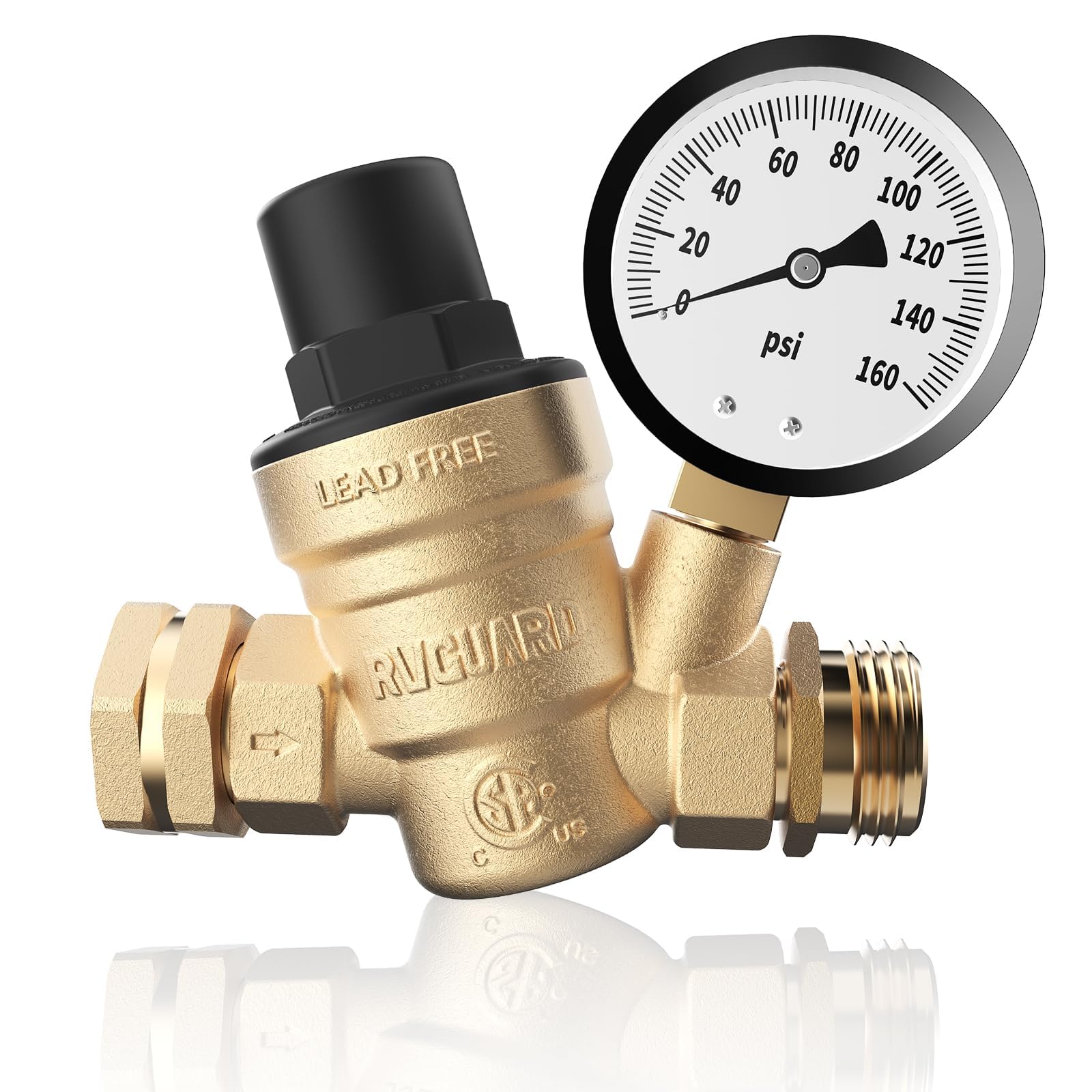
Campground water hookups are notorious for spiking far higher than your trailer’s plumbing can safely take. This regulator drops that incoming pressure to a factory setting of 45 psi — the pounds-per-square-inch figure your faucets, shower, and toilet valve are happiest at — and does it through a simple 3/4-inch garden hose thread that screws straight onto the post.
The reason it dominates this category is the adjustability combined with a built-in gauge. You can see the pressure reading in real time and dial it up or down with a screwdriver — clockwise to increase, counterclockwise to decrease. That matters when you roll into a park with weak pressure and want more flow, or into one with a punishing spike and need to back it way down. RVGUARD also built in an inlet screen to trap grit before it reaches the diaphragm, which is one of the quieter but more useful touches here.
Where it earns real trust is the material spec. The body is C46500 lead-free brass (a plumbing-grade alloy with a very low lead content), and each unit is tested to contain less than 0.13% lead. It meets NSF/ANSI 61 and NSF/ANSI 372 — the two drinking-water safety standards — so you are not running your coffee water through mystery metal. As owners put it: “we have used these on ten camping trips and I have confidence that it is limiting the pressure to an acceptable level.”
What owners rely on it for
- Read-out gauge takes the guesswork out of pressure setting
- Lead-free brass body tested under 0.13% lead, meeting NSF/ANSI 61 and 372
- Built-in inlet screen filters debris before it reaches the seat
- Adjustable across low and high ranges by turning one screw
Where it can fall short
- Some buyers report the pressure control drifts or stops regulating over time
- A few note the gauge threads can weep if they are not taped properly on first install
Buy it if: you tow a camper or travel trailer and want to protect the plumbing at every campground hookup.
Think twice if: you need a heavy-duty inline assembly for a permanent house main — this one is sized for hose connections, not rigid pipe.
2. Cash Acme EB45 Pressure Regulating Valve, 1 Inch NPT Threaded, Metal Top, 60 PSI
A whole-house regulator with a half-cartridge design and a tool-free grip
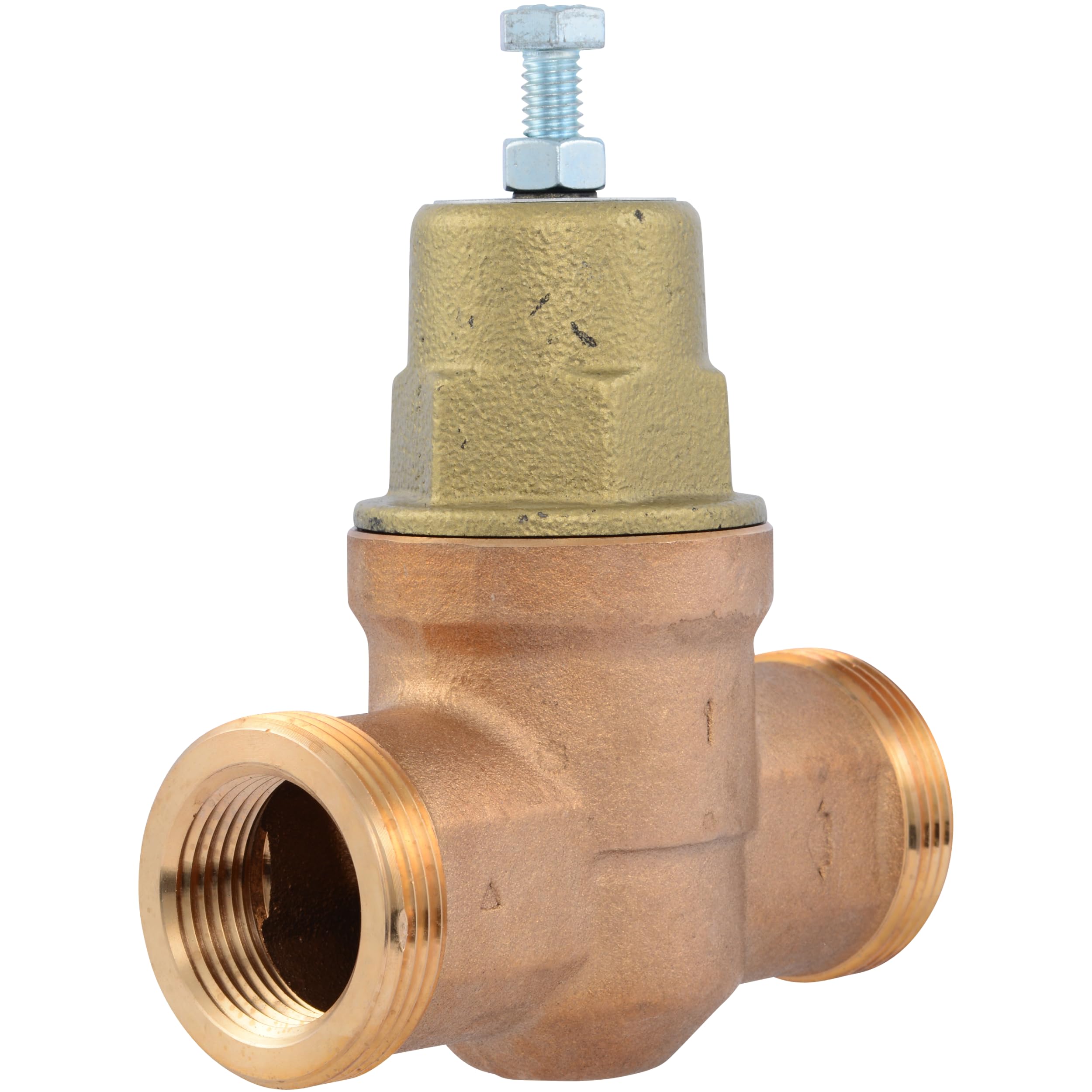
When the problem is the water coming into your house — not your RV — you need a bigger valve, and this one is built around a 1-inch NPT connection (the tapered pipe thread standard on house main lines). It is rated to 60 psi and adjustable from 10 to 70 psi, so it covers both the low-pressure setups and the households fighting high municipal supply.
The defining feature here is the half-cartridge design. It gives you direct access to the pressure-adjusting screw without tearing the whole valve apart, which is why homeowners can test and tune their pressure without a plumber on the phone. Cash Acme also added a tamper-resistant lock so your setting does not drift after someone bumps it. The body is brass with stainless steel and polymer internals, and it is compliant with NSF/ANSI 372 for potable water use.
For a frame of comparison, the RVGUARD above uses a 0.75-inch garden hose thread, while this Cash Acme uses a full 1-inch inlet — a 4.0x gap in connection size that makes this the correct pick for a house main and the wrong pick for a camper hose bib. One owner replaced a Zurn 1-inch unit that “would not keep steady pressure on a water line going to my house” and found this one “keeps steady pressure of 55 lbs and has a lot more volume than the Zurn ever did.”
Where the value sits: the combination of a cartridge-style internal and a tool-free install makes this a genuine upgrade over the basic inline regulators, and the drinking-water compliance is a real spec, not a marketing line.
The honest catch: setting it accurately takes a two-person job — one to turn the screw, one to open a faucet and read the pressure — so factor in a little setup time before you call it done.
Best for: a homeowner who wants to tame an over-pressurized municipal supply feeding the whole house.
Look elsewhere if: you only need to protect a single outdoor spigot or camper connection.
3. Emerson-Fisher R652-CFF 2nd Stage Regulator, Back Mount, 9-13″ W.C Spring, 1/2″ x 3/4″ NPT

The liquid-propane specialist that moves serious fuel volume for high-demand appliances
This valve is a different animal from the water regulators above — it is a second-stage gas regulator built for LP-gas equipment, and its numbers are all about throughput. It is rated to 1,000,000 BTU/hr (British thermal units per hour, the standard measure of gas appliance demand), which is the kind of capacity you need when several high-draw appliances feed off one line.
The 9 to 13-inch W.C spring sets the outlet pressure range — W.C stands for inches of water column, the low-pressure unit used for gas delivery. Inlet pressure is capped at 10 psig, with an emergency inlet rating of 50 psig for surge tolerance. The threaded connections are 1/2-inch FNPT (female national pipe tapered) on the inlet and 3/4-inch FNPT on the outlet, and there is a 3/4-inch NPT screened vent to keep the diaphragm breathing cleanly.
Owners buying this are typically replacing an existing regulator, and the ones who matched the model number right are happy: “Great price and solid. Two plugs for gauges are cool.” The flip side is cautionary but real — one buyer who did not verify the fit was stuck with a wrong-size unit. Check your existing inlet and outlet threads with a tape before ordering; the two plugs for test gauges are a useful bonus if you ever want to verify line pressure.
Why it earns its place: stainless steel body, high BTU capacity, and a vented design make this a proper fuel-gas regulator rather than a general-purpose valve — a critical distinction at this price point.
Reach for it if: you are feeding propane to a boiler, generator, or large appliance and need a second-stage regulator that keeps up.
skip it if: you need a water pressure regulator — this is purpose-built for LP gas and will not do that job.
4. TeeJet 23120-3/4-PP Pressure Relief Valve polypropylene

The sprayer-rig regulator that shrugs off chemicals and holds a smooth line
Agricultural and DIY spray rigs punish valves — the pump slams pressure, the chemical load eats seals, and the valve has to keep the boom pressure steady anyway. This TeeJet handles that with a 145 psi maximum pressure rating (the highest in this lineup, nearly triple the 45 psi ceiling on the RVGUARD above) and polypropylene body construction that resists chemical attack.
Inside it, a 316 stainless steel spring and a Viton O-ring handle the sealing and spring tension. Viton is a high-temperature, chemical-resistant rubber compound — the reason this valve survives sprayer duty where a plain rubber seal would fail. There is also a 1/4-inch FPT gauge port (female pipe thread) so you can plumb in a pressure gauge to monitor the boom line. The threaded connections are National Pipe Tapered, so it threads onto standard sprayer plumbing.
Functionality is the whole story here, and owners confirm the regulation is smooth: this valve “holds up to a roller pump at 5-10 gpm” without the shuttering that plague lesser relief valves. One honest limitation worth knowing — it is a regulating style, not a snap-open relief valve, so it maintains set pressure by bypassing excess flow rather than cracking open and slamming shut. If you need a simple over-pressure pop-off, that behavior is the trade-off.
Why sprayer operators choose it
- 145 psi ceiling handles high-pressure pump output without stress
- 316 stainless spring and Viton O-ring resist chemical and heat wear
- 1/4-inch FPT gauge port lets you plumb a pressure gauge inline
- Polypropylene body is lightweight and chemical resistant
What to know before buying
- It regulates by continuous bypass, so it is not the snappy pop-off valve some buyers expect
- Small niche buyer base — this is a specialty part, not a general household valve
The right tool for: sprayer and roller-pump setups where chemical resistance and smooth regulation beat everything else.
Wrong tool for: a household water line — the connection size and design target agricultural plumbing, not home pipe.
5. Zurn Wilkins 34-975XL 3/4″ 975XL Reduced Pressure Principle Backflow Preventer

The irrigation backflow assembly that lets you keep upstream water out of the drinking supply
If your city inspector has told you that you need a rated backflow preventer on your irrigation line, this is one of the standard solutions. The wye pattern design (a Y-shaped body) reduces install time by giving the water a straighter path, and the first check is easy to access for debris removal — a maintenance job you will be doing at least once a season. The whole unit is serviceable in line, so you do not have to cut it out when a check needs attention.
It comes pre-assembled with the backflow check, pressure regulation, and strainer components already in place. The credentials are the real story: ASSE Listed, IAPMO Listed, UL Classified, C-UL Classified, and CSA Certified, which is what your local water authority will look for on the tag. The bronze body is built to last outdoors in an irrigation pit, and the assembly includes full-port QT ball valves.
Where owners land depends a lot on install quality and climate. Plenty of owners mention easy installs that pass inspection without a hitch, and the review pages sum it up as: “Exact replacement, good price, fast delivery.” The recurring caution is winter — a couple of owners have reported cracking after freeze swings, so blowing the line out or pulling the assembly before the first hard freeze is the smart protocol. If your install is clean and your winter routine is solid, this one does exactly the job it is rated for.
Why inspectors like it: the stacked certifications are the difference between passing a municipal backflow inspection and being told to tear it out and start over.
Choose this if: your municipality requires an approved reduced-pressure principle assembly on an irrigation or sprinkler line.
Steer clear if: you are on a tight budget and just need a simple hose-bib regulator — the certification here is worth it only when code demands it.
6. Watts 3/4″ Reduced Injection Check/Back Pressure Valve Assembly

The heavy-bronze assembly built for high-pressure lines and repeat servicing
Watts is the name veteran plumbers recognize, and this assembly justifies that reputation with a 175 psi maximum pressure rating — the highest ceiling in this entire lineup, well above the 60 psi of the Cash Acme EB45 above. The body is lead-free bronze with NPT inlet and outlet connections at 3/4 inch, and it uses quarter-turn full-port resilient-seated ball valve shutoffs, so one twist of the handle cuts the water for service.
The design favors maintenance: a single access cover opens the whole check chamber so you can clean or replace the modular check components without cutting pipe. Large internal passages keep pressure drop low across the assembly, which is what a high-flow irrigation system needs to keep every zone at the right pressure. Captured springs inside mean the parts stay put while you work — a small safety detail but a useful one when you are elbow-deep in a valve box.
Owners who install this correctly tend to be very happy: “all valves tested at full pressure, no leaks… passed city inspection instantly.” That high install-success rate is why it commands premium money. The one caution is buying the right replacement part — it is engineered to a specific model number, and an owner’s warning to “be sure you are installing the correct replacement unit” is worth heeding before you order.
The case for it
- 175 psi maximum rating handles commercial-grade line pressure
- Lead-free bronze body and NPT connections built to code
- Single access cover opens for module-level maintenance in line
- Quarter-turn full-port ball valve shutoffs simplify servicing
Where it can bite
- Occasional units arrive with factory-damaged seals, requiring a service call to replace
- Premium price point — justified only when code or pressure demands this class of assembly
The pick for you if: you run a sprinkler system where high line pressure and simple in-line servicing matter more than price.
Not for you if: your property runs at modest pressure and your municipality only needs a basic double check — this one is overkill there.
7. Euluese 1-350 1″ Double Check Backflow Preventer, Double Check Valve Assembly
A serviceable double check valve that lets one person flush and swap parts
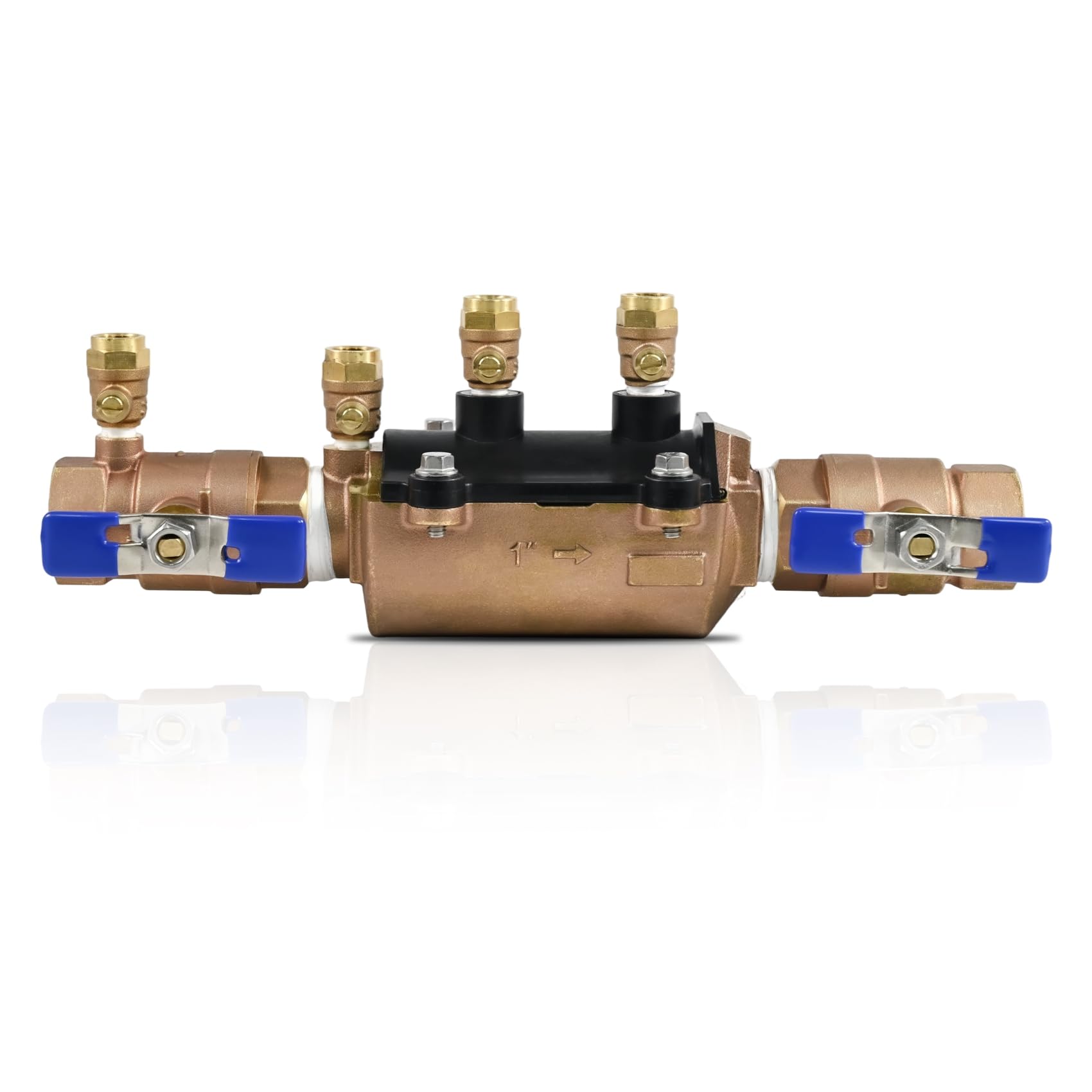
This is the entry point into rated backflow protection: a 1-inch double check valve assembly with a removable pressure vessel designed to cut maintenance time and cost. It supports offline servicing, which means you can pull the check chamber and work on it without taking the whole line down. The flushing tool that comes with it is a single-person job — saving the labor of a second set of hands on every service call.
The body is a mix of bronze, stainless steel, and reinforced nylon, and the manufacturer says the detachable design holds up to harsh outdoor conditions and extreme winter weather. It supports both indoor and outdoor mounting, horizontal or vertical, which gives you layout flexibility the rigid bronze assemblies do not. Inlet is 1 inch via flange, outlet is 1 inch FNPT, so it mates with standard irrigation plumbing.
Here is the honest catch, and it is worth reading twice. One buyer checked the tag and found it printed with a notice that this unit is not NSF approved and contains contaminants not suitable for drinking water. That makes the buying decision simple: this valve is for irrigation, drainage, or non-potable lines only. Check your local code before installing it — some municipalities require an approved assembly, and this one is not the right fit for drinking water use.
The trade-off in one line: you get a serviceable, winter-tolerant double check valve at an entry-level price — but you give up NSF approval and the drinking-water compliance that the RVGUARD and Cash Acme above carry.
Excellent for: irrigation lines, drainage systems, or any non-potable application where you want serviceable parts and a detachable vessel.
Wrong call for: anything connected to drinking water or municipal supply — the manufacturer’s own tag says not NSF approved.
Understanding the Specs
PSI And The Pressure Ceiling
PSI stands for pounds per square inch — the number telling you how much water pressure a valve is built to handle. A regulator rated to 45 psi holds the line at or below that figure. A relief valve rated to 145 or 175 psi works at a much higher ceiling, which is why picking the right rating matters. Buy a valve rated well above your actual incoming pressure so it has headroom and does not run at its limit all day.
NSF/ANSI Compliance Explained
NSF/ANSI 61 covers the materials used for drinking water system components, and NSF/ANSI 372 limits how much lead can be in the metal. A valve that carries both has been tested to a recognized standard, which makes it a real indicator of drinking-water safety. For irrigation-only lines, drinking-water compliance is not required, so a valve without it can still do its job — you just cannot use it on potable water.
Connection Size And Thread Type
Thread sizes like 0.25, 0.5, 0.75, and 1 inch tell you what the valve threads onto. The thread type matters just as much — NPT is the tapered pipe thread used on rigid plumbing, while garden hose thread is the flat-bottomed spigot thread on outdoor taps. Do not assume they are interchangeable even when the nominal size matches. Double check the fitting you are connecting to before you commit.
Regulator vs Relief vs Backflow Preventer
These three do different jobs. A pressure regulator holds the outlet at a chosen pressure. A relief valve controls excess flow by bypassing it, typically on a pump system. A backflow preventer stops water from flowing backward into the supply. Some assemblies combine features, like the Watts unit that handles both a check and a back pressure role. Match the valve type to the problem: regulator for high pressure, relief valve for pump bypass, backflow preventer for reverse flow.
FAQ
Will an RV water pressure regulator work on a house main line?
What pressure should I set my RV water pressure regulator to?
How long does a brass pressure regulator last?
Do I need a backflow preventer or a pressure regulator?
What does NSF/ANSI 61 mean on a water valve?
Can I install a pressure regulator on hot water lines?
Why does my pressure regulator leak at the threads?
What is the difference between a relief valve and a regulating valve?
Do I need a pressure gauge with my back pressure valve?
Can a backflow preventer freeze and crack in winter?
Final Thoughts: The Verdict
For most buyers protecting a camper or travel trailer, the back pressure valve that wins is the RVGUARD RV Water Pressure Regulator, and the reason is simple: lead-free brass tested under 0.13% lead, NSF/ANSI 61 and 372 compliance, a built-in pressure gauge, and an adjustable screw that lets you fine-tune every campground hookup. If you are treating a house main line instead, grab the Cash Acme EB45 with its 1-inch NPT connection and adjustable 10 to 70 psi range. And for code-required sprinkler backflow protection, the Watts Reduced Injection Check Valve Assembly is the one to reach for, with its 175 psi ceiling and lead-free bronze body.
How We Picked
We do not accept paid placement. Every pick is matched to a real buyer and a real use-case; we do not hands-on test units.
Sources & Methodology
Specifications: manufacturer listings and product documentation. Review insights: verified customer reviews, as of September 2026. Pricing: not shown on this page (it changes often); check the current price via the retailer link.
As an Amazon Associate, KitchPrep earns from qualifying purchases. This does not affect which products we feature.
Related Guides
