
Specs are compiled from manufacturer listings and verified buyer reviews and can change over time — please confirm the key details on the product page before buying.
If your pipes bang every time the washing machine fills, or your shower drops to a trickle when someone flushes, the fix is almost always one part: a pressure-reducing valve on your main line. The right one holds household pressure steady even with every tap open. The wrong one gives you fluctuating pressure, dripping joints, and a replacement job in a few years. This guide covers the 2-inch valves built for real main-line use, with the connection types and pressure ranges your system needs.
I’m Mohammad Maruf — the founder and writer behind KitchPrep. This guide is built by comparing the manufacturers’ published specifications and the patterns across verified customer reviews, so you get each pick’s real strengths and trade-offs instead of marketing spin.
This breakdown focuses on fitment, adjustability, and the honest limits of each valve. To find the right main-line regulator for your home, start with this guide to the best 2-inch pressure-reducing valve.
Our Picks at a Glance
How To Choose The Best 2-Inch Pressure-Reducing Valve
A pressure-reducing valve decides whether your whole house gets calm, consistent water. Choosing one depends on three things: the connection type, the pressure range, and the internal build.
Match the connection to your pipe before anything else
Look at your existing pipe before you buy. If it is threaded, count the inches — 2-Inch inlets are the larger main-line size, while a 3/4-Inch inlet is a much smaller residential connection. If it is soldered copper, you need a sweat connection. Get the connection wrong and no amount of adjustment helps. A union end (a nut-and-gasket joint that lets the valve be removed without cutting pipe) makes future swaps far easier.
Set your target pressure first
Most homes run best around 50 to 60 PSI, so a valve rated to 60 PSI and adjustable between 10 and 70 PSI covers the typical range. A valve with a wider adjustable range, like 25 to 75 psi, gives you more headroom to tune the whole house. The factory set point also matters — a valve preset near your target means less fiddling on install day.
Build quality you can feel
Brass, bronze, and stainless steel parts resist corrosion far longer than mixed metals. Also check the strainer screen — a single-cap stainless steel screen catches grit before it reaches the seat, and a cartridge-loaded design means repairs later without replacing the whole body.
Quick Comparison
| Model | Best For | Inlet Size | Connection Type | Max Pressure | Amazon |
|---|---|---|---|---|---|
| Zurn Wilkins 34-600XL★ Best Overall | Easy no-solder swaps | 0.75 inches | FNPT Union and FNPT Female Threaded | — | Amazon |
| Cash Acme EB45 2-Inch NPTTop Performer | Main-line 2-Inch threaded systems | 2 inches | NPT Threaded | 60 psi | Amazon |
| Cash Acme EB45 Double Union | Perfect-fit union installs | 2 inches | National Pipe Thread Female | 60 psi | Amazon |
| Zurn Wilkins 112-NR3XLDUC | Multi-unit property mains | 1.5 inches | Sweat | — | Amazon |
| Watts LF25AUB-Z3 2-Inch | High-capacity commercial mains | 2 inches | NPT Female Union x NPT Female | 300 psi | Amazon |
In‑Depth Reviews
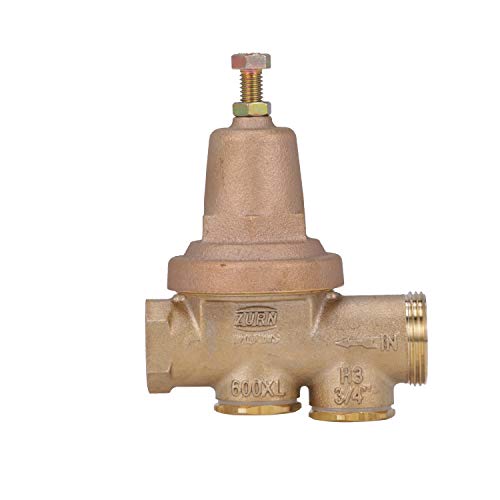
1. Zurn Wilkins 34-600XL 3/4″ 600XL Pressure Reducing Valve
Our pick — over 4.5★ from 700+ verified ratings; the strongest balance of quality and price.
The drop-in replacement plumbers already know, and the one homeowners install themselves without touching a torch.
For anyone swapping out a worn regulator on a smaller residential line, the Zurn Wilkins 34-600XL is the one that keeps showing up in the same conversation. Its inlet is 0.75 inches with an FNPT union and FNPT female threaded connection — that means you thread it on instead of soldering it. The fiber union gasket is what makes the install fast, and a durable brass body with a stainless steel strainer screen (which catches grit before it reaches the valve seat) keeps maintenance low over its life.
What wins people over is how little work it takes to fit. Because it matches the standard OEM footprint, it slots straight into the spot a failed unit left behind. Set the incoming pressure and the household stays steady: at one point the factory sets it to 50 PSI, and one buyer swapped out a faulty Cash Acme EB45 that dropped 20 PSI with a single faucet open and found the new regulator lost only 2 PSI with three faucets running. That is the whole point of the part — pressure that does not flinch when the family splits up across bathrooms.
Here is the honest catch. The threaded end is stiff, so you will need real tools to stop a drip — think a 16-inch crescent wrench plus a pipe wrench to seat it fully. This is a 0.75-Inch valve, not a 2-Inch main-line unit, so it fits smaller residential connections only. It is solid bronze, made in the sense you would expect from a part your water utility stocks, and it is built to outlast the pipe around it.
What earns it the top spot
- Threaded FNPT union install means no soldering and no torch
- Stainless steel strainer screen with single-cap removal for easy cleanout
- Balanced internal design holds steady pressure as incoming supply shifts
- Exact OEM replacement fit for common existing regulators
What to plan around
- Threaded end needs large wrenches — a 16-inch crescent plus a pipe wrench
- 0.75-Inch inlet is the small residential size, not a 2-Inch main-line fit
- Water pressure is a mixed experience for some, so install a pressure gauge and verify your setting
Reach for this if: you want the simplest no-solder swap on a 3/4-inch residential line and prize a well-known, water-utility-grade part.
Look elsewhere if: your incoming main is actually 2 inches — step up to a true 2-Inch unit instead.
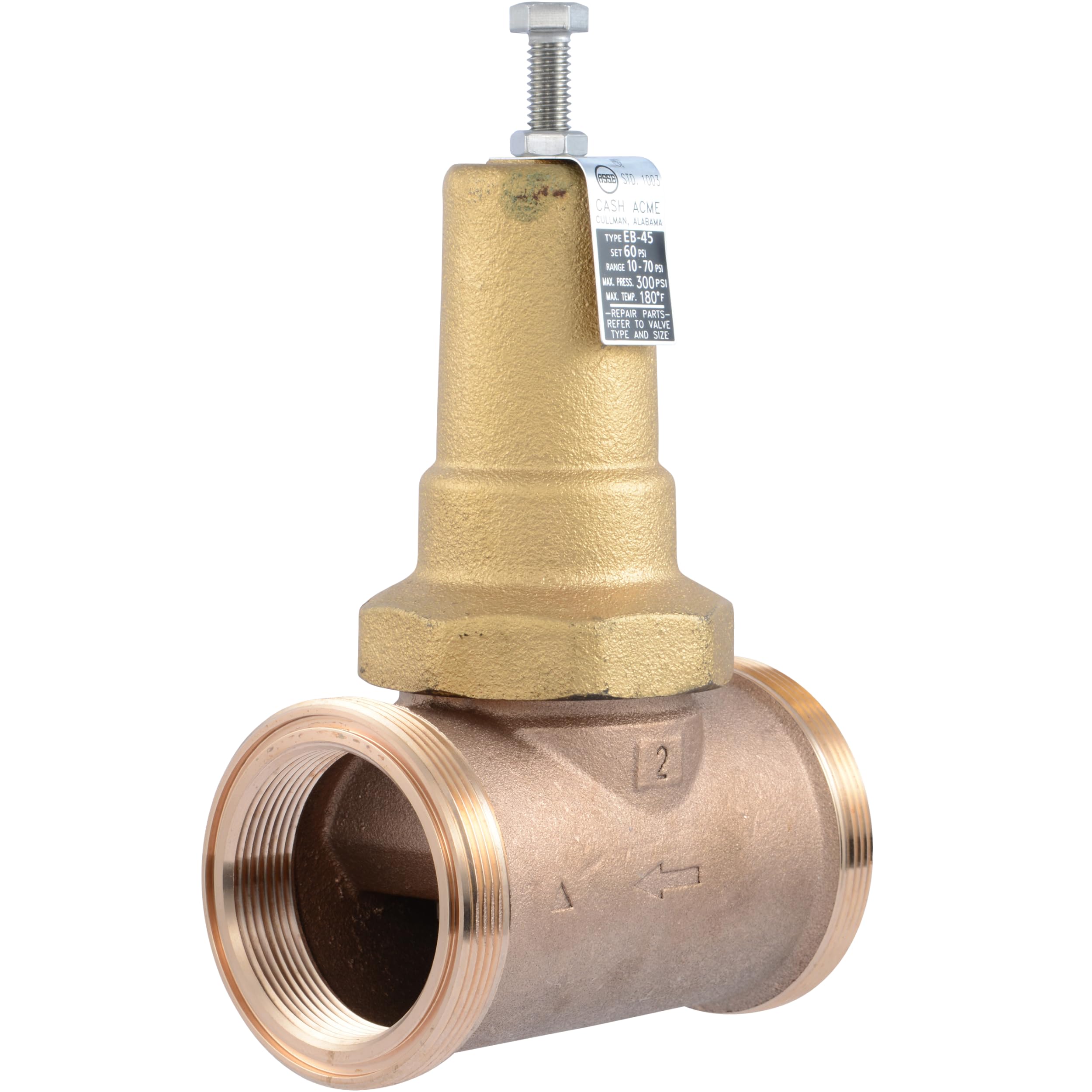
2. Cash Acme EB45 Pressure Regulating Valve, 2 Inch NPT Threaded, Metal Top, 60 PSI
A true 2-Inch threaded main-line valve that keeps pressure flat even when the whole house is drawing water.
The thing that matters most here is the inlet: a full 2 inches of NPT-threaded connection, up from the 0.75 inches on the Zurn above. That size gap is enormous for a main line — this valve is built for the larger incoming pipes where volume, not just pressure, decides whether your shower survives someone running the washing machine. Internally it uses a half-cartridge design that gives you direct access to the pressure-adjusting screw, so tuning the set point does not require pulling anything apart. It is rated to 60 PSI and adjusts anywhere from 10 to 70 PSI, and it handles hot water up to 180 degrees F as well as cold.
The tamper-resistant design locks in your chosen pressure so nobody bumps the setting back open by accident. Owners consistently report it holds steady where their previous valve wandered — one replaced a Zurn 1-inch that could not keep pressure on the house line and found the Cash Acme held 55 lbs with real volume behind it. The body is brass and stainless steel, compliant with NSF/ANSI 372 for potable water, so it is cleared for drinking-water lines. Because it threads on, the install is quick and tool-free compared to a soldered connection.
Straight-talking summary: if your main is 2 inches and threaded, this is the one that claws back the volume a smaller valve strangles. The brass-and-stainless build and the potable-water certification mean it is a long-haul part, not a patch.
One thing to know going in: as a newer listing it has far fewer reviews than the Zurn 34-600XL, so its track record is shorter — but those early buyers are reporting steady, high-volume results.
The pick for you if your incoming main is a true 2-inch threaded line and you are tired of pressure that drops the moment a second tap opens.
Think twice if you need a soldered sweat connection or a smaller residential fit — this is strictly the big threaded format.
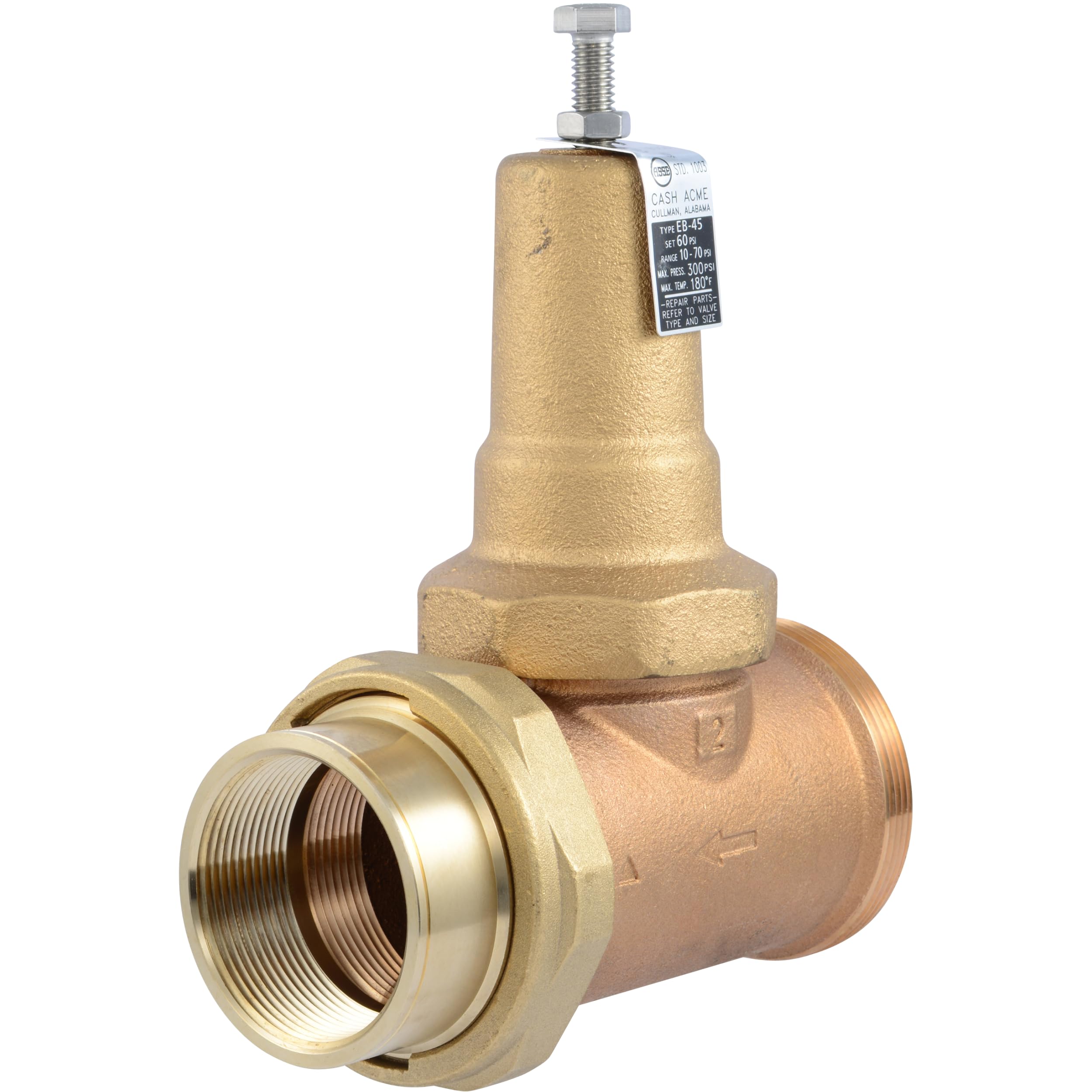
3. Cash Acme EB45 Pressure Regulating Valve, Double Union, 1 Inch NPT Female, 60 PSI
The union end is the star here — it lets you dial in the perfect fit without cutting and re-threading pipe.
When a straight threaded valve will not line up with your existing pipework, the double-union body is what saves the job. The union gives you a threaded joint that lets the valve seat at the exact angle your pipe demands, and that adjustability is the whole reason this version exists. It is rated to 60 PSI with the same 10 to 70 PSI adjustment window as the NPT sibling above, handles hot water to 180 degrees F, and is assembled in the USA. Brass, stainless steel, and durable metallic internals stand up to corrosion, and it carries NSF/ANSI 372 compliance for potable-water lines.
The half-cartridge design again puts the pressure screw within easy reach, and the tamper-resistant lock holds your setting where you left it. Owners are happy with how it performs against far pricier alternatives — people report fitting it, dialing it to their target, and watching the pressure stay put. Functionality is the quality buyers point to most, with solid build quality close behind.
The fit-up advantage: a double-union valve is the smart choice when your pipe geometry is awkward; the union takes up the slack a rigid connection cannot.
The trade-off to weigh honestly: the union makes installation easier, but you are still working with a 1-Inch NPT female format, so confirm your line size before ordering — and expect a real regulator to need periodic replacement over a long service life.
Pick this one when your pipework needs the wiggle room only a union connection provides, and you want a valve that holds your set pressure without fuss.
Skip the changeover hassles by matching this to a 1-Inch NPT female line — check your pipe before you commit.
4. Zurn Wilkins 112-NR3XLDUC 1-1/2″ NR3XL Pressure Reducing Valve with Double Union

Built for multi-unit mains and tight mechanical rooms, where a short valve body is worth its weight in copper.
On a large property, the challenge is fitting the valve into a cramped main without rebuilding the whole run. This Zurn answers that with a compact, short lay length — the overall body length is kept tight so it drops into spaces a bulkier valve cannot. The 1.5-Inch sweat connection means it solders onto copper, and the double union lets you service it without disturbing the pipe. It is a cartridge-loaded design, so when the working guts eventually wear, you replace the cartridge rather than the whole valve. The threaded bell resists corrosion and gives you access to the internals, and an integral stainless steel strainer screen holds up over years of grit.
Owners running larger systems are the ones most impressed. One installed it on a 34-bedroom apartment complex where the incoming main had no regulator at all, and it handled the job — saving hundreds against a discount plumbing warehouse quote. Another set the pressure off the water heater outlet and found it easy to install, use, and adjust. Quality is the trait buyers praise most here, and the certifications back it: ASSE Listed 1003, IAPMO Listed, CSA Certified, and meeting NSF/ANSI 61.
The honest note buyers raise is reliability — most report it works great, while a few report a unit that failed early, which is the reality of any valve on a heavy-duty line. And mind the flow arrow: install it backward and it will seem broken until you flip it around.
The right call for landlords, property managers, and anyone regulating a multi-unit or high-volume main who needs a compact, serviceable, certified valve.
Not for you if you are on a simple 3/4-inch residential line — this commercial-grade 1.5-Inch sweat valve is more valve than that job needs.
5. Watts LF25AUB-Z3 Series 2″ Lead-Free Water Pressure Reducing Valve

A full 2-Inch lead-free workhorse that shrugs off incoming pressure up to 300 psi.
For a commercial, industrial, or large residential main, the numbers on this Watts set it apart. The inlet is a full 2 inches — matching the Cash Acme 2-inch unit in size but built with a much heftier pressure ceiling: it is rated to a maximum of 300 psi versus the Cash Acme’s 60 psi. It comes with an adjustable range of 25 to 75 psi and a standard factory setting of 50 psi, and it operates across 33 degrees F to 180 degrees F. That is a wide envelope for a valve feeding an entire building.
The lead-free cast copper silicon alloy body is the headline material choice, paired with a replaceable seat module, a thermal expansion bypass (which lets water flow back through the valve when outlet pressure climbs, protecting your system), and a sealed stainless steel spring cage. A removable integral stainless steel strainer keeps debris off the seat, and the NPT female union inlet by NPT female outlet threads straight onto standard fittings. At 12.7 pounds, this is a heavy, substantial piece of equipment.
Value and quality are what buyers highlight most, and the recurring practical note is about sizing to an older unit. Buyers report it works beautifully on gravity-fed, high-pressure irrigation and as a long-life house replacement — one ran its predecessor for 20 years and a plumber swapped this in within about an hour. The one caveat to plan for is that this current version sits roughly an inch shorter than an earlier same-code model, so it is not always a straight drop-in on a legacy install and may need a small extension or a re-plumb.
Choose the Watts if you need a true 2-inch lead-free valve with serious high-pressure headroom and a replaceable seat module for long-term serviceability.
Measure first if you are replacing an older unit of the same code — the shorter body may require a small adjustment to fit.
Understanding the Specs
Inlet Connection Size
The inlet size is the width of the opening where water enters the valve, and it must match your pipe exactly. A 2-inch inlet feeds a large main line, while a 0.75-inch inlet handles a smaller residential connection — the two are not interchangeable. Get this wrong and the valve simply will not fit your system, no adapter choice will rescue it. Always measure your pipe or read the fitting before ordering.
Maximum Pressure and Adjustment Range
Maximum pressure is the highest incoming pressure the valve is built to withstand — some handle up to 300 psi, others are rated to 60 psi. The adjustment range is the window you can dial your household pressure into, such as 10 to 70 PSI or 25 to 75 psi. You want a range that brackets your target, typically around 50 to 60 PSI, so you can fine-tune the whole house without running out of adjustment.
FAQ
Will a 2-inch pressure-reducing valve fit my house main line?
What pressure should I set my pressure-reducing valve to?
What is the difference between NPT threaded and sweat connections?
Do I need a double union valve or a single threaded one?
How long does a pressure-reducing valve last?
Why is my water pressure still dropping when a second faucet opens?
Can a pressure-reducing valve handle hot water?
What certifications should I look for on a water pressure valve?
Does a pressure-reducing valve stop pipe banging and water hammer?
Will a shorter replacement valve still fit my existing plumbing?
Final Thoughts: The Verdict
For most buyers, the 2-inch pressure-reducing valve winner is the Zurn Wilkins 34-600XL because it installs without soldering, holds steady pressure with several faucets running, and carries the water-utility-grade build that keeps maintenance low. If your main line is a true 2-Inch threaded pipe, grab the Cash Acme EB45 2-Inch NPT Threaded — it holds volume where a smaller valve sags. And for a commercial-grade main that needs high-pressure headroom and a replaceable seat module, the Watts LF25AUB-Z3 is the one to reach for.
The smart move is to confirm your pipe size and connection type before you order — that single step decides which of these five is the right valve for your system. Match it, set your pressure with a gauge, and your whole house gets calm water day after day.
How We Picked
We do not accept paid placement. Every pick is matched to a real buyer and a real use-case; we do not hands-on test units.
Sources & Methodology
Specifications: manufacturer listings and product documentation. Review insights: verified customer reviews, as of September 2026. Pricing: not shown on this page (it changes often); check the current price via the retailer link.
As an Amazon Associate, KitchPrep earns from qualifying purchases. This does not affect which products we feature.
Related Guides
