
Specs are compiled from manufacturer listings and verified buyer reviews and can change over time — please confirm the key details on the product page before buying.
If you are swapping a heavy lead-acid battery for a lithium one, the three things that actually decide whether you are happy are usable amp hours, real weight, and whether the battery’s brain can survive cold weather. A 100Ah lithium pack gives you nearly all 100Ah, while a 100Ah lead-acid unit only lets you safely drain about half. That usable-capacity gap is why a smaller lithium battery often outlasts the lead-acid brick you are pulling out. This guide walks through nine deep-cycle 12V lithium batteries, explains each one in plain words, and points you to the pick that fits how you actually camp, fish, or live off-grid.
I’m Mohammad Maruf — the founder and writer behind KitchPrep. This guide is built by comparing the manufacturers’ published specifications and the patterns across verified customer reviews, so you get each pick’s real strengths and trade-offs instead of marketing spin.
The choices below range from compact weekend units to a heavyweight pack that runs an air conditioner, so you can match capacity to the job. Read on for the 12 volt lithium battery deep cycle picks that hold their voltage under real loads.
Our Picks at a Glance
How To Choose The Best 12 Volt Lithium Battery Deep Cycle
Picking a deep-cycle lithium battery is mostly about matching three numbers to your real routine: how many amp hours you burn in a day, how much weight you are willing to carry, and how cold it gets where you store the battery. Match those three and the rest of the spec sheet matters far less.
Amp hours versus usable amp hours
A 100Ah lithium battery lets you use close to all 100Ah. A lead-acid 100Ah battery only gives you about half before you risk damaging it. That is why a lighter lithium pack can run your fridge or trolling motor longer than the lead-acid battery it replaces.
What the BMS actually does
The BMS is the small circuit board inside that watches every cell. It cuts off charging if the battery gets too full, cuts discharge if it drops too low, and shuts things down if it overheats. A higher amp rating on that BMS means you can run bigger loads — a 200A BMS supports heavier draw than a 100A unit.
Cold weather and low-temperature cut-off
Lithium cells do not like being charged when they are freezing. Many of these batteries simply block charging below a set temperature to protect themselves. A few add self-heating, which warms the cells first so you can charge in winter.
Quick Comparison
| Model | Best For | Capacity | BMS Rating | Weight | Amazon |
|---|---|---|---|---|---|
| Litime 12V 100Ah LiFePO4★ Best Overall | RV, marine, off-grid | 100Ah | 100A | 22.2 lb | Amazon |
| DUNFUME 12V 100Ah Group 31Smart Pick | Budget RV and solar | 100Ah | 100A | 21.6 lb | Amazon |
| Yeagulch 12V 150Ah LiFePO4Big Runtime | Longer runtime builds | 150Ah | 100A | 41 lb | Amazon |
| DC HOUSE 12V 100Ah Bluetooth | Trolling motor and boat | 100Ah | 100A | 23.8 lb | Amazon |
| WattCycle 12V 100Ah Mini | Small-space installs | 100Ah | 100A | 20.94 lb | Amazon |
| ECO-WORTHY 12V 100Ah SOC Display | No-phone status checks | 100Ah | 100A | 25.1 lb | Amazon |
| Power Queen 12V 125Ah Group 27 | RV and trolling motor | 125Ah | 100A | 25.1 lb | Amazon |
| ECO-WORTHY EnergyRock 12V 280Ah | Big off-grid storage | 280Ah | 200A | ~60 lb | Amazon |
| VATRER POWER 12.8V 460Ah | Whole-cabin power | 460Ah | 300A | 104.7 lb | Amazon |
In‑Depth Reviews
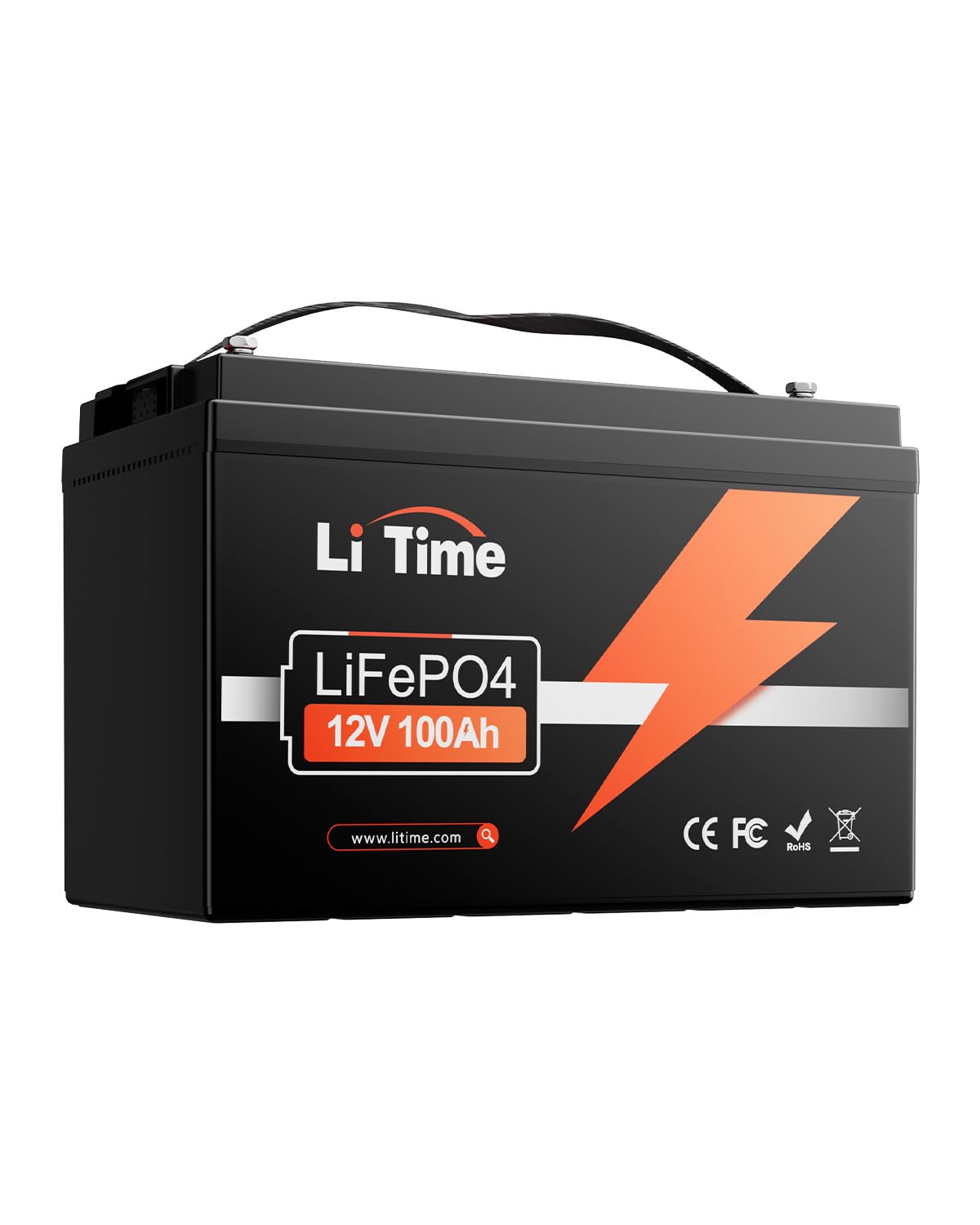
1. Litime 12V 100Ah LiFePO4 Battery, Group 31
Our pick — over 4.5★ from 700+ verified ratings; the strongest balance of quality and price.
A 100Ah pack that weighs less than a third of the lead-acid brick it replaces.
This is the battery to reach for if you are converting an RV, camper van, or fishing boat and you want the whole job to be uneventful. The case weighs a claimed 22.16 lbs — roughly a third of what a comparable lead-acid unit weighs — so one person can lift it into a battery tray without help or a back brace. Inside, LiTime uses A+ grade automotive cells, the same cell tier the auto industry grades for consistency, and ships it with a 100A BMS that handles overcharge, over-discharge, and short-circuit protection among more than 20 safeguards.
Longevity is where the spec sheet gets interesting: LiTime rates it for 4,000+ cycles at 100% depth of discharge, 6,000 at 80%, and 15,000 at 60%, and notes that AGM batteries in the same size typically manage 200–500 cycles over about three years. For a fishing rig, the real-world proof is in the review pages — a buyer running two 10- and 12-inch Xplore fish finders plus a Mega Live 2 on a 100Ah LiTime reports fishing “anywhere on the low end of four hours to 10 or 11” and never dropping below 65%. That is a full day of fish finders on one charge with 65% still in reserve.
Expansion works the way you would hope: 4P4S wiring takes four of these up to a 51.2V 400Ah bank good for around 20.48kWh of storage, which is the territory where 30- to 70-lb thrust trolling motors and home backup start to feel practical. LiTime backs it with a five-year service agreement and 24/7 online support, plus AIG product liability insurance on the unit itself. The honest catch: this is an energy-storage battery only — LiTime specifically says it is not for starting engines, golf carts, or jacks, so do not buy it to crank anything. And the listing notes no Bluetooth on this particular model, so you will not get phone monitoring here.
What wins people over
- 22.16 lb carry weight makes install a one-person job
- 4,000+ cycles at 100% depth of discharge, per the maker
- Scales to a 20.48kWh bank with 4P4S wiring
- Five-year service support with 24/7 online help
Worth knowing before you buy
- Energy-storage duty only — never for starting engines, golf carts, or jacks
- No Bluetooth monitoring on this model
- Group 31 footprint is larger than the mini-format packs further down
Go here if: you want a proven, low-drama RV or marine pack with the widest upgrade path and the longest cycle rating in the group.
Look elsewhere if: you want live phone monitoring of state of charge — this one is a straight-up battery with no app.
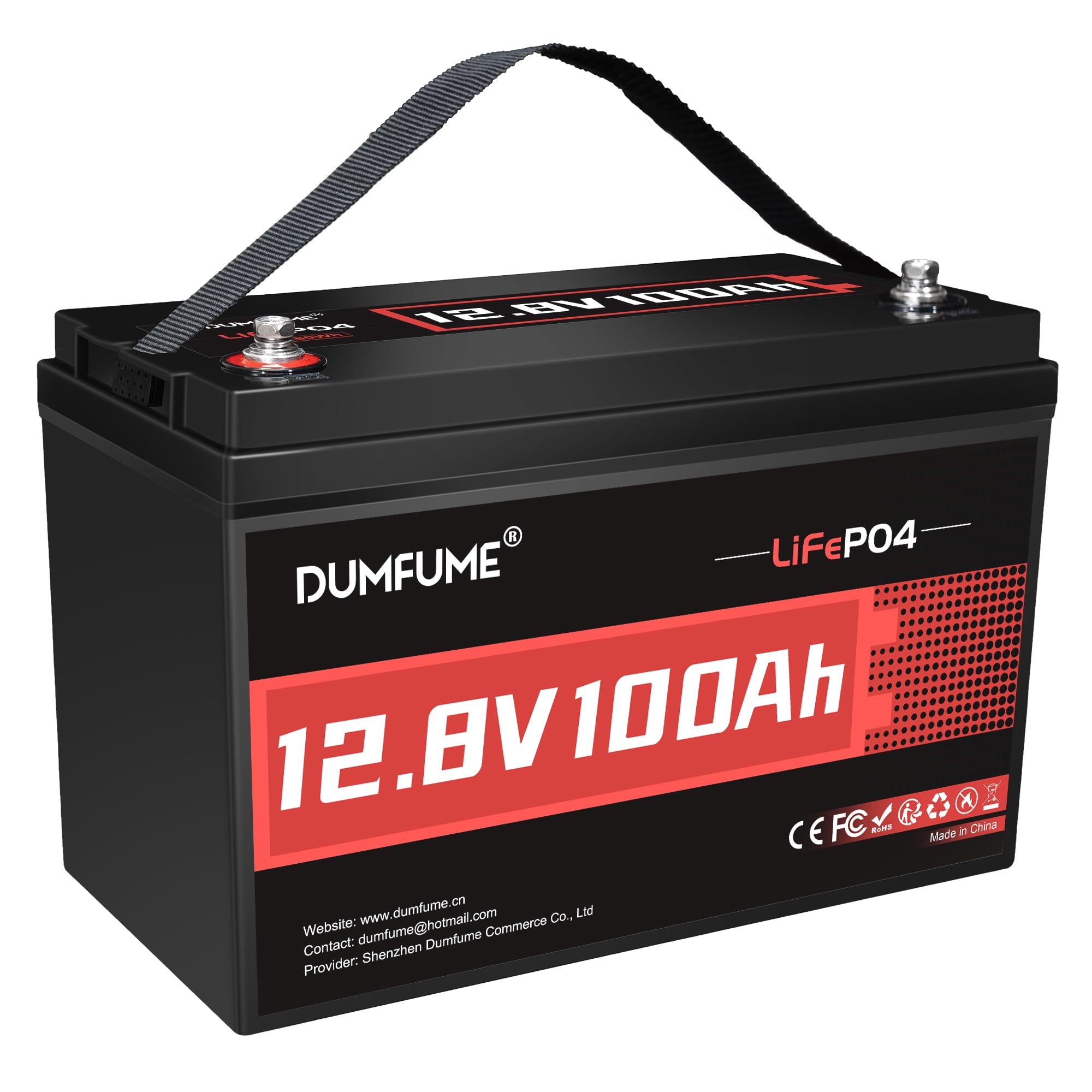
2. 12V 100Ah LiFePO4 Lithium Battery Group 31 Rechargeable
The value pick that squeezes full amp hours into a footprint closer to a lead-acid Group 31.
The pitch here is simple: full 1.28kWh of energy storage in a case the maker claims is 25% smaller than a typical equivalent, and it drops straight into lead-acid wiring with no rewiring needed. Weighing in at 21.6 lbs against the 63.9 lbs of a traditional 100Ah AGM — that is the number that sells this battery to anyone whose back has already hauled a lead-acid brick up a boat ramp.
Where the DUNFUME gets interesting against the LiTime above: LiTime claims a 10-year lifespan on A+ automotive-grade cells, while DUNFUME leans on the compactness angle and its own cycle claims. Both run the same 100A BMS tier. The real difference shows up in the reviews — the DUNFUME pages praise build quality most, but the second most-discussed thread is charging life, flagged as mixed. Some buyers report arriving units that needed a jump start from a charged battery and a 20A charger before they would accept a charge; a campervan owner running a 12V fridge on a 3.5A draw had a unit hit BMS low-voltage cut-off after a year. That is one owner’s experience, not a pattern — plenty of buyers are running these happily — but plan a wake-up charge on arrival rather than assuming it comes ready.
Series and parallel support runs to 4S4P, which builds a 51.2V 400Ah system for home storage, UPS duty, or a camper build. DUNFUME fits an M8 terminal, ABS casing for dust and weather resistance (explicitly not waterproof), and a 5-year warranty. It also notes the battery needs temperatures of at least 5°C to run, and return shipping for cold-weather charging failures is not covered — so if you camp where the mercury drops, look at the self-heating option further down instead.
Best for a first conversion: drop-in lead-acid replacement with 1.28kWh of storage and no wiring changes — ideal for a camper or small solar rig.
Bring a charger: the battery may need a top-up before first use, and it is not rated for sub-5°C operation.
Reach for this if: you want maximum amp hours in minimum case size and you are running it in mild weather with a charger on hand.
Skip this if: your build lives in deep winter — the cold-temp operating floor makes the other picks a tighter fit.
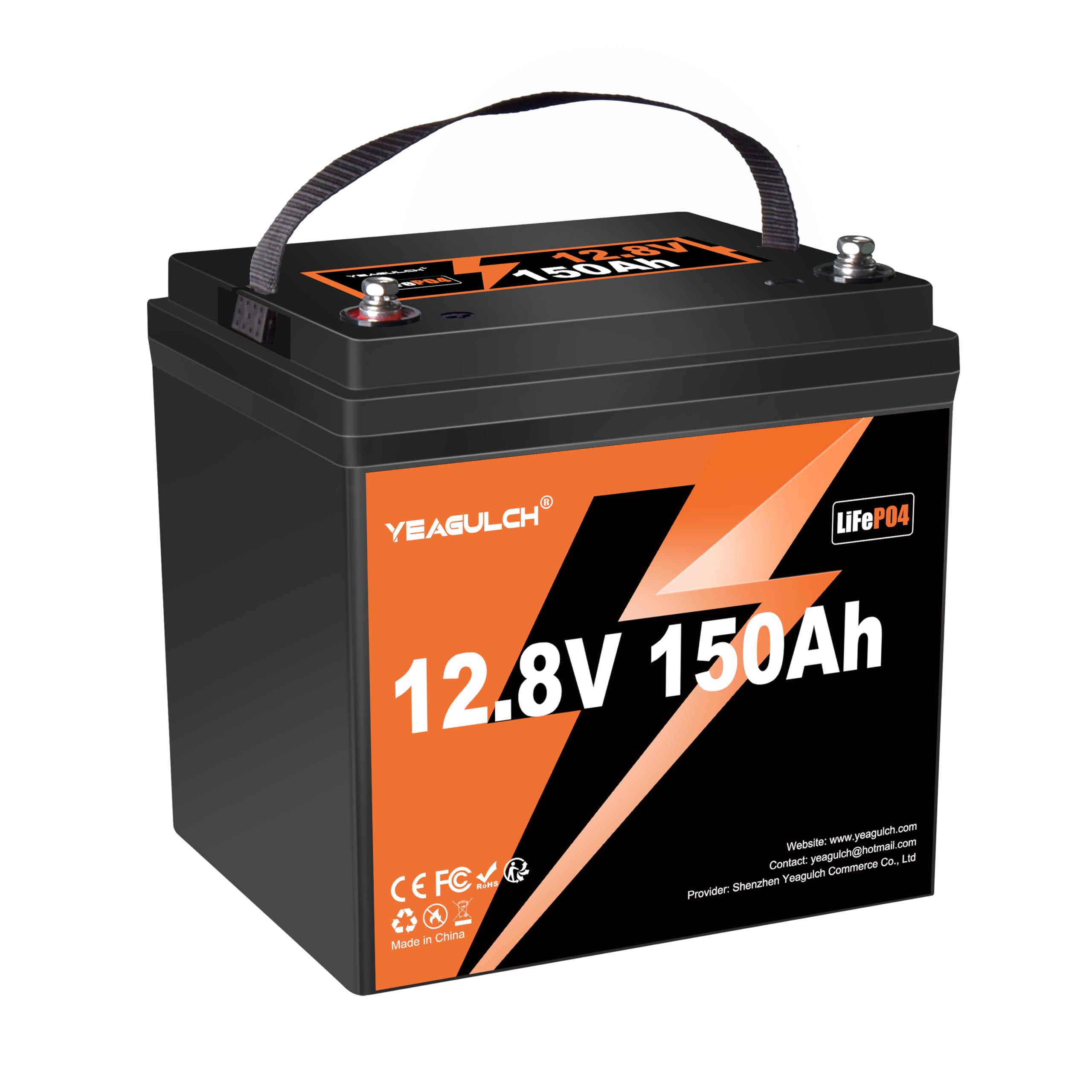
3. Upgrade 12V 150Ah LiFePO4 Lithium Battery 100A BMS 15000+ Deep Cycle
Half again the capacity of the 100Ah packs above, in a case most RV trays will swallow.
The one number that changes your math here is 150Ah — roughly 1,290Wh in the listing, or about half again the runtime of a 100Ah unit at the same draw. Yeagulch fits it into a 10.01 × 7.68 × 9.84-inch footprint and lists it at 41.03 lbs, which is light enough for most one-person installs but heavy enough that the review pages offer one blunt tip: “Weight is heavy. Buy a dolly to move it.”
The specs get more interesting on the protection side. The 100A BMS adds low-temperature cut-off at 32°F for charging and 149°F for high-temperature charging shutoff — the kind of guard that matters if you are leaving a battery in an unheated shed over winter. It scales to 4S for a 51.2V system or 4P for a 600Ah bank, and 4S4P gives you both. Cycle rating is listed at 15,000 cycles at 60% depth of discharge, with the maker claiming 30 times the lifespan of lead-acid.
Where buyers sound off most is reliability; where they are split is battery life — the same two sides of the same coin with these packs. A trolling motor user on a 14-foot Jon Boat reports fishing all day with two adults and gear and burning only one third of charge; a solar setup user reports full power after six months. But not every story glows, and an occasional unit arrives as a dud on arrival, with a warranty dispute following. Note this one carries no built-in Bluetooth, so there is no phone app to watch state of charge — you will need a shunt or a voltage meter to see what is left in the tank.
Capacity math that matters: 150Ah gives you a full extra half-day of fishing or fridge runtime over the 100Ah class without stepping to a two-battery bank.
The missing feature: no Bluetooth, no self-heating, and one 41-lb unit to install — plan for a phone-free battery monitor.
This suits: canoe and pontoon trolling motor builds, and solar storage where a mid-size single battery is the goal.
Think twice if: you want live phone state-of-charge or a lighter case to lift in and out of a tight compartment.
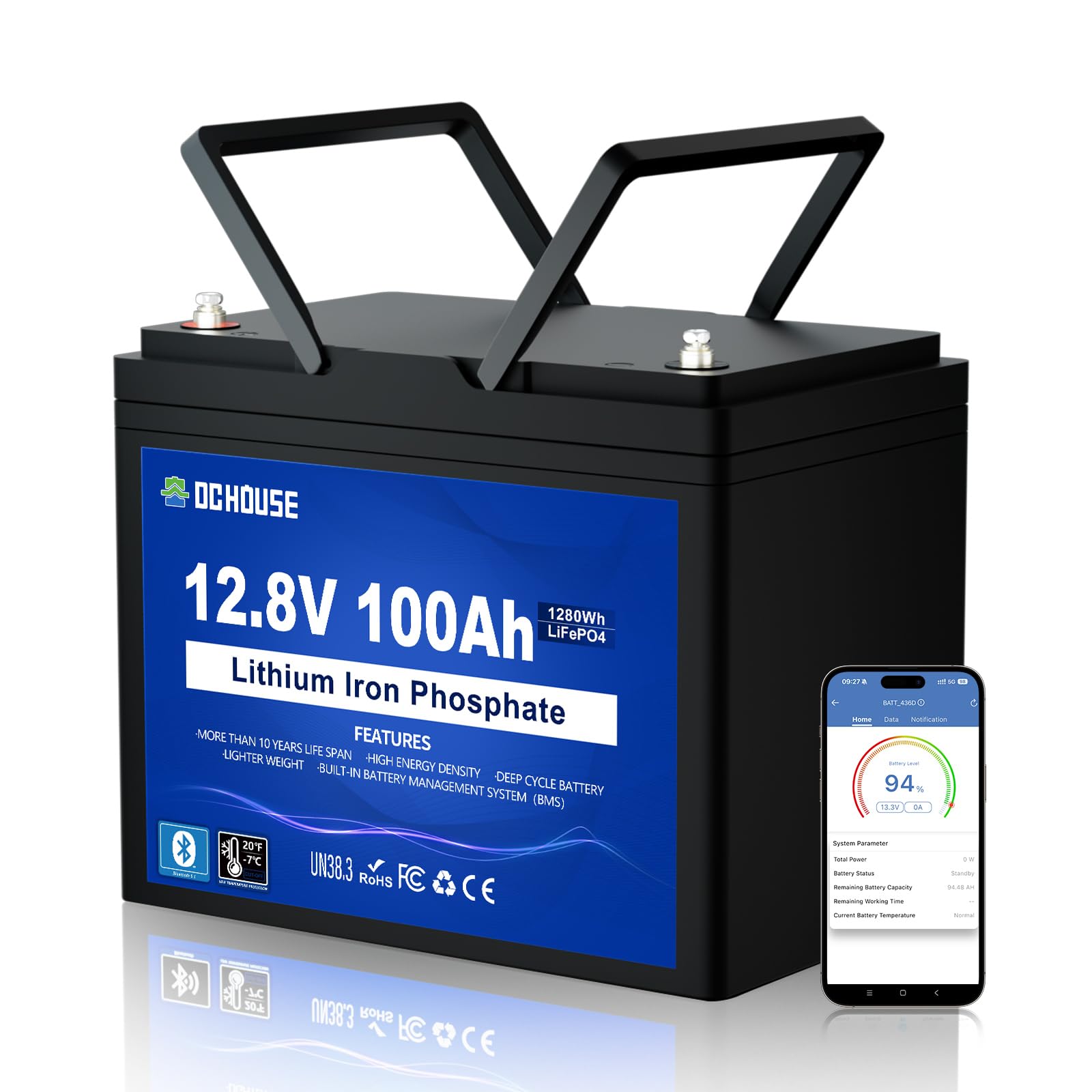
4. DC HOUSE 12V 100Ah Bluetooth LiFePO4 Trolling Motor Battery
Built for the fisherman who wants to know exactly how much charge is left in the tank.
This 100Ah DC HOUSE lands in a footprint close to the BCI Group 24 size — the mainstream battery-box standard — measuring just 0.32 inches taller than the spec, so it slots into most existing trays. What makes it stand apart is Bluetooth 5.1 monitoring: pair it to the DC HOUSE app and you get state of charge, voltage, and current down to individual cell-level detail, plus fault alerts and push notifications when something looks off. Bluetooth range is listed at 5 to 10 meters, so it holds connection from inside the boat while you are fishing.
The BMS adds low-temperature protection that cuts charging below 19.4°F and cuts discharge below -4°F, then reopens once the case warms back to 32°F. Cycle rating is high — 15,000 cycles claimed with a 10-year service life, against the 200-500 cycles typical of lead-acid. A fisherman running a Minn Kota 55lb thrust motor at 75–100% speed for three hours reports using only 40% of capacity, and another running a heavy 16-foot aluminum boat on a windy day reports four straight hours at 60% remaining. That is a full day of trolling on one charge with reserve. Amazon’s own review summary calls it a good budget option — plenty of battery for the money.
Series and parallel expansion runs to 4 batteries in series or 4 in parallel, with a maximum of 8 total, though 4P4S is not allowed here — that is a real wiring limit to plan around if you are building a large bank. It supports M8 terminal bolts and comes with a three-year warranty. The battery is rated for energy storage only, not cranking an engine or running a golf cart, and it needs the correct lithium-dedicated charger rather than a generic lead-acid unit to charge properly.
Why anglers rate it
- Bluetooth 5.1 app shows state of charge down to the individual cell
- 4 to 16 hours of trolling motor runtime depending on load, per reviews
- Group 24 footprint fits most standard boat trays
- Low-temp cut-off protects cells below freezing
The fine print
- 4P4S expansion not allowed — max is 4 series or 4 parallel
- No starting, cranking, or golf cart duty
- Bluetooth range stays inside 5–10 meters
Built for boat owners: trolling motor and fish finder duty where you want real-time charge visibility without a shunt meter.
Pass on it if: you plan to stack past 4-series-4-parallel — the wiring rules here cap you well short of that.
5. WattCycle 12V 100Ah Mini LiFePO4 Battery with Bluetooth 100A BMS Group 24
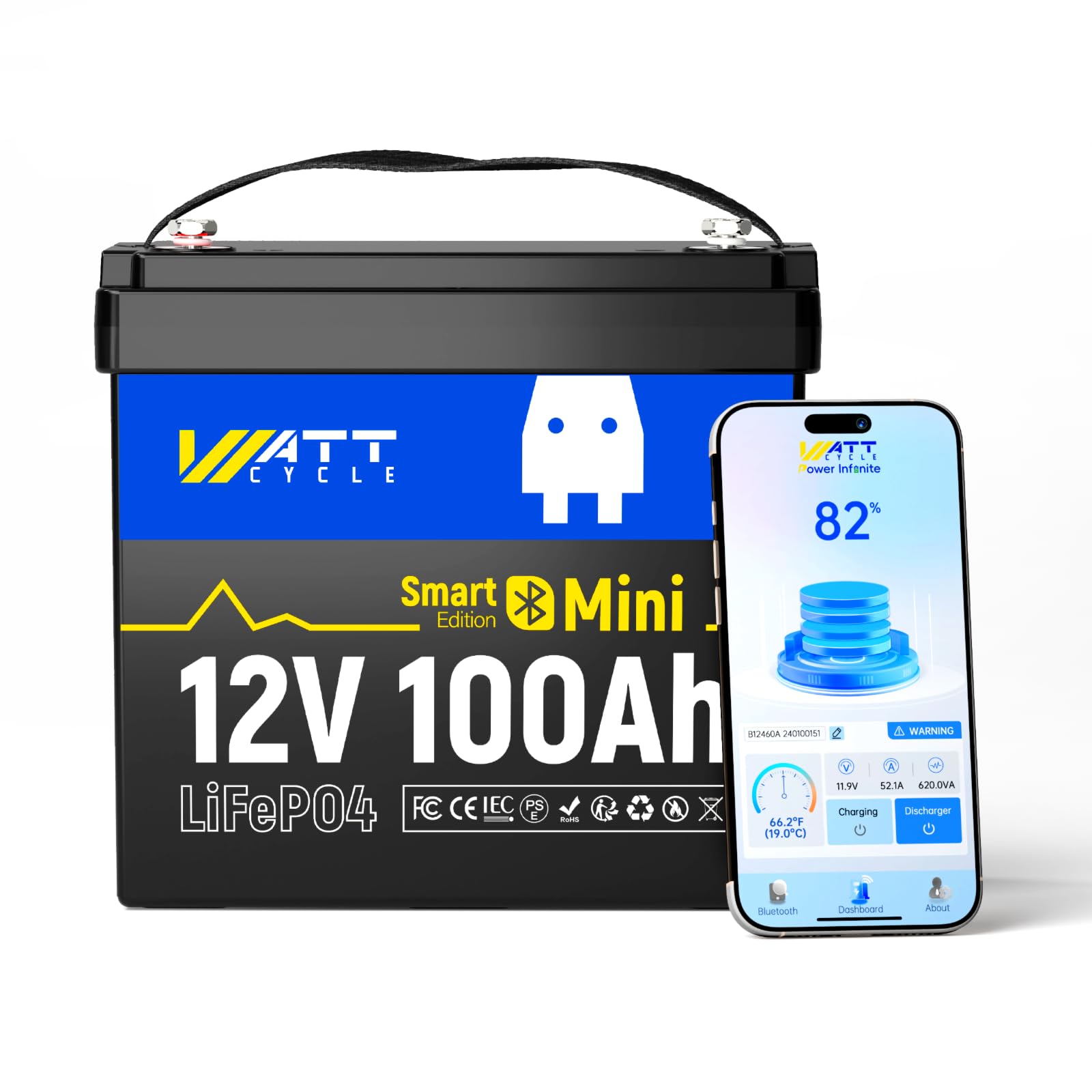
The lightest and smallest 100Ah pack on this list — 20.94 lbs in a case you can hold in one hand.
WattCycle claims an 11% weight reduction and a 39% volume reduction over its own first-generation design, which lands it at 20.94 lbs in a case that measures 9 × 5.4 × 8.2 inches. Compact enough that a boat owner swapping out lead-acid near the transom immediately notices the weight difference; a buyer with a Minn Kota trolling motor setup praised exactly that in the review pages. Bluetooth monitoring works through the WattCycle app, and unlike the DC HOUSE above where the app name is fixed, you can rename the Bluetooth connection yourself — a small convenience if you are running multiple banks in one vehicle.
Inside are EV-grade A+ cells rated for up to 15,000 cycles and a claimed 10-year lifespan, wired for 4S4P scaling up to a 20.48kWh system. The 100A BMS handles overcharge, over-discharge, overload, overheating, and short-circuit protection, and the low-temperature range spans -4°F to 158°F with auto shutoff below freezing. Runners on a golf cart report the cart performing great compared to lead-acid. Battery quality and reliability are the two things buyers talk about most in this listing — the mass of positive feedback centers on those.
Where it gets honest: a handful of buyers with 24V 400Ah rigs built from 8 WattCycle Mini batteries report BMS lockups over the long haul, one after about a year of use. That is a real pattern of concern for heavy multi-battery banks, not a universal problem — plenty of single-battery and two-battery buyers keep reporting strong performance in car audio, RV trailer, and trolling motor duty. The battery comes with a 5-year warranty and 24-hour technical support response, which is worth factoring in if you plan to push a big multi-unit build.
Space-savers will love it: less than 21 lbs and a genuinely mini case mean you can fit more batteries into the same locker or compartment.
Mix with care: multi-battery banks are where the long-term BMS reports get mixed, so single or paired builds are the safer fit.
Perfect for: weight-sensitive installs — small boats, pop-up campers, and any rig where every pound near the transom matters.
Not the best call if: you intend to build a large 4S4P bank and want proven long-term reliability across eight batteries.
6. ECO-WORTHY 12V 100AH LiFePO4 Battery with SOC Display Flame-Retardant
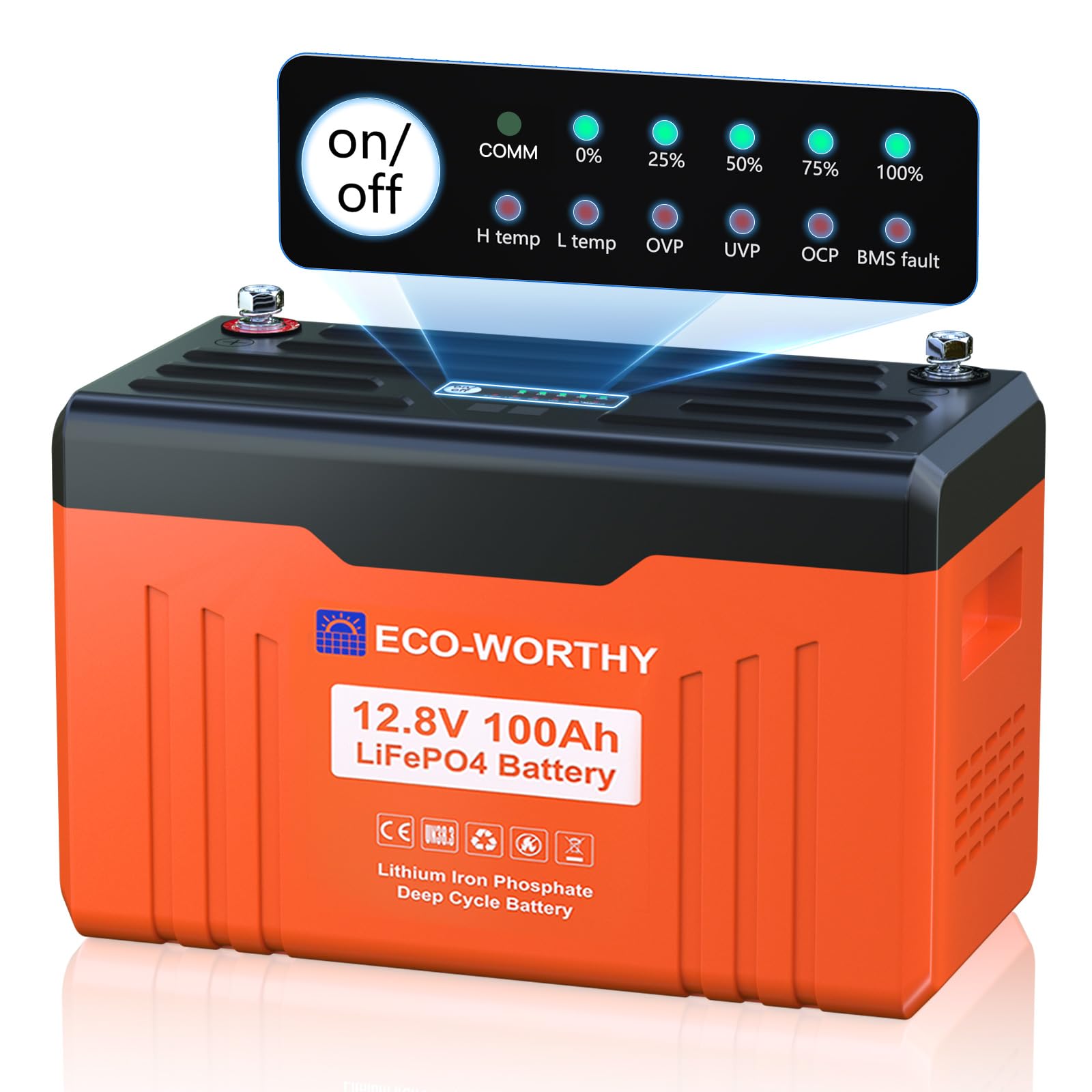
The only battery here that shows state of charge on its own top panel without pulling out a phone.
Most of the smart batteries on this list only let you see state of charge through an app, which is useless when your phone is dead or you are mid-troubleshoot. ECO-WORTHY built in both: a top-mounted display with push-button status check, plus Bluetooth app monitoring with a stated 98-foot range for voltage, current, capacity, SOC, cell voltages, and consistency. It also has a built-in buzzer that sounds the alarm on a BMS fault — a considered detail for anyone wiring into a home backup or off-grid rig.
The case is listed at 25.1 lbs and dimensions group it as a Group 27. Inside, the cells are held by a metal fixture designed to prevent expanding and short circuits, and the bus matrix supports 4P2S expansion to 10.24kWh — plenty for a camper running a fridge and lights, or a moderate home storage setup. Three-year warranty and M8 screw terminals come standard.
Two honest notes here. First, the state-of-charge readout has a real limitation that a couple of owners flagged: below about 1A of load the phone app and display can be inaccurate, showing 90% when the true state of charge is closer to 10% on a coulomb-counting budget meter — for small loads, use a proper voltmeter or shunt-based coulomb meter instead. Second, battery-life reports are mixed across reviews: most buyers run these happily through a full winter on a pontoon boat or in a camper, but at least one buyer had a battery that read 100% in the app and then died mid-trip. That is rare but worth factoring in for critical-load use.
Standout feature: the top-panel display is genuinely useful — a glance beats waiting for an app to open, especially during install or fault checks.
Read this before trusting the gauge: the on-board SOC meter is accurate under real loads but less so with very small draws — bring a voltmeter for those.
Great for: RV and camper installs where you want a battery that shows its own status without a phone, plus the remote convenience of the app.
Consider elsewhere if: you need rock-solid SOC accuracy at sub-1-amp draws, where a shunt meter is the better monitoring path.
7. Power Queen 12V 125Ah LiFePO4 Lithium Battery Group 27 Bluetooth for RV
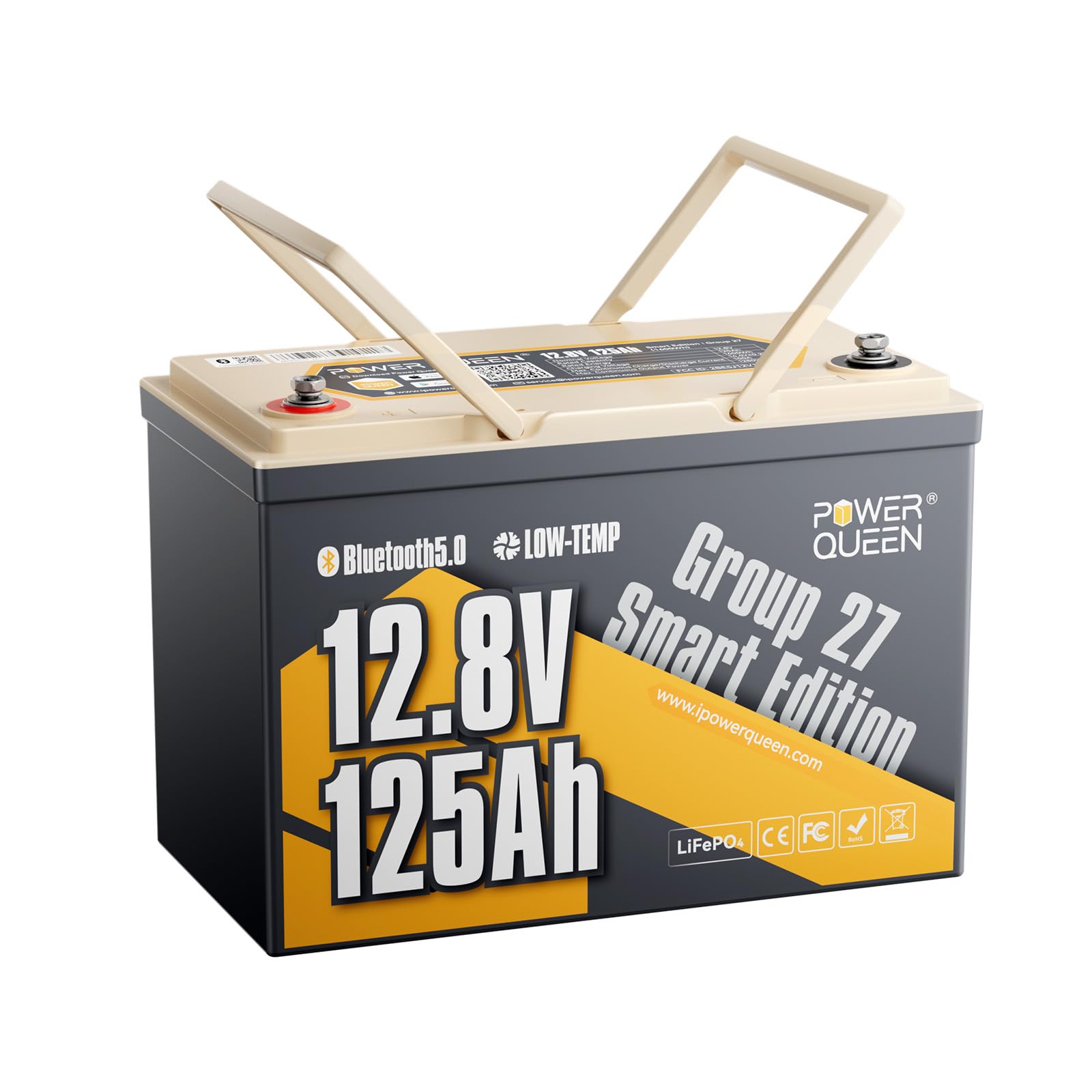
The Group 27 drop-in that adds 320Wh over the 100Ah pack it replaces — same footprint.
Power Queen built this around a very specific problem: you have a Group 27 battery tray that fits a 100Ah lithium exactly, and you want more runtime without going to two batteries. The answer is a 125Ah case in the same BCI Group 27 size — 12.13 × 6.69 × 8.31 inches — that carries 320Wh more energy than a 100Ah lithium in the same form factor. The marketing math is a claimed 32 hours of extra runtime on a 10W lighting load, which translates to about four extra evenings of cabin lights before you need to charge again.
The BMS here is Power Queen’s own design, with over 20 protections including low-temperature charge cut-off below 32°F and low-temperature discharge cut-off below -4°F, plus a pre-charge function for compatibility with inverters and a 30-second auto-resume after overload. A pontoon owner running a Minn Kota 45lb thrust motor reports 6 hours of use on 15% charge, then towing through high wind for 4 miles, fishing 2 more hours, and finishing at 48% — that is peak-day endurance in real water conditions.
Comparison against the WattCycle Mini above is worth noting: WattCycle shaves off more weight and case volume, but Power Queen adds the 25 extra amp hours. Different trade-offs, same problem being solved. Owners repeatedly call out the Bluetooth app for its live state-of-charge display and remote discharge control, though at least one notes the app has some issues while the battery itself works fine. The battery is rated as an energy-storage unit only, not a starter, and Power Queen backs it with a 5-year warranty and a 24/7 technical support line.
Real capacity gain: Group 27 fit with 320Wh more than a same-size 100Ah — genuine upgrade, not just marketing.
App caveat: the Bluetooth monitoring is a strong feature but not everyone’s app experience is smooth — bring patience on day one.
Ideal for: fifth-wheel and travel-trailer owners who want the most runtime per Group 27 slot and app-based monitoring for confidence.
Better fit elsewhere if: you want the absolute lightest case on the list or a fully proven large-bank performer.
8. ECO-WORTHY EnergyRock 12V 280Ah Metal Case LiFePO4 Lithium Battery
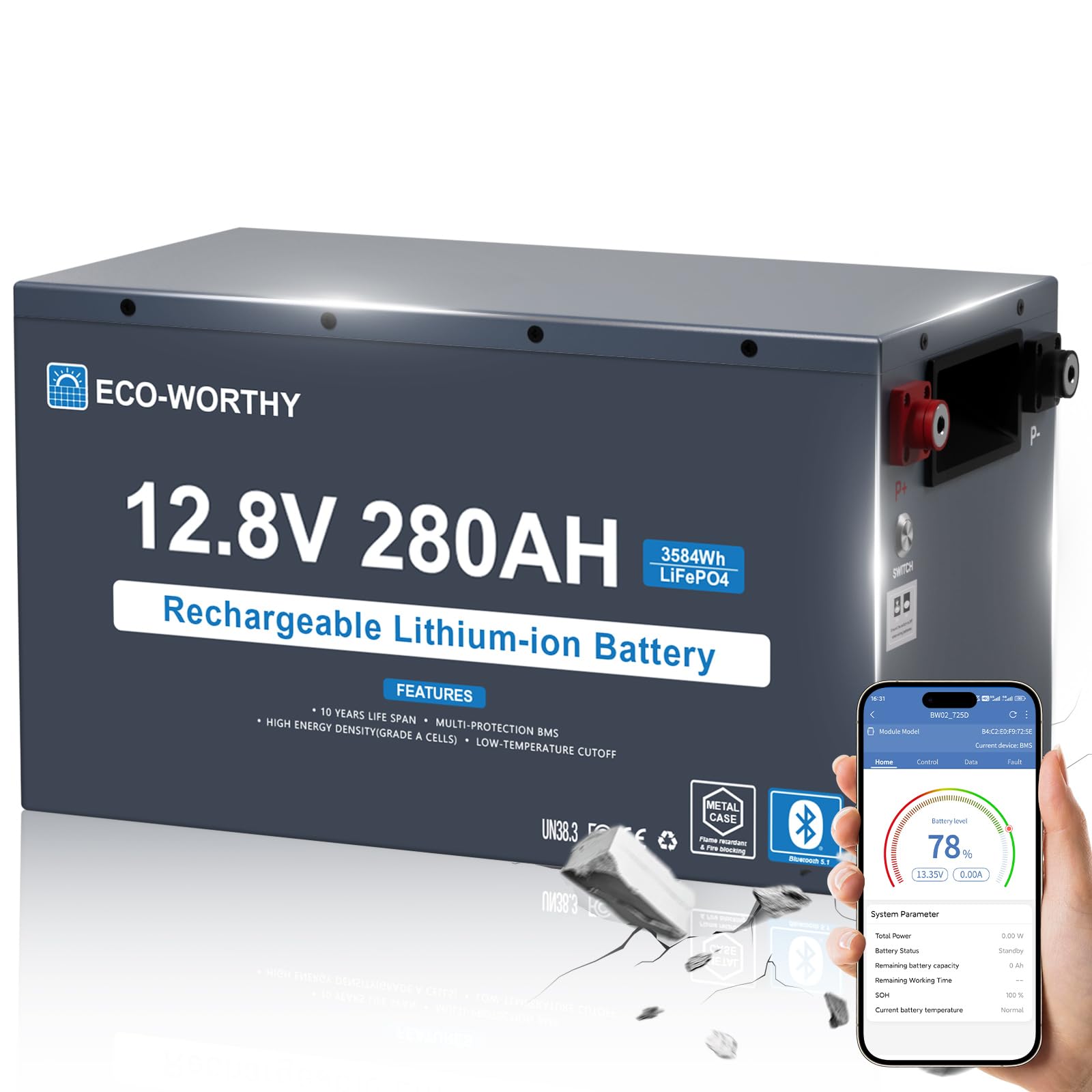
A 280Ah metal-cased tank that runs a campervan air conditioner and skips the battery box.
Stepping up from 100Ah to 280Ah changes the whole conversation. This pack carries 3,584Wh — enough that a buyer running a 12,000 BTU portable AC in a campervan reports it lasting two hours down to 30% charge, and another reports a 1/2 HP sump pump at roughly 500W running five continuous hours, or 12+ hours on intermittent duty. Those are loads the 100Ah units in this guide simply cannot push for long.
The build is what separates this from the rest: a heavy-duty metal case with reinforced internal cell holders that resist vibration and impact, plus four mounting feet and a metal enclosure that lets you install it as-is — no separate battery box required. A one-touch safety switch cuts discharge completely for maintenance, and the internal cabling is clean: heavy-duty terminals with flat layout. The 200A BMS is the strongest protection tier on this list short of the Vatrer below, with low-temp charge cut-off for cold-weather protection.
Owners genuinely rave about this one — battery quality and battery life are the top themes, with reviewers calling it a “never thought I would say a battery is nice” purchase for campervans, an off-grid Tahoe setup running Victron and 3000W inverter over multiple four-day weekends, and an RV rig that replaced two deep-cycle batteries with one unit that finally keeps the fridge running all week on a single 100W solar panel. The heaviness is real — around 60 lbs — and at least one buyer returned it because of that weight, wanting a lighter option. If you can hoist the case into place, it earns its keep; if you cannot, look at the 100Ah or 150Ah picks above.
What buyers rave about
- Metal case resists heat, shock, and road vibration without an extra battery box
- 200A BMS handles high-draw loads like RV air conditioners and 2500W inverters
- One-touch safety switch for safe install and maintenance
- Bluetooth monitoring plus low-temp charge protection
Where it asks for more
- Around 60 lbs — a genuinely heavy install for one person
- Arrives as a broad metal footprint that may need fit modifications in tight bays
- No watertight lid seal or IP certification from the factory
The right fit for: off-grid cabins, campervans, and RV builds where one big battery beats a stack of small ones and the case does double duty as protection.
Look past it if: you are already weight-limited or cannot lift 60 lbs into the tray yourself — a single 100Ah might serve better.
9. VATRER POWER 12.8V 460Ah Self-Heating LiFePO4 RV Battery, APP Monitoring
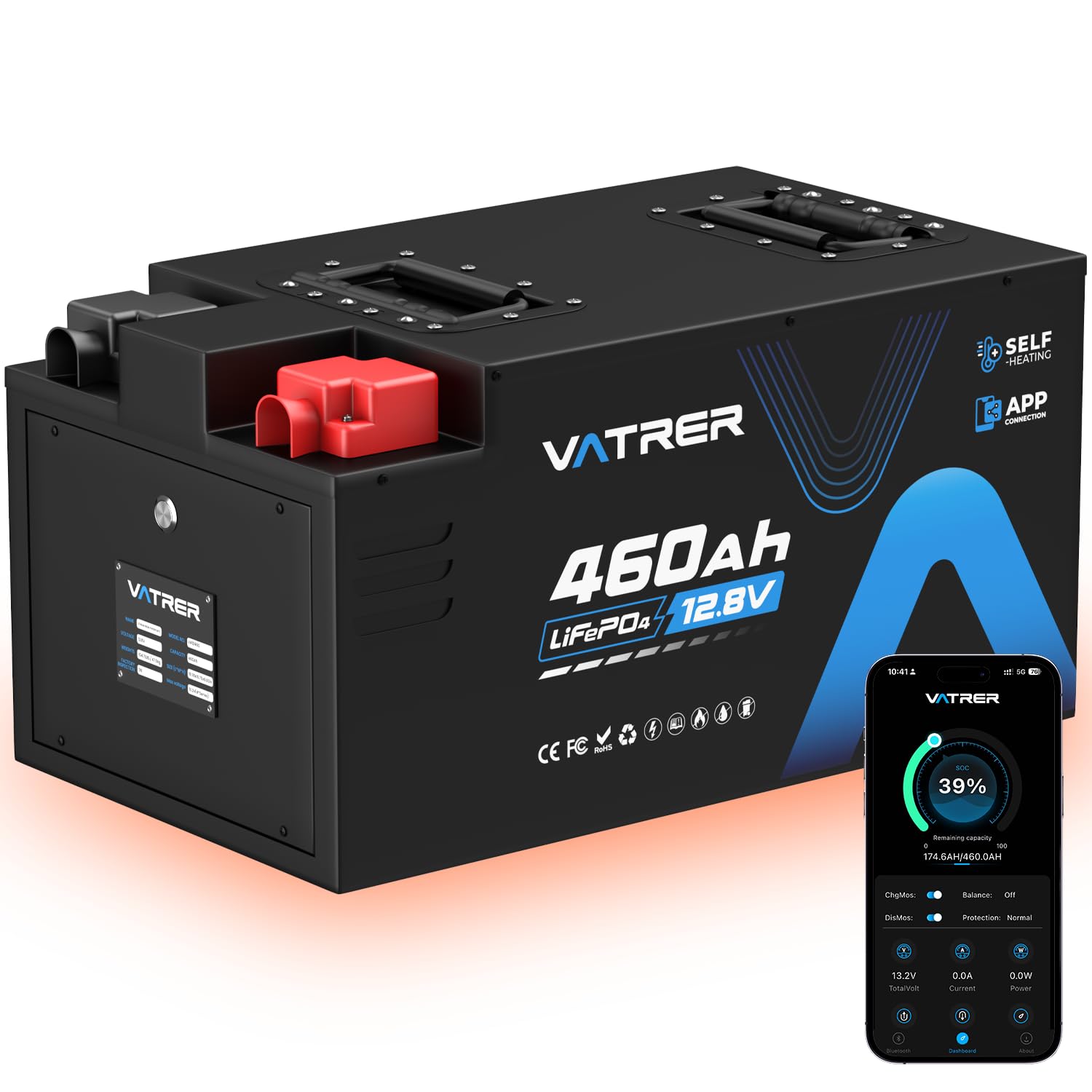
Automatic self-heating plus a 300A BMS make this the one pack here that charges below freezing.
Most deep-cycle lithium batteries cut off charging when it gets cold. This one actively warms itself. When the BMS sees the battery connected to a charger between -4°F and 41°F, it runs a self-heating cycle, stops once the cells hit 41°F, then begins charging normally. That single feature turns this into the choice for a Canadian or upper-Midwest winter install, where the other batteries on the list would sit frozen and unusable.
The energy math is on a different scale entirely. 460Ah is roughly the equivalent of five 100Ah batteries, but Vatrer packs it into 1.1ft³ of space — a form factor smaller than five separate units. Capacity expands to a max 51.2V 1840Ah 4P4S bank with 94.2kWh usable energy, which is proper home-backup territory. A buyer running it in a camper reports it came charged to 49%, hit 100% in about four hours at 45 amps, then ran the camper for three days with only a little solar input. Another reports the battery lasted four nights of RV dry camping in overcast Newfoundland with 30% still showing.
The 300A continuous discharge rating is the highest in this guide and lets the pack feed big loads — an RV air conditioner, an oven, a desktop PC running all night on 12V. That load ceiling is exactly what separates it from the 100A and 200A packs above. The trade-offs are real: it weighs 104.7 lbs, needs proper physical support in the bay, and Bluetooth range is short — a common theme with the app, and at least one buyer running a hard-used 300Ah Vatrer had the BMS fail at 2.3 years. But the warranty story is strong: Vatrer replaced that unit through coverage, and the buyer upgraded to this 460Ah and raved about the response. The 5-year limited warranty with prepaid return shipping on quality issues covers that risk.
The self-heating win: cold-weather camping changes from “cannot charge until spring” to a normal trip, thanks to automatic warming of the cells before charging.
The honest weight: 104.7 lbs is a two-person lift, and the Bluetooth app range is shorter than you might expect from a premium battery.
Pick this if: you live somewhere cold, need a 300-amp ceiling for air conditioners and big inverters, and want a single pack to carry whole-cabin loads.
Overkill if: a weekend camper trailer with a fridge and lights is your real use — the 280Ah pick above handles that without the mass.
Understanding the Specs
Amp hours and watt hours
Amp hours (Ah) tell you how much current the battery can deliver over an hour. A 100Ah pack can deliver 1 amp for 100 hours, or 100 amps for one hour. Watt hours (Wh) multiply amps by volts, so a 12.8V 100Ah battery holds roughly 1,280Wh of usable energy — the number that actually predicts how long a fridge or trolling motor will run.
BMS amp rating
The BMS rating tells you the maximum continuous current the battery will deliver. A 100A BMS supports loads up to 100 amps continuous — enough for most RV lighting, fridges, and trolling motors. A 200A or 300A BMS is what you need for air conditioners, ovens, or big inverters that pull serious amps at once.
Cycle life and depth of discharge
Depth of discharge (DOD) is how far you drain the battery each cycle. Manufacturers publish two or three cycle figures — one at 100% DOD, one at 80%, one at 60% — because shallower drains last far longer. A pack rated 15,000 cycles at 60% DOD will outlive one run to 100% every time.
Low-temperature protection and self-heating
Charging a cold lithium cell can damage it. Low-temperature cut-off stops the charge automatically when the case drops below a set temperature, often around 32°F. Self-heating goes further: it uses battery energy to warm the cells up to a safe temperature before charging begins, so you can actually use the battery in winter.
Series and parallel wiring
Wiring batteries in series stacks their voltage — four 12V batteries in series become a 48V bank. Wiring them in parallel keeps voltage the same but adds amp hours — four 100Ah batteries in parallel become a 400Ah bank. Some batteries allow both 4S and 4P in the same configuration, which is how you build high-voltage, high-capacity storage for whole-home use.
Case material and mounting
Plastic ABS cases are lighter and cheaper. Metal cases resist heat, vibration, and impact, and often include mounting feet — meaning they can be installed directly in an RV or camper without a separate battery box. This matters for mobile installs where the battery takes a beating on rough roads.
FAQ
Can I use a 12V lithium battery in place of a lead-acid battery in my RV?
What size lithium battery do I need for a trolling motor?
Will my existing RV charger charge a LiFePO4 battery?
How cold is too cold for a 12V lithium deep cycle battery?
What is the difference between a deep cycle battery and a starter battery?
How many cycles will a 12V LiFePO4 battery last?
Can I wire two 12V lithium batteries together for more capacity?
Do I need a special charger for a LiFePO4 battery?
Is a metal case battery better than a plastic case for an RV?
What does “self-heating” mean on a lithium RV battery?
How much power does a 100Ah lithium battery actually hold?
Final Thoughts: The Verdict
For the majority of shoppers, the 12 volt lithium battery deep cycle winner is the LiTime 12V 100Ah LiFePO4 because it pairs a 22.16-lb carry weight with a 4,000+ cycle rating at full depth of discharge, 20.48kWh of expansion headroom, and a five-year service agreement — the most complete package for an RV, boat, or off-grid conversion. If you want a compact Group 24 drop-in with live app monitoring for trolling motors, grab the DC HOUSE 12V 100Ah Bluetooth. And for serious whole-cabin power that charges in the cold, the VATRER POWER 12V 460Ah Self-Heating is the one to reach for — its automatic warming system and 300A discharge ceiling are the highest specs in this guide. Whichever direction you go, match amp hours to your daily draw and pick a BMS tier that covers your heaviest load.
How We Picked
We do not accept paid placement. Every pick is matched to a real buyer and a real use-case; we do not hands-on test units.
Sources & Methodology
Specifications: manufacturer listings and product documentation. Review insights: verified customer reviews, as of September 2026. Pricing: not shown on this page (it changes often); check the current price via the retailer link.
As an Amazon Associate, KitchPrep earns from qualifying purchases. This does not affect which products we feature.
Related Guides
