
Specs are compiled from manufacturer listings and verified buyer reviews and can change over time — please confirm the key details on the product page before buying.
Buying a 13,000-watt generator is really about one question: will it carry your whole house when the grid drops? The short answer is yes — if you match the fuel type to what you actually have on site. Gasoline gives the most watts but you have to store it and rotate it. Propane stores forever. Natural gas never runs out as long as the utility line holds. This guide sorts twelve big-output machines by exactly that decision, not by marketing wattage stickers.
I’m Mohammad Maruf — the founder and writer behind KitchPrep. This guide is built by comparing the manufacturers’ published specifications and the patterns across verified customer reviews, so you get each pick’s real strengths and trade-offs instead of marketing spin.
One thing to know before you scroll: this list uses flexible matching, so you will see machines rated at 13,000 watts alongside 14,500 and 15,000-watt units of the same portable home-backup type. Every pick meets or exceeds the output you searched for, and each one serves the same job. Below you will find the 13000 watt generator picks that hold up once the lights actually go out.
Our Picks at a Glance

How To Choose The Best 13000 Watt Generator
Big-output generators are sold on one headline number, and that number is the one you should trust least. Here is what actually decides whether a machine keeps your freezer and furnace alive through a three-day outage.
Start with running watts, not surge watts
Surge watts are the brief burst a motor needs to kick over — your fridge compressor, your furnace fan, your well pump. Running watts are what the unit holds steady once everything is spinning. Your household load has to fit inside the running figure, and the surge figure only needs to cover the few seconds when a big motor starts. A machine rated at 13,000 surge and 10,500 running will happily run a normal house but will object if you add a second air conditioner on top.
Pick the fuel you can actually keep coming
A tri-fuel machine — one that runs gasoline, propane, AND natural gas — gives you the most options during a shortage. Gasoline delivers the highest wattage of the three but needs stabilizer and rotation because it goes stale. Propane stores indefinitely in a tank you already own. Natural gas gives the lowest wattage of the three but never stops flowing as long as the utility line is up. If a storm takes out the gas main too, only gasoline and propane keep you running.
The 50-amp outlet is the quiet dealbreaker
A transfer switch lets you power your panel directly instead of running extension cords through a window. For that you need a 120/240V 50-amp outlet on the generator. A 30-amp outlet will carry a house too, but it caps how much you can pull at once. If you plan to run central air plus a water heater plus a kitchen circuit together, the 50-amp path is the one that does not trip.
Carbon monoxide shutdown is standard now — but learn how it behaves
Nearly every machine on this list carries a CO sensor that kills the engine when carbon monoxide builds up. It is a genuine safety feature, and it is also the single most common source of “my generator keeps shutting off” frustration. Placement matters enormously: exhaust has to blow away from the unit, never into a still corner or against a wall. Expect to experiment with where you park it.
Quick Comparison
| Model | Best For | Fuel Type | Engine | Outlet Setup | Amazon |
|---|---|---|---|---|---|
| DuroMax XP13000HXT★ Best Overall | Whole-home tri-fuel backup | Gasoline, Propane, Natural Gas | 500cc 4-stroke | 50-amp transfer-switch ready | Amazon |
| DuroStar DS13000MXBest Value | Budget dual-fuel whole home | Gasoline and Propane | 500cc 4-stroke | 50-amp transfer-switch ready | Amazon |
| WEN TF-1450XTop Performer | Highest gasoline output on a budget | Gasoline, LPG, Natural Gas | 500cc 4-stroke | NEMA L14-30R and 14-50R | Amazon |
| Westinghouse WGen10500DFc | Longest runtime on one tank | Gasoline, LPG | 500cc 4-stroke | L14-30R and 14-50R | Amazon |
| DuroMax XP13000EH | Proven dual-fuel workhorse | Gasoline/Propane | 500cc 4-stroke | 50-amp transfer-switch ready | Amazon |
| Green-Power America GN13000DEW | Light dual-fuel jobsite use | Dual Fuel | 420cc 4-stroke | 50A RV-ready outlet | Amazon |
| Green-Power America GN13000EW | Gas-only home and RV backup | Gas | 479cc 4-stroke | Six outlets incl. TT-50 | Amazon |
| WEN TF1300iX | Quiet tri-fuel inverter power | Gasoline, Propane, Natural Gas | 550cc 4-stroke | 14-50R and L5-30R | Amazon |
| Champion 201161 | Storm-season tri-fuel reliability | Gasoline, Propane, Natural Gas | 717cc V-Twin | 50-amp transfer-switch ready | Amazon |
In‑Depth Reviews
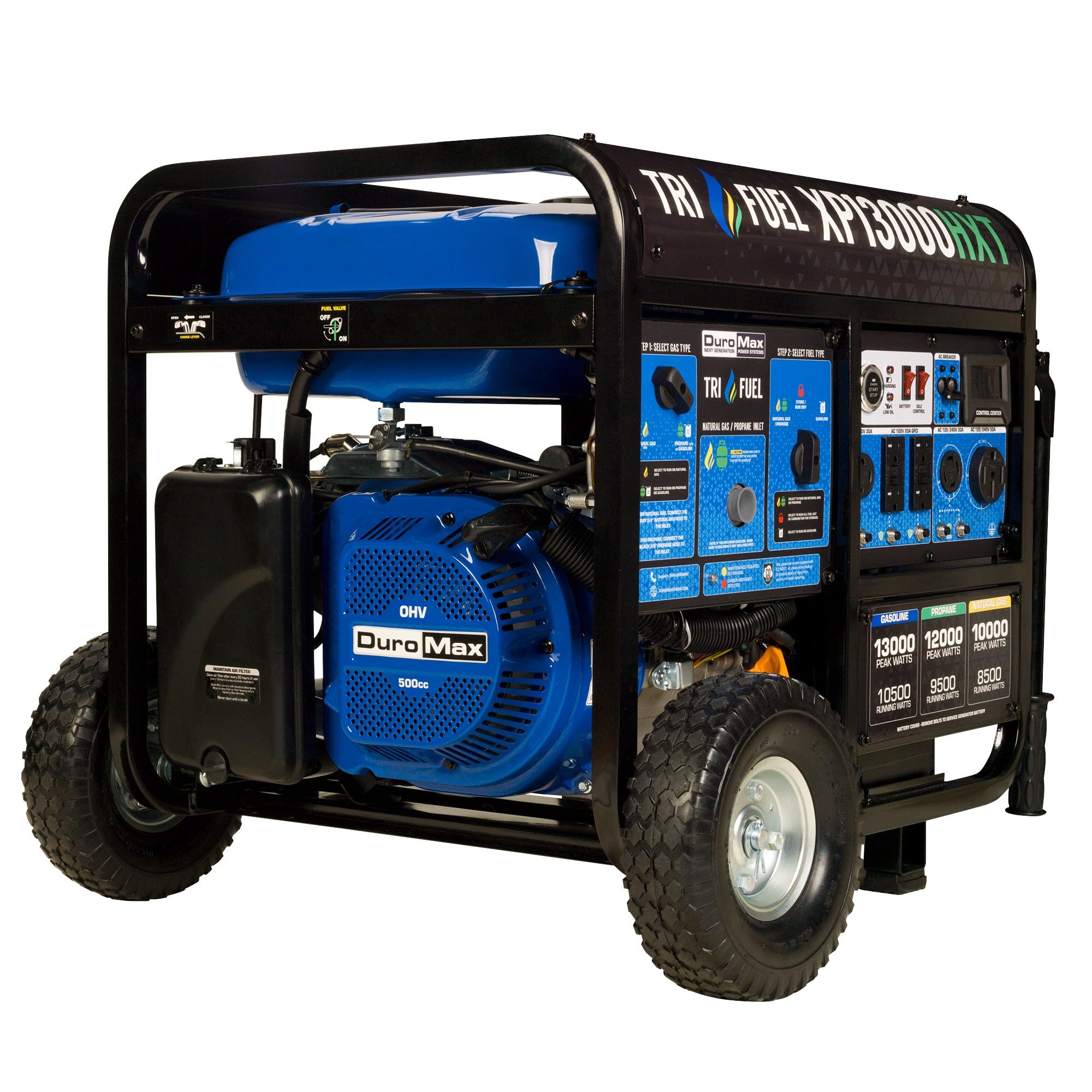
1. DuroMax XP13000HXT 13,000-Watt 500cc Tri Fuel Portable Generator with CO Alert
Our pick — over 4.5★ from 400+ verified ratings; the strongest balance of quality and price.
Three fuels, a remote fob, and a panel you can wire straight into your house.
This is the pick for the household that wants one machine to cover every outage scenario. It runs on gasoline, propane, or natural gas, and switching between them takes seconds on the front-facing interface. That matters most in a real storm, because the fuel you planned on is often the fuel that sells out. A 500cc 4-stroke engine sits at the center, feeding a transfer-switch-ready 50-amp outlet so you can wire the panel instead of stringing extension cords.
Starting is handled two ways: a push button on the unit, or a remote control from across the yard. The included kit covers the fiddly parts — an oil funnel, spark plug wrench, tool set, wheel and handle kit, a 15-foot x 3/4-inch natural gas hose, a propane regulator, and a deep-cycle remote. It weighs 240 pounds, so plan on the wheels doing the work rather than your back. It measures 30 inches long by 30 inches wide by 26 inches high, which is a hair more footprint than the DuroStar DS13000MX at 29.75 by 27.5 by 25.75 inches.
Owners genuinely run whole houses on this thing, and the pattern that comes through is tri-fuel first, propane second. One buyer had a battery fail at the three-month mark and DuroMax shipped a replacement within three to five days — worth knowing, because these units do live on a battery tender between outages. The natural-gas crew reports it consuming 225,000 BTU/hr at full load and needing a 3/4-inch gas line, so check your meter and plumbing before you commit. It arrives without oil and wants roughly a quart of 10W-30, plus a few start attempts the first time while the line primes.
What earns it the top slot
- Three fuel sources — gasoline, propane, and natural gas — so a shortage never strands you
- Transfer-switch-ready 50-amp outlet, the same heavy-duty connection class as the DuroStar DS13000MX
- Remote control start plus push-button start, so you are not standing in the rain at the panel
- Digital display, electric start, and CO Alert all included on the control face
- Full accessory kit in the box: gas hose, propane regulator, wheel kit, and tool set
Where it asks something of you
- 240 pounds — the wheels help, but this is not a one-person lift up a step
- Needs roughly a quart of oil added before first start; it does not ship with oil in the sump
- Natural gas mode demands a 3/4-inch supply line and 225,000 BTU/hr at full load
- The gas hose reducer is tight to seat, and the first few starts take patience while the line purges
The pick if: you have a natural gas stub or a propane tank on site and want one machine that covers every fuel scenario.
Think again if: you have no 3/4-inch gas line and no propane plan — you would be paying for a third fuel you cannot use.
2. DuroStar DS13000MX 13,000-Watt 500cc Dual Fuel Portable Generator
The steel-framed dual-fuel unit that swallows a 1.5-ton air conditioner without flinching.
If you want 13,000 watts, a 50-amp outlet, and push-button start without paying tri-fuel money, this is where the math lands. It runs gasoline or propane through the same 500cc 4-stroke engine, rated at 13 KW maximum and 43.75 amps. The front-facing fuel selector lets you flip between the two in seconds, which is the difference between running your furnace in a gas-main outage and watching it sit dark.
The frame is all metal, no plastic panel to crack when you drag it across gravel. Measuring 29.75 inches long by 27.5 wide by 25.75 high, it sits slightly more compact than the XP13000HXT. Everything for setup ships in the box: oil funnel, spark plug wrench, tool set, wheel and handle kit, propane regulator, remote control, and manual.
Owners push this one hard. It carries whole houses, and the heavy loads go where you would expect — a 1.5-ton AC, a split unit, the fridge, stove, microwave, water heater, all at once, with only a slight strain when a central air unit kicks on. The recurring gripe is the CO alarm. One reviewer noted the unit shutting down after roughly 20 minutes despite placing it on a hill with no obstructions and running a fan for fresh air. Treat CO sensor placement as a project, not an afterthought, and keep the exhaust pointed into open air. Delivery advice is consistent too: have a hand truck waiting, because this arrives heavy.
The strength here: a 50-amp transfer-switch outlet and 13,000 watts at a genuinely mid-range price, with a steel frame and included propane regulator.
The honest catch: the CO shutdown sensor is sensitive, and a handful of owners have had trouble keeping it running in still air. Where you park it decides whether it stays on.
Worth it for: the household running gasoline or propane that wants whole-home power without a third fuel it will never plumb in.
Look elsewhere if: you need natural gas specifically — this one stops at two fuels.
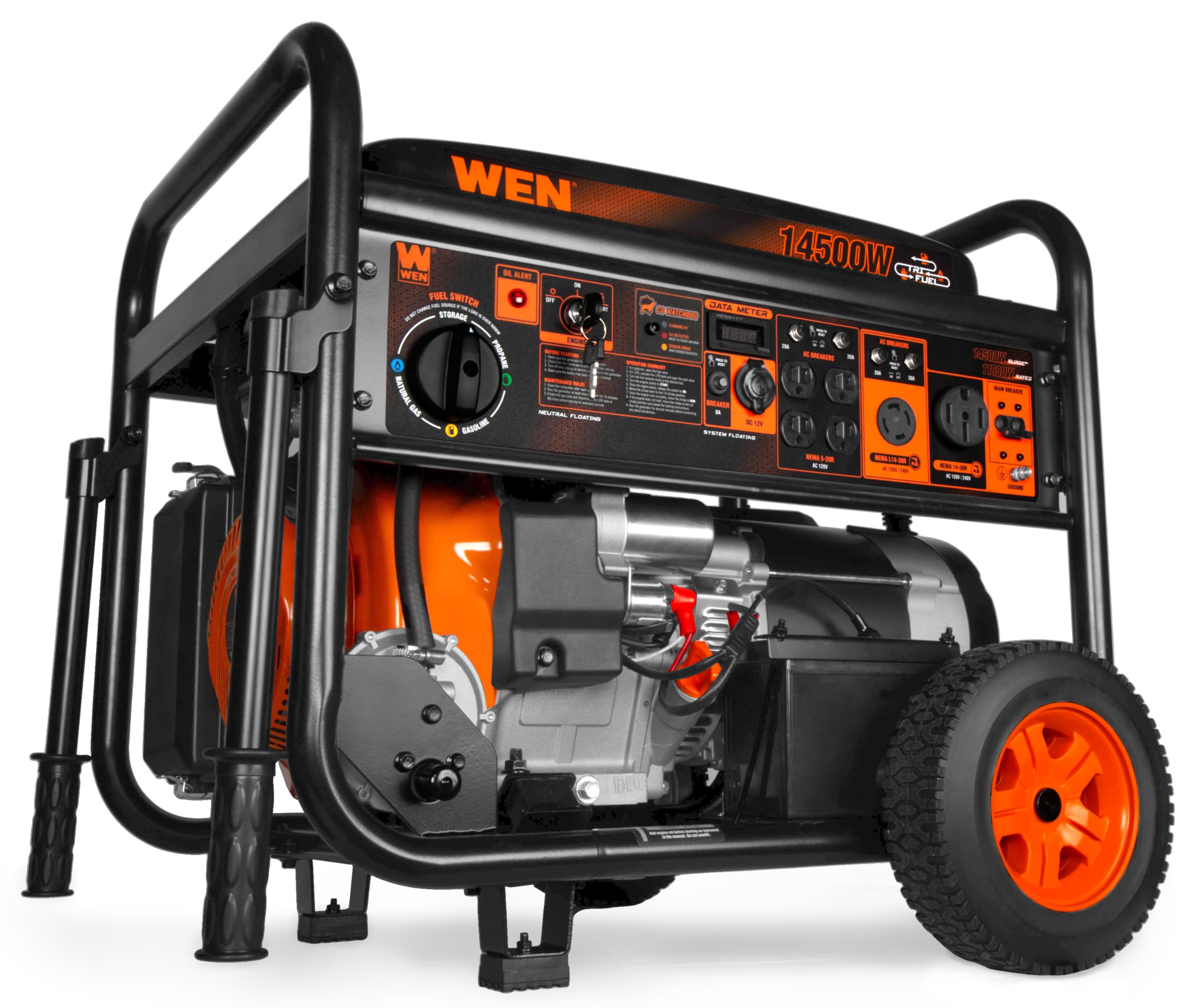
3. WEN 14,500-Watt 120V/240V Tri-Fuel Generator (TF-1450X)
14,500 surge watts on gasoline, with an 8.2-gallon tank and a three-year warranty behind it.
The headline here is headroom. On gasoline this unit delivers 14,500 surge watts and 11,500 running watts. On propane it drops to 12,500 surge and 10,300 running. On natural gas it settles at 10,500 surge and 8,750 running. A dial on the front switches between all three. That spread tells you something practical: if your heart is set on gas, you get the most muscle; if you want the fuel that never goes stale, propane gives you 10,300 running watts and you adjust your load accordingly.
You get a 120V/240V output, which is what makes it transfer-switch friendly. Its 8.2-gallon tank runs up to 12 hours at half load. The 500cc 4-stroke OHV engine fires on a key turn. Outlets cover a 12V DC automotive outlet, four 120V 5-20R outlets, and both a NEMA L14-30R and a NEMA 14-50R for transfer-switch wiring. A three-year limited warranty backs the whole thing.
Owner reports here are unusually concrete. One household in a 1600 square-foot duplex ran the AC, the furnace, the entire main floor, a commercial freezer, and the upstairs master suite off it. The setup shipped with every tool needed, including a spark plug wrench, and fired on propane on the first try. There is a real break-in routine to follow — an 8-hour oil break-in before you load it up — and skipping it is how people end up with problems later. The consistent complaint is noise; expect it to be heard from inside the house when a heavy load kicks in.
Where it wins: the 14,500-watt gasoline surge figure is the highest of any dual- or tri-fuel unit on this list, and the three-year limited warranty is longer than the typical one-year cover.
What to budget for: it tops out the gasoline-only output on this list while the paired volume suggests quieter running is possible elsewhere — if engine noise inside the house is a dealbreaker, the inverter machines below are built differently.
Made for: a mid-range tri-fuel buyer who wants maximum gasoline surge watts and the flexibility to fall back on propane or gas.
skip it if: you need silent operation beside a bedroom window — this is a conventional open-frame machine, not an inverter.
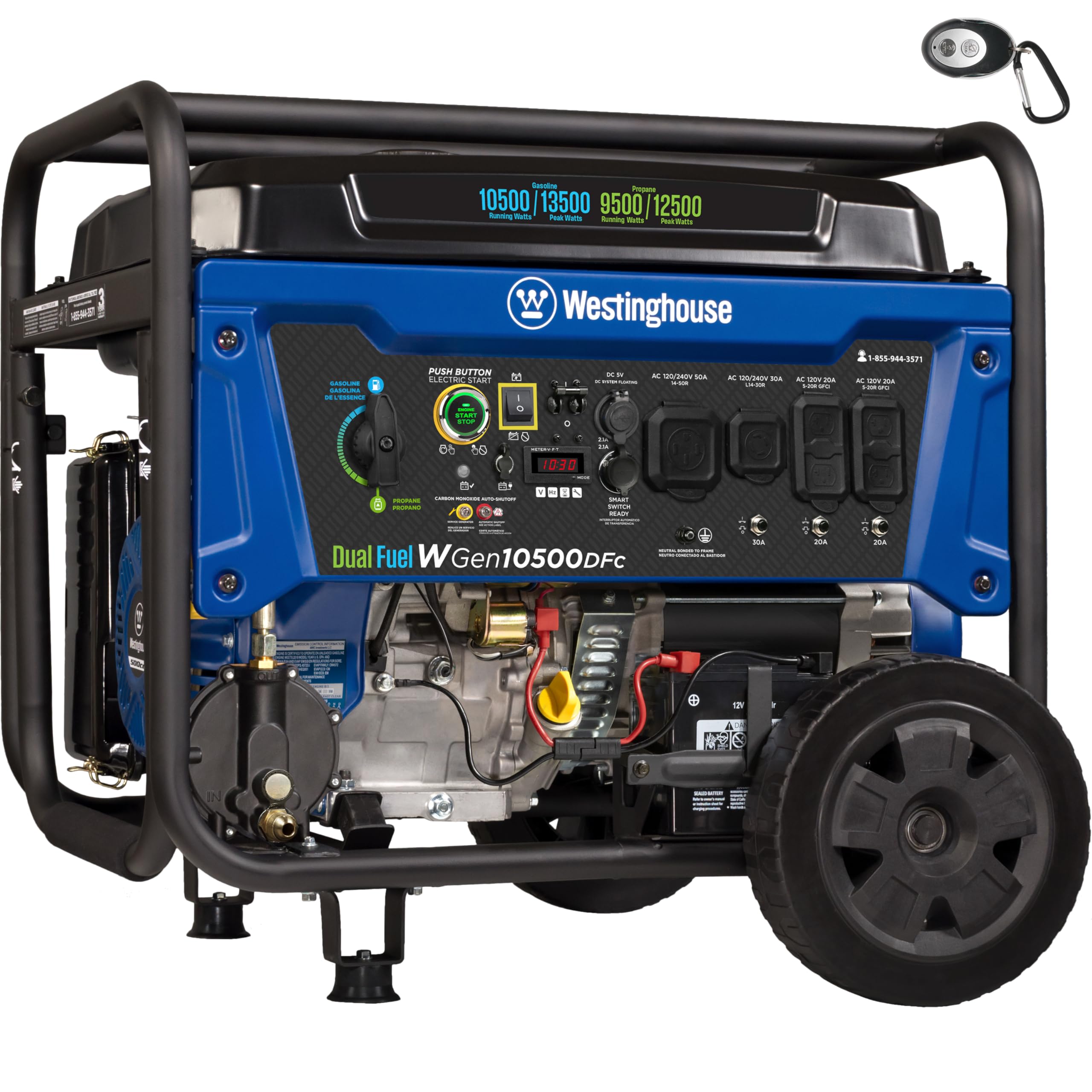
4. Westinghouse WGen10500DFc 13500 Peak Watt Dual Fuel Home Backup Generator
Nineteen hours on one tank — the one you leave running overnight.
Fuel endurance is the quiet spec that decides how an outage actually feels. This Westinghouse runs up to 19 hours on a 9.5-gallon fuel tank with a built-in fuel gauge, and that single number is why it earns its place. On gasoline it produces 13,500 peak watts and 10,500 running; on propane, 12,500 peak and 9,500 running. The 500cc 4-stroke OHV engine uses a cast iron sleeve, which is a wear component you want in an engine that will sit idle for eleven months and then run for a week straight.
Starting options are unusually generous for this class: a remote start key fob, electric start, and recoil backup all on one machine. The outlet set covers two GFCI 120V 5-20R household receptacles, one transfer-switch-ready 120V L14-30R at 30 amps, and one RV-ready 120/240V 14-50R at 50 amps — all with rubber covers. It ships with the key fob, a 12V battery charger, engine oil, oil funnel, tool kit, and manual, so minimal assembly is genuinely all that stands between the crate and a running unit.
What wins people over is that it simply works — set it up, hit the fob, and the house comes back. Florida and South Carolina buyers preparing for hurricane season lean on it for exactly that. One notable detail: Westinghouse upgraded several orders from dual fuel to tri-fuel at no charge, which is a factory-side decision rather than a spec you can count on, so treat tri-fuel capability as a bonus if it lands and propane as the baseline. It weighs 230 pounds and carries a three-year limited service, labor, and parts warranty with a nationwide service network.
The deciding number: 19 hours of runtime on a 9.5-gallon tank is the longest stretch on this list, and the cast iron cylinder sleeve is built for long idle periods followed by hard use.
Set expectations on: at 10,500 running watts on gasoline it is not the biggest output here — it is the one that lasts longest between refuels, which is a different priority.
Best fit: the hurricane-season household that values overnight endurance and a key-fob start over raw peak wattage.
Reconsider if: you need natural gas as a third fuel — this one runs gasoline and propane.
5. DuroMax XP13000EH 13,000-Watt Dual Fuel Portable Generator

The dual-fuel DuroMax that has been hauled through more outages than any other pick here.
This is the machine that made 13,000-watt dual fuel a household phrase, and the reason is straightforward: it built a track record nothing else on this list comes close to matching. It runs gasoline or propane through a 500cc 4-stroke engine, delivers 13,000 watts, offers a transfer-switch-ready 50-amp outlet, weighs 234 pounds, and switches fuel types on a front-facing interface. It measures 30 inches long by 29 wide by 26 high.
The build details are where it earns its keep. The frame and power panel are all metal with no plastic parts. The windings are 100% copper, which conducts heat better than aluminum and is the reason these units tend to outlive the cheaper competition. The no-flat tires roll over gravel and grass without digging in. Everything needed for assembly ships in the box: oil funnel, spark plug wrench, tool set, and wheel and handle kit. It does not include oil, which is a first-run errand you should plan for.
Buyers report a pattern that is worth internalizing before you buy. Two small setup gotchas come up repeatedly: the red shipping brace has to come off, and the negative battery cable has to be connected before the electric start will do anything. The choke sticker is reportedly reversed from the manual — right closes the butterfly. Once running, it powers the expected whole-home load: HVAC, oven, fridge, freezer, water heater, lights, TV, and WiFi, all through the 50-amp connection. Going the propane-only route is common advice to keep the carburetor clean, and an additive like Stabil alongside the fuel is standard practice among long-term owners.
Why the reliability reputation holds
- 100% copper windings rather than aluminum, which handles heat better over years of use
- All-metal frame and power panel with no plastic parts to crack
- 50-amp transfer-switch-ready outlet and 13,000 watts for the whole-house load
- Electric start plus pull-start backup, with dual fuel switching on a front knob
- No-flat tires roll over terrain that would bog down smaller wheels
Setup quirks to know before delivery day
- No oil in the box — budget for it and add it before the first start
- The red shipping brace has to be removed and the negative battery cable connected before the electric start responds
- Choke sticker reportedly runs opposite to the manual — right closes the butterfly
- Louder than some buyers hope for from a 500cc engine under heavy load
For the buyer who: wants dual-fuel 13,000-watt backup on a machine with a long, well-documented service record.
Then look at: the XP13000HXT above if natural gas is on your property — that one adds the third fuel for the same headline wattage.
6. Green-Power America GN13000DEW 13,000-Watt Dual Fuel Generator

A 420cc dual-fuel frame that fits where the big-block machines will not.
The engine is the story here. A 420cc 4-stroke rated at 18 hp is a smaller displacement than the 500cc blocks used across most of this list, and that shows up in the footprint: 27.5 inches long by 22 wide by 21.5 high, with an aluminum frame and a 204-pound shipping weight. If you are storing this on a shelf in a shed, or parking it in a tight RV bay, that size difference is the whole point.
It is a dual-fuel machine — gasoline or propane, switched on the fly. The 50A outlet is RV-ready, and the mobility kit uses large never-flat wheels and a folding handle. An automatic voltage regulator protects sensitive electronics from surge spikes, which is what you want if a laptop or a freezer control board is on the same circuit. You also get a low oil shutdown, overload protection, and circuit safety cutoffs.
Honest assessment: this pick has a much shorter public review record than the DuroMax or Westinghouse machines, and the reports that do exist include a couple of rough deliveries — units arriving with oil already in the sump from prior use, missing hardware, and one that had to go back to Amazon after a warranty dispute. That is not a reason to write off the model. It is a reason to inspect the crate on arrival, photograph the condition before you open it, and register the warranty immediately. Buy it for the compact frame and the price tier, and treat the unboxing as part of the job.
What you are paying for: a 420cc dual-fuel generator with a 50A RV-ready outlet in a footprint noticeably smaller than the 500cc machines on this list.
What to guard against: inspect the unit the day it lands. Some deliveries arrive with used oil or missing fasteners, and catching that immediately is what protects your refund or warranty claim.
For tight storage: the buyer who needs 13,000 watts of dual-fuel backup but does not have room for a full-size frame.
Be ready for: a much smaller review base than the DuroMax and Westinghouse picks, so verify condition on delivery.
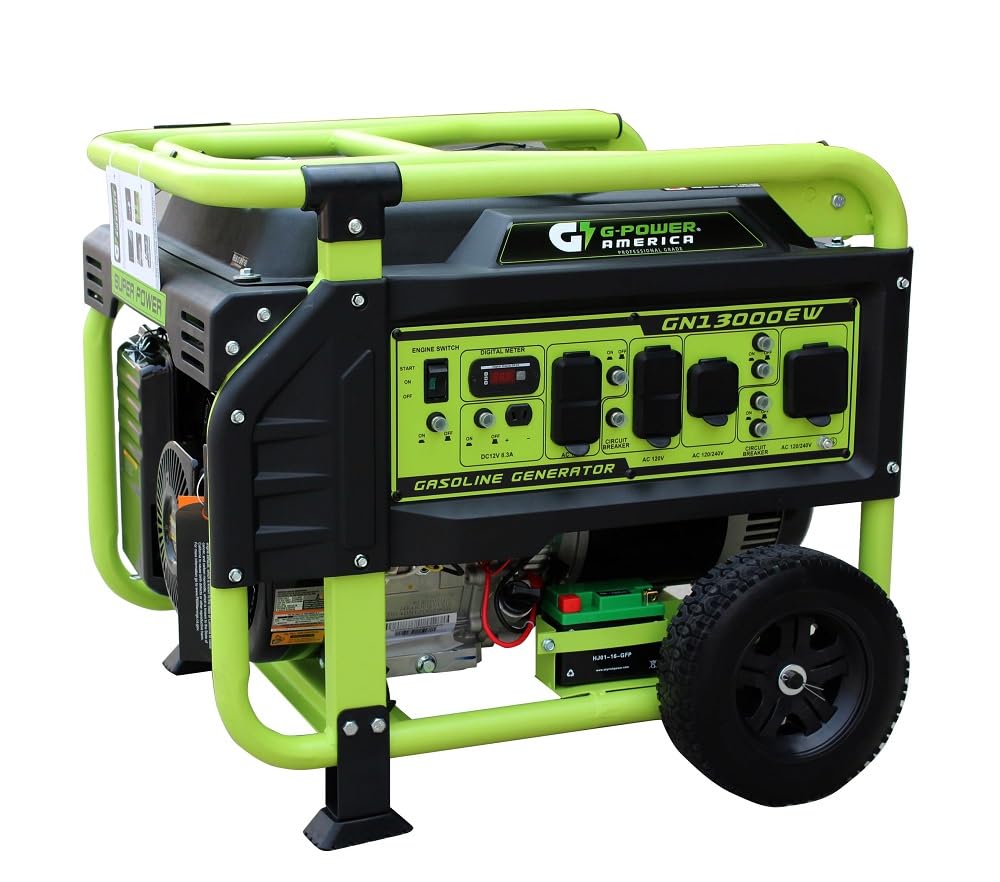
7. Green-Power America GN13000EW 13000 Watt Gasoline Portable Generator
Six weather-covered outlets and a 479cc engine — a gasoline-only workhorse for the job site.
This one makes its case on outlet count and engine size rather than fuel flexibility. A 479cc 18HP G-POWER engine that is EPA certified drives 10,000 watts of continuous running power. Its 6.6-gallon tank runs about 7 hours at half load. Simple fact that rarely gets said out loud: gasoline gives you more watts than propane or natural gas will ever deliver, so a gas-only machine is the most pound-for-pound powerful option per cylinder.
The outlet set is the most generous here. Six weather-covered AC connections: four 120V/20A NEMA 5-20A, one 120V/240V Twist-Lock NEMA L14-30R, and one 120V/240/50A NEMA RV-ready TT-50. Plus a 12V/8.3A DC outlet for battery charging. A 3-in-1 LED indicator displays voltage, frequency, and hours. A built-in fuel gauge tells you when to top up. The 10-inch solid wheels and fold-away handles do the moving, backed by a low oil automatic shutoff that kills the engine before the sump runs dry.
Realistic use case is where this pick shines — camping, tailgating, job sites, and RV air conditioning, with home backup as a secondary role. The one review pattern note is the small number of units that start and then quit after ten seconds, which points to initial setup rather than the design; follow the low-oil and fuel-priming steps exactly before you declare it dead. Where owners do report positively, they run big loads — LED lights, two 18k BTU mini splits, a well pump, a septic lift, and two tankless water heaters, with the caveat that you have to shut off the AC to run a large 54-amp heater. That is normal load management on a 10,000-running-watt machine, not a defect.
The strongest draw: six covered outlets including both a transfer-switch-capable 30-amp and an RV-ready 50-amp, plus a 3-in-1 gauge for voltage, frequency, and hours — rare at this price tier.
Accept the constraint: gasoline only. If you want propane or natural gas, that flexibility is not on this machine.
For the camper and job site: anyone who wants the most outlets per dollar, an 18HP engine, and is comfortable managing gasoline.
Not for you if: fuel storage and stabilizer rotation sounds like a chore — a dual-fuel or tri-fuel pick above fits that life better.
8. WEN TF1300iX 13,000-Watt Tri-Fuel Inverter Generator
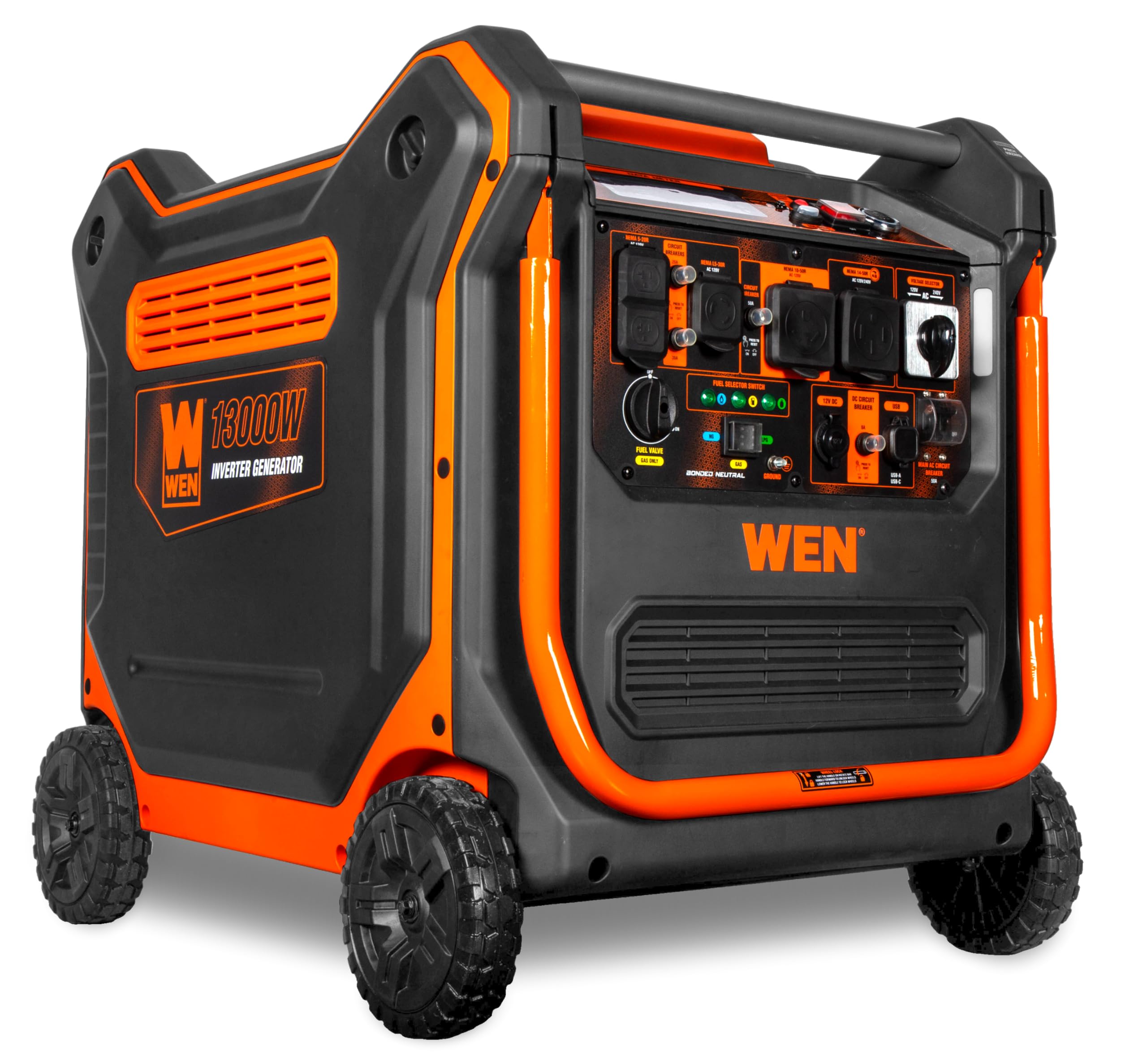
Inverter-quiet tri-fuel power — the one you could actually start at midnight.
Inverter generators convert engine output to clean, stable electricity, and that changes what the machine sounds like. This WEN uses a 550cc 4-stroke OHV engine across three fuels: gasoline at 13,000 surge and 10,500 running watts, propane at 11,250 surge and 9,000 running, and natural gas at 10,000 surge and 8,000 running. A switch on the panel moves you between them. Its 7.1-gallon tank runs up to 7.7 hours at half load.
The outlet layout is designed for real connection options, not cord spaghetti. Two 120V 5-20R outlets, a 120V/240V transfer-switch- or EV-ready 14-50R, a 120V L5-30R, a 120V 10-50R, a 12V DC outlet, and two USB outlets. The bonded-neutral 120V/240V configuration is what makes it legal and safe to wire into a transfer switch or to Level 2 charge a battery or hybrid electric vehicle. The CO Watchdog shutdown sensor kills the engine when carbon monoxide climbs, and a three-year limited warranty covers the machine.
Owners genuinely praise the quiet — one describes it as barely audible in nearby rooms, and the general tone is that the noise level surprises people who expected open-frame racket. Two practical notes come through clearly. First, the neutral situation: if you are wiring it into an inlet box or interlock, the floating neutral may need bonding, and standalone use wants a bonding plug. Second, and more importantly, this unit cannot feed 240V and 120V receptacles at the same time — a voltage selector switches off the unselected side. That is fine for most homes but a dealbreaker if you simultaneously need 240V for equipment and 120V for tools out of the same machine.
Quiet by design: the inverter architecture and 550cc engine make this the one neighbors will tolerate running at night, backed by a three-year warranty and a bonded-neutral setup suitable for EV charging.
Know this before you buy: the voltage selector prevents simultaneous 240V and 120V output. If you need both at once, this is not the machine for that job.
Fits the household that: values quiet operation and clean inverter power, wants tri-fuel flexibility, and manages loads rather than maxing everything at once.
Not the right pick if: you need to run 240V equipment and 120V tools off the same machine simultaneously.
9. DuroMax XP15000HX 15,000-Watt Dual Fuel Portable Generator
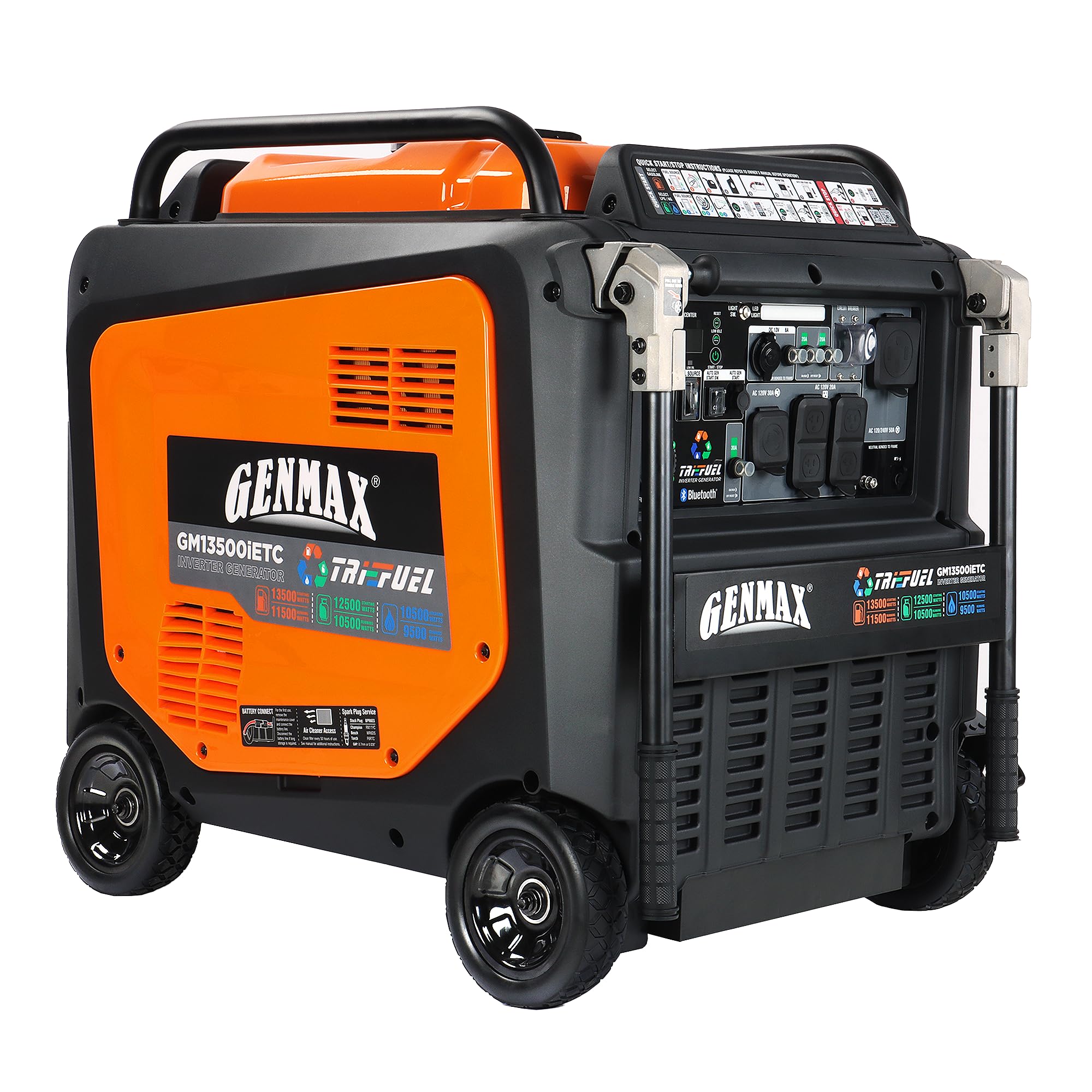
Five ways to start it, including one that fires the moment your power drops.
Start methods are where this GENMAX separates itself. You can start it with the push button, a remote key fob, a Bluetooth app on your phone, a recoil backup cord, or — the standout — an ATS 2-Wire Auto-Start that kicks the generator on automatically during an outage. That last option is what changes the ownership experience: it means you do not have to be home, or awake, when the power goes. Combine it with the included CO Shield shutdown and CARB compliance for legal sale and use in all 50 U.S. states, and you have a machine built for unattended backup.
Output is tri-fuel through a 550cc 4-stroke OHV engine: gasoline at 13,500 peak and 11,500 running watts, propane at 12,500 peak and 10,500 running, and natural gas at 10,500 peak and 9,500 running. Because it is an inverter, it delivers under 3% total harmonic distortion (THD) — a measure of how clean the electrical waveform is — which matters for sensitive electronics like laptops, phones, and medical equipment. Outlets cover a 120V/240V 14-50R for EV charging and heavy tools, a 120V L5-30R, four 120V 5-20R GFCI receptacles, and 12V DC ports.
Two features quietly make it easier to own than the competition. Eco-Mode adjusts engine speed to match the load, dropping the noise level to 62 dB(A) at 25% load, which the maker compares to normal conversation — and stretching runtime to 11.2 hours on its 6.9-gallon tank. A soft LED light built into the control panel illuminates things in the dark, which is a small thing until you are plugging a 50-amp cord in at 2 a.m. Owners back up the noise claim. One report notes a large 120V grinder that never even knocked it out of Eco-Mode, and another covers a 4-ton heat pump on a soft start that surges briefly and then idles back down.
Why the auto-start changes everything
- ATS 2-Wire Auto-Start fires the unit automatically when the grid drops, no one home required
- Five start methods including Bluetooth app control and remote key fob
- Under 3% THD inverter output, safe for laptops, phones, and sensitive electronics
- 62 dB(A) at 25% load in Eco-Mode, with up to 11.2 hours of runtime on a 6.9-gallon tank
- Built-in LED control panel light for plugging in after dark
What the premium buys and what it costs
- 273.7 pounds — the foldable handle and wheels help, but it is still a heavy machine
- Bluetooth app control requires a phone and a connection you may not want to manage during an outage
- Auto-start wiring needs to be installed correctly — a job for an electrician, not a weekend wiring project
- ATS auto-start requires a licensed electrician to wire the transfer switch — not a DIY job
- Short public review record compared to the DuroMax and Westinghouse picks, so long-term durability is still being proven
The one for hands-off backup: a tri-fuel inverter that turns itself on during an outage and runs quiet enough to live beside.
Only if you will plumb it right: the ATS auto-start is the reason to buy it, and it needs proper transfer-switch wiring to work as intended.

