
Specs are compiled from manufacturer listings and verified buyer reviews and can change over time — please confirm the key details on the product page before buying.
You need a 12-inch wall cabinet that fits a tight gap and looks good every day. All three fit the same 12-inch footprint: one arrives with its door pre-hung, one gives you two adjustable shelves, and one is solid American hardwood. A quick heads-up: this list uses flexible matching for the 12-inch width, so we accept the nearest sold width (12 or 13 inches) rather than jumping to a 15-inch cabinet that would not fit the same gap. A 13-inch cabinet fills the same gap as a 12-inch one; a 15-inch cabinet does not.
I’m Mohammad Maruf — the founder and writer behind KitchPrep. This guide is built by comparing the manufacturers’ published specifications and the patterns across verified customer reviews, so you get each pick’s real strengths and trade-offs instead of marketing spin.
Two of the three cabinets here arrive as ready-to-assemble kits, so your own comfort with a drill and a level matters as much as the hinge hardware does. That single question — build it yourself or bolt it up finished — separates these 12 inch kitchen cabinets more than finish or door style.
Our Picks at a Glance

How To Choose The Best 12 Inch Kitchen Cabinets
Twelve inches of width sounds like nothing until you try to buy it. This is the size that fills the dead gap between a refrigerator and a wall, or the sliver above a laundry sink where a full-size cabinet simply will not go. Because the footprint is small, every choice you make about height, shelves, and mounting shows up immediately. Height, shelf count, and mounting hardware decide whether it works in your gap.
Height decides which wall it belongs on
A 24-inch-tall cabinet (the W1224 label on the Design House pick) sits lower and reads as a standard upper. A 30-inch-tall cabinet (the Quicklock and ONESTOCK picks) reaches higher up the wall and gives you more vertical storage in the same 12-inch width. Measure from your countertop or floor to the underside of your soffit or ceiling first — that gap, not the cabinet, is what limits you. If you have a short wall above a counter, the 24-inch height is the one that clears.
One shelf or two changes what fits inside
The number of adjustable shelves is the quiet difference between these cabinets. Two adjustable shelves split the interior into three zones, which suits stacked plates or cleaning supplies you want separated. One shelf gives you two taller zones, better for cereal boxes or a blender. Adjustable means you can move the shelf up or down without tools beyond lifting the pins — and anti-slip shelf pins keep that shelf from shifting when you slide something heavy across it.
Ready-to-assemble versus already built
Two of the three cabinets in this list ship as flat ready-to-assemble (RTA) kits: the panels, door, hinges, and shelves arrive loose, and you glue and screw them together. The third arrives with its door already hung. RTA saves on shipping and price but asks for an afternoon of work and a bit of handiness. An assembled-door unit gets you to the mounting step faster. RTA costs less and takes an afternoon; the pre-hung door skips that step.
Hinge quality you can feel
Look for soft-close hinges, which slow the door in the last inch so it settles quietly instead of banging. Six-way adjustable hinges (found on the Design House unit) let you nudge the door up, down, and sideways after mounting so the gaps line up evenly. In a kitchen with hard floors or tile, that quiet close matters every single day.
Where it mounts and how it holds
Every cabinet here is wall mounted, which means it hangs off the studs behind your drywall. The pre-drilled bracket holes are what you bolt through, so check the count before install day. If the manufacturer ships more brackets than there are holes, you will need wood glue and extra screws to firm up the joints. Materials matter here too: 1/2-inch plywood sides hold a screw far better than particle board, and solid wood frames survive a stripped hole.
Quick Comparison
| Model | Best For | Height | Adjustable Shelves | Frame Material | Amazon |
|---|---|---|---|---|---|
| Design House Brookings Kitchen Wall Cabinet, 12″, White★ Best Overall | Fastest install, tidy hinge alignment | 24 inches | 1 | Wood | Amazon |
| White Shaker Wall Cabinet – Ready to Assemble, 12″ W x 30″ H x 12″ D | Tall utility and laundry storage | 30 inches | 2 | Engineered Wood | Amazon |
| Quicklock RTA 30″ Tall Wall Kitchen Cabinets, Raw Maple | Solid hardwood and American build | 30 inches | Shelves included | Maple Wood | Amazon |
In‑Depth Reviews
1. Design House Brookings Kitchen Wall Cabinet, 12″, White
The cabinet that arrives with its door already hung and its hinges already dialed in.
If you want the shortest path from box to wall, this is the pick to lead with. The door comes pre-assembled with soft-close hardware already fitted, so there is no hinge alignment to chase after you mount it — one owner’s build took about 10 minutes because the front panel arrived ready to go. That is the real payoff of a W1224 cabinet (a 24-inch-tall, 12-inch-wide wall unit): you spend your afternoon bolting it to studs, not building a box.
This cabinet stands 24 inches tall and 12 inches wide, so it is the lower-profile option of the three here. The Quicklock and ONESTOCK units both stand 30 inches, a 25% taller reach up the same 12-inch-wide frame. Inside, you get 1 adjustable shelf with anti-slip shelf pins, so the shelf stays put when you drag a heavy stack of cans across it. The frame is solid wood with 1/2-inch plywood sides, and the interior is finished, which keeps the inside looking as clean as the outside instead of leaving raw board exposed. Six-way adjustable hinges let you correct a crooked door after mounting, and the Shaker door style matches standard kitchen cabinetry.
What wins most people over here is how the door behaves: soft-close means it eases shut instead of banging, which is the difference you notice in a kitchen with tile floors. Ease of assembly and weight are what tend to come up — it goes together fast and hangs lighter than the particle-board cabinets it replaces. Buyers have been happy describing the finish and door look, and the white matches a satin white paint scheme closely. One buyer did note they had to cut the depth to 6.5 inches to set the cabinet into an inset install, so measure your opening depth before you commit. The honest catch: a few units have arrived with misaligned pre-drilled holes or missing pilot holes, and a pro carpenter ran into that on one cabinet. It is workable with a power drill and a bit of patience, but it is not a zero-tools job for everyone.
What earns its keep
- Door arrives pre-hung with soft-close hinges already fitted, so install day is mostly mounting
- 24-inch height fits shorter wall runs where the 30-inch cabinets in this list would crowd the space
- 1/2-inch plywood sides and a solid wood face and door frame hold screws far better than particle board
- Anti-slip shelf pins keep the adjustable shelf steady under load
What to plan around
- A few units show up with misaligned or missing pre-drilled holes that need a power drill to correct
- Only 1 adjustable shelf, versus 2 in the ONESTOCK cabinet
- Inset installs call for trimming depth, so check your opening first
Choose this when: you want the fastest, least fussy install and a lower 24-inch profile that fits a short wall run above a counter.
Think twice if: you need maximum vertical storage or a second shelf — the taller 30-inch cabinets here give you more room.
2. White Shaker Wall Cabinet – Ready to Assemble, 12″ W x 30″ H x 12″ D

More shelf, more height, more room to organize — if you are handy enough to build it.
This ONESTOCK cabinet is the storage-maximizer of the group. It measures 12 inches wide, 30 inches tall, and 12 inches deep, and it packs 2 adjustable shelves inside — double the single shelf in the Design House unit above. That extra shelf splits the interior into three stacked zones, so you can separate pantry staples from cleaning bottles in the same narrow footprint. It is also grade-A plywood construction, a step up from basic engineered board, and it weighs in at 20 pounds.
This arrives as a ready-to-assemble kit, and the feedback on that process is genuinely split: plenty of buyers find it straightforward and are done in a session, while others hit snags. The instruction sheet is the recurring sore spot — the parts arrive with pictures of the pieces rather than clear written steps. If you have assembled flat-pack furniture before, the build is straightforward. If you have not, budget time for online assembly guides. One buyer’s kit shipped with only 6 pre-drilled bracket spots but 14 brackets in the box, so they reached for wood glue on the joints and reinforced the mount to the studs with extra screws and a support beam. Building it yourself is the trade you make for the extra shelf and the taller frame.
Once it is together, quality is what people come back to — the build is described as solid and the appearance as clean, with several owners fitting it into utility rooms and laundry closets where the 30-inch height is useful. A Shaker door style and a painted white finish make it easy to slot alongside existing cabinetry. The one thing to know: a small number of units have arrived with damage or raw unfinished back panels that did not fit, so open the box and check the contents before you start assembling.
Storage you can feel: 2 adjustable shelves and 30 inches of height turn a 12-inch-wide sliver into three usable zones.
Build-it-yourself caveat: the assembly instructions are thin and some kits need extra glue, screws, and a stud-mounted brace — plan for an afternoon and a drill.
Reach for this if: you want the most organized storage in the narrowest footprint and you are comfortable putting a flat-pack cabinet together yourself.
Look elsewhere if: you would rather mount a pre-hung door and skip the build — the Design House cabinet gets you there faster.
3. Quicklock RTA 30″ Tall Wall Kitchen Cabinets, Raw Maple
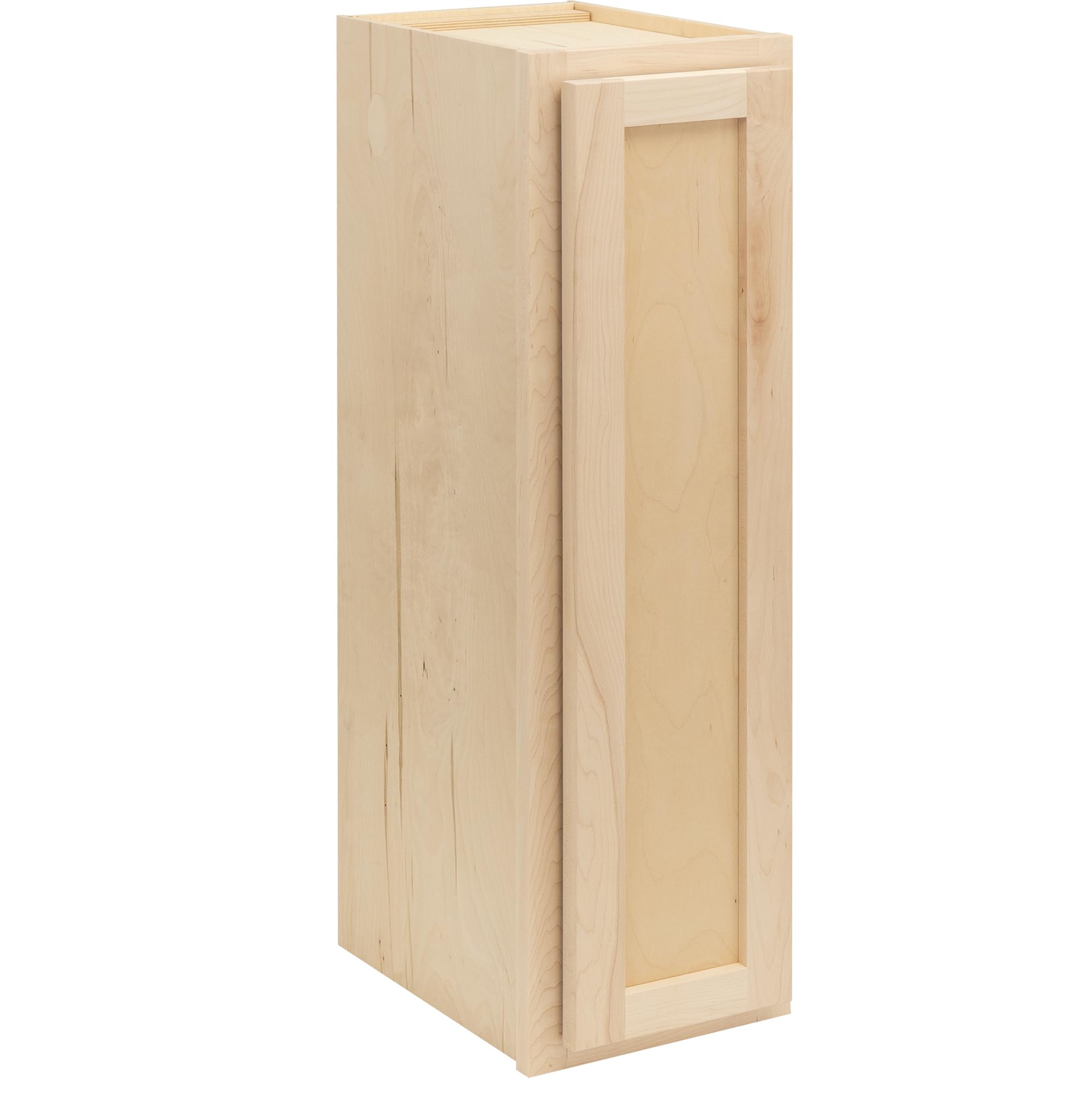
A raw maple cabinet built in America — dovetails so tight they will fight you.
This Quicklock pick stands apart on material alone. It is 100% hardwood with a real maple front and birch plywood sides, backs, and shelves — no particle board anywhere — and it is made in America with Amish craftsmanship. It shares the same 30-inch height, 12-inch width, and 12-inch depth as the ONESTOCK cabinet, but the wood underneath is a different league: the Quicklock carries a solid maple frame where the ONESTOCK uses engineered wood. For anyone who wants to stain or paint their own color, the raw maple finish is the whole point.
Its standout feature is the dovetail joint (an interlocking corner where the two panels lock together like puzzle teeth). Dovetails that tight are a mark of quality, but they are also the trade-off: one buyer found the joints so tight that pressing the dovetail frame together splintered the birch plywood despite sanding and chiseling the edges first, and the plywood-to-plywood joints went together fine. The lesson that buyer shared was to route or sand the edges before assembling. Meanwhile, other buyers report the glue-and-slide assembly going cleanly with no misalignment and no missing parts, so your experience hinges a lot on how you handle those tight joints.
Inside, you get soft-close hardware, an included assembly guide in full color step-by-step form, and a water-resistant UV-coated interior (a clear finish that wipes clean when something spills inside). Quality and ease of assembly are what most owners highlight, with the solid feel and the made-in-America build coming up often. There is a match to watch here: the Quicklock and the ONESTOCK cabinet both run 30 inches tall and 12 inches wide, so if you are choosing between them, the Quicklock wins on material and the ONESTOCK wins on the extra shelf count. A handful of owners have hit doors slightly misaligned top and bottom or a bent panel on arrival, so inspect what ships. Note the raw, unfinished surface — you will need to paint or stain it yourself.
Where it pulls ahead
- 100% hardwood with a real maple front and birch plywood sides, shelves, and back — no particle board
- Made in America with a full-color step-by-step assembly guide included
- Soft-close hinges that several owners describe as working well with minimal adjustment
- Water-resistant UV-coated interior wipes clean after spills
Where it asks more
- Dovetail joints run very tight — a few buyers suggest sanding or routing edges before assembly
- Raw maple arrives unfinished, so you handle the paint or stain yourself
- Slightly fewer pre-drilled mount points than bracket hardware provided in some kits
The material winner: solid maple and birch throughout, made in America, and built to take a stain or paint in whatever color you choose.
The prep it needs: tight dovetails and a raw surface mean you should plan for edge sanding before you assemble and a finishing session afterward.
Understanding the Specs
Width and Height
Width is the number that decides whether a cabinet fits your gap at all — here every pick sits in a 12-inch-wide footprint, the size that fills slivers no full-size cabinet can. Height is the second decision: a 24-inch-tall cabinet suits a lower wall run or a spot under a soffit, while a 30-inch-tall cabinet reaches higher and packs in more vertical storage. Measure the gap you are filling before you buy, because a cabinet that is taller than your available vertical space simply will not mount.
Shelves and Adjustability
Adjustable shelves (ones you can lift and reposition on pins) let you shape the interior to what you store. More shelves means more separated zones for small items; fewer shelves means taller open space for larger items. Anti-slip shelf pins keep the shelf from sliding when you pull something heavy across it. If you plan to store tall bottles, a single shelf gives you two tall zones; if you are stacking cans and boxes, two shelves give you three shorter zones.
Frame and Door Material
Solid wood frames and 1/2-inch plywood sides hold mounting screws firmly and survive a stripped hole, while particle board crumbles under the same load. A solid wood face and door frame, or a full hardwood build with plywood panels, is the more durable choice for a cabinet that hangs off two studs holding real weight. Note the difference between a maple front with birch plywood panels and a fully engineered-wood cabinet — both can work, but the hardwood build lasts longer under heavy use.
Hinge Hardware
Soft-close hinges slow the door in its last inch so it settles quietly instead of banging, which matters in a hard-floored kitchen. Six-way adjustable hinges let you correct a door that hangs crooked after mounting, nudging it up, down, or sideways for even gaps. On a ready-to-assemble cabinet, the hinge hardware often arrives pre-fitted to the door panel — check whether yours does so you know how much alignment work remains once the box is on the wall.
FAQ
Will a 12-inch cabinet fit the gap beside my refrigerator?
Should I choose a 24-inch-tall or 30-inch-tall wall cabinet?
Is a ready-to-assemble cabinet harder to install than a pre-built one?
Do I need to hit studs to hang a 12-inch wall cabinet?
What does soft-close mean and is it worth having?
How many shelves should a 12-inch-wide cabinet have?
What is grade-A plywood and why does it matter in a cabinet?
Can I paint or stain the Quicklock raw maple cabinet?
My cabinet arrived with a damaged panel what should I do?
Why do some cabinets ship more brackets than pre-drilled holes?
Final Thoughts: The Verdict
Here is the honest truth about the 12 inch kitchen cabinets in this list: the best one for you depends on whether you would rather mount a finished box or build your own. For the quickest, least fussy install, the Design House Brookings 12″ Wall Cabinet is the winner — its door arrives pre-hung with soft-close hinges already fitted, and the 24-inch height fits shorter wall runs. If you want the most storage in the narrowest footprint and you are comfortable assembling a kit, the White Shaker 30″ Wall Cabinet gives you 2 adjustable shelves and a full 30 inches of height. And for the buyer who wants genuine solid wood and American craftsmanship, the Quicklock RTA 30″ Cabinet delivers full hardwood maple and birch — just plan to sand those tight dovetails and finish the raw surface yourself. All three fit a 12-inch gap; pick the one whose assembly matches your afternoon.
How We Picked
We do not accept paid placement. Every pick is matched to a real buyer and a real use-case; we do not hands-on test units.
Sources & Methodology
Specifications: manufacturer listings and product documentation. Review insights: verified customer reviews, as of September 2026. Pricing: not shown on this page (it changes often); check the current price via the retailer link.
As an Amazon Associate, KitchPrep earns from qualifying purchases. This does not affect which products we feature.
Related Guides
