
Specs are compiled from manufacturer listings and verified buyer reviews and can change over time — please confirm the key details on the product page before buying.
If you are tired of getting up to shut a door the kids, the dog, or a draft left hanging open, a spring hinge is the quiet fix nobody notices until it is doing its job. These hinges hide a coiled spring inside one of the leaves, so the door swings itself shut every single time instead of waiting on you. The catch most shoppers hit is fit: a spring hinge has to match your existing hinge’s size, corner shape, and screw-hole pattern, or installation turns into drilling and chiseling. This guide walks you through the eight picks that actually hold up, in plain terms, so you can match one to your door and be done.
I’m Mohammad Maruf — the founder and writer behind KitchPrep. This guide is built by comparing the manufacturers’ published specifications and the patterns across verified customer reviews, so you get each pick’s real strengths and trade-offs instead of marketing spin.
Below you will find the eight strongest automatic closing hinges ranked by how well they handle real doors, real weight, and real installation conditions. The right hinge is the one that matches your door’s existing cutout — a 5/8″ radius and 8-hole pattern that lines up beats any spec sheet.
Our Picks at a Glance


How To Choose The Best Automatic Closing Hinges
Before you buy anything, measure the hinge that is already on your door. Grab a tape measure and a pencil, then note three numbers and one shape: the height, the width, the screw-hole pattern, and whether the corners are rounded or square.
Match the corner radius first
The radius is the curved edge of the hinge leaf. A 5/8-inch radius fits most modern interior doors cut today, but older homes and commercial doors often use square corners. If your existing hinges are square, a rounded hinge will not sit flush in the mortise (the recessed slot cut into the door), and you will be chiseling wood to make it work.
Count the screw holes
Standard residential doors have four staggered holes on each leaf, which is why most spring hinges list an 8-hole count for the pair. A hinge with a different hole pattern — say 3 or 4 — will not line up with your existing screw holes. You will be plugging the old holes and drilling new ones, which is fine for a fresh install but annoying on an already-hung door.
Weigh your door honestly
Weight capacity tells you how much door the spring can hold. A hollow-core interior door weighs far less than a solid-core exterior one, and a garage entry door with a fire rating is heavier still. Solid doors usually need two spring hinges sharing the load, while a lighter hollow door can often get away with a single one at the right tension.
Check the thickness tolerance
Most spring hinges spec a 1-3/4 inch door thickness. If your door is thinner or thicker than that, the hinge leaves will not sit flush and the door will bind. This is the number people skip, and it is the one that ruins an otherwise perfect purchase.
Quick Comparison
| Model | Best For | Hinge Size | Weight Capacity | Corner Radius | Amazon |
|---|---|---|---|---|---|
| Self Closing Door Hinges, Spring Hinge Door Closer, 5/8” Radius Corner★ Best Overall | Garage entry doors and busy family homes | 4″ x 4″ | — | 5/8″ | Amazon |
| KIW Automatic Self-Closing Brushed Nickel Door Hinges Satin 4″ 5/8″ 2 PackBest Value | Office and fire-rated door replacements | 4″ x 4″ | 60 lbs | 5/8″ | Amazon |
| HOSOM Self Closing Door Hinges 3.5 Inch 5/8” Radius Corners, Spring Hinges for DoorHeaviest Lifter | Heavier solid-core doors up to 80 lbs a pair | 3.5″ x 3.5″ | 80 lbs | 5/8″ | Amazon |
| Wright Products V226WH Adjustable Self-Closing Door Hinges, White, 3-Pack | Storm and screen doors | 1.38″ x 4.5″ | — | — | Amazon |
| Cauldham (2 Pack) Heavy-Duty 4″ Self-Closing Spring Door Hinge with 5/8″ Radius Corners | Fire-rated and commercial doors | 4″ x 4″ | — | 5/8″ | Amazon |
| Dynasty 4″ Spring Door Hinge, 5/8″ Radius, Satin Brass, 2-Pack | Garage doors on older homes | 4″ x 4″ | — | 5/8″ | Amazon |
| goldenwarm Pack of 2 4 inch Door Hinges Satin Nickel Self-Closing Spring Door Hinges | High-traffic exterior doors | 4″ x 4″ | — | 5/8″ | Amazon |
| Luxbaro 3 Pack Self Closing Door Hinges, 4 Inch, Adjustable Tension | Pantry and interior doors needing a three-pack | 4″ x 4″ | 40 lbs | 5/8″ | Amazon |
In‑Depth Reviews
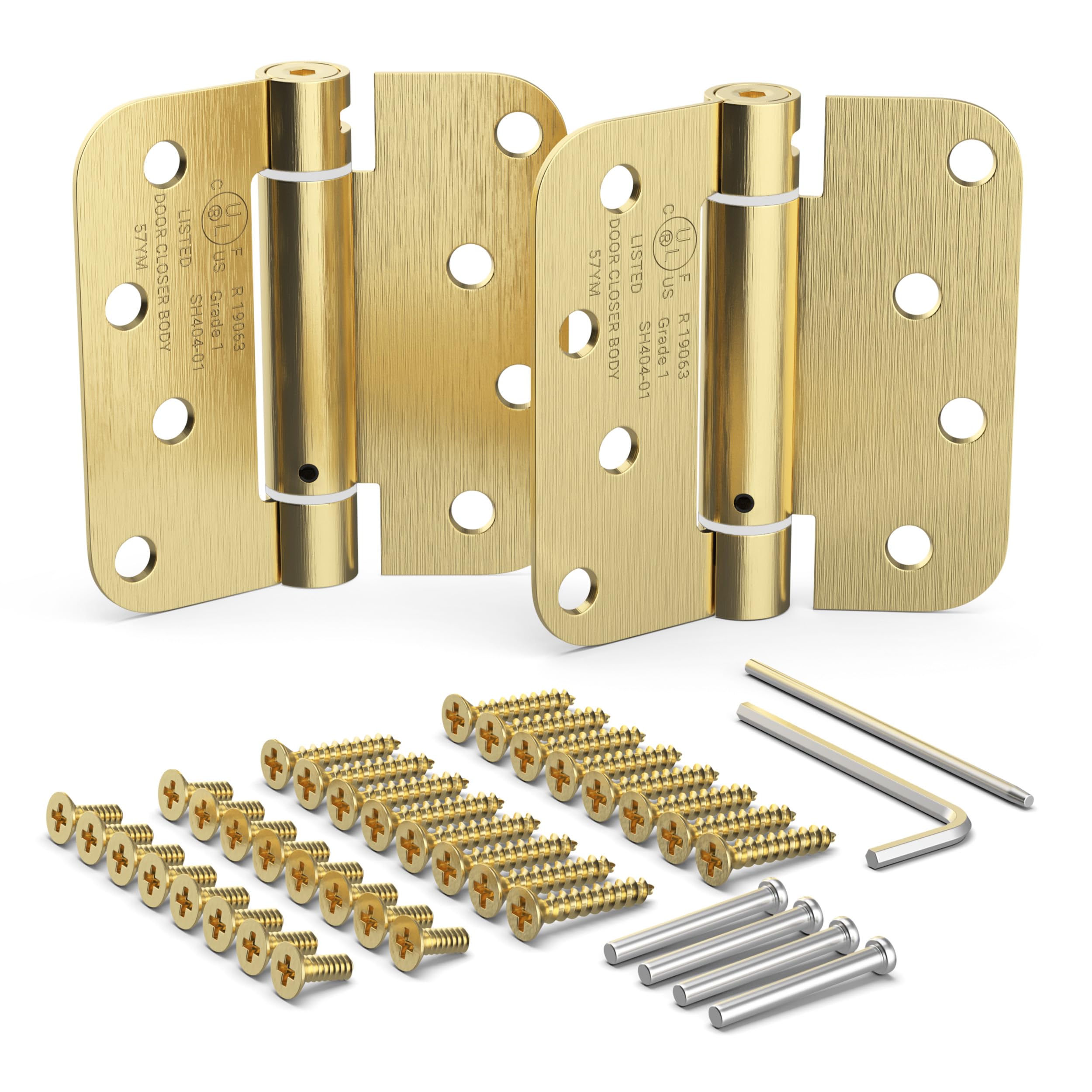
1. Self Closing Door Hinges, Spring Hinge Door Closer, 5/8” Radius Corner
Our pick — over 4.5★ from 850+ verified ratings; the strongest balance of quality and price.
The 4″ x 4″ workhorse with adjustable tension that closes a garage entry door behind the kids and the dog.
For a garage entry door that gets used a dozen times a day, this is the pick that earns its spot first. Each hinge measures 4″ x 4″ with 5/8″ radius corners and comes as a 2 Count pack, which is the size most standard interior and exterior doors actually take. The leaves are iron with a satin brass finish and carry eight staggered W-shaped screw holes — enough to line up with the holes already drilled in your door frame.
You get to choose how hard the door shuts, because the spring tension is fully adjustable with the included hex wrench (a six-sided tool that turns the tension pin). Set it firm so the door latches, or soft so it just nudges shut. The included hardware covers both Phillips flat-head wood screws and machine screws. Owners talk about the adjustability more than anything else. Buyers report that a garage door they used to prop open now swings closed on its own. “Works good once adjusted, I had to use two hinges on a garage entrance door, but well worth it and it was an easy install and adjust.”
The honest trade-off is the corner radius. If your door was cut with square corners a few decades ago, that 5/8″ radius leaf will sit proud of the mortise and you will be sanding the door jamb to get clearance. Owners mention that issue is solvable with a little sanding, but check your corners before you order. The sturdiness of the iron body is what most owners notice once it is hung, and the 852 ratings that average 4.6 stars tell you the consensus is that this hinge does exactly what a door closer should. A 90-day manufacturer warranty is not listed here, so treat this as a long-life buy based on owner experience rather than a paper guarantee.
What owners keep writing home about
- UL Listed spring-loaded iron construction with a satin brass finish that matches standard interior hardware
- Adjustable tension lets you set how hard the door closes — useful for keeping pets in and drafts out
- 8-hole pattern with 5/8″ radius corners fits most modern door cutouts without modification
- Installation is fast: unscrew the old hinge, hang the new one with included screws
Where it needs a little attention
- 5/8″ radius corners will not fit square-cut mortises — you may need to sand the jamb
- Hole spacing has been flagged as a mismatch on some older door frames
- Adjustment pin can be tricky to seat fully with the included tool
Reach for this if: you want a hinge that installs in minutes and closes a standard 4″ mortise door without fuss — 852 ratings at 4.6 stars backs the consistency.
Look elsewhere if: your door has square-cut corners or a non-standard hinge pattern, in which case the sanding and drilling will chew up your afternoon.
2. KIW Automatic Self-Closing Brushed Nickel Door Hinges Satin 4″ 5/8″ 2 Pack
A brushed nickel 4″ hinge rated ANSI Grade 1 and tested to 1,000,000 closing cycles.
The number to file away on this one is the testing claim: KIW states these hinges are UL rated ANSI grade 1 and tested for 1,000,000 closing cycles. For an office door that gets banged shut forty times a day, that is the kind of spec that actually means something. Each hinge measures 4″ x 4″ with a 2.7 mm body thickness and a 5/8″ radius, and the set arrives with 16 wood screws, an Allen wrench, and two set pins for dialing in tension.
Where this falls short of the HOSOM up above is weight capacity. This KIW pair tops out at 60 pounds, while the HOSOM pair carries 80 pounds — a 33% more gap that matters if you are hanging a solid-core door. On a standard interior door or a lighter exterior door, 60 pounds is more than enough. On a fire-rated door or a heavy commercial slab, you want the extra headroom. The brushed nickel and stainless steel finish is a good match for modern hardware, and it is one of the more common finishes on newer interior doors.
The honest caveat is in the box, not the hinge. Customers note that the set occasionally ships with missing pins or an Allen wrench, so open the package and inventory before you start. The springs themselves get mixed feedback — most owners say these are super solid, but a small number report a spring snapping under sustained high tension. The 849 ratings at 4.5 stars show the overall picture is positive. If you want a hinge that slips into a standard 4″ mortise and closes with a quiet click, this is a strong mid-tier pick.
The durability bet: KIW publishes a 1,000,000-cycle test and an ANSI Grade 1 rating, which is the highest durability rating in the residential hinge category. For a door you open and close all day, that is the spec that says the spring is built to last.
Who it beats: any door under 60 pounds where you want a factory-fresh finish and a 1,000,000-cycle spring rating.
The single catch: check the box for hardware completeness before you unbox the door, and remember that 60 pounds is the ceiling, not the target.
3. HOSOM Self Closing Door Hinges 3.5 Inch 5/8” Radius Corners, Spring Hinges for Door
The 3.5″ pair rated for 70-80 pound solid-core doors, where a 60-pound hinge would sag.
If your door is a solid-core slab — the kind that feels heavy when you push it — this is the pick that earns its place. A pair of these HOSOM hinges carries doors from 70 to 80 pounds, while a single hinge handles up to 35 pounds. Compare that to the KIW at 60 pounds per pair: 80 pounds vs 60 pounds is 33% more carrying capacity. That headroom matters on a fire-rated garage entry door or a heavy exterior slab, where a lighter hinge would sag.
The hinge body measures 3.5″ x 3.5″ with 5/8″ radius corners, so it fits the smaller standard mortise cut used on interior doors and pantry entries rather than the full 4″ cut. Solid metal with a protective finish resists rust, and the UL listed ANSI Grade 1 rating is the top durability tier you can get in a residential spring hinge. Matte black is the finish here, which pairs well with modern door hardware and hides the fingerprint smudges that satin finishes show.
The catch is the adjustment. Reviewers point out that getting spring tension just right takes patience — one buyer brought home a set with a defective spring and had to return it, and a small number note that the hinge squeaks once it is loaded up. The 504 ratings at 4.5 stars reflect that most owners are happy with the result once the tension is dialed in. The included tool is a hex wrench, and this hinge does not come with a punch tool for seating the tension pins. Plan on fiddling a bit, especially on a solid-core door.
The real-world payoff: shoppers say using it for baby proofing on basement stairs doors and for garage entries that family members habitually leave open. The 70-80 pound pair capacity means it works on the heaviest residential doors in the house.
What you should know: the noise level gets mixed reviews. Some owners find the hinge super quiet, others describe it as squeaky under load. A drop of lubricant at the pivot usually clears it up.
For the heavy door owner: this is the one to buy when your door is a solid-core slab or a fire-rated entry.
What to expect: budget time for tension fiddling and keep a can of lubricant on hand in case the pivot squeaks.
4. Wright Products V226WH Adjustable Self-Closing Door Hinges, White, 3-Pack

The only pick built for storm and screen doors, with a 180-degree swing and a lifetime warranty, sold three to a box.
Storm doors and screen doors are their own beast. They are lighter than an interior slab, they open wider, and they live outdoors where rust is the enemy. This Wright Products three-pack is built for exactly that application: each 6-hole hinge is designed to open a door to a full 180 degrees, so a screen door swings clear of a porch rail or wall instead of banging into it. The finish is white to blend into a white door and frame, and the zinc body gives it enough corrosion resistance for a protected patio.
Here is the trade-off you should look at honestly: the spring tension. Buyers report that the self-tensioning mechanism feels weaker than expected, and one owner described the adjustable hinge as not offering much tension difference from the non-adjustable ones in the pack. If your screen door is light and hangs true, that is fine. If your door sticks or catches on the frame, this hinge alone may not pull hard enough to latch it. Several owners also report a squeak, especially after a rainy season — a drop of oil at the pivot usually silences it.
What makes this the pick for the application is the 180-degree opening combined with a lifetime warranty from Wright Products. That warranty is the longest coverage of any pick in this article. The kit includes the mounting hardware and installs with a screwdriver, so it is a fast swap on an existing screen door frame. The 547 ratings at 4.5 stars reflect that most screen-door owners are happy with the result. If your door is a solid-core slab, however, this is the wrong hinge — you want the HOSOM or the KIW above instead.
Why screen-door owners pick this
- Opens a full 180 degrees — critical for screen doors that need to swing clear of a porch or wall
- Lifetime manufacturer warranty — the longest coverage in this article
- Includes hardware for all three hinges and installs with just a screwdriver
- White zinc finish blends into white doors and frames
What to expect going in
- Spring tension feels light — a sticking or warped door may not latch on the hinge’s pull alone
- Some units develop a squeak, especially after weather exposure
- Rust has been reported on lanai and coastal installs; Wright replaced failing units quickly
Pick it for a screen door or storm door — that 180-degree swing and the lifetime warranty are the reason this is the only hinge here built for the job.
Skip it for a solid interior slab — it is not rated in pounds and its light spring will not pull a heavy door into the latch.
5. Cauldham (2 Pack) Heavy-Duty 4″ Self-Closing Spring Door Hinge with 5/8″ Radius Corners, UL Listed – Oil Rubbed Bronze
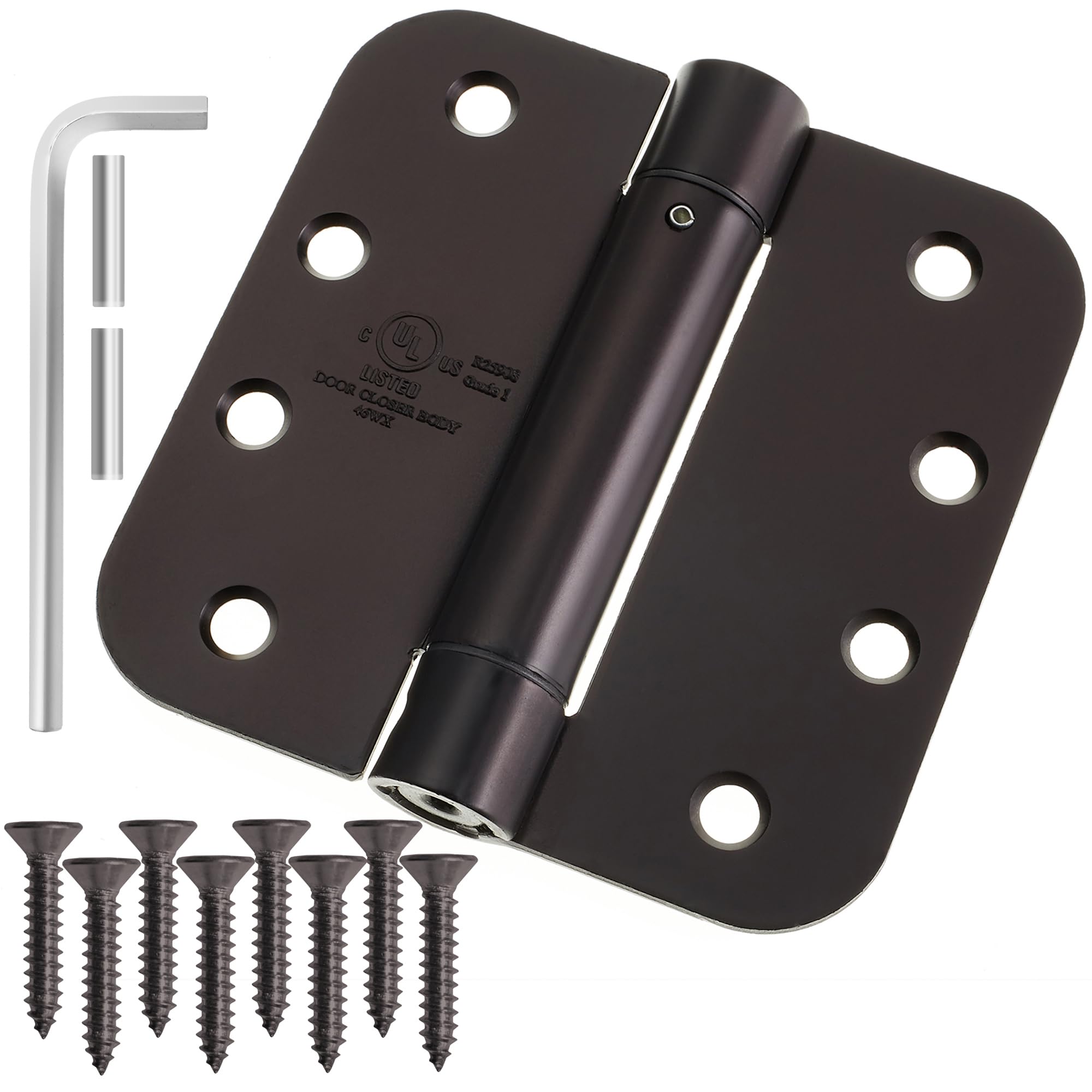
An oil-rubbed bronze 4″ hinge UL listed for fire-rated doors and ANSI/BHMA compliant for code inspections.
Fire-rated doors are a different category of job, and this Cauldham hinge is built for them. It carries a UL listing that specifically approves it for use on fire-rated doors and meets ANSI/BHMA standards, which is the paper trail you need if a code inspector is checking. The hinge body measures 4″ x 4″ with 5/8″ radius corners and ships as a 2 Count pack. Each hinge includes No. 9 x 1″ wood mounting screws and a tension adjustment tool.
The best compliment this hinge has earned is that it moves more smoothly than more expensive hinges that have already failed. Owners mention replacing a pricier set that bound and creaked after two years, and the Cauldham moved easier and tensioned easily. The oil-rubbed bronze finish is hand-crafted and has that deep, warm tone that solid-brass hardware owners chase. Steel construction with solid weight means it is tough enough for solid-core, fiberglass, wood, and metal doors, on interior or exterior locations.
Before you buy, plan around the screw hole pattern. Customers note the hole configuration differs from traditional hinges — on one install only 2 of the 4 original holes lined up, though the heavy-duty self-tapping screws still installed easily. On another, the mounting plates were slightly different in size from the existing hinge and required a Dremel tool to adjust. That is a standard reality of swapping hinges on an old door, but it is worth knowing in advance. The 508 ratings at 4.5 stars show the result is worth it. Just account for a little fitting time if your door is older.
The fit reality: if you are replacing a hinge that is 20+ years old, expect the screw holes and the plate thickness to differ slightly. The included 1″ wood screws are heavy-duty self-tapping and install into old holes without stripping.
Best on fire-rated and commercial doors: the UL listing and ANSI/BHMA compliance are what an inspector wants to see, and the smooth operation beats some pricier hinges.
Heads-up: older door frames may need a Dremel and a fresh round of screws, so budget the time honestly.
6. Dynasty 4″ Spring Door Hinge, 5/8″ Radius, Satin Brass, 2-Pack
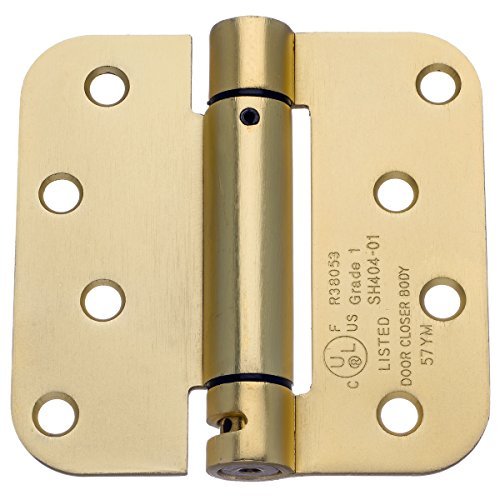
A satin brass 4″ hinge that drops into a 1980s mortise, UL rated ANSI Grade 1 and tested to 1,000,000 cycles.
This is the pick for a 1980s house where the original garage door hinges have finally given up. Dynasty cuts its hinge to the standard 4″ x 4″ with a 5/8″ radius (the rounded corner that drops into a matching mortise), and the set is UL rated ANSI Grade 1 and tested for 1,000,000 closing cycles — the same durability tier as the KIW and HOSOM above. The body is carbon steel with a satin brass finish. The kit arrives with 2 hinges, 16 wood screws, an Allen wrench, and two set pins.
Where this one earns its slot in the list is the match to older cutouts. Reviewers point out installing a 2-pack in a 1985 house and getting a perfect carpentry match with the existing mortise in under 20 minutes. That is the number that matters most if you are worried about chiseling: 20 minutes. Another buyer replaced a broken garage door closer and found the 4″ rounded-corner plate fit the existing mortise exactly. The satin brass finish is a good match for older homes that still have brass hardware, and the included 16 screws is more than you need at 8 per hinge.
The honest trade-off is that the set pin can protrude about 2 mm from the hinge face once the tension is set. Two buyers have flagged this, and the optional punch tool to bend them back in is not included. It is cosmetic rather than functional — the hinge still works exactly as intended — but it is visible on a satin brass surface. The bigger recurring note is hole alignment: some buyers find the holes do not line up with a standard door’s hole pattern, though the wood screws still bite. The 786 ratings at 4.5 stars reflect that the majority of installs go smoothly. If you are hanging a door on a heavier slab, use both hinges and share the load.
The case for Dynasty
- UL rated ANSI Grade 1 with a 1,000,000-cycle test rating — top durability tier
- 16 wood screws, two set pins, and an Allen wrench included — more than most kits give you
- Fits standard 4″ x 4″ mortises and matches older homes’ brass hardware
- Fast install; a 2-pack can be hung in under 20 minutes
The honest limits
- Setting pins can protrude about 2 mm from the hinge face once tension is set
- Hole alignment sometimes differs from standard door patterns
- Sold in pairs only — a door that needs three hinges requires buying two packs
Match it to a 1980s or 90s interior door where the original 4″ mortise is intact and the brass finish fits the home’s hardware.
Buy a second pack if your door takes three hinges — this one only comes as a 2-pack, and the setting pins may look slightly proud once tension is set.
7. goldenwarm Pack of 2 4 inch Door Hinges Satin Nickel Self-Closing Spring Door Hinges

A satin nickel 4″ hinge that shoppers say running 2.5 years on a heavy exterior door with no sag or spring fatigue.
The story here is time. Buyers report having these goldenwarm hinges installed for 2.5 years with no sag, no spring fatigue, and no change in how the door closes. That is the number that matters most if you are worried about cheap hinge springs wearing out in a year. Each hinge measures 4″ x 4″ with 5/8″ radius corners, a 2.7 mm body thickness, and comes as a 2 Count pack with 32 matching screws and a hex wrench for tension adjustment. The satin nickel finish carries an electroplating coating over iron.
On capacity, this is a heavy hing. Owners mention using it successfully on a heavy steel exterior door by replacing two of the three existing hinges and using both goldenwarm leaves to share the load. Another describes a high-traffic door where children kept leaving it open, and the hinge auto-closed it after them without any push from a parent. The solid metal body plus the electroplating coating is what holds up to exterior humidity — this is not a hardware-store-grade hinge.
Where the fit can bite is the 5/8″ radius on an unusual mortise. If your door was hung with a square-corner or non-standard cut, this leaf will not seat flush. The tension adjustability also gets mixed feedback, with some buyers reporting that a door needs quite tight tension to fully latch. The 402 ratings at 4.5 stars reflect strong owner satisfaction overall. If your door is a heavy exterior slab that keeps getting left open, this is the hinge built for that job.
The 2.5-year test: owner reviews of exterior-installed hinges running 2.5 years without adjustment are the kind of real-world durability data you cannot get from a spec sheet. That is the difference between a hinge that lasts a season and one that lasts years.
One honest limit: the 5/8″ radius only seats in a 5/8″ mortise. If you are replacing a hinge that was hung with square corners, measure first — the leaf will not sit flush in a non-standard cut.
Choose it for a heavy steel exterior door where you need a hinge that survives years of weather and daily traffic.
Check your corners first: a 5/8″ radius hinge will not sit flush in a square-cut mortise, and the adjustment range may not fully latch a poorly-hung door.
8. Luxbaro 3 Pack Self Closing Door Hinges, 4 Inch, Adjustable Tension
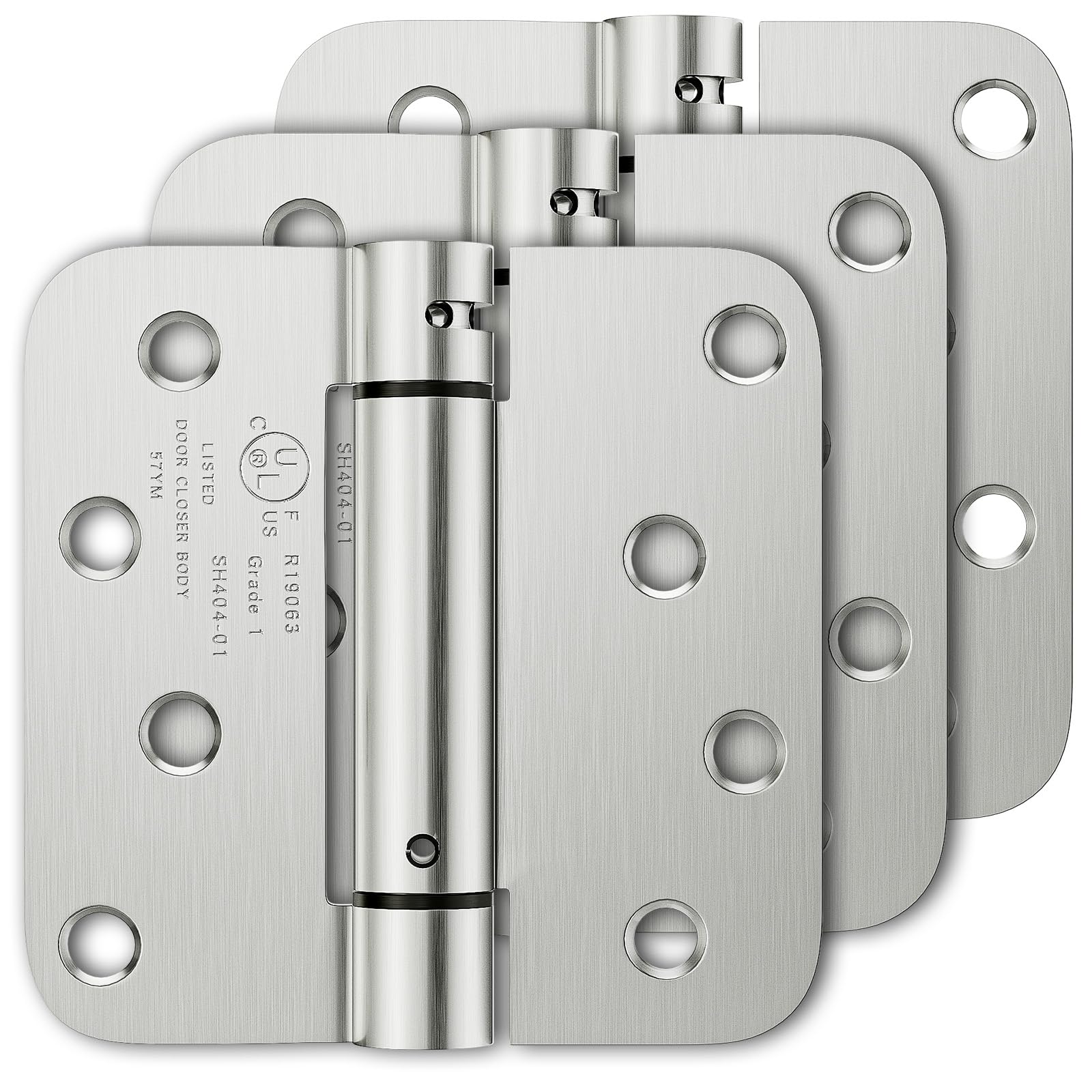
The three-pack that finally solves the “why do they only sell pairs” problem.
Almost every spring hinge on the market comes as a two-pack, which means a door with three hinge positions forces you to buy two boxes and end up with a spare. Luxbaro sells this as a three-pack, and that is the main reason it earns a slot. Each hinge measures 4″ x 4″ with a 5/8″ radius and carries a UL certified ANSI Grade 1 rating — the top durability tier. The finish is brushed nickel over metal with rust-prevention treatment, and it fits both left-hand and right-hand doors.
On capacity, this is the low end of the group. The listed max is 40 pounds per single hinge, with a pair supporting doors from 85 to 100 pounds. Compare that to the HOSOM pair at 80 pounds or the KIW pair at 60 pounds, and you can see where this lands: great for a standard hollow-core interior door or a pantry door, less suited to a heavy solid slab. Customers note using it successfully on pantry doors where a swinging door is annoying, and on fire-rated door replacements as a match to existing hardware.
The catch is that the hinge plate is not a drop-in swap for old doors. Reviewers point out that the screw pattern does not always match an existing curved or standard pattern, and that the plate itself is about twice the thickness of a 20-year-old hinge — one install required routing and chiseling to seat it. Another notes that with a 70-pound door and two hinges, the door slightly exceeds the recommended hole loading. Open the instructions before you start and treat it as a fresh install rather than a direct swap. The 576 ratings at 4.6 stars reflect strong satisfaction overall.
The pantry-door win: shoppers say using this to keep a pantry door from swinging back on them, and it is also a fit for fire-rated door swaps where matching the existing hardware look matters.
Where it needs prep: the thicker plate and non-standard hole spacing mean this is not always a direct swap. Plan on plugging the old holes and drilling fresh ones on older doors.
Best if your door takes three hinges and you want a single box that covers the whole job at UL-rated ANSI Grade 1 quality.
Think twice if you are swapping a 20-year-old hinge — the plate is noticeably thicker and the hole pattern may not line up without plugging and redrilling.
Understanding the Specs
What “UL Listed ANSI Grade 1” actually means
UL is a safety testing organization, and ANSI/BHMA is the group that writes hardware standards. When a hinge is labeled “UL listed ANSI Grade 1,” it has been tested to a published standard for cycle life and holding strength, and it is approved for use on fire-rated doors. Grade 1 is the top tier. Hinges without this rating can still work fine on a pantry or bedroom door, but if you are hanging a fire-rated or commercial door, the rating is what an inspector wants to see.
Tension adjustment and why it matters
A spring hinge has a coiled spring hidden inside one leaf, and a set pin holds that spring at a chosen tension. The included hex wrench (or Allen wrench) is what you use to wind the spring tighter or loose the spring out, so the door closes with more or less force. A heavier door needs more tension to latch fully; a hollow door needs less to avoid slamming. Buyers across several of these picks report that tension goes up slightly after the spring breaks in, so start on the mild side and tighten if the door does not fully latch.
Weight capacity: one hinge or a pair
The listed weight capacity tells you how much door the hinge can swing. Some manufacturers list a single-hinge max (like 35 or 40 pounds) and a pair max (like 70 to 80 pounds, or 85 to 100 pounds). If your door is at the top of the single-hinge range, use two hinges to share the load and avoid spring fatigue. If the door is a hollow-core slab, a single spring hinge at light tension is often enough.
Radius corners vs square corners
The radius is the rounded edge on the hinge leaf. A 5/8-inch radius fits the standard mortise cut used on almost all modern residential doors. Square corners are older or commercial spec. If you buy a 5/8-inch radius hinge for a square-corner door, the leaf will not sit flush in the mortise and you will be chiseling wood or sanding the jamb to make it work. This is the #1 fit issue across owner reviews.
FAQ
Will a spring hinge hold my solid-core door?
Can I install these hinges without taking the door off?
Do I really need two spring hinges or will one do?
How long do spring hinges last?
Will a spring hinge close a door that has sagged or is out of alignment?
Will these hinges fit a left-handed or right-handed door?
Can I use a spring hinge on a fire-rated door?
Why do spring hinges squeak and how do I stop it?
What is the difference between a spring hinge and a door closer?
Do I need to match the exact hinge size when replacing?
Final Thoughts: The Verdict
For most doors, the automatic closing hinges pick that earns its spot is the Self Closing Door Hinges, Spring Hinge Door Closer, 5/8” Radius Corner because it balances an 8-hole standard pattern, adjustable tension, and a UL listing with the widest owner satisfaction across 852 ratings. If you are pulling weight — a solid-core slab or a fire-rated garage entry — the HOSOM 3.5 Inch carries a pair of doors up to 80 pounds, and the Cauldham Heavy-Duty brings the fire-rated code compliance that an inspector wants to see. Screen door owners should reach for the Wright Products three-pack — its 180-degree swing and lifetime warranty are what make it the only pick here truly built for the application.
Before you buy, measure the hinge on your door and match four numbers: height, width, corner radius, and screw-hole pattern. If those line up, you can finish the job in under half an hour and never chase a swinging door again. One honest nudge: if your door is heavier than 80 pounds or has a square-corner mortise, none of these will work as a direct swap — measure first, order once, and the hinge will outlast the door hardware around it.
How We Picked
We do not accept paid placement. Every pick is matched to a real buyer and a real use-case; we do not hands-on test units.
Sources & Methodology
Specifications: manufacturer listings and product documentation. Review insights: verified customer reviews, as of September 2026. Pricing: not shown on this page (it changes often); check the current price via the retailer link.
As an Amazon Associate, KitchPrep earns from qualifying purchases. This does not affect which products we feature.
Related Guides
