
Specs are compiled from manufacturer listings and verified buyer reviews and can change over time — please confirm the key details on the product page before buying.
If you cut trim, baseboards, or framing lumber, the difference between a frustrating saw and a great one depends on three things: how much crosscut width you get, how smoothly the head slides, and how little space the saw eats up against your workshop wall. Every pick here is a 10-inch sliding compound miter saw — the blade diameter is 10 inches, “sliding” means the cutting head travels forward and back on rails so you can crosscut wider boards than a fixed saw, and “compound” means it tilts as well as swivels for angled cuts. That combination lets one saw crosscut a 2×12 shelf and bevel a 45-degree picture frame in the same afternoon.
I’m Mohammad Maruf — the founder and writer behind KitchPrep. This guide is built by comparing the manufacturers’ published specifications and the patterns across verified customer reviews, so you get each pick’s real strengths and trade-offs instead of marketing spin.
Each pick below notes its footprint, its crosscut capacity, and its honest trade-offs, so you can match one to your bench. The right 10-inch sliding compound miter saw turns a cramped garage corner into a proper cutting station.
Our Picks at a Glance


How To Choose The Best 10-Inch Sliding Compound Miter Saw
Start with the cuts you actually make. A trim carpenter lives at 90 degrees and 45 degrees, while a deck builder spends the day in 2x material. That single fact decides whether crosscut capacity or bevel range matters most to you.
Does it slide toward the wall or away from it?
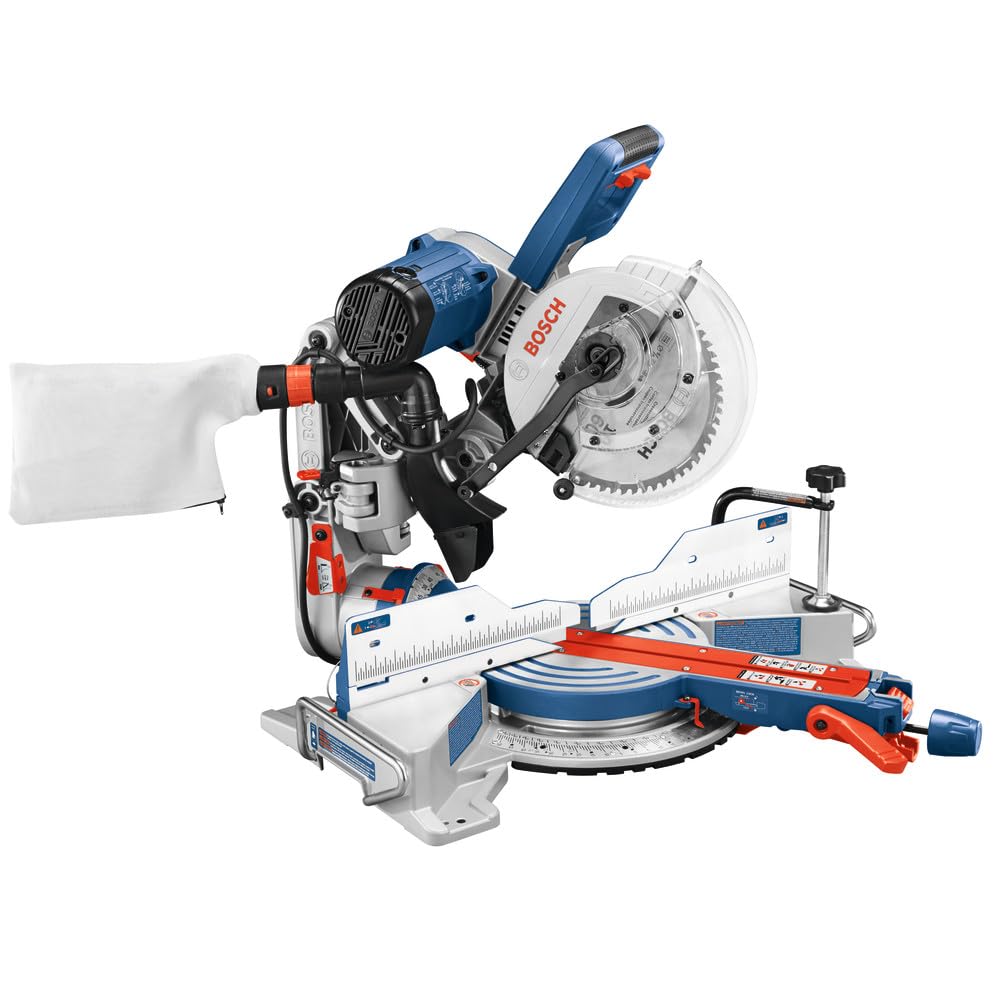
Every saw here slides, but they do it differently. Some designs run their rails forward and the head travels back toward the wall. Others reverse that motion so the rails never need rear clearance. This is the biggest space decision in this category: a saw that needs rear clearance will not sit on a narrow bench. The Bosch CM10GD uses articulated hinge arms that reduce its front-to-back footprint by up to 10 inches, and the Delta, WEN MM1015, and Evolution models each advertise wall-friendly placement too.
What width and thickness can you actually cut?
Crosscut capacity is the number buyers scan first. Look for stated board sizes, not blade size — for example, the WEN MM1011T crosscuts boards up to 12 inches wide and 3-1/2 inches thick, and the SKIL MS6305-00 handles 2×12 at 90 degrees and 2×8 at 45 degrees. If you cut wide shelving or thick posts, crosscut capacity decides the purchase before motor specs come into play.
Single bevel or dual bevel?
A single-bevel saw tilts only to the left. A dual-bevel tilts both left and right, so you flip the workpiece less often on angled trim and crown. Dual bevel costs more, but on repeated picture-frame and crown cuts it saves the time you would spend flipping the board. The Bosch goes furthest here with a wide 47-degree left and right bevel range and detents at 0, 33.9, and 45 degrees.
How will you see the cut line?
Three guide types show up on this list: a laser beam, an LED shadow line, and a plain scale. A shadow line casts the blade’s own silhouette onto the wood, so it tracks the actual cut. SKIL calls its LED shadow line more accurate than lasers, and VEVOR’s LED guide projects a crisp line. Lasers are handy indoors but can wash out in bright daylight — several Evolution and Delta owners note exactly that.
Quick Comparison
| Model | Best For | Power & Speed | Bevel Type | Weight | Amazon |
|---|---|---|---|---|---|
| Bosch CM10GD★ Best Overall | Space-tight precision woodwork | 15 A, 4,800 RPM | Dual bevel, 47° L/R | 64 lb | Amazon |
| Makita LS1019LTop Performer | Trim and crown in tight shops | 10 in. blade, dual-bevel | Dual bevel | 72.8 lb | Amazon |
| SKIL MS6305-00Best Value | Mid-range value with dual bevel | 15 A, 4,800 RPM | Dual bevel, 45° L/R | 39.4 lb | Amazon |
| Evolution R255SMS-DB+ | Cutting metal and wood on one blade | 10 in., multi-material TCT blade | Dual bevel, 45° L/R | 44.8 lb | Amazon |
| Milwaukee 2734-21HD | Cordless jobsite work | Cordless M18, 10 in. blade | Dual bevel | 45 lb | Amazon |
| Evolution R255SMS+ | Multi-material cutting with clamps | 15 A, multi-material TCT blade | Single bevel, 0–45° | 41.8 lb | Amazon |
| Delta 10 in. Sliding Miter Saw | Moving between rooms and jobs | 15 A, 5,500 RPM | Single bevel, 0–45° | 30 lb | Amazon |
| WEN MM1015 | Compact dual-bevel bench work | 15 A, 10 in. blade | Dual bevel, 45° L/R | 48 lb | Amazon |
| VEVOR 10 in. Double Bevel | Beginner-friendly precision cuts | 15 A, 5,000 RPM | Dual bevel | 39.7 lb | Amazon |
| WEN MM1011T | Wall-hugging budget trim cuts | 15 A, 10 in. blade | Single bevel, 45° left | 37.2 lb | Amazon |
| NOVORIK 10 in. Sliding Miter Saw | Entry-level laser-guided cutting | 15 A / 1800 W, 4,000 RPM | Single bevel, 0–45° | — | Amazon |
In‑Depth Reviews
1. Bosch 15.0 Amp CM10GD 10 In. Dual-Bevel Glide Miter Saw
Our pick — over 4.5★ from 650+ verified ratings; the strongest balance of quality and price.
A wall-hugging precision machine that slices oak without a laser and still earns its keep.
This is the pick for the woodworker who has a wall behind the bench and no room to spare. Bosch’s Axial-Glide system replaces the usual slide rails with articulated hinge arms, and the company states those arms cut the saw’s front-to-back footprint by up to 10 inches compared to slide saws of similar capacity. In plain terms, you do not need to leave empty air behind the saw — it can sit closer to the wall than almost anything else here. The 15 Amp motor turns at 4,800 no-load RPM, which is the fastest cooling, hardest-working speed on this list alongside the SKIL.
Cutting capacity is where it separates from the budget crowd: a 12-inch horizontal cut capacity, a 5-1/2-inch vertical baseboard capacity against the fence, and a 6-inch crown cut capacity nested against that fence at 45 degrees. A pro flooring installer who bought this saw reports the 60-tooth blade cutting oak and hickory splinter-free, and calls the detents and bevel stops accurate both ways. That is the core experience here: sharp, repeatable angles straight from the start. The design also favors tight spaces in a way a competitor cannot match: at 32″L x 26.5″W x 20.5″H its footprint is 13% larger than the NOVORIK’s, but its working clearance behind the saw is the smallest of the group.
What wins people over is the build quality and the smoothness of the slide — the head glides on those hinge arms with none of the side-to-side slop you feel on cheaper rails. Two honest notes before you commit. At 64 pounds this saw is genuinely heavy, 72% more weight than the 37.2-pound WEN MM1011T, so treat it as a bench saw rather than a saw you carry up stairs. And the dust chute is the recurring gripe — it collects some dust but owners tend to add a deeper DIY nozzle or a shop vac adapter. There is no factory laser, either, though many owners add one. The current 4.7-star rating across 600+ owners reflects the agreement on quality; value-for-money and ergonomics came back mixed, mostly around that weight and the trigger placement.
Why woodworkers keep it
- Axial-Glide hinge arms reduce front-to-back footprint by up to 10 inches, so it works against a wall
- 15 Amp motor at 4,800 no-load RPM cuts oak and hickory cleanly
- Wide 47-degree left and right bevel with detents at 0, 33.9, and 45 degrees
- Miter detents at 0, 15, 31.6, 22.5, 45 and 60 degrees cover most joint angles
- All bevel and miter adjustments sit up front, so no reaching behind the saw
Where it asks for patience
- 64 pounds makes it a fixed-bench saw, not a portable one
- Dust collection is the most common complaint — plan on a shop vac upgrade
- No laser or LED cut guide included
Built for the wall-backed bench: if your miter station is tight against a wall and you cut trim, baseboard, or crown, this is the saw that justifies the extra weight.
Think twice if you haul to jobsites daily: the 64-pound frame and the weak dust chute are real costs you will feel.
2. Makita LS1019L 10″ Dual-Bevel Sliding Compound Miter Saw with Laser
The crown-cutting capacity of a 12-inch saw packed into a 10-inch frame that runs on ball bearings.
For crown molding work in a shop where every inch counts, this is the saw to beat. Makita fits a 6-5/8-inch nested crown molding capacity and a 5-1/4-inch vertical cutting capacity into a 10-inch blade saw, with an innovative direct drive gearbox and guard system doing the work. The rail design is a two-steel-rail system on a single slide-glide operation — the same guiding principle that lets it run flush against a wall. The linear ball bearing system is what separates it in feel: owners consistently describe the head moving with dead-on accuracy and almost no play.
Compared to the Bosch above, the Makita trades some compactness for rail smoothness and adds a factory laser, a 60-tooth micro-polished blade, plus a vertical vise in the box. It is also heavier at 72.8 pounds, the heaviest saw here. That weight is the trade for the ball-bearing rails and the deep cutting capacities. Where it really earns praise is performance — the dominant theme in owner feedback — along with accuracy, dust collection, and smooth operation. A long-time carpenter who owns one reports the dust collection pulling 80-90% of the debris with the dual-port shroud and a shop-vac adapter, and calls it the best miter saw he has used.
Be aware of one pattern worth checking yourself: alignment of the blade carriage on the rails. Buyers have reported receiving units that cut out of square for months before a replacement solved it, so plan to verify alignment with test cuts or a dial indicator soon after unboxing. The dust port also sits awkwardly at the rear, which some users reroute with a top-port adapter. Value, adjustability, and alignment all came back mixed in owner feedback, while cutting performance drew split reviews — mostly from users whose 45-degree bevel cuts needed tuning. Sort the alignment early and you are left with a genuinely precise machine.
The rail difference: a linear ball bearing system on two steel rails gives this saw the smoothest, steadiest head travel in this group, and the 6-5/8-inch nested crown capacity beats what a 10-inch saw is normally expected to handle.
The catch to check: verify blade-to-rail alignment on arrival, and budget for a dust-port adapter if you run a shop vac.
Reach for this if: you cut crown, need a laser plus dead-on rail feel, and want 12-inch-class capacity from a 10-inch blade.
Look elsewhere if: you want a light saw or you would rather not spend time squaring a machine you just unboxed.
3. SKIL 10″ Dual Bevel Sliding Compound Miter Saw MS6305-00
Mid-range money for a dual-bevel saw that cuts 2×12 and stays square after years of use.
If you want dual-bevel capability without paying pro-tier money, this is the balance on this list. The 15 Amp motor delivers 4,800 RPM and crosscuts 2×12 lumber at 90 degrees and 2×8 at 45 degrees, and the head cuts up to 50 degrees left and right with 11 positive stops at the most-used angles. That is more angle range than either WEN model offers and a wider miter sweep than the Bosch. The dual bevel adds 48-degree, 45-degree left, 0-degree, and 45-degree right stops, so picture-frame and crown cuts flip less often.
The feature buyers talk about most is the LED shadow line, which casts the blade’s silhouette onto the wood instead of a laser dot. SKIL states it gives greater accuracy than lasers, and the technology is why a lot of owners here say their cuts land clean with minimal tear-out. The saw is also light at 39.4 pounds, which makes the trip to a jobsite far less punishing than the 72.8-pound Makita. Three days of cutting treated 4×4 posts left one owner describing it as very light weight and easy to move to a work site and back — a fair test of what this builds for.
Two things to plan for. First, some buyers report the blade drifting off a perfect 90-degree bevel, and durability feedback is mixed, so check your bevel lock early and keep it snug. Second, several mention the arbor nut arriving very tight from the factory, and one found the head lock pin only released when the saw was clamped down. Neither is unusual on a new saw, but you may want a longer-handled wrench on hand for that first blade change. This is the crowd favorite by volume here — 4.6 stars across 2,000+ owners — and it is the pick that gives you dual bevel, the shadow line, and 2×12 capacity together at a mid-range price.
Where it punches up: the LED shadow line and the 2×12 crosscut give you pro-tier trim capability at a mid-range budget. For buyers torn between a budget single-bevel and a pro saw, this is where the extra money lands most usefully.
The honest limits: feed it straight, tighten the bevel lock, and expect a stiff arbor nut from the start.
Best bang for your bench dollar: a dual-bevel slider with a shadow line and 2×12 capacity, and it is the lightest dual-bevel saw here at 39.4 pounds.
skip it if: you need cabinet-grade bevel accuracy from the start without tuning, or you weigh every cut for the finest finish.
4. Evolution Power Tools R255SMS-DB+ 10-Inch Dual Bevel Sliding Miter Saw

One blade that chews through mild steel, decking, and hardwood — with a three-year warranty behind it.
This is the pick for someone who cuts more than wood. The R255SMS-DB+ ships with a single multi-material TCT blade (tungsten-carbide-tipped, the hard cutting edges that survive tougher stock) that handles wood, wood with embedded nails, composite decking, mild steel, and plastic without a blade swap. Evolution states it cuts mild steel with virtually no sparks and a cool-to-the-touch finish, and users back that up — steel fabricators here describe the 52-tooth blade cutting 3/16-inch angle iron cleanly after roughly 50 cuts with no tooth loss when eased in slowly.
The bevel range is genuinely wide: 45-degree to 45-degree dual bevel left and right plus a 50-degree to 50-degree miter sweep. The slow start is a feature, not a fault — several owners mention a soft-start that prevents breaker trips, and one describes the spin-up as taking about two seconds before it settles into a smooth run. Build quality is the thing everyone raves about, followed by performance and cutting performance. Where it gets mixed feedback is blade durability — the supplied blade wears faster on heavy steel, and dedicated blades are recommended for continuous metal work. One saw also arrived with a missing blade, which Evolution replaced without question, and their replacement parts support got high marks when a kick cracked the fence casting.
Expect to tune it. A blunt review from a buyer cutting 16-gauge square tube found the stock blade lasting about a day before swapping to another brand that worked better. Another describes several hours of setup and adjustment and calls it good for rough framing only, not cabinet work. Those are the real caveats on a dual-bevel, multi-material machine at this price tier — plan on squaring the fence, the blade, and the laser from the start, and it will serve a generalist well.
Best for metal-and-wood crossover: one blade, 50-degree miter sweep, a soft start that protects your circuit, and a three-year warranty most saws here cannot match.
The trade-off: the included blade is the weak link on continuous steel, and setup can eat an afternoon.
Who this suits: fabricators, deck builders, and DIYers cutting steel, plastic, and wood on one machine.
Who should pass: finish carpenters chasing out-of-the-box cabinet accuracy, who will find the tuning time frustrating.
5. Milwaukee 2734-21HD M18 Fuel Dual Bevel Sliding Compound Miter Saw, 10″

The saw that runs all day on a charge and never looks for an outlet.
For a remodeler working in occupied homes or on sites with no power nearby, cordless freedom is the whole argument. This Milwaukee runs on the M18 Fuel battery platform and, at 45 pounds, is lighter than the Bosch and the Makita while offering the same 10-inch dual-bevel sliding capability. The side carrying handles make one-hand transport between rooms realistic.
There is no cord to route and no extension lead to trip over, which matters more than any spec on a punch list. A commercial contractor who owns one uses it on every job, according to the buyer who described that neighbor. What people appreciate most is the brand-level build quality — that is the dominant positive note — and the design carries a durable build with more run-time as its stated goals. Feedback here is genuinely split on value, though, and the notes are consistent: it is priced high because it is a Milwaukee cordless tool, and the dust collection while running a shop vac leaves room for improvement.
Weigh that honestly. This saw carries 4.6 stars across 60+ owners — strong, but the smallest review pool of the premium machines here. Battery and charger are sold separately from some listings, so confirm what is in the box. And the dust port is not this saw’s strongest suit; users looking for clean cutting want a vac rig with it. If your workspace has reliable power and you never need portability, a corded saw here offers more cutting capacity per dollar. If you move between rooms and jobsites, the cordless convenience is the whole point.
Where it wins: no cord, side handles for easy transport, and a reported all-day runtime on one M18 pack — a genuine advantage the corded saws cannot match.
The honest cost: Milwaukee cordless pricing, plus dust collection that underwhelms with a shop vac attached.
Made for the mobile job: buy it if your cut station is whatever room you are working in and outlets are scarce.
Think corded if: your bench has power and your budget cares more about capacity per dollar than freedom from a cord.
6. Evolution Power Tools R255SMS+ PLUS 10-Inch Sliding Miter Saw

Single-bevel simplicity that still slices angle iron and leaves an instantly workable edge.
The plus-version of Evolution’s multi-material saw adds the accessories that make it a complete kit: dual quick-release clamps, a dust bag, taller fences, a slide rail protector, a 3-meter cable, and integrated carry handles. It cuts wood, wood with embedded nails, composite decking, mild steel, and plastic on one blade, with a 0-45-degree bevel and a wide 50-to-50-degree miter range. The stated benefit for metal work is a cool-to-the-touch cut with virtually no sparks and no burrs, which means less finishing time on a steel frame.
Versus the dual-bevel Evolution above, this one tilts only to the left, so you save some money and give up the second bevel direction. For steel framing and metal furniture that trade is often worth it. One fabricator here has been cutting 16-gauge square tube and describes the saw as faster than a band or abrasive saw, with accurate miter angles and a powerful motor that handles 4×4 lumber. Another calls it more useful than a 12-inch Bosch for steel work specifically, praising the 52-tooth blade cutting 3/16-inch angle iron cleanly with no tooth loss if you ease it in.
Now the reality check. The included multi-material blade is alloy steel and wears on heavy stock — one owner reports about 100 cuts of 1-1/8-inch and 1-inch angle before replacement. The chip bag collects little, and hot chips spray rearward, so a face shield and long sleeves are worth wearing. The laser can wash out in daylight, and one buyer found the clamp flimsy enough that workpieces moved. Several also note many plastic parts. It handles homeowner-grade work well and is not built for continuous professional load. Still, it is a sub-mid-range saw with a three-year warranty and the widest miter range on this list.
What earns it a spot
- One TCT blade cuts wood, decking, mild steel, and plastic with no swap
- Wide 50-degree to 50-degree miter sweep, though bevel is single-direction at 0-45 degrees
- Ships with dual quick-release clamps, taller fences, and a slide rail protector
- Soft start prevents breaker trips on older shop circuits
- 3-year warranty included
What to prepare for
- Supplied blade wears quickly on continuous steel
- Laser is hard to read in bright daylight
- Many plastic components; not built for full-time pro duty
- Chip bag catches little and chips spray rearward
A fabricator-friendly bargain: pick it if you cut mixed metal and wood on one machine and want the clamps and fences included.
pass on it if: you need dual bevel for crown and trim, or you cut heavy steel daily and want a blade that lasts.
7. Delta 10 in. Compound Sliding Miter Saw

The lightest saw in this lineup, built to move from room to room without a second pair of hands.
If your saw travels — between rooms, between job sites, between the bench and the truck — weight is the spec that decides everything. Delta’s 10-inch slider comes in at 30 pounds, the lightest of the eleven here, and the product page lists it as easy to move from room to room or job to job. The cord exits out the rear of the slide bar, which protects it from the blade during operation, and a spindle lock holds the arbor steady while you loosen the blade nut. The 15 Amp motor spins at 5,500 RPM, the highest no-load speed on this list.
The saw bevels left from 0 to 45 degrees and cuts nominal 2-inch by 12-inch stock at full bevel, so it handles wide shelving even at an angle. Weight and performance earn the strongest owner feedback — buyers describe it as light, easy to set up, accurate from the start, with a smooth slider and a good clamp. One mounting solution has it bolted to a repurposed cart with 1×3 furring strips and four bolts, which is exactly the kind of flexible setup this saw invites. Its 24-tooth blade cuts smoothly, though heavier users swap to a 60-tooth for oak.
The honest trade-offs sit on the fine-tuning side. Cutting accuracy and durability got mixed feedback — a plastic throat plate broke for one buyer on first use, and a 3-star reviewer found it louder than most, with a dust bag that blocks the slide bars and a cord too short to be convenient. The laser is weak and best indoors. Angle adjustment drew the most negative notes, so verify your detents when it arrives. For weekend woodworking and home projects, though, it is a steady, value-priced stable of a machine that will follow you anywhere.
Portability first: at 30 pounds with a protected rear cord and a spindle lock, this is the saw you can carry solo and set up in minutes.
The catch: the weak laser, short cord, and mixed accuracy feedback mean you should check the angles on arrival.
The mobile pick: ideal if your cuts happen across multiple rooms or houses and every trip up a ladder matters.
Better a fixed bench for you: if you cut in one shop and want the finest bevel accuracy, spend toward the Bosch or Makita instead.
8. WEN MM1015 15-Amp 10-Inch Dual Bevel Sliding Compound Miter Saw

A dual-bevel slider that parks flush against the wall and crosscuts 12-inch boards to boot.
Here is a saw for the small shop where the bench runs right up to the wall. WEN’s dual-rail slide system is designed so the saw operates flush against a wall while keeping its footprint minimized, and the head crosscuts boards up to 12 inches wide and 3.75 inches thick. It bevels up to 45 degrees or miters up to 49 degrees in either direction with 9 miter stops, and the onboard LED cutline guide lights up your line of cut. A 40-tooth carbide-tipped blade with a 5/8-inch arbor comes in the box, along with two adjustable support fences, a quick-clamp, a dust port, a dust bag, a carrying handle, and a two-year warranty.
Shoppers who use it as a first sliding miter saw describe easy assembly, dual bevel cuts to 45 degrees both left and right, and square 0-degree cuts front and rear right from the box. One notes the forward slide rails allow it to sit against a wall — the exact reason to consider it over the other WEN on this list, which is single-bevel and lighter. Another praises its dust collection as better than more expensive saws and reports no side deflection in the slide. The compact footprint is what wins people over, though quality and performance anchor the positive feedback overall.
The recurring complaint here is the blade bolt. Several owners mention the factory-tightened arbor nut being extremely difficult to remove, one needing a pipe extension and a clamp to break it loose, and that same buyer calls the included clamp flimsy and notes the fence is not co-planer, with blunt adjustment points for fine-tuning 90 degrees. A rarer report is of the blade loosening and the gearbox needing work after a year. For a part-time woodworker this saw is a solid dual-bevel value if you tune it once on arrival and swap the included blade for fine trim.
Space-saving dual bevel: 49-degree miter both ways, 12-inch crosscut capacity, and a LED cutline — a lot of capability for the footprint.
The first-job warning: that factory-tight arbor nut is real, so have the right wrench and a way to hold the arbor before your first blade change.
Fits the tight-shop life: choose this if a wall sits directly behind your bench and you want dual bevel without stretching the budget.
it’s not for you if: you want to change the blade on day one without a fight, or you need smoother out-of-the-box bevel accuracy.
9. VEVOR 10″ Double Bevel Sliding Compound Miter Saw
A beginner-friendly double-bevel slider that shows you exactly where the blade will land.
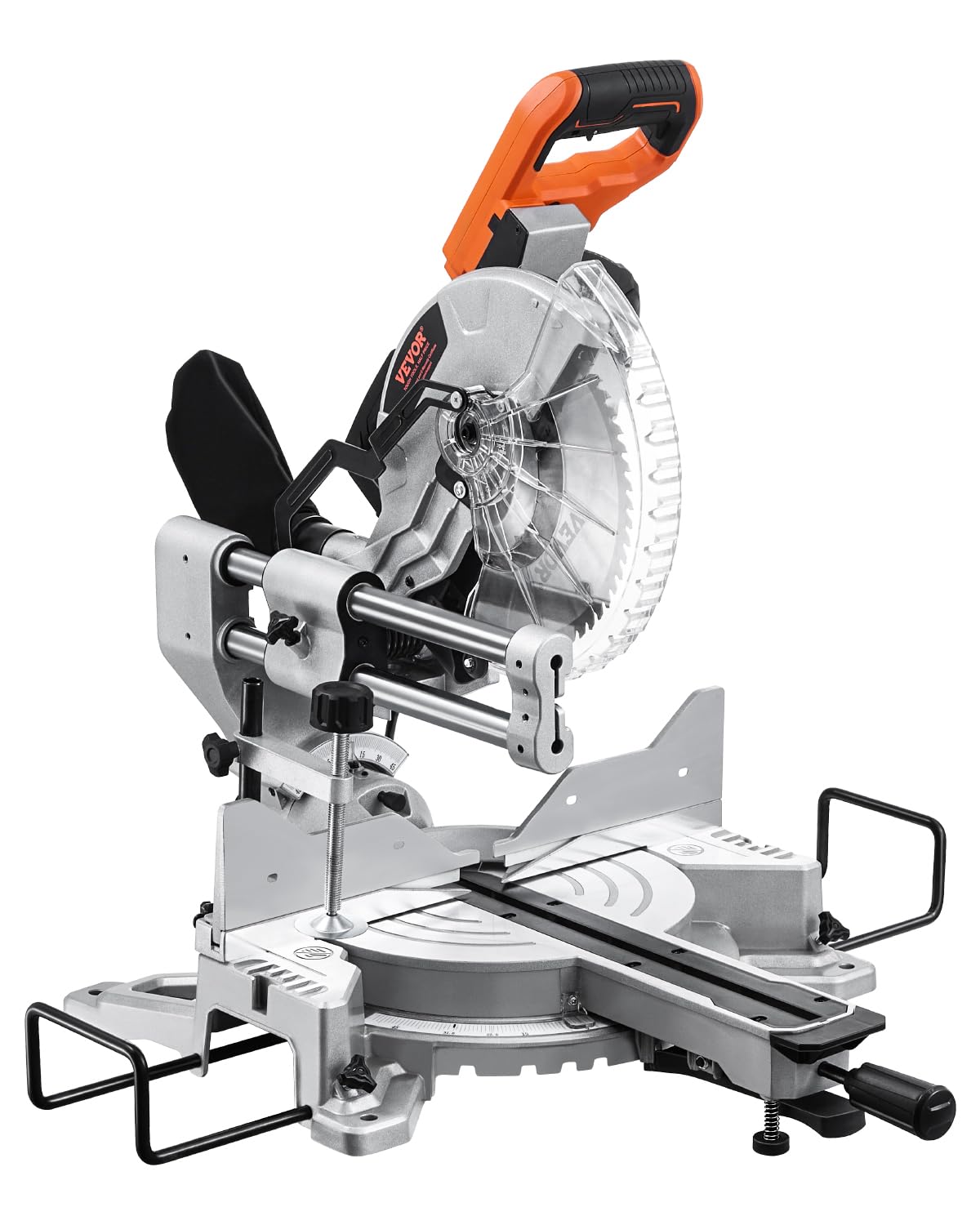
New to miter saws and worried about cutting accurately? This one is built to remove the guesswork. The LED guide projects a crisp cut line, precision scales and locking hardware fix your angles fast, and the axial sliding system lets the head travel forward and back for wider crosscuts with a design that permits wall-mounted placement to save floor space. Power comes from 2300W straight-cut and 2800W bevel-cut ratings with a 5,000 RPM speed, and the 60-tooth blade leaves cleaner edges than a low-tooth blade would. It also cuts wood, composite decking, and laminates, with side arm supports that hold 8-foot pieces.
Double bevel is the headline — this saw tilts both directions for bi-directional angled cuts, which is exactly what custom frames and wood art need. It sits at a beginner-friendly price point with a double-bevel feature set that normally shows up on pricier machines. Buyers describe it as a good-value, ergonomic saw that fits tight spaces and cut accurately, and the shadow-line style cut indicator earns praise for aiding accuracy. It is also light at 39.7 pounds, so one person can move it around a shop.
The caveats are worth stating plainly. Reviewers describe plastic knobs that may wear over time, blade installation that is trickier than it should be, and a dust bag too small to be useful. One buyer notes the dust discharge can clog on soft wood if you run the 32-tooth blade, and calls the shadow guide superior to a laser. Longevity is an open question at this price tier, and while it handles home use reliably, owners say it is not built for professional volume. For learning, framing, and weekend projects, it delivers real precision without a big spend.
Why beginners like it
- LED guide projects a crisp cut line so you see exactly where the blade lands
- Double bevel cuts both directions for frames and angled joinery
- Axial slide system allows wall-mounted placement to save floor space
- 5,000 RPM speed with 2300W straight-cut and 2800W bevel-cut ratings
- 39.7 pounds, light enough for one person to reposition
Where it shows its price
- Plastic knobs may wear with heavy use
- Blade installation is fiddly from the start
- Dust bag is small and can clog on soft wood
- Not built for professional-grade volume
A sensible first saw: ideal if you are learning woodworking and want double bevel and a clear cut guide without a big outlay.
Look upmarket if: you need a saw for daily production cutting, or you want metal parts throughout.
10. WEN MM1011T 10-Inch Sliding Compound Miter Saw

The budget trim saw that hugs the wall and crosscuts a full 12 inches of board.
For baseboard and chair-rail work on a tight budget, this is the value pick. The 15 Amp motor cuts boards up to 12 inches wide and 3-1/2 inches thick, and the head miters 45 degrees in either direction with 9 miter stops, or bevels 45 degrees to the left. Crown molding nests to 7-1/2 inches and baseboard vertical capacity runs 6-3/4 inches. The onboard Class II laser lights your cut line, and a 10-inch 40-tooth carbide-tipped blade, two table extensions, a clamp assembly, a dust bag, and a dust port adapter all come in the box, backed by a two-year warranty.
The space-saving design is the real draw. Buyers describe the front slide rails letting them place it against a wall — no rear clearance needed — and call it accurate and reliable for baseboard and chair-rail cuts. Owners cutting 4/4 and 8/4 lumber report the motor staying cool with accurate cuts, and one suggests making a zero-clearance strip for cleaner edges. A long-term user finds minimal difference versus pricier brands and rates it a good fit for hobbyists who can upgrade later if they outgrow it.
What you accept at this price is a slower blade brake and detents that can loosen with years of use — one owner notes sloppier miter stops after a couple of years and recommends it not be used for dadoes. The blade also arrives stiff: the arbor bolt can be over-tightened from the factory and the blade-to-bed alignment off slightly, so check squareness on setup. It ships missing a 6mm hex wrench for one buyer, so keep one handy. Blade accuracy feedback runs mixed, yet for occasional trim work it is a smart, low-risk entry to sliding miter saws.
The trim-task value: front-facing rails, a 12-inch crosscut, and a laser at the lowest budget tier — a sharp beginner’s first sliding saw.
The honest limit: slow blade brake and detents that may loosen over the years, so check squareness on arrival and keep a 6mm hex wrench nearby.
Made for tight trim jobs: grab this if you cut baseboard and chair rail against a wall and want a sliding saw without stretching the budget.
Better to look upmarket if: you cut every day, need dual bevel, or want detents that stay crisp for years.
11. NOVORIK Single Bevel Compound Sliding Miter Saw, 10″

A laser-guided starter saw that cuts wood, plastic, and soft metal without a premium price tag.
If this is your first sliding miter saw and you want to spend as little as possible while keeping a laser guide, start here. The NOVORIK runs a 15 Amp / 1800 W motor at a 4,000 RPM no-load speed — the lowest of this group, which is exactly what you would expect at the entry tier — and it ships with a 10-inch 40-tooth TCT blade for woodworking ready to cut. The bevel range is 0 to 45 degrees, the miter base swings -45 to +45 degrees with positive stops at 0, 15, 22.5, 30, and 45 degrees in both directions, and a laser tracks the real-time cut position. A blade guard and a dust extraction port for a vacuum hose round out the safety kit, and a clamping device, two side supports, and a wrench come included.
It also cuts more than wood. NOVORIK states the saw handles wood, plastic, and soft metal, and at 28.3″L x 15″W x 18″H it is the most compact body here — 13% smaller than the Bosch CM10GD’s footprint. That compactness matters on a crowded bench. The 2-year manufacturer warranty matches WEN, though it runs shorter than Evolution’s 3-year guarantee. Setting up from the start is straightforward, and buyers describe it as solid as a rock and smooth to slide and cut.
The honest scale-check depends on the blade and the entry-tier finish. The included blade is alloy steel with 40 teeth, so it leaves rougher edges than a 60-tooth blade, and one owner calls the degree dial’s zero mark a sticker, which raises a long-term durability question. Others find the angled gauge takes some getting used to and note the beam is slightly off even though the light is handy. Build quality and adjustability came back mixed in owner feedback, so plan to verify your angles on setup. What makes this easy to recommend is the support: a buyer in the middle of a first-order problem had the replacement shipped right away with no fuss. If you are brand-agnostic and value-conscious, this is the low-cost way in.
The budget entry point: laser guidance, a 40-tooth TCT blade, and a compact 28.3-inch body at the lowest price tier here — with a 2-year warranty behind it.
What you trade: a lower 4,000 RPM speed, a 40-tooth starter blade, and a sticker-based zero mark that may not last.
A cheap, friendly first sliding saw: reach for it if you are brand-new, budget-focused, and cutting wood, plastic, and the occasional soft metal.
Look higher if: you need dual bevel, a 12-inch crosscut, or smoother trim finishes from the start.
Understanding the Specs
Sliding Crosscut Capacity
This is how wide a board the saw can cut in one pass, and it is the number that decides whether a saw suits you. A sliding head travels forward and back to reach further than a fixed miter saw can, which is why these saws list figures like 12-inch crosscuts. The WEN MM1011T crosscuts boards up to 12 inches wide and 3-1/2 inches thick, and the SKIL MS6305-00 handles 2×12 at 90 degrees. If you cut shelving or wide boards, that width number is the one to lock in before anything else.
Bevel Range and Detents
The bevel is the tilt of the blade; a detent is a preset notch that locks the saw at a common angle so you do not have to guess. A single-bevel saw tilts to the left only, while a dual-bevel tilts both left and right — the Bosch offers a wide 47-degree left and right bevel with detents at 0, 33.9, and 45 degrees. More detents means faster setups on repeat work, and the SKIL’s 11 positive stops at the most-used angles serve the same purpose. For crown and picture-frame cuts, a dual-bevel saw saves you from flipping the board.
FAQ
Will a 10-inch sliding miter saw cut a 2×12?
What is the difference between single bevel and dual bevel?
Can a sliding miter saw sit flat against a wall?
Is a laser or a shadow line more accurate?
Can these saws cut metal as well as wood?
How heavy is a 10-inch sliding compound miter saw?
Do I need a shop vac for dust collection?
What miter stops should I look for?
Is a cordless miter saw worth it over a corded one?
Why is my new miter saw cutting slightly off-square?
Final Thoughts: The Verdict
For most workshops, the best 10-inch sliding compound miter saw is the Bosch CM10GD because its Axial-Glide hinge arms cut the front-to-back footprint by up to 10 inches, letting it sit closer to a wall than anything else here while its 15 Amp, 4,800 RPM motor cuts oak and hickory splinter-free. If crown molding and near-perfect rail feel matter most, the Makita LS1019L brings ball-bearing slides and a 6-5/8-inch nested crown capacity. And for cutting metal and wood on one blade, the Evolution R255SMS+ is the one to reach for.
How We Picked
We do not accept paid placement. Every pick is matched to a real buyer and a real use-case; we do not hands-on test units.
Sources & Methodology
Specifications: manufacturer listings and product documentation. Review insights: verified customer reviews, as of September 2026. Pricing: not shown on this page (it changes often); check the current price via the retailer link.
As an Amazon Associate, KitchPrep earns from qualifying purchases. This does not affect which products we feature.
Related Guides
