
Specs are compiled from manufacturer listings and verified buyer reviews and can change over time — please confirm the key details on the product page before buying.
If your kitchen or shop light is flickering, humming, or refusing to strike, you almost certainly don’t need a whole new fixture. You need a ballast — the small box that feeds the right voltage to your tubes. Each pick below lists the exact lamp code and lamp count it drives, so you can match it to your tube before ordering. If you want the safest default, the Philips ICN4P32N is the crowd favorite at 4.7 stars across 900+ ratings, and it takes the top spot here.
I’m Mohammad Maruf — the founder and writer behind KitchPrep. This guide is built by comparing the manufacturers’ published specifications and the patterns across verified customer reviews, so you get each pick’s real strengths and trade-offs instead of marketing spin.
You’ll see which ballast suits linear T8 tubes, which is built for circline rings, and which handles the long eight-foot lamps. Each pick below is matched to the lamp codes it drives — T8, T12, or circline — so you can find the ballast for lighting before you climb the ladder a second time.
Our Picks at a Glance

How To Choose The Best Ballast for Lighting
The mistake that sends most people back to the store is buying a ballast that matches the fixture brand but not the lamp code. What matters is the lamp code on the tube and how many tubes the fixture holds.
Start With Your Lamp Code
The letters and numbers printed on the tube give you the diameter, wattage, and base type. A T8 is a one-inch-diameter tube, and a T12 is the fatter older tube. The leading number is the nominal wattage. An F32T8 ballast runs 32-watt T8 lamps; a T12 ballast runs the fat tubes. Read the code on the tube itself — not the fixture label — before you order.
Count The Lamps And Check The Connector
A single-lamp ballast and a four-lamp ballast are not interchangeable. The tube’s end pins must match too — G13 is the standard two-pin base on most linear tubes, while G5 is the smaller pin spacing. If the pins don’t line up, the tube physically will not seat.
Match The Voltage And The Start Type
Residential fixtures in North America are almost always 120 volts. Commercial buildings sometimes run 277 volts, which is why universal-voltage ballasts exist — they cover both. Instant start fires the tube the moment you flip the switch, while rapid start warms the filaments first and tends to be gentler on lamps that cycle on and off a lot.
Quick Comparison
| Model | Best For | Lamp Type | Lamp Count | Voltage | Amazon |
|---|---|---|---|---|---|
| Philips ICN4P32N★ Best Overall | All-round T8 replacement | T8, G13 base | 3 or 4 lamp | 100–240V | Amazon |
| Philips ICN-2P32-NClean Swap | Simple two-lamp swaps | Plastic housing | 2 lamp | 120V class | Amazon |
| Sunpark SL26TCircline Specialist | Circline kitchen lamps | Circline, sockets attached | 1 lamp | 120V class | Amazon |
| Solus 120V Rapid Start | Aquarium and sconce fixtures | Linear fluorescent, G5 base | 1 lamp | 100–120V | Amazon |
| Interglobal IG13-20EL | Fish tank hoods | T8, 1.26-inch diameter | 1 lamp | 100–120V | Amazon |
| Advance ICN-4P32-SC | High-power-factor commercial runs | T8, G13 base | 4 lamp | 120–277V | Amazon |
| Keystone KTEB-2C72-1-TP-WS-CP | Circline rings with new sockets | Circline, sockets included | 1 lamp | 100–120V | Amazon |
| Keystone KTEB-432RIS-1-TP-SL | Four-lamp office and shop fixtures | T8, G13 base | 3 or 4 lamp | 100–120V | Amazon |
| Robertson ISL296T12MV | Eight-foot T12 shop lighting | F96T12 / F72T12 / F48T12 | 1 or 2 lamp | 120–277V | Amazon |
In‑Depth Reviews
1. PHILIPS LIGHTING ICN4P32N 3/4F17-F32 Elec Ballast, Black
Our pick — over 4.5★ from 950+ verified ratings; the strongest balance of quality and price.
The do-everything T8 ballast that runs three or four lamps without a whimper
If you own a four-tube workshop or kitchen fixture and the tubes all quit at the same moment, this is the box that fixes it. It runs 3 or 4 lamps and carries a 130-watt incandescent-equivalent rating — a figure that tells you it is built to drive a full bank of tubes, not a single bulb. The wide 100-to-240-volt and 60-hertz input (the standard North American wall supply) means the same unit works whether you’re on a 120-volt household line or a higher commercial feed.
Wiring is the part that scares people, and it shouldn’t. Disconnect the power, match the wire colors, and you’re done — the job is measured in minutes, not afternoons, and owners who initially blamed a dead bulb often find the ballast was the real culprit. It turns on instantly rather than ramping up, so a cold garage in winter still gets light the moment you hit the switch. The black housing is listed as shock and vibration resistant, which matters on a garage wall next to a running door or compressor.
The honest catch is lifespan. Some units run the better part of a decade while others give up inside a couple of years, and that spread is real — it’s the trade-off on this design. At 1 lb it’s a solid chunk of hardware, not a featherweight, so plan for a firm mount. Think twice only if you need a circline ring or an eight-foot tube, since this one is aimed squarely at standard linear lamps.
What buyers keep coming back for
- Genuinely simple wiring — color-match and go
- Instant ignition, and it’s reported to strike fine in cold weather
- Wide 100–240V input covers household and commercial feeds
- Cheaper than scrapping the whole fixture
Where it asks you to live with it
- Lifespan varies widely — some last years, some fall short
- Limited to T8 linear lamps, not circline or eight-foot tubes
- At 1 lb the housing is heavier than the original in some fixtures
Reach for this if: you’re feeding 3 or 4 standard T8 lamps and want the least fussy install.
Look elsewhere if: your fixture takes a circline ring or a long eight-foot lamp — the tube types simply don’t match.
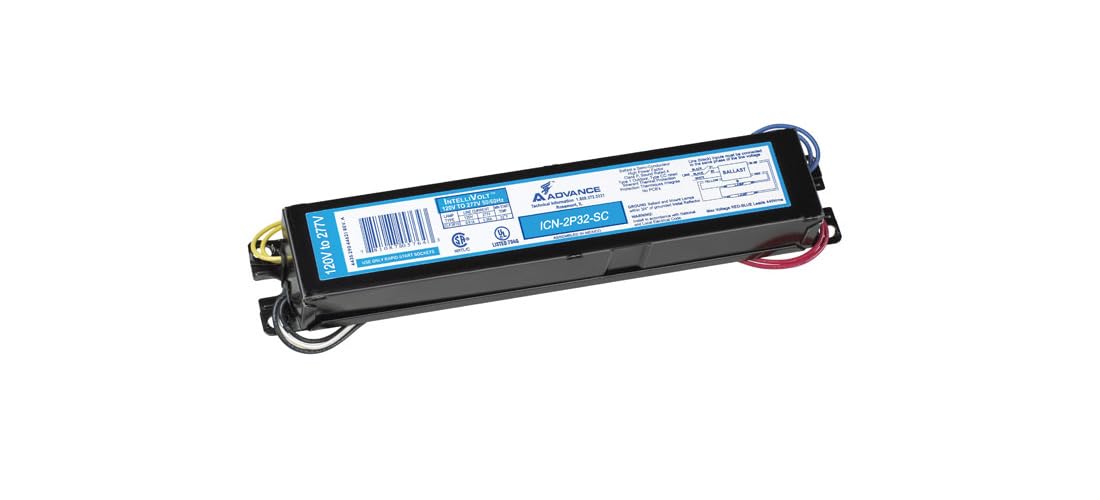
2. PHILIPS ICN-2P32-N BALLAST
The drop-in swap that matches your old ballast wire-for-wire
You get a fit that drops straight into the channel your old unit came out of, and the wires line up too. It measures 9.5 inches long and only 1.18 inches tall, so it slides into the same space. The assembled width is 1.7 inches, which keeps it tucked inside a standard fluorescent channel cover with room left for the wiring.
The clever part is the color coding. Owners who have been staring at a dead fixture report this arrives with the same wire colors as the unit it replaces — match them up, and the swap takes roughly a quarter of an hour. The plastic housing carries CSA/UL certification (independent safety-lab approvals that verify the unit meets North American electrical standards), and at 9.6 ounces it’s light enough to hold up with one hand while you tighten the screws.
Compatibility is the one variable to nail down before ordering, because the correct ballast depends on your exact lamp count and base rather than the fixture brand. Get that right and this is as close to a guaranteed fit as the category offers. Packaging is the recurring gripe — the ends can arrive bent when the unit ships loose in a bag, and the metal straightens out easily enough. It still lights up fine in most of those cases.
Fits without drama: The dimensions closely match common two-lamp channels, and the matching wire colors remove the guesswork that trips up most first-time ballast swaps.
The nagging detail: Loose bagged shipping sometimes bends the mounting ends. Check the unit before you climb the ladder so you’re not making two trips.
The straightforward answer: a two-lamp fluorescent channel that needs an honest like-for-like replacement.
Not your pick if: you’re after a four-lamp setup or a circline ring, where the lamp count is simply different.
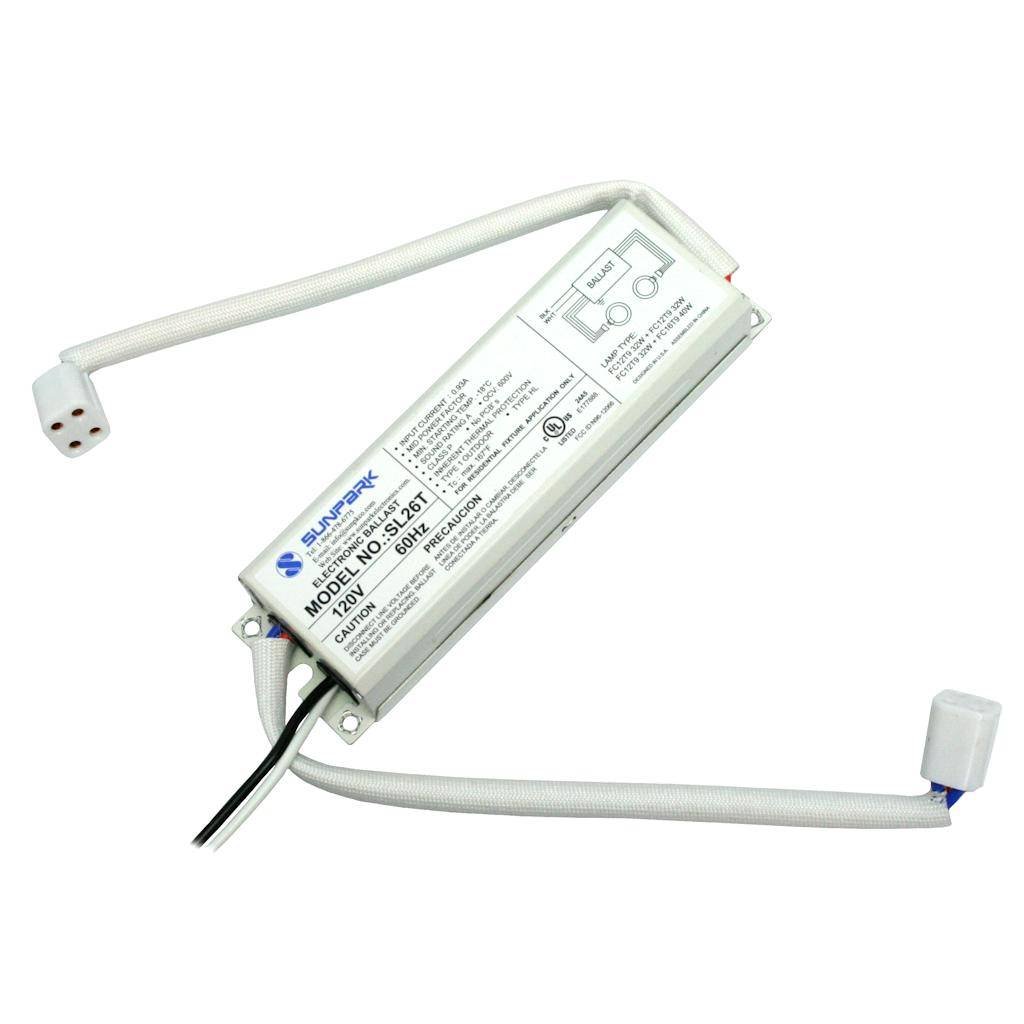
3. Sunpark SL26T Electronic Circline Ballast
The round-lamp fix for those kitchen ceiling domes nobody stocks anymore
That circular tube in your kitchen ceiling is a circline, and it takes a ballast built for the shape — which is exactly why you can’t find one at the hardware store. This unit arrives with the lamp holders already attached, so you’re not hunting for separate sockets. It shines where ordinary linear ballasts fall short, and it’s designed to run a single circline lamp.
At 10.24 ounces it’s a hefty little block, and interestingly it’s the weight outlier of the group compared to the Solus, which comes in at just 3.84 ounces. That extra mass is in the housing and the attached sockets rather than the electronics. Owners replacing a twenty-year-old dead unit routinely finish the job in under five minutes and get both bulbs lit at full brightness on the first try. It connects without fuss, and it’s been reported to run both CFL and LED circular bulbs.
The one dimension worth measuring is the cord. The lead is a little shorter than some originals, so on certain mounts you may need to rotate the fixture or angle the wires to make the reach — a minor pivot, but check before you commit. Durability is the other honest note: some of these run for years while others give out around the two-year mark, and that spread is part of the deal with this design.
Why the kitchen crew swears by it
- Lamp holders come attached — no separate sockets to source
- Swaps in under five minutes in most reported cases
- Lit both bulbs at full brightness straight away
- Runs both CFL and LED circular lamps
Where it asks for patience
- The lead cord runs shorter than some originals
- Lifespan is uneven — some go for years, some closer to two
- Built for one circline lamp, not multi-tube fixtures
Your unit if: a round circline tube powers your kitchen or bath fixture and you want the sockets included.
skip it if: your fixture runs straight linear tubes — the shape is wrong for that job.
4. Solus 120V Electronic Single Lamp Fluorescent Ballast – Rapid Start, Metal Housing
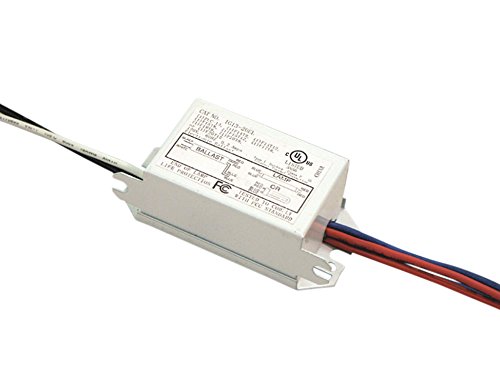
The lightweight single-lamp box that keeps fish tank lids glowing
Here’s where the numbers get dramatic. At 3.84 ounces this Solus is featherweight compared to the Sunpark SL26T at 10.24 ounces — a real gap you feel the moment you hold both. The aluminum case is compact, with built-in mounting holes so you can screw it into a recessed or surface-mounted fixture without fabricating brackets. Rapid start means it warms the lamp filaments before striking, which is gentler on tubes that switch on and off through the day.
It runs a single lamp and covers common linear fluorescent sizes including F14T8, F15T12, and F20T12 — the kind of tubes you find in aquarium hoods, under-cabinet strips, and wall sconces. The organized lead wires keep things tidy during the mount, and Class P inherent thermal protection adds an internal safeguard that shuts the unit down if it overheats. It’s UL and cUL listed with no PCBs. On the power side it draws 100 to 120 volts at 60 hertz, the standard household range.
Aquarium owners tend to keep a spare once the first one proves itself, and the reports from that crowd are steady — one notes a prior unit lasting three years, which most owners accept for this component. The UV rating on the housing (a measure of how well the plastic resists sunlight damage) makes it a natural fit for aquarium and specialty lighting. The catch is the narrow scope: this one is built for a single linear tube, not multi-lamp banks, so confirm your lamp code first.
Weight and warmth: The 3.84-ounce aluminum body and 100–120V range make this the least fussy option for a single-lamp residential fixture, and the rapid start keeps tubes from fighting the switch.
Confirm your tube: It shines on F14T8, F15T12, and F20T12 lamps. If your fixture uses a different code, this ballast won’t drive it correctly.
A natural fit for: aquarium hoods, under-cabinet strips, and sconces running a single linear lamp.
Move on if: your fixture uses multiple tubes or a circline ring, since this runs one lamp only.
5. IG13-20EL Magnetic Fluorescent Ballast, 1-Lamp, T8 F20T8, 20W, 120V

The cheap little box that rescues an aquarium hood from the trash
When a fish tank hood quits, the whole assembly often looks like a write-off. This ballast is the fifty-dollar save instead. It’s an electronic replacement aimed at aquarium hoods and aquatic fluorescent systems, and it handles a list of lamp types including F20T12, F15T8, F14T8, F17T8, F18T8, and FC8T9. It draws 120 volts and — this is the standout — its minimum starting temperature is 0°F, so it lights a cold garage or unheated tank room without hesitation.
The footprint is tiny at 3.07 inches long and 1.56 inches wide, and it’s light at 4.64 ounces. Wiring is straightforward: two red wires, two blue, one black, one white, and 60-hertz operation. Owners swapping these into hoods report the mounting holes line right up with existing fixtures, which is the difference between a fifteen-minute job and an afternoon of drilling.
The honest trade-off is service life. These are widely treated as a consumable — one owner reports getting about three years and two months out of theirs before it started missing ignition, and then simply ordered another. That’s typical for this price class, and the math still beats a new hood every time. Just be aware the wire positions on the replacement can differ from the original even when the model number matches — the red and blue leads (the two output wires) may exit the same side rather than opposite sides, so route the excess into the housing.
The aquarium-hood reality check
- Runs a wide set of T8 and T12-sized lamps including FC8T9
- Starts reliably down to 0°F — useful for cold rooms
- Tiny 3.07 x 1.56-inch footprint fits cramped hoods
- Mounting holes line up with many existing fixtures
What you should plan around
- Treated as a consumable — service life runs a few years at best
- Wire exit positions can differ from the original unit
- Designed for single lamps in small fixtures
Buy it for: reviving a fish tank hood or small single-lamp fixture cheaply instead of replacing the assembly.
Not for: large multi-tube fixtures or anyone expecting a decade of service — this is a replace-it-when-it-goes part.
6. Advance ICN-4P32-SC Electronic Fluorescent Ballast, 4 Lamp, 32W T8, 120/277V

The universal-voltage workhorse built for four-lamp commercial runs
This is the ballast that handles the buildings where 120 volts isn’t the whole story. It runs four 32-watt T8 lamps and accepts 120/277 volts, so it fits both a household feed and the higher commercial voltage without a second part number. The 150-watt incandescent-equivalent rating puts it well above the Solus single-lamp unit at 75 watts — a clear signal it’s driving a much larger lamp load.
Two specs do the heavy lifting. High power factor means the unit uses the incoming current efficiently rather than wasting it, which is what commercial installs care about. Instant start fires the lamps immediately, no warm-up. The listed dimensions put the unit at 9.75 inches wide and 1.75 inches tall, and at 12.32 ounces it’s the heaviest here — matched only by the Robertson at 13.28 ounces — so count on a firm mount inside the channel.
If you wire it correctly it works perfectly: two yellow leads, plus blue and red, correspond to the lamps and ballast in series. Get the series wrong and you’ll chase a phantom fault for an hour. Once set, these have a reputation for running for years — some still going after seven with the flicker gone. The one quirk is a slightly slower strike than the older version it replaces in some setups.
Wire it in series: Red, blue, and yellow go to the tubes, black and white to power, green to ground. The unit is unforgiving of crossed series wiring, but flawless once it’s right.
Built to endure: Several buyers report units still working after seven years with no flicker, which puts this among the longer-lived options in the group.
For the commercial-minded: four-lamp T8 fixtures on either 120 or 277 volts, where long service life matters.
Overkill if: you’re running a single or two-lamp residential channel — the lamp count is wrong for that.
7. Keystone Ballasts KTEB-2C72-1-TP-WS-CP Circline, 120V, w/sockets

The circline kit that ships with fresh sockets already in the box
This Keystone covers 22/32 watt or 32/40 watt circline lamps at 120 volts with rapid start, and it comes with the sockets — the small clips that hold your tube in place. That matters because old circline fixtures often have brittle, cracked sockets that crumble the moment you touch them. Having a fresh set in the box saves a second trip. It’s designed for a single FC8T9, FC12T9, or FC16T9 lamp.
At 13.28 ounces it’s the heaviest unit on this list, just ahead of the Advance at 12.32 ounces, with a 3 x 2-inch footprint and a white housing. Rapid start warms the lamp before it strikes, and owners mention bright, instant-on light with no buzzing or flickering after the swap. Replacing old 1990s-era magnetic units with this electronic version is a known upgrade path, and one long-term follow-up cites tubes lasting longer on this ballast than on the old ones.
The color temperature sits at 2800 Kelvin — a warm, yellow-white shade rather than a crisp daylight white, which suits a kitchen or reading lamp but will read noticeably softer than a shop fixture. The recurring note is lifespan: some run beyond a year and a couple fall short, so chalk that up as the standard variation for the design. The rest of the experience is smooth, right down to the socket swap.
What makes the swap painless
- Sockets come in the box — no separate sourcing
- Rapid start with instant-on, buzz-free output reported
- Direct replacement for old 1990s circline ballasts
- Warm 2800K light suits kitchens and reading nooks
Where you’ll need to be careful
- Heaviest unit in this group at 13.28 ounces
- Lifespan varies — a year-plus for some, less for others
- Single circline lamp only, not linear tube banks
Choose it when: your circline fixture has dead sockets and you want everything in one box.
Look elsewhere when: the job is a linear T8 fixture — the lamp and socket type don’t match.
8. KTEB-432RIS-1-TP-SL 4 Lamp F32T8 120V Electronic Ballast

The flicker-free four-lamp workhorse that swaps in while you hold the ladder
Four-lamp T8 fixtures live in basements, garages, and workshops, and they quit in the same way — a maddening flicker or a total blackout. This Keystone runs 3 or 4 lamps at 120 volts with instant start, and it’s listed as flicker-free. It draws on the standard 60-hertz household frequency and holds a 32-watt incandescent-equivalent rating, sized exactly for the F32T8 tube family.
The wiring gets the most praise, and it’s well-earned. The leads arrive pre-stripped, which is the detail that turns a fiddly job into a quick one — one owner had theirs wired up and running in about ten minutes. Color coding is clear, and owners swapping a dead unit for the same brand report an exact fit against a fixture that had run for a decade.
The build favors efficiency, with a high efficiency rating printed on the spec sheet, and the housing sits at 3 x 2 inches. The three-year manufacturer warranty is the standout confidence signal here, since it’s a written guarantee rather than a marketing line. The honest caveat is the same one that dogs this whole category: lifespan isn’t guaranteed, and even a unit that lasts ten years will eventually need replacing. For a fixture you intend to keep, the warranty softens that risk.
Pre-stripped wires change the job: No stripping, no guessing — color-code the leads and you’re done. Most reported installs finish in about ten minutes.
The warranty is the real edge: Three years of manufacturer coverage on a component that usually carries none is note, since lifespan is the unpredictable part of any ballast.
Best for: 3 or 4-lamp T8 fixtures where you want pre-stripped wiring and a written warranty.
Wrong fit for: circline rings or long eight-foot T12 tubes — the lamp code is different.
9. Robertson ISL296T12MV Ballast (3P20158) – 1 or 2 Lamp F96T12 (96W)

The eight-foot shop light specialist that runs on a parallel circuit
Eight-foot fluorescent tubes are a whole different beast, and this Robertson is built for exactly that. It runs one or two lamps including F96T12, F96T12/ES, F72T12, and F48T12, and it accepts 120–277 volts so it works in both homes and commercial spaces. Two specs stand out: parallel operation keeps one lamp running even if the other fails, which keeps light on in a shop or warehouse even mid-failure. And the quiet operation is rated at Sound Rated A with no buzzing.
On the technical side it’s instant start with no preheating, low total harmonic distortion under 10%, and a power factor above 0.98 — the numbers that matter to anyone running multiple fixtures off one circuit. It’s UL listed with Class P, Type HL, and Type 1 Outdoor ratings, CSA certified, and compliant with FCC Part 18 for electromagnetic and radio interference limits. It’s also encased and potted for thermal protection, which helps it survive a cold shop below 60°F.
A caution before you buy: the wiring is stricter than the old magnetic unit it replaces. Hot and neutral go to the ballast, one red lead goes to both sockets at one end, and two blue leads run to the sockets at the other end. Plan to sit down with the diagram and draw it out. It’s still a fraction of the cost of a new fixture, and owners running several of these in cold workspaces keep ordering more. Shipping can drag for some buyers, so build in a buffer if you’re under time pressure.
Why it earns its keep in a big space
- Parallel operation keeps one lamp lit if the other fails
- Sound Rated A quiet — no buzz in the shop
- UL listed with Class P, Type HL, and Type 1 Outdoor ratings
- 120–277V universal voltage covers home and commercial feeds
Where it demands care
- Wiring is stricter than older magnetic ballasts — draw the diagram
- Shipping times have stretched for some buyers
- Some customers note shorter service life in the worst cases
Made for: eight-foot dual-tube shop and warehouse fixtures that need quiet, parallel operation.
Wrong tool if: you’re wiring a standard four-foot T8 channel — the lamp code doesn’t fit.
Understanding the Specs
Lamp Code and Base Type
The code printed on your tube is the whole ball game. The letter tells you the tube diameter — T8 is one inch, T12 is the fatter older size — and the leading number is the nominal wattage. The base is the connector at the tube ends: G13 is the common two-pin standard, while G5 is a smaller pin spacing you’ll find on slimmer linear lamps. A DC circline lamp like FC12T9 or FC16T9 takes its own dedicated ballast. Match all three and the tube will seat and strike. Miss any one and you’ll be climbing back down the ladder.
Quick Start Vs Magnetic Vs Rapid Start
Instant start fires the tube the second you flip the switch, with no warm-up — ideal for lights that stay on for long stretches. Rapid start warms the lamp filaments first, which is gentler on tubes that cycle frequently. Both are electronic, which is why they run cool and quiet. Old magnetic ballasts are the ones that buzzed and flickered, and most of the picks here are electronic replacements for them. If your fixture hums, that hum is usually the sign you’re still running a magnetic unit.
FAQ
How do I know which ballast matches my fixture?
Is the wire color code the same on every ballast?
Can I replace a magnetic ballast with an electronic one?
Does the voltage rating need to match my house exactly?
How long does a ballast usually last?
Will the ballast work with LED tubes?
What is the difference between instant start and rapid start?
Do I need to shut off power before replacing a ballast?
Why is my fixture still flickering after I replaced the bulbs?
Can a single ballast run both a linear tube and a circline ring?
Final Thoughts: The Verdict
For most fixtures, the winner among these ballast for lighting picks is the Philips ICN4P32N because it handles 3 or 4 standard T8 lamps on a wide 100–240-volt range, wires in minutes, and strikes instantly. It’s the highest-rated pick here and the crowd favorite at 4.7 stars across 900+ ratings — a strong signal that the majority of buyers are satisfied. If you’re feeding a single circline ring, grab the Sunpark SL26T, which comes with the sockets attached. And for eight-foot T12 shop lighting, the Robertson ISL296T12MV is the one to reach for, with parallel operation that keeps one lamp lit if the other fails. The smartest move is to read your tube’s code before ordering — that one habit prevents almost every wrong-ballast return.
How We Picked
We do not accept paid placement. Every pick is matched to a real buyer and a real use-case; we do not hands-on test units.
Sources & Methodology
Specifications: manufacturer listings and product documentation. Review insights: verified customer reviews, as of September 2026. Pricing: not shown on this page (it changes often); check the current price via the retailer link.
As an Amazon Associate, KitchPrep earns from qualifying purchases. This does not affect which products we feature.
Related Guides
