
Specs are compiled from manufacturer listings and verified buyer reviews and can change over time — please confirm the key details on the product page before buying.
If you want to stop paying the utility for the power you use in your own yard, a ground-mounted solar array is the simplest way to do it. You bolt panels to a frame or a lean-to, run cable to a charge controller, and let the sun top up a battery bank that feeds an inverter. The trick is picking the right wattage, the right voltage, and the right mount for the space you actually have — because a 400W pair and an 800W quad solve very different problems, and a cheap controller can quietly waste half your harvest. This guide walks through eleven real backyard arrays, what each one is genuinely good at, and where each one will frustrate you.
I’m Mohammad Maruf — the founder and writer behind KitchPrep. This guide is built by comparing the manufacturers’ published specifications and the patterns across verified customer reviews, so you get each pick’s real strengths and trade-offs instead of marketing spin.
Most people shopping for a backyard solar array get stuck on wattage alone, then discover the controller, the mount, and the shade decide how much power actually lands in the battery. That gap is what this guide closes — with real numbers, real trade-offs, and no guesswork.
Our Picks at a Glance

How To Choose The Best Backyard Solar Array
A backyard array is a long-term purchase, so the first decision is not which panel looks nicest — it is how much power you want to replace and how many hours of real sun your patch of yard gets. Panels are rated under standard test conditions, which means lab-grade light and temperature. Real yards are rarely lab-grade, so sizing your array a little above your target is the normal move for anyone building something that lasts.
Match the array to what you’re actually powering
If you only want a shed light, a security camera, or a greenhouse fan, a lower-wattage kit with its own battery and inverter gets you running without you having to buy parts individually. If you are trying to run a fridge, a mini-split, or a camper’s air conditioner, you are in a different league — you need the panel wattage, a lithium battery bank with real usable capacity, and an inverter rated for your loads. Sorting your loads first stops you from buying an array that stalls the moment you plug in the biggest appliance.
Ground mount versus lean-to versus roof
Ground mounts and lean-to setups let you aim the panels at the sun and get air moving behind them, which matters because heat cuts output. Pre-drilled holes on the back of most rigid panels make Z brackets and tilt mounts straightforward, but you always need mounting hardware unless the listing says it is included. Roof mounting trades the whole yard for the top of a shed or cabin — less ideal for cooling, but it keeps the yard usable and the panels out of reach of the mower.
Series or parallel, and why it matters at home
Wiring two panels in series stacks their voltage, so current stays low and cable runs can be thinner over distance. Wiring in parallel keeps voltage the same and adds current, which is safer on a 12V system unless your controller specifically handles higher input voltage. The one thing you must never do is exceed the voltage your charge controller is rated for — the controllers bundled in these kits have hard input ceilings, and every configuration you choose has to sit underneath them.
Quick Comparison
| Model | Best For | Rated Power | Voltage | Kit Contents | Amazon |
|---|---|---|---|---|---|
| Callsun N-Type 16BB 400W Bifacial (2 × 200W) | Yard setups that want flexible 400W strings | 400W total | 23.74V | Panels only | Amazon |
| ECO-WORTHY 400W 12V Premium Kit (4 × 100W) | First complete off-grid system for a shed | 400W total | 12V | Panels + 40A MPPT + Bluetooth | Amazon |
| DOKIO 800W Solar Panel Set (2 × 400W) | Bigger arrays with fewer roof joints | 800W total | 31V | Panels only | Amazon |
| EPOCH 860W Bifacial (2 × 430W) | Camper and cabin arrays needing rear-side gain | 400W rated output | 24V | Panels only | Amazon |
| STAR 860W Bifacial (2 × 430W) | Tight yards that still want high output | 860W total | 24V/48V system | Panels only | Amazon |
| ECO-Worthy 1.6KWH 400W Kit | Sheds and campers that need stored power | 400W total | 12V | Panels + 2 batteries + 2000W inverter + MPPT | Amazon |
| Renogy 1280W N-Type 18BB (4 × 320W) | Permanent home and farm arrays | 320W per panel | 24V | Panels only | Amazon |
| SUNGOLDPOWER 6 × 560W Bifacial | Large residential and commercial builds | 560W per panel | 42.1V | Panels only | Amazon |
| ECO-WORTHY 1200W 4.68KWH System | Whole-home backup on a budget | 3000W inverter | 24V | 6 panels + 2 batteries + 3000W inverter + MPPT | Amazon |
In‑Depth Reviews
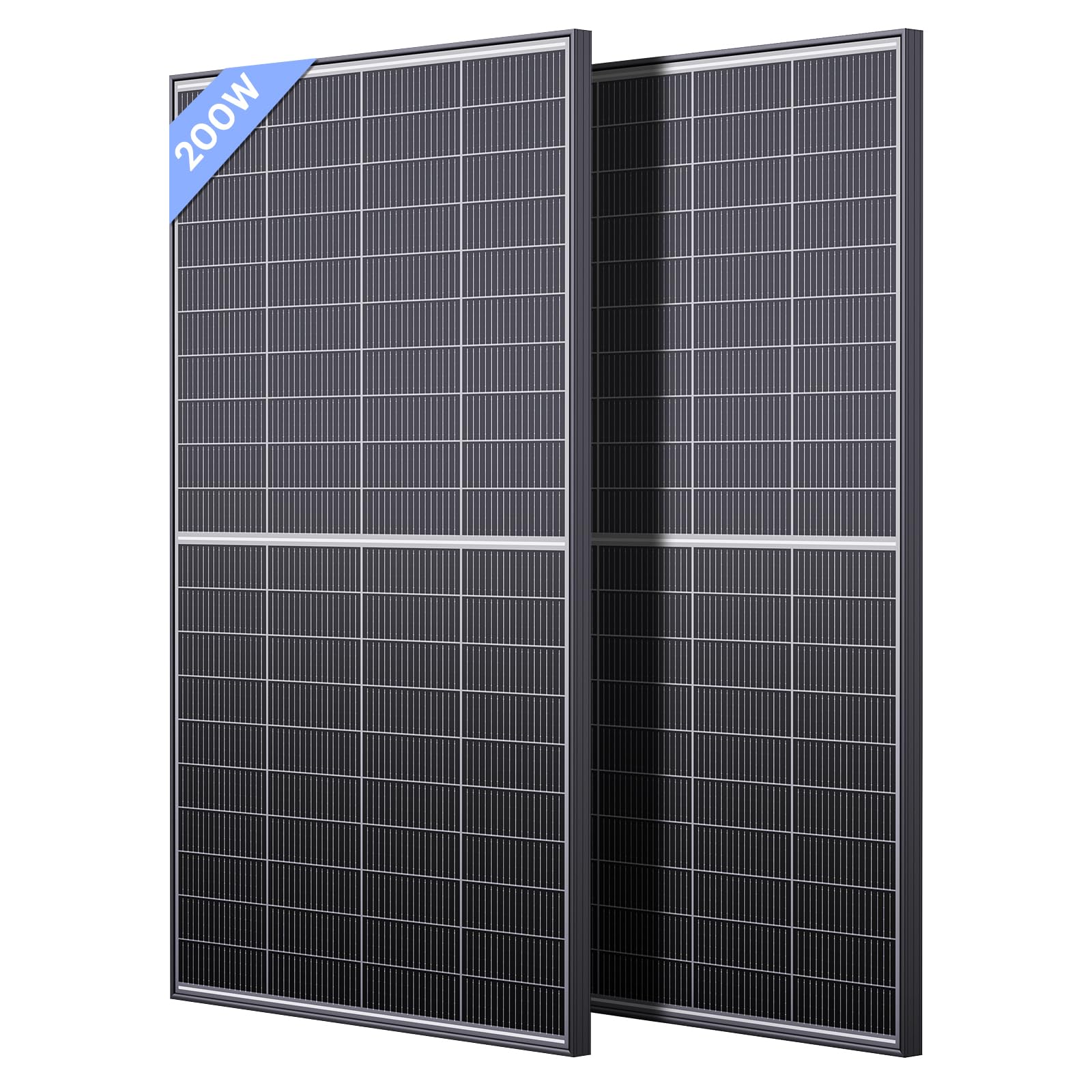
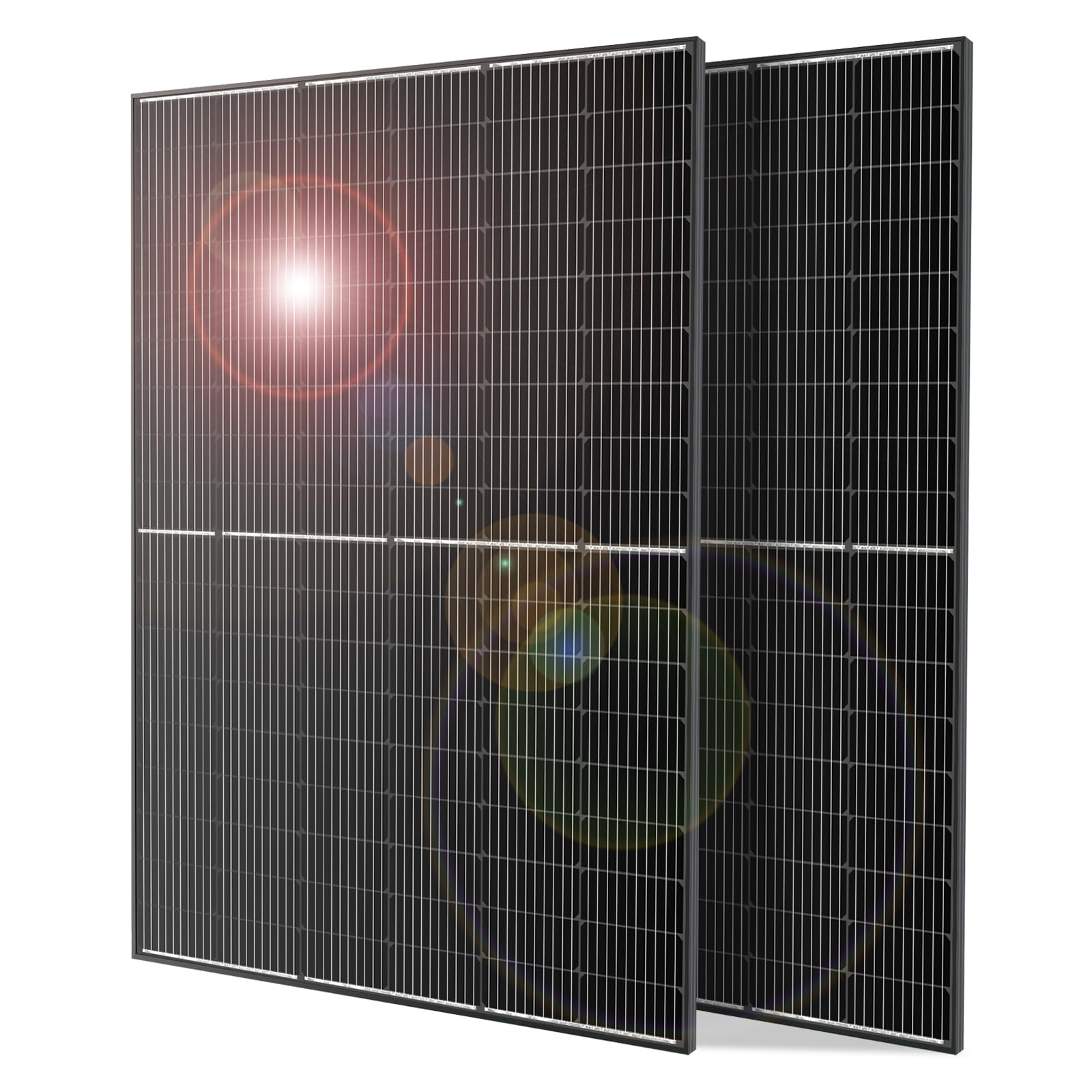
1. N-Type 16BB 400W Bifacial Solar Panel, 2Pcs 200 Watt Solar Panel
Two 200W bifacial panels that keep producing when half the array falls under cloud shadow.
Start with the 25.6% conversion efficiency of the N-type monocrystalline cells — roughly a quarter of the sunlight hitting the glass becomes usable electricity. That efficiency is why this pair is a default pick for yard arrays: owners keep reporting harvests above the 200W label. Deliveries land with two panels per box, so four panels means two boxes on the porch.
Second, the wiring math is friendly. Two panels run in series give you 47.48V Vmp and 54.62V Voc while holding a 8.43A operating current, which sits comfortably inside the 60V-class solar input window most portable power stations use. Owners running off-grid garages, campers, and cabins report the array carrying fridges, TVs, internet, and a cooler around the clock, and cold winter air lifts peak wattage on bifacial glass instead of dropping it.
The twin-cell anti-shading design is what keeps output up when shade hits. The panel is split into two independently operating halves, so when a tree branch or a building shadow falls across one half, the other half keeps pushing current. The transparent backsheet catches reflected light off gravel, snow, or a white wall, adding rear-face yield when the mount sits over a bright surface. Temperature coefficient lands at -0.30%/K, which means the array holds onto more of its output in Texas or Arizona heat than a steeper spec would suggest.
What owners get excited about
- Two 200W panels in series hitting 400W total at 47.48V Vmp and 54.62V Voc — inside 60V-class portable power station inputs
- 8.43A operating current that plays nicely with common charge controllers
- 25.6% conversion efficiency from N-type monocrystalline cells with 16BB busbar, which helps reduce hot spots and microcrack risk
- Independent halves keep generating when one side is under a shadow
- Tempered glass, corrosion-resistant aluminum frame, and IP68 junction box rated for outdoor life
Where the shine comes off
- At 23.8 lbs per panel and 51.3″L × 30.3″W × 1.4″H, each unit wants two hands and a helper for solo roof or lean-to installs
- Panels only — you supply the mounting hardware, controller, and cabling
- A few owners in scorching climates note output sags in high heat
Top pick if you want flexibility: Two 200W halves that scale from a single yard setup to a multi-panel 2s2p array and hold up under real weather.
Skip if you need it all in one box: There is no controller, no battery, and no mounting kit included — this is a panel-only purchase.
2. ECO-WORTHY 400 Watt 12 Volt Premium Solar Panel Kit: 4pcs 100W + 40A MPPT + Bluetooth
Four 100W panels, a 40A MPPT controller, and Bluetooth monitoring in one box for a bare shed.
Four 100W monocrystalline panels travel together with a 40A MPPT charge controller, a BT-02 Bluetooth module, and mounting Z brackets. The controller runs a tracking efficiency of up to 99% and a peak conversion efficiency of 98%, and the kit ships with a fuse and the MC4 connectors to finish the job. Panel amperage lands at 3.76A per unit — noticeably lower than higher-output single-panel setups — which is the honest trade-off of splitting the same wattage across four smaller frames.
Owner feedback centers on the company’s responsive support. The company behind the kit gets credit for old-fashioned customer support, with a buyer noting he had a question and was helped by “people that really care about their company and the satisfaction of their customers.” That post-sale care shows up in the review pages as a running theme, along with the kit working happily on RV boondocking trips and shed power over modest cable runs.
Where it needs a careful set of eyes: the included hardware is sized for short runs, and at least one owner reported the controller-to-battery wiring being undersized for a full-time rig, leading to a melted controller that was replaced under warranty. If your run from panel to battery is longer than a few feet, plan to upsize the cable yourself. For a beginner wiring a shed or a small off-grid cabin for the first time, it is a complete, beginner-friendly system that avoids the “wait, I need what else?” problem.
The kit-in-a-box win: Panels, 40A MPPT controller, Bluetooth 5.0 module, Z brackets, and fuse all arrive together, with the controller holding 99% tracking efficiency and 98% peak conversion efficiency.
Right for first-timers: A complete 400W system for sheds, beginner cabins, and short-run RV installs where all the pieces coming together matters more than peak power per panel.
Think twice if you’re running long cable: The kit is sized for short runs, so plan to upgrade the controller-to-battery wire for full-time installations.
3. DOKIO 800W Solar Panel Set, Two 400W 31V Panels for 24V Off-Grid Systems
Two big 400W plates that cut the joint count on your mount instead of multiplying it.
Eight hundred watts in two frames means far fewer connections than eight 100W panels would need. Fewer MC4 joints, fewer Y-branches, fewer failure points — and less time on the roof with a wrench. Each panel carries 3 m of MC4 leads, so reaching your controller without immediate extensions is the norm rather than the exception. The 31V output pairs naturally with 24V off-grid systems, and the tempered glass plus aluminum frame with sealed junction boxes is built for year-round yard exposure.
Where it earns its keep is on mounts that were designed for portability. A field-day builder used DOKIO panels to create two hinged 400W arrays because they run lighter than the equivalent Renogy frames, and ran them in parallel, series, or 2S2P depending on the controller in play. Performance ratings across the review pages sit in the “works great for the money” column — the array delivers usable output without needing a truck to move it.
The honest catch is one of expectations rather than hardware. Solar panels do not hit STC wattage unless the sun is dead overhead and the cells are cool, so a heat-soaked August afternoon will leave these well under their 400W label. Parallel wiring on 12V systems is the recommended starting configuration for safer voltage and steadier charging — push to series only when your controller explicitly supports higher input voltage. And be ready for the physical heft: at roughly 4× the footprint of a 100W panel, they need a real plan, a helper, and a sturdy frame before you cut any cable.
Worth buying for
- 800W in just two frames — dramatically fewer joints, connectors, and hours on the mount
- 3 m MC4 leads on each panel reduce the need for immediate extensions
- 31V output pairs cleanly with 24V off-grid systems
- Tempered glass, aluminum frame, and sealed junction boxes handle year-round yard weather
Know before you buy
- Large and awkward on arrival — plan a helper and stage the unboxing on a porch
- Real-world output runs under the 400W STC label in heat, as with any panel
- Panels only — no controller, no mounting hardware, no cabling beyond the short leads
Built for the tinkerer: Anyone assembling a 24V yard array who wants 800W of capacity without eight sets of bolts and bushings.
Look elsewhere if you want a starter kit: You will need to source the controller, battery, and mount separately to get this array running.
4. EPOCH 860W Bifacial Solar Panels, 2 × 430W N-Type Class A Monocrystalline
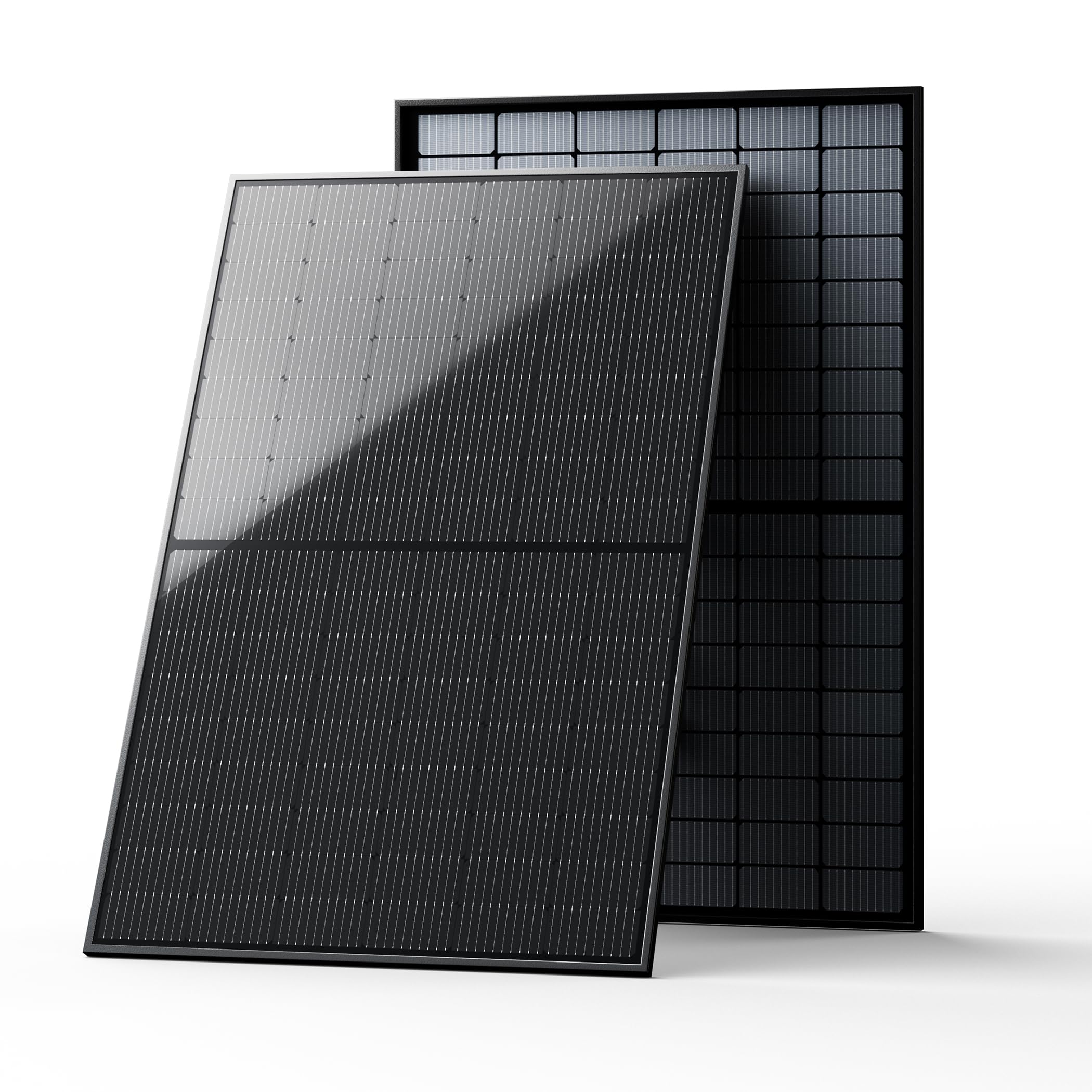
A bifacial pair that catches the light bouncing back off whatever is behind it.
Two 430W panels give this kit 860W of nameplate capacity, and every watt is designed to be reached from two directions. The transparent backsheet and bifacial cell layout accept light from the front and the rear, so a bright ground surface under the mount can quietly add to the harvest. Efficiency figures reach up to 25% with light transmission rated at 91.5%, and the panel covers hail and snow loads up to 5400 Pa plus a 2400 Pa negative wind load — real numbers for real weather.
Owners putting these on vans and mobile mounts see them hanging right around 90% of rated on a good day, with the rear-facing side clearly doing its share. The frames ship with pre-drilled holes on the back sized for standard Z brackets, corner brackets, pole mounts, and tilt mounts, so the ground-mount planning is already done for you. Best conditions are a bright surface under the array — a white shed wall, gravel, or even snow — which is where bifacial panels earn the extra output.
Two caveats worth knowing up front. First, the panel widths run wider than comparable 400W units, so if you’re packing them into an existing porch deck frame, measure twice. Second, the weight lands near 107 lbs for the pair, which is a two-person lift for any roof or improve bracket install. And bifacial gain only shows up when the rear side has something to reflect — flat on a dark lawn with no bright surface behind, the array behaves like a standard 430W panel rather than a supercharged one.
The real-world number: Rear-side reflection plus 91.5% light transmission on the front means a bright-surface ground mount gets you the full benefit of a bifacial design.
Reach for this if: Your mount has a light-colored surface, gravel, or snow behind it and you want the rear-face yield that a monofacial panel cannot give you.
Look elsewhere if: Your install sits flat against dark ground with nothing behind the panel — the bifacial premium simply will not pay off in that setup.
5. 860 Watt Bifacial Solar Panels, UL61730 Certified 16BB 25% High Efficiency

Half-cell layout and a 5400 Pa snow rating in a couple of frames you can hang on a cabin.
Two 430W panels sit inside a genuinely compact form factor: the maker claims the array takes up 20% less space than traditional 400W+ panels using its half-cell design. The bifacial rating lifts the practical gain up to 30% extra from the rear side when reflected light is available, and the low temperature coefficient of -0.26%/°C helps the panels hold their output even in hot environments up to 65°C — meaningful for southern yard installs. The junction box is IP68-rated and the frames carry both extreme wind (2400 Pa) and snow (5400 Pa) load ratings.
The certification story is the differentiator. UL61730 certification is not something every bifacial panel on the market carries, and it puts this one squarely inside North American safety standards for off-grid and grid-tied use. A+ grade monocrystalline cells with HJT technology and a current screening step cut power mismatch loss by up to 2%. In weak light — mornings, evenings, and cloudy days — owners repeatedly note the panels keep putting out usable current well before and well after true solar noon.
Two real things to plan for. First, the frames ship with no mounting hardware, so brackets are a separate purchase before the panels ever see a bolt. Second, the size is real — each panel is 67.8″ × 44.7″ in the frame and the pair weighs in heavy, so staging two people for the lift is the safer call. The shade-resistant design keeps one panel section pulling current when the other is under tree or debris shadow, which is why installs in tree-lined yards still report usable output on partially shaded afternoons.
Why the certification matters: UL61730 compliance plus 5400 Pa snow load and 2400 Pa wind load ratings means this pair can face a genuine four-season yard without a compliance headache.
Pick it if compliance and shade tolerance both matter: Certifications plus half-cell anti-shade design make it a serious fit for permanent outdoor installs.
Note the mounting cost: No brackets are included — factor that into the build plan before you order a mount.
6. ECO-WORTHY 200 Watt 12V Complete Solar Panel Starter Kit for RV Off Grid
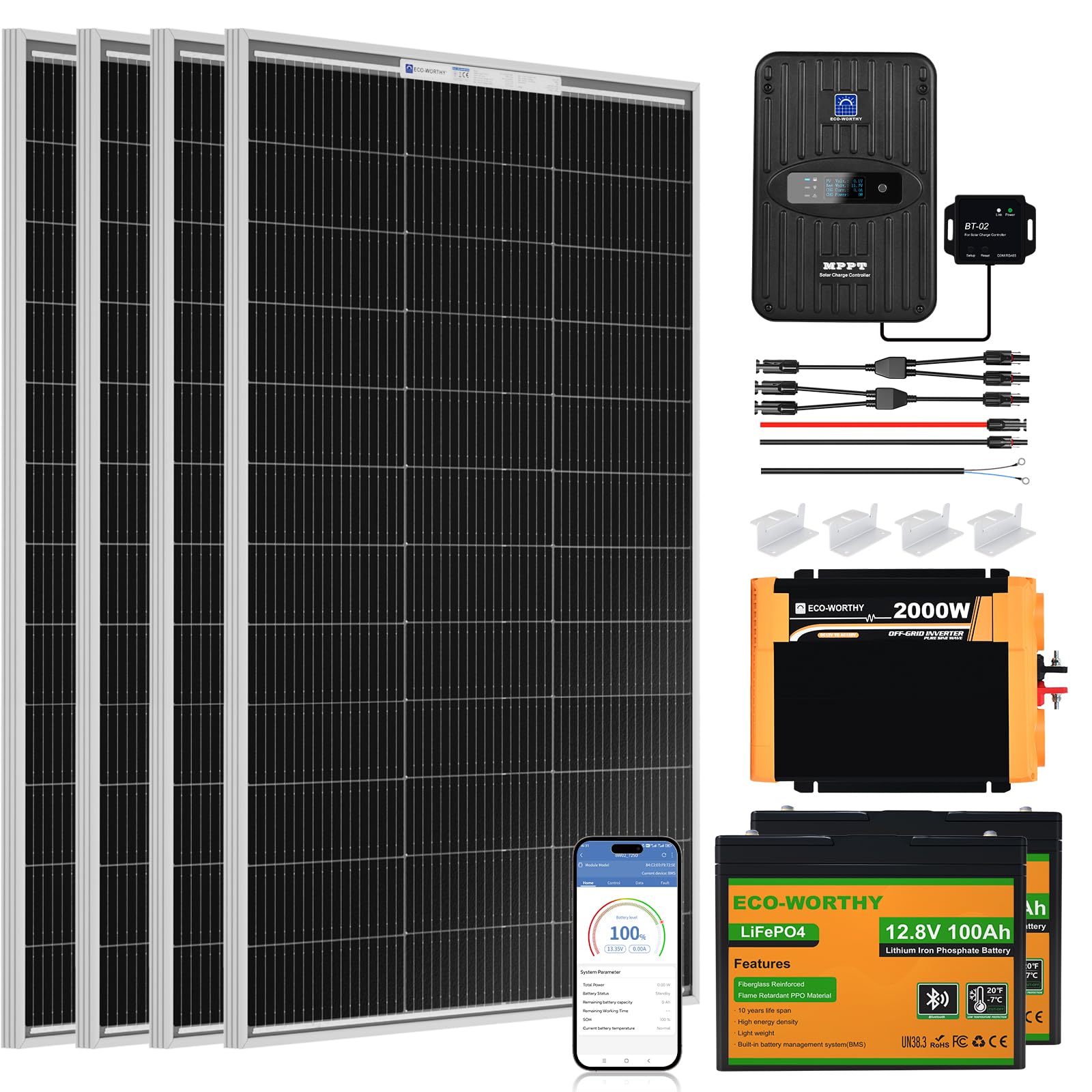
Two lithium batteries and a 2000W inverter turn four panels into real evening power.
The headline on this kit is the energy storage side: two 12V 100Ah lithium batteries paired with a 40A MPPT controller and a 2000W pure sine wave inverter, all bundled with four 100W bifacial panels. Ideal daily output is rated at 1.6KWH under four hours of sunlight, and the lithium packs deliver more than 3000 deep cycles with a built-in BMS handling protection. For a shed, cabin, or camper running a fridge plus lights plus a laptop, that combination is the difference between a system that dies at dark and one that keeps the freezer running through the evening.
The panels themselves use 12BB solar cells with a stated 23% conversion rate, and the kit’s design leans on the pair of batteries to absorb daytime generation so loads can pull from stored power after sunset. RV and cabin buyers report the system running its advertised devices — TVs, fridges, and small AC loads under 2000W — without much fuss. Note that the inverter is the ceiling here: anything above 2000W rated, or with a big startup surge, is outside what this kit will hold.
Where buyers need to set expectations is on evening and cloudy-day capacity. The included battery bank stores 1.6KWH, which is plenty for lights and electronics but will not carry an air conditioner through a summer night. Adding two more lithium batteries is a common upgrade path here, and several owners have done exactly that. Manual clarity is another common gripe — most buyers end up on YouTube or Google for the initial setup rather than the printed directions, so budget an afternoon for wire-up.
Strong on
- Two 12V 100Ah lithium batteries for real overnight capacity with a 3000+ deep cycle rating
- 40A MPPT controller with up to 99% tracking efficiency and 98% peak conversion efficiency
- 2000W pure sine wave inverter covers fridges, TVs, and small AC loads
- Four 100W bifacial panels rated at 23% conversion using 12BB cells
Real limits
- 1.6KWH of stored power runs lights and electronics but not an AC through the night
- Inverter caps loads at 2000W — bigger appliance startups need a different plan
- Printed instructions are thin; expect to lean on online guides
The right pick for stored overnight power: RV, cabin, or shed setups that want evening runtime from a battery bank without assembling every component individually.
Not for whole-home AC: If you need air conditioning coverage through the night, plan for extra batteries or a bigger inverter from day one.
7. Renogy Solar Panels 1280 Watt N-Type 18BB, 25% High-Efficiency

Four high-efficiency panels built for a permanent array on a farm or home roof.
Each of the four panels carries a 320W rating and 25% cell efficiency from n-type 18BB cells — the higher busbar count is what cuts the hot spot effect when weather gets rough. Total system capacity lands at 1280W, and the panels are cut for permanent mounts with pre-drilled back holes compatible with Renogy ground mounts, Z brackets, corner brackets, pole mounts, and tilt mounts. IP68-rated connectors and anti-corrosion coating make them a natural fit for farm, cabin, and shed installs that are meant to sit outside through every season.
Real-world owner reports cluster around steady, boring performance — which is exactly what you want from a permanent array. Configurations run from 4S2P yielding roughly 120V to series-parallel mixes that keep batteries near full by mid-afternoon. Van full-timers running these alongside lithium battery banks report good charging even through cloudy and rainy days, and the fact that one set fits on a 26-foot Class A RV roof and still runs a top air conditioner off a 2500W inverter for up to three hours on a sunny afternoon is the kind of statement that makes permanent-mount buyers pay attention.
The honest trade-offs are physical and cosmetic. Each panel weighs in heavy and takes real square footage, which is why the review pages note that the biggest bang-for-buck options are also the ones too large for flexible ground mounts. Some owners note the frames arriving bent after poor shipping, and at least one delivery arrived shattered and involved a return process. Also, real output tends to land slightly under nameplate in summer heat, matching the general physics of any solar panel — the cold, well-angled days are the ones that hit the label.
Why permanent installers pick it: 1280W of total capacity with 18BB busbars that reduce hot-spot risk and IP68 connectors rated for outdoor exposure is the recipe for a long-running home or farm array.
The right call for a fixed array: Home rooftops, farms, and outbuildings where the panels will be installed once and left to work for years.
Overkill for casual setups: If you want portability or a small starter kit, this is heavier and bulkier than what you need.
8. SUNGOLDPOWER 16BB N-Type 6pcs 560W Bifacial PERC Solar Panels
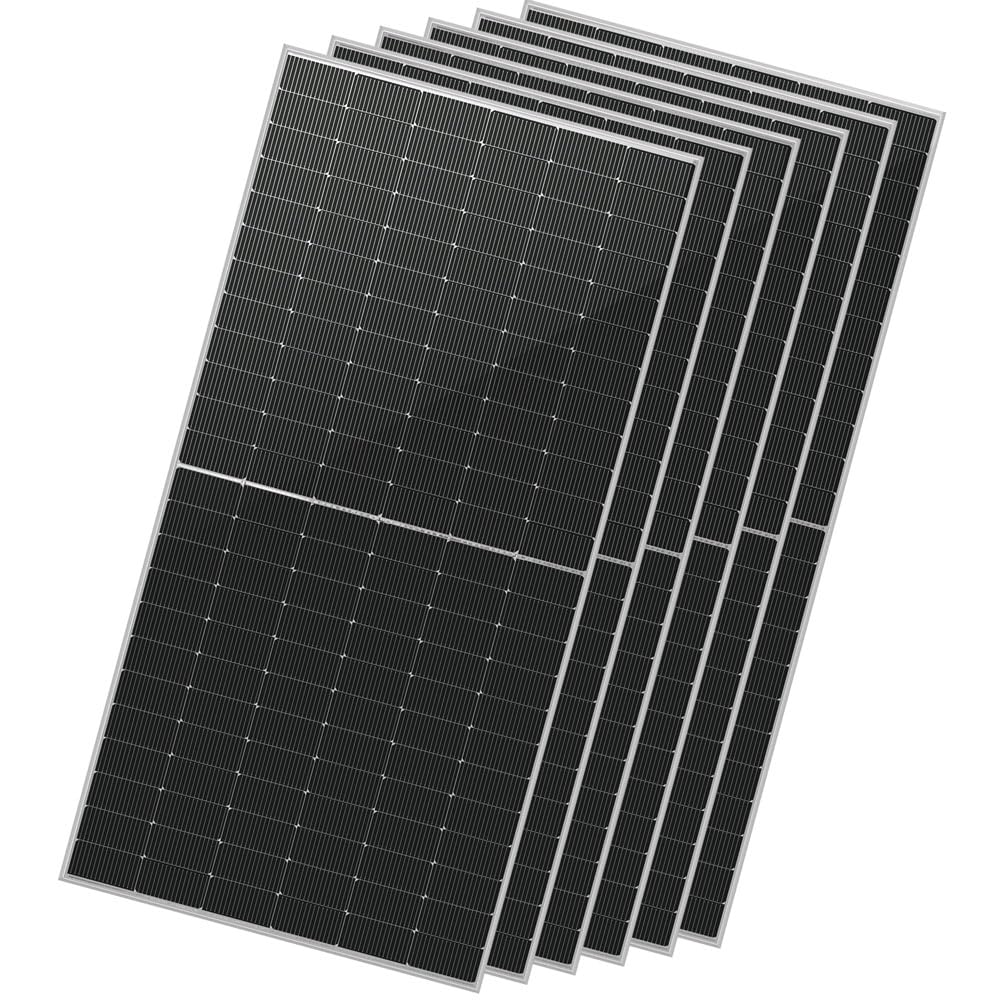
Six bifacial panels that will power a serious off-grid build while staying affordable.
Six panels at 560W each put this kit squarely in the full-array category. Rated efficiency climbs to 30% from the 16BB n-type bifacial PERC cells, and the panel is spec’d to generate extra energy from the rear side when reflected light is available. Each frame runs at 42.1V with 13.3A, which is well-suited to a group string into a 24V or 48V system through an MPPT controller. The construction uses monocrystalline silicon with excellent EVA encapsulation, high-transmission low-iron tempered glass, and a waterproof film — real materials on a real PV module.
Owner use-cases point to cabin and rural setups where the array is expected to feed a big inverter. One build uses the six panels with a 10,000-watt inverter, another plan runs them on an animal enclosure, and a third uses them flat-mounted on an RV roof where they pull extra output in the morning and evening when the sun is angled. Shipping is repeatedly called out as properly packed, with corner protection that survives the trip.
The catch is scale. At 89.8″L × 44.6″W × 1.4″H per panel and 67.9 lbs each, this is not a two-person weekend install — you need a proper rack, a truck, and probably a friend with a trailer. The 16BB busbar count is high for hotspot tolerance, but the practical truth is that unless your ground has a reflective surface — snow, gravel, or light concrete — the bifacial rear side will not contribute much. If you are looking for a small starter setup, this is very much the wrong end of the spectrum.
Where it wins: Thirty percent efficiency from a 560W frame with a 16BB busbar is high-end bifacial territory, and the six-panel bundle gets you there without buying individual frames.
Only if you are building large: Rural off-grid projects, commercial builds, or homes that need serious PV capacity and have the ground space to host it.
Too much for a starter: A casual shed or small camper setup will be overwhelmed by a six-panel array of this scale.
9. ECO-WORTHY 1200W 24V 4.68KWH Lithium Battery Solar System Off Grid
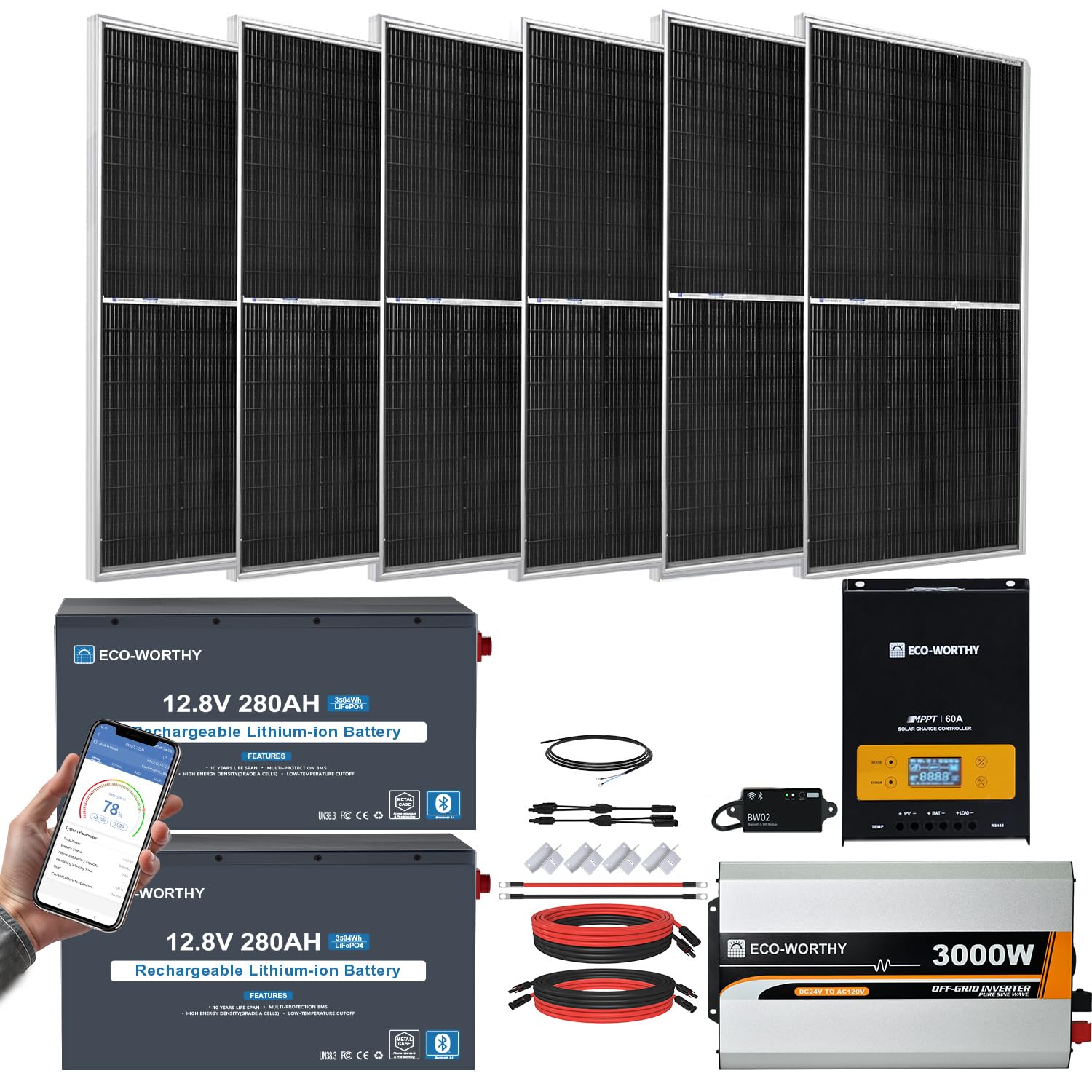
A full system with enough stored power to keep the fridge and the wi-fi humming.
Six 195W bifacial panels, two 12.8V 280Ah lithium batteries, a 60A MPPT controller, a 3000W pure sine wave inverter, and Bluetooth monitoring come bundled together in one complete off-grid build. Ideal daily output and stored capacity are rated at 4.68KWH (under four hours of sunlight), and the battery packs are rated for more than 6000 deep cycles with a BMS chip handling protection internally. The 60A MPPT controller pulls up to 99% tracking efficiency and 98% peak conversion efficiency, and the maker quotes 82 feet of Bluetooth range for monitoring.
The best feedback owners bring back is the daily-use rhythm: a 55″ TV, Starlink, monitors, laptops, a security router, and a small air conditioner running off the system without stalling. Someone running a small fridge and a wine fridge reports the array covering them 100% of the time, and bills dropping as the loads shift off the grid. The panels benefit from reflective surfaces underneath — one user found a reflective material behind the ground mount picked up noticeable extra output.
The genuine limitations are worth planning around. Installation instructions are incomplete, and buyers who have never wired a 24V system end up on YouTube or chasing down support — which has been responsive about replacement parts but slow on initial answers. The system tops out at what its battery can hold on a cloudy stretch, so if you get multi-day overcast and want to run the air conditioner, you will need either a generator assist or more storage. Also worth noting: you supply your own breakers and grounding — they are not in the box.
Brings to the table
- Six 195W bifacial panels, two 280Ah lithium batteries, 60A MPPT, and 3000W inverter bundled together
- 4.68KWH ideal daily output with a battery bank rated for more than 6000 deep cycles
- 99% MPPT tracking efficiency and 98% peak conversion efficiency
- Bluetooth monitoring with an 82-foot effective range
Plan around
- Multi-day cloudy stretches need a generator or bigger battery bank
- Instructions come as separate component manuals — expect to piece it together
- Breakers and grounding parts are not included in the kit
Right for serious backup: Homes, cabins, or shops that want to cut the utility bill and keep critical loads running without assembling the whole system themselves.
Overkill for a small shed: Six panels and 4.68KWH of storage is more than a barn light or greenhouse fan will ever use.
Understanding the Specs
Bifacial vs monofacial panels
A bifacial panel has a transparent backsheet, so it accepts light on both the front glass and the rear face. That rear face catches reflected light bouncing off whatever sits behind it — gravel, snow, a white wall, or a bright concrete pad. In a yard with a light-colored ground or on a snow-covered winter mount, the bifacial design can push the panel above its monofacial equivalent; on dark grass with no reflective surface behind it, the rear side barely contributes and you are essentially buying a monofacial panel.
MPPT vs PWM charge controllers
An MPPT (maximum power point tracking) controller constantly shifts its internal load to match whatever the panels can deliver at that moment, so it squeezes more of your harvest into the battery. A PWM (pulse width modulation) controller is simpler and cheaper, and it lets more power go to waste when the panel voltage climbs — which is exactly why kit makers pair MPPT controllers with higher-voltage arrays. If your panels run at 30V or higher and you are feeding a 12V battery, MPPT is effectively mandatory to avoid throwing away voltage.
FAQ
What size solar array do I actually need for a backyard cabin?
Do bifacial solar panels really produce extra power?
Series or parallel for a 12 volt backyard system?
Can I mount solar panels flat on the ground instead of on a roof?
What happens if part of my panel is shaded by a tree?
Will my panels lose output in hot summer weather?
How long do these solar panels last?
Do these complete kits include batteries and inverters?
What gauge wire do I need between panels and controller?
Can I add this array to my existing RV or cabin electrical system?
Final Thoughts: The Verdict
For most yards, the backyard solar array winner is the Callsun N-Type 16BB 400W Bifacial Solar Panel pair because it turns a 400W rating into reliably above-label harvest and stays smooth when half the array slips into shadow. If you want a complete starter system with a controller and Bluetooth monitoring in the same box, grab the ECO-WORTHY 400W 12V Premium Kit. And for a permanent mount with maximum headroom, the Renogy 1280 Watt N-Type 18BB is the array to build your roof or field around. Whatever you pick, look at the panel’s temperature coefficient and shade tolerance first — those are the two specs that decide how the array behaves on the actual muggy afternoon you will run it, more than the nameplate number on the box.
How We Picked
We do not accept paid placement. Every pick is matched to a real buyer and a real use-case; we do not hands-on test units.
Sources & Methodology
Specifications: manufacturer listings and product documentation. Review insights: verified customer reviews, as of September 2026. Pricing: not shown on this page (it changes often); check the current price via the retailer link.
As an Amazon Associate, KitchPrep earns from qualifying purchases. This does not affect which products we feature.
Related Guides
